Feeds:
Posts
Comments

Archive for the ‘Dave Eggers’ Category

SOUNDTRACK: DAVID CROSS-Bigger and Blackerer (2010).

I’ve liked David Cross for years, both in Mr. Show and everywhere else he’s been (I love comparing his nebbish character in Arrested Development to his obnoxious hippie in Running Wilde). And his standup is just fantastic.

This new(ish) CD (which has the same name but different content as the DVD) is wonderfully obscene and profane and all around hilarious.  What’s particularly fun is the nonsensical “titles” he gives to his bits (although these are more accurate than on his previous disc): “REALLY Silly Religious Crazies, I mean, Double, Triple Crazy!!” and “Random Goofabouts”

The disc opens with a song(!), a swinging song ala Tom Jones which Cross sings (his voice isn’t very good, but he’s never off key, which is something) which actually features some cool time changes and a bit of pathos.  But the jokes are very funny.  He opens with an extended bit about drugs (mostly about drugs he has taken).  It’s a bit long, but the details are hilarious and the payoffs at the end are wonderful.  I also enjoyed that the drug bits are a cautionary tale, yet he never turns preachy, in fact, he inverts expectations throughout.

The race jokes are really great too, especially the MLK license plate bit.  But indeed, Cross really shines when it comes to religion.  I’ve never really heard a riff on Orthodox Jews before, and his dismissal of Catholicism is brutal and short, but it’s the Mormons who get the bulk of his abuse (mostly because of the awesome power they wield), especially since the religion is a sham.

He’s also not afraid to make observations that will offend some (although no one who listens to him) but are spot on.  There’s an excellent bit about Obama haters who bemoan the state of the country but who will immediately fight any “elitist” who bemoans other aspects of the country.  And it very funny, indeed.

Cross has spent some time in England (filming The Increasingly Poor Decisions of Todd Margaret) and his British accent is quite good now (it’s used to excellent effect in heaven).  He also has great rapport with the crowd, who are exuberantly noisy.

This CD is an excellent introduction to Cross’ standup.  The jokes aren’t really timely (although the health care yelling bit will date it somewhat, except that the debate itself will go one for years to come, so maybe it won’t), so even if it’s five years from now, the jokes will still be funny.

Cross is not a delicate comedian and his jokes are not for the faint of heart, but, man, is he funny.

[READ: November 9, 2010] It is Right to Draw Their Fur

Polymath Dave Eggers is back with another fascinating (and fascinatingly bound) title.  This time, the collection contains a series of drawings.  Most of the drawings are of animals and they all feature words on them.  (This sort of thing: Picture + words + humor (from many different artists) is presented in a book that I am currently enjoying called More Things Like This).  Similar items also appeared in McSweeney’s 27 (you can see my Post about that issue here)).

Eggers explains in the introduction that he went to art school.  He was an aspiring painter and then a cartoonist and illustrator.  And in his down time, he spent a lot of time drawing animals.  And they are quite good.  Eggers’ art has an odd quality to it that I can’t quite put my finger on.  All of his pictures seem off in a small way.  It doesn’t make them bad at all, in fact, it actually makes you want to look at them more to see what is off about them.  (I think some people call that “compelling”).

The project comes in a hugely oversized cardboard sleeve (14 inches x 19 inches).  There are 26 large sized posters (they are folded and their unfolded size reaches something like 27″ x 37″).  There’s also a booklet which features even more of these drawings.  The booklet has an appendix with some drawings that are not animals (well, they are humans, so yes, they are animals).  And, the most peculiar part, there’s a bibliography.  The bibliography goes on for four pages and includes all manner of things from Sartre’s Being and Nothingness to Auel’s Clan of the Cave Bear to Gara’s The Presidency of Franklin Pierce to The Collected Poems of William Carlos Williams to Saint-Saens’ Le carnaval des animaux.

You can see two examples here.  In my opinion these are not the best combination art/words in the book (although the drawings are very good).  There are some other ones where the juxtaposition appealed to me much more.

The package is quite expensive (and justified–it is a lot of stuff and beautifully put together), but I have a hard time believing someone would spend $42 on it.  (I received mine as part of the McSweeney’s book club, so that’s nice.)

Read Full Post »

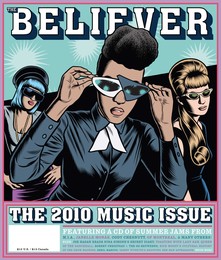
SOUNDTRACK: The Believer July/August 2010 Music Issue Compilation CD: “We Bumped Our Heads Against the Clouds” (2010).

Of all the Believer music compilations, this is by far my least favorite.  It would be oversimplifying things to say that the music is not for me, but in many respects it is not.  Chuck Lightning, the curator of the project states that this compilation is more or less a look into the state of the union for black artists.  And that invariably means a lot of R&B and songs that might be heard on Glee (I like the show, but I never know any of the music).

Deep Cotton’s “Self!” reminds me of novelty dance hit from the late 80s.  Of Montreal, who I thought sounded totally different from this, offer “Hydra Fancies” which is as catchy a disco anthem as any disco anthem can be.  Roman GianArthur’s “Depraved Valet” is an amazingly falsettoed Prince knock off.  Cody Chestnutt’s “”Come Back Like Spring” is a simple almost acapella ode to spring.  Saul Williams’ oddly titled “B.S. in a Tampon” is a spoken word with acoustic guitar that reminds me of Gil Scot-Heron.  Janelle Monáe’s “Cold War” is the first really catchy song (the la las remind me of Carole King), although  I could do without the overstated “Calinda” part and the extended fade.

The first song I really liked was BLK JCKs “Iietys” which sounded enough like TV on the Radio to be really interesting.  Spree Wilson’s “Chaos” also sounds like TV on the Radio (the more R&B side of the band, although the guitar solo is a dead ringer for “Hotel California.”  Scar’s “Rewind” is the song that should be on Glee.  I want to hate it but it is so damned catchy, I can’t.  Again, those Oh Oh Ohs are too perfect (and the auto0tune of course is unassailable).

Rob Roy’s “Velvet Rope Blues” is my favorite song on the disc by a large distance. It’s a weird rap that reminds me of The Streets, with an awesome sung chorus ala OutKast.  Hollyweed’s “Have You Ever Made Love to a Weirdo” is a trippy, juvenile space rap that is really silly.  Sarah hates it but I kind of like it, as it’s in the spirit of Frank Zappa, (although I hate the sax solo).  Fear & Fancy’ s “Off the Grid” sounds also not unlike OutKast.  And George 2.0′ s “Turn Off the TV” is a anti-TV rap rant (with the somewhat ironic conclusion that you yourself might end up ON the TV).

M.I.A. is probably the biggest name on the disc. “Born Free” is a weird little track of highly distorted vocals over a punk guitar buzzsaw sound.  But her vocals are mixed so loud in the mix that they sound unrelated.  It sounds not unlike a Go! Team track.  This track makes me wonder how she became such a sensation.

Hot Heavy & Bad’s “One” returns to that disco sound in the vocals with some contemporary bass sounds.  It wears out its welcome pretty quickly.  Tendaberry’s “Cold Boy” sounds like a less horn-y Fishbone.  Mother Novella offers one of the few all guitar songs, “Closer 9 1/2” and it’s an okay mid tempo rocker.

The final song is pretty awesome in theory: Nina Simone covering Alice Cooper.  That’s right, Nina Simone covering Alice Cooper.  Sadly I don’t know the Alice Cooper song, so it’s a bit lost on me.

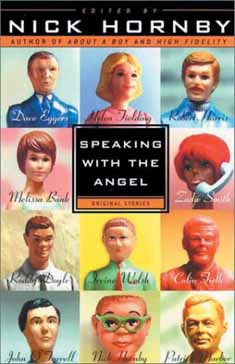
[READ: September 16, 2010] Speaking with the Angel

I bought this volume when it came out (and apparently donated $1 to TreeHouse at the same time).  It’s a collection edited by Nick Hornby (and the cover is designed similarly to the way High Fidelity and even About a Boy were at the time (“the Hornby look,” I suppose).

I didn’t buy it for Hornby alone, although he does have a story in it, but because it looked like a really promising collection of stories from authors I liked.  And for some reason I didn’t read it until now.  It includes 12 stories, and as the introduction notes, $1 was donated to TreeHouse.org.uk (in the US $1 goes to TreeHouse and another $1 goes to New York Child Learning Institute).  I don’t know if the money still goes there, but you can donate with a form at the back of the book.  (more…)

Read Full Post »

SOUNDTRACK: BLUE ÖYSTER CULT-compilations and live releases (1978-2010).

For a band that had basically two hits (“Don’t Fear the Reaper” and “Burnin’ for You”) and maybe a half a dozen other songs that people might have heard of, BOC has an astonishing number of “greatest hits” collections.

Starting in 1987 we got Career of Evil: The Metal Years (1987), Don’t Fear the Reaper (1989), On Flame with Rock n’ Roll (1990), Cult Classic (which is actually the band re-recording their old tracks (!)) (1994), and the two cd collection Workshop of the Telescopes (1995).  There’s even Singles Collection, (2005) which is a collection of their European singles & Bsides.

This doesn’t include any of the “budget price” collections: E.T.I. Revisited, Tattoo Vampire, Super Hits, Then and Now, The Essential, Are You Ready To Rock?, Shooting Shark, Best of, and the 2010 release: Playlist: The Very Best of).

The lesson is that you evidently won’t lose money making a BOC collection.

I don’t know that any of these collections are any better than the others.

The 2 CD one is for completists, but for the most part you’re going to get the same basic tracks on all of them.

And, although none of them have “Monsters” for the average person looking for some BOC, any disc is a good one.

Regardless of the number of hits they had, BOC was tremendous live.  And, as a result, there have also been a ton of live records released.  Initially the band (like Rush) released a live album after every three studio albums. On Your Feet or On Your Knees (1975) Some Enchanted Evening (1978) and Extraterrestrial Live (1982) were the “real releases.”

Then, in 1994 we got Live 1976 as both CD and DVD (which spares us nothing, including Eric Bloom’s lengthy harangue about the unfairness of…the speed limit).  It’s the most raw and unpolished on live sets.  2002 saw the release of A Long Day’s Night, a recording of a 2002 concert (also on DVD) which had Eric Bloom, Buck Dharma an Allan Lanier reunited.

They also have a number of might-be real live releases (fans debate the legitimacy of many of these).  Picking a concert disc is tough if only because it depends on the era you like.  ETLive is regarded as the best “real” live disc, although the reissued double disc set of Some Enchanted Evening is hard to pass up.  Likewise, the 2002 recording is a good overview of their career, and includes some of their more recent work.

If you consider live albums best of’s (which many people do) I think it’s far to say that BOC has more best of’s than original discs.  Fascinating.  Many BOC fans believe that if they buy all the best of discs, it will convince Columbia to finally reissue the rest of the original discs (and there are a number of worthy contenders!) in deluxe packages.  I don’t know if it will work, but I applaud the effort.

[READ: October 2009-February 2010] State By State

This is a big book. And, since it’s a collection essays, it’s not really the kind of big book that you read straight through.  It’s a perfect dip in book.  And that’s why it took me so long to get through.

I would love to spend a huge amount of time devoting a post to each essay in the book.  But, well, there’s 51 (including D.C.) and quite a few of them I read so long ago I couldn’t say anything meaningful about.  But I will summarize or at least give a sentence about each essay, because they’re all so different.

I’ll also say that I read the Introduction and Preface last (which may have been a mistake, but whatever).  The Preface reveals that what I took to be a flaw in the book was actually intentional.  But let me back up and set up the book better.

The catalyst for the book is the WPA American Guide Series and sort of Steinbeck’s Travels with Charley.  The WPA Guides were written in the 1930s as part of the Works Progress Administration.  48 guide books were written, one for each state.  Some famous writers wrote the books, but they were ultimately edited (and many say watered down) by a committee.  I haven’t read any of them, but am quite interested in them (and am looking to get the New Jersey one).  Each guide was multiple hundreds of pages (the New Jersey one is over 800).

State By State is written in the spirit of that series, except the whole book is 500 pages (which is about 10 pages per state, give or take).  And, once again, famous writers were asked to contribute (no committee edited this book, though).  I’ve included the entire list of authors at the end of the post, for quick access.

So I started the book with New Jersey, of course.  I didn’t realize who Anthony Bourdain was until I looked him up in the contributor’s list (I’m sure he is thrilled to hear that).  And his contribution was simultaneously exciting and disappointing,.  Exciting because he and I had quite similar upbringings: he grew up in North Jersey (although in the wealitheir county next to mine) and had similar (although, again, more wealthy) experiences. The disappointing thing for me was that Bourdain fled the state  for New York City (and, as I now know, untold wealth and fame (except by me))  I felt that his fleeing the state, while something many people aspire to, is not really representative of the residents of the state as a whole.

And that dissatisfaction is what I thought of as the flaw of the book (until I read the Preface).  In the Preface, Matt Weiland explains that they asked all different authors to write about states.  They asked some natives, they asked some moved-ins, they asked some temporary residents and they asked a couple of people to go to a state for the first time.  In reality, this decision makes for a very diverse and highly entertaining reading.  In my idealized world, I feel like it’s disingenuous to have people who just stop in to give their impression of an area.  But hey, that’s not the kind of book they wanted to compile, and I did enjoy what they gave us, so idealism be damned.

For most of the book, whenever I read an essay by someone who wasn’t a native or a resident of a state, I assumed that there weren’t any famous writers from that state.  I’ve no idea if that played into anything or not.  From what I gather, they had a list of authors, and a list of states (I was delighted to read that three people wanted to write about New Jersey-if the other two writers ever decided to put 1,000 words  to paper, I’d love to read them (hey editors, how about State by State Bonus Features online, including any extra essays that people may have wanted to write).

From New Jersey, I proceeded alphabetically.  And, I have to say that I’m a little glad I did.  I say this because the first few states in the book come across as rather negative and kind of unpleasant.  Alabama (written by George Packer) comes across as downtrodden, like a place you’d really have to love to live there.  Even Alaska, which ended up being a very cool story, felt like a veil of oppression resided over the state (or at  least the part of the state that Paul Greenberg wrote bout.)  But what I liked about this essay and the book in general was that the authors often focused on unexpected or little known aspects of each state.  So the Alaska essay focused on Native fisherman and the salmon industry.  Obviously it doesn’t do justice to the rest of that enormous state,  but that’s not what the book is about.

The book is meant to be a personal account of the author’s experiences in the state. (more…)

Read Full Post »

SOUNDTRACK: DO MAKE SAY THINK-Other Truths [CST062] (2009).

I’ve always enjoyed Do Make Say Think’s CDs.  They play instrumentals that are always intriguing and which never get dull.

But this CD far exceeds anything they have done so far (and  they’ve done some great work).   There are only four tracks, and they range from 8 to 12 minutes long.  Each track is named for a word in the band’s name: Do, Make, Say, Think.  And each one is a fully realized mini epic.

“Do” sounds like a gorgeous Mogwai track.  While “Make” has wonderfully diverse elements: a cool percussion midsection and a horn-fueled end section that works perfectly with the maniacal drumming.  “Say” is another Mogwai-like exploration, although it is nicely complemented by horns.  It also ends with a slow jazzy section that works in context but is somewhat unexpected. Finally, “Think” closes the disc with a delightful denouement.  It’s the slowest (and shortest) track, and it shows that even slowing down their instrumentals doesn’t make them dull.

It’s a fantastic record from start to finish.  This is hands down my favorite Constellation release in quite some time.

[READ: December 2009 – January 13, 2010] McSweeney’s #33.

The ever-evolving McSweeney’s has set out to do the unlikely: they printed Issue #33 as a Sunday Newspaper.  It is called The San Francisco Panorama and, indeed, it is just like a huge Sunday newspaper. It has real news in (it is meant to be current as of December 7, 2009).  As well as a Sports section, a magazine section and even comics!

[DIGRESSION] I stopped reading newspapers quite some time ago.  I worked for one in college and have long been aware that the news is just something to fill the space between ads.  I do like newspapers in theory, and certainly hope they don’t all go away but print issues are a dying breed.  When I think about the waste that accompanies a newspaper, I’m horrified.  Sarah and I even did a Sunday New York Times subscription for a while, but there were half a dozen sections that we would simply discard unopened.  And, realistically that’s understandable.  Given how long it took me  to read all of the Panorama, if you actually tried to read the whole Sunday paper, you’d be finished the following Sunday (or even two Sundays later).

Their lofty goal here was to show what print journalism can still do. And with that I concur heartily.  Even if I don’t read the newspaper, the newspapers as entities are worth saving.  Because it is pretty much only print journalism that finds real, honest to God, worthy news stories.  TV news is a joke.  There is virtually nothing of value on network TV.  Fox News is beyond a joke.  CNBC is sad (although Rachel Maddow is awesome!) and even CNN, the originator of all of this 24 hour news nonsense still can’t fill their airtime with non-sensationalized news.

Obviously, there are some decent internet sites, but for the most part they don’t have the budget to support real news investigation.  You either get sensationalized crap like Drudge or rebroadcasts of real news.

So, print is the last bastion of news.  And you can see that in journalistic pieces in The New Yorker, Harper’s, The Walrus, Prospect and, yes, in newspapers.

But enough.  What about THIS newspaper?  Oh and unlike other McSweeney’s reviews I’ve done, there is NO WAY that I am writing a thorough comment on everything in here.  There’s just way too much.  Plus, there are many sections that are just news blurbs.  Larger articles and familiar authors will be addressed, however.  [UPDATE: January 18]: If, however, like Alia Malek below, you bring it to my attention that I’ve left you out (or gotten something wrong!) drop me a line, and I’ll correct things.

There is in fact a Panorama Information Pamphlet which answers a lot of basic questions, like why, how and how often (just this once, they promise!). There’s also a Numbers section which details the size, scope and cost of making this (it shows that with an initial start up, anyone could make a newspaper if they talked enough about what the readers were interested in). (more…)

Read Full Post »

SOUNDTRACK: THE DECEMBERISTS-Austin City Limits (2007).

I’ve recently discovered the awesomeness of Austin City Limits.  And in the two or so years that I’ve been watching, I’ve seen some great live shows (even is most bands are reduced to 30 minutes).  This re-broadcast of The Decemberists, however, just blew me away.
The concert comes from The Crane Wife tour, and it is just a wonderful exploration of this fantastic CD.  I’ve liked the Decemberists for years, and have listened to all of their discs multiple times, but there was something about this recording, in particular the wailing guitar work of Colin Meloy (seeing him lying on the floor making crazed feedback was pretty impressive), and the amazing solo work of Chris Funk that gave me even more respect for this wonderful album and the band.

It is highly recommended. For more info see here.

[READ: January 14, 2010] 100 Page Tribute to David Foster Wallace

I was able to order a copy of this journal directly from The University of Arizona and received it not too long ago.  It is a two part issue (55/56) that is chock full of all kinds of things, including this 100 page tribute to DFW.  I intend to read the whole thing, or at least more than just the DFW stuff, but as I don’t see that happening too soon, I wanted to address this tribute section directly.

DFW received his MFA from UA and he was also an editor at Sonora Review.  He also published “/Solomon Silverfish/” there shortly after getting his MFA.  So the tributes make sense from this publication.  All of the tributes here come from varied people and are all either interesting or moving to the Wallace fan. (more…)

Read Full Post »

SOUNDTRACK: KISS-Kiss (1974).

I’ve always loved the first Kiss record.  Everything about it is over the top, and I can’t imagine what people thought of it when it hit shelves back in 1974.
And yet, for such a preposterous looking record, the tracks are really great.  The music is a mixture of pop, Rolling Stones rock swagger, Beatles harmonies, and a sort of proto-heavy metal.

“Strutter” proves to be a great opening track with a great riff and fun vocals.  And it’s just one of thousands of Kiss songs about hot chicks that, because of its metaphorical/obscure lyrics is less offensive than it might have been.  “Nothin’ to Lose” is another lyrically inscrutable song that I’ve always assumed was very dirty: “Before I had a baby, I tried every way.  I thought about the back door.  Didn’t know what to say.”  And yet it is so outrageously poppy that no one minds singing along.  “Firehouse” is a wonderfully over the top song with great falsetto vocals and an awesome solo from Ace. “Cold Gin”  is another rocking classic with cool basswork and guitar solo notes over a standard rocking verse.  Side one ends with”Let Me Know” a pop song hiding under the guise of a heavy rock song.  The song is such a poppy bit of fluff (check out the soulful harmonies before the ending guitar solo kicks in), but it works wonders.

Side Two starts with a silly cover of “Kissin’ Time” that of course is appropriate for this band (and if they went for a more poppy sound overall, this would have been their anthem, no doubt).  “Deuce” follows, and it blasts forth with some heavy stuttering and slighty off-sounding guitars.  It also has the best opening lyric ever: “Get up and get your grandma out of here.” Which is later followed by one of the top ten Huh? choruses off all time, “You know your man is working hard, he’s worth a deuce.”  (Rampant speculation as to what a “deuce” was in 1974 can be found online).  I’ve always loved the “Love Theme from Kiss” which is possibly the most hated pre-disco Kiss song that I can think of.  It’s a weird pseudo-middle-eastern instrumental that I’ve always thought was trippy and funny.  And then comes “100,000 Years,” another one of my favorite songs.  Again, the lyrics are just bizarre (and I’ve always mis-heard them until I looked them up just now: “How could you have waited so long, it must have been a bitch while I was gone” (I’d always thought the “it” was actually “you” which means the song isn’t as nasty as I ‘d always thought).  So, it’s sort of like The Odyssey, then.  But musically the song is just phenomenal: a great guitar riff over simple bass notes and a staggering guitar solo.

The disc ends with the outstanding “Black Diamond.”  There’s so much to love about this song.  It’s a gritty tale about life on the streets.  It opens with a pretty acoustic guitar ballad sung by Paul.  Then, after the awesome “Hit it!” the song kicks in powerfully.  Peter takes over vocals, and his rough voice works perfectly.  It’s only five minutes long, but it feels like a great epic track.  No the least of which is because the song ends with a cool concept: a single note, punctuated with drums, that is slowed down (from the original taped master), getting slower and slower making the notes sound heavier and heavier, slower and slower.  You can even hear the drum riff played at a by-now snail pace.  It’s very cool.

This is really a great album, and it’s somewhat overshadowed by their mid 70’s more famous music.  And if you like 70s rock but don’t think you like Kiss, this is one disc you can sneak into your collection.

[READ: December 20, 2009] The New Sins

I’m not entirely sure what to make of this.  I bought it from McSweeney’s in their attic sale for a couple of bucks.  David Byrne is Talking Heads David Byrne, so everything he makes is arty, avant garde and hard to fathom on a first listen/view.  But I’m unlikely to read this again, so he gets a cursory attempt here.

The New Sins purports to be a collection of what the “new” sins are.  It’s also written as if it were an ancient text that was recently uncovered and translated into English (although obviously, the word choices are laughably not ancient (web design, for instance).  Basically, what you get is a list of behaviors that until recently were not sins but which are now.  The odd thing about the book is that the sins are not an obvious parody of virtues or anything like that.  He doesn’t just say that kindness is a sin, he adds that ambition is a sin as well.  So it’s not even simple inversion. (more…)

Read Full Post »

createdSOUNDTRACK: ONE RING ZERO-As Smart as We Are (2004).

orzI had this CD sitting around my house for about 4 years.  I had received it as a promo disc from Soft Skull Press (along with several other books on CD) and I just never put it on.  Then one day I was going through all these promos to see if any were books I wanted to listen to.  It was then that I actually read the disc label and saw that it was a band with lyrics written by some of my favorite authors.

I liked the disc so much I wound up buying it because the packaging is truly cool.  It’s a little booklet and it features an interview with the band and some really cool insights into how the songs came about, how they got the writers to submit lyrics, and the cool fact that One Ring Zero became McSweeney’s house band, accompanying writers during their weekly readings.

One Ring Zero is comprised of two guys (and guests).  And for this disc they split the tracks in half and one of them wrote melodies for 8 songs and the other guy wrote melodies for the other 8.  I’m not sure that I could tell the song writers apart by their styles, though.

But sure, the lyrics are probably great, but what does the band sound like?  Well, in the introduction, they are described as specializing “in the sort of 19th century, gypsy-klezmer, circus-flea-cartoon music you mainly hear in your dreams.” And, yep, that is a good summary of things.  The band uses water pipes, claviola, slide whistle and a theremin (among other homemade instruments).

And so, as with other McSweeney’s things, I’m going to list all of the lyricists with their titles.  But lyrically it’s an interesting concoction.  The authors were asked to write lyrics, but not necessarily songs.  So some pieces don’t have choruses.  Some pieces are just silly, and some pieces work quite nicely.  But most of them are really poems (and I can’t really review poems).  They’re fun to read, and it is fun to see what these authors made of this assignment.

PAUL AUSTER-“Natty Man Blues”
A rollicking opening that lopes around with the nonsensical lyrics, “There ain’t no sin in Cincinnati.” This one feels like a twisted Western.

DANIEL HANDLER-“Radio”
A supremely catchy (and rather vulgar) song that gets stuck in my head for days.  “Fucking good, fucking good, fucking good…”

DARIN STRAUSS-“We Both Have a Feeling That You Still Want Me”
A Dark and somewhat disturbing song that is also quite fun.

RICK MOODY-“Kiss Me, You Brat”
A delicate twinkly piece sung byguest vocalist Allysa Lamb *the first female vocalist to appear) .  Once the chorus breaks in, it has an almost carnivalesque tone to it.  This is the only song whose lyrics were written after the music.

LAWRENCE KRAUSER-“Deposition Disposition”
A twisted song that works as a call and response with delightful theremin sounds.  It has a very noir feel.

CLAY McLEOD CHAPMAN-“Half and Half”
This is a sort of comic torchy ballad.  Lyrically, it’ a bout being a hermaphrodite (and it’s dirty too).  Vocals by Hanna Cheek.

DAVE EGGERS-“The Ghost of Rita Gonzalo”
This has a sort of Beach Boys-y folky sound (albeit totally underproduced).  But that theremin is certainly back.

MARGARET ATWOOD-“Frankenstein Monster Song”
This song begins simply with some keyboard notes but it breaks into a very creepy middle section.  It’s fun to think of Margaret Atwood working on this piece.

AARON NAPARSTEK-“Honku”
This song’s only about 20 seconds long.  It is one of a series of haikus about cars, hence honku.

DENIS JOHNSON-“Blessing”
The most folk-sounding of all the tracks (acoustic guitar & tambourine).  It reminds me of Negativland, somehow.  It is also either religious or blasphemous.  I can’t quite be sure which.

NEIL GAIMAN-“On the Wall”
A tender piano ballad.  The chorus gets more sinister, although it retains that simple ballad feel throughout.  It’s probably the least catchy of all the songs.  But lyrically it’s quite sharp.

AMY FUSSELMAN-“All About House Plants”
An absurdist accordion-driven march.  This is probably the most TMBG-like of the bunch (especially when the background vocals kick in).

MYLA GOLDBERG-“Golem”
This song opens (appropriately) with a very Jewish-sounding vibe (especially the clarinet).  But once that intro is over, the song turns into a sinister, spare piece.

A.M. HOMES-“Snow”
This song opens as a sort of indie guitar rock song.  It slowly builds, but just as it reached a full sound, it quickly ends.  The song’s lyrics totally about twenty words.

BEN GREENMAN-“Nothing Else is Happening”
This song has more of that sinister carnivalesque feel to it (especially when the spooky background vocals and the accordion kick in).  The epilogue of a sample from a carnival ride doesn’t hurt either.

JONATHAN AMES-“The Story of the Hairy Call”
This song has a great lo-fi guitar sound (accented with what sounds like who knows what: an electronic thumb piano?).  It rages with a crazily catchy chorus, especially given the raging absurdity of the lyrics.

JONATHAN LETHEM-“Water”
This track is especially interesting. The two writers each wrote melodies for these lyrics.  So, rather than picking one, they simply merged them. It sounds schizophrenic, but is really quite wonderful.  The two melodies sound nothing alike, yet the work together quite well.

[READ: Some time in 2004 & Summer 2009] Created in Darkness by Troubled Americans

This was the first collection of McSweeney’s humorous stories/pieces/lists whatever you call them.  Some of the pieces came from McSweeney’s issues, but most of them came from McSweeney’s Internet Tendency.

The humor spans a great deal of categories, there’s some literary, some absurd, some nonsensical and, most amusingly, lists.  The back of the book has an entire selection of lists, but there are also some scattered throughout the book as well (I don’t know what criteria was used to allow some lists to be in the “main” part).

As with the other McSweeney’s collections, I’m only writing a line or two about each piece.  For the lists, I’m including a representative sample (not necessarily the best one, though!)

Overall, I enjoyed the book quite a lot (which is why I re-read it this year).  There are puns, there are twisted takes on pop culture, there are literary amusements (Ezra Pound features prominently, which seems odd).  It spans the spectrum of humor.  You may not like every piece, but there’s bound to be many things that make you laugh. (more…)

Read Full Post »

adidasSOUNDTRACK: TV ON THE RADIO-Dear Science, (2008).

sciencThe problem with TV on the Radio for me is that their first EP is so damned good that anything else they do pales in comparison.  Having said that, Dear Science, comes really close to topping that EP.  I liked Cookie Mountain (their previous disc) but I felt like they put so many elements into the mix that it detracted from the best part of the band: Tunde Adepimbe & Kyp Malone’s vocals.

And so, on Dear Science, the vocals are back up front where they belong.  This disc is a lot less busy, which may seem a little like selling out, but instead, it just heightens the complexity and originality of the band’s work.  The disc rocks hard but it also heightens some really cool jazz and dance elements.    But it all comes back to the melodies and vocals for me.  And on Dear Science, they pretty much outdo themselves.

And you can dance to it!

[READ: September 30, 2009] Shiny Adidas Tracksuits and the Death of Camp and Other Essays

After reading David Foster Wallace’s essay in this book, I looked at the other articles here and decided to read the whole thing.  And I’m really glad I did.  It’s an interesting book full of, funny and often thought-provoking pop culture articles circa 1996.  As with some of the other pop culture/political books that I’ve read several years after they were relevant, it’s often weird to look back and see what things fully occupied the popular landscape at the time.  And, when a piece is completed dated, it’s pretty obvious, and sometimes unintentionally funny.  But there are many pieces here that are timeless (or at least hold up for a decade), and those are still really good reads.

This book also does a good job of summarizing the tenor of the defunct Might magazine.  A dose of irony, a splash of humor and a lot of criticism of what’s trendy.

The strange thing to me about this book, though is the targets that they chose to go after sometimes.  Rather than critiquing right-wing attitudes or corporate shenanigans (which they do touch on), they really seem to be after pop and rock celebrity.  For instance, there are two separate articles which take a potshot at Eddie Vedder (this was around the time of the Ticketmaster fiasco which didn’t put him in the best light but which could hardly be seen as only self-serving).  This seems rather unfair, unless his sincerity could really be called into question by a bunch of ironic jokesters.  Magazines like Radar and Spy used to do snarky articles like this. I’d always thought that Might was a little better than that.  But indeed, there’s one or two pieces here that have a holier- (or perhaps indier)-than-thou attitude.   Which may have been fine in the 90s but which seem petulant now.

But aside from those, the irony-free pieces are very enjoyable.  (more…)

Read Full Post »

ny1It took me going to Seattle to learn about The New Yorker magazine.  I was visiting my friend Rob and he was really surprised that I didn’t read the magazine all the time (my reading always seems to surprise people, see The Believer.)

Upon my first read of the magazine, I was surprised to see that the first twenty pages or so are taken up with upcoming shows: films, concerts, sports, everything.  I actually wondered how much content would be left after all that small print.

Since then I have learned that Sasha Frere-Jones writes columns in here quite ofuiten.  For reasons known only to my head, I was convinced that Sasha was a black woman.  Little did I realize that he is not.  And that he was in a band that I have a CD of called Ui.  He is an excellent resource for all things music, whether I like the artist he’s talking about or not.  Some entries are here.  This audio entry about Auto-Tune is simply fantastic.

But of course, there’s a lot of content.  And the first thing you get are letters.  I don’t think I have EVER looked at the letters section. (more…)

Read Full Post »

wild thingsSOUNDTRACK: FANTÔMAS-Suspended Animation (2005).

fantomasIf you know Fantômas, then you know what you’re in for.  If you don’t, well, it’s a surprise!

Fantômas are the brain child of Mike Patton (Mr Bungle-era more than Faith No More with help from Buzz Osborne from The Melvins and Dave Lombardo from Slayer).  Suspended Animation is designed as a soundtrack to April, 2005.  There are thirty tracks, and each one corresponds to a calendar page.  The limited edition (which is apparently still in print as I got one last month) is a calendar with art by Yoshitomo Nara.  Nara’s work combines cuteness and menace, just like the CD.

A piece by Nara

A piece by Nara

Although, really the CD is more menace than cute.

This disc seems to combine Patton’s favorite things: cartoon music (many ‘toons are sampled here), death metal, short sharp blasts of noise and his fascinating vocal deliveries.

This write-up makes the disc sound very intriguing, but before you rush out to check it out, do know what you’re in for: short, noisy blasts of utter chaos.  It is not for the weak of heart or the queasy of stomach (or for the lover of melody).  It’s not even a case of , oh the songs are short, the next one will come along soon.  While there is diversity, it’s diverse within it’s own little world.  Of noise!

Be afraid.  But if you’re still interested after that caveat, then by all means check it out, if only for the calendar!

[READ: August 23, 2009] Where the Wild Things Are/”Max at Sea”

Because of Dave Egger’s story “Max at Sea” (which is basically a retelling of Where the Wild Things Are I felt I needed to re-read the original.  So thank you Dave Eggers for that.

The original is a fun story which seems to be more visually based than word based.  The drawings are sublime and indeed there are several pgaes with no words at all.  And, so, the filmmakers’ question remains: how to you make a film out of a 48-page book, many of which don’t even have words?  Stills from the movie do look pretty awesome.

And thus, Dave Eggers’ story was born.

I’m not actually going to reveiw Where the Wild Things Are, because, well, it’s a classic, and it’s  awesome.  What more can I say about it?  But I did want to reevaluate Egger’s piece having re-read Sendak’s.

It is quite clear that Eggers is in no way trying to re-write the story.  He has fleshed out a lot of details that are absent from the original (which the original in now way needs, but again, if you’re going to make a film, you need some kind of backstory). (more…)

Read Full Post »

« Newer Posts - Older Posts »