Feeds:
Posts
Comments

Archive for the ‘Magazines’ Category

storiesSOUNDTRACKPOLYPHONIC SPREE-Tiny Desk Concert #259 (December 21, 2012).

The Polyphonic Spree performs a Tiny Desk Concert.I really enjoyed Polyphonic Spree’s first album (and their strange robes and cult-like following (apparently even within the band).

They put out a Christmas album some time ago, and since we have a big pile of Christmas albums, I grabbed that one.  I didn’t love it, but it was a fun addition to our collection.

This Tiny Desk Concert is notable for just how many members of the band are behind (and on the side of) the Tiny Desk (perhaps 18?).

And the band is suitably musical–trombone, trumpet, keys, drums, bass, cello, violin and a ten (or so) piece choir.

Interestingly, I find that the weak link in this whole thing is leader Chris DeLaughter.  It’s just that his voice is really not that interesting. It’s especially notable on “The Christmas Song” where he sings some high notes unaccompanied.  When the choir comes in (and they change the melody) it sounds really cool.  I especially love the way they make “reindeer really know how to fly” into a high note.

The first song is “Happy Xmas (War Is Over)” which I feel is the Christmas song they might be best known for.  It’s pretty traditional to the original, with the choir filling in for the kids.  The addition of horns really adds a lot to it.

“Silver Bells” gets a pretty rocking treatment–the buildup at the beginning is pretty cool.  They change the main melody to an almost circus-like waltz. I love the way it sounds when everyone joins in–and when the choir is singing along to the rocking end (with a very different melody) it sounds great.  But once again DeLaughter’s voice doesn’t seem up to the task of leading this larger group.

But it’s festive and fun, especially with everyone in red robes (and DeLaughters green one).

[READ: December 2016] Christmas Stories (1854-1864)

Last year, I started reading some Charles Dickens Christmas Stories in December.  I imagined that I’d finish the whole book this season (all 750 pages of it), but I didn’t come close.  I enjoy these stories but they are not quick reads by any standard.

The fascinating thing with a lot of these stories is that they appeared in All the Year Round, a Victorian periodical founded and owned by Dickens and published between 1859 and 1895 throughout the United Kingdom.  But just because these stories came out for the Christmas issue doesn’t mean they have anything to do with Christmas directly.

I thought I’d be reading a whole chunk of the book in a row, but I wound up skipping around a bit.  Maybe next year I’ll finish the remaining stories. (more…)

Read Full Post »

CV1_TNY_11_01_10.inddSOUNDTRACK: THE OH HELLOS-Holiday Tiny Desk Concert #588 (December 19, 2016).

ohhellosThere was a time when a band played one Tiny Desk Concert and that was it.  That tradition has been broken twice before on special occasions.  But this time, the distance between shows was just over a year.  What gives?

Well, in addition to the band being pretty sick last time, The Oh Hellos have released The Oh Hellos’ Family Christmas Album and are on the Christmas Extravaganza Tour.  so what better group to do a holiday Tiny Desk Concert?

The band plays four songs.  Their EP is full os interesting folky transitions that sound nothing like the main songs, but which flow into them seamlessly.  Like “Deck the Halls” which has a rocking intro and rocking chords on the downbeats.  There’s also fun bluegrass fiddles and banjo.  I really like how the music of the song sounds so different from the traditional version and yet when they actually sing it, it is spot on.

Then a wild shift in tone to a beautiful acoustic rendition of “Mvmt III: “Silent Night, Holy Night”” sung by Maggie Heath.  The opening guitar melody is really different and interesting–enticing and unexpectedly morphing into the traditional song.  Once the main part of the song is done, they switch to a kind of oh ho oh ho chant–folky and warm.

For the next song Tyler says that its a tradition in their extended family that for the holidays they eat a lot and then break out the hand chimes.  He says they are going to sing the one verse of “Jingle Bells” that everyone knows.  Bob asks if there are more.  Tyler’s not sure. They play some kind of hand bells (and Bob gets one too) while everybody sings.

The final track is “Mvmt IV: “Every Bell On Earth Will Ring.””  It opens with another cool rolling guitar intro on acoustic guitar which is followed by the electric guitar.  And the song morphs into “Joy to the World.”  The harmonies are outstanding.  And once again, you’d never guess the song by the guitar parts.  The middle  rocks out in a very fun way until it shifts to a section of “I Saw Three Ships” sung by Maggie.  With about 1 minute left snow starts falling from the ceiling as they shift to “O Come Let Us Adore Him.”

It’s a pretty fantastic Tiny Desk Holiday show. And their album seems like it might be a fun addition to any holiday music collection.

[READ: July 19, 2016] “Blue Roses”

I’ve never read anything by Hwang before so I don’t know what her stories are typically like.  But this one has such a distinctive narrator that I wondered if she normally writes like this.  The story is the first person from an older Taiwanese lady, Lin.  She is opinionated and judgmental and, I think, most often wrong.

Linstarts by saying she had asked her daughter if she might invite her friend Wang Piesan over for Christmas Dinner.  The daughter says she doesn’t know this woman, so no.  This gets Lin so mad that she more or less refuses to talk to her daughter for most of the rest of the story.

It was bad enough that her daughter said no but then her husband suggested “if you want to invite her maybe you should host.”  Lin is outraged: “I’ve waited your whole life for you to invite me to dinner.  Now you want to take it back?”  To make things worse her daughter called back the next day to ask if she would babysit that night.  Lin is appalled: “She didn’t realize that anything had happened between us.”

Lin said no and also that she also wouldn’t be going to Christmas Dinner now. (more…)

Read Full Post »

giant-daysSOUNDTRACK: NATHANIEL RATELIFF & THE NIGHT SWEATS-Tiny Desk Concert #488 (November 17, 2015).

nateNathaniel Rateliff & The Night Sweats get a ton of airplay on WXPN–perhaps a bit too much airplay.  And yet I can’t deny the supreme catchiness of his music which owes a lot to Van Morrison’s brand of soul music.

Rateliff was (and perhaps still is) a folk singer.  But in 2015, he released this album with the band The Night Sweats and has had huge success with this more rocking soulfulness.

“I Need Never Get Old” sounds so much like a Van Morrison song that it’s hard to deny how catchy it is (especially the chorus).  “Look It Here” has a similar vibe with the kind of loudly mumbled vocals that sit nicely with backing vocals and horns.  The middle of the song picks up in intensity and changes the overall tone in a good way that segues nicely back into the main melody.

“I’ve Been Failing You” features more piano up front.  It’s a little more bluesy than soulful so I like it a bit less.  Although the backing vocals in the quiet section (Don’t you weep and don’t you worry) are very cool.

Typically a band does three songs, but Bob walks up and shakes his hand and asks if he wants to do another.  Nathaniel asks, do another or do that one over?  But Bob says, no another song if they want to.

The band agrees they can’t really do “Shake,” so instead they play “Mellow Out.”  Rateliff says, “Same key different song.”  And everyone laughs until he realized, “wait it’s actually a different key.  What do I know?”

“Mellow Out” which opens with some very Van Morrison “do do do dos.”   It sounds very much like the other songs–catchy and swinging with horns in all the right places.  When the song ends Bob says it sounded great and someone comments that they had an extra late night last night before the audio turns off.

I am genuinely surprised that they didn’t play “S.O.B.,” their first single (a song used in a Lipton commercial–although not any part that sings “son of a bitch, I might add).  But since I don’t really like that song, I’m glad they played the other ones.

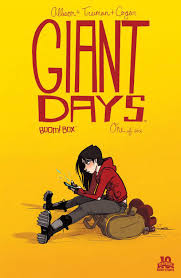
[READ: June 15, 2016] Giant Days Vol. 1

Giant Days was excerpted in the back of a Lumberjanes book and I loved the excerpt–very funny with a great drawing style. Then as I am wont to do, I forgot all about it.  But in the library the other day, the librarian recommended the book and I was delighted to be reminded about it.

This series is set in a British college.  Susan, Esther, and Daisy are roommates.  Susan is the sensible one–a little angry at men and unwilling to take crap from anyone.  Esther is a goth hottie.  She dresses outlandishly and has a (literal?) forcefield of bad luck around her.  And Daisy was home schooled–she is very sweet and rather naive.

I loved right from the start when the three girls head out to campus.  Susan bets Esther that she can’t go three days without some kind of drama happening around her.  But as soon as they get outside, Susan see McGraw.  And she is furious.  McGraw has floppy hair and a big ol’ mustache.  And they launch into each other with cold pleasantries.

When the girls  force Susan to tell the story, there’s a very funny moment when the other two start chanting Flash-Back Flash-Back but we get a brief, intentionally unsatisfying one. (more…)

Read Full Post »

2016-12-05-21-06-09SOUNDTRACK: JOLIE HOLLAND-Tiny Desk Concert #210 (April 23, 2012).

I’d published these posts without Soundtracks while I was reading the calendars.  But I decided to add Tiny Desk Concerts to them when I realized that I’d love to post about all of the remaining 100 or shows and this was a good way to knock out 25 of them.

jolieJolie Holland was the singer of The Be Good Tanyas, a band I know of but am not familiar with.  Since that band disbanded, she has released six solo albums.   She sings a kind of dusky folk music.  Her voice isn’t gravelly, but it is somewhat gritty—with a kind of nonchalant slurring of words that is strangely enticing.

She plays three songs here.  “Tender Mirror” is a smooth song that is amusingly ended right on cue by Bob Boilen’s telephone ringing (which he says hasn’t rung in years).

“The Devil’s Sake” is a but more raucous with louder guitar strumming.  Although I’m far more impressed by her whistling, which sounds pretty spectacular all throughout the middle of the song.

She says that the guitar she is playing is her hardest guitar to play.  Bob asks if it’s an old friend.  She says it’s an old neighbor.  She got it at a garage sale and when she takes it in to be worked on, the people at the guitar store laugh at it.

The final song, “First Sign of Spring” is a piano song but she’s going to play it on the guitar (and you’d never know it was a piano song).

Bob loves Jolie Holland.  I found her enjoyable, but I don’t think I’d pursue anything else by her.

[READ: December 8, 2016] “Treading”

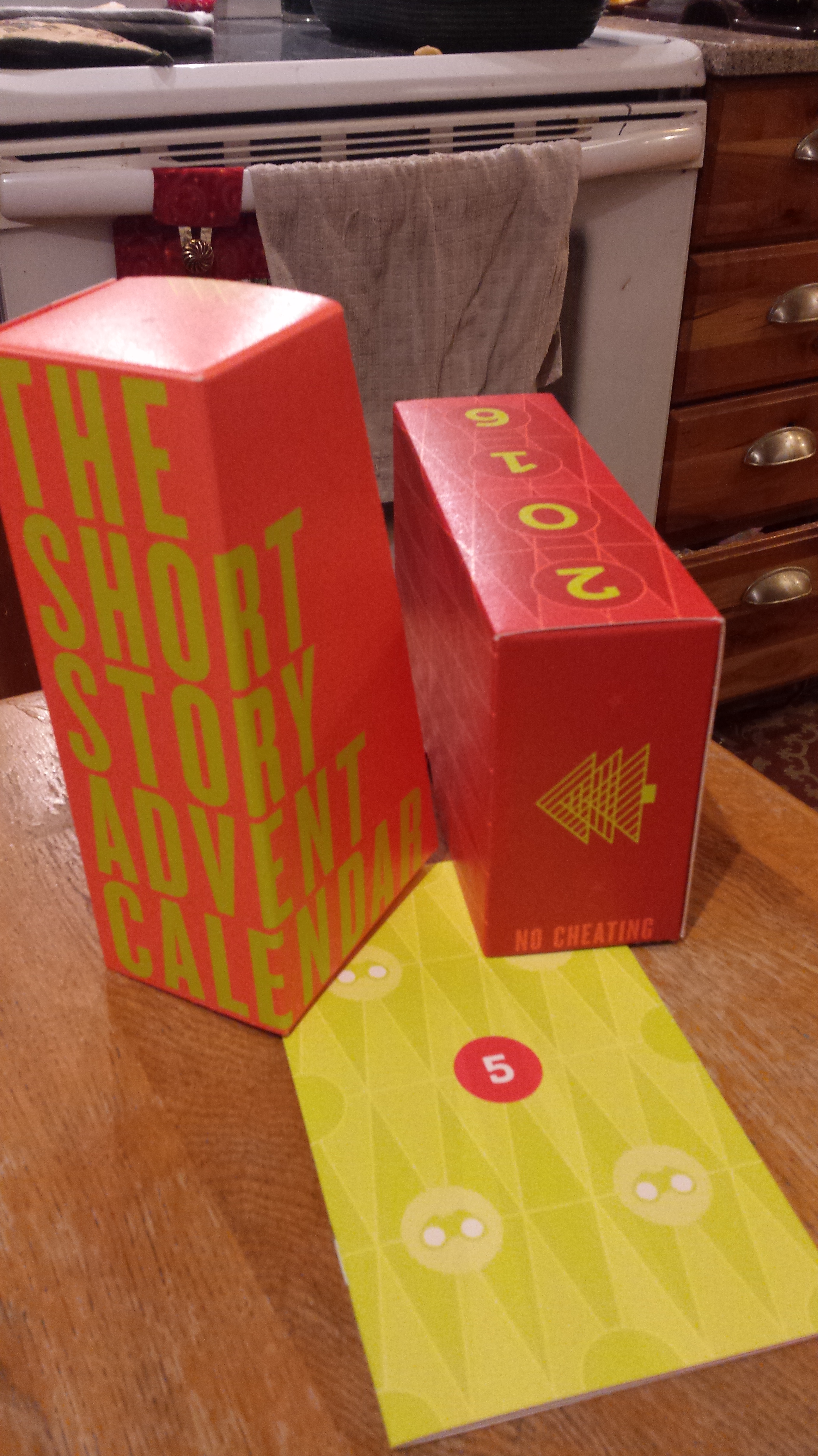
Near the end of November, I found out about The Short Story Advent Calendar.  Which is what exactly?  Well…

The Short Story Advent Calendar returns, not a moment too soon, to spice up your holidays with another collection of 24 stories that readers open one by one on the mornings leading up to Christmas.  This year’s stories once again come from some of your favourite writers across the continent—plus a couple of new crushes you haven’t met yet. Most of the stories have never appeared in a book before. Some have never been published, period.

I already had plans for what to post about in December, but since this arrived (a few days late for advent, but that was my fault for ordering so late) I’ve decided to post about every story on each day.

I really enjoyed this story because even though it was kind of funny, it was sad underneath.  It was a short slice of life scene with all of the “story” implied.  It has a simple construct–a one-sided conversation–and it really shows one man’s insecurity.

The story concerns Georgie, an overweight man in his early 30s.  He answers the door and his unanswered dialogue begins.

He welcomes the person into his house, saying he doesn’t have to remove his shoes.  But he takes that back immediately saying that there are new hardwood floors. (more…)

Read Full Post »

peanuts-1995SOUNDTRACK: TINARIWEN-Tiny Desk Concert #184 (January 5, 2012).

tinariwenTinariwen are a band from northern Mali, whose members met in the training camps of Col. Moammar Gadhafi. Much has been written about them and their story, which is pretty amazing.  I’m only going to talk about this Tint Desk Concert.

Typically, they play an interesting electric guitar kind of trance music.  But for this one they were all acoustic.  As Bob Boilen notes, they are his “favorite electric-guitar-based band on the planet.”  But he says he was:

“initially worried and disappointed when I learned that it was coming to play the Tiny Desk as a trio carrying acoustic guitars. My heart sank a bit more when the three Tuareg musicians from the Sahara arrived in jeans and polo shirts instead of the beautiful, flowing robes I’d seen them wear on stage so many times.

But they switched clothes and they do not disappoint on acoustic guitar.

I don’t know their music all that well, but it feels like the acoustic nature of this show is even more soothing and trance inducing.  The two acoustic guitars interweave–one playing lead (which is mostly hammered notes–not a “solo” per se) and the other strumming.  The percussion is the sound of two hands rubbing, clacking (with a cigarette lighter) and pounding (for bass drum) a large gourd.

The songs tend to be almost looping.  Like they could go on forever.  There’s no real verse chorus structure that I can tell.  It’s more of a meditative sound.

All of the vocals are in Tamashek and I have no idea what the songs are about.

On “Adounia” both guitarists sing and the voices sound very traditional, almost atonal. “Takkest Tamidaret” opens with a more conventional sounding guitar lick, but it’s all so quiet in the mix, that you can’t tell how much his fingers are moving.  The lyrics are a bit slower, but still in that droning style.  I love the way “Tenhert”  has a a cool riff from the lead guitar–one that probably sounds more intense on electric guitar.  He sing/speaks incredibly quickly.  “Tahlamoyt” is a much slower song with the lyrics pretty much all spoken word.

The “Mali sound” is pretty distinctive and Tinariwen are great proponents of it, spreading it around the world for all to hear.

[READ: June 8, 2016] The Complete Peanuts 1995-1996

I was under the impression that these last few volumes of books would show a serious drop in quality.  I had assumed that with the amount of product the Peanuts characters were sponsoring that these strips would be more cute.  But that is far from true.  I enjoyed this book as much if mot more than some of the other recent volumes.

I was also surprised to discover that I really enjoyed the Sunday cartoons more than the dailies.  In the past I haven’t really gotten big laughs form the Sundays–it seemed like the big stories and jokes were in the dailies and the Sundays were unrelated one offs with varying degrees of punch.  But I enjoyed a dozen or so in this book.

One of the major additions in this book is the inclusion of a slightly older Rerun.  He is now mobile and even heading to kindergarten (I love that he is aging while the others aren’t).  But rather than using Rerun for obvious cute child jokes (he’s no longer riding the back of his mom’s bike) Rerun is now making funny “outsider” observations about the world of Peanuts–he is constantly disenchanted with the way  things are going and with the belief that people are always lying to him.  There are also a ton of strips of him trying to shoot a basketball and failing miserably.  Schulz has always tended to take an idea and run and run and run with it, but this one is pretty good for the number that he uses it. (more…)

Read Full Post »

bream SOUNDTRACK: THE INTERNET-Tiny Desk Concert #474 (September 29, 2015).

internetThe Internet are an offshoot of Odd Future.  This is an R&B group fronted by Syd the Kid, and the music is really delicate–almost easy-listening-sounding keys and a ropey bass line.

Syd’s voice is beautiful and soulful and she raps and sing delicately.  Which is why it’s surprising that the first words of the first song are “now she wanna fuck with me / live a life of luxury.”  But after the surprise of these lyrics the chill music is kind of soothing: “roll up an L and light it.” And I love her falsetto for the chorus”

“She blowin up my phone.  All I hear is wha wha, wha wha (Band: wha wha).”

“Under Control” is a song dedicated to her band:  she promises she’ll be there for all of them “when I’m a legend baby and we’re all rich”

Her confidence and casualness is totally infectious. And I love the the wah-wahs effects on the keys as the song nears the end.

The last song is called “Dontcha” which gets a “yes!” from the crowd when she says she’s going to play it.  (That makes her very happy).  She says she’s never done an acoustic version before.  I gather it’s a single, although I enjoyed the other two songs a bit more.

The veering into R&B territory is not my thing, but it’s cool to hear her branch into different genres in one song.

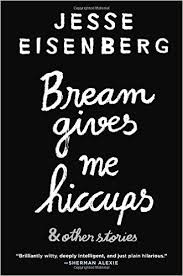
[READ: May 15, 2016] Bream Gives Me Hiccups and Other Stories.

I’ve really enjoyed the comic pieces that I’ve read by Eisenberg–he writes a lot for the New Yorker.  In fact, I had recently decided that I would read and post about all of Eisenberg’s New Yorker pieces at some point in the future.  Well, it turns out that nearly every one of those New Yorker pieces has turned up in this book (there’s three that didn’t).  So that saved some time.

What that means is that most of these pieces are quite short.  And that very few of them are stories in the conventional sense.  They tend to be a few pages long, or sometimes longer pieces done as diary entries.

What is most interesting about Eisenberg’s writing is that most of these stories are funny–some are very funny–but there is also a lot of pathos and sadness in them.  Many of the characters come from broken homes and many of the situations are rather bleak.  And yet he manages to make them funny. (more…)

Read Full Post »

dfwreadSOUNDTRACK: CHRISTIAN SCOTT aTUNDE ADJUAH-Tiny Desk Concert #477 (October 9, 2015).

aacsChristian Scott aTunde Adjuah and his septet play what he calls stretch music: “the particular type of jazz fusion he’s up to: something more seamless than a simple collision of genre signifiers.”

They note that even his appearance stretches traditional jazz: “You may note that he showed up in a Joy Division sleeveless T-shirt and gold chain.” It’s sleek and clearly modern, awash in guitar riffs, but also bold and emotionally naked.

Christian Scott aTunde Adjuah (not sure how to abbreviate that) is a trumpeter and he can hit some loud powerful and long –held notes.   It’s funny that when he bends over the trumpet grows quieter—those ic really are direction-based.

For the first song “TWIN” he does some impressive soloing over a simple and cool beat—piano and delicate guitar riffs (there’s also an upright bass and drummer).   After his lengthy solo there’s a flute solo that also works perfectly (if less dramatically) with the background music.  (Christian plays tambourine during her solo).  He says that this song is about being a twin.  His brother, Kyle Scott is a film director and for whom Christians scores the music.  Christian also explains that he comes from an African-American and Native-American background and that this song has rhythms as a sort of history of his family that touches on Mali, Senegal Gambia and The Ivory Coast and makes its way to the Caribbean, Cuba and into New Orleans.

He’s pleased to play the Tiny Desk Concert for an audience that appreciates “Music that has nutritional value.”

For the second song, “West of the West” he brings on a young alto-saxophonist who plays with his drummer in a different band. The song opens with a rocking electric guitar solo and then the jazzy band kicks in behind it.  The instrumental features a couple of solos by the saxophonist, the pianist and the bassist.

“K.K.P.D.” is a dramatic song for which he gives a lengthy back story.  Many years ago in his home of New Orleans, he was stopped by New Orleans police late at night for no reason other than to harass and intimidate him.  he was coming back from a gig.  He resisted and was in a serious situation and was seriously threatened—the story is long and very affecting, especially given how articulate (I know, terrible word, but true) and calm he is about retelling this horrifying story.  His pride almost made him do something ill-advised, but instead he channeled that pent-up frustration into a piece of music whose long-form title is “Ku Klux Police Department.”

He adds that we see things on TV about inner cities or the ninth ward and we believe them to be true.  Like that the neighborhood is happy that the police are clearing out the youth there.  We begin to think that the narrative is true, although the people who live there can tell you otherwise.  Despite the title and the origin, the is song is designed to reach a consensus to move forward –not to build derision or hate.  He says that we have to start working on that now, because if it doesn’t start now then our children will continue to inherit this situation.

It opens with a noisy guitar wash and fast drums.  It’s quite noisy and chaotic although it resolves very nicely into an almost sweet piano-based song with slow horns.  The middle of the song ramps up with some intense soloing from Christian.  I love how that segues into a very different section with an electronic drum and delicate piano.  Chritsian’s next solo is much more optimistic.  The final section is just wonderfully catchy.

When he introduces the band, he points out just how young some of his newest members are: Drummer Corey Fonville (another new member) used a djembe as a bass drum, and also brought a MIDI pad so he could emulate the sound of a drum machine; Lawrence Fields, piano; Kris Funn, bass; Dominic Minix , guitar (21 years old); Braxton Cook, saxophone (24 years-old) and Elena Pinderhughes, flute: 20 years old!

I don’t listen to a ton of jazz, but I really liked this Tiny Desk Concert a lot.

[READ: July-October 2016] The David Foster Wallace Reader

I’ve had this book since Sarah bought it for me for Christmas in 2014.  I haven’t been in a huge hurry to read it because I have read almost everything in it already.  And some of that I have even read recently.  But this summer I decided to read some of my bigger books, so this was a good time as any.

One of the fascinating things about reading this book is the excerpting in the fiction section.  I have never really read excerpts from DFWs longer books before.  And once you decontextualize the parts, you can really appreciate them for themselves rather than as a means to the end of the story.  This is especially true of the excerpts from Broom of the System and Infinite Jest.  But also just reading some of these sections as a short story makes for an interesting experience.

It was also very interesting to read the non-fiction all together like that.  These pieces come from difference anthologies, but they have thematic similarities  So, placing them together like that allows for really comparing the stories.

And of course, the selling point for most DFW fans is the teaching materials in the center of the book–an opportunity to look into the man’s mind at work shaping younger minds.

I have written about virtually everything in this book already (title links refer back to previous posts), so mostly these are thoughts about the pieces themselves and not a part of a whole. (more…)

Read Full Post »

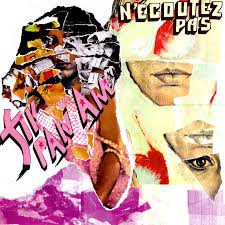
clowns SOUNDTRACK: LE FLY PAN AM: N’écoutez pas [CST031] (2004).

flypanam31N’écoutez pas (Do Not Listen) was the third and final full length album from Constellation’s Fly Pan Am (or in this case Le Fly Pan Am).  There are several short tracks on the disc as well as two 11 minutes songs

“Brûlez suivant, suivante!” (Burn Next, Next!) Opens the disc and hints that it’s going to be a standard rock album—4×4 drums and a dense buzzy electric guitar.  And even when the song proper starts, there’s chanted worded in French and some noisy guitar—its very far from the bass and funky glitchy stuff of previous albums.  The song has very conventional element—a drum break where one might clap along and what sounds like people singing lalalalalala, but all under a veneer of noise and decay that makes it anything but poppy.  There’s a deep voice speaking insistently in French and way in the background a person screaming.  So, really it’s rather unconventional, but within a relatively “normal” framework.  “Ex éleveurs de renards argentés” (Ex breeders silver foxes) is the noise of completely detuned guitars getting plucked and strummed for 30 seconds until a piano plays a chord and all else stops.  It seems like a song will begin but, no, more noises—industrial waves and cars honking takes over.  And then a cacophony of voices begins talking all over each other (including a couple in English).  It’s all over after about 2 minutes.

“Autant zig-zag” (As much zig-zag) is a totally apt name for this song.  This is the first 11 minute track.  After a minute or so introduction, the song comes in with a propulsive bass (not funky at all like the last album) and the song feels like it’s ready to rock.  And it does.  It keeps up this rhythm for a bit and then shifts to a new part with wordless vocals.  There’s even a call and response section with sung words and ooh ooohs as response.  The song shifts to a kind of pummeling section that continues for several minutes until the end.  It contains pretty much everything the band does.  “Buvez nos larmes de métal” (Drink our metal tears) is a noise collage with dramatic movie soundtrack type music played behind the static and distant voices and noises.

“Pas à pas step until” (Step by Step until) has a commanding one, two, three, pause, four, riff going on that is at once catchy and noisy.  The song proper comes in with whispered singing and a wild bass line.  Alexandre St-Onge contributes his wonderful chaos to this song which has some really catchy backing vocals in it

“…” opens side two with what sounds like a voice repeating Fly Pan Am over an over amidst the sound of someone else chewing.  It segues into “Très très ‘retro'” “Very Very ‘Retro’” is the other 11 minute song.  It has two guests, Dominique Petrin on vocals and Tim Heck on electronics.  The song opens with a high-pitched bass and some great counterpoint rhythms.   There’s more hidden vocals throughout the song  Around three minutes in, the bass gets funky.  This runs on for several minutes with some interesting sound effects thrown in until there’s a loud pop and silence.   And then another pop and organ music takes over.  At about 9 minute the song resumes the funky bass line. Again, the band has crammed a lot of stuff into this song.

“Vos rêves revers” (Your dreams setback) has a nice bass sound with some ringing guitar notes.  There’s whispered vocals that sing a melody of sorts.  It’s a fairly conventional song—catchy and bouncy with vocals and everything (true they are whispered and hushed vocals but they do follow a melody line).  At about 4 minutes (of 6), the songs crashes unto itself with the drums and the guitars seeming to fall apart

“Ce sale désir éfilé qui sortant de ma bouche” (This dirty tapered desire coming out of my mouth) has a deep echoing drum kick which keeps a beat.  In the distant background a keening voice kind of follows the melody.  The disc ends with “Le faux pas aimer vous souhaite d’être follement ami” (The false not love you madly want to be friend).  It’s a one minute song with sliding guitars and rock drums which propel this to as close to punk as the band has gotten.  There’s chanting and excitement and fun and then the whole song unravels after about 40 seconds at the end with a sloppy piano denouement.

And that was it from this avant-garde band. The members went on to make lots of other music, Jonathan Parant went on to form Feu Thérèse. Felix Morel has played drums with all kind of interesting bands including Et Sans.  Roger Tellier-Craig has been in Et Sans and Set Fire to Flames among others.  And Jean-Sebastian Truchy has played in several bands including Avec le soleil sortant de sa bouche.

[READ: February 6, 2016] City of Clowns

In the afterword to this book, Alarcón explains how it as written.  He lived in Lima, Peru for a year, teaching.  But while he was there, he had writer’s block.  So he moved to a farmhouse in the middle of America–pure solitude.  And there he wrote the story “City of Clowns” (which I read back in 2013 in the New Yorker) in English.  Sheila Alvarado talked to him about turning the book into a graphic novel.  And so it was completed (after much labor, he says) in a slightly condensed Spanish edition to be released in Spain.  And then, eventually, it was translated into English again, from the Spanish graphic novel.

Since the story really doesn’t change from the short story version, I’m going to put my original comments here:

It opens with Oscarcito going to the hospital because his father died the night before.  He finds his mother mopping floors because his father’s bill was unpaid.  And in that very first paragraph, she introduces her son to Carmela—the woman whom his father left them for.  She was mopping the floor with Oscarcito’s  mother.  He is confused and enraged by this.

His half brothers are also there.  He had never met them before, preferring to stay away from his father’s other life.  But he saw them in front of him and clearly saw that they were related to him.  But the most galling thing was that although he was the oldest of all the children, they were clearly the chosen children—after all, his father stayed with them.

Then we learn about his father’s life.  He was born in Cerro de Pasco and moved to Lima when his young family was still young.  He worked hard in semi-legitimate businesses and then brought his family to the city.  Young Oscarcito, age 8, loved it.  But his mother hated missing her family in Cerro de Pasco.  And now they were living with his father who was practically a stranger. His father worked hard and succeeded, but he was rarely home.

Between flashbacks to his father’s story we see that Oscarcito is now a reporter for the local newspaper and he has been asked to write about the clowns that are prevalent around the city.  Oscarcito is on a bus when a clown approaches.  The clown is pelted by water balloons but still manages to climb aboard the bus and peddle his wares—gaining a few coins for his “act.”  Oscarcito is not interested in the subject and puts it off.

So he travels to his mother’s house to see how she is doing, but a neighbor there tells him she has been living with Carmela since his father got sick.  His mother was embarrassed by this and asked the neighbor not to say anything to him.

His mother had been a cleaning lady since they moved to Lima.  She worked for the Azcártes, a wealthy local family who treated her very well and treated Oscarcito practically like their own son.  Oscar was even sent to a nice school where he was welcomed until they realized where he was from.  Gangs would steal anything from anyone, and were called Piranhas.  And that became Oscar’s nickname at school.  And soon he was made fun of by just about everyone, but especially by one boy.

A flashback then shows that Oscarcito went to work with his father doing construction on a few occasions—they worked very hard on expansions of people’s houses—working hard and working well and making good improvements.  But all the while, they were waiting patiently until they could rob them of all of their fine things.

So when he found his father was working for the father of the boy who made fun of him, he wanted in, and he stole the boy’s suit.

Finally, after putting off his article for ages, Oscarcito meets and interviews a clown.  And that clown tells him how he started and invites him along.  And Oscarcito does.  He finds that he likes the anonymity of the job.

All of the threads come to a head as the story reaches its close—where Oscar will confront his mother and deal with his newfound joy at being a clown.

The ending was very powerful and I enjoyed this story immensely.

There are few details from the original story that have been changed (and I amended my comments accordingly).

There is also an extra scene added of him dating a girl named Carla who walked on stilts.  There’s an erotic moment which is really interesting and which brings a whole new level of fascination to Oscar’s clown life.

Obviously the biggest change is Alvarado’s illustrations.  She does an excellent job recreating these scenes much as I imagined them.  I really  enjoyed the way she worked within the mens’ professions–putting words on bricks as his father was laying them, hanging papers up to dry with text on them, and using excellent distinctions of black and white to show the different settings in Oscar’s life.

The biggest change I think is the depiction of Oscar in his clown suit.  It’s nothing like I imagined and is all the better for it.  Alarcón says that now this is “its true and definitive form” of the book, and I imagine that this is what I will think of when I think of the story.

For ease of searching, I include: Daniel Alarcon.


Read Full Post »

harpjulySOUNDTRACK: JERUSALEM IN MY HEART-Mo7it Al-Mo7it [CST093] (2013)

mo7So just what is Jerusalem in My Heart?  According to the Constellation records website:

Jerusalem In My Heart (JIMH) has been a live audio-visual happening since 2005, with Montréal-based producer and musician Radwan Ghazi Moumneh at its core. Moumneh is a Lebanese national who has spent a large part of his adult life in Canada.  Moumneh is also active in the Beirut and Lebanese experimental music scenes, where he spends a few months every year.

but more specifically, what does it sound like?

Jerusalem In My Heart (JIMH) is a project of contemporary Arabic and electronic music interwoven with 16mm film projections and light-based (de)constructions of space, exploring a relationship between music, visuals, projections and audience.  …   [The album blends] melismatic singing in classic Arabic styles and electronic compositions with contemporary electronic production. …  Moumneh’s voice has become a powerfully authentic instrument, [along with Saturated synths and the overdriven signals of Moumneh’s acoustic buzuk and zurna].

And what’s up with the title of the record?

The numeral 7 is pronounced like an h; all titles on the album are rendered in contemporary colloquial “mobile” Arabic (the transliterative characters used in Arabic phone texting).

Alright, now that that’s out of the way, the album begins with “Koll lil-mali7ati fi al-khimar al-aswadi (Speak of the Woman in the Black Robe)” which opens with an echoed voice that reminds me of the way a dance track might start.  But it quickly becomes clear that the singer is sing in Arabic and in a somewhat traditional manner (but with an echoed effect on the voice).  I don’t really know how Arabic music might be sung, but this is what it sounds like to me.  By the end of the track, some keyboards are added, echoing to the end.

The second track, “3andalib al-furat (Nightingale of the Euphrates)” is a 9-minute instrumental.  It opened with acoustic stringed instruments Dina Cindric playing the Rast Virginal on the banks of Al-Furat.  It is a beautiful piece, recorded outdoors with the sounds of birds and other animals contributing.  It never grows louder than these instruments.

And then this acoustic and mellow piece jumps into the very electronic sounding third song, “Yudaghdegh al-ra3ey wala al-ghanam (He titillates the shepherd, but not the sheep…).”   The opening riff is very late 70s Tangerine Dream-sounding.  I expected a lengthy instrumental, so I was very surprised when the female vocalist (I assume Malena Szlam Salazar) began singing in tradition Arabic style.  It’s a great mix.  Especially at the end as her voice gets more processed.

Track four, “3anzah jarbanah (Sick, Diseased Goat)” is a mostly a capella vocal song with Moumneh singing in his mournful keening voice.  He sounds pained as his voice has a slight echo to it.  After about three minutes a distorted keyboard plays behind the voice.  It has a distinctly 1980s sci-fi vibe.

“Ya dam3et el-ein 3 (Oh Tear of the Eye 3)”  is 5 minute-instrumental which I believe is done mostly by Sarah Pagé playing the Bayat Harp on the banks of Dajla.  Again birds are heard throughout.  These instrumentals are just lovely.

“Ko7l el-ein, 3oumian el-ein (Eyeliner of the Eye, Blindness of the Eye)” has a kind of solo opening on what I assume is the buzuk.  It’s fast and a little wild by the end with an electronic sounding synth line running in the background that more or less takes over the song.  The final track is ” Amanem (Amanem)” which has Moumneh’s vocals and a keyboard drone behind it.  It’s a rather mournful and spooky  vocal style and sounds likes he as about to cry.

Since I don’t really know what the album is about, the ending seems like kind of a downer.  But since I am exposed to practically no contemporary Arabic music, I found this to be a really interesting listen, and I wonder if it is in any way representative of contemporary Arabic music.

[READ: August 22, 2016] “My Holy Land Vacation”

I read this more of Bissell, not because of the contents, as I like Bissell quite a bit.  But I found myself strangely engrossed by this story of traveling to Israel with a busload of Conservatives.

Bissell says that he enjoys listening to right-wing radio.  He names a few hosts who I don’t know and then ends with Dennis Prager.  I don’t know him either, but he is the impetus for this article so there ya go.  Bissell describes him as the “patriarch trying to keep the conversation moderately high-minded” which sounds pretty good.

Prager is Jewish and his audience is largely Christian.  And in the summer he organized a Stand with Israel tour.  For about $5,000 you could go on an all-inclusive guided tour across the world’ holiest and most contested land.

Bissell provides some context that the religious right hasn’t always been fans of Israel.  Indeed my recollection is that the Christian right was very antisemitic.  But by 2002 conservatives were vested in the cause because of some common beliefs like forbidding abortion and being suspicious of Muslims.

When Bissell first saw Prager in person he admits to the man’s charisma.  Bissell talks about what is known as the Israel Test which is summed up “if you ever find fault with Israel, you’re horrible.”  Prager believes that all American parents should send their children to Israel between high school and college to let their moral compass be righted again.

As for the trip itself–the food is plentiful everywhere–embarrassingly so.  He doesn’t like many of the people on the trip.  And he and his wife have to remember to not act like New York liberals.  But the one thing that Tom and his wife (and the people he has grown to like on the bus) can agree on is that their guide David is “the tour guide to have while Standing with Israel.”

Bissell is pleased to hear that the locals are pretty even-handed about a lot of things, always trying to explain up how most of the citizenry–both Israelis and Palestinians want peace.  But the travelers are appalled at this even handedness.  They want partisanship.  A woman yells that there no way that Israelis are teaching their children to hate.  A soldier–a man who lives here–responds to her that he knows Israeli families who do raise their children to hate Palestinians.  She responds, “Respectfully, no.  Respectfully, no.”

Later when they go to Nazareth, their tour guide explains that Nazareth has pretty much always been Arab territory–they didn’t take it from the Israelis, but no one appears satisfied with this answer.

Eventually they go to a settlement and meet self-described “Israeli rednecks.”  The man was born in Cleveland and moved to Israel in 1961.  He is a rabble-rouser and makes Bissell uncomfortable.  Bissell has to leave the room during the man’s excoriations.  When he steps outside, he meets Pastor Marty who is also appalled at the belligerence.  Marty blames talk radio in general and wonders when the last time “anyone was forced to have a civil discussion with someone who thought differently.”

But the real crisis is aboard Bus Five–Bissell’s bus–because their beloved tour guide has been fired because of complaints.  And a whole section talks about the bus’ reaction to this.  They even form factions who want to Stand Up for Dave, and the de facto leader begins trying to find out who is for or against Dave.  The section is pretty fun and strangely exciting.

But the final section grows much more serous.  They visit Yad Vashem, Jerusalem’s Holocaust Memorial.

Soon the rest of the bus and its occupants are forgotten and Bissell simply thinks about this memorial and the thousands of dead.  And then he thinks of his own family–he and his wife left their relatively new-born daughter home with grandparents.

I expected that this essay would be full of some crazy people spouting crazy things.  And to an extent it was, but what I like about Bissell’s writing is how empathetic he is and how he can really convey different perspectives while retaining his own individuality.  The essay also  contained a lot of interesting information and had a surprisingly emotional ending–one that is far removed from right-wing radio..

Read Full Post »

c28SOUNDTRACK: HISS TRACKS-Shortwave Nights [CST104] (2014).

hissThe Hiss Tracks album begins with a rumbling roiling and yes a kind of hissing sound.  There was a moment of concern that this would be literally 40 minutes of static . But no, there are some interesting electronic blips and phrases amidst he roiling rumble.

Some context about this band from the Constellation site:

Hiss Tracts is an ongoing collaboration between “sound sculptors” David Bryant and Kevin Doria. Both players are known for their work within various strains of drone-inflected and experimental music: Bryant as a member of Godspeed You! Black Emperor and Set Fire To Flames, Doria as a member of Growing and for his solo work as Total Life.

Hiss Tracts opens new collaborative, procedural and narrative pathways for these fine musicians to continue exploring soundscape-based composition and production. Both are guitar players, and the electric guitar figures as both recognizable and unrecognizable source instrument on Shortwave Nights, but the deployment of a wide range of additional analog sources and signals ensures that there is no confusing this for a guitar-based drone, noise or post-rock record.

So there you have it.  Once the rumble of that first song, ‘…shortwave nights,” dissipates there are some ringing guitar sounds quietly repeating amid a low static and other sounds.   The song ends with some dissonant guitar notes.  It’s eight minutes in total and has the feeling of an ambient soundtrack, but not a relaxing one or of background music.

“half-speed addict starts with broken wollensak” does indeed begin slowly, at about half-speed, with more rumbling sounds.  The song speeds up at the end, with muffled sounds keeping a very fast pace and a keyboard note rings out as the song finishes.  “slowed rugs” has a kind of one note drone while some vibrating drones continue over it—it’s a gentle electronic sound manipulation.   The oscillating notes fold in on themselves and mutate into some thing else.  As the song nears its end, a repeated series of unusual notes seems to rise from the din.

“drake motel / “9 gold cadillacs”” is a one minute interstitial that opens and closes with someone playing a harmonica.  The player offers it to someone else and then the rest is a series of statements from an unnamed person:

I would never put my mouth on something that you had put your mouth on.
The more you love people the worse they treat you I am so tired of it.
My daddy spent million of dollars trying to by a friend and he died without one.
You can give a sumbitch a million dollars cash tax-free and tomorrow they wouldn’t give you a cracker if you were starving to death.  That is a bible prophecy.

“windpipe gtrs.” sounds like a bunch of didgeridoos trying to overtake each other.  “halo getters” is an ominous piece, with more of that rumbling static and some portentous chords over the top.  The five-minute song doesn’t change much although about a minute in some guitars ring out sounding very outer spacey.  The song repeats and eventually warbles to and end which somehow feels warmer than the rest, like little explosions of quiet sound which almost sound like car horns.

“for the transient projectionist” opens with ringing bells/gongs.  After a few minutes of this peaceful sound, some music bubbles up—waves of warm keyboards and washes of mild static.  It seems to have a natural progression before ending.

“ahhh-weee dictaphone” is a 41 second interstitial of what sounds like vocal goofing around.  “test recording at trembling city” has mechanical ringing tones coming on in waves.  The song builds in intensity as it sounds almost like a high-speed-something about to crash, or a siren going off.  It is rather unsettling.  “beijing bullhorn / dopplered light” is mostly staticy radio and voices muttering under some gentle washes of chords.   It is a relatively pretty ending to a somewhat unsettling disc.

The instruments included on the disc include: guitar, tape machine, piano, mellotron, portasound, bowls, field recordings, oscillators, sampler, synthesizer

This is a pretty esoteric disc that many people won’t enjoy, but if you like experimental ambient textures, it’s worth a listen.

[READ: March 10, 2016]  “Undecided”

After last night’s debate, in which evidently there are some 36% of the population undecided about whom to vote for, here’s a political piece from the 2008 election.  What I especially loved about this one was just how relevant it all seemed 8 years later.  The “undecided” voters aren’t getting as much airtime yet, but one wonders how poll numbers can shift when the candidates are so radially different.  I recall in the 2008 election how people seemed genuinely undecided about the two candidates and Sedaris (and myself and many others) just ask: HUH?.

Sedaris notes how the undecideds get interviewed about being undecided and they all look “very happy to be on TV.” And oh dear, they just can’t make up their minds.

“I look at these people and can’t quite believe that they exist.  Are they professional actors? I wonder or are they simply laymen who want a lot of attention?”

And then he says to imagine their perspective as if you were on an airplane.  The attendant brings the food cart over and in what may have been the most apt analogy:

Can I interest you in the chicken? she asks.  Or would you prefer the platter of shit with bits of broken glass in it?

To follow through he says that being undecided is to “pause for a moment and then ask how the chicken is cooked.” (more…)

Read Full Post »

« Newer Posts - Older Posts »