
Feeds:
Posts
Comments

Archive for the ‘Magazines’ Category

TNY 8.25.08 cvr.inddSOUNDTRACK: BIG THIEF-Tiny Desk Concert #562 (August 29, 2016).

bigthiefBob Boilen absolutely loves Big Thief’s debut album (it made his top ten this year).  I think it’s really good, but I don’t quite love it the way he does.

But I think their first song, “Masterpiece” is really a great song.  And in this Tiny Desk Concert, they play it with a slightly different feel.  It seems to allow the sounds of the guitars to come through a little more.  Like the album, though, the harmonies are wonderful.

When the video started, the camera focused on just Adrianne Lenker and Buck Meek, and since the first song starts with just the two of them I wasn’t even sure of the whole band was there.  They are, although it’s odd how isolated the rhythms section looks in this video.

“Paul” is a mellow song with a strangely subdued and yet catchy chorus.  It’s kind of funny to watch Buck Meek really getting down to what is a fairly mellow track–although his guitar parts are pretty cool blasts of music.

“Lorraine” also get a mellow treatment here.  For this version it’s just her singing and playing the guitar.  It works very well in this Tiny setting and her voice really shines.

[READ: March 1, 2016] “Awake”

This story is about a college Economics major who just can’t get enough sex.

Well, that’s how it starts anyhow.  Richard is lying in bed next to Ana.  He moves in close behind her, hinting.  But she moves away quickly (she is actually asleep, so that’s a reflex).  He is annoyed although he shouldn’t be–I mean they did it twice already that night.

So instead of thinking about sex he decides to think about something else.  But what? (more…)

Read Full Post »

6916SOUNDTRACK: GIRL IN A COMA-Tiny Desk Concert #190 (January 30, 2012).

girlcoma I was planning on writing only about recent Tiny Desk Concerts for a while, but Nina Diaz’s (Aug 2016) Concert informed me that she was the singer of the band Girl in a Coma who are presently on a hiatus while Nina tours some solo material.

So I went back and watched this Tiny Desk to see the origins of Diaz’s music.

Girl in a Coma is a three-piece with Nina Diaz on guitar and vocals, her sister Phanie Diaz on drums and Jenn Alva on bass.  The blurb suggests that the band plays punk–typically loud crunchy guitars (although I listened to the recorded version of “Smart” and it doesn’t really sound very different from this version).  So I didn’t get that.

At any rate, the trio sounds great in this setting.  The percussion is simply tambourine and a shaker.  And Alva’s bass is really melodic and lovely playing more than just the same notes as the guitar.

“Smart” is really catchy (although Diaz does some weird things with her voice late in the song).  “Knocking At Your Door” has a fast, almost metal sounding guitar (albeit acoustic here).  But it’s the bass (which is not doing anything crazy) that takes center stage with the melodies she plays.

Before the final song Nina says it feels like show and tell or something.  And while she’s saying this, the other two switch places, with the drummer coming up front and the bass sitting in the back.

“So” has a pretty traditional folk song structure.  The reason for the switch of seats comes in the second verse when Phanie plays the melodica.  It’s a pretty song and Diaz’s voice is really nice.

I really can’t imagine them being a punk band at all, frankly.

I’m also going to point out what Diaz looks like here for contrast of what she looks like in her solo show four and a half years later.  In 2012, she’s wearing dark jeans and a v neck sweater (stripes in the purple family).  Her hair has bangs and a long braid on the side.  And she has no obvious makeup on.  Keep that in mind for the next post

[READ: November 1, 2008] “Tits-Up in a Ditch”

I read this story back in November 2008 and just couldn’t get into it.  I tried several times and could not penetrate the barrier that I felt Proulx was creating.  Well, here it is 8 years later and I tried it again, and not only did I finish it, I sort of enjoyed it.  Even though it, like everything else I seem to have read from Proulx was incredibly depressing.

The story is about Dakotah.  Dakotah’s mother abandoned her when she was a baby and left her own parents to take care of her.  They resented their daughter and Dakotah from the start.  They were harsh and uncaring towards her (although it could be prairie love, I suppose).  The grandparents are named Verl and Bonita Lister (Proulx has fun with names in her stories).

Verl and Bonita are hardscrabble, religious folks who don’t have a lot of joy.  Well, Verl had moments of happiness but probably no joy–he rode hard and then injured himself.  But he was stuck because during the 1980s in Wyoming oil companies came in and took away all the workers.

Verl gives us the title of the story when he says “Had me some luck today.  Goddam cow got herself tits-up in the ditch couple days ago.  Dead, time I found her.”  See, charming people. (more…)

Read Full Post »

7_28_08-640SOUNDTRACK: NINA DIAZ-Tiny Desk Concert #561 (August 26, 2016).

nina And here it is four and a half years later.  Nina Diaz has gone from wearing dark jeans and a v neck sweater (stripes in the purple family) to wearing a Sonic Youth T-shirt with the neck collar torn off and the sleeves removed.  Her arms are covered in tattoos.  Her hair is long and down and she’s got pink eye shadow on.  girlcoma2Here’s a comparison photo.

Her voice sounds much more powerful as well.

I’m fascinated by her bassist who is playing a seven string bass (and has crazy hair).  And I’m intrigued that there’s a dedicated melodica player in this show.

As she sings “January 9th” you can see how much more confident she is (not that she was nervous in 2012).   She sings her songs with real power and sway in her body.  The song opens with some cool bass lines (he really uses all of the 7 strings, which I like).  And as the song moves along the backup band sings harmonies which sound very good.

“Dig” has a bunch of cool things going on.  There’s an interesting, somewhat sinister main guitar melody, a cool bass line and a slide guitar from the second guitarist.  I really like the way she delivers the lines in the middle of the song–a kind of accent that works great with the lyrics.

As she opens “For You” she says she’d like to “hopefully have it on in the background when someone’s losing their virginity.”  And with a lyric like “For you I’ll go all the way.  I scream your name,” it seems pretty likely.  It begins with just her voice and acoustic guitar (with the other guitarist playing some melodies too).  The song is a sweet tender ballad and when she asks at the end if we can picture someone losing their virginity to it, the answer is certainly yes.

[READ: March 1, 2016] “The Teacher”

This story goes in some interesting directions.  It begins with the narrator (I) talking about the “girls” Betty and Maeve.  They are good girls, who do whatever they can to help people out.  In their apartment, they have taken in pregnant teens, boys caught stealing and even, once, a suspected sex offender (which didn’t make the town happy).

Maeve types documents and Betty reads manuscripts for a publisher.  And that’s how they met Dr. Chacko.

Betty received Chacko’s manuscript.  It was really long and handwritten. So Maeve copied it out on the computer and they both fell in love with the content.  When they tried to explain the book to the narrator they couldn’t do it in any way that made sense to her.  They also failed to describe him to her as well. (more…)

Read Full Post »

62SOUNDTRACK: THE JAYHAWKS-Tiny Desk Concert #556 (August 8, 2016).

jayhawksWhen The Jayhawks first had a hit back in 1992 (“Waiting for the Sun”), I actively disliked it.  I’m not sure why but at the time something about it really rubbed me wrong.  Now, I happen to really like the song. But more interestingly, I think that their newest album, especially “Quiet Corners & Empty Spaces” is fantastic.  It’s one of my favorite songs of 2016.

The verses are simple and catchy, the chorus is mesmerizingly fun to sing.  And the way the band fills in around Gary Louris’ voice is just perfect (and those harmonies, wow).  The version here is perfect–feeling a little more  “live” than it does on record (as it should)

“Lovers of the Sun” mixes the verses of an unwritten Sloan song with a 1960s folk California chorus.  The e-bow (which they’re worried didn’t get picked up) sounds cool and eerie at the same time.

“Leaving the Monsters Behind” has a bouncy bassline that propels this song and everyone sings delightful harmonies.  There’s close harmonies with Louris and higher ones from the drummer.  The middle section (ostensibly the solo) is really interesting for the way it shifts dramatically and the bass plays something very different from the bouncy main part.  The parts work very well together.

“Comeback Kids” opens with a high riff on the guitar and a slow bass keeping the pace.  I love that keyboardist Karen Grotberg switches back and forth between piano and this little synth pad thing that plays cool theremin-like sounds.  The riff that leads to chorus is really dramatic as well.  The ending, in which everyone sings some “oohs” and the riffs build and build, is right on.

I’m delighted at how much I’ve changed my mind about The Jayhawks.  And it only took 24 years (and many many breakups, re-formations and personnel changes) for me to change my mind.

[READ: February 26, 2016] “A Night at the Opera”

I found this story to be rather unsatisfying.  And it may have just been that when I printed it out, the first section was on one page and the second section–the start of page two–seemed so different that I wondered if I had somehow printed the wrong second page.

The story opens with the narrator reflecting on watching the Marx Brothers movie A Night at the Opera and how they laughed and laughed.

Then the second part jumps to a hospital known as Park House.  It is a place for people who need assistance all the time.  There are varying degrees of mental deficiencies in the hospital: the violent, the uncontrollably deluded, those who had murdered or who would murder, and the speechless. (more…)

Read Full Post »

tny 5.26.08 cvr.indd SOUNDTRACK: KEVIN MORBY-Tiny Desk Concert #554 (August 1, 2016).

morby

I didn’t know Kevin Morby before listening to this concert.  He was in two bands that I’ve also never heard of: Woods and The Babies.

Morby plays a kind of smooth folk (but somehow not really folky because the low end feels a bit more rocking).  I found at least the song “Dorothy” to be kind of like Lou Reed–same style of delivery and groove, but on an acoustic guitar (and sounding far less like a disaffected New Yorker).

He plays three songs and his band consists of a drummer a bassist and a lead guitarist.  He sings and plays acoustic guitar.

“Cut Me Down” is a mostly acoustic-feeling song (you can barely hear the electric guitar).  He even takes the few leads that are there.  The song has  some good dramatic pauses, and then about half way through, it shifts to a new melody–the bassist and the electric guitar playing similarly high notes.

“Dorothy” is a much more interesting song to me.  Even if I do feel lit sounds bit like Lour Reed.  It’s on this song that guitarist Meg Duffy shines more.  Her guitar has a cool echo effect on it.  And while she’s not playing loud or hard, she’s got a cool sound, especially when she plays lead.  On this song her lead guitar “substitutes” for other instruments.  He sings that he could “get that piano” or “that trumpet” to play something like… and she gives a little solo (I particularly like the “trumpet” one).  She also gets a chill proper  solo.

But it’s the final song, “I Have Been to the Mountain” which is the most dramatic and interesting.  In addition to the minor keys chords he plays, the bass comes in with a cool riff.  And the chorus is intense.  With good reason.  The song is about the 2014 chokehold death of Eric Garner at the hands of a New York City police officer:

 That man lived in this town / Till that pig took him down / And have you heard the sound / Of a man stop breathing, pleading?

But it’s not overstated or melodramatic.  And Meg gets a cool solo in the middle as well.

[READ: February 23, 2016] “Over, Around, and Through, Your Highness”

I have gotten to the point where I pretty much don’t even read the New Yorker’s Shouts & Murmurs column anymore.  Most of the pieces are an extended joke that could best be summed up by a few paragraphs rather than a whole page.  But there are some authors who I will always give time to and Woody Allen is one of them.

His short funny pieces are not musings on a joke, they are actual stories that develop and usually reflect back on themselves by the end.

This piece opens with a movie producer bemoaning the state of things.  In typical Woody Allen fashion, he plays with pop culture, talking about the latest film “Mourning Becomes Electra on Ice.” He notes that if he’s not careful his next job will be an easy one in which he answers the questions “Did you work last week?  Did you look for work?” (more…)

Read Full Post »

rek2SOUNDTRACK: OF MONTREAL-Tiny Desk Concert #263 (January 28, 2013).

of-montrealWhen I saw that Of Montreal was doing a Tiny Desk Concert I really had no idea what to expect.  I mean, it could have been anything.  The blurb even jokes that Of Montreal concerts have been described as “wildly theatrical,” “flamboyant,” “synchronized dancing” and having “strange, wandering creatures that look like amoebas.”

So I was absolutely not expecting to see two guys with acoustic guitars and a woman singing a gentle folk song.  I actually double checked to make sure I was watching the right show.

Evidently around this time, Kevin Barnes (the man behind Of Montreal) had been working on quieter, more personal work. And so we get these three songs which are, more or less, Barnes solo.

The first song, “Feminine Effects” has the assistance of singer Rebecca Cash and guitarist Bryan Poole.  Cash sings the entire song, and it’s quite lovely, if not a little dark.

The next two songs “Imbecile Rages” and “Amphibian Days” are Barnes by himself, strumming guitar and singing.  The music is fairly straightforward, although he does throw in some unexpected chords which makes the songs stand out. And, of course, his lyrics and delivery are quirky. His enunciation is peculiar and even more pronounced in this setting.

This is a real surprise for Of Montreal fans, and frankly almost a red herring for anyone new to the band.

[READ: December 31, 2016] The Impossible Fortress

Sarah received an advanced reader’s copy of this book from her friend Mary Lynn and thought I would like it.  And boy did I ever.  I read this book in half a day.  It’s a quick read and while not profound of life-changing, it was really fun and funny–with a fairly dark twist.

There are two major plots in this book and they intertwine very nicely.

The first–the “action” plot–involves the Vanna White Playboy issue.  The second–the main character plot–involves coding a video game on a Commodore 64.  For this book is set in 1987 in the suburban New Jersey town of Wetbridge.  Our protagonists are 14-year-old boys who never really fit into other cliques.

The story is about Billy Marvin.  He never knew his father and his mother has started working the overnight shift at the Food Mart to make an extra dollar an hour.  Billy’s mom has really high hopes for Billy.  But his school life is pretty dismal.  His mom believes that Billy is really smart and she tries to get Billy into honors classes.  But his grades indicate remedial classes.  If he can succeed in these classes he can get moved up.  But he does not succeed. At all. (more…)

Read Full Post »

922SOUNDTRACK: SAUL WILLIAMS-Tiny Desk Concert #565(September 16, 2016).

saulSaul Williams sings three songs in this Tiny Desk Concert.  He is accompanied by two guys on acoustic guitars.  But his songs are so much more than the few chords played guitars.

I was unfamiliar with Williams before this Concert.  He is a rapper, poet, activist, writer and much more.  All of his songs include impassioned spoken sections in which he (presumably) free verses eloquently.

He opens the set with a series of statements/accusations.  And when he announces the title of the song, “Burundi” he tells us that the song is called… an astonishing list of cities that have similar problems.  He explains that the chorus contains stanzas from the Sufi poet Rumi: I’m a candle, you can chop my neck a million times but I still burn bright and stand.  The middle of the song is a lengthy spoken section in which he talks about everything that is going on in the world.  And he ends with this excellent thought: “The voice and vision that counters power cannot be wiped out.”

For “Think Like They Book Say,” one of the guitarists plays out a rhythmic tapping on the body of the guitar while the other plays the melody.  It’s a menacing sort of melody and it is dedicated to Chelsea Manning.

Before the final song Saul grabs Bob Boilen’s James Brown doll.  He cradles the doll, kisses his forehead and then has his guitarist play a lullaby “Down For Some Ignorance.”  It begins as a very mellow song.  And then mid way through the song, he presses a button on his computer and the song turns into an electronic wildstorm of sounds and samples.

During the end of the song, he recites a phenomenal list of grievances.  And as the song ends, you can see that he has brought a tear to his own eye.

It’s a very powerful Tiny Desk.

[READ: March 10, 2016] “My Gal”

I’ve mentioned before that I really like George Saunders’ work, and I find his funny pieces to be especially funny.

What’s odd about this piece (which was in Shouts and Murmurs) is that it was topical.  Nothing odd about that exactly, except that reading it nearly 8 years later, in another election cycle, it seems almost quaint.  Especially since Trump has replaced Sarah Palin as the Republican’s (and now the country’s) biggest idiot and liar.

This essay is by a guy who loves Sarah Palin–she’s his gal. (more…)

Read Full Post »

ny928SOUNDTRACK: COMMON-Tiny Desk Concert #569 (at the White House–October 4, 2016).

comonFor the first time in Tiny Desk history, they moved the desk from Bob’s corner of the office to The White House.  Not a bad move.

Boilen explains:

the White House called and said they were putting on an event called South by South Lawn, a day-long festival filled with innovators and creators from the worlds of technology and art, including music, we jumped at the chance to get involved. We chose Common as the performer and the White House library as the space.

I don’t know much about Common.  And, I don’t know what his album tracks are like.  But for this concert, Boilen explains:

Common put together a special six-piece band of close friends that includes the great Robert Glasper, with his eloquent and delicate touch, on keyboards and Derrick Hodge, whose music spans from hip-hop to folk and has made a big imprint on the world of jazz, on bass. Common also asked his longtime friend and collaborator Bilal to sing on two songs.

I didn’t know his lyrics, but I found his songs to be thought-provoking and smart. Perfect for the White House library.  But that is apparently what Common (who used to be known as Common Sense) is all about: “morality and responsibility continue to play significant roles in his songs”

Common plays four songs: three brand new songs, along with one classic, “I Used To Love H.E.R.”

“I Used To Love H.E.R.” is a very clever ode to hip-hop in which he uses a woman as a metaphor for the genre. It’s really well done.  “Letter To The Free” is about how slavery has not really been abolished–it has just turned into mass incarceration.  “The Day The Women Took Over” is an ode to women and certainly sounds like a song that was written for the woman who was then in the White House and the woman who should have been our next president.  “Little Chicago Boy” is a tribute to his father–a man that Common has always respected.

Musically, the group sounds great–a light, jazzy feel with some great flute from his sister and perfect playing from the rest of the band.

The blurb ends

Common told us that he’d been invited to the White House many times before, including by Michelle Obama for a poetry reading back in 2011, but he was thrilled by the prospect of performing his music during Barack Obama’s final months as president.

And with the Great Liar presumably heading to the White House, this may be the last time any musician I’d want to hear will appear there again.

[READ: March 10, 2016] “Three”

This story was told in three parts with a narrative bookend holding it together.  I had to reread the “introduction” after reading the whole story to see what an interestingly crafted tale this was.

The intro begins “This is an account of three people who died.  Quite recently, one after the other….  They weren’t important, as the wide world defines ‘importance.'”

And then we meet the three people who all lived in this provincial town in the north of Italy.  She says they share no real connection either, except “purity of spirit.”

The first person was her mother-in-law Ombretta.  She was never intrusive to the narrator and even though the narrator was her son’s second wife, there was never any weirdness about that either.  There was a big celebration for her 90th birthday.  Soon after, she took ill.

And this is when the narrator realized how much she had fallen in love with Nonna Ombretta.  And as part of her summation of Ombretta’s death we learn some interesting details about her. (more…)

Read Full Post »

6916SOUNDTRACK: MARGARET GLASPY-Tiny Desk Concert #560 (August 22, 2016).

margaretI really love Glaspy’s 2016 album Emotions & Math.  Her lyrics are sharp, her voice is unusual and mesmerizing and her guitar licks are simple but just chock full of hooks.  What’s not to like?

This Tiny Desk sees her playing songs from that album. Her band is just a bassist, a drummer and her on guitar and voice.

“Emotions & Math” starts off quietly with just bass and drums while she sings in that unique way of hers.  Then the guitar comes in–it’s nothing fancy, but it plays off the bass notes in a very cool way.  And it’s super catchy too.

“Love Like This” opens with a cool bass and drums rhythm–bouncy and tribal.  And when her guitar comes in, it’s with a ripping couple of chords before disappearing again.  Once again, the bass is rumbling along with her chords accenting in a neat way.

“You and I” bounces along with some low chords and bass and Glaspy’s most growly vocals. This song features the first “solo” which is really just the notes of the chords played, but it really stands out among the deep notes.  And once again, the whole business is really catchy.

“Somebody to Anybody” is just her singing and playing guitar.  Although it feels a little quiet without the rhythm section, she fills in more guitar parts on this song and it feels quite full.  And the chorus is, that word again, very catchy.

It was this Tiny Desk that sold me on getting her album, and I’m glad I did.

[READ: March 17, 2016] “The Running Novelist”

This essay appeared in the Summer Fiction issue of the New Yorker.  Since I really like Murakami, and hope to read more of him one of the days, I’m going to include this essay because it is as surprising as some of his fiction.

This is the story of how he became a runner and how he became a novelist.

He had been the owner of a small jazz club (which I feel he has written about in one of his stories).  It stayed open late and was a novelty in Tokyo at the time.  He had a niche audience and while many people didn’t like the place, he had a steady clientele.

His friends said it would never work, but he didn’t listen and he became quietly successful.  He was there in the morning and worked late at night.  And once he made a profit he hired people to help him out. (more…)

Read Full Post »

slowreadSOUNDTRACK: DIRTY THREE-Tiny Desk Concert #245 (October 15, 2012).
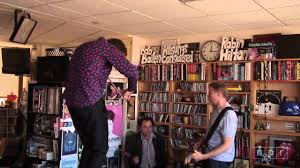
dirty-3For a Murakami collection I should really have picked a jazz Tiny Desk Concert.  But none jumped out at my on my list.  So I decided to do something that might be jazzy in spirit, even if it is nothing like jazz at all.

Dirty Three are a three-piece band which consists of violinist Warren Ellis (who works closely with Nick Cave), drummer Jim White (who I had the pleasure of seeing live with Xylouris White), and guitarist Mick Turner (who has released a string of gorgeous instrumental solo albums and worked a lot with Will Oldham).

I’ve liked Dirty Three for years, although I kind of lost touch with them back around 2000.  So it was fun to see that they are still working.  (They’ve released all of 3 albums since 2000).

Jim White plays an eccentric but very cool style of drum–it always feels improvised and random, and maybe it is, but it’s never “wrong.”  Turner is the only one who is keeping the song, shall we say, “stable.”  He’s got the rhythm and melody both with his strumming.  And Ellis is all over the place with melody lines and bowing.

For this Tiny Desk, they play three songs.  Their music is ostensibly instrumental although Warren Ellis is not above shouting and yelling and keening when appropriate.

The first two songs are from their 2012 album and the last one is from Ocean Songs.

“Rain Song” opens with Ellis strumming the violin while Turner plays slightly different chords.  Then Ellis takes off on a series of spiralling violin rolls.  As always, White is back there waving his arms around with the loosest grip on drumsticks I’ve ever seen.  He plays brushes on this song but the drums are far from quiet.  Meanwhile Ellis is soloing away, yelling where appropriate and doing high kicks when White hits the cymbals.   As the song comes to an end, White is going nuts on the drums and Ellis takes off his jacket (revealing a wonderful purple shirt) .  He starts screaming wildly as he physically gets into his violin playing.

“The Pier” is about realizing that it’s the rest of the world that is driving you crazy.  It’s about “trying to undermine Facebook and realize a new way of communicating with people beyond the internet.”  It’ about… are you ready Mick?  Okay.  “The Pier” is a slower song with some plucked violin.  Ellis climbs up on the desk and dances around as he plays.  This one feels a but more controlled but in no way staid.

For “Last Horse in the Sand,” white switches to mallets and adds a tambourine to his cymbal.  It’s really interesting to watch White play around with things–moving his gear around as he plays.  He switches sticks and seems to be not even paying attention, but without ever really losing momentum or timing.  For this song, Ellis and Turner are the mellow ones while White is just all over the place with his amazing drumming.

I haven’t said anything about Turner because he is really the grounding of the band, while the other two are taking flights of fancy.

This is a wild and untamed set and it’s a lot of fun.  It’s also amusing to watch the audience witnessing this seeming chaos.

[READ: December 16, 2016] Slow Reader Vol. 1

Madras Press had released 16 small books, which I enjoyed reading quite a lot.  I have posted about some and will post about more in the new year.  But word is that they have given up on the small books and have switched their attention to a new magazine/journal called Slow Reader.  The first issue came out this month and it collects stories, essays, poems, illustrations, and other things that center around novelist Haruki Murakami.

Support this small press!  You can order this issue directly (and name your price, although I think the asking price is $6).

From an article elsewhere I’ve learned that future issues will cluster around M.F.K. Fisher, Kazuo Ishiguro, and Patricia Highsmith.

This issue contains essays, fiction and illustrations, some dating back as far as 2000.

CHIP KIDD-cover illustration (wind-up bird)
Chip Kidd is awesome

GRANT SNIDER-Murakami Bingo Board
This bingo is hilariously apt–covering most of the bases of Murakami’s writing: cats, jazz, running, and even a Chip Kidd cover.

JESSE BALL-Sheep Man
A line drawing of a sheep standing upright with the caption “The sheep man’s peculiar tail was never visible to me.”

HARRIET LEE-MERRION-Diner illustration
A nice line drawing of a corner diner

KAREN MURPHY-Sputnik and two moon illustrations
Two simple drawings of Sputnik and two moons.

BEIDI GUO-Hard Boiled Wonderland and the End of the World map
A cool map of the locations of the novel.

DINA AVILA–Murakami Tasting Menu at Nodoguro in Portland, OR
I don’t really get if the menu items are related to the stories but it’s a neat idea that there are foods named after his works. But why are so many called IQ84?

EUGENIA BURCHI–IQ84 menus
A drawing of foods with what I think are character names (I haven’t read the novel yet).

FABIO VALESINI-train illustrations taken from the book trailer for Colorless Tsukuru Tazaki and His Years of Pilgrimage
No idea what the original context is, but it’s a neat, clean drawing of a train station.

JEFFREY BROWN-“In Conversation” What Jeffrey Brown Thinks About
The first piece is an amusing cartoon in which Brown scores a job at an indie bookstore by mentioning Murakami.  The little blurb says that it is an only slightly exaggerated account. There’s also a later picture by Brown of Murakami’s face posted on a bulletin board (with a lost cat flier), that’s really great.

DANIEL HANDLER-“I Love Murakami”
Handler begins his piece by apologizing to dozens of authors before saying that Murakami is our greatest living practitioner of fiction.  He mentions a few books but heaps a ton of praise on Wind Up Bird Chronicles and mentions his excitement at  finally getting Norwegian Wood in English (it had been untranslated for many years).  He wrote this essay in 2000.

YOKO OGAWA-“On Murakami’s “The Last Lawn of the Afternoon” [Translated from the Japanese by Stephen Snyder]
Ogawa writes about a house in her neighborhood which has a lawn that she finds unsettling–it’s perfectly manicured and a pale, cool shade of green.  She is reminded of the Murakami story in which a boy mows a woman’s lawn and she asks him an unexpected question.  Ogawa imagines a woman in that home asking the same kinds of questions.

ETGAR KERET-“What Do We Have in Our Pockets?”
This was inspired by Murakami’s story “On Seeing the 100% Perfect Girl One Beautiful April Morning.”  This story is about a man whose pockets are always bulging with unusual items.  People often say to him, “What the fuck do you have in your pockets?”  And his answer is that he carries things that he imagines the perfect woman needing–a stamp or a toothpick.  It is a wonderfully charming story.

RIVKA GALCHEN-“The Monkey Did It”
Of all of the items in this collection, this is  the only piece I’d read before.  I remembered parts of it (particularly the excerpts from “A Shinagawa Monkey,” and her talking about Colorless Tsukuru Tazaki.  I also recalled her saying that she liked his short stories better than his novels, but that she was perhaps wrong in thinking that.  The one thing I didn’t pick up on last time was that in the beginning of the essay she writes about Toricelli’s Trumpet or Gabriel’s Horn–an item with finite volume but infinite surface area.  She says this perfect describes Murakami’s work.  And I love that she ties it to translator Philip Gabriel who is a gentle and modest translator–perfect for the watery novel.

TESS GALLAGHER-“Murakami and Carver Meet at Sky House”
Before he had written any substantial works, Murakami translated Raymond Carver’s works into Japanese.  Ray was excited and bemused that Haruki and his wife Yoko would travel from Japan to meet with him.  This essay tells us that the following poem came about as Ray tried to imagine how his poems could possibly be appreciated in Japan.  Murakami told him how both the Japanese and American people of the 1980s were experiencing humiliation at being unable to make a decent living.  Gallagher says that if they were to meet today Ray would be awkward about Haruki’s stature.  But he would have loved knowing that Murakami had translated everything he had written.

RAYMOND CARVER-“The Projectile”
This poem is wonderful. It begins with Carver speaking about his meeting with Murakami and then flashing back to when he was 16 and was hit with an ice ball.  It was thrown from someone in the street through a small crack in the window of the car he was riding in–a chance in a million.

RICHARD POWERS-“The Global Distributed Self-Mirroring Subterranean Neurological Soul-Sharing Picture Show”
This is the most abstract and “intellectual” of the essays here.  It speaks of a team of neuroscientists discovering a lucky accident–that neurons in the brain fire when someone else makes a motion that we recognize.  Similarly, in Murakami–representation is the beginning of reality.  He speaks of the parallel narratives in Hard Boiled Wonderland.  He wonders at the universality of dreams and ideas in Murakami.  “But if his own stories are steeped in the endless weirdness hiding just inside everyday life, how then to account for Murakami’s astonishing popularity throughout the world?”

MARY MORRIS-“The Interpreter”
I loved this story.  An American business woman is giving a series of lectures in Japan.  She is assigned a translator who goes with her nearly everywhere.  She is a little annoyed that he is always there, but he is very respectful of her and only speaks when spoken to.  She assumes he is translating her speeches correctly, but during one, the audience laughs where there was nothing funny.  She doesn’t want to disrespect him, but she can’t imagine what he said to them.  In the next one, they are practically doubled over with laughter at what he says.  Finally she has to confront him about it.  He reveals astonishing insights into her personal life.  And the next day he is called away–just as she has begun to feel close to him.

In the author’s note, she says that the she was at an writer’s meeting in Princeton (where she teaches) and Murakami was there eating with them. He was by himself, and she talked to him because she was a fan of his work.  She relates a story of holding up a sign for him when he ran the New York City Marathon.  She says that the part about the translator and his family (which I didn’t mention) is from an actual translator she met in Japan.

AIMEE BENDER-“Spelunking with Murakami”
Bender speaks of trusting Murakami.  She says when the cat started speaking in one of his books, she began to mistrust him.  Nevertheless, she says, she loves a lot of writers but only trusts a few of them.  She’s not trusting Murakami’s honesty or his ability to make her smarter.  Rather, she trusts him like a man with a torch in a cave–someone who is willing to explore–and to be in front leading the way.

SUMANTH PRABHAKER-Editor’s Note
Prabhaker would like to ask the world’s philosophers why some things seem to happen to us in a random fashion.

Read Full Post »

« Newer Posts - Older Posts »