Feeds:
Posts
Comments

Archive for the ‘Biography’ Category

SOUNDTRACK: PATTY GRIFFIN-Tiny Desk Concert #282 (June 24, 2013).

I have Patty Griffin’s first two albums—I like her folkie sensibilities and her voice which I tend to think of as a little unusual.  And yet it’s not unusual here at all.  She sings powerfully and beautifully.

For this Tiny Desk Concert she’s playing some from her then new release:

she takes care to balance the exquisite mourning of “Faithful Son” — and the sweetly somber “That Kind of Lonely,” which Griffin describes as “a song about finally letting go of your delayed adolescence” — by closing her set with the playfully bawdy, kindly celebratory “Get Ready Marie.” Inspired by a favorite photo of her grandparents, the song finds Griffin viewing two complicated lives with the generous, hopeful eye she’s been casting on her subjects for three fruitful decades now.

She opens with “Faithful Son.” I love how the middle of this has a cool section where the two acoustic guitars (played by Griffin and Dave Pulkingham) face each other and strum hard for a bit.  The problem for me with this song is that the baritone guitar (played by Craig Ross) is either out of tune or the Ross hits a few wrong notes.  Since it resonates a bit louder than anything else, it’s really noticeable.  The accordion (played by John Deaderick) isn’t loud enough either.

“That Kind Of Lonely” is, as noted, a song about finally letting go of your delayed adolescence.  It’s a pretty, quiet number.  A good contrast to “Get Ready Marie.”  She says she is always picking on her family for stories.  She says she got this idea from a photograph of her grandparents taken just after they wed in the 1920s.  Her grandmother is looking at the camera like maybe she made the biggest mistake of her life and her grandfather (who looks really handsome) looks like he can’t wait to get his hands on her. They had a wild relationship—plates were lying.  This is a comic bawdy song that sounds like a traditional drinking song with some great lyrics:

No this isn’t the end of our story
No our marriage stuck like a habit
But I had a good hunch, when she kissed me a bunch
She could do other things like a rabbit

It’s in ¾ time and the accordion is louder here and it all sounds terrific.  It’s hard to believe that she’s been playing for 30 years, but she sure sounds like a pro.

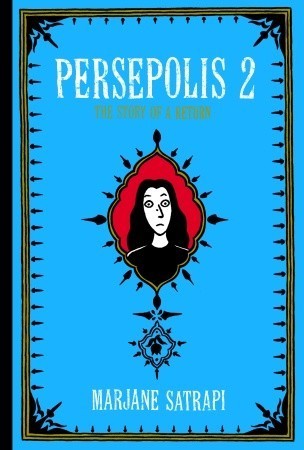
[READ: March 26, 2016] Persepolis 2

I found Persepolis to be an amazing book.  A peek inside a regime that was sort of mythically wicked during my childhood. Marjane’s personal story was interesting of course, but I enjoyed seeing just what was happening in this world that seemed so mysterious when I was growing up.

This sequel is a little less exciting because it is more or less about a lonely teenager in Europe.  I think if the first book wasn’t so groundbreaking, this one wouldn’t feel as disappointing.  Her story is interesting and her experiences are story-worthy, but compared to the first book this one is the awkward teenage years.

We see that Marjane’s being sent to Europe didn’t go quite as planned.  She stayed with her mom’s friend.  But the friend fought with her husband all the time and their house was not a happy one. They felt that they couldn’t look after Marjane so they sent her to boarding school in Vienna–Marjane didn’t speak German. (more…)

Read Full Post »

SOUNDTRACK: BILLY BRAGG-Tiny Desk Concert #281 (June 17, 2013).

I really like Billy Bragg.  Not necessarily all of his music, but I like a lot of it and I certainly love what he stands for.  If you like his instantly recognizable voice (which I do), then just about anything he does sounds good.  But no doubt some songs are catchier than others.

Bragg played a Tiny Desk Concert in 2016 with someone else as part of a duo.  I’d listened to that one first, but I liked this one more.

For this one he is accompanied on the first two songs by dobro player C.J. Hillman.

Bragg talks a lot–he has many lengthy stories between songs–and he’s pretty much always funny or thoughtful.  He introduces the first song by saying that moving into a new building always has troubles–you’ll always need someone to fix things up.  With that, his first song is called “Handyman Blues.”

It’s a great story song.  I especially like this line:

Don’t be expecting me to put up shelves or build a garden shed / but I can write a song about how much I love you instead.

It’s amusing that in the next song workers actually interrupt his song.  They were “met with lot of hammering on our rooftop by some real handymen as they put the finishing touches on NPR’s new home.”

For the second song they

channeled the spirit of legendary American folksinger Woody Guthrie, with whom Bragg collaborated — albeit posthumously, in Guthrie’s case — when he took Guthrie’s unsung words and set them to song with the help of Wilco. Here, he takes a song Guthrie himself co-opted and altered: a gospel tune (“This World Is Not My Home”) he’d turned into an anthem against inaction.

Bragg introduces this song as saying he took it over when the U.S. was having the debate about universal health care.  He says that people still face all the same problems that this classic song talks about–people losing homes to banks or families struggling to make ends meet.  But the middle verse is about a wife who dies on the floor for want of proper health care.  Bragg says that that doesn’t happen in his country anymore and it’s hard for people in his country to imagine that a generous country like the US still hasn’t resolved that issue (and five years later things are even worse with Trumpcare–#ITMFA #RESIST).

Guthrie called the song “I Ain’t Got No Home (In This World Anymore”).  After he sings a verse, the hammering starts and they pause the song to wait for the work to finish before he re-starts the song.  In the meantime they talk about what his band should do in Washington.  Someone says the National Archives and he jokes the Nashville Archive?  He says that they really enjoyed Nashville.  Then he mentions the National Archive to CJ and says

We can find out how the Americans started the war of 1812.  (chuckles).  I just played Annapolis, they’re still sore about it over there.  Never mind who won the war but who started it.

It’s another nice story song.  The dobro works perfectly with it.

“Sexuality” is the only song on this set that I knew.  It’s an old favorite that is serious and funny as well (and very progressive for when it was written).  It sounds terrific and is super catchy.  Although he comments that the acoustics aren’t that great in this new building–there’s not much bounce back off the walls “for those of us who technically aren’t great singers.  But for those of us who are buskers like myself, it’s not bad.”

Introducing the final song, “No One Knows Nothing Anymore” he says he read an article on the BBC about a kid who proved that economics professors were wrong and the article commented that “the trouble with economics is that no one knows nothing anymore.”  He says that had just written a song with that same name, so he’s with the zeitgeist.

He also interjects that there will be pedants–“and there are one or two who listen to NPR, I’m sure” who will write in to say it should be ‘no one knows anything any more.’  But the first thing they teach you at songwriting school is that alliteration trumps grammar.

And then he starts strumming “Sexuality “and says “Oh, I’ve just played that.”

“No One Knows Nothing Anymore” is a nice folkie, very-Billy Bragg song–good melody and really good lyrics.

At the end, as the camera fades to black he says “Chris, pass the hat around.”

I’m so happy that Billy Bragg is still making music.

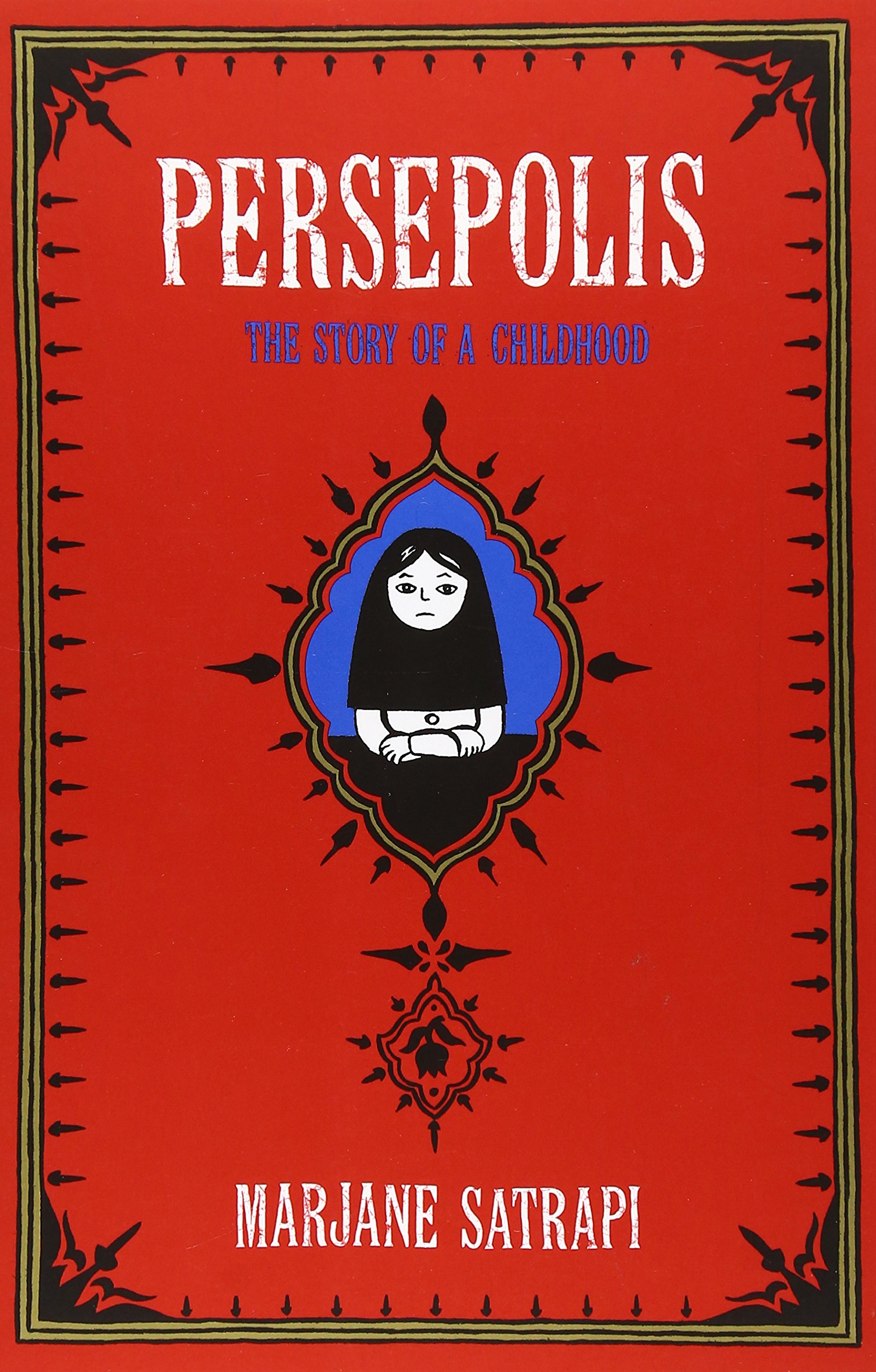
[READ: March 26, 2016] Persepolis

This graphic novel is legendary, and I’m embarrassed it has taken me 13 years to read it.

Persepolis is a memoir of a young girl growing up in Iran during the 70s and 80s.  I appreciated the contextualizing introduction in which she explains the history of the country.

The introduction lays out a basic outline of the history of Iran and the Middle East (that goes all the way back to B.C years).  She explains that Iran has always been a rich nation and has constantly been under attack.  When oil was discovered, the West came calling.  Great Britain wielded a powerful influence over Iranian economy.  During WWII, Iran remained neutral but then was invaded by the west.

The Prime Minister of Iran (not the Shah) nationalized the oil industry in 1951 which led to an embargo and a coup organized by the CIA.  The leader, Reza Shah was succeeded by his son, Mohammad Reza Shah–known simply as the Shah of Iran.  The Shah stayed in power until 1979 when he fled to escape the Islamic Revolution.

She says that since the Islamic revolution Iran has been associated with fundamentalism, fanaticism and terrorism, but she knows that this is far from the truth.  And that’s what inspired her to writ this book.

(more…)

Read Full Post »

SOUNDTRACK: MATT ULERY’S LOOM-Tiny Desk Concert #312 (October 19, 2013).

When a jazz band (or really any band) is named after a person, it’s always fun to try to guess who that person is in the band.  The first song “Coriander”  starts out with some trumpet notes and a kind of intro melody that’s played by both the sax and the trumpet.  And then about a minute and a half in, the keyboards take over, with a great cool 70s jazz/funk sound (the keys sound is my favorite part of this band).  And then of course behind all of this is the constancy of the drummer and the upright bass.  So, which one is Ulery?

I never would have guessed that he’s he bassist.  For his job in this band is basically to hold everything together.  The horns are doing their own thing, the drummer is doing all kinds of cool syncopated jazz beats. And the keys are just soloing like mad.  I don’t know if it’s because the bass isn’t very loud in the mix (it’s really isn’t), but his presence is almost not really there.  At the 4 minute mark of “Coriander,” the whole band drops away and the keys pick up a cool riff and then the horns chime in and eventually the bass comes back in.  I think he’s just not loud enough because watching him, it sure looks like he’s doing a lot more than what I hear.  And yet he’s never flashy.  As I say, he’s the ground, not the star.

When he speaks he’s rather quiet as well.  He says he loves NPR and gives a shout-out to his local Chicago station WBEZ.

Then they launch into the second song “My Favorite Stranger”  in which the keyboardist has now switched to accordion (a pretty pearly white and red affair).  I really like when the bass clarinet takes over the melody for a bit.  The accordion acts like drone with the trumpet taking most of the leads (although I love when the bass clarinet gets to run those same leads as well).

And for some background on Ulery:

The Chicago bassist Matt Ulery writes beautiful music in an unpretentious way. It’s intricate stuff, with interlocking parts and segmented structures. It often borrows from Eastern European scales, orchestral tone colors, folky textures. (On his backpack, he sports a SXSW patch from when he toured with a rock band called In Tall Buildings.) But it doesn’t sound like calculus class, as in some other ambitious works of modern jazz. It never seems to stray too far away from pretty melody over undulating rhythms, and that deceptive simplicity sets it apart.

Last year Ulery put out a grand two-disc set of music you might call “chamber jazz.” By A Little Light had strings, orchestral horns and singers — the whole nine yards. But he has also long done lavish on a smaller scale with a band called Loom. A rejiggered quintet lineup (note: Matt Ulery, bass; Marquis Hill, trumpet; Geof Bradfield, bass clarinet; Rob Clearfield, keyboards/accordion; Jon Dietemyer, drums) produced this year’s Wake An Echo, which the band brought to our office during a brief summer tour.

[READ: December 14, 2014] Tetris

I really enjoyed Box Brown’s take on Andre the Giant.  I really wasn’t sure what a book about Tetris could contain.  I mean, I love the game, but what’s there to say about it?  Well, it turns out, quite a lot–250 pages worth, in fact.

Beyond the game itself, Brown talks a bit about the history of video game development, including a bit of the history of Nintendo. But then he gets into what happened when people started to get addicted to those little falling blocks.  Who knew that Tetris had such a convoluted history?

The book starts off (in Brown’s wonderfully simple drawing style) with a picture of Alexey Pajitnov, the creator of Tetris and his friend Vladimir Pokhilo.  Alexey says he has been thinking about the pentomino puzzle. (more…)

Read Full Post »

manner SOUNDTRACK: BEN GIBBARD-Tiny Desk Concert #251 (November 19, 2012).

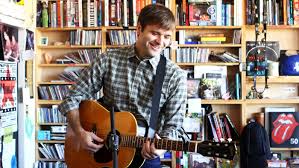
benBen Gibbard is the voice of Death Cab for Cutie.  His voice is instantly recognizable and his melodies are surprisingly catchy.

This Tiny Desk Concert (they say it’s number 250, but I count 251) is just him and his acoustic guitar.  I didn’t know he did solo work, but apparently he does (in addition to being in The Postal Service and All-Time Quarterback).

Gibbard just released a solo album, Former Lives, which he’s said is a repository for material that didn’t work as Death Cab for Cutie songs; from that record, only “Teardrop Windows” pops up in his Tiny Desk Concert. For the rest, he draws from Death Cab’s most recent album (“St. Peter’s Cathedral,” from Codes and Keys) and, of all places, last year’s Arthur soundtrack (“When the Sun Goes Down on Your Street”).

As mentioned he plays three songs and his voice is so warm and familiar I felt like I knew these songs even if I didn’t.

I knew “St. Peter’s Cathedral.” It is a lovely song with very little in the way of chord changes.  But the melody is gentle and pretty.  And the song appears to be entirely about this church.  Which is interesting because the second song is also about a building in Seattle.  “Teardrop Windows” is a surprisingly sad song about an inanimate object.  It’s written from the building’s point of view as he mourns that no one uses him anymore.  And such beautiful lyrics too:

Once built in boast as the tallest on the coast he was once the city’s only toast / In old postcards was positioned as the star, he was looked up to with fond regard / But in 1962 the Needle made its big debut and everybody forgot what it outgrew

The final song “When the Sun Goes Down on Your Street” was indeed for the Russel Brand movie Arthur.  Somehow I can’t picture those two together.  It’s a lovely song, too.

I prefer Gibbard’s more upbeat and fleshed out music, but it’s great to hear him stripped down as well.

[READ: January 2017] “My Writing Education: A Time Line,” “The Bravery of E.L. Doctorow,” “Remembering Updike,” and “Offloading for Mrs. Schwartz” 

I had been planning to have my entire month of February dedicated to children’s books.  I have a whole bunch that I read last year and never had an opportunity to post them.  So I thought why not make February all about children’s books.  But there is just too much bullshit going on in our country right now–so much hatred and ugliness–that I felt like I had to get this post full of good vibes out there before I fall completely into bad feelings myself. It;s important to show that adults can be kind and loving, despite what our leaders demonstrate.  Fortunately most children’s books are all about that too, so the them holds for February.

George Saunders is a wonderful writer, but he is also a very kind human being.  Despite his oftentimes funny, sarcastic humor, he is a great humanitarian and is always very generous with praise where it is warranted.

The other day I mentioned an interview with Saunders at the New York Times.  Amid a lot of talk with and about Saunders, there is this gem:

Junot Díaz described the Saunders’s effect to me this way: “There’s no one who has a better eye for the absurd and dehumanizing parameters of our current culture of capital. But then the other side is how the cool rigor of his fiction is counterbalanced by this enormous compassion. Just how capacious his moral vision is sometimes gets lost, because few people cut as hard or deep as Saunders does.”

These first three pieces are all examples of his love and respect for other writers–both for their skill and for their generosity.

“My Writing Education: A Time Line”

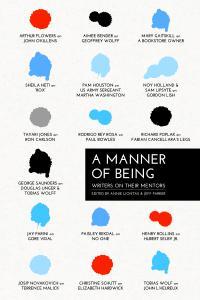
“My Writing Education” comes from a book called A Manner of Being: Writers on Their Mentors.  Saunders’ mentor was Tobias Wolff.  And for this essay, his admiration takes the form of a diary.  (more…)

Read Full Post »

feynman SOUNDTRACK: LARA ST. JOHN-Tiny Desk Concert #530 (May 9, 2016).

laraWhen Lara St. John released her first CD it made ripples because of the way she appeared on it (presumably topless).  But if that was a stunt to get people to listen, it was a good one because the music on it was phenomenal (and the disc sold very well).  St. John is masterful on the violin and has released a dozen or so CDs of herself playing.

I have never seen her play before and it is a marvel watching her fingers  fly (and slide) all over the neck of the violin (including some absurdly high and fast notes).

The first piece is “Czardashian Rhapsody.”  It is an amazing mashup of two songs by Martin Kennedy: Czardas, the most familiar Hungarian melody for violin and Hungarian Rhapsody No. 2, the most familiar Hungarian melody for piano.  He merged them into a real barnstormer.  It’s 6 minutes of switching back and forth between the familiar melodies and very gypsy-esque sections (and some very long held notes).

The song is 6 minutes of musical acrobatics.

Although this is billed as St. John’s show, much recognition must go to her pianist Matt Herskowitz who is also magnificent.

St. John clearly has a sense of humor since she named her new album Shiksa.  She says the album actually has ten different titles because every culture has a word for “big Canadian chicks” like herself.

The second piece is “Sari Siroun Yar” by Serouj Kradjian.  She says it was the first song she heard when she went to Armenia in the lat 1980s.  It is a bittersweet Armenian troubadour song.  While this song is much more mellow than the first, it still showcases some amazing playing on both musicians’ parts.  The opening notes she plays high on the fret board which gives the violin a very different sound–almost breathy.  And the main melody is quite lovely.

The final song is once again a wild one.  “Oltenian Hora” is one that St. John arranged herself.  It plays off a catalog of violin tricks, St. John explains, practiced by traditional Romanian gypsy fiddlers: rapid-fire whistles, bird calls and slithery harmonics, all in a variety of off-kilter rhythms.  I’ve never seen some of the things she does on the violin (those bird calls are amazing).  And by the end she is bowing so hard the bow seems about to break.  It is way intense and really awesome.

I’m not sure I’ve ever seen a violinist get out of breath from playing so hard before, but she deserves all of the applause.

[READ: March 15, 2016] Feynman

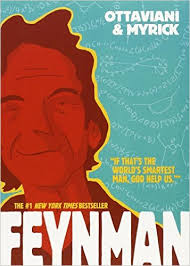
This is a graphic novel biography of Richard Feynman.  Ottaviani worked as a nuclear engineer, programmer and reference librarian, so you can trust him.

I have respected Richard Feynman for years.  I have a few of his books, although I can’t say I have read them intensely.  I knew that he was considered an amazing professor–making really intense subjects easier for the layman to understand.  And many of his lectures are available as audiobooks.

But there was so much about him that I didn’t know.  And this biography (which runs nearly 300 pages and is jam packed with information) covers nearly all of it.  Including excerpts from his own publications and attaching a massive bibliography for more works by and about Feynman. (more…)
Read Full Post »

  karlove5SOUNDTRACK: RAGA ROCKERS-“Slakt” [“Slaughter”] (1988), “Hun er Fri” [“She is Free”] (1988) and “Noen å hate” [“Someone to hate”] (1990).

ragaKarl Ove mentions many bands in his books.  Raga Rockers appeared twice in this one.  I can’t find a ton about them online, because they never really made it beyond Norway, but the Google translated version of their website says:

Raga Rockers is an ingenious rock ‘n roll band that has existed since 1982.

Today the band consists of: Michael Krohn (vocals, lyrics), Hugo Alvar Stein (keyboards / guitar), Eivind Staxrud (guitar), Arne Sæther (keys), Livio Aiello (bass) and Jan Kristiansen (drums).

The band came out of the punk community in the early eighties, but became such a “poppy” large parts of the Norwegian people have founded acquaintance with them.  Songs like “She is free” and “Someone to hate” is almost singalong classics! Their greatest triumph came perhaps in 1999 when they played for thousands of ecstatic Norwegians at the yellow stage at Roskilde Festival. (Reviews of the show by Dagbladet (which Karl Ove wrote for) and Dagsavisen–both are in English.

Despite their punk roots and the rather violent song titles, the songs are almost poppy–heavy guitars but simple chords and a singer who doesn’t sound angry at all.  In fact, if I didn’t read about their punk roots, I’d swear these songs are kinda goofy.

“Slakt” is a simple song, opening with a 4/4 drum and splashes of guitar.  The middle is a bluesy riff with a chorus of “ah ha ha”  The lead singer’s voice is mostly kind of deep–not quite what I expected from the heavy guitars.

“Hun Er Fri” is quite different from the others songs.  It’s only 90 seconds long and features a piano.  The chords are still simple the piano may be playing single notes in fact).  The lyrics are pretty much nonstop and kind of fast.  It seems like a silly pop trifle and I can see why it’s popular among their fans.  The first time I listened to it, I was surprised it ended when it did.  This bootleg live version is certainly fun.

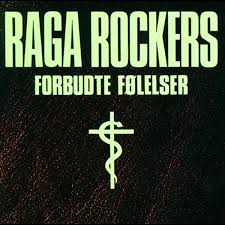
rocknrollThese two songs came from their 1988 album Forbudte følelser [Prohibited feelings]

“Noen å hate” has a bit more of a metal sound, but is essentially the same kind of heavy rock with simple chord progressions.  There’s a good solo at the end.  A black metal band called Vreid has done a cover of this song (which really only sounds different because the Vreid singer is more growly).

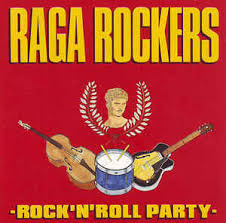
This song comes from their 1990 album Rock n’ Roll Party.

And yes, they are still around.  They took a hiatus in the 2000s but came back with three albums 2007’s Übermensch, 2010’s Shit Happens and 2013’s Faktor X.

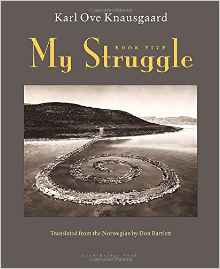
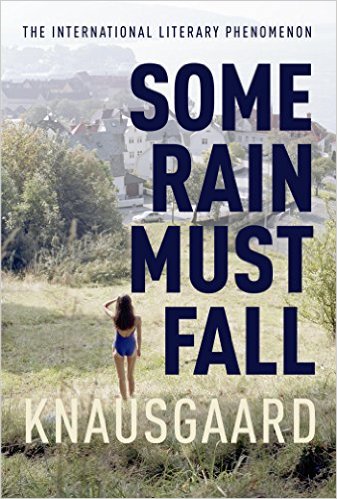
[READ: May 1, 2016] My Struggle Book Five

karlove 5ukI realized as I read this fifth book that I should have been keeping a vague sense of the timeline of these books.  Specifically, because he opens this book with this: “The fourteen years I lived in Bergen from 1988 to 2002 are long gone.”  So if he was born in 1968, this book covers roughly ages 19-33.

So my general outline for the other volumes:
Book Five: 1988-2002 (19-33)
Book Four: 1987 (18)
Book Three: 1968-1981  (1-13)
Book Two: 2008 (40) (with flashbacks to meeting his second wife in 2003 or so)
Book One: 2008 (40) (with flashbacks to his father’s death in 1998 or so)

What era could Book Six possibly be about?

We’ll find out next year in what is said to be the 1,200 page final volume.

So as I mentioned above, Karl Ove talks about the fourteen years he lived in Bergen.  And it made me laugh that he says:

The fourteen years I lived in Bergen, from 1988 to 2002, are long gone, no traces of them are left, other than as incidents a few people might remember, a flash of recollection here, a flash of recollection there, and of course whatever exists in my own memory of that time.  But there is surprisingly little.

And then he proceeds to write 600+ pages about that time. (more…)

Read Full Post »

karlove SOUNDTRACK: ESPERANZA SPALDING-Tiny Desk Concert #110 (February 12, 2011).

esperanzaI didn’t know who Esperanza Spalding was before this show.  But she defied my expectations by being a fairly tiny woman who sings while playing an upright bass (not a very common combination for anyone).

For the first song, “Little Fly,” she plays a kind of jazzy bass, but has a string accompaniment–violins, guitars etc.  But it’s clear that the bass is the star.   And while her playing is very good (she has some great vibrato), it’s her voice that is mesmerizing–she’s hunched over playing the bass and still manages to sound strong and powerful.  “Little Fly”‘s lyrics come from a poem by William Blake.

“Midnight Sun” is a solo performance–just her voice and bass.  I loved the beginning where she sang notes along with what she played.  Then when the lyrics come in she sings in a very jazz voice (with eyes closed the whole time).  Turns out this is a Lionel Hampton song that only appears on the Japanese release of her album which make explain her singing style.

Because on the final song she sounds very different.  “Apple Blossom” is her own composition.  It’s her singing with the string section playing along (there’s no bass).  The song is lovely, but I prefer it when she plays bass in the song, too.

I enjoyed this performance and how delightful Spalding was.

[READ: January 9, 2016] “My Saga: Part Two”

Speaking of not finishing multi part essays, I ended my post about Part One of this essay by saying I couldn’t wait for part two.  And then apparently I forgot all about it because here it is almost a year later before I read part two (which was published two weeks later).

In this second half of Karl Ove’s journey he spends most of his time realizing that he hasn’t really learned very much for his assignment.  I can’t imagine anyone else being able to write endlessly about how he has nothing to write about (and still make it strangely compelling–his stress produces good sentences).

He does make some interesting connections though. (more…)

Read Full Post »

dramaSOUNDTRACK: SHARON JONES AND THE DAP-KINGS-Tiny Desk Concert #497 (December 21, 2015).

sharonTo end out the Tiny Desk Christmas season, I chose this year’s entry.  And for this year’s Christmas show, they went all out.  There’s lights strung around the office, there’s twinkling gold tinsel behind them, presenting a wall of glitter, and a sign that says Dappy Holidays.

I don’t love Sharon Jones and the Dap-Kings (I often feel like I am the only person who doesn’t).  I’m not a big fan of the blues or of soul music, so there is that.  But then I heard her blues version of “Silent Night” and it is a travesty.  “Silent Night” is a beautiful tender song.  If done right, it can make you cry.  But this is just dreadful. You don’t make “calm” a ten syllable word.  You don’t sing “talkin ’bout a Silent Night.”  You don’t make this song fun.  You don’t show off you crooning skills with this song.  You just sing it.  Perfectly.

When she’s not tinkering with classics, though, Jones has some good fun with two originals.  The first is the fun “8 Days of Hanukkah” She sings about all the things they’ll do on each day–spin the dreidel, roll out the latkes, and the best: “we’re cooking up the brisket the kosher butcher sold my uncle Saul,”  It’s a lot of fun (when the horns launch into the dreidel song amid their jamming it’s a good time).  This is the kind of soul that I like–lots of swinging horns and good times.

And Sharon herself seems like a fun person–she asks for help remembering the lyrics to the final song and plays it off in a fun way.

“Big Bulbs” is another original.  It’s also funny with the lyrics, “Baby you got them big bulbs flashing in your windows tonight.”  IT seems like it’s a double entendre but I don’t really think it is, it’s just fun.

Despite my aversion to the first song, she totally won me over with the second two songs, and I’d happily add those to any holiday mix.

[READ: December 10, 2015] Drama

I really enjoyed Telgemeier’s Smile and Sisters.  But I enjoyed Drama even more.

This story is an ode to everyone who works behind the scenes at the drama club.  But it’s also a chance for the stars to shine and the shy kids to come out too.  All done in Telgemeier’s delightfully simple yet effective drawing and storytelling style.

Callie is in love with the drama club.  She works late on sets, she loves seeing things come to completion.  She also knows she has no talent to be on stage.

And things are good.  Until the drama arises.  Greg and Matt are her friends.  Greg is a little older and Callie has a crush on him.  When Greg tells her that his girlfriend Bonnie broke up with him, she is pretty excited.  And they share a kiss.  But from that moment on, not only does Greg avoid her, but Matt is a jerk to her, too.  Not bad for the first few pages. (more…)

Read Full Post »

borgesSOUNDTRACK: SEU JORGE-Tiny Desk Concert #79 (September 13, 2010).

seuSeu Jorge was the melancholy singer in Wes Anderson’s movie The Life Aquatic With Steve Zissou. He sang the David Bowie songs and was amazingly soulful and brought a completely unexpected quality to the Bowie songs.

He plays these five songs with his band Almaz.  For reasons unclear to me only one of the songs is on the video, but the other four are available in audio format.

He sings three songs in Portuguese, and his voice is husky and passionate, so even if you don’t know what he’s singing about, you can feel the emotion.

The first song in English “Everybody Loves the Sunshine” has a cool trippy 70s vibe, with some cool keyboards.  Although I don’t love his version of “Rock with You” which I imagine was super fun to sing, but it’s so different from the Michael Jackson version that it’s hard to reconcile the tow.

  • Cirandar” (Audio Only)
  • “Saudosa Bahia” (Audio Only)
  • “Everybody Loves The Sunshine” (Audio Only)
  • “Pai Joao”
  • “Rock With You” (Audio Only)

[READ: October 19, 2015] The Last Interview and Other Conversations

I have never really read any Borges (a piece here and there sure, but I have his Collected Fictions waiting for me and just haven’t gotten to it. However, when I saw this book at work I decided to give it a read. I have very much enjoyed the other books in The Last Interview series (there are ten and I have read four) so I thought I’d like this too, and I did.

Borges is a fascinating individual. He was legally blind from a youngish age and was completely blind by the time of the last interview. He was humble (but not exactly humble—he genuinely didn’t think he was that great of an author). He was a pacifist (remaining neutral even in WWII) and basically spent his whole life immersed in books.

This book contains three interviews

“Original Mythology” by Richard Burgin (from Conversations with Jorge Luis Borges, 1968)

“Borges and I” by Daniel Bourne, Stephen Cape, Charles Silver (Artful Dodger 1980)

“The Last Interview” by Gloria Lopez Lecube (La Isla FM Radio, Argentina, 1985) [translated by Kit Maude] (more…)

Read Full Post »

pablo SOUNDTRACK: BUILT TO SPILL-Live (2000).

btsliveSoon after releasing “Carry the Zero,” Built to Spill released this, their first (and so far only) live disc.

This disc shows a jamming side of the band that their records up to now hadn’t really displayed (sure there was some evidence of the jam band within, but who would have guessed 2 songs on this disc would stretch to 20 minutes?).

The live set also shows a rather contrarian spirit in that there are only 9 songs in 70 some minutes and only 5 of the songs are actual Built to Spill songs.

The disc opens with “The Plan,” a great version of their most recent disc’s opener.  Then they jump right into Perfect from Now On’s  opening track “Randy Described Eternity.”  That song has a lot of parts and sections, and they do them perfectly.  They follow it with another song from Perfect, “Stop the Show” which also has multiple parts and again, they nail it.  These three songs were recorded in New York.  Brett Netson joined them for “Randy,” and “Stop” which really helps to flesh out those songs.

The next song is a cover of The Halo Benders’ “Virginia Reel Around the Fountain.”  And if it sounds very fitting for Doug, he was in The Halo Benders with Calvin Johnson before he started Built to Spill.  Then comes the centerpiece of the record–a 20 minute version of Neil Young’s “Cortez the Killer.”  And it is amazing.  He sounds enough like Neil to be totally respectful, without just being a rip off.  It’s probably the best version of this song I’ve heard (until I saw Neil do it this summer).

They switch gears to their first single, “Car,” a delightful 3 minute song.   And then, to fill out this almost all covers section, they play “Singing Sores Make Perfect Swords” a song originally done by Love as Laughter.  I don’t know the original, but it fits in with Doug’s style.  These four songs were record in Seattle.

There’s one song that was recorded in Denver, “I Would Hurt a Fly,” which is yet another song from Perfect, and is one of my favorite songs of theirs.  It does not disappoint.

The final song on the disc is a nineteen minute version of the song “Broken Chairs” (which is 8 minutes long on Secret).  They do the whistling section and a ton of solos.  Indeed, the way they stretch out the song out with guitar solos and noise (and the way the song ends with feedback) is really cool.  Netson joined them for “Fly” and “Broken Chairs” (which is why that ending solo is so intense.

It’ s a great live collection of songs and the sound is outstanding.  You’d never know it was recorded in different venues, either.

[READ: October 4, 2015] Pablo

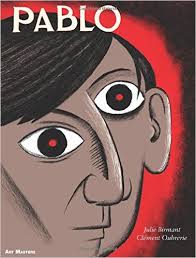
Judging this book by its cover you would be correct in assuming that it is about Pablo Picasso.  But rather than being a simple history of the Art Master (the title of the series), this is a thorough recounting of Picasso’s life.  And what’s even more interesting is that the story is told from the point of view of Picasso’s lover and model Fernande Olivier.

And Fernande’s diary entries make up the bulk of the story and allow for a very personal look into the man and the stylistic choices that Picasso made over the years.  As the book says on the back, the authors show “how Picasso’s style developed in response to his friendships and rivalries.”  And of his rivals none was greater than Henri Matisse.  (The book also covers Picasso’s life before she met him too, of course).

The original work was published (in French) in four volumes.   This edition was translated by Edward Gauvin.

I especially like the way the book begins from the point of view of Fernande as an old woman, still alive and reminiscing about her life. (And yes, it’s amazing to realize that Picasso died in 1973…in my lifetime!).  (more…)

Read Full Post »

« Newer Posts - Older Posts »