Feeds:
Posts
Comments

Archive for the ‘Yuck!’ Category

 SOUNDTRACK: RED BARAAT-Chaal Baby (2010).

Red Baraat is one of the few bands to play two Tiny Desk Concerts. I’ve also had the fun experience of seeing them live.

The band was founded by dhol player Sunny Jain as a way to bring Bangrha music to Brooklyn.  The band speaks to many disciplines and plays a wonderful mash up of styles.  So while the foundation is bangrha music, there’s elements of funk, go-go, Afro-Cuban, Brazilian, and jazz–all designed as one big party.

This debut album features the dhol, soprano and tenor sax, trumpets, trombones, sousaphone and drums and percussion.

To my ear the sousaphone is the grounding instrument–often standing out as the bass while the rest of the brass is playing melody or soloing.  And yes, sometimes the sousaphone gets a solo or two as well.

I love the vocal interjections–whether nonsense or actual words I can’t tell, but they are often fast and fun–good punctuation to the melody.  And the band knows melody.  The main riff of “Tunak Tunak Tun” is a blast.  And the vocal phrases are there to humanize the party.  I didn’t realize that this was a cover of Bhangra pop singer Daler Mehndi’s song of the same name, but that explains the catchiness.

In fact there are several covers on the album.  “Hey Jamalo” (a reworking of Malkit Singh’s popular “Hey Jamalo Tootak Tootak Tootiyan”) opens with a rousing introduction with a solo from dhol.  I rather wish there was more obvious dhol playing (which is so much fun to watch live) but it blends in pretty perfectly with the rest of the music and fits perfectly with the percussion solo in the middle of this song.

They play three Bollywood soundtrack hits “Dum Maro Dum,” “Samaro Mantra,” and “Mehndi Laga Ke Rakhna.” “Dum Maro Dum” has some cool percussion sounds an a real jazz feel–I love the way they stretch out the notes in the middle.

The word Baraat (Hindi: बरात) (Urdu: برات‬‎) means a groom’s wedding procession in North India, West India and Pakistan.  Unsurprisingly, they play two covers of traditional Indian wedding songs “Punjabi Wedding Song (Balle Balle),” which has some fun stop and start melodies and a real marching band kind of vibe and “Aaj Mere Yaar Ki Shaadi Hai” which opens with some dramatic percussion before settling into some very pretty processional music.

But it’s not all raucous party music.  “Arcana” slows things down with a cool riff or two and nice accompaniment.

However, other songs like “Drum and Brass,” escape easy categorization with a clarinet reminiscent of Eastern Europe combined with percussion and melodies from Western Asia.

The title song “Chaal Baby” has some great chanting and dramatic horns moments which I saw described as “the Dirty Dozen Brass Band gone Bollywood” or belonging at a Punjabi football halftime show.

Speaking of marching band, there are a few moments on this album that felt kind of like a marching band to me.  “Mehndi Laga Ke Rakhna” was an example of a marching band vibe.  That kind of sound is hard to avoid (if indeed they are trying to) with that kind of instrumentation, although perhaps that is the inevitable comparison to processional music. My experience is that it works better live than on record.

But songs like the original “Baraat to Nowhere,” showcase a great original melody and some fun soloing.  Nearly every song features a solo by one or more members of the band allowing everyone to show his chops.  And back to that sousaphone–I’ve never heard anyone make sounds like that from an instrument before.  Great stuff.

“Samaro Mantra” the Bollywood song, ends the album on almost a down note.  The melody is somber, the drums are martial.  It’s kind of an odd choice for an otherwise upbeat and celebratory album.  But maybe it works as a calm down after an exiting wedding–time to go home everybody, party’s over.

Sunny Jain – dhol / drumset / percussion ; Rohin Khemani – tavil / doumbek ; Tomas Fujiwara – drumset ; Arun Luthra – soprano sax ; Mike Bomwell – tenor sax ; Sonny Singh – trumpet ; MiWi La Lupa – bass trumpet ; Smoota – trombone ; John Altieri – sousaphone

[READ: January 14, 2018] “Pieces”

I rather enjoyed Hye-Young Pyun’s previous story and was intrigued to read another one.  This one was translated by Sora Kim-Russell.

The previous one was thoughtful and disturbing and so is this one.

In this story, which is surprisingly unspecific about the characters, a man’s wife went missing a month earlier.  She slipped off off of a gorge and was presumed drowned.

He has just gotten a call from the police that a body part has been found and they would like him to identify it.  The part that was found was a right leg. (more…)

Read Full Post »

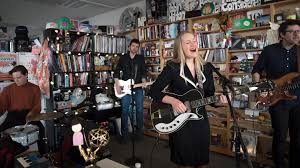
SOUNDTRACK: ANNA MEREDITH-Tiny Desk Concert #713 (March 2, 2018).

I have never heard anything like this.  From sound to melody, to intensity, to instrumentation, this whole thing just rocked my world.

The melody for “Nautilus” is just so unexpected.  It opens with an echoed horn sound repeating.  And then the melody progresses up a scale, but not a scale, a kind of modified scale that seems off kilter just as it seems familiar.  The cello plays it, the guitar plays it, the sousaphone (!) plays it.  And it continues on in like fashion until only the high notes remain and then a menacing low riff on sousaphone cello and guitar breaks through–a great villain soundtrack if ever there was.  While everyone plays this riff, Anna returns to the keys to play the modified scale.

Meanwhile, the drummer has looked like he’s asleep behind his small kit.  And then 3 anda half minutes in he wakes up and starts playing a loud but slow rhythm.  The guitar begins soloing and as it fades out that main riff begins, now with a simple drum beat–not matching what anyone else is playing, mind you.  The sousaphone (which must have an echo on it or something and the cello pick up the low menace and it seems like everybody is doing his and her own thing.  But it all works amazingly.

So just who is Anna Meredith?

Anna Meredith was a former BBC Scottish Symphony Orchestra Composer in Residence. Two of the three songs performed here come from her 2016 release called Varmints.

Bob Boilen was also impressed when he first saw Anna Meredith live:

I first saw this British composer a year ago, in a stunning performance at the SXSW musical festival. It was one of the best concerts of my life. The music I heard sent me into a state of reverie. If music could levitate my body, this is how it would sound. It carried me away and thrilled my soul. I was giddy for days.

Now, I know this isn’t music for everyone. … But if you know and love the music of Philip Glass, King Crimson or Steve Reich — music that’s electrifying, challenging and sonically soars and ripples through your body — then crank this up.

Lest you worry that she couldn’t translate it to the Tiny Desk (she says they normally have 23 suitcases full of crap so this has been an exciting challenge to squeeze in here)

Out of nearly 700 performances at the Tiny Desk, this is simply the most exhilarating one I’ve experienced. The instrumentation is unusual, with pulsing bass sounds produced by a wonderful combination of cello, tuba and electronics. It’s all rhythmically propelled by an astonishing drummer and Meredith pounding a pair of floor toms. And much of the repetitive melody is keyboard-and-guitar-driven that morphs and erupt with earth-shaking fervor.

The second song, “Ribbons” is quieter.  It’s and new song and it has vocals.  Her vocals aren’t great (“hard when you’ve got the voice of a five-year old boy”) but the melody she builds around it shows that her  voice is just one more instrument (albeit saying interesting words).  Actually, that’s not fair, they are just so different from the noise of the other two songs that it feels very faint in comparison.

It opens with a quiet guitar and electronic drum.  And slowly everyone else joins in.  A nice string accompaniment from the cello (Maddie Cutter), bass notes on the sousaphone (Tom Kelly) and even backing vocals from everyone.  By the third go around the drummer (Sam Wilson) is playing the glockenspiel.  By that time the song has built into a beautiful round and the quietness of her voice makes complete sense.  As the song nears its end, Sam has switches to a very fast but quiet rhythm on the floor tom.

She introduces the band and wishes a happy birthday to guitarist Jack Ross.  She says this is a great present as “so far all we’ve gotten him is an apple corer, the gifts have been a bit low grade.”

They make some gear switches, “we have a bit of a logistics problem with all our gear we can’t quite afford to bring enough glockenspiels, we pass the pure crap glockenspiel  around ans everyone gets to go ‘my turn!'”

“The Vapours” opens with a wonderfully wild guitar riff–fast and high-pitched and repeated over and over.  Anna Meredith adds waves of synths and then in comes the sousaphone and plucked cello.  Then fast thumping on the floor tom propels the song along.  The song slows a bit a Anna plays the clarinet (!).  The song dramatically shifts to some complicated time signature while Anna plays glockenspiel.  After a few rounds, while this complex guitar riff continues the drum and sousaphone start playing a pretty standard beat the contradicts everything else that’s going on and then Anna just starts pounding the crap out of some more toms.

All through this there are electronic sounds adding to the chaos and I have no idea who is triggering them, but it’s really cool.

The end is almost circusy with the big sousaphone notes and yet it’s like no circus anyone has every heard.  When the camera pulls back and you can see everyone working so hard and yet smiling ear to ear (especially Maddie), you know this is some great stuff.

The end of the song winds up with a hugely complicated tapping melody on the guitar and everyone else working up a huge sweat.

I couldn’t get over how much I loved this.  I immediately ordered Varmints and checked her touring schedule.

How disappointed was I to see that Anna Meredith had played Philly just last month and has now gone back to Europe!  I do hope she comes back soon.

[READ: August 30, 2017] McSweeney’s 48

For some reason, I find the prospect of reading McSweeney’s daunting.  I think it’s because I like to post about every story in them, so I know I’m in for a lot of work when I undertake it.

And yet I pretty much always enjoy every piece in each issue.  Well, that explains why it took me some three years to read this issue (although I did read Boots Riley’s screenplay in under a year).

This issue promised: “dazzling new work; a screenplay from Boots Riley with a septet of stories from Croatia.”

LETTERS

GARY RUDOREN writes about using the Giellete Fusion Platinum Razor every day for 18 days and how things were good but have gotten a little ugly.  On day 24 he had a four-inch gash under his nose.  Later on Day 38 it was even worse–a face full of bloody tissue squares.  By day 67 he is writing to thank McSweeney’s for whatever they did perhaps it was the medical marijuana but now his face is baby butt smooth even without shaving.  He wants to change the slogan to Gilette Fusion the shave that lasts forever. (more…)

Read Full Post »

SOUNDTRACK: ROY AYERS-Tiny Desk Concert #712 (March 1, 2018).

I hadn’t heard of Roy Ayers, although I imagine I’ve heard his work somewhere before.  I love the vibes so I was looking forward to his set.

I was a little bummed to hear him singing–I assumed it would be all instrumental. Especially since his songs aren’t exactly lyrically masterful.  But the jazzy funky solos were pretty great.

Roy Ayers [is a] 77-year-old jazz-funk icon.  He sauntered through the office with a Cheshire grin on his face, sharing jokes with anyone within earshot. Accompanying him was a trio of brilliantly seasoned musicians — keyboardist Mark Adams, bassist Trevor Allen and drummer Christopher De Carmine. Later during the performance, pride washed across Ayers’ face as his bandmates took the spotlight. (Be sure to watch as Adams woos not just the room but brightens Ayers’ face during his solo.)

The set began with one of Ayers’ more recognizable hits: an extended version of “Searching,” a song that embodies the eternal quest for peace and love.  The vibes solo at 2 and a half minutes is worth the wait, though.

The lyrics are essentially.  I’m searching, searching, searching searching. It takes over a minute for him to even get to the vibes!  It’s followed by a groovy keyboard solo that starts mellow be really takes off by the end.

During “Black Family” (from his 1983 album Lots Of Love), you’ll hear him call out “Fela” throughout. That’s because Afrobeat legend Fela Kuti was a huge influence on Ayers in the late 1970s; the two eventually collaborated on an album, 1980’s Music Of Many Colors. “Black Family” is, in part, a tribute to Fela, even if the original version didn’t include his name.

Again the lyrics: “lo-lo-lo-lo-long time ago” and not much else repeated over and over and over. But it’s all lead up to a great vibes solo (as the band gets more and more intense).  I love that the keyboardist has a keytar as well and is playing both keys at the same time–soloing on the keytar with an awesome funky sound.  There’s even a cool bass solo.

Concluding this mini-concert, Ayers closed the set out with his signature tune, “Everybody Loves the Sunshine”, a feel-good ode if there ever was one. The essence of this song flowed right through him and out to the NPR audience.

Another terrific vibes solo is followed by a keytar solo which is full of samples of people singing notes (they sound like Steely Dan samples)–it’s weird and kind of cool.

[READ: August 2017] McSweeney’s No 46

As the subtitle reflects this issue is all about Latin American crime.  It features thirteen stories selected by Daniel Galera.  And in his introduction he explains what he was looking for:

DANIEL GALERA-Introduction
He says it used to be easy to talk about Latin American fiction–magical realism, slums and urban violence.  But now things have expanded.  So he asked 13 writers to put their own Latin American spin on the crime story.

And of course, each McSweeney’s starts with

Letters

DANIEL ALARCÓN writes passionately about Diego Maradona’s famous “Goal of the Century” and how as a child he watched it dozens of times and then saw it thousands of times in his head.  When he learned of Maradona’s questionable “Hand of God” goal, his father said that his previous goal was so good it counted twice.  But Daniel grows sad realizing that the goal of the century also marked the beginning of Maradona’s decline.

LAIA JUFRESA this was a fascinating tale about a game called Let’s Kill Carlo that her family played.   It involves a convoluted history including her mother “inventing” a child in order for her husband to come to Mexico from Italy and avoid conscription there.  But when this child “Carlo” “came of age” they had to think of reason why he wasn’t there anymore–so they invented the Let’s Kill Carlo game.

YURI HERRERA waiting for a bus in New Orleans as a man lay in the gutter also waiting.

VALERIA LUISELLI her friend recently moved to Minneapolis with her nervous wreck Chihuahua named President.   He was diagnoses with terminal cancer and the vet encouraged all manner of alternative therapies.  This friend was a very sweet person and had many virtues. And yet perhaps through her virtue the alternative therapy seems to have worked.

FRANCISCO GOLDMAN wants to know why immigration officers at Newark Airport are such dicks (and this was before Trump–#ITMFA).  He speaks of personal examples of Mexican citizens being treated badly.  He had asked a friend to brings books for him and she was harassed terribly asked why did she need so many bags for such a short stay.  Another time he was flying back to NYC with a Mexican girlfriend.   She went through customs and he didn’t hear anything for hours.  He didn’t know if she would even make it though customs at all–even though she’d done nothing wrong.   He imagines wondering how these officers live and what their lives must be like that they seem to take pleasure in messing with other people’s lives. (more…)

Read Full Post »

SOUNDTRACK: SHAKEY GRAVES-Tiny Desk Concert #495 (December 14, 2015).

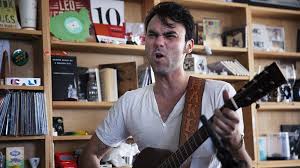
I thought I had posted about every Tiny Desk Concert, but on double checking I found that I had missed this one.  I had heard of Shakey Graves and I assumed he was a country/folkie singer.  Which he is, although really his style is to mix country, blues and rock ‘n’ roll.  I also had no idea his real name is Alejandro Rose-Garcia.

This set sees Graves on acoustic guitar (with a strap with his name on it) accompanied by another acoustic guitar (which seems rather small) and a mandolin.

“To Cure What Ails” is a pretty, slow folk song. It’s simple enough with nice high mandolin notes and a good guitar line between verses.  Shakey has a nice voice and the song feels compelling like a story, although I don’t think it is.  He’s also charming and funny in little ways–he makes a lot of funny faces and chuckles.  But his music is really solid and the harmony at he end of the song is really great.

For “The Perfect Parts” the mandolin switches to bass and they have a little discussion n how to play it.  Shakey tells the drummer how to play the beat and then says they’re going to make it us as they go along.  This song is darker and has a cool sinister vibe.  He sings in kind of deep mumble for this song which works well for this song.  The song gets a little intense for a few lines.  And by the end it builds pretty loud with some good whoa ho ho backing vocals.  So much so that for the last chord, “he attempted a stage dive at the Tiny Desk.”

For the last song, “Only Son,” he:

breaks out his guitar and suitcase kick drum/hi-hat, [and] a palpable rush of swooning adrenaline hits the room. I felt that at the Americana Festival in Nashville, at the Newport Folk Festival and here at the Tiny Desk.

He says it is soon to be the last of the suitcase kick drums (this is his third).  He dreamed about having an object that he could cart around with him and still make a lot of noise.  The drum is actually behind him and he stomps the pedals with his heels (I can;t believe the camera never zoomed in on it).

He says the song is about “the moment in your life when you realize you’re not alone… there’s an aha! moment where you’re like ‘not just me?’  The drummer plays bass, the mandolin player has the mandolin back and Shakey has the kick drum suitcase.  There’s some terrific harmonies (and chuckling ) throughout the song, and I love the way it stops and starts.

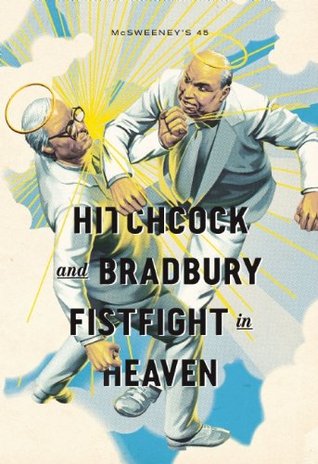
[READ: Late 2016 and early 2017] McSweeney’s #45

The premise of this collection was just too juicy to pass up.  Although it did take me a while to read it.  Eggers’ introduction talks about the contents of this issue.

DAVE EGGERS-Introduction
Eggers says he came across a collection of stories edited by Hitchcock. He really liked it and then learned that Hitchcock had edited 60 volumes over the course of 35 years.  He was excited to read literary genre fiction.  But he was more impressed that theses stories did what literary fiction often forgets: having something happen.  He then bought a cheap book edited by Bradbury (Timeless Stories for Today and Tomorrow) and he liked it too.  He was surprised that there were so many canonical writers (Steinbeck, Kafka, Cheever) in a Bradbury collection.

So, why not make a new collection in which we can compare the two genres.

Despite this looking like a pulpy paperback, there were still Letters.

LETTERS

CORY DOCTOROW
Doctorow says that Science fiction is not, indeed, predictive.  That any genre which deals with so many potential future events is bound to get some things right.

JAMIE QUATRO
Quatro says she was asked to write a letter for this genre issue, but Quatro doesn’t do genre, so she was about to pass.  Then her son, from the backseat, asks what bulwark means.  Then inimical.  Then miasma.  He is reading a book called Deathwatch about soldiers whose brains are removed so they no longer fear. Suddenly, when she compares this idea to her essay on Barthelme, she sees that maybe McSweeney’s was on to something after all.

BENAJMIN PERCY
In fifth grade Percy (who has a story below) gave his teacher a jar full of ectoplasm.  He has always been different.  He proposes the Exploding Helicopter clause: if a story does not contain an exploding helicopter (or giant sharks, or robots with lasers for eyes or demons, sexy vampires. et al), they won’t publish it.

ANTHONY MARRA
Marra discusses Michael Crichton and how something doesn’t have to be Good to be good.  He says Crichton was a starting point for him as an adult reader.  And what can be wrong with that? (more…)

Read Full Post »

815SOUNDTRACK: BORIS-DEAR (2017).

The plan was that after 25 years, Boris would retire.  They recorded songs for Dear, but then toured the anniversary of the album Pink.  This inspired them to write more songs, and somehow through all of that, Dear was created (with apparently enough music for two more albums).

Then they toured Dear (a tour I was lucky enough to see) and are still going.  Who knows if they are done.  Who knows if this is their final album.  Either way, this is a doozy.

10 songs and 70 minutes (on the U.S. release), Dear specialized in slow droney heavy songs.  The album opens with seven smacks of a drum before loud heavy chords signal the beginning of “D.O.W.N -Domination of Waiting Noise.”  The vocals are loud but just loud enough to add to the overall drone sound.  Things slow down further with “Deadsong” a deep bass drone with whispered, rather spooky/demonic vocals.

Despite the drones there are moments of catchiness (relative).  “Absoluego” is a faster, downtuned song with a big shouted chorus and “Beyond” is a quiet, moody song featuring Wata on vocals.  About 90 seconds into the song there is blast of metal guitars and drums that lasts for 30 seconds or so before fading out.  When it happens again, one of the guys starts singing too, a faster heavier, catchier melody.

“Kagero” opens with a low rumble.  Eventually a slow, heavy guitar comes in with near falsetto singing.  “Biotope” has a steady pulsing bass drum through the track.  The guitars are slower with an occasional plucked string that resonates. This song even has some ooohs in it.

“The Power” has my favorite Boris riff since “Tu la la.”  It’s got six notes all of which are strangely menacing and yet catchy at the same time. This was a great song to see live.  “Momentio Mori” is slow and menacing with cool echoed/chorused vocals–there’s an Alice in Chains vibe to the vocals.  With about a minute left, the song slows down and grows quiet almost as a lead in to the 12 minute “Dystopia -Vanishing Point.”  This song opens with two minutes of warbly accordion (I loved watching Wata play this part live) and some thundering drums.  It all fades away into some quiet ringing guitars and whispered vocals.  This continues for a few minutes as waves of guitars are added.  And then at 7 minutes the loud guitars and drums blast forth and Wata gets to do a screaming solo for the final 4 minutes.  She is still soloing as the song abruptly ends and switches to the final track.

“Dear” opens with those low downtuned guitars echoing.  I love that the guitars simply slide up to a very high note and hold it until sliding back down.  There’s a muffled chug on the low chords while the heavily echoed vocals ring out.  The song continues like this, a mountain of low rumble, for 9 minutes until it starts to consume itself–feedbacking and disintegrating until it sounds like all of the plugs are pulled.

There’s not a lot of diversity on this disc, which resembles some of their earlier music.  I’m very curious to see what they do next.

[READ: February 9, 2016] “The Republic of Bad Taste”

This story (it feels complete and not like an excerpt, although the title seems unlikely as a short story title) was 20 pages long in this issue of the New Yorker.  That’s one of the longest pieces I’ve seen in the magazine.

And it covers a lot of ground.

Like how does an at-risk-youth counselor agree to commit murder?

It begins by introducing us to Andreas Wolf in East Germany circa 1987.  He is a disaffected youth, an atheist with a super libido and he has found employment at the church on Siegfeldstrasse.  Andreas felt the whole regime was ridiculous.  In fact he felt that a lot of things were ridiculous.  The Republic was just so German that it couldn’t even go after misfits unless it was by the book.

His “job” at the church was as a youth counselor.  He was surprisingly good at it. In part because he really didn’t care and in part because he himself was almost at risk.  He wasn’t really at risk because his father had a good position with the government, but they had more or less disowned him (aside from agreeing to make sure he never got into real trouble).  Plus, he was pretty good-looking so many of the at risk girls found him attractive–with all that implies.

He took advantage of this.  He found that his monetary reward was so pitiful that a reward in beautiful girls made up for it.  At the same time, he did have some scruples.  He never had sex with anyone underage or anyone who had been sexually abused.  What a guy. (more…)

Read Full Post »

 SOUNDTRACK: THE CROSSRHODES-Tiny Desk Concert #704 (February 9, 2018).

Who knew there was explicitly Christian rap?  I mean, obviously there must be. But I never expected to hear it, especially not Christian songs that used the n-word and the f-word.

I’d never heard of The Crossrhodes, so here’s what the blurb says

Witnessing The Crossrhodes perform at the Tiny Desk instantly snapped me back to their early beginnings, just a few miles away from NPR headquarters. In 2001… the Crossrhodes stepped on stage. Week after week, the band passionately performed original material that jumped between society’s woes and their own love lives. Word eventually spread outside of the D.C. area and one-half of the group, Raheem DeVaughn, landed a record deal.

DeVaughn went on to achieve R&B superstardom, earning two Grammy nominations, while the other half of the group, Wes Felton, has remained a pillar of D.C. culture, excelling as both a musician and actor. They reunited and released their first album in over a decade last year. Footprints on the Moon recapitulates and magnifies the ideals they conveyed in the early 2000s with a hyper-focused sense of urgency.

Poet, Raquel Ra Brown opened the show with a poem.  After her introduction, and they were the band is dressed, I expected to hear more of a gospel sound, not for him to start out by going “yo, unh.”

“Footprints on the Moon” seems to be inspirational, but what’s with this lyric:

They lyin’ bout them there two white feet
That landed on the moon a year after they killed King

And again, the songs are fairly pious and you get this couplet:

The only topic of discussion is who they touchin’
Or who they buyin’ or who they fu**in’

Sure there’s politic on the song, but where is this music going?

“How You Gon’ Fall” has a pretty great chorus but the verses are again, pretty rough

cops shot 30 rounds in 15 seconds
4 month old baby in the rear section
another mother gotta call the reverend
a dead daughter, sister, veteran
now the media posing all the questions
slandering the victim pointing out aggression
somehow the angel of god kept the baby protected
coz grandma prayed beyond the pictures and necklace

The tautology of “Praying Prayers” is surprisingly catchy .  It’s probably my favorite song of the bunch

“America” has some well thought out complaints about the country, and it ends with the last few bars of the National Anthem.  I like that they took a knee during that part.

As the show ends, he gets everyone to chant, “I got the power, you got the power, we got the power; that’s power to the people.”

Overall, there was some good stuff in this set. Not my thing but I can certainly appreciate most of it.

[READ: September 21, 2017] “Fistfight, Sacramento, August 1950”

So the crux of this story is that a fist fight between two men brings a man and a woman together.

How delightful.

The story is written in a thoughtful manner, but it is still just about two dumb drunks fighting.

Inexplicably, James Sutter, in a bar, leans over and says–as if to no one–I hate Okies. Frannie Begara challenges him to a fight outside.

So they go out in the dark (the streetlight frames their ring).  Each man has his fan base ringing behind him. (more…)

Read Full Post »

SOUNDTRACK: VICENTE GARCÍA-Tiny Desk Concert #701 (February 2, 2018).

Singer-songwriter Vicente García plays a delicate acoustic guitar and has a pretty crooning voice.

The blurb says that he

is still relatively under the radar, but performances like the one he gave at the Tiny Desk are starting to turn some heads.

García’s music isn’t dominated by his native Dominican Republic, but you can hear it in every note. His poetic lyrics are like short stories, sung by a voice both plaintive and evocative, yet always distinct.

“San Rafael” is quite a pretty song echoing the beauty of San Rafael.

Before “A La Mar” (the title of second album which means ‘to the sea’) he introduces [unclear] Vasquez from Dominican Republic on percussion and Ricardo Muñoz from Bogota on the keys.  There’s a neat moment where he plays a harmonic on the guitar in a rather unusual way.  The delicate percussion really adds a lot, as does the bass line plays on the keys.

“Dulcito e Coco” opens with a lovely guitar melody and a close up of the fascinating percussion box that Vazquez is playing–a purple, strangely-shaped box that seems to get different sounds where you strike it.  The song stays quiet throughout although it does get a bit bigger by the end.


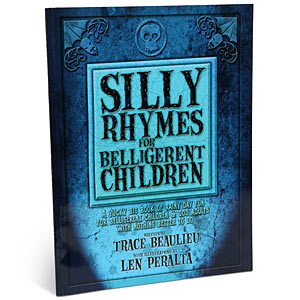
[READ: November 13, 2017] Silly Rhymes for Belligerent Children

I was so excited to see Trace Beaulieu in person.  Ans even though this book is available everywhere, it was especially neat to buy it from the man himself and get him to autograph it.

It is subtitled A Yucky Big Book of Rainy Day Fun for Belligerent Children & Odd Adults with Nothing Better to Do.  The illustrations are by Len Peralta who apparently has not done anything else I’ve read even though his work looks so familiar and is really good.

So what is this?

Well the title is pretty accurate.  Trace has concocted snarky funny poems.  Most of them are pretty short (and in this format are often two or three lines per page) and accompanied by an illustration). (more…)

Read Full Post »

SOUNDTRACK: GEORGE CLINTON & THE P-FUNK ALL STARS-Tiny Desk Concert #697 (January 24, 2018).

George Clinton is famous for being from outer space and for bringing the funk.  That was a pretty long time ago.  He’s now 77, but he still has the energy and the passion, although it is weird to see him looking so…normal.

He’s just got on a cool coat–no colored dreadlocks, no dresses or sequins.  But he still holds a room’s attention.

P-Funk’s lineage runs 50-plus years. From The Parliaments to Funkadelic to Parliament Funkadelic to the P-Funk All Stars, George Clinton has conducted the mothership as a reliable father figure. When he commands you to “put a glide in your stride and a dip in your hip, and come on up to the Mothership,” he’s presenting to you the first law of Funktonian physics. We at NPR pledged our groovellegiance when he and his P-Funk All Stars touched down to bless the Tiny Desk.

I love that Clinton has kept the spirit and familial nature of P-Funk alive all these years:

Clinton has brought his own bloodline into the most recent lineup of P-Funk: His grandchildren are the newest backup singers, while another grandchild serves as tour manager. Though this was a much smaller outfit than their traditional stage shows — no horn section, no dancers, no Sir Nose D’Voidoffunk — the extended family was also in full effect. Garrett Shider on rhythm guitar, filling in for his late father, Garry Shider, aka Starchild. Even original trumpeter Bennie Cowan, who still tours with the group but didn’t make it to the Tiny Desk, typically plays alongside his son Benzel on drums. Blackbyrd McKnight and Lige Curry cement the foundation as elder statesmen who’ve been rocking with Clinton since 1978.

They play three songs.  I don’t know how much Clinton sang back in the day–was he the lead singer or just a bringer of the funk?  But in “Standing On The Verge Of Getting It On” most of the vocals are chanted and sung by the backing vocalists (Tonysha Nelson, Patavian Lewis, and Tairee Parks).  Clinton is more like the hype man–getting everyone worked up, clapping and making noise.  Rhythm guitarist Garrett Shider takes a lead vocal, keeping the funk going.  The song is big and the riff is great and the funk is entirely in the house.  Dwayne Blackbyrd McKnight plays an awesome funky guitar throughout the Concert.

“One Nation Under A Groove” is a more mellow (relatively), smoother song.  I love the guitar sound, and there’s some suitably funky and retro-sounding keyboards from Danny Bedrosian.

“Give up the Funk (Tear the Roof off the Sucker)” is the real classic.  Clinton is really into this one–dancing and clapping and the bass by Lige Curry and drums by Benzel Cowan are terrific.

He may not have the interstellar look, but Clinton still has the funk.

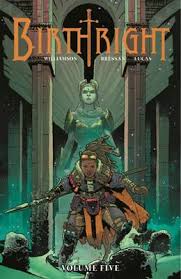
[READ: October 25, 2017] Birthright: Volume Five

This is the first Birthright volume that I didn’t love.  There was a lot of demon head ripping off and tentacles and splatters.  Fire and blood and gore, but not a lot of coherent action.

It started out quite good with Rya’s back story. We see her as a baby on a battlefield being rescued by, of all creaturs…an orc.  He told her of the prophecy to defeat Lore.  And then she met young Mikey and “knew that the prophecy was a load of razorbeast dung.”

Then we see Mikey quickly develop into the man he is–and then disappear.  It was rumored he was killed but then Kallista gave away that he was still alive.  That made Rya really mad. (more…)

Read Full Post »

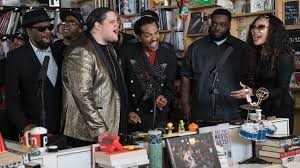
SOUNDTRACK: ARTISTS FROM THE “TAKE ME TO THE RIVER” TOUR-Tiny Desk Concert #692 (January 15, 2018).

This is a touring band playing classic soul.  But I found the modern updates to be unpleasant and almost undermined the tone of the show.  The blurb says:

“Take Me To The River” is a 1974 song from the legendary Al Green and guitarist “Teenie” Hodges. And though it wasn’t a big hit at the time, this song’s mix of religion and desire has become part of pop music’s canon.

Here at the Tiny Desk, some of the original players of this deep southern soul have come together to honor and update this tradition. It’s a celebration of Memphis soul old and new, with 13 musicians wedged behind the desk.

Some of those players of the old include singers Bobby Rush and William Bell; on the Hammond organ, Rev. Charles Hodges and LeRoy Hodges on bass. But it’s what’s new that makes this more than a look back – the addition of southern rappers Frayser Boy and Al Kapone – that truly puts this project on new musical ground.

But it is this update–Frayser Boy and Al Kapone who really ruined this show for me.

I’m not suggesting that the original lyrics to “Push and Pull” are profound.  They are not, but Frayser Bay’s rap is just up front and graphic whereas the original song is more understated (as much as something called “Push and Pull” can be).  Bobby Rush is a great singer and he looks spectacular in his sequined jacket.  Rush has a nice harmonica solo too.  That rap just seemed to come in and mess the whole thing up.

“I Forget To Be Your Lover” suffers from the same problem.  William Bell has a great sound–a cool rough voice.  And the original has this conceit: “I forgot to be your lover and I’m sorry.”  Al Kapone  comes in with a fairly explicit and hardly apologetic rap.  And what’s even stranger is that Rev. Charles Hodges who plays an outstanding organ throughout the show (I loved seeing the organ’s spinning fan that makes the great organ sound), plays really sour notes while Kapone is rapping.  Each verse has this weird nauseating sound. In every other section it sounds amazing, but during the rap it’s almost like he’s commenting on the rudeness of the rap.  The contrast is even more stark when Bell takes back the song mid way through and holds a high falsetto note for about 10 seconds–which really shows his power and range.

The backing vocals by Ashton Riker and Evvie McKinney are a nice touch.   Then on “Take Me to the River” Riker shares lead duties with Bobby Rush and they sound great together.  Riker hits some powerful high notes while Rush keeps it all together.  This is the song that really sells the show.  But look at how uncomfortable Frayser Boy looks during this song.

The rest of the band sounds just fine, playing quiet and understated:  LeRoy Hodges (bass), Edward Cleveland (drums), Andrew Saino (guitar), Jamel Mitchell (sax), Scott Thompson (trumpet), Martin Shore (percussion).

[READ: November 10, 2017] The Talented Ribkins

I saw Ladee Hubbard on Seth Meyers.  She was really interesting (and went to Princeton) and her book sounded fascinating.

On the surface the book is fairly simple, even fairly uneventful. Johnny Ribkin has to come up with $100,000 in a week because he has run afoul of a powerful man.

A few things separate this from similar books.  The first is that over the course of his life, Johnny buried various amounts of money and possessions in random places around the state of Florida.  He should be able to find the money fairly easily.  The reason why he buried all of this is part of the story.

Another thing is that he and his siblings all have special powers.  Not exactly superpowers, but certainly special powers.  And while these powers don’t exactly come into play in the quest, they are ever-present and unavoidable.

So what the heck is going on here? (more…)

Read Full Post »

SOUNDTRACK: THE WEATHER STATION-Tiny Desk Concert #689 (January 8, 2017).

The Weather Station played a show in Philly a while back.  I knew that Bob Boilen really liked the album, and I thought about checking them out live.  But things came up and I didn’t.  And now here they are at a Tiny Desk.

It was the first song here, that Bob especially liked:

It’s called “Thirty” and in less than four minutes and nearly 400 words, singer Tamara Lindeman paints images of joy intertwined with the awaking jolt of turning thirty.

The dollar was down
But my friends opened businesses
There were new children
And again, I didn’t get married
I wasn’t close to my family
And my dad was raising a child in Nairobi
She was three now, he told me

The song is a pretty, shuffling song (spare drums from Ian Kehoewith a speedy rhythm guitar (from Lindeman), a roaming bassline (Ben Whiteleyand some cool guitar licks (William Kidman) over the top (both of which are really lovely).

The musicians in The Weather Station underpin these words with delicate playing and by sitting quietly but poignantly under Tamara Lindeman’s beautiful voice. Her soft voice shifts pitch with a rapid flow in a Joni Mitchell-sort of way, never coming up in volume more than a quiet, table conversation level.

There’s a great (relatively) wailing solo that really pushes the song forward and which ends perfectly when Tamara starts singing again.

“You and I (On the Other Side of the World)” has a slow slinkiness that I rather like.  There’s also some nice, understated backing vocals (deep male voices under Tamara’s higher register).  I love the bass work at the end of the song, too.

Tamara’s voice sounds very much like someone else or maybe a number of people: I hear Laura Marling and yes, Joni Mitchell, but maybe Margo Timmins as well.  In other words, all good benchmarks.

In fact, the final song, “Free” has a real Cowboy Junkies feel with the big slow echoing rhythm guitar that opens it.

On “Free,” there’s some great lead guitar work once again as well as a wonderful bass line.

a song Lindeman describes as about being both free and not free at the same time, there’s restraint in the voice and a release in the powerful guitar chords. That tension and release is an essential element to The Weather Station’s sound and one of the joys I’ve found listening to their enchanting music.

Initially I wasn’t blown away by this concert, but I found myself hitting replay over and over, enjoying it more each time.

[READ: August 20, 2017] Fierce Kingdom

I read about this story on Skimm, a daily news digest that I have since read is geared to women (and according to some criticism, treats women like they are dumb.  I have recently stopped subscribing to it because I do find it rather dumb and subtly right-wing (how could a site for women not be pissed that Hillary lost? #RESIST).  But whatever, the book sounded interesting so I put it on hold.

The premise is fairly simple: a woman and her young child (4 perhaps), are in a zoo.  Right around closing time two gunmen enter the zoo and start killing people.  What will she do?

For some reason, the blurbs didn’t reveal that there were gunmen, just that “something” happened. Well, honestly what else could it have been but gunmen. So, perhaps I spoiled that part but it came out pretty early anyway.

The story begins with a time stamp 4:55 PM. The zoo closes at 5:30 and Joan and her boy Lincoln are sitting in their favorite spot waiting to leave the zoo.  As they head toward the exit around 5:30, she notices bodies on the ground.  She had heard explosions earlier but didn’t think much of it,  But when she sees the bodies, she quickly puts things together and takes off.

Now the blurb for the book on the inside cover says “an electrifying novel about the primal and unyielding bond between a mother and her son, and the lengths she’ll go to protect him.”  That’s not wrong exactly but I feel like that puts a weird focus on it being about mother hood instead of survival.  Must be some kind of marketing thing.  I didn’t get the sense in the book that it has anything to do with motherhood–I mean frankly any parent would do that for his or her child and I’m sure any person would do the same for anyone they loved.  The fact that the child is younger and doesn’t have the same cognitive skills make the story more compelling.

Because, frankly, as she hides in an abandoned animal enclosure, there’s no reason she would ever have to leave such an enclosure–she can’t be seen, she is well protected, and it is dark.  She even has her cell phone and she talks to her husband (I find it a bit hard to believe that the police wouldn’t listen to him if he has a text from his wife in the zoo, but that’s what happens).  The bad guys even come into where she is and don’t see her.

So, end of story right?  At least I couldn’t imagine why there would be more story when she is safe and the police are coming. (more…)

Read Full Post »

« Newer Posts - Older Posts »