Feeds:
Posts
Comments

Archive for the ‘War’ Category

wwiSOUNDTRACK: LAIBACH-Let It Be (1988).

220px-LaibachletitbeBecause Let It Be doesn’t end with The Beatles.  In 1988, Laibach, the Slovenian industrial band covered the entire Let It Be album (except for the title song).  Laibach are something of a proto-Rammstein, full of bombast and loud voices, stomping beats and despite the Slovakian heritage, a very Teutonic feel.

Opening with “Get Back,” the song is a stomping industrial march.  The lead singer (I have no idea who the members even are, as they don’t say much about themselves on the record).  I’ve always enjoyed this version, and I kind of assumed that the whole album would be similarly bombastic.

However, after the bombast of the first song, “Two of Us” opens with a crooning voice singing a long.  It’s a nice change.  The music is industrial and loud–but the keyboard riff is also cool. and different.  Most of the songs are unrecognizable as the original, but I think “Dig a Pony” may be the most unlike the original.  The chorus melody is very different and I barely recognized it.  The high notes of “because” are done in a low bass spoken word.  It’s quite a change.

“Across the Universe” is genuinely pretty with two female singers and a harpsichord.  “I Me Mine” has very similar vocals although the music is very different–with strings and stomping drums.  “Dig It” is a nonsense song on the original, but Laibach have a fun (if that’s the word) making it more of a real song with lots of shouting.  “Maggie Mae” is a folks song that The Beatles recorded.  Laibach call it “Maggie Mae” but instead record tradition German songs “Auf der Lüneburger Heide” & “Was gleicht wohl auf Erden.”

“I’ve got a Feeling” is done like a rally.  There is cheering and shouting and the lyrics are delivered in a dramatic spoken word (complete with Oh Yeahs).  The audience cheers and responds.  After nearly 4 minutes, the cheering continues, but they throw in a steel drum melody of “The Long and Winding Road” (I wondered how they would handle that pretty song).

I don’t really like the original of “1 after 909” but I like the way this one is done.  It’s very heavy and rocking with some crazy guitar solos and a refrain of “Smoke on the Water.”  “For You Blue” is transformed into an stomping synth version with the vocal melody popping up during the synth line.  After 4 minutes of the song, there’s a circus-like rendition of the melody to end the disc.

This is a vastly different rendition of the Beatles album, one that many people will find unpleasant, but I actually knew this version before the original and it will always be fun to me.  It’s also interesting how 20 years later, Rammstein would become very successful performing a very similar style of music.

[READ: February 10, 2015] The First World War A|Z

Sarah and I had recently begin watching Downton Abbey (I know, only four years late).  During the season that focuses on World War I, I realized that I was woefully ignorant about details of this war.  I’m also surprised there hasn’t been more made of its centennial–I’m sure a bigger deal was made in Britain.  At the same time, I saw this book at work and it seemed like a good way for me to fill in the gaps.

I am amused and confused that the subtitle says “from assassination to zeppelin” when in fact it is actually from “ace to zeppelin” but I guess assassination is more catchy?

Anyhow, this book was put together by the Imperial War Museum, the British Museum which was founded while the war was underway–such was the significance and unprecedented nature of the war that it was deemed worthy of having a museum while it was still going on.

This book is basically a tiny encyclopedia about the war written in a imaginable digest sized book.  It’s only 178 pages, so it is perfect for people who want to learn some details without getting terribly bogged down in the trenches (sorry) of the detail. (more…)

Read Full Post »

nov3SOUNDTRACK: COLONEL LES CLAYPOOL’S FEARLESS FLYING FROG BRIGADE-Live Frogs Set 2 (2001).

220px-Live_Frogs_Set_2After few months after releasing Set 1, Claypool released Set 2.  At the end of Set 1, he concluded by saying that the next set would feature: “more Pink Floyd than any human being should ever withstand.”

And indeed, Set 2 is the entire Pink Floyd Animals album.

Do the Flying Frog Brigade still includes former Primus guys Todd Huth (guitar) and Jay Lane (drums) in addition to guitarist Eenor, Jeff Chimenti on keyboards and Skerik on saxophone.  And of course, Les on bass and vocals.

Les says he always wanted to get a band together that could do justice t o Pink Floyd and he certainly found one.  The album sounds great here.  All five songs sound spot on.  I believe someone other than Les sings lead on “Sheep,” but I see no evidence of that.

There are some lengthy jams, and of course, sax where there isn’t any, but this isn’t meant to be a note for note recreation.  Rather it a respectful rendition with some excellent musicians who are willing to have a little fun with the songs too.  It’s a great release.

[READ: January 20, 2014] “Lamb Stew”

This week’s issue of the New Yorker was its semi-annual food issue.  As such there were four food-related essays by writers who I’ve written about before.  The section was called “Rations.”

The second was by Will Mackin.

Mackin was a soldier north of Basra.  And he talks about ow the desert cooked everything.  Iraqis call it “the date cooker,” the British soldiers call it “the face cooker,” but in his experience it cooked everything. (more…)

Read Full Post »

withoutSOUNDTRACK: GOJIRA-L’Enfant Sauvage (2012).

gojiraGojira is a French heavy heavy metal band, and this album was highly recommended back in 2012 (I didn’t realize it wasn’t their debut–they have quite a few records out already).  This album is quite heavy, but it has a lot of diverse elements to keep it interesting.

At the same time, they do rely on a couple of guitar effects which make the album weirdly samey (no idea if they do it on other albums too).  The two biggest offenders in this “repeated” scenario are the seeming over-reliance on the open high e string to add contrast to the heavy chugging chords.  It’s a cool effect once or twice but they do it a lot (especially in the song “The Axe” where it happens way too much and which is then followed by “Liquid Fire” where they do it again).  The other thing they do is this weird scraping sound.  It happens in the first few notes as the disc opens (in “Explosia”).  It’s a really cool sound and quite distinctive.  When you do a weird sound like that a lot in one song, it feels like maybe too much, but then to do it in several other songs, it feels like a crutch.

Which is a shame because the rest of the album is really interesting–the vocals are growly but audible and there’s occasionally really cool backing harmony vocals (“Liquid Fire”) and some really unusual different parts to songs.

So “Explosia” opens really heavy with a crazy riff and pounding drums (and that weird scraping sound).  I love that at 2:30 it switches from bludgeoning to slower (but still heavy) and that as the song fades out with another heavy section there are slow guitar notes that remind me of a Western.  It’s really cool. “L’Enfant Sauvage” uses that open high E string in an interesting riff (by doing more than just letting the string ring out).  (The scraping sound appears here too, but in limited quantity). I like the way the song’s volume just drops for the last thirty seconds or so.

“The Axe” opens with a pummeling drum and guitar sound.  “Liquid Fire” alternates between heavy guitars and that open high E sound.  “The Wild Healer” is a simple, pretty instrumental.  It is 2 minutes long and the main riff is simple one (again all on one string).  There’s an interesting solo that plays along behind the main riff which is quite pretty–but it all ends very abruptly.

“Planned Obsolescence” jumps right in with some pummeling guitars (an a scrape sound).  It slows down a bit, but towards the end the pummeling double bass drums resume until the really slow sweet guitar section that comes in around 3:45.  “Mouth of Kala” has a heavy riff which is a cool change (even if the riff is fairly simple).  But there’s some nice melodies that alternate with the heavy stuff.  I also really like the way the song ends with a very different riff and sound than the beginning.  (And the backing vocals are really cool too).

“The Gift of Guilt” has an interesting open E string riff (which is similar to Iron Maiden’s “The Trooper,” although they do something very different with it.  This song is just littered with odd effects, like a big heavy “bowh” sound and some high-pitched guitar pyrotechnics.  But I love the way it alternates parts (the growly vocals work really well here, too) and then ends so melodically.

“Pain is a Master” opens with a slow guitar riff and whispered voices, it’s a great change of pace for the disc.  Once the slow part ends, the guitars and drums pound furiously and we get some more odd effects–a siren sound (from the guitar) alternating with the ubiquitous scrape.  But the middle parts are really quite different, slower, slightly more menacing.  “Born in Winter” opens and closes with a slow and atmospheric section (delicate vocals even).  In the middle it gets heavier (and has some really fast drumming).

“The Fall” has an Alice in Chains vibe in one section and then a more cookie monster type vocal on another.  The scraping sound returns for a final showing. I really like the way the album just sort of disintegrated into random sounds as it ends.

So overall I really enjoyed this album. It’s probably nitpicky to complain about the overuse of certain sounds, especially since they are cool.  But they have so much creativity on the disc, that to hear the same things a few times just seems redundant.  Nevertheless the album rocks and is a really enjoyable metal album.  I was supposed to see them open for Mastadon earlier in the month but something came up and I had to eat the tickets (who knew you couldn’t even give away Mastadon/Gojira tickets, come on!).

[READ: November 21, 2014] Without Blood

I’ve been enjoying Baricco so much that I decided to grab this book while I was in the library too. I had already read this book a couple of years ago, or actually, I had read the version that appeared in the New Yorker.  The Wikipedia entry says that the New Yorker version is a”revised form” of the novel.  I didn’t know what that meant exactly.  But basically I gather it means that Ann Goldstein (who translated the New Yorker version) has re-translated the story (or that they edited it for the magazine the first time).

The New Yorker version is really long for a New Yorker story (it is practically the whole novel), so it’s understandable why things were a little shorter for the magazine.  But she hasn’t changed very much for the book.  There’s a lot of little modifications–tenses of verbs (in flashback situations), word phrases are altered, additional details seems to have been added and there is at least one small section in this novel that was not in the New Yorker version.

This “new” section is about a woman who is sitting in the cafe with them.  She asks the waiter about the two main characters and we learn a little about her past as well (it’s not relevant to the story and I can see why it was omitted, but it does flesh out the scene).  I am not willing to do a page by page comparison of the two (even though that is something I tend to do). But suffice it to say that the stories are virtually identical, although I found it more satisfying reading the novel version.

Since my original recap is basically how I would summarize it this time as well, I am including it here almost verbatim.  But in the spirit of the updated version of the novel, I am modifying this post from the original in small details–see if you can spot the differences. (more…)

Read Full Post »

artichokeSOUNDTRACK: PLACEBO-Loud Like Love (2013).

lllI enjoyed Placebo’s previous EP and I had high hopes for this album.  And I was not disappointed.  Loud Like Love is a great record–with very catchy songwriting, clever word play and a return to the sound that we love best from them–loud guitars, sleazy bass and so much angst.

The title track opens with a quiet guitar riff until the whole band bursts forth and it emerges as the rocking Placebo of old.  The track is a loud brash rocker—catchy as anything they’ve done. “Scene of the Crime” introduces some keyboards to the opening and slowly builds to a bracing end chorus. “Too Many Friends” has always bugged me for the opening line, “My computer thinks I’m gay” which I find inscrutable, especially since it is sung with virtually no musical accompaniment. Later, the follow-up line makes up for it: “Whats the difference anyway? when all that people do all day is stare into a phone.”  The song turns around from there and has a great chorus.  “Hold on to Me” is the slow brooding song on the disc, full of angst.  “Rob the Bank” has a great raunchy bass sound that propels this rocker

“Exit Wounds “is a longer song (almost 6 minutes) with a very electronic sounding drum beat introduction. “Purify” has a breakdown in the middle with some spoken word echoes.   “Begin the End” is the first of two 6 minute songs that close the disc.  This one has a kind of epic feel—he’s not hurrying through this one, allowing it to linger with us a bit longer.  I enjoy the way it seems to ramp up a bit after 5 minutes. “Bosco” ends the disc with a piano intro.  It’s slow song with a great melody.  It’s even a little touching.

Those who hate Molko’s voice will not like this album, and it clearly is not designed to convert anyone.  But new listeners may find this batch of quite accessible songs to be a great introduction to the band.

[READ: November 4, 2014] Artichoke Tales

I saw this book in the children’s section of my library and the cover drawing of a girl with an artichoke on top of her head blowing a dandelion looked so peaceful and nice that I brought it home for my daughter.

And I’m glad I read it first because on page 24, two artichoke people have sex (in shadow) and on the next page the guy thinks to himself “I made her come” (which could, of course, be taken two ways, but still).  A couple of “fucks” later on in the book coupled with my late realization that this book was published by Fantagraphics confirmed that this is in no way a children’s book–it may not even a be a teen book.

But it is a good book, nonetheless–just don’t be fooled by how sweet it looks. (more…)

Read Full Post »

krausSOUNDTRACK: THE FLAMING LIPS-The Terror (2013).

terror After the distortion heavy and heaviness of At War with the Mystics and Embryonic (to say nothing of their other experimental releases), I wasn’t sure what to expect from an album called The Terror.  Yet with a title like that the album is far more invested in psychological terror than in pummeling you with scary noises and music.  The album is more unsettling and spooky with existential dread.

Wayne Coyne has always been a pretty optimistic guy–weird, sure, dealing with feelings of dread, sure, but never so dark and insular.  But I learned that before recording this album and most likely as an impetus to record it,  Coyne separated from his partner of 25 years, Michelle, and Lips multi-instrumentalist Steven Drozd temporarily relapsed into addiction.

In an interview, Drozd says the album is like a crisis of life confidence.  He also says that the uniformity in sonic style was intentional: “Instead of writing songs and then figuring out sounds, we’d write the other way around: create sounds then make songs out of those sounds.”

So the vocals are quite low in the mix, and there is not a lot of “music” in the album.  Rather there are layers of sounds–swishing synths, spiraling noises, percussion effects that seems to almost cover up the vocals, giving it a very claustrophobic effect.  “Look… The Sun Rising” opens the disc.  It is primarily percussion with some noisy sounds and really sharp piercing guitars (that play noisy counterpoint to the soothing chorus of Oh Oh Ohs).  And yet after all of that noise and chaos, the very lovely “Be Free, A Way” surfaces as a quiet introspective song.  There are gentle keyboard notes (not unlike on Yoshimi) that propel this song along.  “Try to Explain” is a pretty song with some unusual sound effects swirling around it (The Lips can’t so straight up pretty, right?).  And yet lyrically, this song, along with the rest, is very dark indeed.

“You Lust” is a 13 minute (!) invocation about various forms of lust.  It opens with the couplet: “You’ve got a lot of nerve/A lot of nerve to fuck with me.”  The middle of the song is a kind of Pink Floydian keyboard workout.  It’s a  lengthy jam that’s kind of samey, but I’ll bet if you can really sit (with headphones) and close your eyes and focus it’s pretty intense.  After about ten minutes of that repetitive claustrophobia, some lightening occurs with sprinkled keyboard notes.

“The Terror” is primarily in Coyne’s falsetto, and it seems gentle until the mechanized noises come bursting forth.  “You Are Alone” is the shortest thing here, under 4 minutes of squeaking noises.  And again, a lovely melody despite the title.  I feel like this song summarizes the album pretty well.  In it, Coyne sings “I’m not alone” while a deeper voice replies, “you are alone.”  Whose voice will ultimately win?

  “Butterfly, How Long It Takes to Die” returns to that abrasive guitar of the earlier tracks, but the main body of this 7 minute song is just bass, keening keyboards and Coyne’s whispered voice.  There’s a recurring synth line that is magical and/or creepy depending on your frame of mind.  It, along with many of the other songs, have a kind of coda that links the songs.  This one is mostly just choral voices, but it twists the ends of the songs in a different direction. “Turning Violent” is a quiet track, in which Coyne sounds nearly defeated until the second half of the song grows louder and more animated with layers of vocals.  The disc ends with “Always There…In Our Hearts” which seems to offer some hope…maybe.  There’s signs of uplift in the melody, and when the drums kick in at the end, it seems to propel the song into a more intense frame of mind.

And lyrically, despite all of the darkness that is always there in our hearts, there is a light peeking out: “always therein our hearts a joy of life that overwhelms.”

Although most reviewers find this album unremittingly bleak, I find the music to be beautiful in an aching sort of way–a beautiful way to deal with pain (better than getting the same tattoo as Miley Cyrus, anyway).

[READ: October 31, 2014] The Kraus Project

The title page of this book read: The Kraus Project: Essays by Karl Kraus translated and annotated by Jonathan Franzen with assistance and additional notes from Paul Reitter and Daniel Kehlmann.

So just what is this thing anyhow?  Well Karl Kraus was a German writer (1874-1936) whose main contributions to letters were some essays and a newsletter Die Fackel (The Torch).  The authors compare the newspaper (favorably) to a blog (while also complaining about what blogs have done to letters).  He started Die Fackel in 1899 and he continued to direct, publish, and write it until his death.  He used the paper to launch attacks on hypocrisy, psychoanalysis, corruption of the Habsburg empire, nationalism of the pan-German movement, laissez-faire economic policies, and numerous other subjects.  For the first ten or so years, Kraus was the editor, accepting contributions from around the German speaking word.  But in 1911, he became the sole contributor to the newsletter.

He also wrote many essays (he did not care much for fiction), including the two main ones that compression this book: “Heine and the Consequences” (1910) and “Nestroy and Posterity” (1912).  The book also includes two follow up essays: “Afterword to Heine and the Consequences” and “Between Two Strains of Life: Final Word to Heine and the Consequences” (1917) and a poem: “Let No One Ask…” (1934).

The essays themselves are quite brief.  Despite the first coming in at 135 pages, note that the left pages are all in German (so reduce 135 by half), nearly all of the English pages are filled with footnotes (reduce by half again) and some of the footnotes run for several pages.  So the essay could be said to be about 25-30 pages.

The same is true for all of the pages in the book.  The left sides are in German (except the footnotes) and most pages are split in half because of the footnotes.  Which means that Franzen and friends write far more than Kraus did.  Ultimately, this book is actually three things: It is a collection of Kraus’ essays with Franzen’s fine translation; it is an explication of Kraus’ attitude and about life in Germany during Kraus’ life and finally it is an insight into Franzen as a young man living in Germany and why Kraus was so appealing to him.

The first part: Kraus’ essays. (more…)

Read Full Post »

CV1_TNY_01_13_14McCall.inddSOUNDTRACK: PHISH-Live Bait 7 (2012).
bait7This free sampler from 2012 is practically a greatest hits collection for me.  There are 8 tracks on the collection and none of them is shorter than 15 minutes.

It opens with a 1995 concert in which “Wilson” segues into “Tweezer” (for a combined total of 30 minutes).  Then there’s a 13 minute version of “Stash” from 2010 and an 18 minute version of “Split Open and Melt” from 1999.  The songs meld very nicely together with just the slightest change in recording sounds making any notable difference.

“You Enjoy Myself” comes from way back in 1992, and it ends with an extended vocal nonsense section–all four of them mouthing crazy sounds in a rhythmic pattern.  The only song of the set that I don’t love is “Runaway Jim,” but the jam section is great in this one.

“Reba” from 1996 works perfectly with “Gumbo” from 1998.  And the set closes with another 1992 recording.  The band opens with “All Things Reconsidered” which Trey explains is a reworking of the NPR theme.  But he then tells the audience that they can sing along to the next song, David Bowie” (which opens with a little nod to the Simpsons).

There’s no sign of a Live Bait 10, unfortunately, but having 9 free releases of highlights from live shows is still pretty sweet.  If only their show in Philly hadn’t sold out.

[READ: June 12, 2014] “The Paper Revolution”

Dinaw Mengestu’s first story (in the 20 under 40 issue) was about a refugee which I felt was more than a stereotypical refugee story.  This new story is about student revolutionaries, and it looks at them in a different (and somewhat confusing) way.

The narrator, who is eventually called Professor Langston by his friend Isaac, is at the University in the capital city, Kampala.  When he first meets Isaac, he finds him an interesting fellow–a man studying politics, because what else is there to study in Africa?  When the narrator says he’s studying literature, that’s when Isaac calls him the professor.

Isaac is full of information that he loves sharing (starting his sentence with “Did you know?”) He lectures about the British rule and their plan to turn this city into a new London if they lost the war.  Isaac fills him with political theory, and the university was the ideal place for it “Every aspiring militant, radical and revolutionary in Eastern and Central Africa was ran to the university.”

He and Isaac watch the “radicals” and can tell from their shoes which ones are truly poor. But there is one boy–so rarely seen as to possibly be invisible–who was the genuine article.  And soon enough there is graffiti on the walls which everyone attributes to him.  But the graffiti is whitewashed and a sign is put up admonishing: “It is a Crime against the country to deface our University walls.” (more…)

Read Full Post »

march2014SOUNDTRACK: HRSTA–Stem Stem in Electro [CST036] (2005).

cst036webI really like this album a lot.  It has all of the trappings of post rock (long songs which are rather epic in nature with lots of building and no standard verse chord structure), but it also feels doggedly commercial–super catchy in the way the elements combine and the choruses swell.

“…and we climb” is a simple four chord song that builds over the course of 6 minutes.  It seems like it will be just instrumental, but after almost 3 minutes a gang begins chanting about how “we climb to the light.”  The songs builds in intensity and then fades out to just voices.  “Blood on the Sun” is a guitar-based song with female vocals–echoing and pretty while the guitar plays on.  The song doesn’t vary much, but the combination of the voices and the chord changes is a really good one.  “Une infinite de trous en forme d’homme” is a swirling instrumental with a circular guitar pattern and washes of chords in the background.   “Folkways Orange” starts with strong vibrato guitars and compelling wavery vocals.  There’s some interesting chord changes but mostly the song is just a solid song that stays strong for 5 minutes.

“Swallow’s Tail” is one of my favorite songs on the disc.  It begins with a screechy noise that acts as a rhythm.  Then the great guitar melody follows along.  It’s not complex, but it is intertwining and intriguing.  At around 2 minutes a guitar chord motif begins.  It has a sort or tension in it, like it’s expecting something to come along.  And then the whispering vocals begin. The guitars roar to life for a few bars and then settle down as the vocals count out what is the Swallows Tail.  Then the music rages back in.  This is followed by “Heaven Is Yours,” a series of random noises and spacey sounds, as if resting from the catharsis of track 5.  “Gently Gently” is a short angsty song full of washes of chords.   The final track, “Quelque chose a propos des raquetteurs” opens with more great sounding guitars.  You can feel that it is going to be epic.  The violins come in after a minute to really build the song.  When the vocals come in around 5 minutes, it reminds me of the chords structure and build up at the end of Pink Floyd’s “Atom Heart Mother,” which is quite alright with me.

It’s a fabulous example of post-rock.

[READ: May 11, 2014] “The Academies of Siam”

Joaquim Maria Macahado de Assis was alive from 1839-1908, so this is not a current story by any means.  It comes from a new collection called Stories which was translated from the Portuguese by Rhett McNeil.  I don’t know the first thing about the author.

This story is a strange one.  It sets up the hypothetical question asking if you know about the academies of Siam.  It follows this question with “I am well aware that there have never been any academies in Siam, but suppose that there were…”  Huh.  He asks us to imagine that there were four of them and then gives this tale in four parts.

In the first, there is a question posed as to whether souls have a gender–is a man more feminine because he has a feminine soul?  This is asked because the king is considered quite a feminine man.  He doesn’t like war or any kind of fighting, he has honeyed eyes and a silvery voice.  Indeed, Kalaphangko is “practically a lady.”

The academics form two camps on this issue.  Those who say that souls are gendered and those who do not.  And soon enough violence breaks out over the issue.  (more…)

Read Full Post »

pharm SOUNDTRACK: BLACK OX ORKESTAR-Ver Tanzt? [CST029] (2004).

cst029webBlack Ox Orkestar play traditional Yiddish music in a somewhat untraditional manner.
There are half instrumentals and half songs with vocals sung in Yiddish (which means I don’t know what they mean).  According to the Constellation website they are a: blend of originals and new arrangements for pieces pulled from various Eastern European songbooks.  And since the members come from “punk-rock, free-jazz, and other liberation musics,” it’s an approach to this music that may interest people who don’t normally like traditional music (and may turn off those who do).

.  I can’t really speak to the music, as I’m quite unfamiliar with it.  I prefer the instrumentals because I like the way the music tends to interweave.  Like “Cretan Song” which is a rollicking fun song like the Yiddish equivalent of an Irish seisún.  And yet. some of the vocals songs are really enjoyable too, like “Toyte Goyes in Shineln” which has a great melody and feels very familiar to me.  While “Ver Tantz?” begins as a slow melancholy song and turns rambunctious–almost chaotic.

Enjoyment depends on an appreciation for tradition Yiddish music, of course.

[READ: May 5, 2014] The Pharmacist’s Mate

I read this book a few years ago.  I read it again because McSweeney’s reissued it with Fusselman’s other book 8 on the flip side.  I wanted to read 8 and decided that since Pharmacist was so short I would read it as well.

And I’m glad I did because while they are not related exactly, they both work as a form of non-fiction and 8 is a nice postscript to what she talks about in Pharmacist.

As with most genre defying books, this is more or less a memoir, although it is written in a somewhat strange format–each small section is numbered (and eventually all the numbers turn into 1s because she realizes that she is starting anew with each section.

The Pharmacist’s mate of the title is her father, now deceased.  She includes notes from his time in the war as a sort of parallel to what’s going on with her own life. She very much wants a baby.  And through the book we see her engage in multiple ways of conceiving from natural to in vitro.  And then we read her angst about becoming a parent  And losing a parent. (more…)

Read Full Post »

medusaSOUNDTRACK: PETER BJORN & JOHN-“I Wish I Was a Spy” (2012).

awesome4Yo Gabba Gabba has always been a source of interesting music–very cool bands devote time and music to this, frankly bizarre kids show.

This song from Peter Bjorn and John is fantastic.  While the lyrics are kid friendly, there’s no reason that this song need be played only for kids.

The song opens with a good vibrato “spy” guitar lick and vocal breaths.  The unusual percussion really shows how much this song sounds like a PB&J song even if it is of a very specific genre.  When the vocals come in (sounding very PB&J), the lyrics simply state that he wishes he was a spy, and then he gives some great examples of what he would do as a spy.

But the big surprise comes from the chorus which s bright and bouncy and talks about how we can all pretend we are all agents.

The Yo Gabba Gabba version ends at 2 minutes, but the extended version has more instrumental surf/spy guitar work.  It’s kind of an extraneous coda, but the sound they capture is really cool, so it’s fun to get the extra minute of guitar work.

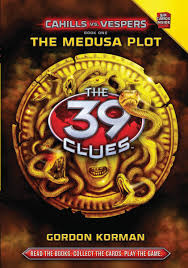
[READ: May 6, 2014] The Medusa Plot

When I finished Vespers Rising, I said I would pace myself because the Cahills vs. Vespers series was six book which would conclude in March 2013.  Clearly I paced myself too slowly because here it is May 2014, Cahils vs. vespers is long done, and they are on the next series already.

But hey, I’m not playing the online game so there’s no time constraints for me.

Also, Clark started reading the original series so I wanted to keep a little ahead of him.  It seemed like a good time to start this middle series.

And man, once I started reading I was immediately brought back into the exciting world of Dan and Amy Cahill.  I had forgotten about the short story in Vespers Rising (about the ring that Amy now has) and about the Vespers in general.  But that didn’t matter, because it was quickly set up that the Vespers (led by the unknown V-1) in particular are bad and they will stop at nothing to achieve their goal (which we don’t know yet).

It has been two years since the end of the 39 Clues.  As the book opens, several members of the disparate Cahill family clan are kidnapped: Fiske Cahill, Reagan Holt, Natalie Kabra (who, with her brother is now poor since their evil mother disowned them for not being evil enough), Alistair Oh (no!) and Ted Starling (his brother Ned escaped), Phoenix Wizard (Jonah’s little cousin) and, gasp, Nellie Gomez!  They are taken to an undisclosed location, given jumpsuits and left in a small cell with nothing to do and minimal food on a regular basis. (more…)

Read Full Post »

half pastSOUNDTRACK: FEU THÉRÈSE-Feu Thérèse [CST040] (2006).

feu1Feu Thérèse is a band created because of the hiatus of Le Fly Pan Am.  They offer a melange of styles, as befits the visual arts origins of several of the members.  And yet, there is a solid rhythm section that grounds the band in a wonderful way.

“Ferrari en Feu” opens with 3 minutes of pulsing waves of synths and electronic bird-call-like sounds. It’s unclear exactly what you’re listening to and it seems like the whole album will be a kind of ambient collection.  Then a proper rock song kicks in with chords and notes and drums–it has a cool psychedelic vibe and feels very late 60s.  “Mademoiselle Gentleman” has pulsing bass notes and staccato guitars with a layers of distorted laughing throughout (there’s no “singing” on the first two songs). At around 4 minutes (out of 6) the feedback squalls too and a simple steady beat.

“Tu n’avais qu’une oreille” seems like a traditional song–with singing (in the Serge Gainsbourg, dirty old man style of whisper/singing) which has a middle section that is quite conventional (with ahh ahhs) but again at 4 minutes, the song shifts into a faster drumming section (with more spoken words).  But then a lengthy trippy guitar solo shatters the mellowness.  “L’homme avec couer avec elle” starts with what sounds like horns.  At around 4 minutes in turns into a kind of western but with a crazy clarinet solo accompanied by sped up noises that sound like Pink Floyd’s Ummagumma.  There’s more psychedelic Pink Floyd styles on the final track, “Ce n’est pas les jardins du Luxembourg.”  The song opens with “drips” that sound like “Echoes.”  And then there’s more Ummagumma birds/animals (possibly distorted seagulls?).   At (yes) 4 minutes it turns into a trippy psychedelic organ based song (with Indian music as well).  The song is 12 minutes and leaves no sound unheard.

The music is experimental but it is not terribly “difficult.”  It’s actually quite a fun album which demands multiple listens.

[READ: April 24, 2014] Half Past Danger

The tagline for this book (which is presented like a movie in a number of ways) is Dames. Dinosaurs. Danger.  And the cover features a giant Nazi flag in flames.  Sounds like pulp genius to me.

And so it is.  Stephen Mooney has been an artist for some great graphic novels over the years and this is his first book that he wrote on his own, based on a labor of love–having Nazis fight dinosaurs.  Like a dream come true.

So obviously, this is a story of an alternate past.  Set in 1943 in the South Pacific, an Army battalion is tracking an area when they discover a secret Nazi base.  There are not supposed to be any Nazis this far east, and yet there they are.   Sergeant Tommy “Irish” Flynn is surprised but he gets his team ready to take pictures and prepare a report.  But that loud rumble sounds like the biggest tank they have ever heard.  And then out steps a T-Rex (in a great reveal).  The T-Rex wipes out all of Irish’s company.  Irish escapes with a few photos and little else.

We jump cut to two months later where Irish is drinking in a bar in New York City.  In walks General Noble of the USMC and Elizabeth Huntington-Moss of British MI6.  They request his service.  He tells them to fuck off.  Actually no, he doesn’t.  This is a PG13 story, there’s a few “shite”s and an occasional “damn” but it is squarely in the realm of comics–implied sex, a lot of blood and a few mild words.  A brawl ensues, in which a Japanese fighter helps out Noble & Moss.  And soon Irish is recovering and being told what’s going on.  After some string reluctance, Irish agrees to go back to the island.

Noble proves to be a supremely tough and string fellow.  The Japanese soldier has defected to the U.S. after the non-respectful attack on Pearl Harbor.  And Moss is an enigma.  As they approach the island, there is plane trouble and a wonderfully cool scene in the water (which I won’t spoil but the art and graphics are terrifying and wonderfully drawn and colored–Mooney did the colors for the first chapter, while Jordie Bellaire did the other five).  (more…)

Read Full Post »

« Newer Posts - Older Posts »