Feeds:
Posts
Comments

Archive for the ‘Thieves’ Category

SOUNDTRACK: MESHELL NDEGEOCELLO–Tiny Desk (Home) Concert #167 (February 10, 2021).

I bought Meshell Ndegeocello’s Plantation Lullabies back in 1993 on the strength of “If That’s Your Boyfriend,” a funky track that is still pretty great.  I didn’t realize she had been steadily putting out music ever since.

This Tiny Desk (home) concert … includes songs from throughout her career framed by her thoughts on the importance and influence of James Baldwin: “He deserves flowers every day. Most of all because he was willing to discuss things that were painful, hard to look at, hard to see, hard to accept.”

Ndegeocello is a bad-ass bass player with a serious funk edge.  And yet in this Tiny Desk Concert, she strips almost all of that away.

The first song comes from Lullabies, but in this version of “Step Into the Projects” she strips away all the music and turns the song into a spoken word piece (although she does keep the rhythm of the original).

For the next three songs she is accompanied by her longtime guitarist Chris Bruce.

“Price of the Ticket,” is from Ndegeocello’s recent project, Chapter & Verse: The Gospel of James Baldwin, “a 21st century ritual toolkit for justice” inspired by Baldwin’s The Fire Next Time.  In the track, it’s just Bruce’s gentle guitar and Meshell’s quiet voice.

“Forget My Name” from Comet Come To Me (2014) is stripped down from its original reggae arrangement and lays bare the haunting imagery in the lyrics.

She plays some spare bass, but musically it’s all about Bruce–the cool low riff and the pretty high melody.

“Fool of Me,” from her acclaimed album Bitter (1999), ends the set with just vocals and guitar.

Like the other songs, it is spare and beautiful, allowing you to really hear the words.  I love Meshell’s funk, but this is a beautiful set.

[READ: March 29, 2021] Parable of the Sower [2026-2027 (chapter 19)]

I have not read Cormac McCarthy’s The Road, and I don’t intend to.  But I feel like this book acts as a precursor to that one.  And that is something I did not in any way expect.

2026 opens in June, almost seven months after the previous entry.  I’m curious about the distance between entries.  It’s possible that Lauren has dozens and dozens of pages that just said, “today sucked” and we don’t need to see that.  But I am curious about the time jumps.

Is it a way for Butler to move us ahead quickly so that something that needed to take a few years to happen is given the time to do so?  I’m thinking about Mars a bit.  In two years a lot can happen with the space program.  Of course, the President was supposed to cancel the program.  So who knows what’s going on there.  Aside from basic passage of time, did we need to wait six months to see what came next?  I’m not sure.

In June Keith is back–bigger and more confident.  He’s not yet 14, but he’s very successful, bringing home money and gifts (but none for his father).  He has ingratiated himself into a gang by being the only literate one in the group:

They’re all older than me, but not one of them can read or write anything.  They stole all this great stuff and they couldn’t even use it.  Before I got there they even broke some of it because they couldn’t read the instructions. (105)

Lauren and Keith have a heart-to-heart–really their first ever.  He learns a bit about her and while he gains a little more respect he also tells her that she’d never survive out there–she doesn’t know enough.  He also tells her about these new crazies called Paints who paint their skin green or blue or yellow and eat fire and kill rich people.

Keith comes back on her birthday and gives her a present.  A month later he is dead–killed in a horrific and gruesome way.  He was clearly tortured and left to be found.  His death was a message for someone–a rival gang, probably.

But they don’t call the police:

cops liked to solve cases by “discovering” evidence against whomever they decided must be guilty.  Best to give them nothing.  They never helped when people called for help.  They came later and more often than not, made a bad situation worse. (114)

In October, a new component to the story crops up.

Kagimoto, Stamm, Frampton and Company (KSF) has taken over a nearby town called Olivar.  It is small and well to do.  The citizens voted to let their town be taken over–privatized.  They intend to set up energy resources in the community–solar, wind, desalinization.  They mean to own great industries in an area that people have given up on.

Kagimoto, Stamm Frampton: Japanese, German, Canadian.  When I was young, people said it would come to this. Well why shouldn’t other countries buy what’s left of us if we put it up for sale. (121)

This is another aspect of the story that confuses me.  Is it basically that Los Angeles has exploded and the rest of the country is okay?  There’s talk about work up north, but why?  What happened to the country that they/we would let L.A. collapse but nothing else.  Or maybe it’s the entire South West?  Nobody knows anything about the East Coast, apparently.   I’m hoping that they will get explained a bit later on.

Olivar was accepting applications to live there.  They were looking for educated people.  And here we learn that both of Lauren’s parents have PhDs [a commentary on the invisibility of Black scholars?].  Her stepmother thinks it’s a great idea to go to Olivar.  They would be guaranteed safety and security.  But her father is against it, calling it “half antebellum revival and half science fiction” (122).

Anyone KSF hired would have a hard time living on the salary offered. In not very much time, I think the new hires would be in debt to the company.  That’s an old company-town trick–get people into debt, hang on to them and work them harder.  Debt slavery. That might work in Christopher Bonner’s America. Labor laws, state and federal are not what they once were. (121)

Come November, the Garfields have been accepted at Olivar.  The Garfieds include Joanne, Lauren’s one time best friend (who misplaced Lauren’s trust by tattling to her father).  Joanne has been serious with Harry Balter.  But Harry is staying in Rebledo.  Lauren suggests they get married and then Harry can move in with them, but she says that Harry wants to get married and travel north.  He thinks they way Lauren’s father does about Olivar.

But the Garfields are still going: “conservative and sensible and mature and wrong” (128).

In November, Lauren’s father did not come home one night.  They spend days looking for him with no luck.  The search parties uncover all kinds of remains, some of which they think might be her father’s but which turn out not to be.

The search also reveals an aspect of Lauren’s hyperempathy that we didn’t know–sound doesn’t trigger it (she hears a man screaming), only sight does.

Five days alter they have a Sunday survive that turns more or less into a memorial.  Lauren speaks at he service and proves to be powerful preacher.  She speaks of God but presumably she means her own god–the earthseed god.  By mid-December they have a formal funeral–they accept that he would have found his way home by now.

Later, when KSF came for the Garfields, it was in an armored truck

The two movers were a black and a white, and I could see that Cory considered that hopeful.  Maybe Olivar wouldn’t be the white enclave that Dad had expected. (139)

All along Lauren has been romantically involved with Curtis.  People anticipated that she would get married an have a baby with him–something she strongly resisted.  Indeed, her plan all along was to leave Rebledo without him.  But now with Lauren’s father gone (he was the reason she hadn’t left yet–she didn’t want to hurt him), Curtis suggests that they both go.  He’s upset that she wanted to go without him, but she explains that she didn’t want to force him to make that choice.

Two days later, someone burned down the Payne/Parrish house; while that was going on. they robbed three of the other houses including Lauren’s.

I’ve been frightened at the phrases that Butler says that prove eerily prophetic to the last few years:

People are setting fires because they’re frustrated, angry, hopeless. They have no power to improve their lives, but they have the power to make others even more miserable.  And the only way to prove to yourself that you have power is to use it.  (143)

Interestingly, the drug that gave Lauren her hyperempathy–Paracetco–was initially a legitimate drug intended to help victims of Alzheimer’s disease.  Pyro was an accident–a homebrew on the East coast it made it was away across the country.

People on the fire drug get off on watching things burn.  Blaze, fuego, flash, sunfire.  The most popular name is pyro short for pyromania [I’m fascinated that she needed to spell that out as I feel that in 2021 (and much earlier) it was a common abbreviation].

As the year ends, the families try to make due with what they have left.

Then we enter 2027.  Once again it’s six months into the year.  And this is when things change dramatically.   Thieves drove a truck through their wall and set everything on fire.  Nearly everyone in the community was killed.  [I did wonder if it was worthwhile learning anyone’s names, and it was two people I didn’t think twice about who survived].  The description is a violent orgy of death, rape, fire and who knows what else.  It is brutally described.  Lauren escaped.  She had the forethought to run back in and put on clothe and shoes and grab her bug out bag.  No one else in her family had done so. She saw them n bare feet and pajamas and then she didn’t see them any more.  She managed to get outside and to hide until the next day,

She crept back into her community and went to her house which was being looted and stripped. She knew where there were some hiding places and she managed to get clothes for her family as well as money that was hidden in the ground.  She grabbed a gun and got out, looking like all the other miserable looters.

Lauren was sure she was alone.  Then out of the rubble came Harry Balter and Zahra Moss–the youngest wife of Richard Moss the polygamist.  Zahra’s baby was killed (brutally) and an attacker was about to (or had begun to) rape her when Harry saved her (and got beaten for his help).  Neither one had planned for anything like this and they are pretty hopeless.  Lauren decides that three is safer than one and invites them to go North with her.

Zahra’s backstory is interesting.  Richard bought her from her mother who was a drug addict and a prostitute.  Zahra has lived on the streets and she knows what’s what.  She takes them to Hanning Joss, the biggest secure store complex.  I’m fascinated to learn that there are are still megastores and that they have security allowing people to shop safely there–commerce always wins.

Then they do what everybody else does–they head North.  Lauren has decided to pass as a man.  She’s tall and muscular and can do so, so she cuts her hair short.  They encounter much danger and violence but manage to get relatively far north.  Harry is a trusting guy, trying to avoid violence in any way possible.  But Lauren (and Zahra) knows the reality of the situation–kill or be killed; steal or be stolen from.  And with Lauren’s hyperempathy, she can’t afford to let people around her suffer.  She winds up cutting a man’s throat to stop the hurting that he (and she) are feeling.  Harry is appalled at her.  So she finally admits to her hyperempathy assuming they’ll abandon her.  But they do not–three is better than two.

Zahra and Harry become a couple and have unprotected sex (what harm could come from that?)

Then the trio meet another family who seems to be tagging along after them.  Everyone is out for themselves, but Lauren takes pity on this mixed race couple with a baby.  She helps them out at the second Hanning Joss and a few days later, when Lauren saves their baby from a feral dog, they agree that five (or six) is better than three and two (or three).

The new people are Travis Charles Douglas, Gloria Natividad Douglas and six month old Dominic. They are going to Seattle where Travis’ aunt lives.  Travis is quite taken aback when he learns that Lauren is a woman–especially since she saved them, but he’s going to have to get over it.

All of this time, Earthseed has been running around in Lauren’s head, but it hasn’t really shown up.

Then in chapter 18, Lauren starts talking to them about Earthseed.  Travis is a (surprisingly) intelligent man–he knows about entropy.

Travis’s mother was a live in cook for a rich man.  But before that she had written for newspapers and magazines.  She taught Travis to read. The man she worked for had a library and she would sneak out one book at a  time–he didn’t want Travis touching his stuff.

Of course. Slaves did that two hundred years ago.  They sneaked around and educated themselves as best they could sometimes suffering whipping, sale or mutilation for their efforts. (218)

Natividad was a maid and the rich man let them marry:  The son of the cook marrying one of the maids. That was like something out of another era too.

They discuss her poems–Earthseed.  Travis pushes back against her ideas, although never in an aggressive way.

She argues that here is no pore pervasive power than change.  Travis says that nobody is going to worship change.  Lauren says she hopes not

This excerpt from God is Change summarizes this discussion nicely:

“I was looking for God. I didn’t know whether there was a god to find, but I wanted to know. God would have to be a power that could not be defied by anyone or anything.”
“Change.”
“Change, yes.”
“But it’s not a god. It’s not a person or an intelligence or even a thing. It’s just … I don’t know. An idea.”
“It’s a truth. Change is ongoing. Everything changes in some way— size, position, composition, frequency, velocity, thinking, whatever. Every living thing, every bit of matter, all the energy in the universe changes in some way.”
“Sort of like saying God is the second law of thermodynamics?”
“That’s an aspect of God. There are all kinds of changes in the universe.”
“But why personify change by calling it God? Since change is just an idea, why not call it that? Just say change is important.”
“Because after a while, it won’t be important. People forget ideas. They’re more likely to remember God— especially when they’re scared or desperate.”
“Your stuff isn’t very comforting.”
“It is after a while. I’m still growing into it myself. God isn’t good or evil, doesn’t favor you or hate you, and yet God is better partnered than fought.”
“Your God doesn’t care about you at all.”
“All the more reason to care about myself and others. All the more reason to create Earthseed communities and shape God together. ‘God is Trickster, Teacher, Chaos, Clay.’ We decide which aspect we embrace— and how to deal with the others.”
“But nobody’s going to worship change.”
“I hope not.  Earthseed deals with ongoing reality, not with supernatural authority figures. Worship is no good without action. With action, it’s only useful if it steadies you, focuses your efforts, eases your mind.”
“Praying makes people feel better even when there’s no action they can take. I used to think that was all God was good for.”
“That isn’t what God is for, but there are times when that’s what prayer is for. And there are times when that’s what these verses are for. God is Change, and in the end, God prevails. But there’s hope in understanding the nature of God— not punishing or jealous, but infinitely malleable. There’s comfort in realizing that everyone and everything yields to God. There’s power in knowing that God can be focused, diverted, shaped by anyone at all. But there’s no power in having strength and brains, and yet waiting for God to fix things for you. Best to understand that and return the effort: Shape God.”

Lauren thinks he might join her movement.  Zahra is already on board.

She imagines finding and isolated place on the coast and making a deal with the owners–if there were more of them and they were better armed, they could provide security as well as education.

This fantasy, this plan gives the first sign of hope in this bleak world of Lauren’s.  It seems impossible.

Read Full Post »

SOUNDTRACK: THE MOTHERS OF INVENTION-“Trouble Every Day” (1966).

Frank Zappa and the Mothers of Invention would play all kinds of music over the course of their existence (even more genres added when Frank went solo).  It’s not even entirely clear how you’d describe their first album Freak Out!

This song opens up side three of the double album and is a bluesy song based around a four note (and one bent note) melody and includes harmonica solo.  The song runs almost 6 minutes long and doesn’t change much until after about five and a half the tempo increases dramatically until the song fades.

It was written after the Watts Riots.  It was an accurate description and also sadly prescient.

Right in the middle of the song Frank states:

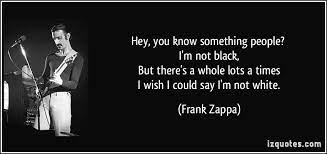
Hey you know something people I’m not black But there’s a whole lots a times I wish I could say I’m not white

That seems like it was a pretty powerful thing to say (and something you’d be unlikely to hear on the radio) back in 1965.

The chorus sticks with us

So I’m watchin’ and I’m waitin’
Hopin’ for the best
Even think I’ll go to prayin’
Every time I hear ’em sayin’
That there’s no way to delay
That trouble comin’ every day
No way to delay
That trouble comin’ every day

He certainly predicted the state of 24 hour news

Well you can cool it, You can heat it…
Cause, baby, I don’t need it…

Take your TV tube and eat it
‘N all that phony stuff on sports
‘N all THOSE unconfirmed reports
You know I watched that rotten box
Until my head began to hurt
From checkin’ out the way
The newsmen say they get the dirt
Before the guys on channel so-and-so
And further they assert
That any show they’ll interrupt
To bring you news if it comes up
They say that if the place blows up
They’ll be the first to tell
Because the boys they got downtown
Are workin’ hard and doin’ swell,
And if anybody gets the news
Before it hits the street,
They say that no one blabs it faster
Their coverage can’t be beat

Things haven’t changed since this song was written

And it’s the same across the nation
Black & white discrimination
They’re yellin’ “You can’t understand me!”
And all the other crap they hand me
In the papers and TV
‘N all that mass stupidity
That seems to grow more every day
Each time you hear some nitwit say
He wants to go and do you in
Because the color of your skin
Just don’t appeal to him
(No matter if it’s black or white)
Because he’s out for blood tonight

Perhaps the theme verse for recent events

Don’t you know that this could start
On any street in any town
In any state if any clown
Decides that now’s the time to fight
For some ideal he thinks is right
And if a million more agree
There ain’t no great society
As it applies to you and me
Our country isn’t free
And the law refuses to see
If all that you can ever be
Is just a lousy janitor
Unless your uncle owns a store

It’s a shame this song still resonates.

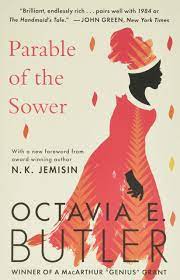
[READ: March 22, 2021] Parable of the Sower [2024-2025]

I found Kindred to be an enjoyable (not exactly the right word, I know) novel.  I thought the premise was really cool and I thought the content was impactful and was conveyed really well.  It was a powerful story that did not shy away from brutality.

But it in no way prepared me for Parable of the Sower.

I didn’t know anything about this book at all before starting.  At first I thought it was neat that it was set in 2024 (hey that’s so close!)  And that, coincidentally, myself and my daughters are almost the same ages as the main character and her father (will this be our future?).

But then, holy crap, Butler doesn’t hold back.

The brutality of Kindred was based on reality.  It was horrible and, in retrospect, hard to believe that people could do such things.  The brutality of Sower, however, is all based on the future projection.  The book was written in 1993. Basically, she posits that in 30 years, America has become a rotting hellscape.  And while we haven’t reached quite the levels that she imagines, there are some pretty eerie accuracies.  I have to assume, given the natural of the elected politicians, that some things are going to get very very spookily prescient.

The book opens in 2024 with a quote from Earthseed.  We don’t know what that is yet, but by the end of this week’s read we’ll learn that Earthseed is a sort of manifesto written by the main character, Lauren Oya Olamina–I didn’t realize her name was given after the first quote from Earthseed until looking back on it.  Each chapter has another quote from Earthseed and then the story unfolds as a series of diary entries. (more…)

Read Full Post »

SOUNDTRACK: THE DISTILLERS-Very Special Christmas Special, “Baby It’s Covid Outside” (December 18, 2020).

Despite going to many live shows, I haven’t watched a lot of streaming concerts. It’s not the same, and I don’t really like watching things on my computer anyway.

I’m not exactly sure what prompted me to buy a ticket for this one.  I saw The Distillers last year and enjoyed the show. But I feel like I didn’t get to fully appreciate it because the crowd was really rowdy and knew the band far more than I did.

So this seemed like a chance to see them “live” up close. The entire special was barely 40 minutes.  This is a bit of a bummer, but at the same time, it was really a perfect length for me.

In addition to the music, there were some skits.  As the show opens, Black Metal Santa unpacks some presents from his sack.  There’s a gun on a stack of presents, he pulls out a squeaking chicken dog toy and then a very adult toy.  He turns around, all Black Metal and says “Merry Fucking Christmas boys and girls, here’s The Distillers.”

On a well-decked-out Christmas-themed set The Distillers start to play.  There’s all kinds of Christmas things–blow up snowmen and giant stocking as well as digital flames.  And a full rig of lights. The band sounds great and the recording is well mixed.  The drums and bass sound huge.

They open with “Sick of It All.”  Brody Dalle is up front playing guitar and singing.  To her right is Tony Bevilacqua on guitar.  To her left is Ryan Sinn on bass.  All three are wearing Santa hats.  They all sing the opening verses and it sounds like a wall of vocals. Drummer Andy Granelli is not wearing a Santa hat, but he does have a knit cap on. The song sounds great–a blast of punk to celebrate the season.

They follow with the outrageously catchy punk of “Oh Serena.”  When I saw them, they opened with these two songs as well.  But this set list deviates somewhat. 

Up next is the quieter “L.A. Girl.”  It starts with everyone playing softly while Brody sings.  Then the whole band kicks in with massive drumming and some tasty bass fills. A martial drum beat opens “I’m a Revenant.”  Both guitarists play the lead riffs before Brody starts singing.  This song has some great sing-along moments as well as a brief part where it’s just Brody before the band marches in again.

“Sunsets” comes next.  They didn’t play this when I saw them.  Brody’s guitar is clean as the song opens.  She sings without a snarl.  The song does not turn into a balls out rocker.  It stays slow but gets very intense.  Bevilacqua makes interesting bendy sounds from his guitar in the middle jam section.  The song slows to a bass rumble before some Christmas music starts playing.

Black Metal Santa comes out and gives Brody a present.  It’s the album Faith by The Cure.  But there’s nothing inside–it’s just the cover. Black Metal Santa says, “Its my ‘Primary’ Christmas gift to you.  A cover.  Now play the damn song.”  It’s an amusing introduction to the song “Primary,” which I did not expect at all.  It sounds fantastic–close to the original, but heavier and obviously with Brody’s vocals sounding very different from Robert Smith’s.  She restrains her vocals until a loud snarling “oh remember” part.

Brody removes the Santa hat for “Dismantle Me” and the lights get brighter so you can see her more clearly.  This song has a great split with really fast guitars from Bevilacqua and slower guitars from Brody. 

The super fast chords continue into “Die on a Rope.”  This song also has some “Oh way oh” parts that are really catchy for such a dark song.  The middle jam is just bass and drums and Bevilacqua’s squeaky feedback while Brody sings.  There’s some thunderous drumming in the end as they jump into “City of Angels.”  This song is really catchy as she and the boys sing together.  There’s another cool middle section of just Brody’s guitar and noisy guitar sounds from Bevilacqua before the band roars off again.

The song ends and Brody looks off stage and says “Jesus.”  Granelli chides, “Brody, it’s Christmas.”  But she points off stage and Jesus comes out.  They ask what he’s doing there and he says it’s his birthday. They ask if he can make it snow.  Jesus says he makes miracles happen–he’s got a guy.   He calls a guy who comes down and the snow starts to fall.  Jesus and the guy get in a fight over who actually makes the miracles happen.  The guy says “ever since cofefe.”  But Granelli stops them, “we’re trying to do a Christmas show here, knock it off.”

Brody takes the mic and says “this year’s been a real ass kicker.  We’re looking forward to the new year.” 

Then they start Ramones’ “Merry Christmas (I Don’t Want to Fight Tonight).”  It sounds great and is a perfect set ender for a holiday special.

The show ends and they play the Ramones song over the credits.  The band takes bows and makes snow angels.

It’s a fun special and totally worth the $15.

[READ: December 25, 2020] “The George Spelvin Players”

This year, S. ordered me The Short Story Advent Calendar.  This is my fifth time reading the Calendar.  I didn’t know about the first one until it was long out of print (sigh), but each year since has been very enjoyable.  Here’s what they say this year

You know the drill by now. The 2020 Short Story Advent Calendar is a deluxe box set of individually bound short stories from some of the best writers in North America.

This year’s slipcase is a thing of beauty, too, with electric-yellow lining and spot-glossed lettering. It also comes wrapped in two rubber bands to keep those booklets snug in their beds.

As always, each story is a surprise, so you won’t know what you’re getting until you crack the seal every morning starting December 1. Once you’ve read that day’s story, check back here to read an exclusive interview with the author.

It’s December 25.  Rebecca Makkai, author of The Great Believers, could’ve sworn she left that porridge bowl right over there [Click the link to the H&O extras for the story].

I started this story and thought it was so familiar that I was sure I had read it before.  But as it went along, it didn’t seem familiar anymore, so maybe there is a similar component of it that I had read in another story. (more…)

Read Full Post »

SOUNDTRACK: RHEOSTATICS-Mowat Collegiate Late (1982).

This Rheostatics show dates all the way back to 1982, when the band was very very different.

This is the second oldest show I have been provided with to date… (based on the fact that Chemical World is introduced as a new song and it isn’t played on the other Mowat show on the site). From Mowat Collegiate in Scarborough it is slightly later in the year and has much clearer sound.

These old shows confuse me because I can’t tell who is singing.  To me it sounds like Tim singing lead on all the songs, but I didn’t think he was the main singer back then.  Or is it that Dave Bidini’s voice is so much different because they were all just babies?  I assume it’s Bidini doing the talking, and his voice is sure different (not Tom Waits different, but still).  I’m also not sure who is playing what.  I assume Tim is on bass, but he doesn’t usually play bass when he sings.  Dave Clark is also very quiet (he is usually full of jokes and poetry and whatnot).  I’m assuming that’s David Crosby (not that David Crosby) on lead guitar.

And somebody is playing with a high pitched oscillator type sound for the first few songs.  I wonder who is doing that while apparently playing their actual instruments. 

This set starts out with “National Pride.”  A funky, bass-slapping, bass-sliding song that shows that the early Rheos were far more into funk than anything else. 

The set (actually I guess it is two sets) is full of covers.  But each one is done in their new wave-ish ska-ish, not sounding anything like the original, style

The Kinks’ “Well Respected Man About Town” is almost unrecognizable with the bouncy bass in the verses and the entirely un-Kinks-like quality to the rest of the song.

“Chemical World” is described as new song (it’s one of the few from this era that has survived a little).  It starts out with Dave Clark on drums. It’s all new wave guitar and a lolloping bass.

“Girl in My Magazine” is a full-on ska song with bouncy guitars and a big fat bass.

Then they run through “Louie Louie” which sounds like the original in some ways–melodically–but it’s still got that big funky bass sound going on. 

Dave (or Tim) keeps encouraging everyone to come up and dance.

Up next is the “single which we’ll be handing out after our next set (we’re playing twice) called “Satellite dancing.”  It’s got the same basic sound but with a kind of blues riff underpinning the ska guitars.

As the song ends, someone says, stay tuned for Mark Malibu & the funky Wasagas.  Interestingly Mark Malibu & the Wasagas broke up in 1982, but reformed with all the original members in 2014 and have released three albums.

Presumably after a break and they are back with a new set of different songs.

This set opens with a lengthy bass intro and echoing reggae guitars which turns into a lengthy drum solo.  It’s called “Reggae Trenchtown Jam” and it’s basically just a nine minute jam.  In the middle of the song while encouraging people to dance, someone says, In Missouri and Kentucky they’ve outlawed… [can’t hear the rest].

Up next is “My Generation,” which is “on that record.”  This is , like The Kinks’ cover, a very unusual new wave version of the song–again almost unrecognizable.  Despite the prominent bass in this set, there’s no wailing bass solos like ion the original.  There is a wailing guitar solo though and the song jams out about five minutes.   

Up next is the shortest song of the night.  “Man of Action” is under three minutes with more of those reggae guitars.

Then comes a song by Sly and the Family Stone.  “Thank You (Falettinme Be Mice Elf Agin)” sounds like one of their own songs, they have so taken it over.  Surprisingly, given their funk, this sounds nothing at all like the original.  Even the super catchy chorus is done in a very different way.  They are indeed being Mice Elf.  There’s a jamming section at the end with some serious slap bass.

Up next is “an old ska song” called “The Suburb Shuffle.”  I can’t find anything about this song.  Although the introduction says “I’m sure everyone in Scarborough can relate to it.  It’s about green houses and black driveways and well-cut lawns and flowers in the sidewalks.   It has nothing to do with Martha and the Muffins.”  It is indeed a suburban ska song.

They end the set with “Shake Your Body Thang” and “we want everyone up on stage, especially Mark Malibu.”  I think this one musty be Tim singing.  The jam this one out for nearly nine minutes.  Mid way through, they invite people on stage.  There’s a break down when it’s just drums and vocals.  It’s got everything a 1982 collegiate rock band should have.

It’s impossible to believe that these are the same guys.

[READ: October 22, 2020] Lightfall Book 1

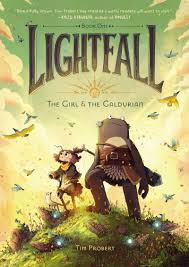
This is an enchanting first book in a new series. Tim Probert’s illustrations are wonderful–a fantastic soft palette and delightfully unusual characters.

Set in the land if Irpa, we first meet Bea and her cat Nimm. Bea is somewhat nervous by nature. Especially when it comes to a small jar with a flame in it which she is meant to be guarding.

Bea lives with her adoptive grandfather named Alfrid the Pig Wizard. Alfrid is, as the name suggests, a pig and a wizard and he makes potions for people. But he is also very forgetful. He leaves reminders for himself, but they don’t always help.

Bea ventures out to get some ingredients for a potion. She is in a tree, when the branch breaks. As she hangs on for dear life, a tall froglike creature walks past (on two legs), and as she falls out of the tree he catches her. The creature is Cadwaller, known as Cad. (more…)

Read Full Post »

SOUNDTRACK: LAURA MARLING-Tiny Desk (Home) Concert #10 (April 16, 2010).

I have become a huge fan of Laura Marling over the last few years.  I was so looking forward to her solo performance this past March. It was one of my bigger coronavirus disappointments that the intimate show is not going to be rescheduled.

Marling has been doing regular guitar lessons about her own songs (her tunings and playing style is unique and wonderful to see demonstrated).  You can see the past (and future) ones here.

(While many artists have postponed the release of their new music in the face of the COVID-19 pandemic, Laura Marling rushed to change the release date of her album from late summer to April.

As of right now her album is only available digitally. The physical release is slated for summer.

On this Tiny Desk (home) concert, we find her in her living room, with an intimate performance of songs from her just-released record Song For Our Daughter. The album is an homage to a future generation of women and to Maya Angelou’s Letter to My Daughter, a collection of essays addressed to a fictional daughter. The warm, home setting makes room for Laura Marling’s extraordinary voice to shine.

“Held Down” has a lot of backing vocals and arrangements on the record and this stripped down version sounds amazing without it all.

“Strange Girl” demonstrates her deeper singing style in a fast and bouncy song.

“Song For Our Daughter” is a slower song, beautiful and thoughtful.

I just cannot get over how beautiful her voice is.  These personal performances almost make up for not seeing her live.

[READ: April 20, 2020] Mac B. Kid Spy: The Impossible Crime

This is the second book in a new series illustrated by Mike Lowery.  It begins

My name is Mac Barnett.  I am an author.  But before I was an author, I was a kid.  And when I was a kid, I was a spy.  An author’s job is to make up stories.  But the story you are about to read is true.

This actually happened to me.

It’s 1989 and Mac is at the mini golf course.  But he is there not for the mini golf but for the video games. He is playing Spy Master 2–the arcade update to the home game.  Mac was just about to beat the big boss–something no one else had ever done before.  People were cheering him on. Except for Derek Lafoy (who did not invite Mac to his birthday party in the previous book). Derek called him Mac Barn Head and chanted “Choke!”

But this book isn’t about video games, its about the Queen of England who called Mac at the golf course to tell him that she thought the Crown Jewels were going to be stolen again.  (In the previous book Mac helped rescue the Crown jewels for the Queen). (more…)

Read Full Post »

SOUNDTRACK: KIRILL GERSTEIN-Tiny Desk Concert #958 (March 11, 2020).

I can’t really keep track of classical pianists. There are so many who are truly amazing.  But I love hearing them.  I also like it when they have a good sense of humor, which most of them seem to have.

The last time pianist Kirill Gerstein was at NPR we gave him a full-size, grand piano to play in a big recording studio. But for this Tiny Desk performance, we scaled him down to our trusty upright. “What will you ask me to play the next time,” he quipped, “a toy piano?”

Even if we had handed him a pint-sized instrument, I’m sure Gerstein could make it sing. Just listen to how Chopin’s lyrical melodies, built from rippling notes and flamboyant runs, flow like a song without words in Gerstein’s agile hands.

What sets Gerstein apart?  Perhaps its his connection to jazz.

The 40-year-old pianist, born in Voronezh, Russia, taught himself to play jazz by listening to his parents’ record collection. A chance meeting with vibraphonist Gary Burton landed him a scholarship to study jazz at Boston’s Berklee College of Music. At age 14, Gerstein was the youngest to enroll at the institution.

He opens the set with Chopin: “Waltz in A-flat, Op. 42.”  It is fast and amazing with some slow, jaunty parts.  Near the end, wow, doe he pound out those bass chords.

Before the second piece he says that it hasn’t been heard on a recording yet–it’s a newly written piece by Thomas Adès.  Two lovers want to hide in the closet and … sleep with each other.  They emerge dead in the morning, so its lascivious and morbid and a very beautiful piece.

The Berceuse for solo piano was written for Gerstein by Thomas Adès, adapted from his 2016 opera The Exterminating Angel. The work, both brooding and beautiful, receives its premiere recording at the Tiny Desk.

It is slow and beautiful, full of sadness and longing.  Until the end when the bass comes pounding and rumbling, full of ominous threat and dread.  And listen to how long he lets those last bass notes ring out!

Up next is a piece by Liszt who I am particularity fond of (even if I only know a few of his pieces).  Gerstein says that Liszt is perhaps the greatest composer that ever touched the instrument.  There are several hundred not famous pieces.  This is a late piece called “A quick Hungarian march.”  Technically it’s called “Ungarischer Geschwindsmarsch”

Gerstein follows by dusting off a truly neglected – and quirky – Hungarian March by Franz Liszt. To my knowledge it’s been recorded only once.

It is jaunty and spirited until the middle where it goes back and forth between fast runs and bouncy melodies.

Since I hadn’t read about his jazz background the first time I listened to this concert I was really surprised when he said he’d be playing the Gershwin-Earl Wild standard “Embraceable You” which he says is for dessert at this lunchtime concert.

Gerstein’s jazz background is still close to his heart. Which brings us to his lovely-rendered closer: Gershwin’s “Embraceable You,” arranged by the American pianist Earl Wild.

Like all master performers, Gerstein gives you the illusion that he’s making it all up as he goes along, even though the virtuosic transcription is intricately mapped out. And somehow, he makes that upright piano sound nine feet long.

It really does sound like he is working on the fly–playing beautiful runs. It’s hard to imagine transcribing and learning all of those notes instead of just improvising them, but that’s what make a great pianist, I guess.

[READ: November 2019] The Abyss

I saw this book at work and thought, a turn of the 20th century Russian author writing about the Abyss?  What’s not to like?

I had not heard of Leonid Andreyev, perhaps because much of his work has not been translated into English.  He died in 1919 and is considered “the leading exponent of the Silver Age of Russian literature.”

This book was translated by Hugh Aplin and it is remarkable how contemporary these stories sound (aside from obviously nineteenth and twentieth century details).

Bargamot and Garaska (1898)
Bargamot was a policeman–a big, thick-headed policeman.  His superiors called him numskull.  But the people on the streets he looked after were quite fond of him because he knew the area and what he knew he knew very well.  This story is set on Easter Saturday night.  People would soon be going to church.  But he was on duty until three o’ clock and he wouldn’t be able to eat until then. The day was going smoothly and he would soon be home until he saw Garaksa, clearly drunk, heading his way: “Where he had managed to get sozzled before daylight constituted his secret, but that he had got sozzled was beyond all doubt.”  Bargamot threatened to send Garaska to the station, but Garaska talked to him about the festivities of the day and was about to present to him an egg (a Russian custom).  But Bargamot’s rough handling smashed the egg.  This story turns surprisingly tender and sad, with a rather touching final line.

A Grand Slam (1899)
This has nothing to do with baseball.  It is about a card game called Vint, which is similar to bridge.  For six years these four people have been playing it: fat hot-tempered Maslennikov (whose name is Nikolai Dmitriyevich, we find out about five pages in) paired with old man Yakov Ivanovich and Yevpraksia Vasilyevna paired with her gloomy brother Prokopy Vailyevich.  Dmitriyevich desperately wanted a grand slam but he had been paired with Yakov Ivanovich who never took risks. Ivanovich was very conservative and never bet more than four–even when he ran an entire trick, he never bet more than four–you never know what might happen. They speak of news and local happenings (like the Dreyfus Affair), but Dmitriyevich stays focused on the game because his cards are lining up for a Grand Slam.  As he goes for that last card, he falls out of his chair, presumably dead.

Silence (1900)
This story is divided into sections.  Fr. Ignaty and his wife need to speak with their daughter Vera. They have a fight and Fr. Ignaty refuses to speak to her any more.  Soon enough she goes out and throws herself under a train [I would hate to be a train conductor in Russia].  In Part II silence has fallen over the house.  In Part III he tries to talk to his wife about his feelings and his sadness over their daughter, but she remains silent.  In the final part, Fr Ignaty finally breaks down.  But is it the silence that has gotten to him?

Once Upon a Time There Lived (1901)
Laventy Petrovich was a large man. He went to Moscow for someone in the city to look at his unusual illness.  He was a silent and morose man and he specifically asked for no visitors.  The hospital assigned Fr. Deacon to him.  Fr. Deacon was another patient, unfailingly positive.  He and Petrovich were at opposite sides of the spectrum.  But even as it became clear that Fr. Deacon was deathly ill, he remained positive.  Until Petrovich told him that the doctors said that Fr. Deacon has a week to live.  There was also a young student who was daily visited by the girl he loved.  They liked Fr deacon and did not like Petrovich. I’m not sure if the ending is a surprise, but it is certainly sudden with happiness doled out in very specific ways.

A Robbery in the Offing (1902)
That night there was to be a robbery and maybe a murder.  A man, alone with his thought is scared by nearly everything–he is very jumpy because he is the one about to do the robbery.  The man was frightened by a noise until he saw it was a little puppy.  The puppy was shivering and the man tried to frighten him to get him to go home. But the puppy seemed too ignore him.  So began the battle of wits between a big strong man and a tiny freezing puppy.  Imagine a man with a robbery in the offing worrying about a little puppy.

The Abyss (1902)
Two young lovers went for a walk.  Zinochka was 17 and very much in love.  Nemovetsky was 21 and similarly in love.  They wandered into an area they didn’t recognize and happened upon three men.  The men punched Nemovetsky and knocked him out then they chased Zinochka . When he came to, he found her body, naked but still alive.  This was a hard story to read.

Ben Tobit (1903)
This was one of the first stories in the book that I really really liked.  It is set on the day of Jesus Christ’s crucifixion.  On that day, Jerusalem merchant Ben Tobit had a terrible toothache.  Ben was a kind man and did not like injustice, but it was hard to be kind with this much pain.  His wife tried to help by giving him various medicines (like purified rat droppings). She then tried to distract him when the thieves came trudging past on their way to the crucifixion site.  It distracted him somewhat but mostly didn’t interest him.  She said, “They say he healed the blind.”  He replied, “If only he’d cure this toothache of mine!.”  The next day he felt better and they walked to the site to see what they missed.

Phantoms (1904)
Yegor Timofeyevich had gone mad so his relatives collected money to send him to a clinic.  He knew he was in a madhouse but also knew that he could make himself incorporeal and walk wherever he wanted.  He was exceedingly happy. There was a patient who would continually knock on any locked door.  He would walk through all the unlocked doors but when he got to a locked one he would knock and knock and knock.

There was a doctor’s assistant the hospital named Maria Astafeevna, whom Yegor was certain liked him.  He thought very highly of her.  But another man Petrov could say nothing nice about her.  He felt that she was like all women: debauched deceitful and mocking. This attitude upset Yegor tremendously.  Maria was actually in love with Dr Shevyrov. But she hated that he went to Babylon–where he drank three bottles of champagne each night until 5 AM.  She imagined that one day she would ask to be his wife bit only if he stopped going there.

The man Petrov was also terrified of his mother, believing that she had bribed officials to lock him up. He would become hysterical when she would visit.  It was only Yegor’s assurances to her that her son was a decent man that made her feel okay.

Most days things went on exactly the same, the same faces, the same conversation and the same knocking.

The Thief (1904)
Fyodor Yurasov was a thrice-convicted thief.  While on the train, even though he had plenty of money, he stole a gentleman;s purse.  As he tried to blend in, he imagined everyone thought he was an honest, young German (he came up with the name Heinrich Walter).  But when he tried to be civil, everyone ignored him.  Some were downright rude to him.  Later when he hears that the gendarme are looking for someone, he assumed it is he.

Lazarus (1906)
This story looks at what Lazarus’ life was like after he came back–appearing a few days dead and with a shorter temper.  People understood and forgave him, but still.  Soon, however, people began to avoid him and claimed that all of the madmen in the village were people whom Lazarus had looked upon.   It’s such an interesting (if exceeding dark) tale that no one bothered to investigate before.

A Son of Man (1909)
As Fr. Ivan Bogoyavlensky grew older he grew more disatisfied with his role in life.  He wanted to remove his surname and replace it with a five-digit number (The church elders assumed he’d gone mad).  He then bought a gramophone and listened only to stories of Jewish and Armenian life.  His wife hated it and it drove their puppy mad (?!).  Indeed he kept trying to get the puppies to listen to the gramophone and they consistently went crazy and eventually died.  The church sent a deacon to help Fr Ivan through this but he the deacon and Fr Ivan butted heads immediately.  Fr Ivan began mocked everything about their religion.

Incaution (1910)
A priest arrived at a railway station and saw a steam engine for the first time. There was no one around, so he climbed aboard.  It wouldn’t be dangerous to flick some switches and pull some levers.  Would it?

Peace (1911)
A dignitary was dying and an devil–an ordinary devil–came to his bedside offering him eternal life in hell.  The man didn’t want to suffer but the devil said that suffering was terrible until you got used to it and then it was nothing.  The devil makes a stronger and stronger case if only the man would take this pen and sign.

Ipatov (1911)
Nikolai Ipatov was a rich merchant who went bankrupt. Soon he became silent and despondent.  The local priest chastised him saying that the house of god was a house of joy.  He refused to let the merchant back in until he grew happy again.  Which he didn’t.  Eventually his children took over the situation and and put his house up for sale.  But when someone came to look at the house, they heard Ipatov’s moaning and grew existential realizing that a man without guilt could still be afflicted this way.

The Return (1913)
The narrator had been in a cell n St Peterburg for three years because of a political incident.  His wife, who was supposed to be waiting for him in a hotel room had stepped out with another man.  He hired a cab to follow them.  They kept driving around and around, some streets seeming to stretch on endlessly.  Then the cab driver told him that they had been at the same intersection many times.  He finally arrived at the gate and when he banged on it, who should open the gate but his prison guard.

The Flight (1914)
Yury Mikhailovich was an experienced pilot.  Twenty eight flights and no troubles.   He always felt, “If I crash, I crash, nothing to be done about it.”  Despite everything he had on earth, he longed to be up ion the sky…possibly forever.  It’s incredible that Andreyev wrote a story like this in 1914!


Read Full Post »

SOUNDTRACK: NEIL PEART-September 12, 1952-January 7, 2020.

When I was in high school, Rush was my favorite band, hands down.  I listened to them all the time.  I made tapes of all of their songs in alphabetical order and would listen to them straight through.

I still loved them in college, but a little less so as my tastes broadened.  But every new release was something special.

It’s frankly astonishing that I didn’t seem them live until 1990.  There were shows somewhat nearby when I was in college, but I never wanted to travel too far on a school night (nerd!).

For a band I loved so much, it’s also odd that I’ve only seen them live 5 times.  However, their live shows are pretty consistent.  They play the same set every night of a tour (as I found out when I saw them two nights apart), and there wasn’t much that set each show apart–although They did start making their shows more and more fun as the years went on, though).

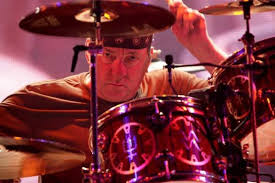
One constant was always Neil Peart’s drum solo. It too was similar every night.  Although I suspect that there was a lot more going on than I was a ware of.  It was also easy to forget just how incredible these solos were.  Sure it was fun when he started adding synth pads and playing music instead of just drums, but even before that his drumming was, of course, amazing.

It was easy to lose sight of that because I had always taken it for granted.

I am happy to have seen Rush on their final tour.  I am sad to hear of Neil’s passing.  I would have been devastated had it happened twenty years ago, but now I am more devastated for his family.

So here’s two (of dozens) memorials.  The first one is from the CBC.  They included a mashup of some of Neil’s best drum solos:

But what better way to remember the drum master than with a supercut of his drum solos? From a 2004 performance of “Der Trommler” in Frankfurt, Germany, to a 2011 performance on The Late Show With David Letterman, to his first-ever recorded drum solo (in 1974 in Cleveland, Ohio), dive into nearly five minutes of Peart’s epic drum solos, below.

The best Neil Peart drum solos of all time.

I was only going to include this link, because it was a good summary, then I saw that Pitchfork ranked five of Neil’s best drum solos (an impossible task, really).  But it is nice to have them all in one place.

You can find that link here.

Starting in the 1980s Neil’s solos were given a name (which shows that they were pretty much the same every night).  Although as I understand it, the framework was the same but the actual hits were improvised each night.

Even after all of these years and hearing these drum solos hundreds of times, watching them still blows my mind.

  • “The Rhythm Method”
  • “O Baterista”
  • “Der Trommler”
  • “De Slagwerker,”
  • “Moto Perpetuo”
  • “Here It Is!”, “Drumbastica,” “The Percussor – (I) Binary Love Theme / (II) Steambanger’s Ball”

[READ: January 2020] Canada 1867-2017

In this book, Paul Taillefer looks at the most historically significant event from each tear of Canadian history.  And he tries to convey that event in about a page.  Can you imagine learning the history of your country and trying to condense every year into three paragraphs?

And then do it again in French?  For this book is also bilingual.

I can’t read French, but i can tell that the French is not a direct translation of the English (or vice versa).

For instance in 1869, the final sentence is:

This, in turn, signaled the start of the Red River Rebellion which would not end until the Battle of Batoche in 1885.

Neither Batoche nor 1885 appears in the entire French write up.  So that’s interesting, I suppose.  I wonder if the content is very different for French-reading audiences. (more…)

Read Full Post »

SOUNDTRACK: PEARL JAM-“Santa Cruz” (1993).

On December 2, Pearl Jam announced that their fan club holiday singles will be released to streaming services.  Their first holiday single was released back in 1991.  It was “Let Me Sleep (Christmas Time).” They are rolling out the songs one at a time under the banner 12 Days of Pearl Jam.

These releases are coming out as a daily surprise.

Pearl Jam released a song called “Santa God” the other day. This song also has Santa in the title, but it is not about Santa Claus.  It is indeed about Santa Cruz.

This song appeared on the b side of the band’s terrific take on the John Doe song “Golden State” (co-sung with Corin Tucker of Sleater-Kinney).

This song also has a folkie feel–acoustic guitars and multi-tracked vocals from Eddie.  It even opens with a harmonica!

It’s a delightful road song abut travelling to Santa Cruz:

Heading South a compass reads
Look at our speed, we’re going sixty-three
Look out the window as the trees go green
I look at them and they look at me
Got Neil Young on the stereo
He comes along whenever i go

It’s a really pretty song and deserves to get more airplay.  Frankly if Santa Cruz hasn’t used it their official anthem, the town leaders are fools.

[READ: December 9, 2019] “The Snow Man”

This year, S. ordered me The Short Story Advent Calendar.  This is my fourth time reading the Calendar.  I didn’t know about the first one until it was long out of print (sigh), but each year since has been very enjoyable.  Here’s what they say this year

The Short Story Advent Calendar is back! And to celebrate its fifth anniversary, we’ve decided to make the festivities even more festive, with five different coloured editions to help you ring in the holiday season.

No matter which colour you choose, the insides are the same: it’s another collection of expertly curated, individually bound short stories from some of the best writers in North America and beyond.

(This is a collection of literary, non-religious short stories for adults. For more information, visit our Frequently Asked Questions page.)

As always, each story is a surprise, so you won’t know what you’re getting until you crack the seal every morning starting December 1. Once you’ve read that day’s story, check back here to read an exclusive interview with the author.

Want a copy?  Order one here.

I’m pairing music this year with some Christmas songs that I have come across this year.

This story, written over a hundred years ago, felt rather timeless.  Aside from a few word choices and spelling, this story could have been written this year.

It’s also amusing that it is a Christmas story but is actually about a thief doing a job on Christmas Eve.

He starts the remembrance saying that he has both good and bad reasons for remembering Christmas of 189-.  He’d had his eye on Wharton manor “as a crib worth the cracking” (being ahead of MTV Cribs by over 100 years).  This particular job ended his thieving career and set him on the path to good.

The narrator assures us he was never the mere midnight marauder who is supposed to “lurk under the bed until the family is asleep.”  He fancied himself better than that.  He never carried a weapon and trusted fortune to be his guide:

if i were dolt enough to walk into a trap or let another man’s wits outwit mine…I ought to yield him the palm like a gentleman.

The manor was well protected–a large wall and a winding drive kept it hidden from sight.  The wall was there more as a protection from the precipitous drop on the other side of it than to keep people out.  (more…)

Read Full Post »

SOUNDTRACK: TAYLOR SWIFT-Tiny Desk Concert #902 (October 16, 2019).

Most Tiny Desk Concerts are from musicians that few people have heard of.

Not this one!

It’s hard to imagine exactly how it happened that Tiny Desk Concert managed to get Taylor Swift to play.  And to play with just a acoustic guitar and piano.  “It’s just me. There’s no dancers, unfortunately,” she quipped.

I have seen people already complain that Tiny Desk is supposed to be for unknown artists blah blah blah.  But I think it’s pretty awesome that a) Taylor Swift is a fan of NPR and Tiny Desk and b) that this show will bring more notoriety to Tiny Desk and potentially other bands.

Plus–I had no idea that Taylor Swift was not a studio creation–that she’s actually a real and thoughtful person who wrote her own music.

She talks confidently and casually about songwriting and she seems pretty genuinely pleased to be there.

As she settled in for her Tiny Desk, she looked out at the 300-plus NPR employees and guests. “Wow! This is a lot of people in a tiny office!” she said. “I love it!”

She delightfully says, “It’s great to be in DC.  You guys had anything exciting going on in the last couple of weeks?  Any possible changes in play?”

And, hey, she writes good songs, too.

I’ve never really listened to her music–although I love “Shake It Off.”  I haven’t actually heard anything of her new album so this was all new to me.

After introducing herself, she explained her objective: “I just decided to take this as an opportunity to show you guys how the songs sounded when I first wrote them.”

She talks a lot about each song and why she wrote them.

Opening with an acoustic rendition of “The Man,” from her 2019 album Lover, Swift delivered a critique of gender double-standards with a sense of humor (and a perfectly deployed hair toss), Leonardo DiCaprio name-check and all.

She says she has been thinking about the topic for many years and it was something she wanted to write about conceptually for a very long time because we have a bit of double standard issue in our society.  She wondered if there was a concise and catchy way to write a song about this?  So she decided to imagine what her life would be like if she said and did all the same things but if she was a man.

While not an original idea, she tackles it really well.  And I like that she’s using her platform to address the issue

I would be complex
I would be cool
They’d say I played the field before
I found someone to commit to
And that would be okay
For me to do
Every conquest I had made
Would make me more of a boss to you
I’d be a fearless leader
I’d be an alpha type
When everyone believes ya…
What’s that like?

And it’s really catchy too.

At the end of the song she gives her pick to a little one in the audience (to a room full of awws).  Then she switches instruments.

She talks about the process of writing songs–when something comes and its easy, that’s wonderful.  But most days you show up… and the idea doesn’t.  Then you have to know the craft of songwriting–you’re not always going to be inspired and that’s okay.

Turning to the piano for Lover‘s title track, with a smile, she explained the guitar-string scars of the song’s bridge.

She says that she has scars on her hands from playing guitar when she was young–when she played until her fingers bled or when a string snapped and cut her.  In your life you received all kinds of scars–emotional and physical and if someone is going to take your hand, they’d better take your hand scars and all.

It’s a pretty piano ballad and her voice is really pure.

After the song she removes her blazer to reveal a velvet top (she must have been very hot).  “You guys ever had costume changes at Tiny Desk?” She then finds three more guitar picks to give to three other kids, one of whom you can quickly see is pretty darn excited.

Picking up the guitar again for “Death by a Thousand Cuts,” Swift confronted a question that she says has haunted her career: What will you ever do if you get happy?

She receives this question over and over that “has the potential to seriously deteriorate my mental health.”  “What will you ever do if you get happy?  Will you just never be able to write a song again?    She says she used to reply that she started off when she was 12, she was writing songs about things she had no idea what she was talking about.  She wrote songs about heartbreak based on movies and books and character studies.  So she would say, “If stuff is going on in the world maybe she could hey inspiration from that.

But then she really asked herself that question.  “Would I not be able to write break up songs?  I love break up songs!  They’re so fun to write.”  She says she had friends going through breakups and she was watching movie and reading books about breakups and these ideas came to her.  She woke up with heartbreak lyrics in her head and realized “It’s still here!”

Across the song’s run-on thoughts and relentless searching, Swift offered an answer: She’ll continue to excel at crafting superb story-songs.

I rather like her songs on acoustic guitar–even if I’m not much of a fan of break up songs.

Before the final song, “All to Well,” she talks about how she never googles herself–she recommends you not do it either.  But her dad does.  He sends her links to lists that people rank her songs (she finds it very nice that people care enough to do that).  When the Red album came out, she said there’s a song and “I’m the only one who loves this song this much–because it happens to me and its personal.”  But it turns out that this song tops everyone’s favorite list.  “I’m happy that my opinion lines up with your opinion on that.”

I actually didn’t know this song at all–I guess I am really isolated from pop music.

She says, “here’s a sad song about fall.”  It’s very pretty on piano and once again her voice is really great.  I really like the way the words unfold and then reflect back on themselves.  It’s a really wonderfully crafted song.

This Tiny Desk Concert may not introduce Taylor Swift to a lot of people, but it pretty much did introduce me to her music.  And I was really impressed.

[READ: August 19, 2019] Lost Empress

I loved Sergio De la Pava’s A Naked Singularity. It was complicated and funny and clever and bizarre and thoroughly engaging.

Lost Empress is even better.

There’s a story about a woman running a football team–and being overlooked because she is a woman.

There is a storyline about 911 operators, and the guy who transcribes them.

The third story is about a tough, smart guy who is in jail.  He is his own defense for trying to get out.  And he hatches a plan that involves stealing artwork, the Paterson Falls and the Super Bowl.

I enjoyed it in part because much of it is set in Paterson, NJ.  I grew up next to Paterson and the city has for most of my life been in a state of decline.  Despite all of the great things it has to offer (like the Paterson Falls! which get a shout out in this book), Paterson gets no respect.  This book doesn’t exactly aim to correct that, but it does give the city something cool–a football team.

It also jokes about “what the hell is up with Paterson?”  The city had once tried to rebrand itself in which they staged a contest  for “an official slogan for the troubled city.”  Proposals emerged: “the verifiably untrue, the unintentionally insulting/intentionally insulating, the so vague that sense fails to be created, the rhyme or alliteration for its own sake, and the technically true but not even conceivably relevant.” (more…)

Read Full Post »

SOUNDTRACK: NICOLE BUS-Tiny Desk Concert #882 (August 21, 2019).

Nicole Bus is from Amsterdam.  Everything about her makes it seem like she has been around for a while.  Her style of music, her raspy voice (which makes her sound older than she is) and her choice of instrumentation (the horns and flute melodies sound old school).  But she is an emerging artist:

Nicole Bus’ sound is nostalgic. It’s reminiscent of vintage R&B, yet still feels current, and can transcend age and demographics.

Her style is R&B, but her singing style is far more reggae influenced.  It’s really fascinating.  The first song, “You,” opens with spooky piano from Eugene “Man Man” Roberts and slow horns from Chris Stevens (trumpet) and Aaron Goode (trombone). I love the addition of the flutes from Korey Riker.  More and more I can’t get over how good flutes sound in rock.  Her delivery is quite reggae until she lets out with her powerful raspy voice.  The song is really catchy.

Nicole followed by premiering a new song about women’s empowerment, “Love It.”  Drummer Mark Thomas starts with drums and then switches to hand drums.  Anthony DeCarlo adds acoustic guitar while Jasmine Patton sing high note backing vocals.  I love in the middle of the song when Eugene “Man Man” Roberts play a very 70s-sounding fill on the keyboards.  Riker adds more great flutes.

She ends the set

with “Mr. Big Shot,” an up-tempo banger mixing high-energy rhythms with ragga-influenced vocals.

Nicole plays acoustic guitar and there’s a cool, catchy four note bass riff from Ray Bernard that propels the song along.  Lamarcus Eldridge joins Patton for some great backing vocals.  This melody has been stuck in my head for days now.

I’d never heard of Nicole Bus, but I really enjoyed her set and her energy.

[READ: September 1, 2019] Paper Girls

This book turned out to be so much more interesting than I imagined.

The title was strangely puzzling and the cover had a kind of 1980s look to it.

It didn’t occur to me that “paper girls” meant newspaper delivery girls.

It’s coincidental that this book starts out with the main character, Erin, getting up at 4:40 to deliver papers since that’s almost exactly the same way as Middlewest in which Abel gets up at 4:30 to deliver papers.

Anyhow this story is quite different form that one because it has a cool feminist attitude, although it is also supernatural.

It begins with Erin asleep and dreaming of Christa McAuliffe in heaven.  Then she wakes up at 4:40 and gets ready to deliver the Cleveland Preserver.  It’s also November 1 (1988) as evidenced by The Far Side calendar (nice touch). The calendar has “hell morning” written on it.

Why?  Because at 4:40 on the morning after Halloween there are still hooligans roaming the streets.  One dressed as Freddy Krueger harasses Erin immediately.  But while he is giving Erin a hard time, three girls pull up on bikes and harass right back.  One girl uses some very inappropriate language which Erin (who goes to Catholic school) chastises her for.  The girl, Mac, waits for a thank you. (more…)

Read Full Post »

« Newer Posts - Older Posts »