Feeds:
Posts
Comments

Archive for the ‘Politicians’ Category

SOUNDTRACK: MELANIE CHARLES-Tiny Desk (Home) Concert #165 (January 4, 2021).

I had never heard of Melanie Charles and boy was I in for a treat with this being my first exposure to her.

A Brooklynite proud of her rich Haitian heritage, Charles is conscious of the giant shoulders upon which she stands and takes steps to both honor and advance this music. Behind her, smiling pictures of her guardian angels, Mary Lou Williams and Billie Holiday, encourage Charles while she and her musicians blend the mystique of Haitian folk music with the sorrowful optimism of negro spirituals and the free space for elevation that jazz improvisation allows.

The video opens on a dark screen with samples being manipulated and twisted.  It’s amazing to have the camera fade from black into this really old-fashioned looking scene–upright bass, snare drum and a nearly sepia filter on the video.  And then there’s Melanie Charlie dressed in a beautiful but old-fashioned looking ensemble manipulating all of the sounds.

She is playing from the

Williamsburg Music Center, one of Brooklyn’s last surviving black-owned jazz venues… This performance was a full circle moment for Melanie Charles. The Williamsburg Music Center is owned by Gerry Eastman, a celebrated musician and composer who taught the jazz class Charles and her brother and saxophonist, Rogerst Charles, attended when they were in high school. According to Charles, Eastman “represents a special era of Brooklyn jazz musicians” and created a space that gave these artists a place to perform when all other doors were closed to them.

Then she starts singing French while Jonathan Michel plays a bass solo /melody.  This song is

“Damballa Wedo,” [in which] Charles channels her Haitian roots and delivers a modern twist of a traditional vodou song by Toto Bissainthe. She sings that when we seek transformation, we may become someone who those around us no longer recognize, but that the change is necessary and part of the ancestors’ divine plan. “C’est bon, c’est bon,” she sings.

Up next she offers a little Sun Ra vibration.  She plays a sample and dramatically shuts it off as it loops.  The starkness of the silence is very dramatic.   Then she starts singing

Charles’ arrangement of “Deep River” is inspired by her admiration for Sun Ra. The biography of the eccentric composer, arranger, musician, and early pioneer of Afrofuturism, Space Is The Place rests on a stand behind her. By really digging into his approach and arrangements and using his “spaceship setup as a performance guide,” she breathes new life into this spiritual, injecting it with a potency that is simultaneously somber and otherworldly.

While the sample continues the band picks things up.  The bass and sax play the main melody while Melanie plays some sharp and cool flute accents.

And what a voice!

Before the final song, she introduces the band:

Jonathan Michel: who looks like an upright bassist–he’s got that Ron Johnson turtleneck.  Shout out to Ron Johnson.  On drums, Diego Ramirez: coming in at the last minute and learning the songs over night.  On saxophone, Rogerst Charles, my blood brother, my heart.

The final song is “Dilemma.”

She finishes the set with “Dilemma,” a new song written to find the balance between self-care and showing up for those you love amid the cries for justice during the first summer of the pandemic. On our phone call, Charles explained that the song is an anthem that reminds us to not to “dim your light for anybody” and “remember how vibrant we are, despite what we as black people had to deal with in 2020.”

She plays keys and sings a soft song until the whole band joins in.  After a couple of minutes she she sings a high note and the sax plays the same note a wailing harmony of greatness.

With about two minutes left she starts singing the coda “we’ve been doing alright be we still shine bright.”  The band sings along and she interjects:

We’ve been doing alright
even though we didn’t get our stimulus.
But we still shine bright.

[READ: March 31, 2021] Only Righteous Fights

On December 31 of 2020 I donated some money to Elizabeth Warren (I’m not actually sure to what end it was used–presumably her Senatorial campaign?) to pre-order this collection of speeches (and get a laminated bookmark!).

There are few things more disappointing than reading amazing, inspiring and truly moving speeches by a person who lost a candidacy.

Kamala Harris and Elizabeth Warren were my number 1 and number 2 choices for President.  I didn’t have to worry too much about which one I would ultimately choose, I was just happy they both were so successful (until they weren’t).  Having Harris as V.P. is pretty awesome, and I will acknowledge that Biden (who was my last choice) has been doing a good job thus far (apparently having taken ideas from all the other candidates…which is rather a good idea).

But reading this book and seeing how genuine Warren was (or came across) and how much she cared (or appeared to) for the people she spoke to and about, it is crushing that her campaign didn’t last.

There are five speeches in the book as well as lots of photos.  There’s a few smaller sections as well, like photos from the Selfie Line, Letters to Elizabeth and Pinky Promises.

What’s impressive is how she manages to hit all of her main bullet points and yet how each speech is quite different. (more…)

Read Full Post »

SOUNDTRACK: MESHELL NDEGEOCELLO–Tiny Desk (Home) Concert #167 (February 10, 2021).

I bought Meshell Ndegeocello’s Plantation Lullabies back in 1993 on the strength of “If That’s Your Boyfriend,” a funky track that is still pretty great.  I didn’t realize she had been steadily putting out music ever since.

This Tiny Desk (home) concert … includes songs from throughout her career framed by her thoughts on the importance and influence of James Baldwin: “He deserves flowers every day. Most of all because he was willing to discuss things that were painful, hard to look at, hard to see, hard to accept.”

Ndegeocello is a bad-ass bass player with a serious funk edge.  And yet in this Tiny Desk Concert, she strips almost all of that away.

The first song comes from Lullabies, but in this version of “Step Into the Projects” she strips away all the music and turns the song into a spoken word piece (although she does keep the rhythm of the original).

For the next three songs she is accompanied by her longtime guitarist Chris Bruce.

“Price of the Ticket,” is from Ndegeocello’s recent project, Chapter & Verse: The Gospel of James Baldwin, “a 21st century ritual toolkit for justice” inspired by Baldwin’s The Fire Next Time.  In the track, it’s just Bruce’s gentle guitar and Meshell’s quiet voice.

“Forget My Name” from Comet Come To Me (2014) is stripped down from its original reggae arrangement and lays bare the haunting imagery in the lyrics.

She plays some spare bass, but musically it’s all about Bruce–the cool low riff and the pretty high melody.

“Fool of Me,” from her acclaimed album Bitter (1999), ends the set with just vocals and guitar.

Like the other songs, it is spare and beautiful, allowing you to really hear the words.  I love Meshell’s funk, but this is a beautiful set.

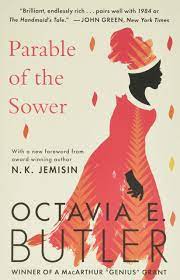
[READ: March 29, 2021] Parable of the Sower [2026-2027 (chapter 19)]

I have not read Cormac McCarthy’s The Road, and I don’t intend to.  But I feel like this book acts as a precursor to that one.  And that is something I did not in any way expect.

2026 opens in June, almost seven months after the previous entry.  I’m curious about the distance between entries.  It’s possible that Lauren has dozens and dozens of pages that just said, “today sucked” and we don’t need to see that.  But I am curious about the time jumps.

Is it a way for Butler to move us ahead quickly so that something that needed to take a few years to happen is given the time to do so?  I’m thinking about Mars a bit.  In two years a lot can happen with the space program.  Of course, the President was supposed to cancel the program.  So who knows what’s going on there.  Aside from basic passage of time, did we need to wait six months to see what came next?  I’m not sure.

In June Keith is back–bigger and more confident.  He’s not yet 14, but he’s very successful, bringing home money and gifts (but none for his father).  He has ingratiated himself into a gang by being the only literate one in the group:

They’re all older than me, but not one of them can read or write anything.  They stole all this great stuff and they couldn’t even use it.  Before I got there they even broke some of it because they couldn’t read the instructions. (105)

Lauren and Keith have a heart-to-heart–really their first ever.  He learns a bit about her and while he gains a little more respect he also tells her that she’d never survive out there–she doesn’t know enough.  He also tells her about these new crazies called Paints who paint their skin green or blue or yellow and eat fire and kill rich people.

Keith comes back on her birthday and gives her a present.  A month later he is dead–killed in a horrific and gruesome way.  He was clearly tortured and left to be found.  His death was a message for someone–a rival gang, probably.

But they don’t call the police:

cops liked to solve cases by “discovering” evidence against whomever they decided must be guilty.  Best to give them nothing.  They never helped when people called for help.  They came later and more often than not, made a bad situation worse. (114)

In October, a new component to the story crops up.

Kagimoto, Stamm, Frampton and Company (KSF) has taken over a nearby town called Olivar.  It is small and well to do.  The citizens voted to let their town be taken over–privatized.  They intend to set up energy resources in the community–solar, wind, desalinization.  They mean to own great industries in an area that people have given up on.

Kagimoto, Stamm Frampton: Japanese, German, Canadian.  When I was young, people said it would come to this. Well why shouldn’t other countries buy what’s left of us if we put it up for sale. (121)

This is another aspect of the story that confuses me.  Is it basically that Los Angeles has exploded and the rest of the country is okay?  There’s talk about work up north, but why?  What happened to the country that they/we would let L.A. collapse but nothing else.  Or maybe it’s the entire South West?  Nobody knows anything about the East Coast, apparently.   I’m hoping that they will get explained a bit later on.

Olivar was accepting applications to live there.  They were looking for educated people.  And here we learn that both of Lauren’s parents have PhDs [a commentary on the invisibility of Black scholars?].  Her stepmother thinks it’s a great idea to go to Olivar.  They would be guaranteed safety and security.  But her father is against it, calling it “half antebellum revival and half science fiction” (122).

Anyone KSF hired would have a hard time living on the salary offered. In not very much time, I think the new hires would be in debt to the company.  That’s an old company-town trick–get people into debt, hang on to them and work them harder.  Debt slavery. That might work in Christopher Bonner’s America. Labor laws, state and federal are not what they once were. (121)

Come November, the Garfields have been accepted at Olivar.  The Garfieds include Joanne, Lauren’s one time best friend (who misplaced Lauren’s trust by tattling to her father).  Joanne has been serious with Harry Balter.  But Harry is staying in Rebledo.  Lauren suggests they get married and then Harry can move in with them, but she says that Harry wants to get married and travel north.  He thinks they way Lauren’s father does about Olivar.

But the Garfields are still going: “conservative and sensible and mature and wrong” (128).

In November, Lauren’s father did not come home one night.  They spend days looking for him with no luck.  The search parties uncover all kinds of remains, some of which they think might be her father’s but which turn out not to be.

The search also reveals an aspect of Lauren’s hyperempathy that we didn’t know–sound doesn’t trigger it (she hears a man screaming), only sight does.

Five days alter they have a Sunday survive that turns more or less into a memorial.  Lauren speaks at he service and proves to be powerful preacher.  She speaks of God but presumably she means her own god–the earthseed god.  By mid-December they have a formal funeral–they accept that he would have found his way home by now.

Later, when KSF came for the Garfields, it was in an armored truck

The two movers were a black and a white, and I could see that Cory considered that hopeful.  Maybe Olivar wouldn’t be the white enclave that Dad had expected. (139)

All along Lauren has been romantically involved with Curtis.  People anticipated that she would get married an have a baby with him–something she strongly resisted.  Indeed, her plan all along was to leave Rebledo without him.  But now with Lauren’s father gone (he was the reason she hadn’t left yet–she didn’t want to hurt him), Curtis suggests that they both go.  He’s upset that she wanted to go without him, but she explains that she didn’t want to force him to make that choice.

Two days later, someone burned down the Payne/Parrish house; while that was going on. they robbed three of the other houses including Lauren’s.

I’ve been frightened at the phrases that Butler says that prove eerily prophetic to the last few years:

People are setting fires because they’re frustrated, angry, hopeless. They have no power to improve their lives, but they have the power to make others even more miserable.  And the only way to prove to yourself that you have power is to use it.  (143)

Interestingly, the drug that gave Lauren her hyperempathy–Paracetco–was initially a legitimate drug intended to help victims of Alzheimer’s disease.  Pyro was an accident–a homebrew on the East coast it made it was away across the country.

People on the fire drug get off on watching things burn.  Blaze, fuego, flash, sunfire.  The most popular name is pyro short for pyromania [I’m fascinated that she needed to spell that out as I feel that in 2021 (and much earlier) it was a common abbreviation].

As the year ends, the families try to make due with what they have left.

Then we enter 2027.  Once again it’s six months into the year.  And this is when things change dramatically.   Thieves drove a truck through their wall and set everything on fire.  Nearly everyone in the community was killed.  [I did wonder if it was worthwhile learning anyone’s names, and it was two people I didn’t think twice about who survived].  The description is a violent orgy of death, rape, fire and who knows what else.  It is brutally described.  Lauren escaped.  She had the forethought to run back in and put on clothe and shoes and grab her bug out bag.  No one else in her family had done so. She saw them n bare feet and pajamas and then she didn’t see them any more.  She managed to get outside and to hide until the next day,

She crept back into her community and went to her house which was being looted and stripped. She knew where there were some hiding places and she managed to get clothes for her family as well as money that was hidden in the ground.  She grabbed a gun and got out, looking like all the other miserable looters.

Lauren was sure she was alone.  Then out of the rubble came Harry Balter and Zahra Moss–the youngest wife of Richard Moss the polygamist.  Zahra’s baby was killed (brutally) and an attacker was about to (or had begun to) rape her when Harry saved her (and got beaten for his help).  Neither one had planned for anything like this and they are pretty hopeless.  Lauren decides that three is safer than one and invites them to go North with her.

Zahra’s backstory is interesting.  Richard bought her from her mother who was a drug addict and a prostitute.  Zahra has lived on the streets and she knows what’s what.  She takes them to Hanning Joss, the biggest secure store complex.  I’m fascinated to learn that there are are still megastores and that they have security allowing people to shop safely there–commerce always wins.

Then they do what everybody else does–they head North.  Lauren has decided to pass as a man.  She’s tall and muscular and can do so, so she cuts her hair short.  They encounter much danger and violence but manage to get relatively far north.  Harry is a trusting guy, trying to avoid violence in any way possible.  But Lauren (and Zahra) knows the reality of the situation–kill or be killed; steal or be stolen from.  And with Lauren’s hyperempathy, she can’t afford to let people around her suffer.  She winds up cutting a man’s throat to stop the hurting that he (and she) are feeling.  Harry is appalled at her.  So she finally admits to her hyperempathy assuming they’ll abandon her.  But they do not–three is better than two.

Zahra and Harry become a couple and have unprotected sex (what harm could come from that?)

Then the trio meet another family who seems to be tagging along after them.  Everyone is out for themselves, but Lauren takes pity on this mixed race couple with a baby.  She helps them out at the second Hanning Joss and a few days later, when Lauren saves their baby from a feral dog, they agree that five (or six) is better than three and two (or three).

The new people are Travis Charles Douglas, Gloria Natividad Douglas and six month old Dominic. They are going to Seattle where Travis’ aunt lives.  Travis is quite taken aback when he learns that Lauren is a woman–especially since she saved them, but he’s going to have to get over it.

All of this time, Earthseed has been running around in Lauren’s head, but it hasn’t really shown up.

Then in chapter 18, Lauren starts talking to them about Earthseed.  Travis is a (surprisingly) intelligent man–he knows about entropy.

Travis’s mother was a live in cook for a rich man.  But before that she had written for newspapers and magazines.  She taught Travis to read. The man she worked for had a library and she would sneak out one book at a  time–he didn’t want Travis touching his stuff.

Of course. Slaves did that two hundred years ago.  They sneaked around and educated themselves as best they could sometimes suffering whipping, sale or mutilation for their efforts. (218)

Natividad was a maid and the rich man let them marry:  The son of the cook marrying one of the maids. That was like something out of another era too.

They discuss her poems–Earthseed.  Travis pushes back against her ideas, although never in an aggressive way.

She argues that here is no pore pervasive power than change.  Travis says that nobody is going to worship change.  Lauren says she hopes not

This excerpt from God is Change summarizes this discussion nicely:

“I was looking for God. I didn’t know whether there was a god to find, but I wanted to know. God would have to be a power that could not be defied by anyone or anything.”
“Change.”
“Change, yes.”
“But it’s not a god. It’s not a person or an intelligence or even a thing. It’s just … I don’t know. An idea.”
“It’s a truth. Change is ongoing. Everything changes in some way— size, position, composition, frequency, velocity, thinking, whatever. Every living thing, every bit of matter, all the energy in the universe changes in some way.”
“Sort of like saying God is the second law of thermodynamics?”
“That’s an aspect of God. There are all kinds of changes in the universe.”
“But why personify change by calling it God? Since change is just an idea, why not call it that? Just say change is important.”
“Because after a while, it won’t be important. People forget ideas. They’re more likely to remember God— especially when they’re scared or desperate.”
“Your stuff isn’t very comforting.”
“It is after a while. I’m still growing into it myself. God isn’t good or evil, doesn’t favor you or hate you, and yet God is better partnered than fought.”
“Your God doesn’t care about you at all.”
“All the more reason to care about myself and others. All the more reason to create Earthseed communities and shape God together. ‘God is Trickster, Teacher, Chaos, Clay.’ We decide which aspect we embrace— and how to deal with the others.”
“But nobody’s going to worship change.”
“I hope not.  Earthseed deals with ongoing reality, not with supernatural authority figures. Worship is no good without action. With action, it’s only useful if it steadies you, focuses your efforts, eases your mind.”
“Praying makes people feel better even when there’s no action they can take. I used to think that was all God was good for.”
“That isn’t what God is for, but there are times when that’s what prayer is for. And there are times when that’s what these verses are for. God is Change, and in the end, God prevails. But there’s hope in understanding the nature of God— not punishing or jealous, but infinitely malleable. There’s comfort in realizing that everyone and everything yields to God. There’s power in knowing that God can be focused, diverted, shaped by anyone at all. But there’s no power in having strength and brains, and yet waiting for God to fix things for you. Best to understand that and return the effort: Shape God.”

Lauren thinks he might join her movement.  Zahra is already on board.

She imagines finding and isolated place on the coast and making a deal with the owners–if there were more of them and they were better armed, they could provide security as well as education.

This fantasy, this plan gives the first sign of hope in this bleak world of Lauren’s.  It seems impossible.

Read Full Post »
SOUNDTRACK: MR. BUNGLE-The Raging Wrath of the Easter Bunny Demo (2020/1986).

In 1986, Mr. Bungle released a demo tape called The Raging Wrath of the Easter Bunny.

In 2020, after a reunion tour of sorts, the band rerecorded the album, with some slight personnel changes. Original singer Mike Patton was still there as was masterful guitarist Trey Spruance and bassist Trevor Dunn.  But they had two impressive guests stars (who also performed live with them), Scott Ian (from Anthrax) on rhythm guitar and Dave Lombardo, drummer extraordinaire.

And thus they re-recorded the initial demo.  Fans of Mr. Bungle’s later genre bending work would be a little disappointed because this was pretty much a heavy heavy metal record.  But it is Mr. Bungle so you know there’s gonna be some weird stuff too.

The only song they don’t play from the original is “Evil Satan” which is more or less a goof anyway.

“Grizzly Adams” opens the album with a very pretty guitar instrumental. Spruance really shines with this moody, weird piece.  But even when the full band joins in in the last 30 seconds, it doesn’t prepare you for the heaviness to come.

“Anarchy Up Your Anus” is old school metal–heavy guitars with an Anthrax/Slayer vibe.  There’s even a lengthy scream after the opening drum fills.  This song has an opening narration by Rhea Perlman.  Yes.  Rhea Perlman.  The narration comes from the Chilling, Thrilling Sounds Of The Haunted House Disney album (on the demo they just played the audio from the record).

“Raping Your Mind” is out of sequence from the demo (it was originally song 6).  It continues with the heavy Anthrax-like riffage and some serious drumming.  There’s a cool middle moment where there’s two guitar solos and just bass and drums in the back–there’s some seriously wicked guitar soloing going on.

“Hypocrites /Habla Español o Muere” was originally a longer song, but they decided to shorten it and add this humorous cover of the Stormtroopers of Death song.  The title is mentioned in the first few seconds, then after 30 seconds, the song jumps into a bit of “la Cucaracha” and then segues into “Speak Spanish or Die.”

“Bungle Grind” is really heavy with some classic mosh sections and faster riffage.

“Methematics” is a new song.  It’s a bit more standard heavy metal and not so much early thrash until the double bass drums kick.  There’s lots of parts including a classic punk style in the middle.  This is more akin to the later, adventurous Mr. Bungle, but at 8 minutes it is a little long.

“Eracist” is another new song.  This one is great.  Really catchy with some good old fashion metal riffs and chanted chorus.  There’s a seriously heavy middle section, too.

“Spreading the Thighs of Death” was the third song on the demo.  It’s some good fast thrash with wicked chord changes and massive double bass drum.  There’s some really wild guitar soloing too.

“Loss For Words” is a Corrosion of Conformity cover.  It’s a pretty serious cover version.  Patton’s vocal delivery is even a little different.

“Glutton for Punishment” is another new song that fits into the classic riff an thump thrash.  There’s a whispered vocal part where you can actually hear the words!  And a fascinatingly fiddly guitar solo that left me wondering how he did it.

“Sudden Death” ended the demo and ends this as well.  A heavy chugging riff and super fast thrashing–it’s impressive that they can keep it up for seven plus minutes.  I rather liked the “yes/no” chanting at the end.

This album isn’t for everyone (as most Mr. Bungle albums aren’t).  But it does show off some quality old school metal and some serious skill for a band covering themselves 30 years later.

[READ: March 24, 2021] Zed

I saw this book in Barnes & Noble and fell in love with the cover.  I made sure to look for it at the library and was pretty psyched when it came in.

And I was pleased as soon as I started reading.

Set in the not too distant future, one tech company, Beetle, dominates the world.  I thought that Beetle was pretty inspired name.  It could be Apple (who have a connection to The Beatles, with Apple Records) and it looks a lot like the word Google, although I suppose it is probably closest to being about Amazon–with their online assistant Athena.

Nearly every citizen (the book takes place in London, but Beetle is global) wears a BeetleBand which monitors everything you do–like a Fitbit or Apple Watch on steroids.

It tells you when you are stressed or when you should hydrate or that you shouldn’t have that donut.  Indeed, everything is now really “smart”: fridges, doors, cars.  Everything in your house is monitoring you. And everyone has a Veep, a personal assistant who does everything for you (except for physical things, since it has no body). You pay for all the best stuff in Beetle bucks–the cryptocurrency that replaced actual  money as the dominant currency.  If you didn’t convert your pounds, euros or dollars, when the rate was good, you’re just stuck.

When the book says everyone, it’s really mostly everyone. There are some people who can’t afford such extravagance.  People who don’t work for Beetle get paid in regular money which isn’t very useful.  There are also neo-Luddites who want nothing to do with Beetle.  But they are carefully monitored by Beetle.

Most people work and communicate in a virtual world with avatars that are some version of themselves.  And most importantly, every person has a Lifechain–the algorithm that determines the longevity and happiness you should experience.  This predictions are pretty much never wrong and everyone uses them to judge people–employers, police, etc. Everything you do, every decision you make changes our Lifehchain, which changes you likelihood of doing x y or zed. (more…)

Read Full Post »

SOUNDTRACK: SEVANA-Tiny Desk (Home) Concert #159 (January 26, 2021).

I had not heard of Sevana, although she is a member of Protoje’s In.Digg.Nation collective

“If You Only Knew” is a pretty pop song.  I enjoyed the way the music dropped out and there wa s quiet drum fill Mark Reid.

This concert was filmed at the Kingston Creative Hub back in September 2020 (the interludes you’ll hear about the pandemic are reflective of that time).

The second song “Blessed” opens with gently picked guitars from and Nicolas Groskoef and Almando ‘Mundo Don’ Douglas who also both play solos throughout Almando first, Nicolas later in the song.  It sounds like a Santana song and is an example of her

jumping delicately between traditional R&B, Caribbean gospel and soul, with touches of reggae interspersed.   On “Blessed,” an infectious ode about the miracle of life and faith, she welcomes us with open arms into her church and demonstrates the wide range of her multi-octave voice.

“Be Somebody” has some interesting sound effects and vocal samples from Jean-Andre Lawrence and washes of keys from Rhoan Johnson.

She closes out the four-song set with her most recognizable tune, “Mango,” a dancehall-influenced love song.

I would have thought this dancehall song would be more of a banger, but aside for some quietly pulsing bass from Kawain Williamson, the song is pretty mellow.

[READ: June 3, 2019] “A Dream of Glorious Return”

This is an excerpt from Rushdie’s novel Fury which I have not read.  The thesis sentence comes fairly early though.

Life is fury, he’d thought.  Fury–sexual, Oedipal, political, magical, brutal–drives us to out finest heights and coarsest depths

It concerns professor Malik Solanka, a fifty-five year old retired historian of ideas.  He is presently living in Manhattan, although that is a recent change in his life.

He seemed to mostly want to be a solitary man–celibate by choice–ignoring those around him.  Like his neighbor, that damn Mark Skywalker who asked if the slogan “The sun never Sets on American Express International” would seem offensive to Britons.

The novel really sets the time and place quite well–current movies, the election (“unlovable presidential candidates (Gush, Bore))” and the talk of Cuban refugee Elian Gonzales.

The phone rings and it is his wife Eleanor in England.  She complains that their son is ill and he doesn’t seem to care.   But more importantly

without a scrap of credible explanation you walked out on us, you went off across the ocean and betrayed all those who need and love you most.

He thinks back to how they met and how he had fallen in love with her voice.  Fifteen years ago when he phoned a publishing friend, Eleanor had answered and he was smitten with her voice–asking her out for dinner that evening.

So how could he leave her and his child?  One night

he sat in the kitchen, in the middle of the night, with murder on the brain: actual murder, not the metaphorical kind.  He’d even brought a carving knife upstairs and stood for a terrible, dumb minute over the body of his sleeping wife.  Then he turned away, slept in the spare bedroom, and in the morning had packed his bags and caught the first flight to New York

He had left his first wife Sara earlier in a less dramatic fashion.  They married too quickly and felt trapped almost immediately.

He reflected back to his childhood in Bombay when Mr Venkat, the big-deal banker whose son Chandra was the ten year old Malik’s best friend

became a sannyasi on his sixtieth birthday, and abandoned his family forever, wearing no more than a hand-hewn loincloth, with a long wooden staff in one hand and begging bowl in the other.

He would never return.

This story could go in many directions from here.

Read Full Post »

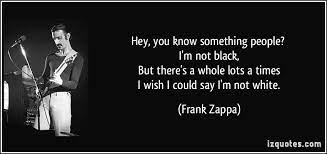
SOUNDTRACK: THE MOTHERS OF INVENTION-“Trouble Every Day” (1966).

Frank Zappa and the Mothers of Invention would play all kinds of music over the course of their existence (even more genres added when Frank went solo).  It’s not even entirely clear how you’d describe their first album Freak Out!

This song opens up side three of the double album and is a bluesy song based around a four note (and one bent note) melody and includes harmonica solo.  The song runs almost 6 minutes long and doesn’t change much until after about five and a half the tempo increases dramatically until the song fades.

It was written after the Watts Riots.  It was an accurate description and also sadly prescient.

Right in the middle of the song Frank states:

Hey you know something people I’m not black But there’s a whole lots a times I wish I could say I’m not white

That seems like it was a pretty powerful thing to say (and something you’d be unlikely to hear on the radio) back in 1965.

The chorus sticks with us

So I’m watchin’ and I’m waitin’
Hopin’ for the best
Even think I’ll go to prayin’
Every time I hear ’em sayin’
That there’s no way to delay
That trouble comin’ every day
No way to delay
That trouble comin’ every day

He certainly predicted the state of 24 hour news

Well you can cool it, You can heat it…
Cause, baby, I don’t need it…

Take your TV tube and eat it
‘N all that phony stuff on sports
‘N all THOSE unconfirmed reports
You know I watched that rotten box
Until my head began to hurt
From checkin’ out the way
The newsmen say they get the dirt
Before the guys on channel so-and-so
And further they assert
That any show they’ll interrupt
To bring you news if it comes up
They say that if the place blows up
They’ll be the first to tell
Because the boys they got downtown
Are workin’ hard and doin’ swell,
And if anybody gets the news
Before it hits the street,
They say that no one blabs it faster
Their coverage can’t be beat

Things haven’t changed since this song was written

And it’s the same across the nation
Black & white discrimination
They’re yellin’ “You can’t understand me!”
And all the other crap they hand me
In the papers and TV
‘N all that mass stupidity
That seems to grow more every day
Each time you hear some nitwit say
He wants to go and do you in
Because the color of your skin
Just don’t appeal to him
(No matter if it’s black or white)
Because he’s out for blood tonight

Perhaps the theme verse for recent events

Don’t you know that this could start
On any street in any town
In any state if any clown
Decides that now’s the time to fight
For some ideal he thinks is right
And if a million more agree
There ain’t no great society
As it applies to you and me
Our country isn’t free
And the law refuses to see
If all that you can ever be
Is just a lousy janitor
Unless your uncle owns a store

It’s a shame this song still resonates.

[READ: March 22, 2021] Parable of the Sower [2024-2025]

I found Kindred to be an enjoyable (not exactly the right word, I know) novel.  I thought the premise was really cool and I thought the content was impactful and was conveyed really well.  It was a powerful story that did not shy away from brutality.

But it in no way prepared me for Parable of the Sower.

I didn’t know anything about this book at all before starting.  At first I thought it was neat that it was set in 2024 (hey that’s so close!)  And that, coincidentally, myself and my daughters are almost the same ages as the main character and her father (will this be our future?).

But then, holy crap, Butler doesn’t hold back.

The brutality of Kindred was based on reality.  It was horrible and, in retrospect, hard to believe that people could do such things.  The brutality of Sower, however, is all based on the future projection.  The book was written in 1993. Basically, she posits that in 30 years, America has become a rotting hellscape.  And while we haven’t reached quite the levels that she imagines, there are some pretty eerie accuracies.  I have to assume, given the natural of the elected politicians, that some things are going to get very very spookily prescient.

The book opens in 2024 with a quote from Earthseed.  We don’t know what that is yet, but by the end of this week’s read we’ll learn that Earthseed is a sort of manifesto written by the main character, Lauren Oya Olamina–I didn’t realize her name was given after the first quote from Earthseed until looking back on it.  Each chapter has another quote from Earthseed and then the story unfolds as a series of diary entries. (more…)

Read Full Post »

SOUNDTRACK: ROKIA TRAORÉ-GlobalFEST Tiny Desk (Home) Concert #136 (January 14, 2021).

Rokia Traore.GlobalFEST is an annual event, held in New York City, in which bands from all over the world have an opportunity to showcase their music to an American audience.  I’ve never been, and it sounds a little exhausting, but it also sounds really fun.

The Tiny Desk is teaming up with globalFEST this year for a thrilling virtual music festival: Tiny Desk Meets globalFEST. The online fest includes four nights of concerts featuring 16 bands from all over the world. 

Given the pandemic’s challenges and the hardening of international borders, NPR Music and globalFEST is moving from the nightclub to your screen of choice and sharing this festival with the world. Each night, we’ll present four artists in intimate settings (often behind desks donning globes), and it’s all hosted by African superstar Angélique Kidjo, who performed at the inaugural edition of globalFEST in 2004.

The final artist of the fourth and final night is Malian singer Rokia Traoré.

Rokia Traoré performed at globalFEST in 2005, the music festival’s second year, and it’s a thrill to present her meditative performance as part of Tiny Desk meets globalFEST. Her work is rooted in the Malian musical tradition, but defies the confines of a single culture. Born in Mali to a diplomat father, Traoré had a nomadic upbringing that exposed her to a wide variety of international musical influences. She joins us from Blues Faso, a theater inside her Foundation Passerelle in Mali, which she created to support emerging, interdisciplinary artists, from music and the performing arts to visual arts and photography.

She plays three songs that more or less segue into each other.  I don’t know a lot about music from Mali, but the little I know I can recognize from the Ngoni played by Mamah Diabaté and the guitar played by Samba Diabaté, with lots of speedy runs.   In “Souba Lé” melody is played on the balafon by Massa Joël Diarra (although I wish they’d have shown us it up close).  Both this song and “Tiramakan” feature subtle bass from Aristide Nebout.  The final song “Fakoly” is a little louder and drummer Roméo Djibré is a bit more prominent.

But all of these songs are all about Rokia Traoré’s vocals which soar and ring out.

[READ: February 25, 2021] March Book 3

Each book has gotten longer.  Book one was 121 pages, Book 2 was 187 and Book 3 is 246.

This book begins right after the bombing of the Sixteenth Street Baptist church in Birmingham, Alabama in 1963.   You meet the victims before they were killed.  It continues through until the passing of the Voting Rights Act in 1965.  Holy cow was there a lot of violence in these two years and the amazing art by Nate Powell never shies away from showing it.

Eagle Scouts at Klan rallies who then go on to kill Black teenager’s, hicks in pickups celebrating the deaths of the girls in the church with anti-integration chants and, as we see more and more in this book, police killing innocent people and not getting in any trouble because of it.

This book has opened my eyes to what Black people have known all along about police forces.  That they are completely corrupt and need to be restructured from the ground up.  When you see that it was their job to be racist in 1963, is it any surprise that they are still racist in 2021?

Reading a book like this I can’t help but think that the best thing we could have done for our country would have been to let the south secede.  Bring all people of color north and let the racists fester in their own lack of diversity.  Because their racism poisons the whole country.  And yet that is exactly the opposite belief that this book is based upon.

I’m embarrassed at how naïve I am. (more…)

Read Full Post »

SOUNDTRACKELISAPIE-GlobalFEST Tiny Desk (Home) Concert #136/156 (January 14, 2021).

ElisapieGlobalFEST is an annual event, held in New York City, in which bands from all over the world have an opportunity to showcase their music to an American audience.  I’ve never been, and it sounds a little exhausting, but it also sounds really fun.

The Tiny Desk is teaming up with globalFEST this year for a thrilling virtual music festival: Tiny Desk Meets globalFEST. The online fest includes four nights of concerts featuring 16 bands from all over the world. 

Given the pandemic’s challenges and the hardening of international borders, NPR Music and globalFEST is moving from the nightclub to your screen of choice and sharing this festival with the world. Each night, we’ll present four artists in intimate settings (often behind desks donning globes), and it’s all hosted by African superstar Angélique Kidjo, who performed at the inaugural edition of globalFEST in 2004.

The second artist of the fourth and final night is First Nations singer Elisapie.

Elisapie returns to Tiny Desk for a show-stopping performance from Montreal, with the disco globe of our dreams helping to light her set. Elisapie, in both her songs and work, is a resounding advocate of First Nations culture in Canada. In her set, she harnesses an incredible energy with electrifying, emotive vocals.

I had really enjoyed Elisapie’s previous Tiny desk.  I found her to be a less extreme, but no less dramatic performer than Tanya Tagaq.  Her band is outstanding creating all kinds of textures to surround her voice.

The first song is “Qanniuguma.”  It starts quietly with a single ringing guitar note from Jean-Sébastien Williams and little taps of percussion from Robbie Kuster.  Joshua Toal adds some quiet bass as the guitar plays some higher notes.  After a minute Elisapie starts singing.  Another 30 seconds later the drums get louder and Jason Sharp start sprinkling in some raw bass saxophone.  As the song grows more intense, Elisapie adds some breathing and chanting–throat singing.  Things quiet down and then build again with the sax and the guitar soloing as the drums and bass keep things steady

Behind her you can see Mont Royal, which has a lot of history.

The second song “Wolves Don’t Live by the Rules” is “a small song” but very meaningful.  It starts in a similar way with ringing notes an thumping drums.  She sings this one in  English and it feels like a much more conventional sounding song.  It’s pretty quiet but the instrumental breaks adds huge guitar chords and the end is really loud.

Introducing the final song, “Arnaq” (which means Woman) she says women tend to forget that we have a lot of strength and we should celebrate it loud and clear.  This one opens with a loud raw sliding guitar like an early PJ Harvey song.  The song’s chorus builds with an “ah ya ya ya” as the instruments add chunky noises–scratches from the guitar and skronks from the sax and all kinds of precious.  It’s a cool noise fest, although the guitar could be a smidge louder.

I’d really like to see her live.

[READ: February 25, 2021] March Book 2

Book Two picks up John Lewis’ life.

Like the first, it starts with Lewis’ preparations for the inauguration of Barack Obama.

Then it flashes back.  Lewis was in college and had moved to Nashville where the growing student movement was gaining strength.

The visuals are even more striking in this book.  The panels of the white woman pouring water and then soap (or flour) on the quietly sitting Black diners and then hosing them down is really arresting.  As is the sequence (which is almost entirely black) of a room full of peaceful protestors being locked in a room when the fumigator was set off.

I couldn’t believe that a man couldn’t really left us there to die.  Were we not human to him?

Then next round of protesta was at the segregated movie theaters.  I love that they chose the Ten Commandments to protest (the irony was lost on the whites in Alabama).  The Black protesters would line up and would be refused seating.  Hundreds of people who would then get back on line and be refused seating again.  Whites would throw things at them and hurl abuse at them. (more…)

Read Full Post »

SOUNDTRACKEDWIN PEREZ-GlobalFEST Tiny Desk (Home) Concert #136/155 (January 14, 2021).

Edwin PerezGlobalFEST is an annual event, held in New York City, in which bands from all over the world have an opportunity to showcase their music to an American audience.  I’ve never been, and it sounds a little exhausting, but it also sounds really fun.

The Tiny Desk is teaming up with globalFEST this year for a thrilling virtual music festival: Tiny Desk Meets globalFEST. The online fest includes four nights of concerts featuring 16 bands from all over the world. 

Given the pandemic’s challenges and the hardening of international borders, NPR Music and globalFEST is moving from the nightclub to your screen of choice and sharing this festival with the world. Each night, we’ll present four artists in intimate settings (often behind desks donning globes), and it’s all hosted by African superstar Angélique Kidjo, who performed at the inaugural edition of globalFEST in 2004.

The first artist of the fourth and final night is Edwin Perez.

From the basement of the Bowery Electric in downtown Manhattan, composer and vocalist Edwin Perez and his 10-piece band come together to put on a show. With a strong backbeat and enough room to move around, Perez’s up-tempo energy brings the party and keeps it going. The theme of the night is salsa dura music, which originated in New York in the 1970s and gained acclaim thanks to acts like the Fania All-Stars and Spanish Harlem Orchestra.

This set is a lot of fun (even with the seriousness of the second song).  Cuban music is so full of percussion and horns it’s hard not to want to dance to it.  And this band has three percussionists: Nelson Mathew Gonzalez: bongo, cowbell (from Puerto Rico); Manuel Alejandro Carro: timbales (from Cuba); Oreste Abrantes: (from Puerto Rico).  The horn section is also pretty large: Leonardo Govin (from Cuba) and Michael Pallas (From Dominican Republic): trombone; Jonathan Powell (from USA) and Kalí Rodriguez (from Cuba): trumpet.

They play three songs. “La Salsa Que Me Crió” has lots of percussion and a great trumpet solo.  Perez even dances during the instrumental breaks.  And throughout, Jorge Bringas (from Cuba) keeps the bass steady.

After introducing the band, he says “Say her name Breonna Taylor.  Say his name Philando castile.  Say his name George Floyd.  End the abuse.”  This is the introduction to the quieter “No Puedo Respirar” (I Can’t Breathe).   Despite the subject, this song is not a dirge.  I don’t know what the words are but there is joy in the music as well.  There’s a jazzy keyboard solo from Ahmed Alom Vega (USA).

Yuniel Jimenez (From Cuba) opens the final song “Mi Tierra” with a fantastic introductory solo on the Cuban tres guitar.  The rest of the song brings back the Cuban horns and percussion. There’s even a drum solo (or two) in the middle.

[READ: February 25, 2021] March Book 1

I had heard amazing things about this trilogy of books.  I don’t know why it took me so long to get around to reading them.  Now that John Lewis is dead for almost a year, it was time to read them.

This is essentially a biography so it’s not easy to write about.  It’s also an incredible story of selflessness, fortitude and unbelievable courage.

The framing device is very well executed.  After a brief prologue that shows John and is marchers getting attacked by police, the book shows us Washington D.C. January 20, 2009, the day that Barack Obama is being inaugurated President.  Since John is (in 2009) in office he will be attending the ceremonies.

As he is preparing and getting ready to leave, a woman and her two children walk into his room hoping to look at Mr. Lewis’ office–a inspirational moment for her young boys.  But it happens that John (or Bob as he is called) is still in his office. They are embarrassed to interrupt, but he welcomes them warmly and shows them some of the things around his office.

Like photos of him meeting President Kennedy when Lewis was 23.  And from the March on Washington in 1963, where Dr King gave his “I have a dream” speech.

Then the boy asks him why he has so many chickens in his office.

The story then flashes back to young John (called Bob by his parents).  His father purchased 110 acres in Pike County, Alabama for $300. John was incharge of the chickens on the farm.  He also loved preaching.  He learned to read at 5 and began preaching to the chickens (they never said Amen or anything).

He also loved going to school.  He would even away from his house on the days his father insisted all the children work in the field because he didn’t want to fall behind.  (Even if it meant getting in trouble).

One of the first being moments in his life wa when his Uncle Otis drove him North.

Otis knew which places offered colored bathrooms and the ones where you would never get out of the car: “Alabama, Tennessee, Kentucky.  These were the states we had to be careful in as we made our way North.”

It wasn’t until they got to Ohio that his uncle relaxed.  They arrive in Buffalo 17 hours later and John was amazed to see white and black people living next door to each other. (more…)

Read Full Post »

 SOUNDTRACK: THE REDNECK MANIFESTO-The How (2018).

Despite a terrible name that would keep me away from wanting to see them, The Redneck Manifesto are a very interesting and complicated band.  I discovered them through the book of Irish drummers.  TRM drummer Mervyn Craig is in the book.

The How is the band’s fifth album (and first in eight years).  The album is chock full of instrumentals that touch all genres of music.

There are jazzy elements, dancey elements and rock elements.  There are solos (but never long solos) and jamming sections.  Most of the songs are around 4 minutes long with a couple running a little longer.

“Djin Chin” has jangly chords and quiet riffs that switch to a muted melody.  All the while the bass is loping around.  It shifts tempos three times in the first two minutes.  Around three minutes the bass takes over the lead instrument pushing the song along with deep notes.

“The Rainbow Men” has a circular kind of riff with swirling effects that launch the song during the musical pauses.  After a minute and a half it drastically shifts direction and the adds in a cool solo.

“Sip Don’t Gulp” starts with a catchy bouncy guitar riff and bass lines.  At two minutes it too shifts gears to a staggered riff that sounds great.

“Kobo” is the shortest song and seems to tell a melodic story.  The two guitars play short, fast rhythms as call and response while the bass rumbles along.

“Head Full of Gold” is over 6 minutes with a thumping bass, rumbling drums and soft synths.  “No One” is nearly 7 minutes and feels conventionally catchy until you try to keep up with the beats.  After a middle series of washes from various instruments, the back half is a synthy almost dancey rhythm.

“Sweep” is a pretty song until the half-way mark when it just takes off in a fury of fast drumming and complex chords.  The end builds in upward riding notes until it hits a calming ending

“We Pigment” is a poppy staccato dancey number.  The second half turns martial with a series of four beat drum patterns and a soaring guitar solo.  More staccato runs through to the end.  “The Underneath Sun” also has a lot of staccato–fast guitar notes interspersed with bigger chords.  The end of the song is just littered with sweeping guitar slides until the thumping conclusion.

This album is great and I’m looking forward to exploring their other releases.

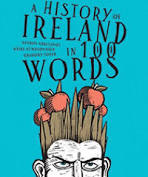
[READ: January 10, 2021] A History of Ireland in 100 Words

This book looks at old Irish words–how they’ve evolved and how they show the way Irish history came about.  The authors say:

our store of words says something fundamental about us and how we think.  This book is meant to provide insights into moments of life that may be otherwise absent from history books.  The focus is on Gaelic Ireland throughout as Gaelic was the native language of the majority of the inhabitants of the island for the last 2000 years. It yielded its primacy to English only in the last 150 years.

We selected words with the aim of illustrating each of our themes as broadly as possible.  We wanted the words in all their richness to tell their story … like how the word that originally meant noble came to mean cheaper (saor).

Almost all of the entries reference The cattle raid of Cooley (The Ulster Cycle) which features the hero Cú Chulainn.  This story is at the heart of most of historical Ireland and it’s pretty fascinating how many of these Gaelic words either originate with that story or get their foundation from the story.

There’s a general pronunciation guide although I wish each word had a phonetic guide because anyone who speaks English will look at Irish a if it is just a jumble of nonsensical consonants.

The book is broken down into sections, although the authors insist that there is no correct way to read the book.

  • Writing and Literature
  • Technology and Science
  • Food and Feasting
  • The Body
  • Social Circles
  • Other Worlds
  • War and Politics
  • A Sense of Place
  • Coming and Going
  • Health and Happiness
  • Trade and Status
  • Entertainment and Sport
  • The Last Word

There are also delightfully weird wood carving-like drawings from by Joe McLaren scattered throughout the book.

The words are listed below with either a definition or an interesting anecdote included. (more…)

Read Full Post »

SOUNDTRACK: U.K. SUBS-Another Kind of Blues (1978).

In this essay, Rebecca Kushner mentions a bunch of punk band members that she either knew or hung out with.  I was amazed at how many of them I’d heard of but didn’t really know.  So this seemed like a good opportunity to go punk surfing.

U.K. Subs are a punk band that I’ve heard of but really knew nothing about.  A little research tells me that they have been active all of these years–their latest release was in 2019.  That’s some serious staying power.  According to Wikipedia, there have been about 75 members of the band over the years.

This first album is a pretty fascinating listen.  Most of the seventeen songs are under two minutes long, but they’re not blisteringly fast or anything.  The songs are more or less blues based (as the title indicates) but faster and grittier

This is definitely a punk album.  But they follow a lot of rock song conventions.  Indeed, “I Live in a Car” is a minute and a half long but it’s got verses a chorus and two guitar solos.  “I Couldn’t Be You” even has a harmonica solo.

But songs like “Tomorrow’s Girls” offer good old punk chanting choruses.  And “World War” which is all of a minute and twenty three seconds is actually over 20 seconds of explosion.

“Stranglehold” was a pretty big hit in England and it’s easy to see why.  It’s got an immediate riff, a three chord chorus that’s easy to sing along with and a bouncy bass line.  And it’s all of one minute and fifty-seven seconds.

Checking some of their other releases through the years, UK Subs definitely went through a metal phase in the 80s and 90s, but their 2016 album Zeizo has found the punk spirit again.  I think I like Zeizo better than their first.

[READ: February 2, 2021] “The Hard Crowd”

I’ve read a few things by Rachel Kushner, although I’ve never given any thought to her biography.  I never would have guessed that Kushner was part of a San Francisco pub scene when she was growing up (or that she is essentially my age).

This essay is about that time in her life.  When Jimmy Carter was president and he quoted Bob Dylan in his acceptance speech “He not busy being born is busy dying.”

She says that being born is an existential category of gaining experience and living intensely in the present.  Conversely, dying doesn’t have to be negative–the new stuff is over but you turn reflective you examine and tally–it is behind you but it continues to exists somewhere.

She says she’s been watching film footage found on Youtube shot in 1966 or 1967 from a car moving slowly along Market Street in San Francisco, where she grew up.  She assumes it is B roll from a film, because it is professional grade (she imagines it was for Steve McQueen’s Bullitt, but that’s not based on anything).

She worked at the Baskin Robbins making $2.85 an ahour.   The shop is now gone and she thinks it’s weird to be sentimental about a chain store, but when her mother took her to the IHOP years after she worked there, it all came flooding back–sights, smells.  Despite every one being identical, this one was hers. (more…)

Read Full Post »

« Newer Posts - Older Posts »