Feeds:
Posts
Comments

Archive for the ‘Marriage Trouble’ Category

SOUNDTRACK: JAPANDROIDS-Live on KEXP, June 16, 2009 (2009).

Back in 2009,  one of the guys from Japandroids had surgery and they had to cancel some dates.  That’s only relevant to this because when this set is over, the guitarist is bleeding from his scar.

Japandroids are two guys and they make a lot of noise.  I can recall jamming on guitar with my friend on drums and even when we were totally in synch, we never sounded this good.  It really sounds like there are four or five people playing.  This set has three songs from their debut album and an amazing cover of Big Black’s “Racer X.”

The three  songs are very good and the guys pay hard and fast and, as I said, they sound amazing.  It’s a great set.  You can hear the whole thing here.  There’s also video of the performance.  It’s broken  into two parts.  This is part two, with the blistering cover of “Racer X.”

[READ: September 17, 2012] Bluebeard

I’ve mentioned this book a few times in the last couple of days as something that I’d been struggling with.  And, indeed, I found it to be a little slow going.  I was excited to start reading it because, as the subtitle says, this is an autobiography of Rabo Karabekian, an artist who appeared in Breakfast of Champions–I love that Vonnegut keeps working within his own universe.  But there was something about the early pages of the story that were just not that compelling.

Rabo is having a hard time getting his book going, and while that is a dramatic effect, I had a hard time getting into the book too.  It’s not that complicated of a story.  There are really only about a half dozen characters in the book:

Rabo–he is an American Abstract Expressionist painter (contemporary of Jackson Pollack, Jasper Johns, et al).
Circe Berman–she is an author who writes under the pseudonym Polly Madison (ha).  Madison’s books look at the real life of American young people and are staggeringly popular.
Paul Slazinger–Rabo’s next door neighbor who spends most of his time in Rabo’s house, although he and Rabo mostly ignore each other.  Slazinger is a writer with a decades long writer’s block.
Dan Gregory–a famous artist for whom Rabo apprenticed.  Gregory was such a good detailist that he once created a perfect forgery of a bill (on a dare).  Gregory was also a terrible racist and philanderer and treated Rabo with contempt at best.
Marilee Kemp–Gregory’s mistress and sometime muse.  She inadvertently sends Rabo an encouraging letter on behalf of Gregory and then she and Rabo begin a writing relationship which blossoms when they eventually meet. (more…)

Read Full Post »

SOUNDTRACK: THE FLAMING LIPS-Dark Side of the Moon live at Hangout Music Festival, May 2012 (2012).

Recently, the Flaming Lips and friends released a version of Dark Side of the Moon that was noisy and chaotic and resembled the original in some  ways but departed from it radically in others.  When Palladia aired this concert of the band performing the album in its entirety I wasn’t sure what to expect.

I was pleasantly surprised that their rendition of the album is quite faithful to the original.  There’s plenty of Flaming Lips-isms in it, but it sounds a lot closer to the Pink Floyd version than The Flaming Lips and Stardeath and White Dwarfs with Henry Rollins and Peaches version.  And that’s a good thing.

I have to admit the audio wasn’t as clear as I would have expected (which is surprising for the Lips)–it was very hard to hear Wayne when he was talking.  That may have worked well for the singing though as he sounded almost exactly like David Gilmour on most of the songs.  The stage was also filled with people.  In addition to the four band members, there was a cast of dancers dressed like Swiss maids, there were some extra musicians  and two women.  One, dressed in a gold lame body suit (with wings) sang all of the wailing vocals on the album (and did a very good job) and the other I’m not sure what she did–neither woman was introduced during the aired set so I don’t know who they were.

Many bands throw things out into the crowd during a set, well, during “Money,” Wayne Coyne tossed out giant confetti balloons that were filled with actual money, allegedly $10,000 donated by none other than Dave Matthews.  That’s pretty intense and hopefully didn’t cause any damage.

Check Palladia for when they’re going to air it again.  I just learned that there is a You Tube video of the whole concert (more than just Dark Side of the Moon) and you can watch it here:

It’s a good fun set and shows just how much Stephen Drodz does on stage (I mean, seriously, check out the guitar he plays in “The Yeah Yeah Yeah Song”) and that Wayne’s hands must be either very cold or have no sensation.

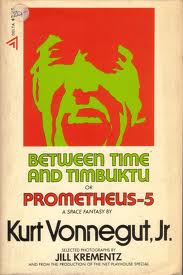
[READ: September 24, 2012] Between Time and Timbuktu

I have been reading a lot of Vonnegut lately. I had it in my head that I would just blow through all of his books.  But I admit I’m getting a little burnt out.  Deadeye Dick and Galàpagos were kind of numbing and Bluebeard which I’m working through now is fun, but a little exhausting.  There’s no reason I should be ordering new Vonnegut books to read now, but I saw that the library had a copy of Between Time and Timbuktu (which is hard to find) and since I won’t be using that library for much longer, I decided to order it.

And I’m glad I did.  Between Time and Timbuktu was a TV movie made by compiling a bunch of scenes from Vonnegut’s first few books.  The basic script was by David O’Dell and Vonnegut himself had a hand in working on it (like “grafting the head of a box turtle onto the neck of a giraffe”).  And as the story progresses you can see some of the best set pieces from his novels.

But the framing device is new.  A man, Stony Stephenson has won a jingle contest for Blast-Off Space Food.  The TV crew appear at his house (and meet his mother in a dressing gown (she’s a funny character)) to break the news.  He gets dragged away and a few months later we see the blast off of the rocket.  When he gets into space, Stony will launch into the Chrono-Synclastic Infundibulum (the Infundibulum comes from Sirens of Titan). (more…)

Read Full Post »

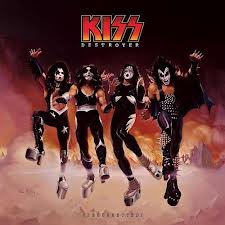
SOUNDTRACK: KISS-Destroyer {Resurrected} (2012).

Bob Ezrin, überproducer, decided he wanted to remaster Kiss’ Destroyer album (for its 35 year anniversary).  If his notes are to believed, this was all Ezrin’s doing with little input from the band.  The notes are interesting and explain Bob’s rational at the time and his rationale for remastering it now.

The remastering isn’t major–the guitars sound more vibrant (there seems to be extra flourishes on “King of the Night Time World”, the vocals sound a little fuller (with some extra echo).  I actually think I’d like the drums to be a little louder–Peter does some great drumming here and it should be emphasized more.  Ezrin explains that do to the limitations of the originals there wasn’t a lot he could do to  re-mix the album.

The most exciting find of the remaster is the new guitar solo for “Sweet Pain.”  It’s not a huge deal, it’s only a few notes, but it is  fun to hear a new take (even if the “real: solo is better).

He adds a “Get Up/Get Down” at the end of the solo in “Detroit Rock City” (which I do not like).  He also repeats an “ahhh” in “Beth” in the middle which just makes me think the song should end.  In the liner notes, he says they added new car crashes at the end of “Detroit Rock City” although  I can’t really hear it. There seems to be more of the little kid’s voice in “God of Thunder” (I always wish they’d provided transcript of what he says).  And overall I think that song sounds the best with the new mix–more intense, more scary, more bombastic.  As for the mellower songs (“Great Expectations,” “Do You Love Me?”) there’s a bit more oomph in the backing vocals.

In the notes he says he fixed something that has been bugging him for 35 years.  The internet boards suggest that it is this: In “Detroit Rock City,” Paul sang “Moving fast down 95,” but 95 goes nowhere near Detroit, so he mixed Paul’s voice to say “moving fast doin’ 95.”  I never really understood which one he was saying to begin with, so I can’t be sure of this.  Overall, is it worth getting this remaster?  Well, probably not. It sounds better and fuller, but not radically different.

The only other  Kiss albums he produced were Revenge and The Elder–Bob, I’d love a remaster of The Elder!

[READ: September 23, 2012] “The Casserole”

This really short story (less than two pages) has a title that’s not terribly exciting.  It also prepares you very little for what will happen and just how the casserole will come into play.

The story is of a trip that a long-married husband and wife take to her family’s ancestral home–a large farm with tons of acres, tons of livestock and worth tons of money.  But he and his wife don’t want the farm (which her parents want to give them), they’re happy in the city, being school teachers who live frugally, saving for a rainy day.

The story is almost all flashback as the couple waits to board the ferry that crosses the river to the house.  He thinks about how they don’t have kids (and never wanted them) and how this drives her parents crazy (they desperately want an heir to their property).  He thinks about how they spend very little money on anything–keeping it squirreled away for their retirement.  Even if his wife might like to go to Belize to show off her still hot body.  He thinks about how the only thing he would spend money on is a beautiful room to house his record collection and maybe to buy an awesome stereo–and how his wife is unimpressed by this. (more…)

Read Full Post »

SOUNDTRACK: …AND YOU WILL KNOW US BY THE TRAIL OF DEAD-Live on KEXP, March 12, 2009 (2009).

Back in 2009, …And You Will Know Us by the Trail of Dead had been hit by a truck.  Really.  Evidently no one was hurt too bad, but they did have to cancel a show in Salt Lake City. 

Nevertheless, they managed to get to KEXP to play a four song set from their latest album The Century of Self.  The opener “The Giant’s Causeway” is full of bombast and noise  and has a surprisingly catchy melody in the middle.  It merges into “The Far Pavillion” (just like on the album) which sounds like pretty typical Trail of Dead–rocking and yet melodic, with some good screaming parts.

“Luna Park” is something of a surprise to me as it’s a piano-based ballad (which I suppose Trail of Dead plays, but which I don’t associate with them).   “Bells of Creation” also opens with a piano, but it quickly grows very loud.  It’s a cool song with lots of depth.

I had actually stopped listening to Trail of Dead after Worlds Apart (and album I liked, but I guess the band fell off my radar) so it’s nice to hear they’ve still got it.  At least as of three years ago.

[READ: September 17, 2012] Galápagos

Each of these 1980’s era Vonnegut books gets darker than the last.  In this one the entire human race is wiped out (except for a few people who spawn what eventually becomes of the human race in a million years).  For indeed, this book is set one million years in the future and it is written by a person who was there, one million years in the past when the human race destroyed itself.  It’s not till very late in the book that we learn who the narrator is and, hilariously, what his relationship is to the Vonnegut canon.

In typically Vonnegut fashion, the story is told in that spiral style in which he tells you a bit of something and then circles back to it again later and comes back again later until finally 200 or so pages into the book you get all the details of what is happening.  Interspersed with the respawning f the human race (and flippers) is the story of the Adam and Eve and Eve and Eve and Eve and Eve who created the human race–how they got to be together, what their lives were like before and what contribution they made to humanity, such as it is now.

In another bizarre and fascinating twist, every character who is going to die in the near future gets a star next to his name so that the reader knows that that person is going to die.  We get a lot of things like ★Andrew MacIntosh for many pages until the character finally dies.  And pretty much everybody does die.  Well, obviously if it is set a million years in the future, but aside from that part, only a few of the characters survive.

So here’s how these few people managed to create a new human race in the Galápagos Islands.   (more…)

Read Full Post »

SOUNDTRACK: CIRCLE TAKES THE SQUARE Live at Black Cat Washington DC, August 31, 2011 (2011).

I had never heard of Circle Takes the Square before seeing the link to this show on NPR (Thank you, Viking!).  I like the band name (Hollywood Squares reference), and couldn’t imagine what they sounded like.

Song titles like “In the Nervous Light of Sunday” and “We’re Sustained by the Corpse of a Fallen Constellation” and even “Non-Objective Portrait of Karma” lead one in many possible directions.  But it turns out that the band is sort of pigeonholed as screamo, a post-hardcore style that allows mostly for screamed vocals.  And yet these guys also incorporate intricate playing, odd time signatures and some beautiful instrumental passages.

Even though the band plays fast, they don’t play only short songs.  The shortest songs run about three minutes but they have two songs that are over 6 minutes, with several different sections.

I listened to this show a few times and I confess I never really got into it.  I liked some of it but I was never fully able to grasp what was going on.  It could have been the recording quality.  Usually NPR shows are crystal clear, but this one was a bit muddy–which may have been intentional from the band as they are pretty raw sounding.  I did like  the split male/female vocals which added a cool depth to the songs.  But mostly I was impressed by the kind and almost sweet attitude of the lead singer.  He was polite and thankful to the audience (thanking them for braving the weather–the show was during Hurricane Irene–thanking them for coming from both far and near and talking about how excited he was about Pg. 99, the headliners.  It’s funny to hear polite thankfulness and then screaming lyrics like: “Embrace the sweet sound of self-destruction.”

I’d like to hear a studio release before passing final judgment, because there was a lot to like here.

[READ: August 29, 2012] Habibi

I saw this book in a review by Zadie Smith in Harper’s a while back.  I didn’t realize at the time that the author was the same person who did the wonderful Blankets.

This book is an amazing piece of art.  And the story is very good too.

So this massive book (almost 700 pages) is the story of  a woman born into a fictional Middle Eastern country called where the Qur’an is studied and women are more or less chattel.  As the story opens Dodola is sold by her father to a wealthy man who becomes her husband.  The scene of her deflowering, while not graphic at all, is very disturbing nonetheless.  She is afraid of this man and cowers in the fear until they gradually start to see each other as human beings.  And although their age difference is substantial (and yes, gross), she learns to appreciate him.

Until he his killed by the king’s men and Dodola is taken away to the king’s palace to be sold as a slave–her hair is tied to another girl’s hair so they cannot escape.

Through a series of events, she does escape, and when she is hiding out she manages to save the life of a black baby named Cham.  She calls him Zam after the Well of Zamzam (Arabic: زمزم‎) in Mecca, the holiest place in Islam.  And while she is only 12, she takes care of this 3-year-old boy and raises him as her own child. (more…)

Read Full Post »

SOUNDTRACK: MOGWAI-Music for a Forgotten Future (The Singing Mountain) (2011).

This track is a 23 minute instrumental that was used for an art installation by Douglas Gordon (who made the film Zidane, for which Mogwai provided the score) and Olaf Nicolai called “Monument for a Forgotten Future”.  The more I learn about  his installation, the more intrigued I am by it.  According to wikimedia, “Monument for a Forgotten Future” is a sculpture by Olaf Nicolai and Douglas Gordon on the so called “Wilde Insel” (wild island) in Gelsenkirchen-Horst, Germany. It is 1:1 replica of a rock formation in Joshua Tree National Park with a sound installation by Mogwai that can be heard from within the “rock.”  Someone has even posted a video of their trip to it.  In the video (which is literally of a rock), as the filmer approached you can hear the music only when he or she gets pretty close to the installation. It’s just barely audible.  Cool.

As for the music itself, it is very mellow an atmospheric, quite perfect for being on a Wild Island and sitting by/staring at a rock.  There are definitely hints of Mogwai’s sound in the music, although there are a lot more keyboards than guitars (which befits their more recent albums).  It’s very peaceful and quite beautiful.  At about 19 minutes it fades out and seems to being another string laden piece into the mix as well, but it more or less fades into static (which would be a lousy time to get to the installation!).

The music comes free with most editions of Hardcore Will Never Die But You Will.

[READ: August 2, 2012] “Without Blood”

After reading Baricco’s Emmaus, I wanted to see what else he had written.  I found this short story (which is also the name of one of his novels, although I’m not sure if this is an excerpt or the inspiration for the novel–Wikipedia says it is a “revised form” of the novel, whatever that means).

I was a little disconcerted by this story when it opened because it has a very violent introduction.  The farmhouse of Manuel Roca is the site of bloodshed.  Three men, Salinas, El Guerra, and Tito pull up in a Mercedes.  Manuel Roca is the man they are looking for.  He has two children a boy and a girl, Nina.  He tells Nina that she must hide when the men come.  Hide in the cellar and be absolutely still, no matter what happens.  And to not be afraid.  The son, slightly older, wants to help, he even has a gun, but Manuel tells him to hide in the woodshed.  And then the house was riddled with bullets.

Manuel survived that first round but when he looked up, Tito (who was described as a boy but was in fact 20) was standing there with a gun pointed at Manuel.  And he shouted to  Salinas “IT’S TITO.  I’VE GOT HIM.”  When the threesome get inside, they see that Tito has shot Roca in the arm because he had a gun.

When the two men come face to face we learn that this fight has to do with the war.  Roca says the war is over, although Salinas, says “Not yours, Not mine, Doctor.”  Salinas was known as the rat because he deciphered Roca’s men’s coded messages.   But despite the war, Salinas has only shot a gun twice.  The first one was at no one, the second was at his brother who was in the hospital when the war ended.  Salinas went to the hospital with the intent of killing Doctor Roca and his men, but they had fled, leaving all of the sick and dying unattended.  When Salinas’ brother asked him to kill him…please, he could only comply.

After this flashback, Roca’s son came into the room with a shotgun.  From here the scene gets really violent with both Roca and his son killed.  The men realize that Nina must be there as well, so they look all over for her.  It is the boy Tito who finds her in the cellar.  They stared at each other, but Tito let her live.  And the men left.  After they set the house on fire.

Three days later a man on horseback found Nina and took her away.

Wow. (more…)

Read Full Post »

SOUNDTRACK: MOGWAI-Hardcore Will Never Die, But You Will (2011).

With an album title like that, you expect, well, some pretty loud music, right?

For this Mogwai album that’s not what you’ll get.  You’ll get lots of keyboards, and on the opening track “White Noise” you’ll get one of their prettiest melodies in ages.  Sure, there’s some distorted guitar by the end, but this is quite pretty.  “Mexican Grand Prix” opens with a computerized drums, keyboards, a propulsive bass line and whispered vocals.  This could be a dance hit.  What has Mogwai done with Stuart Braithwaite?  When the processed vocals start singing along (no idea what they’re saying), you can easily imagine a dancefloor packed with people for this track.

“Rano Pano” brings in the buzzy guitars again, both the first intro sounds and the noisier melody guitar, while “Death Rays” returns to the happy keyboard feel for a song that reminds me of Explosions in the Sky.  Once again, the melody is beautiful.  “San Pedro” brings guitars back in, with another killer melody and at 3 and a half minutes, it’s the shortest blast of rock.

“Letters to the Metro” opens with a spare piano melody and adds delicate washes throughout.  “George Square Thatcher Death Party” opens with some chanting (no idea what they’re saying) and then some of the loudest bass so far.  It’s another propulsive song, with some buzzy guitars way in the background, but the main force again is the keyboards.  This song sounds very 80s to me, with the processed computerized voice and the keyboard sound they use.  “How to Be a Werewolf” is 6 minutes. It’s a nice song but it doesn’t really grab me like the others.  “Too Raging to Cheers” has more 80s style keyboards (reminding me of Brian Eno or a PBS documentary about space) until about 2 and a half minutes in, when the Mogwai of old come crashes through–lots of cymbals and loud guitars.

“You’re Lionel Richie” is an 8 and a half minute song that opens with some French dialogue.  There’s a complicated guitar melody that plays for a time.  By about 5 minutes, the noise comes in–guitars, keyboards, cymbals, and while it doesn’t crescendo like Mogwai of old, it certainly gives you tastes of them.  This later section of the song brings in a good guitar melody that plays along until the slow fadeout at the end.

I continue to think of Mogwai as a loud, intense band, but their more recent output shows a band changing into something else.  Their melodies are still top notch and they definitely flirt with using noise in some of their songs, but they seems to be making more commercial sounding music (although realistically no band that makes almost exclusively instrumentals can ever be accused of selling out).

[READ: August 10, 2012] “Ghost Town Choir”

I have a read a few things from Ferris.  This story caught me completely by surprise.

The story is from the point of view of a boy who is living with his mom.  She is dating a man named Lawton.  Lawton had moved some of his stuff into their house, including his record collection–his prized possession.  They have a fight; he sings to her from outside their trailer, “What have you got planned tonight, Diana, he sang, though my mom’s name is Sheryl.”  She threw all of her dishes at him until he left.  He came back later that night calling her all kinds of unforgivable names.

Then the story shifts to Lawton’s point of view (both POVs are in first person, although they are quite distinct in style).  The boy goes to Lawton’s trailer even though he is not welcome anymore: “Your momma and me, we’re done.”  Lawton fancies himself a cowboy, and the backing singer in a cowboy band.

Back at home, Sheryl is on a cleaning binge–purging herself of everything.  When she gets to Lawton’s records, she is ready to toss them but the boy asks her not to.  She doesn’t listen and hauls them to the dumpster.  The boy grabs them later on and brings them to his fort in the forest.  That’s where he kept all of the things that the men left in his house after they were gone: “I wonder did they know about he cigarettes they’d never finish?” (more…)

Read Full Post »

SOUNDTRACK: PINK FLOYD-Alan’s Psychedelic Christmas (1970).

I’ve always loved Pink Floyd’s Atom Heart Mother.  I have no recollection of how I stumbled upon this live bootleg, but when I saw that it contained one of the few live recordings of “Alan’s Psychedelic Breakfast” I had to give it a listen.

So this show is from 1970 and was recorded in Sheffield just before Christmas (Nick Mason evidently introduced the show while wearing a Santa Claus suit).  The sound quality is pretty good given that it is 40 some years old.  There’s a bunch of hiss, and the quieter talking bits are hard to understand, but the music sounds fine.

So the show opens with “Alan’s Psychedelic Breakfast” and what is so silly (and I assume funny to watch (a little less funny on bootleg) is that the band made and ate breakfast on stage.  As Collectors Music reviews writes: “This is the only known live recording of ‘Alan’s Psychedelic Breakfast’ but also hosts an amazing performance by the band which included them making morning tea on stage which is audible. Just like most of their earlier performances, the performance of “Alan’s Psychedelic Breakfast” slightly differs from the album version due to some nice jamming done by the band, especially Gilmour with his delay pedal.” As I said, some of the audio is static and hard to make out in this song–the band is conversing during their tea, but who knows what they are saying.  And who know what is o the radio.

Then the band gets down to business.  One of things I love about this period Floyd which is so different from their later work is that the played really long spacey jams often with very few lyrics.  So we get a 12-minute version of “The Embryo” (the only available studio version is a very short one on Works which is quite a shame as the song is really good).  A 14-minute workout of “Fat Old Sun” which is usually only about 5 minutes.

There’s a great version of “Careful with that Axe Eugene” and “Set the Controls for the Heart of the Sun” (15 and 12 minutes respectively).

Then in a killer version of “Saucerful of Secrets,” just as they get to the end, there’s a power failure (at least according to the song title).  The band is rocking out just hitting the climax when suddenly all you can hear are un-miked drums.  Ha. After a couple of minutes, power comes back and they pick up from just before where they left off.

Then the band launches into a full 31-minute version of “Atom Heart Mother” complete with horns and choir  of voices.  It sounds quite good (the horns seem a little sketchy but that might be expected with such staccato music).

The set ends and the band needs an encore.  Apparently they couldn’t remember anything else because they just re-do the last few minutes of “Atom Heart Mother” again.

One of the things that cracks me up about these shows in the 70s in England, is that the audience is so polite. Their applause sounds like a classical theater rather than a rock show.  And with a bootleg you know they didn’t try to make the audience sound bigger than they are.

The whole package is a fun trip.

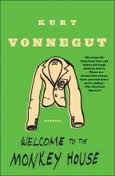
[READ: August 17, 2012] Welcome to the Monkey House

So this book is Vonnegut’s second collection of short stories.  But there’s a twist.  This collection contains all of the short stories from Canary in a Cat House except one. It also contains many of the stories he had written since then as well as stories not collected in Canary.  So you get basically 18 years worth of stories here.  And it’s interesting to see how much he has changed over those years (during which he wrote 5 novels, but not yet Slaughterhouse Five).

Since I read Canary a little while ago (see comments about the stories here), I knew that his 50’s era stories were influenced by WWII.  So it’s interesting to see how his stories from the 690s are not.  They deal more with day to day things and, of course, abstract concepts about humanity, although politics do enter the picture again once Kennedy is elected .

  • Where I Live (1964)

This was a good story to open with because it shows the then-later-period Vonnegut’s mindset and location.  This story is about Barnstable Village on Cape Cod (where I assume Vonnegut lived since there are a number of stories set on the Cape).  This is a very casually written story about an encyclopedia salesman who goes to the local library and sees that their two encyclopedias are from 1910 and 1938.  I enjoyed this line: “He said that many important things had happened since 1938, naming among others, penicillin and Hitler’s invasion of Poland.”  He is told to talk to the library directors who are at the yacht club.  I love the attitude that Vonnegut creates around the village which “has a policy of never accepting anything.  As a happy consequence, it changes about as fast as the rules of chess.” For really, this story is about the Village more than the encyclopedia salesman, and it’s an interesting look at people who move into a new place and want it to never change. (more…)

Read Full Post »

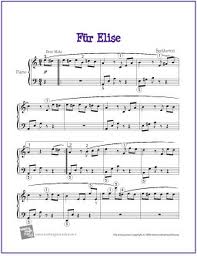
SOUNDTRACK: LUDWIG VAN BEETHOVEN-“Für Elise”

I didn’t know a lot of the music mentioned in this book, but like most people, I know and enjoy “Für Elise.”  It’s an interesting choice of music to end such a crazy chaotic story, although I suppose there are some less than peaceful moments ion the song too.  It’s a shame Bast never gets to play it.

I find the most engaging moments to be when the lone high note comes before the reintroduction of the initial melody.  The middle, minor key section that sounds kind of menacing is also neat–a big switch from the delicate opening.

Why not take 3 minutes and enjoy it now:

[READ: Week of August 20, 2012] JR Week 10

The end is here.  After endlessly interrupted conversations, the book has actually hit a period.

As the last week ended, Bast was being dropped off at the hospital by Coen.  And the bulk of the end of the book takes place in the hospital.  There are many similarities between this book and a big 60s/70s comedy romp, and here is another one–all the characters seems to pile into one location for a big finale.  (Technically the finale happens at Bast’s house, but you get the idea). (more…)

Read Full Post »

SOUNDTRACK: KISS-Smashes, Thrashes + Hits (1988).

This was Kiss’ second greatest hits collection (Double Platinum being the first).  This was before there were literally hundreds of Kiss Greatest Hits collections.  Seriously, look at the list on AllMusic.  This was also the era in which bands would release a greatest hits collection and include one song to sucker fans into buying it.  And we did.

Kiss also re-recorded a bunch of songs for this disc (something they would do many times in the future as well).  I’m not exactly sure what has been re-recorded, although the one obvious change is that Eric Carr sings on “Beth.”  But some of the other songs get tweaks as well.

As for the two new songs, it seems like maybe they were leftovers from the Crazy Nights sessions–they are poppy with keyboards.  “Let’s Put the X in Sex” sounds a lot like Robert Palmer, which is pretty embarrassing.  Although interestingly, the song itself seems to serve as a model for a couple of songs on Hot in the Shade (as if maybe they thought Kiss fans wouldn’t buy the greatest hits?).  “(You Make Me) Rock Hard” is another okay song (which sounds a lot like another song on Hot in the Shade).  Both of these songs are just filled with sex similes, I swear they have more than any other writers in the world.  Both songs would be better without those pesky keyboards.  I rather liked the songs at the time as they are both better than anything on Crazy Nights, although neither one has held up all that well.

And “Beth,”  Kiss’ biggest hit, which may be largely forgotten by the general public by now, has Eric Carr on vocals.  He sounds a bit like Peter Criss, but without Criss’ years of hard living in his voice.  It’s a weird choice, although I understand it from a business standpoint–which is clearly more important than the music, right?

[READ: August 10, 2012] “Paris in the Twenties”

This story starts out with a paragraph that I found very confusingly written.  There’s a very long sentence with several clauses that, after reading the story, make perfect sense, but which up front are more than a little confusing.  The upshot of that paragraph is that in 1972, when the narrator was a senior in high school, a whole bunch of bad things happened to her in a short period of time–just before they were to hear which of the Seven Sisters had accepted them.

The catalyst was that her father threw a tumbler of scotch at the giant window of their penthouse apartment.  The window shattered but did not fall and the glass came back into the room.  The irony of course is that he had chosen the apartment for the gorgeous panoramic views those windows afforded.  Her father had been riled up about the state of the world, and felt that the sexual revolution meant that monogamy was outdated.

Their father was also very conscious of wealth and was very conscious of appearing wealthy–even if “he usually had more credit than money and now had very little of either.”

The narrator escaped into fantasies of Paris in the twenties–she read A Moveable Feast and was determined to move to Paris even if the party was over decades ago. (more…)

Read Full Post »

« Newer Posts - Older Posts »