Feeds:
Posts
Comments

Archive for the ‘Death’ Category

SOUNDTRACK: SUPERCHUNK-1,000 Pounds (2000).

This EP has four tracks: an acoustic version of the title song and, for the first time that I’m aware of, a cover track.

“1,000 pounds” is another great Superchunk single.  It’s boppy and catchy and there’s more and more instrumentation thrown into the mix–acoustic guitars, more strings, a crazy sounding guitar solo with effects I don’t recognize.  It’s also another song where the title is sort of thrown into the chorus without making it sound like the focus of the chorus–another fun Superchunk trick.

The acoustic version subverts the original somewhat with a strange swing vibe.  And speaking of vibes, there are actual vibes in the song.  It almost sounds like a different song entirely.

The second song, “White Noise” is a no longer novel twist to a Superchunk song (they’ve been throwing in so many twist to their sound that it’s impossible to pin them down to anything).  There’s a cool guitar and bass line that sound, somehow, unlike anything else they’ve done.  The soloing is also pervasive, running throughout the verses.  It’s a very cool song.

The big surprise comes in their cover of David Bowie’s “Scary Monsters.”  Their version is noisy and feedback-filled with crazy guitar solos throughout some of the choruses.  It’s full of reckless abandon and is one of their craziest track in some time.  And really it sounds almost nothing like the original.

It’s a great EP and worth tracking down.

[READ: October 10, 2010] “The Volunteers”

Chang-rae Lee is the next writer in the New Yorker’s 1999 20 Under 40 collection.

This story is set during World War II.  However, unlike most WWII stories that I have read, this one is told from the point of view of Japanese soldiers (specifically, it is narrated by a Korean-born, Japanese-raised medic).

The narrator, Lieutenant Kurohata, is friendly with an inferior soldier, Corporal Endo.  He and Endo are from the same town so they have a friendship which, when they are alone, supersedes their ranking differences (although Kurohata is a little uncomfortable about that).  Endo, like many soldiers, is somewhat obsessed with a series of photos of naked women.  He is constantly trading for new ones and then showing them (surreptitiously) to Kurohata.  Kurohata is not terribly impressed with the behavior–he seems more mature in general–although he also implies that he is not very sexual–and he finds the whole proceedings somewhat beneath him. (more…)

Read Full Post »

[LISTENED TO: October 20, 2010] Readings

This (all too brief) collection of readings by David Foster Wallace includes several excerpts and a few shorter pieces.  I’ve noticed that there seem to be more and more videos (audios) of DFW reading on YouTube.  If I had time I would try to gather all of these videos (or even just try to watch them), but for now, I’ll stick with what’s at the David Foster Wallace Audio Project.

The Consider the Lobster reading is an excerpt from”The View from Mrs. Thompson’s”.  I’d never heard him read this piece before and it is a fascinating look at the events of 9/11/01 from Bloomington, Indiana.  I haven’t read the piece in a few years and it was quite affecting to hear him read it aloud.  The introduction was also interesting because he mentions that this is the quickest piece he has ever written (I wonder how many drafts he was able to do in that short period). (more…)

Read Full Post »

[LISTENED TO: October 20, 2010] Dubliners Part II

This collection covers the last five stories from the book.  They are all longer stories, especially the fantastic novella “The Dead,” which runs well over an hour.  The titles included in Part II are:

A Painful Case
Ivy Day in the Committee Room
A Mother
Grace
The Dead

These last five stories look at (continuing the theme from my previous post) middle age and later life.  The protagonists are all older, and as with the first part, they all must deal with harsh realities and even death.

“A Painful Case” is the first story in the book where the title doesn’t directly apply to the protagonist (even  though, of course, it does).  Mr Duffy is a solitary man.  He goes out from time to time but is not really social.  At a concert he meets Mrs Sinico and they form a friendship.  Her husband approves of the friendship because he believes that Mr Duffy is really after their daughter.  The relationship grows stronger and stronger and Mrs Sinico feels closer to him than she does to her husband.  Then, Mrs Sinico make a gesture indicating she’d like a more intimate relationship.  Mr Duffy is immediately turned off by this and vows to himself to see her no more.  This leads to a quote that I assume is not original to Joyce, and yet it is still common today: “Love between man and man is impossible because there must not be sexual intercourse and friendship between man and woman is impossible because there must be sexual intercourse.”  The strange thing about this story is that it then jumps ahead four years.  We learn that Mrs Sinico took the dissolution of their friendship very hard indeed.  And naturally, Mr Duffy is made to rethink his life choices.  It’s yet another story of despair. (more…)

Read Full Post »

SOUNDTRACK: SUPERCHUNK-“watery hands” (1997).

Even though I enjoy the manic energy of early Superchunk, I find myself really enjoying the later, more “sophisticated” songs.

“Watery Hands” continues this more “sweet” sound that Superchunk has been exploring.  It also includes a cool break that offers a little bass solo as well as even more keyboards (so it seems that the keyboard experiment pleased them).

Meanwhile, the final song, the “watery wurlitzer mix” of water hands is a goofy track, probably the first throwaway track on a Superchunk EP.  And yet, having said that it’s a catchy and silly little ditty, heavy on the wurlitzer and oddball keyboard sounds, which all but eliminates the original, except for faint traces of guitar that pop up here and there.

The middle track “With Bells On” is a decent mid-tempo song.  Nothing terribly exciting but even unexciting Superchunk is usually pretty good.

[READ: October 9, 2010] “The Saviors”

William T. Vollmann was the next writer in the New Yorker’s 1999 20 Under 40 collection.

I have heard a lot about Vollmann.  And I have read a few articles by him.  But I’m sort of daunted by his output.  And this is the first piece of his fiction of that I’ve read.

I don’t know if this is representative of his work, although from what I understand it kind of is.  This is historical fiction loaded down with details (some details which I have to assume he’s made up).  This story compares the lives of Fanya Kaplan and Nadezhda Konstantinova Krupskaya.  (As with so many Russian based stories, those names are hard to keep straight as the story goes along).

In the first paragraph we learn that Fanya Kaplan tried to assassinate Lenin on August 30, 1918.  She was captured and later executed on September 3.  In the second paragraph, we learn that Nadezhda Konstantinova Krupskaya was Lenin’s wife. (more…)

Read Full Post »

[LISTENED TO: October 19, 2010] David Foster Wallace Eulogies

There are some really nice eulogies done for when DFW died.  The official (written) memorial service eulogies (from Jonathan Franzen, Zadie Smith, George Saunders and others) are available here (from an outstanding online journal called Five Dials).  They’re all beautiful (I was amused that the second longest one comes from DFW’s editor!).

The audio eulogies are available at The David Foster Wallace Audio Project.  They include two very long full length ceremonies and several news (NPR mostly) reports.  And there’s a lengthy interview with David’s sister, Amy, which is by far the most moving one.

The first of the lengthy pieces is the ceremony from Amherst.  It consists of colleagues, friends and students all telling stories about DFW.  And their collective memories join together to create a great portrait of the man; things that you’d never know about him (except you kind of would) from reading his work.  The thing that really struck me from this memorial was just how many friends he had.  This seems like an insult but it isn’t meant to be; rather, the impression I had was that he was quite a solitary man, holing up with his dogs and his pens.  But the stories and love from his friends during his college years especially are really quite nice to hear, and showcase a side of him that he left out of his work (except, of course, really he didn’t). (more…)

Read Full Post »

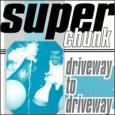
SOUNDTRACK: SUPERCHUNK-“Driveway to Driveway” (1994).

This disc is a first for Superchunk EPs.  The three “B” sides are all acoustic.  One of the nice things about that is that it showcases how good the songs are underneath all of the noise and distortion.

“Seed Toss” is from No Pocky for Kitty & “Sick to Move” is from Superchunk.  Obviously, they’re good songs or they wouldn’t have chosen them (out of all the back catalog…I mean, they could have chosen “Slack Motherfucker” after all).  And these acoustic versions are fun and interesting.

The final track is an acoustic “Driveway to Driveway.”  This is the most immediate in terms of comparison to the original (not least of which is the acoustic is a minute longer).  It allows them to breathe a little bit (and to make the lyrics more clear).

I’m not suggesting that Superchuink should be acoustic by any means, but it’s nice to hear the heart underneath the noise.

[READ: September 30, 2010] “Hawaiian Night”

Rick Moody is the fourth New Yorker 20 Under 40 author in the 1999 issue.

I’ve enjoyed a few of Rick Moody’s works (although now that I looked him up I found that he wrote a book called Garden State set in Haledon NJ (right near where I grew up…how did I not know this?…I shall have to read it very soon).

This piece seems like an experimental scene rather than a short story (or perhaps it’s from a longer work?).  It begins quite fascinatingly in a stark narrative style.  Pieces of information are doled out.  The information sets a scene with more and more detail. It is “Hawaiian Night” at a corporate picnic.  We see the limbo and the tuna skewers.  And then we meet the cast: dozens of interchangeable children having sanctioned fun amidst the adult workers.

And then suddenly things grow dark.   (more…)

Read Full Post »

SOUNDTRACK: THE DUCKWORTH-LEWIS METHOD-The Duckworth Lewis Method (2009).

This is a CD released by the combined forces of Neil Hannon of The Divine Comedy and Thomas Walsh of Pugwash.  And if that weren’t enough of a sales pitch, the title of the band is a method of calculating cricket scores!  And even more…in concordance with that, this CD is largely about cricket.  Huzzah!  Buncha sellouts.

I don’t know a thing about cricket, but I know about great orchestral pop, and this disc has it in spades.  Some of the more obvious cricket songs are even understandable to non cricketers (the themes of “Jiggery Pokery” are familiar to anyone who has failed in a sport–and musically it sounds like a silent film soundtrack).

“The Age of Revolution” begins with an olde-fashioned soundtrack as well (jazz swing, including tap dancing) but quickly jumps into a dancey discoey verse (the two soundtracks blend surprisingly well in the chorus).  And the revolution?  Well, it has something to do with cricket.  Next, “Gentlemen and Players” is a wonderfully Divine Comedy-esque track complete with harpsichords.

“The Sweet Spot” is another discoey dancey track with some funky bass work (and innuendo whispered vocals).  And “Rain Stops Play” is a fun musical interlude.

“Mason on the Boundary” is the first track that seems distinctly Pugwash-y.  Hannon and Walsh have similar singing styles, and I find it hard to know who is who sometimes.  But this track is clearly Walsh’s and it’s very nice indeed.  Similarly, “Flatten the Hay” has that distinct Pugwash XTC/Beach Boys vibe and it’s quite good.

“The Nighwatchman” is also a very DC type song (it even sounds a bit like “The Frog Princess” but pulls away before being a repeat of that great single by introducing some very 70s sounding strings).  The rest of the disc follows in this same wonderfully orchestrated pop feel.  This a great record that, as far as obscure bands that get no statewide attention go, is top notch.

Oh, an it’s even more fun with headphones!

[READ: October 9, 2010] Skippy Dies

Wow, there’s a lot going on in this book.  It’s exhausting just trying to think of all the topics covered: boarding school life, failed romance (two big ones), life as a teacher, the appeal of pop singer Bethani, the Catholic priest sex scandal, drugs of all kinds, sneaking into a girls’ school, World War I, institutional cover ups, M-theory–which is pretty much the entire universe, and donuts.

But let’s start at the beginning.  Yes.  Skippy dies.  In the first couple of pages.  And what’s fascinating about this is that we don’t care.  I mean, in the scene where he dies, he’s not even the major character.  But then Skippy turns out to be more or less the glue of the book once the story proper begins.

Skippy resides at Seabrook school in Dublin (the best, most prestigious Christian academy in the country–sorry Gonzaga).   His roommate is Ruprecht (perhaps the strangest major character name I’ve read in a long time).  Ruprecht is a large boy who is incredibly smart (he will single-handedly raise the school’s average on the year’s final exams).  He is a computer geek who is obsessed with aliens and SETI.  And he hopes to be able to communicate with the other world by using techniques suggested in M-Theory.  The book does an admirable job explaining M-theory and string theory.  I’m not going to take up space here, but there’s a fine description at Wikipedia (or, if you don’t like Wikipedia, here’s an academic explanation that is written for the lay person).

Anyhow, Skippy and Ruprecht are two of a few dozen boys who reside full time at the school.  (Most of the other kids are day students).  And they have a cadre of half a dozen friends that they hang out with who make jokes at each other’s expense.  It’s a very realistically written entourage.  Mario is Italian and claims to have had sex with many many women (thanks to his lucky condom which he has had for three years).  Dennis is the ballbreaker.  He’s the abusive one (but by most standards, he’s not a bad guy).  And a few other hangers on.

This story of dorm life is a good one.  The boys are funny, their stories believable, even if they are all eccentric in their own way.  And then, one day, Skippy sees a girl playing frisbee at the girls’ school across the way (Ruprecht has a telescope which he uses for the stars, while eveyrone else uses it for the girls’ school).  And Skippy winds up becoming rather obsessed with the unknown “frisbee girl.”

This girls’ school plays a part in the story in another way too.  Carl and Barry are the Seabrook’s thugs.  When Barry hits upon the idea of selling ADD meds to the locals (as diet pills), it’s the girls’ school that he mostly preys on.  For yes, this story is also about drugs. (more…)

Read Full Post »

SOUNDTRACK: VIOLET ARCHERS-End of Part One (2005).

The Violet Archers are the new(ish) band for Tim Vesely from the Rheostatics.  I’ve conveniently waited until The Rheos completely broke up before really really getting into them.  And it took me some time before deciding that I needed to get The two Violet Arhcers discs.  And then I discovered they were pretty much unavailable.

But the nice folks who used to sell their discs got me in touch with Tim himself, and he very nicely sent me the two CDs (for a most reasonable price).

When a band breaks up it’s always interesting to see what the solo members do…if they try to go very different from the original band or if they stay the same.  Well, the Rheos were a pretty unusual band, and if these two discs are any indication, it seems like Tim may have been the pop song writer.

“End of Part One” starts with a guitar and cool organ opening before the song kicks into a mellow rocker.  “Coordinates” has more interesting keyboard sounds (these sound strange to me because the The Rheos weren’t very keyboardy).  Lyrically, it’s a great collection of rhymed verses that lead to a wonderful na na na chorus.

The middle songs are a nice mixture of slightly fast rockers and almost folky ballads.   Vesely has a great knack for sing along choruses, but he’s also been alt-enough to know when to throw in an unexpected twist, or an interesting sound (the guitar sound in “Saved Me” is great) and the simple melody of “Simple” makes for a beautiful campfire song.

“Time to Kill” is a delightful gentle rock song with a great chorus and instrumentation.  It sounds like an outtake from a fantastic 1960s compilation.  It’s followed by “All that’s Good” which sounds like an awesome long-lost Neil Young song.  The guitar is spot on and the vocals work wonderfully.

“Fools Gold Rope” is a nice ballad with vocals by Ida Nilsen.  And the last four tracks are all shorter pieces.  “Life and Then” features keyboards prominently, while the oddly titled “Track Display” has some nice guitar work.

This is overlooked pop gem. Nothing is overly commercial, and yet it’s all fun and an enjoyable listen.  I’m glad Vesely is still writing great tunes.

[READ: September 28, 2010] “Sifting the Ashes”

This Dept. of Disputation piece is about cigarettes.  I’ve never smoked and I’ve never been much of a fan of cancer sticks.  However, I find myself siding with Franzen on a few points ion this article.

Franzen has evidently quit smoking several times (it’s even unclear from the way this is written if he’s actually smoking now (1996) or not).  But he never blames Philip Morris or RJ Reynolds for his addiction.  He argues correctly that marketing to kids reserves you a place in hell, but that really, parents and pop culture probably got more kids to smoke than Joe Camel ever did.

He makes some funny observations about smoking (getting freaked out about getting lung cancer?  Why not light up to calm down).  But mostly he notes how all of the attempts in the past to curb smoking have resulted in more hegemony for the big players: The ban on TV advertising saved the industry millions of dollars and froze out new competitors.  Even tax increases on smokes in 1982 were a way for the industry to also raise prices (and make more money) all the while blaming the tax.  And what we wind up with is that no plaintiff can realistically claim ignorance of tobacco’s hazards, therefore the companies will never be deemed negligent for selling cigarettes.

(more…)

Read Full Post »

SOUNDTRACK: SWANS-“My Birth” (2010).

I was a mild fan of the Swans in college ( I loved Children of God) and then post-college, my friend Lar got me obsessed with finding their obscure releases (turns out I have a bunch of LPs that are “valuable.”  Who knew?)  Anyhow, after they broke up I lost touch with Michael Gira’s projects (although Lar got me a cool autograph when Gira last played Dublin).

But Swans are back as heard on NPR.  (NPR?  Yes, NPR).  They have a new album out, but I’ve only heard this track so far.

Swans are loud and abrasive.  Their early stuff is slow and ponderous, nearly glacial–some of the darkest music going that’s not speed metal.  But after a ten plus year hiatus, and all kinds of new musical advancements what will Swans sound like?

“My Birth” is still a bruising song.  It’s loud and heavy but still slow-paced (although much faster than their early stuff).  The drums and bass are loud.  Gira’s vocals are much faster than his almost comically slow deep voice, and now he’s sort of yelling from a distance.

The big difference is that the song sounds contemporary.  Even though it is very Swans-y, it sounds like it has tricks from the last decade (no, not autotune), just a solid juxtaposition of instruments and a very cool/creepy electronic sounding tinkling that runs through the background of the chorus (is it a chorus?).

It sounds more commercial than things they’ve done and yet in no way is it a commercial song.  It abuses the listener and we are thankful for it.  Welcome back, then.

[READ: September 26, 2010] “The Matter with Morris”

This was one of the longer pieces of fiction I’ve seen in The Walrus.  And it was very satisfying.

As the story begins, we learn that Morris is a columnist and that he writes a weekly piece which is taken primarily from his life.  His family hasn’t been all that pleased about what he writes, but he does his best at hiding the details.  (He initially used material from his wife’s analysis business, but he found raiding his own family life to be more satisfying).

And then his life encounters a real tragedy.  He can’t process the problem, and it shows up in his column.  Instead of being quaintly funny, it becomes existentially intense.  Instead of being in first person, it becomes second person (and makes the readers uncomfortable). (more…)

Read Full Post »

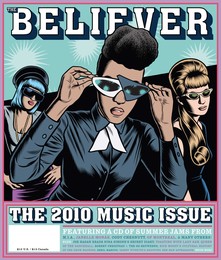
SOUNDTRACK: The Believer July/August 2010 Music Issue Compilation CD: “We Bumped Our Heads Against the Clouds” (2010).

Of all the Believer music compilations, this is by far my least favorite.  It would be oversimplifying things to say that the music is not for me, but in many respects it is not.  Chuck Lightning, the curator of the project states that this compilation is more or less a look into the state of the union for black artists.  And that invariably means a lot of R&B and songs that might be heard on Glee (I like the show, but I never know any of the music).

Deep Cotton’s “Self!” reminds me of novelty dance hit from the late 80s.  Of Montreal, who I thought sounded totally different from this, offer “Hydra Fancies” which is as catchy a disco anthem as any disco anthem can be.  Roman GianArthur’s “Depraved Valet” is an amazingly falsettoed Prince knock off.  Cody Chestnutt’s “”Come Back Like Spring” is a simple almost acapella ode to spring.  Saul Williams’ oddly titled “B.S. in a Tampon” is a spoken word with acoustic guitar that reminds me of Gil Scot-Heron.  Janelle Monáe’s “Cold War” is the first really catchy song (the la las remind me of Carole King), although  I could do without the overstated “Calinda” part and the extended fade.

The first song I really liked was BLK JCKs “Iietys” which sounded enough like TV on the Radio to be really interesting.  Spree Wilson’s “Chaos” also sounds like TV on the Radio (the more R&B side of the band, although the guitar solo is a dead ringer for “Hotel California.”  Scar’s “Rewind” is the song that should be on Glee.  I want to hate it but it is so damned catchy, I can’t.  Again, those Oh Oh Ohs are too perfect (and the auto0tune of course is unassailable).

Rob Roy’s “Velvet Rope Blues” is my favorite song on the disc by a large distance. It’s a weird rap that reminds me of The Streets, with an awesome sung chorus ala OutKast.  Hollyweed’s “Have You Ever Made Love to a Weirdo” is a trippy, juvenile space rap that is really silly.  Sarah hates it but I kind of like it, as it’s in the spirit of Frank Zappa, (although I hate the sax solo).  Fear & Fancy’ s “Off the Grid” sounds also not unlike OutKast.  And George 2.0′ s “Turn Off the TV” is a anti-TV rap rant (with the somewhat ironic conclusion that you yourself might end up ON the TV).

M.I.A. is probably the biggest name on the disc. “Born Free” is a weird little track of highly distorted vocals over a punk guitar buzzsaw sound.  But her vocals are mixed so loud in the mix that they sound unrelated.  It sounds not unlike a Go! Team track.  This track makes me wonder how she became such a sensation.

Hot Heavy & Bad’s “One” returns to that disco sound in the vocals with some contemporary bass sounds.  It wears out its welcome pretty quickly.  Tendaberry’s “Cold Boy” sounds like a less horn-y Fishbone.  Mother Novella offers one of the few all guitar songs, “Closer 9 1/2” and it’s an okay mid tempo rocker.

The final song is pretty awesome in theory: Nina Simone covering Alice Cooper.  That’s right, Nina Simone covering Alice Cooper.  Sadly I don’t know the Alice Cooper song, so it’s a bit lost on me.

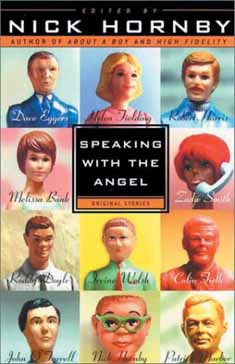
[READ: September 16, 2010] Speaking with the Angel

I bought this volume when it came out (and apparently donated $1 to TreeHouse at the same time).  It’s a collection edited by Nick Hornby (and the cover is designed similarly to the way High Fidelity and even About a Boy were at the time (“the Hornby look,” I suppose).

I didn’t buy it for Hornby alone, although he does have a story in it, but because it looked like a really promising collection of stories from authors I liked.  And for some reason I didn’t read it until now.  It includes 12 stories, and as the introduction notes, $1 was donated to TreeHouse.org.uk (in the US $1 goes to TreeHouse and another $1 goes to New York Child Learning Institute).  I don’t know if the money still goes there, but you can donate with a form at the back of the book.  (more…)

Read Full Post »

« Newer Posts - Older Posts »