Feeds:
Posts
Comments

Archive for the ‘Book Reviews’ Category

SOUNDTRACKMOGWAI-No Education = No Future (Fuck the Curfew) (1998).
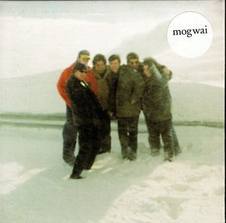
This is a 3 song EP. The opener “Xmas Stripes” is one of my favorite early Mogwai songs.  The opening melody is really great, with a cool interesting bass and a nice guitar over the top.  At about 3:30 the song grows from a silent track to a menacing, growing beast until the drums start and the song and the main riff begins.  By 5 minutes it’s all out rock noise.  By 6 minutes the song is scaled back for the violin solo.  The remaining 7 (!) minutes are a denouement for the song.  Even though I love the track, I mostly love the first 8 or 9 minutes.  The ending tends to drag a bit.

But for all of their noise, Mogwai’s early releases were really quieter instrumentals, meditative songs that were really quite pretty.  “Rollerball” is a beautiful, sad three-minute track.

The last song “Small Children in the Background” continues in this quieter vein.  At nearly 7 minutes, it allows for a noisy middle section.  This noisy section is indeed mostly noise.  And yet the pretty melody of the rest of the track is just as loud throughout the mix, making for a very cool and very brief explosion mid-song.

Not all EPs are essential, but this one is pretty fantastic.  And I have Lar to thank for getting it for me.

[READ: March 10, 2011] Changing My Mind

It’s funny to me when that when I get into an author, I seem to wind up not reading the books that people most talk about until much later.  Take Zadie Smith.  Her debut, White Teeth, is something of a touchstone for many readers.  I missed it when it came out, but I loved On Beauty and figured I’d go back and read it.  That was almost a year ago.  And in that time I have read lots of little things by her and now this collection of essays.

Regardless, this collection of essays is a wonderful look in to the nonfiction world of a writer whom I admire.  And it was quite a treat.  Zadie is an intellectual, and that comes across in all of these paces.  Whether it’s the subjects she’s writing about, the footnotes she uses or just the acknowledgment that she likes art films and not blockbusters, we know where she’s speaking from.  And, of course, I’m right there with her.  The funny thing about this book then is how few of the subjects I know.

The book is broken down into five sections: Reading, Being, Seeing, Feeling and Remembering.  The Reading section is basically book reviews.  The Being section is about her experiences.  The Seeing section is about films.  The Feeling section is about her father and the Remembering section is about David Foster Wallace. (more…)

Read Full Post »

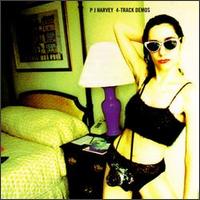
SOUNDTRACK: PJ HARVEY-4-Track Demos (1993).

After the intensity of the Steve Albini produced Rid of Me, Harvey releases this collection of demos.  The amazing thing is that these versions actually seem more intense than the Albini version. Or if not more intense, then certainly more raw.

The songs definitely have an unfinished feel about them, and yet they only vary from the final version in polish (and Albini’s stamp).

“Rid of Me” is just as quiet/loud, and has those high-pitched (and scary) backing vocals.  Speaking of scary vocals, her lead screams in “Legs” are far scarier here than on Rid of Me–like really creepy.  (Which sort of undermines that idea that this was released because Rid of Me was too intense for fans).   “Snake” actually features even creepier vocals–Harvey must have had a field day making these sounds!

I admit that I like the finished version of “50 Ft Queenie” better,”but there’s something about this version of “Yuri-G” that I like better.

The disc also has some tracks unreleased elsewhere.  “Reeling” is an organ-propelled song of female strength with the nice lyric: “Robert DeNiro sit on my face.”  “Hardly Wait” is a slow grinder that is fairly quiet for this time period.  “M-Bike” is a cool angry rocker about a guy and his motorcycle which is one of my favorite tracks on the disc.

It’s a great companion to Rid of Me.

[READ: end of February to early March]  original articles that comprise A Supposedly Fun Thing I’ll Never Do Again

As I mentioned last week, I decided to compare the articles in A Supposedly Fun Thing I’ll Never Do Again with the original publications to see what the differences were.  It quickly became obvious that there were a lot of additions to most of the articles, and it seems rather pointless (well, actually it seems exhausting and really outrageously time-consuming) to mention them all.  But what I did want to note was the things that are in the articles that have been removed from the book.   There’s not a lot but there are a few juicy tidbits (especially in the early articles) that are fun to note for anyone who read only the book and not the original articles.

My process for this was rather unthorough: I read the article and then right afterward I read the book.  If I noticed any changes, I made a note on the article version.  Many of them were surprisingly easy to note as DFW’s writing style (especially his idiosyncratic phrases) really stand out.  This is especially true in the Harper’s articles.  The academic ones were less notable, I believe, and I’m sure I missed a bunch.

I’m not sure in any way how these pieces were dealt with initially by the magazine or DFW.  I assume that DFW handed in the larger article (like we see in the book) and the magazine made suggested edits and DFW edited accordingly.  Then the book copies are probably the originals, bt which have also been updated in some way.

In most cases, it’s not really worth reading the original article, but I’m including links (thanks Howling Fantods), for the curious.

As for length, it’s hard to know exactly what the conversion from magazine article to book is.  The “Tornado Alley” tennis article is 8 pages (more like 4 pages when you take out the ads) and the book is 17.  Perhaps more accurately it seems like one Harper’s column = just under one book page.  I’ll try to figure out what the conversion is if I can.

One last note, whenever I say “article” I mean the original magazine version.  And obviously “book” means ASFTINDA. (more…)

Read Full Post »

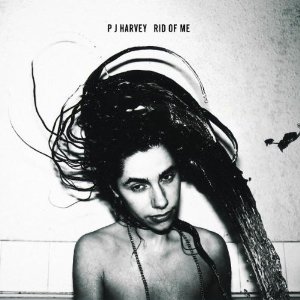
SOUNDTRACK: PJ HARVEY-Rid of Me (1993).

For Rid of Me, PJ Harvey jumped to the big leagues (relatively) by enlisting maniac Steve Albini as a producer.  And he takes the rawness of Dry one step further into a sound that is both raw and sharp.  He really highlights the differences between the highs and lows, the louds and quiets.  And man, when this came out I loved it.

Like NIN’s “March of the Pigs,” the opening of “Rid Of Me” is so quiet that you have to crank up the song really loud.  And then it simply blasts out of the speakers after two quiet verses.

“Legs” turns Harvey’s moan into a voice of distress, really accentuating the hurt in her voice.  And Harvey hasn’t lightened up her attitudes since Dry, especially in the song “Dry” which has the wonderfully disparaging chorus: “You leave me dry.”

“Rub Til It Bleeds” is a simple song that opens with a few guitars and drums but in true Albini fashion it turns into a noisy rocker.  “Man Size Quartet” is a creepy string version of the later song “Man Size” (I’ll bet the two together would sound great).  And the wonderful “Me Jane” is a great mix of rocking guitars and crazy guitar skronk.   Albini really highlights the high-pitched (male) backing vocals, which add an element of creepiness that is very cool.

For me the highlight is “50 Foot Queenie”.  It just absolutely rocks the house from start to finish.  The song is amazing, from the powerful…well…everything including the amazing guitar solo.  “Snake” is a fast rocker (all of 90 seconds long) and “Ecstasy” is a song that feels wrung out, stretched to capacity, like they’ve got nothing left.

It’s not an easy record by any means, but it is very rewarding.  This is a CD that really calls for reamastering.  Because it is too quiet by half, and could really use–not a change in production–just an aural boost.

[READ: end of February and beginning of March] A Supposedly Fun Thing I’ll Never Do Again

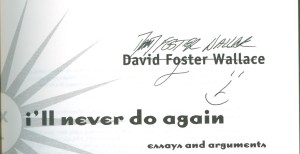
This is a collection of 7 essays that DFW wrote from 1990-1996.  Three were published in Harper’s, two in academic journals, one in Esquire and the last in Premiere.  I devoured this book when it came out (I had adored “Shipping Out” when it was published in Harper’s) and even saw DFW read in Boston (where he signed my copy!).

click to see larger

[Does anyone who was at the reading in Harvard Square…in the Brattle Theater I THINK…remember what excerpts he read?]

The epigram about these articles states: “The following essays have appeared previously (in somewhat different [and sometimes way shorter] forms:)”  It was the “way shorter” that intrigued me enough to check out the originals and compare them to the book versions.  Next week, I’ll be writing a post that compares the two versions, especially focusing on things that are in the articles but NOT in the book (WHA??).

But today I’m just taking about the book itself. (more…)

Read Full Post »

SOUNDTRACK: The 90’s Are Back, Or Whatever… NPR.  (2011).

This is a 90 minute podcast about the music of the 90s.  And, of course, it opens with “The Dream of the 90s” from Portlandia.

I don’t listen to too many full discussions on the All Songs Considered site, but since the 90s were definitely my favorite era of music, I thought it was worth a listen.  Incidentally, it’s funny that the 90s are so meaningful to me when, really I should be a child of the 80s.  But in reality, my 80s music was mostly heavy metal, because I hated all pop radio then.

This radio show (available for free download here) features four NPR music geeks talking about the music they loved during the 90s.  There are some obvious points (“Smells Like Teen Spirit,” “1979,” “Song 2,” “Loser”), but some unexpected songs as well: “Grace” (Jeff Buckley), “Long Snake Moan” (PJ Harvey).  And of course, probably the biggest surprise: Sebadoh’s “Soul and Fire as “song of the decade.”

The hosts have a lot of fun with bad songs (severe bashing on Collective Soul or hilariously cueing up “Can’t Touch This” to punk one of the speakers when they are talking about Missy Elliot–yup, it’s not all alt rock, Missy Elliott and Lauren Hill crop up along with Johnny Cash and Nusrat Fateh Ali Khan).

But let’s not forget my perennial favorite from Cornershop: “Brimful of Asha.”  And, yes, My Bloody Valentine.

These days, when I do listen to the radio, I find that the stations I prefer tend to play a lot of 90s songs, but it’s surprising to me how infrequently they play some of these really big artists (I hear a lot of Harvey Danger, but no My Bloody Valentine).  It’s funny that one of the songs they talk about, Len’s “Steal My Sunshine” I actually heard coming out of a radio at a pool while on vacation in Florida this past January (!?!).

It’s a fun segment and makes me think that although I do like a lot of new music, I’m a gonna hafta retire to Portland.

P.S. Stay till the end of the show for the hilarious impersonation of Trent Reznor.

[READ: February 17, 2011] 3 book reviews

Zadie Smith is an author whose output I fully intend to ingest one of these days.  So I figured why not read a few of her book reviews, too.

Smith reviews three new titles: Harlem is Nowhere: A Journey to the Mecca of Black America, by Sharifa Rhodes-Pitts; My Prizes by Thomas Bernhard; and While the Women are Sleeping by Javier Marías.

I’m intrigued by her review of Harlem is Nowhere.  She seemed to be rather critical of the author, especially of her mannerisms: like calling James Baldwin’s “habit of speaking to Harlem folk, having experiences, and deriving from these encounters “a metaphor about all of black existence”–“The Jimmy.”  (where others might have simply called it “writing”).  Or the fact that the author describes herself as a “single girl” as if that has anything to do with anything.

The second half of the review concedes that once you abandon wanting to known anything precise about historical Harlem, it’s a lovely book.  Smith revels in learning about James VanDerZee, Raven Chanticleer and Alexander Gumby (and her enthusiasm makes me want to investigate this book, if not their own works).

So, despite initial criticisms, she ends the review very positively and gives a thumbs up to the work. (more…)

Read Full Post »

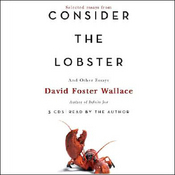
[LISTENED TO: November 18, 2010] Consider the Lobster

This was the final audio book that DFW read.  As with Brief Interviews, this is a collection of selected, unedited essays [actually it says “Text slightly edited for audio, with changes approved by the author.”  I don’t know these essays verbatim, but it seems like the changes simply acknowledge that this an audio essay and not a written one].

The only problem with the entire package is how few essays were selected.

I don’t know if it’s because this collection was recorded later and DFW felt more comfortable reading or because DFW had more fun reading these essays or that these essays lend themselves to more animated reading, but this collection is absolutely stellar.

The audio book includes

  • Consider the Lobster
  • The View from Mrs. Thompson’s
  • Big Red Son
  • How Tracy Austin Broke My Heart

and, sadly, that’s it.

Not included are (more…)

Read Full Post »

SOUNDTRACK: THERAPY?-Lonely, Cryin’ Only [single] (1998).
I have a few Therapy? singles, but I wanted to mention this one specifically because it has two “new” recordings on it.  The first is of “Diane” the Hüsker Dü song that they first recorded on Infernal Love.  The second is of “Teethgrinder” their first “hit” off of Nurse.
I’m always intrigued when bands reinterpret their own songs, but I have to say that these two remakes are disappointing.  “Diane” is slowed down quite a lot and is very very crisp.  But it rather removes some of the creepiness of the original (and it’s a very creepy song).

As for “Teethgrinder,” the original of that song is stellar.  Any changes can only be for the worst.  And that’s the case here.  There’s so many great, weird sounds from the original (and those sounds make it wonderful) that without them, the song is fine, but nothing awesome.

Fortunately these tracks are b-sides and not really official or anything.

[READ: May 4, 2010] The Review of Contemporary Fiction

This is my first exposure to this journal.  The only reason I bought it was for the main (and only) title in the book–Damion Searls’ ; Or The Whale (which I’m reading now and will review shortly).

The rest of the journal contains Book Reviews and ads for forthcoming publications.  Since I didn’t plan to talk about that back matter in ; Or The Whale, I ‘ll do it here.

There are 22 book reviews in the back of this journal (which itself is 368 pages and only costs $8.00!).  Each book is not quite an academic book, but certainly not popular fiction or non-fiction.  There are a lot of French writers (either in translation, or of books about them).  There’s also some reviews of books that were long out of print (Robert Walser’s The Tanners and two works by Breyten Breytenbach).

The one surprise is the inclusion of a sort of meta-science fiction title by Christopher Miller called The Cardboard Universe.  It’s an encyclopedic guide to a sci-fi author whose initials are PKD. (Phoebus K. Dank–although Dank does have a fictional character called Phillip K. Dick).  It sounds great and yet it is an encyclopedic-style book of over 500 pages.  I’m just not sure if I’m up for it.

I’ll probably never read any of the books reviewed (I barely have time for the stuff I really want to read), but they all sounded interesting in one way or another.   For the entire list of books reviewed and more info on the journal, click here.

After the Book Reviews, there’s a Books Received list.  I assume this is all of the books that they were asked to review.  I wonder if they’ll review all of them?   The only author I recognized in the list was A.S. Byatt.

There’s then a few ads for like-minded publications: n+1, Chicago Review, Trickhouse, which looks fascinating, and Absinthe (new European writing).  There’s also a listing for new books from University of Delaware Press about Don DeLillo’s Underworld, Thomas Pynchons’ Mason & Dixon and William Gass’s The Tunnel (which I really ought to read as that book was a mystery to me).  There’s even critics I recognize in these essays!

The final pages are ads for forthcoming books from Dalkey Archive Press (the publishers of The Review of Contemporay Fiction).  I know Dalkey for a few obscure titles (mostly from Flann O’Brien, but others as well).  The books in this list are from the Dalkey Archive Scholarly Series and include titles like Phantasms of Matter in Gogol (and Gombrowicz); Reading Games: An Aesthetics of Play in Flann O’Brien, Samuel Beckett, and Georges Perec (which I admit sounds really interesting, but which I will likely never read).  The final title in the list is called Don’t Ever Get Famous: Essays on New York Writing after the New York School.  I’m curious about this one.  The book blurb mentions a number of writers that I’ve never heard of, so I can’t decide how to take that title.  I only wish the blurb explained it.

If I were more studious, if I worked in academics, if I didn’t read so many other things, I would definitely subscribe to this journal.  But as it stands, I’ll be just getting just this one (and maybe an occasional other one if the mood strikes me).

Read Full Post »

SOUNDTRACK: New Moon Original Motion Picture Soundtrack (2010).

Back in the 90s, it seemed like every week there was a new soundtrack featuring an unreleased song from some great alt rock band.  This meant huge sales for soundtracks, even if for the most part they weren’t solid start to finish.  In fact, mostly you got three great new songs, three pieces of rubbish, one great song by a band you’d never heard before and two or three okay tracks.

The inclusion of a new Death Cab for Cutie song was the big news about this soundtrack.  And overall, the reviews were positive.  And I’m pleased to say there aren’t really any horrible songs here.  (I have no idea how the soundtrack fits in with the movie as I haven’t seen it and probably never will).

But as with that old soundtrack formula: we get a few good songs by reasonably well-known bands: Death Cab for Cutie, Thom Yorke, Bon Iver & St, Vincent, Muse, Grizzly Bear.  And then there’s a whole bunch of good rock songs.  The disc plays as something of a sampler of downcast, mellow alt rock. In fact, the back half of the disc sounds like a pretty decent alt rock radio station from the last decade or so.

Some of the tracks even sound like 90s alt tracks (Hurricane Bells, that song is 16 years old right?  And Sea Wolf, you’re channeling Peter Murphy, I know.)  The final two tracks are okay.  The Editors is kind of a Nick Cave via Joy Division sorta spoken word ballad.  And I admit I’m a little disappointed in the Lykke Li track–they got hyped beyond their ability.  The final track is a piano score, which is fine.

The biggest surprise to me is how much that Death Cab for Cutie songs sounds like a Rush song.  I’ve never considered that the bands sound anything alike before, and yet from the moment the song opens, that could be Geddy Lee singing, and that whole guitar structure is very Rush-like.  Maybe they should do a cover of it.

[READ: April 20, 2010] Maps and Legends

This is a collection of 17 non-fiction pieces by Michael Chabon.  The pieces cover everything from book reviews, essays about reading and writing, comic book and comic book artists and golems.

The opening essay is about the modern short story and it sets the tone for the entire book.  Interestingly, this essay talks about the state of entertainment and how “Entertainment has a bad name.  Serious people learn to mistrust and revile it.  The word wears spandex, pasties, a leisure suit studded with blinking lights. (13).  This very topic is at the heart of the David Lipsky/David Foster Wallace book (and in fact Chabon is mentioned in that book as well.)  Ah, serendipity. (more…)

Read Full Post »

SOUNDTRACK: DO MAKE SAY THINK-Other Truths [CST062] (2009).

I’ve always enjoyed Do Make Say Think’s CDs.  They play instrumentals that are always intriguing and which never get dull.

But this CD far exceeds anything they have done so far (and  they’ve done some great work).   There are only four tracks, and they range from 8 to 12 minutes long.  Each track is named for a word in the band’s name: Do, Make, Say, Think.  And each one is a fully realized mini epic.

“Do” sounds like a gorgeous Mogwai track.  While “Make” has wonderfully diverse elements: a cool percussion midsection and a horn-fueled end section that works perfectly with the maniacal drumming.  “Say” is another Mogwai-like exploration, although it is nicely complemented by horns.  It also ends with a slow jazzy section that works in context but is somewhat unexpected. Finally, “Think” closes the disc with a delightful denouement.  It’s the slowest (and shortest) track, and it shows that even slowing down their instrumentals doesn’t make them dull.

It’s a fantastic record from start to finish.  This is hands down my favorite Constellation release in quite some time.

[READ: December 2009 – January 13, 2010] McSweeney’s #33.

The ever-evolving McSweeney’s has set out to do the unlikely: they printed Issue #33 as a Sunday Newspaper.  It is called The San Francisco Panorama and, indeed, it is just like a huge Sunday newspaper. It has real news in (it is meant to be current as of December 7, 2009).  As well as a Sports section, a magazine section and even comics!

[DIGRESSION] I stopped reading newspapers quite some time ago.  I worked for one in college and have long been aware that the news is just something to fill the space between ads.  I do like newspapers in theory, and certainly hope they don’t all go away but print issues are a dying breed.  When I think about the waste that accompanies a newspaper, I’m horrified.  Sarah and I even did a Sunday New York Times subscription for a while, but there were half a dozen sections that we would simply discard unopened.  And, realistically that’s understandable.  Given how long it took me  to read all of the Panorama, if you actually tried to read the whole Sunday paper, you’d be finished the following Sunday (or even two Sundays later).

Their lofty goal here was to show what print journalism can still do. And with that I concur heartily.  Even if I don’t read the newspaper, the newspapers as entities are worth saving.  Because it is pretty much only print journalism that finds real, honest to God, worthy news stories.  TV news is a joke.  There is virtually nothing of value on network TV.  Fox News is beyond a joke.  CNBC is sad (although Rachel Maddow is awesome!) and even CNN, the originator of all of this 24 hour news nonsense still can’t fill their airtime with non-sensationalized news.

Obviously, there are some decent internet sites, but for the most part they don’t have the budget to support real news investigation.  You either get sensationalized crap like Drudge or rebroadcasts of real news.

So, print is the last bastion of news.  And you can see that in journalistic pieces in The New Yorker, Harper’s, The Walrus, Prospect and, yes, in newspapers.

But enough.  What about THIS newspaper?  Oh and unlike other McSweeney’s reviews I’ve done, there is NO WAY that I am writing a thorough comment on everything in here.  There’s just way too much.  Plus, there are many sections that are just news blurbs.  Larger articles and familiar authors will be addressed, however.  [UPDATE: January 18]: If, however, like Alia Malek below, you bring it to my attention that I’ve left you out (or gotten something wrong!) drop me a line, and I’ll correct things.

There is in fact a Panorama Information Pamphlet which answers a lot of basic questions, like why, how and how often (just this once, they promise!). There’s also a Numbers section which details the size, scope and cost of making this (it shows that with an initial start up, anyone could make a newspaper if they talked enough about what the readers were interested in). (more…)

Read Full Post »

propsectI recently received an e-mail from a nice person at Prospect (a British magazine).  The email asked if I’d like to review their magazine.  After being completely flattered, I said, “Of course!”  And then I waited nervously hoping that the magazine was good and that I wouldn’t have to say anything mean about it, because I would.  Oh yes, I would.

ctBut I don’t have to. They grabbed me right off the bat because the c & the t in the title are connected by a little filigree doodad.   I love typography, so that little flourish was a selling point (okay a superficial one, but I liked it immediately).

The “subtitle” of the magazine is “Good Writing About Things That Matter” and it is a totally apt description.  Prospect is a monthly magazine that covers all aspects of society: British, European, American and the world.  And, indeed, the writing is quite good.

In many ways it reminded me of The Walrus, a favorite magazine of mine.  (It’s a weird comparison since The Walrus has only been around for a few years, while Prospect has been around for about 13 (the November issue is number 164, so I’m guessing here), but it’s an apt comparison for its coverage: politics, culture, arts and more.

Because this was a new (to me)  magazine (and because I knew I’d be reviewing it), I decided to read every article.  There were a few that I thought I wouldn’t care much about.  But the writing totally grabbed me.  For instance, the article about Princess Diana (about whom I am indifferent) was fantastic.  It was cynical and funny and totally engaging.  And the same was true for just about every article in the magazine.

Normally I like to have at least two issues to refer to when reviewing.  So there may very well be things about this issue that are different from the others.  So, forgive, please, if I generalize incorrectly. (more…)

Read Full Post »

dfwshelfSOUNDTRACK: LAND OF KUSH-Against the Day [CST058] (2008).

kushLand of Kush is a huge orchestra created by Sam Shalibi.  Shalibi is a maniac of independent releases, creating everything from orchestral pieces to solo records all with his unique blend of middle eastern tinged music (featuring his oud playing).

This album is inspired by Thomas Pynchon’s Against the Day, a book I have not read.  As such, I can’t say if the music works with the book, or indeed if the songs with lyrics have anything to do with the book at all.  The liner notes essay that Shalibi wrote reveal his deep appreciation for the book and how it made him hear this music.  Pretty neat.  Against the Day the book is over 1,000 pages, so I won’t be getting to it anytime soon.

The CD has 5 tracks: three of them about 8 minutes, one at 14 minutes and the centerpiece comes in at 21 minutes.  To read more than I’m going to say about this band and the album, check out the Constellation Records page.

In general, I find Shalibi’s music to be fascinating, but sometimes a bit much.  He is not afraid to pull out all the stops.  And I think that’s to his credit.  He does free jazz, psychedelic and middle eastern phrasing, often within one song.  And while it’s often very enjoyable, it can also be exhausting.

And that is the case with this disc. The 21 minute “Bilocations” is such a brilliant piece of music.  The main musical line is just fantastic: middle eastern instruments playing a sort of James Bond type suspense theme.  And the vocals are simply amazing.  The singer (and I regret to say I’m not sure which one she is) is snarling and sexy and brings the whole piece to life.  I’ve never heard anyone say “economics” with such emotion before.  And I enjoy probably the first 15 or 16 minutes of it.  The last five drifts into a sort of solo for voice which gets a bit tiresome, actually, especially after the intensity of the first part.

And yet it is then followed up by the last two songs, each about 8 minutes long, again with fantastic motifs that propel these weird and wild pieces beyond the middle eastern psychedelic soundscapes into actual songs.

Despite my amorphous criticisms (I think that the disc is just too long to appreciate in one sitting (and I find middle eastern music is hard for me to digest in more than small doses)) this is my favorite of Shalibi’s releases.  And some day I hope to read the book, too.

[READ: September 19th ish 2009] short uncollected pieces

This is my second (and final, I think) review of multiple DFW uncollected pieces.  There are a few uncollected pieces left that I’m going to read, but they’re all longer and will likely deserve their own post.  Most of these pieces are very short, and I don’t have all that much to say about them.  But, heck, I’m a pseudo-complestist, so I want to have them all here.

All the text in bold, including the links comes from (where else?) The Howling Fantods.  Thanks! (more…)

Read Full Post »

« Newer Posts - Older Posts »