Feeds:
Posts
Comments

Archive for the ‘Animals’ Category

 doubledownSOUNDTRACK: JAKE SCHEPPS’ EXPEDITION QUARTET-Tiny Desk Concert #187 (January 19, 2012).

jakeJake Schepps’ Expedition Quartet is a somewhat unusual string quartet in that the instruments are violin and upright bass (normal) but also guitar and banjo.  And so the songs have a classical feel–melodies repeated in a fugue style, but with the prominence of the banjo, it feels more like a folk song.  The violin takes on a kind of fiddle sound.  And that’s interesting enough, but it’s the story of the music that they are playing which makes it even more fascinating:

About 100 years ago, Béla Bartók was traipsing through his native Hungary (Romania and Slovakia, too) with a bulky Edison phonograph, documenting folk songs and dances. There’s a priceless photo of the young composer, his contraption perched on an outside windowsill with a woman singing into the horn while anxious villagers stare at the camera. By 1918, Bartók had amassed almost 9,000 folk tunes. He made transcriptions of some; others he arranged for piano, while elements of still others found their way into his orchestra pieces and chamber music.

This was the country music of Eastern Europe, and its off-kilter rhythms and pungent melodies continue to captivate music lovers and musicians like Colorado-based banjo player Jake Schepps, who has recorded an entire album of Bartok’s folk-inspired music.

For this concert, with fellow members of Expedition Quartet — violinist Enion Pelta-Tiller, guitarist Grant Gordy and bass player Ian Hutchison, they played a Bartók hoe-down of sorts.

They play three pieces:

“Romanian Folk Dances: ‘Stick Game'”  Bartók (arr. Flinner).  This is a quieter piece with moments of bounce.  Indeed, Schepps doesn’t feel like the leader of this group because everyone shares the spotlight.  The guitar takes a lengthy solo–its got a very jazzy feel (which is a little weird on an acoustic guitar).  The violin takes a pizzicato solo, which is neat.  When Schepps finally does do a solo it’s not a showoffy banjo solo, it just fits in well with what everyone else is playing.

“For Children (Hungarian Folk Tunes): ‘Stars, Stars Brightly Shine'” Bartók (arr. Schepps).  This is a slower tune and it is much shorter as well—it doesn’t really lend itself to soloing.  Although the violin takes on the lead melody and it sounds mournful and beautiful.

“Mikrokosmos No. 78 / ‘Cousin Sally Brown'” Bartók / traditional (arr. Schepps).  Before this track, when someone tells Schepps that No 78 is his favorite of the Mikrokosmos, he says that he prefers 79.  The bassist says that 79 has gotten too commercial.  The end of the song has a tag of “Cousin Sally” a rollicking traditional dance number.  The four seems to play somewhat at odds with each other briefly and when they all rejoin for the end—it’s pretty great.

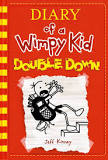
[READ: December 27, 2016] Diary of a Wimpy Kid: Double Down

I keep expecting the quality of the jokes in the Wimpy Kid books to decline.  But rather, this book was not only hilarious, but it worked really well as a book, too.

What I mean is that, I know that the Wimpy Kid series is online and that Kinney does a new story every day (or at least he did , I don’t know if he still does).  These books had always been taken from the online site (and I assume they still are).  But somehow, this book has jokes that circle back to jokes earlier in the book.  There’s at least a half a dozen callbacks which makes this book more than just a collection of diary entries…it’s a perfectly contained unit with a satisfying ending.

(more…)

Read Full Post »

slowreadSOUNDTRACK: DIRTY THREE-Tiny Desk Concert #245 (October 15, 2012).

dirty-3For a Murakami collection I should really have picked a jazz Tiny Desk Concert.  But none jumped out at my on my list.  So I decided to do something that might be jazzy in spirit, even if it is nothing like jazz at all.

Dirty Three are a three-piece band which consists of violinist Warren Ellis (who works closely with Nick Cave), drummer Jim White (who I had the pleasure of seeing live with Xylouris White), and guitarist Mick Turner (who has released a string of gorgeous instrumental solo albums and worked a lot with Will Oldham).

I’ve liked Dirty Three for years, although I kind of lost touch with them back around 2000.  So it was fun to see that they are still working.  (They’ve released all of 3 albums since 2000).

Jim White plays an eccentric but very cool style of drum–it always feels improvised and random, and maybe it is, but it’s never “wrong.”  Turner is the only one who is keeping the song, shall we say, “stable.”  He’s got the rhythm and melody both with his strumming.  And Ellis is all over the place with melody lines and bowing.

For this Tiny Desk, they play three songs.  Their music is ostensibly instrumental although Warren Ellis is not above shouting and yelling and keening when appropriate.

The first two songs are from their 2012 album and the last one is from Ocean Songs.

“Rain Song” opens with Ellis strumming the violin while Turner plays slightly different chords.  Then Ellis takes off on a series of spiralling violin rolls.  As always, White is back there waving his arms around with the loosest grip on drumsticks I’ve ever seen.  He plays brushes on this song but the drums are far from quiet.  Meanwhile Ellis is soloing away, yelling where appropriate and doing high kicks when White hits the cymbals.   As the song comes to an end, White is going nuts on the drums and Ellis takes off his jacket (revealing a wonderful purple shirt) .  He starts screaming wildly as he physically gets into his violin playing.

“The Pier” is about realizing that it’s the rest of the world that is driving you crazy.  It’s about “trying to undermine Facebook and realize a new way of communicating with people beyond the internet.”  It’ about… are you ready Mick?  Okay.  “The Pier” is a slower song with some plucked violin.  Ellis climbs up on the desk and dances around as he plays.  This one feels a but more controlled but in no way staid.

For “Last Horse in the Sand,” white switches to mallets and adds a tambourine to his cymbal.  It’s really interesting to watch White play around with things–moving his gear around as he plays.  He switches sticks and seems to be not even paying attention, but without ever really losing momentum or timing.  For this song, Ellis and Turner are the mellow ones while White is just all over the place with his amazing drumming.

I haven’t said anything about Turner because he is really the grounding of the band, while the other two are taking flights of fancy.

This is a wild and untamed set and it’s a lot of fun.  It’s also amusing to watch the audience witnessing this seeming chaos.

[READ: December 16, 2016] Slow Reader Vol. 1

Madras Press had released 16 small books, which I enjoyed reading quite a lot.  I have posted about some and will post about more in the new year.  But word is that they have given up on the small books and have switched their attention to a new magazine/journal called Slow Reader.  The first issue came out this month and it collects stories, essays, poems, illustrations, and other things that center around novelist Haruki Murakami.

Support this small press!  You can order this issue directly (and name your price, although I think the asking price is $6).

From an article elsewhere I’ve learned that future issues will cluster around M.F.K. Fisher, Kazuo Ishiguro, and Patricia Highsmith.

This issue contains essays, fiction and illustrations, some dating back as far as 2000.

CHIP KIDD-cover illustration (wind-up bird)
Chip Kidd is awesome

GRANT SNIDER-Murakami Bingo Board
This bingo is hilariously apt–covering most of the bases of Murakami’s writing: cats, jazz, running, and even a Chip Kidd cover.

JESSE BALL-Sheep Man
A line drawing of a sheep standing upright with the caption “The sheep man’s peculiar tail was never visible to me.”

HARRIET LEE-MERRION-Diner illustration
A nice line drawing of a corner diner

KAREN MURPHY-Sputnik and two moon illustrations
Two simple drawings of Sputnik and two moons.

BEIDI GUO-Hard Boiled Wonderland and the End of the World map
A cool map of the locations of the novel.

DINA AVILA–Murakami Tasting Menu at Nodoguro in Portland, OR
I don’t really get if the menu items are related to the stories but it’s a neat idea that there are foods named after his works. But why are so many called IQ84?

EUGENIA BURCHI–IQ84 menus
A drawing of foods with what I think are character names (I haven’t read the novel yet).

FABIO VALESINI-train illustrations taken from the book trailer for Colorless Tsukuru Tazaki and His Years of Pilgrimage
No idea what the original context is, but it’s a neat, clean drawing of a train station.

JEFFREY BROWN-“In Conversation” What Jeffrey Brown Thinks About
The first piece is an amusing cartoon in which Brown scores a job at an indie bookstore by mentioning Murakami.  The little blurb says that it is an only slightly exaggerated account. There’s also a later picture by Brown of Murakami’s face posted on a bulletin board (with a lost cat flier), that’s really great.

DANIEL HANDLER-“I Love Murakami”
Handler begins his piece by apologizing to dozens of authors before saying that Murakami is our greatest living practitioner of fiction.  He mentions a few books but heaps a ton of praise on Wind Up Bird Chronicles and mentions his excitement at  finally getting Norwegian Wood in English (it had been untranslated for many years).  He wrote this essay in 2000.

YOKO OGAWA-“On Murakami’s “The Last Lawn of the Afternoon” [Translated from the Japanese by Stephen Snyder]
Ogawa writes about a house in her neighborhood which has a lawn that she finds unsettling–it’s perfectly manicured and a pale, cool shade of green.  She is reminded of the Murakami story in which a boy mows a woman’s lawn and she asks him an unexpected question.  Ogawa imagines a woman in that home asking the same kinds of questions.

ETGAR KERET-“What Do We Have in Our Pockets?”
This was inspired by Murakami’s story “On Seeing the 100% Perfect Girl One Beautiful April Morning.”  This story is about a man whose pockets are always bulging with unusual items.  People often say to him, “What the fuck do you have in your pockets?”  And his answer is that he carries things that he imagines the perfect woman needing–a stamp or a toothpick.  It is a wonderfully charming story.

RIVKA GALCHEN-“The Monkey Did It”
Of all of the items in this collection, this is  the only piece I’d read before.  I remembered parts of it (particularly the excerpts from “A Shinagawa Monkey,” and her talking about Colorless Tsukuru Tazaki.  I also recalled her saying that she liked his short stories better than his novels, but that she was perhaps wrong in thinking that.  The one thing I didn’t pick up on last time was that in the beginning of the essay she writes about Toricelli’s Trumpet or Gabriel’s Horn–an item with finite volume but infinite surface area.  She says this perfect describes Murakami’s work.  And I love that she ties it to translator Philip Gabriel who is a gentle and modest translator–perfect for the watery novel.

TESS GALLAGHER-“Murakami and Carver Meet at Sky House”
Before he had written any substantial works, Murakami translated Raymond Carver’s works into Japanese.  Ray was excited and bemused that Haruki and his wife Yoko would travel from Japan to meet with him.  This essay tells us that the following poem came about as Ray tried to imagine how his poems could possibly be appreciated in Japan.  Murakami told him how both the Japanese and American people of the 1980s were experiencing humiliation at being unable to make a decent living.  Gallagher says that if they were to meet today Ray would be awkward about Haruki’s stature.  But he would have loved knowing that Murakami had translated everything he had written.

RAYMOND CARVER-“The Projectile”
This poem is wonderful. It begins with Carver speaking about his meeting with Murakami and then flashing back to when he was 16 and was hit with an ice ball.  It was thrown from someone in the street through a small crack in the window of the car he was riding in–a chance in a million.

RICHARD POWERS-“The Global Distributed Self-Mirroring Subterranean Neurological Soul-Sharing Picture Show”
This is the most abstract and “intellectual” of the essays here.  It speaks of a team of neuroscientists discovering a lucky accident–that neurons in the brain fire when someone else makes a motion that we recognize.  Similarly, in Murakami–representation is the beginning of reality.  He speaks of the parallel narratives in Hard Boiled Wonderland.  He wonders at the universality of dreams and ideas in Murakami.  “But if his own stories are steeped in the endless weirdness hiding just inside everyday life, how then to account for Murakami’s astonishing popularity throughout the world?”

MARY MORRIS-“The Interpreter”
I loved this story.  An American business woman is giving a series of lectures in Japan.  She is assigned a translator who goes with her nearly everywhere.  She is a little annoyed that he is always there, but he is very respectful of her and only speaks when spoken to.  She assumes he is translating her speeches correctly, but during one, the audience laughs where there was nothing funny.  She doesn’t want to disrespect him, but she can’t imagine what he said to them.  In the next one, they are practically doubled over with laughter at what he says.  Finally she has to confront him about it.  He reveals astonishing insights into her personal life.  And the next day he is called away–just as she has begun to feel close to him.

In the author’s note, she says that the she was at an writer’s meeting in Princeton (where she teaches) and Murakami was there eating with them. He was by himself, and she talked to him because she was a fan of his work.  She relates a story of holding up a sign for him when he ran the New York City Marathon.  She says that the part about the translator and his family (which I didn’t mention) is from an actual translator she met in Japan.

AIMEE BENDER-“Spelunking with Murakami”
Bender speaks of trusting Murakami.  She says when the cat started speaking in one of his books, she began to mistrust him.  Nevertheless, she says, she loves a lot of writers but only trusts a few of them.  She’s not trusting Murakami’s honesty or his ability to make her smarter.  Rather, she trusts him like a man with a torch in a cave–someone who is willing to explore–and to be in front leading the way.

SUMANTH PRABHAKER-Editor’s Note
Prabhaker would like to ask the world’s philosophers why some things seem to happen to us in a random fashion.

Read Full Post »
tinySOUNDTRACK: GREGORY PORTER-Tiny Desk Concert #550 (July 18, 2016).

gregory Gregory Porter is a soul singer.  For this Tiny Desk Concert, it’s just his voice and a piano played by Chip Crawford.  It’s odd that in the middle of July he’s wearing a suit and what looks like a balaclava, but whatever.

The first song, “No Love Dying” is a slow piece and Porter doesn’t really get to show off his power too much.  But his voice sounds great.  When it’s over he says he likes to think of that song in times of trouble, and we are welcome to take it into our houses in time of trouble as well.

“Take Me To The Alley” is about the backstreets and forgotten places and how we treat the people who are in those alleys.  This is also a slow, pretty song.

The final song is a warning, and we’ll know what’ its about when we hear the lyric: “Don’t Be a Fool” that’s all you need to know.  It, too, is a mellow piece, full of love and offering advice to not be a fool.

I didn’t know Porter before this, and I was pleasantly surprised by his songs.

[READ: November 18, 2016] The Tiny Wife

Back in 2014, I ordered all 16 books from Madras Press. Unfortunately, after publishing the 16 books they seem to have gone out of business (actually they are switching to non-fiction, it seems). They still have a web presence where you can buy remaining copies of books.  But what a great business idea this is/was

Madras Press publishes limited-edition short stories and novella-length booklets and distributes the proceeds to a growing list of non-profit organizations chosen by our authors.  The format of our books provides readers with the opportunity to experience stories on their own, with no advertisements or miscellaneous stuff surrounding them.

The format is a 5″ x 5″ square books that easily fit into a pocket.

Proceeds from Kaufman’s book go to Sketch— Working Arts for Street Involved and Homeless Youth.

This has been my favorite story from Madras Press so far. It was suitably weird but it followed its own internal logic and was really funny/intense at the same time. (more…)

Read Full Post »

[LISTENED TO: December 2016] A Boy Called Christmas

boyS. brought his audiobook home for us and we started it the night we went to pick out our Christmas tree.

This is a delightful story of Nikolas, an 11-year-old boy living in Finland in the olden days.  His parents called him Christmas, because he was born on Christmas day.

Nikolas’ life has been one of terrible hardship.  His mother was killed when she was attacked by a bear (a bear that lingers around their house to this day).  His father, Joel, is a woodcutter.  He cuts enough wood for them to survive, but otherwise things are bleak.  They eat mushroom soup for every meal and, in Nikolas’ whole life, he has received just two toys: a sled and a doll with a turnip head.

The only friend that Nikolas has is a mouse named Mika.  Now, this may be a fairy-tale kind of story but even Nikolas can’t understand Mika’s squeaks (although we can).  Mika is constantly on a quest for cheese–even though he has never tasted it.

Joel has noticed a man, a hunter, in their vicinity.  He turns out to be an excellent bowman with silver arrows.  In fact, once, when the bear that killed Nikolas’ mother is nearby, an arrow flies through the air and scares off the bear, saving Nikolas’ life.  The hunter finally comes to their house with a proposition for Joel.

The hunter is on a quest on behalf of the king.  They are setting off to prove that Elfhelm, the mythical land of elves, really does exist.  If they can bring proof to the king, they will be incredibly rich men. Joel and Nikolas believe very strongly in magic and in Elfhellm, and after much hemming and hawing, Joel decides to go on the quest.

This leaves Nikolas alone (with Mika).  So Joel calls his sister Aunt Carlotta to watch over Nikolas while he is gone.

There’s a lot of villains in the story, but Aunt Carlotta might be the worst of them.  She is mean from the start.  She takes all of the cushions for herself and forces Nikolas to sleep outside.  He is put to work immediately–gathering food and firewood–and cooking for her.  And finally she reveals that the only reason she came is because if his father does return–which she doubts–he will give her a lot of money.  As the section with Aunt Carlotta continues, she commits the gravest sin imaginable.  And that’s when the last straw is broken and Nikolas leaves. (more…)

Read Full Post »

compassSOUNDTRACK: CAROLINE ROSE-Tiny Desk Concert #465 (August 24, 2015).

carolineCaroline Rose is a rocking country gal.  Rose’s music is inspired by rockabilly, fast country and traveling from town to town in a van.  She plays electric guitar and the rest of her band includes a bass drum and slide guitar.  The slide guitar kind of dominates the songs though, so they all sound kind of samey to me.

“Yip Yip Yow” is a fast rockabilly type of song with some silly lyrics.  It’s a fun song.  “I’ve Got Soul” This song is bouncy and rocking although I can’t help thinking of the old adage that if you have to say it you probably don’t have it

“I Will Not Be Afraid” is a more inspirational song with a real honky-tonk feel.  The guys ware wearing T-shirts that say “fuck fear” but they had to cover them up for broadcast (which is why they are wearing jackets).

Of all of the recent rocking country gals I’ve been hearing, I like her best.

[READ: March 15, 2016] The Golden Compass Graphic Novel

I loved The Golden Compass when I read it about a decade ago.  I thought it was really smart, really subversive and really engaging.

What you might notice about this graphic novel is that it was translated.  The Golden Compass was written in English.  This graphic novel was written in French (as Les Royaumes du Nord #1) by Stephanie Melchoir and then translated back in to English by Annie Eaton, which is a weird process.  The art was done by Clément Oubrerie.

The original book was quite large (about 400 pages).  This graphic novel is about 8o pages.  And, as you might guess, quite a large chunk of it is pictures.  So it has been reduced pretty drastically.

One of the great things about the book was the subtlety and evocative descriptions.  You can see where I’m going next–this condensed version is…lacking. (more…)

Read Full Post »

thrilignSOUNDTRACK: ADIA VICTORIA-Tiny Desk Concert #545 (June 30, 2016).

adiaAdia Victoria has a rough, raw voice that goes well with her simple, exposed guitar sound.  The blurb says her music “carries the singular perspective of a Southern black woman with a Seventh Day Adventist upbringing, who never felt like she’d fit in.”

She sings three song, mostly in a great, raspy voice.  For “Stuck in the South” she actually seems to be gritting her teeth as she sings: “I don’t know nothing ’bout Southern belles / but I can tell you something ’bout Southern hell.”  When the first verse ends, and her band kicks in, it adds such interesting textures.  A distorted bass and a lead guitar playing quietly distorted sounds.  This song is really captivating.

“And Then You Die” with its swirling sounds and keyboards has a very distinctly Nick Cave feel–gothic in the Southern sense of the word.  Indeed, the first verse is spoken in a delivery that would make Nick proud. This is no to say she cribbed from Cave but it would work very well as a companion song  I really like the way it builds, but the ending is so abrupt–I could have used some more verses.

After the second song the band heads away and Bob says “They’re all leaving you.”  She looks at them and growls, “Get off the stage!” to much laughter.

She sings the final song “Heathen” with just her on acoustic guitar.  It is a simple two chord song.  It’s less interesting than the others, but again, it’s the lyrics that stand out: “I guess that makes me a heathen, something lower than dirt / I hear them calling me heathen, ooh like they think it hurts.”

I’m curious to hear just what Adia would do with these songs when she’s not in this Tiny format.  I imagine she can be really powerful.

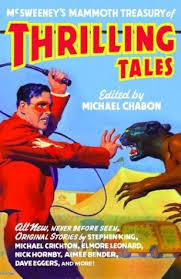
[READ: November 23, 2016] McSweeney’s Mammoth Treasury of Thrilling Tales

For some reason or another I have put off reading this McSweeney’s volume for many years.  This is technically McSweeney’s #10, although it was also released in this printing from a  major publisher. Sadly for me, my McSweeney’s subscription had expired sometime around here so I’ve never actually seen the “official” Volume 10 which I understand has the exact same content but a slightly different cover.

One of the reasons I’ve put off reading this was the small print and pulpy paper–I don’t like pulpy paper.  And it was pretty long, too.

But I think the big reason is that I don’t really like genre fiction.  But I think that’s the point of this issue.  To give people who read non-genre fiction some exposure to genre stuff.

Interestingly I think I’ve learned that I do enjoy some genre fiction after all.  And yet, a lot of the stories here really weren’t very genre-y.  Or very thrilling.  They seemed to have trappings of genre ideas–mystery, horror–but all the while remaining internal stories rather than action-packed.

Which is not to say I didn’t enjoy anything here. I enjoyed a bunch of the stories quite a bit, especially if I didn’t think of them as genre stories.  Although there were a couple of less than exiting stories here, too. (more…)

Read Full Post »

1999 SOUNDTRACK: JANE BUNNETT AND MAQUEQUE-Tiny Desk Concert #548 (July 12, 2016).

bunnettJane Bunnett is a soprano saxophonist and flautist from Toronto who performs largely with Cuban musicians.  She has been traveling there for about 30 years and has performed with all kinds of musicians.  For this Tiny Desk and her current she is playing with the women from Cuba in a band called Maqueque (they won a Juno award last year).

And they sound great together.  It’s interesting that Bunnett takes something of a back seat (or position anyhow) to singer Melvis Santa (who seems to mostly sing sounds (ah ah ahs, bop bop bah dah dahs, as opposed to words) .  But when it’s time to shine, Bunnett is there to impress everyone with her skill.

Felix Contreras says “If you want to hear what Cuba sounds like today, then be sure to listen.”

“Little Feet” features Bunnett playing a cool solo on her sax and Santa singing notes along with her.  But for this song Bunnett really wails.  (she’s quite winded by the end).

Of the three songs, the ten minute “Maqueque” is my favorite.  That’s in part because I don’t really like the sound of the soprano sax (she plays flute on this one) but also because the band membranes really get to show off their chops.  It starts with a simple piano melody and pretty vocals.  Then Bunnett plays the melody on the flute as Santa sings along.   When Bunnett gets her solo on, you can hear her vocalising a bit as she plays the flute.

After the song Bunnett says that women in Cuba don’t get the exposure they deserve, so she picked these woman to let the world hear them.

About 4 minutes in Dánae Olano plays an amazing 2 minute piano solo–fun to listen to and to watch as she is all over the keys–she plays  some great trills and riffs.  She’s very impressive.  About 8 minutes in Yissy Garcia (who Dave Matthews has said plays drums like Jesus) plays a great drum solo.  On the drum kit she is using her palms and fingers to play all of the drums and cymbals–she switches to sticks at the end. The percussionist Magdelys Savigne accompanies her, and while not actually soloing, she is keeping rhythm as well.

Celia Jiménez plays bass.  She doesn’t get to do anything fancy–no solos, but she keeps the rhythm perfect.

bunnett2“25 New Moves” has Bunnett back on sax with Santa singing along to her melody.  It’s a short (4 minute) catchy piece with another cool fast solo from piano and a few cool bass lines as well.

It’s a pretty great set with lot of cool jazzy Cuban melody and rhythms.  I enjoyed this set quite a lot.

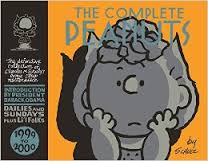
[READ: November 3, 2016] The Complete Peanuts 1999-2000

This is the final volume of Peanuts strips. After 50 years, it finally came to and end.

Schulz was diagnosed with cancer in 1999.  He died in February of 2000.

I was hoping that this book would be shockingly good–full of great “I’m finishing the trip” closure.  But as I understand it, he wasn’t ready to finish the strip, so things move on more as less as normal.

In fact, I found the first few weeks of 1999 to be kind of dull.  The punchlines just didn’t make me smile as much.  Of course there is something to be said for the consistency of the strip.  Linus still has his blanket, Rerun is still coloring (he has become a dominant force in the strip), Patty is still getting things wrong and Sally still doesn’t want to do anything. (more…)

Read Full Post »

lumberjanes-3 SOUNDTRACK: YOUTH LAGOON-Tiny Desk Concert #490 (November 23, 2015).

youthI thought I knew who Youth Lagoon was, but this Tiny Desk surprised me.  Lead singer/keyboardist Trevor Powers sings passionately.  But I was surprised that his voice is quite the falsetto (and at times sounds a bit like Pee Wee Herman).

At first I found this distracting, but after listening for a while I started to enjoy his voice, especially for what it did for the music.  They play three songs.  Two are new and one is older.

“Kerry” is a pretty song with a simple keyboard melody that is nicely duplicates on the guitar at times.  In fact, even though the keyboard is the main instrument, I love the various riffs and melodies that the guitar plays to accompany him.  There are some absolutely gorgeous musical passages in this song and Powers’ fragile voice is perfect for them.  In the middle, when the guitar plays a great solo section, it’s quite something.

“July,” is a wistful reflection on youth and regret from the band’s debut.  It’s a much more spare song with just voice and keys starting for the first minute or so.  About half way through, the rest of the band adds some real beauty to the melody as he sings more intensely.  I particularly like when the bass comes in at the end with a cool pattern of high notes.

“Rotten Human,” is a meditation on the passage of time and search for purpose in life.  I like this lyric: “I’d rather die than piss way my time.” It’s a slow song but once the drums come in the song builds.  I love the melody just before the next part which he sings with much more passion.  The “No I won’t” section sees his voice getting more ragged and angry-sounding–quite a change from the other parts of the songs.  Again there’s some great bass lines near the end of the song.

It took me a couple of listens to warm up to Youth Lagoon, but I really liked them by the end.

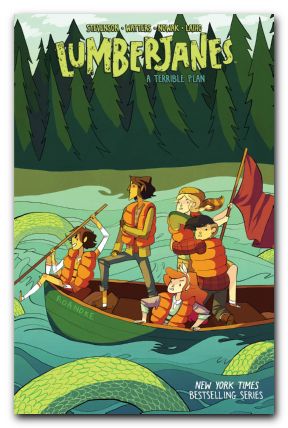
[READ: July 18, 2016] Lumberjanes 3

This is the third volume in the Lumberjanes series and I liked it a lot more than the second one.  This book collects issues 9-12.

The focus in the middle chapter on Mal and Molly was a nice change of pace.  And I thought it was very very funny that the girls tried to spend a chapter collecting “boring badges” for a change of pace.

There were lots of different illustrators in this book, because in the first chapter each the girls tells a story and each has her own illustrator. (more…)

Read Full Post »

castle SOUNDTRACK: TINDERSTICKS-The Waiting Room (2016).

tinderstIt had been four years since the previous Tindersticks album.  And this one was not released on Constellation Records, but rather on Lucky Dog.  Whether or not that had anything to do with the sound of this record I don’t know, but I really like this album a lot.

“Follow Me” is a slow broody melancholy instrumental with a high accordion playing a lovely melody.  It’s completely evocative.  “Second Chance Man” has a kind of unsettling vibrato on Staples’ voice.  But the melody (sparsely played initially on keyboards) is really catchy.  The rest of the band fleshes out the sound after a verse and chorus.  I love that it builds in the middle and then again at the end with horns lifting the gloom off the song.  “Were We Once Lovers” has a thumping bass line and an uptempo feel as Staples’ sings in a kind of falsetto.  I love the way all of the parts form together in the chorus that’s introduced by a simple but effective guitar: “How can I care if it’s the caring that’s killing me.”

“Help Yourself” opens with some soulful horn blasts and Staples’ whispered vocals.  The bass keeps the song going as occasional horn blasts accent this strangely catchy song.  Staples also sings in an uncharacteristically angsty style in this song, which is strangely unsettling as well.  I love the way the song keeps circling round and then almost surprising the chorus when it comes back.

Whenever Tindersticks use a female guest vocalist, they really seem to step up their game.  “Hey Lucinda” is an incredibly catchy song, starting with simple bells and an accordion playing a great melody.   When Staples’ deep voice is balanced by the exotic voice of Lhasa, it makes for a great pairing.  It’s unusual for a catchy song to be so spare, but the simple accordion accents really hold the song together before it takes off near the end.

“This fear of Emptiness” is another gentle instrumental with bass and acoustic guitar accompanied by accordion sections (sometimes dissonant near the end).  “How He Entered” is another spare song with mostly bass and keys and an occasionally scratching sound as an ascent.  But it’s still a very catchy melody.

“The Waiting Room” has that same echo on his voice as he slowly sings over a keyboard melody.  His anguished singing of “don’t let me suffer” totally makes the song.  “Planting Holes” is a short delicate instrumental with a sweet but melancholy keyboard riff running through it.

Perhaps the most dynamic song on the disc is “We Are Dreamers!”  It’s the angriest song I can think of from Tindersticks, with rumbling keyboards and tribal beats as Staples sings bursts of vocals.  But it’s when Savages’ singer Jehnny Beth adds her voice that the song turns really aggressive.  They sing the chorus “This is not us/ We are dreamers!”  And as Beth takes over the chorus, shifting pitch and intensity, Staples is commenting including lines like “You can rob us/ You can trick us/ Peer over our shoulders and steal our ideas”

The final song is “Like Only Lovers Can.”  The delicate and pretty keyboards belie the sadness in the lyrics: “We can only hurt each other the way lovers can.”  The quiet keyboards end the disc.

[READ: March 15, 2016] Castle Waiting Volume 2

I loved Castle Waiting.   And I couldn’t wait to read Volume II.

And I loved it even more.  Linda Medley is such an engaging storyteller.  Her characters feel utterly real and funny and charming.  I could read more and more and more from her.  Which is why I am so bummed that the series ends here (with rumors that she is doing more).

This volume is a bit more playful.  The characters are well-established and settling into their lives at the castle.

As in the previous volume, there are a lot of flashbacks to Jain’s childhood.

But there’s also a lot of wonderfully meandering stories in the present. The man who looks like a horse (literally) has injured his hoof, so he is hobbling around and is not as useful as he might be (and is cranky about it).

But the main story centers around the arrival of two dwarves, I mean hammerlings–only racists would say dwarves.  They are the relatives of Henry, the quiet blacksmith (who is actually human, but was adopted by the dwarves).  Henry is super excited to see them (as excited as his monosyllabic grunts allow him to be).  Actually, we finally learn why he is so standoffish and quiet most of the time.

They are here for a very specific an(and embarrassing) purpose.  They need women’s clothes for the human who works with them back home.

Their presence enlivens everyone in the Castle. They are fun and interesting–enjoying hard work and being very playful. It is with their help that the Castle dwellers do some remodeling, find a booby trap and even learn how to play nine pin bowling.  The older women who still live in the castle take some bets about who will win–with much merriment.  I love that there a whole chapter about them bowling.

There’s a subplot about Jain’s son Pindar being a leshie–a species we learn a bit about, although we also learn that they are extinct.  This plot line is never concluded properly, though.

We also finally learn about Doctor and his crazy mask (it was a sort of gas mask for the plague).  They are all worried about his sanity, especially when he starts walking around wishing everyone a happy Yule (the Christmas stocking subplot is outstanding).

Speaking of Jain, she has decided to move into the Castle (where there is indeed a ghost).  But her kindness appeases the ghost somewhat.  Especially when she teaches Simon to read (I love the scene where he learns to read and then sits at the table reading instead of eating–just like in my house).

There’s a hilarious thread about a very stubborn goat (whom Simon can outsmart).  And a multi-chapter thread about Sister trying to get a cross for Jain’s room.  We finally get to the bottom of the house sprites (they are adorable when we finally find out what they want).  Finishhtory!  Finit!  Reetoomee.

I am so attached to these characters, that I need to hear more about them.

As in the previous book,Medley’s art is simply gorgeous.  She does realism like no one I know and her characters have an awesome blend of realism and hyper-realism that makes them so enjoyable to look at (and unbelievably detailed as well).

There have been a number of graphic novels that I have gotten completely attached to, but none like this.  It was so bittersweet to finish this, knowing there’d be no more–but holding out hope for a surprise some day.

Read Full Post »

castlewaitingSOUNDTRACK: TINDERSTICKS-The Something Rain [CST086] (2012).

tinders This was Tindertsicks third and final full length album for Constellation.  It has some noisy elements–especially the distorted guitar–that feel different from their other releases.  Although overall I find the album a bit too slow and drawn out.

The first song on this disc, “Chocolate” is quite unlike other songs by the band.  It is a 9 minute slow song with a spoken word story delivered by by keyboard player David Boulter.  The music sets a nice tone for this story of living in a squalid bedsit and heading into town.  As the song picks up momentum, the guitar lines and the rest of the band add more atmosphere.  In the story, he goes to the bar to play some pool and picks up a woman–a regular.  By six minutes, the whole band, including horns is playing and the song is louder and more noisy while the story continues.  For the final two and a half minutes the band drops out and the denouement reveals a secret.  It’s a cool story, well delivered.

“Show Me Everything” opens with some slow bass and a buzzy electric guitar as the backing voice sings “show me…”  And, after ten minutes on the disc, we finally hear Stuart Staples’ iconic voice sounding deep and whiskery as lawyers.  I love the songs with the female backing vocals like this one.  “This Fire of Autumn” is a faster song with a throbbing bass line and catchy chorus (with more backing vocalists).  The addition of the vibes makes this a great Tindersticks song.

“A Night so Still” slows things down almost to whisper with the gentle keyboard riff under Staples’ languid delivery.  “Slippin’ Shoes” is a bit more upbeat and the horns come in right at the front of the song.  I love the way the bridge seems almost sinister and slick before resolving into a bright chorus.  “Medicine” is another slow song with multiple layers of guitars and slow horns and strings.

“Frozen” opens with slow horns that sounds like feedback, almost.  When the fast bassline and almost discoey drums come in, it’s kind of surprise, but a nice pick me up from the previous slower songs.  Staples is singing quickly over himself–the echoes of his voices catching up to his new lines. And the scratchy guitars and jazzy horns make a nice moody soundtrack of him pleading “If I could just hold you, hold you.”

“Come Inside” is  7 minute song with a simple keyboard riff that floats over the slow beat.  There’s a long slow jazzy outro–too long frankly.  The final song is the 2 minute “Goodbye Joe.”  Its all tinkling bells and a shuffling bass, a pleasant instrumental to end the disc.

While Tindertsicks albums tend to be kind of slow, this one has a few too many extended slow parts and not enough of Staples’ magical crooning or the more dramatic sounds that the band does so well.  I’m not sure why their next album was not put out by Constellation, ether.

[READ: February 15, 2016] Castle Waiting 1

I have been aware of Castle Waiting for a long time.  I believe I have even picked up an individual book at the comic book shop (of course I never read it because I wanted to start from the beginning).

So this book collects Chapters 1-19 (plus an epilogue).

I was instantly hooked by Medley’s outstanding drawings–so believable and realistic while exaggerated enough to make them all unique characters.  Not to mention the fact that there are humans and human hybrid creatures (and no one bats an eye).  And then top it off with the incredibly creative first chapter.

The story opens with a king and queen having a baby.  Actually they couldn’t have a baby so they employed a local witch for assistance.  The nice witch gives them good advice but when the town’s evil witch hears of this betrayal she plans to curse the baby.  And thus on the girls’ fifteenth birthday, the evil witch says she will prick her finger on a needle and die.  This should sound vaguely familiar to fans of fairy tales   But Medley puts a twist on things immediately by removing all needles form the castle and hiring a creature named Rumpelstiltskin to do all of their work off site.  Rumpelstiltskin has been cut in half and stitched together so when the creature asks for the Queen’s child in payment, the King yells at him and says he knows what kind of trouble that leads to.

The good witch is able to deflect the curse somewhat to make her sleep for 100 years (that should also sound familiar) rather than dying.  So, when the girl’s fifteenth birthday arrives, the bad witch comes and brings a needle to set the plan in motion.  The princess falls asleep–the whole castle falls asleep and, in a neat twist, the bad witch is killed.

And then Medley has a ton of fun with the story.  When the prince comes to wake up the princess, they run off an get married.  And there’s a hilarious multiple paneled spread of the rest of the castle sanding there, mouths agape.  As the scene ends, we see three older women telling a man with a bird’s head that that all happened along long time ago.  And the castle has been a refuge ever since. (more…)

Read Full Post »

« Newer Posts - Older Posts »