Feeds:
Posts
Comments

Archive for the ‘Superstitions’ Category

SOUNDTRACK: WIRE-“Outdoor Miner” (1978).

In Stuart David’s book, In The All-Night Café, he lists the songs on a mixtape that Stuart Murdoch gave to him when they first met.

Although I’ve been a fan of Belle & Sebastian for a long time, I knew almost none of the songs on this mixtape.  So, much like Stuart David, I’m listening to them for the first time trying to see how they inspire Stuart Murdoch.

In the book, David writes how much he does not like “rock,” especially music based around bluesy rock.  Most of these songs, accordingly, do not do that.  In fact, most of these songs are (unsurprisingly) soft and delicate.

Wire is another band that is quite unlike most of the other bands on the mixtape.  Over the years, Wire became a softer, somewhat more poppy band.  But on their first couple of albums, they were pretty abrasive.

True, their music was unconventional–which Murdoch clearly likes, but unlike the other bands, this album, Chairs Missing starts with some really sharp guitars and heavy bass and drums.  Although some of the later songs do have softer choruses.

Interestingly most of the songs on this record are quite short–almost half are under three minutes.  Murdoch seems to like short songs, so “Outdoor Miner” being less than two minutes makes sense.  It is also very different from most of the rest of the album.  The bass is smooth, the guitars jangle and Colin Newman’s voice is really gentle.  There’s also some gorgeous harmonies.

The chorus is really catchy and bouncy and the end of the song (keeping in mind the whole song is less than two minutes) features the chorus with another vocal line singing a counterpoint melody. It packs a lot of goodness in a small package.

[READ: January 31, 2021] Witches of Brooklyn

T. bought this book and knew I’d like it.  She was very right.

I liked everything about his book.  I especially liked the artwork.  As I was admiring the book, I kept thinking that her artwork was different in some way.  Then I read her biography and learned that Sophie Escabasse is French (she now lives in Brooklyn) and her favorite artist is Belgian cartoonist André François.  I didn’t know his work (his books have recently been translated into english as Gomer Goof and Marsupilami).  Escabasse’s work isn’t really like his at all, but they both share the European sensibility that I find different from American artists.

The main character Effie, is fairly straightforward looking, but her aunts are both wonderfully odd looking.  Her Aunt Selimene looks almost like an inverted bowling pin with a long thin chin; Aunt Carolta is very wide and round with wideset eyes.  But what sets her apart is that she wears the tiniest glasses on the bridge of her nose.  When I first looked at her head on, I thought they were nostrils. But they are not and they are hilarious.

The book starts off unusually with the doorbell saying Driiiiing.  I don’t know if I’ve ever seen a doorbell ring start with a D before.

The doorbell rings and two old ladies clamber down the stairs to see who it is (grumbling humorously all the way). It is a man from Adoption services; he is with a little girl.  He is wearing sunglasses even though it is 2 or 3 in the morning.  He asks for Selimene Huchbolt-Walloo.  She is sister to Emily?  Yes.  Then, in an astonishingly fast paced reveal, the man says that Selimene is now Effie’s legal guardian. (He doesn’t say that Emily died, it’s just implied, I guess).  Selimene has a raging temper and yells at the poor man while Aunt Carolta, brings Effie inside and is very nice to her. (more…)

Read Full Post »

SOUNDTRACKHIT LA ROSA-GlobalFEST Tiny Desk (Home) Concert #134/144 (January 12, 2021).

Hit La RosaGlobalFEST is an annual event, held in New York City, in which bands from all over the world have an opportunity to showcase their music to an American audience.  I’ve never been, and it sounds a little exhausting, but it also sounds really fun.

The Tiny Desk is teaming up with globalFEST this year for a thrilling virtual music festival: Tiny Desk Meets globalFEST. The online fest includes four nights of concerts featuring 16 bands from all over the world. 

Given the pandemic’s challenges and the hardening of international borders, NPR Music and globalFEST is moving from the nightclub to your screen of choice and sharing this festival with the world. Each night, we’ll present four artists in intimate settings (often behind desks donning globes), and it’s all hosted by African superstar Angélique Kidjo, who performed at the inaugural edition of globalFEST in 2004.

The second band on the second night is Hit La Rosa from Peru.

Kidjo says their music is like a psychedelic surf-punk cumbia.  That’s true, but in a rather restrained way.  The music is cool and a little wild but it never gets out of control.  They play three songs and again, the musicians’ names aren’t given.

From the candle-lit home of their lead singer, Hit La Rosa comes in hot and doesn’t stop until the final measure. The band explores the many facets of Peruvian cumbia music, infusing it with pop music, folklore, jazz and dancehall to produce its distinctive grooves and hooks. The band’s precise-yet-dreamlike music and punk sensibility all come together to make music that explores life’s shadowy sides. Despite living through a political crisis in Peru, the band brings a message of hope and joy in the midst of struggle and upheaval.

“La Montañita” has a latin drum opening with a weird echoing surf guitar intro.  Sliding bass and trippy keys propel this danceable song along.

“La Marea” opens with a mellow keyboard and slow bass and guitars.  After a coupe of minutes,a drum fill introduces the faster part of the song.  An echoing vibrato-filled guitar solo and trippy synths are accented with Peruvian percussion and drums and it all works really well together.

“Salvia” is trippy and moody with more of the vibrato guitar soloing.  I really like at the end of the song the juxtaposition of the looping guitar melody and the bouncing bass.

[READ: December 14, 2020] Simantov

This story (originally written in Hebrew and translated by Marganit Weinberger-Rotman) was a combination police procedural and eschatological novel about the end times.

I read the summary of the book at work, but the summary really doesn’t indicate just how supernatural the book is going to get.

It would greatly help to have a solid foundation in Biblical lore to fully understand what’s going on in this book.  I mean, the first chapter title contains a footnote:

The First Day of the Counting of the Omer*
*According to the Torah (Lev. 23;15) Jews are obligated to count the days from passover tp pentecost. This counting is a reminder of the link between the Exodus and harvest season.

Things are supernatural right from the get go.  Elijah the prophet comes to Earth to prepare for its smiting (it’s quite an elaborate introduction).  Elijah lands in Israel and leaves a trail of destruction all the way to Shamhazai’s mansion.

So, obviously it helps to know who Shamhazai is (I didn’t–Shamḥazai and his companion Uzzael or Azael are fallen angels of Nephilim).  The Nephilim are literal giants in the Bible–often taken as fallen angels.  That’s a lot of background for the first 9 pages.

The next chapter reminds the reader of the first humans created by God–Adam and Lilith.  Shamhazai was gaga over Lilith.

Incidentally, after reading the book I was looking at what other readers had thought.  One reader on Goodreads said she had to stop reading the book on page 10 after this sentence:

[Lilith] was dark and comely, her eyelashes fluttered like turtledoves, her perky breasts like two erect towers.

I’m going to admit that I found this simile to be really awkward (translation problem or just poor writing?).  I mean, even if Lilith were a giant, her breasts wouldn’t be like towers, right?  It’s hard to know even where to begin with a simile like that.  But I pressed on. (more…)

Read Full Post »

SOUNDTRACK: DUA LIPA-Tiny Desk (Home) Concert #121 (December 4, 2020).

I first encountered Dua Lipa a few years ago when I was watching the NPR series Field Recordings.  It showed Dupa Lipa in 2016 singing a song from a balcony.  An accompanying essay said that she was hoping to “break America.”  I said I thought her song was fine.

I guess she has now broken America as she was on lots of best of lists this year (and the blurb lists her as a “global megastar.”

I haven’t actually heard anything from this album (or any of her albums–oh, she only has two), so this is really my introduction to her.

Of Kosovar Albanian descent, Dua Lipa was raised in the UK and rose to super stardom in the three years since her eponymous debut album dropped in 2017.

The band gets a remarkably full sound for having just a bass (Matthew Carroll) and a guitar (Alex Lanyon).  Even when Lanyon solos, the recording is robust.

I do find it strange that she has FOUR backing singers, though (Naomi Scarlett, Ciara O’Connor, Izzy Chase, and Matthew Allen).  I can’t hear that any of them are doing anything different than the others, making me thing two or even one would suffice, but whatever, it’s good to give musicians a job, right.

And, this is the first time she has been able

to reconnect with her band for their only performance since their tour in support of her sophomore album, Future Nostalgia, was cancelled in March. This vibrant four song set of dance hits, all from Future Nostalgia, will surely have you cutting up the floor in your kitchen while quarantining in the cold weather.

All four of these songs are enjoyable but pretty forgettable.  Even though You can sing along by the end of the song, it’s not likely you’ll be humming them an hour later.

“Levitating” has a fun descending vocal melody and a funky bass line.  I do rather like th emiddle “rapped” section because I like hearing Lipa’s accent as she says her London o’s in

My love is like a rocket, watch it blast-off
And I’m feeling so electric, dance my ass off

“Pretty Please” is a fun dancer. “Love Again” has a lovely full guitar introduction.  And the refrain of “God damn, you got me in love again,” is quite arresting.

“Don’t Start Now” has a cool funky bass line and a catchy chorus–definitely fun to dance along to.

[READ: January 2, 2021] “Our Lady of the Quarry”

This story is written in second person plural (and translated by Megan McDowell).

A group of younger (16 year old) girls are jealous of an older girl, Silvia.  Silvia has a place of her own, a job with a salary, and a know-it-all attitude:

If one of us discovered Frida Kahlo, oh, Silvia had already visited Frida’s house with her cousin in Mexico.

Silvia’s hair was perfectly dyed, she always had money and, worst of all, Diego liked her. (more…)

Read Full Post »

SOUNDTRACK: BORIS-tears e.p. (2019).

Boris tends toward being a very heavy band.  Their two recently albums D.E.A.R. and NO are some intense heavy metal.  They also do a lot of noise and heavy drone.  But they are not afraid of melody.  And they are not at all afraid to make pretty, dancey music.

There are five songs.  The first song “どうしてもあなたをゆるせない (doushitemoanataoyurusenai)” is on the disc twice.  The first version of this song is a remix by Narasaki under his name “Sadesper.”  It opens with a grooving bass line and some pretty guitars.  The drums are metronomic and there’s a sprinkling of keys.  I’m not sure who sings, but there’s a lot of falsetto. I love how just before the chorus there’s some orchestra hits.  It’s pretty much a full on dance song and it suits them perfectly.  You’d never guess it was Boris, but it makes sense once you realize it.  It even ends with a nifty guitar solo that sadly fades out.

“u fu fu” opens with a fast simple guitar chugging riff.  After a good ol’ “Whoo!” from Atsuo, the song pulses forward on the insistent grunted  “ooh ah” that works as a foundation to the song.  There’s a lots of great backing vocals in each ear. With about a minute to go, the bass takes over with a fast, heavy rumble before the harmonizing vocals kick in.

Up next is a fantastic cover of a Coaltar of the Deepers song “To the Beach.”  I didn’t know Coaltar of the Deepers before this release, but I have listened to them a bunch since and they are a terrific Japanese band unknown in the States.  I’m not sure how much this differs from the original , but this version is fantastic–slow and moody with lots of build and release.  The song starts with a pretty guitar melody and then a series of crashing chords and cymbals while Wata’s guitar soars.  The verses are slow with a whispered vocal.  But the choruses resume the crashing chords to punctuate things perfectly.  In the middle of the song as the vocals overlap and blend, it sounds magnificent.

“Peaches” comes next, it’s a 2 minute song sung by Wata.  A pulsing bass line propels the song forward as Wata chants the the word “peaches” over and over with an occasional “la la la” fleshes things out.  A repeating piano is added for a bit and then a shift to a kind o funky bass line that leads to the end of the songs.  It’s only two minutes long and kind of goofy but I wish it was longer.

The disc ends with an instrumental version of “どうしてもあなたをゆるせない.”  The song is so catchy and wonderful that hearing it a second time in the EP is a great thing.  It’s one of the few instrumentals that I think might sound better than the original because you can really hear what the musicians are doing–and its some great stuff.

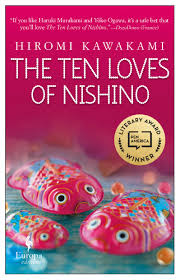
[READ: October 29, 2020] The Ten Loves of Nishino

I have a stack of books waist high next to my desk which I intend to read.  And yet, I continue to find new (to me) books that I jump in and read first.  This book was recommended by the most recent Tiny Desk Contest winner Linda Diaz.  Why on earth would I read a book recommended by a person I’d never heard of before?  She said it was her favorite book ever (which seems weird since it only came out in English last year, but whatever).  It was also pretty short.  So I decided to check it out.

I have enjoyed many of the Japanese writers that I’ve read, so I was intrigued to read a contemporary female author (this book was translated by Allison Markin Powell).

So this book is written in ten chapters–each one written by a lover of Nishino, an enigmatic figure whom we only learn about from the women writing about him.

There is something strangely seductive about Nishino that these women find hard to resist.  He is aloof and puzzling, but that seems to make women want him even more.  But he is perpetually with women (more than these ten, it would appear). (more…)

Read Full Post »

SOUNDTRACK: AILBHE REDDY-“Distrust” (2016).

I found this song from, of all things, a redbull website listing up and coming Irish bands.  It says that this song has been streamed over 3 million times.

This song opens with otherworldy “oohs” before a jagged, slapped guitar melody enters the song.  The guitar feels like it ends too abruptly.  It ‘s a very cool hook.  Especially for a song that is a total kiss-off song like this one.

Over the course of three and a half minutes more and more is added to the song–an insistent bass, drums, more backing vocals and even a violin.  But that persistent guitar runs through the whole song.  As does Ailbhe Reddy’s voice which is clean and piercing.  She speak-sings in the beginning, but when the chorus comes in, her voice is in full power. 

The song soars by the end, as does her voice.  

In the video, she stands absolutely still and strong as the room she is in falls apart around her.  

Reddy has a full album coming out next month. This song isn’t on it, but her new song “Looking Happy” is a real rocker (with a cool video). 

[READ: September 19, 2020] No Country for Old Gnomes

I really enjoyed the first book in the series–Kill the Farm Boy.  I was really looking forward to reading the continuing efforts of the heroes of Pell.

So I was a little surprised to learn that this book has almost nothing to do with the first one.  It’s set in the same place (with the same map up front) and the world remains the same, but this book follows the exploits of a completely different band of accidental warriors. 

That was a little disappointing at first (I miss Fia and Agrabella) but Dawson & Hearne have created a brand new band of travelers who are just as interesting and compelling as the first bunch. All of the characters from the first book make cameos, but they are brief.  The only characters from the first book that have any regular work are King Gustave and Grinda the Sand Witch.

But this book is exciting and funny and in the same vein as the first while being very different as well.  It is full of puns and jokes and twists on fantasy novels all while fleshing out the world that was created in book one (and making great use of the map that’s on the first page).

The book opens with three witches (not Grinda) and a cauldron.  I love a spoof of this scene and this one is especially good.  Two of the witches are casting a spell to help the Bruding Boars win their jousting competition.  But they needed a third so they put an ad on Ye Olde Meet-Up Bulletin Boarde. This third with (who looked quite different from her picture) had a very different spell in mind.

The third witch disappeared after casting a spell full of blood and seeming to be against gnomes.  But, really, who cared about gnomes.

Neither noticed the surfeit of portent in the air, wafting from the coppery-smelling cave, probably because the second witch smelled so strongly of cat urine.
But the portent was there nonetheless.

The book shifts to the Numminen family of gnomes.  Gnomes are generally smöl (ha!) and cheerful. The two sons Onni and Offi are fighting about Offi’s lack of gnomeric behavior.  Offi likes wearing cardigans that are black and covered in bats (gnome cardigans should be bright and cheerful).  So, yes, Offi is a goth gnome.  Whereas Onni is a perfect gnome who wins award for his gnomeric behavior. (more…)

Read Full Post »

SOUNDTRACK: COURTNEY MARIE ANDREWS-Tiny Desk (Home) Concert #68 (August 20, 2020).

Courtney Marie Andrews annoys me because she is not Courtney Barnett.  So whenever a DJ says Courtney, I hope it’s Barnett.  Sometimes it is and sometimes it’s this country singer.

Courtney Marie Andrews seems like a nice enough person but her music is on the wrong side of country for me.

She opens this set with “Burlap String.”  Paul Defiglia plays upright bass and Mat Davidson (aka Twain) adds pedal steel.  In this song

Andrews sings about the fear of love. “I’ve grown cautious, I’ve grown up / I’m a skeptic of love / Don’t wanna lose what I might find.” Yet, “Burlap String” is also a song about how love’s memory lingers, and how the mind rekindles its beauty.

Defiglia leaves after the song.

The blurb says that Andrews is only 29 and she’s been playing for ten years.  She has a new album and WXPN has been playing “It Must Be Someone Else’s Fault” a bunch.  It’s a bouncy song that seems to be full of sadness.

For “If I Told,” which she calls a modern day love song, Davidson switches to the Wurlizer.  Andrews sings a bit of yodel in the chorus.  It’s a catchy moment.

The set ends with Courtney alone at the Wurlitzer, singing “Ships in the Night” the final song on her seventh album, Old Flowers.  It is about lost love and hoping for closure with fondness.

Courtney Marie’s voice is powerful but it’s not my thing.

[READ: August 1, 2020] Kill the Farm Boy

I saw a review for the second book in this series (which has just come out) and it sounded pretty great.  So I looked up the first one only to find out that Dawson and Hearne are both authors with other series to their names.  Dawson has written The Shadow Series (as Lila Bowen), The Hit Series and The Blud Series.  Meanwhile, Hearne has written The Iron Druid Series and Oberon’s Meaty Mysteries.  They’ve also written single volumes of things too.  So they are well known in the fantasy realm.

The acknowledgments say that they met up in the Dallas Fort Worth airport at the barbecue joint (I have eaten there and it was tremendous).  They waited for their flight and discussed killing the farm boy, or in other words, making fun of white male power fantasies that usually involve a kid in a rural area rising to power in the empire after he loses his parents.  They found that skewering topics was fun and decided to write the book together.

So in the land of Pell we meet a farm boy named Worstley.  He cleaned up the goats.  And one goat, Gus, was especially ornery.  One night while Worstley was mucking out the area, a fairy entered the room.  She was haggard and dressed crazily with one sock on and her pants falling off. But the fairly quickly corrected any thoughts about her being a proper fairy by saying she was a pixie and her name was Staph.  She was there to anoint the chosen One.

To prove her magic she pointed at Gus and magicked him into talking.  The first thing Gus said was that his name was Gustave and he called Worstley “Pooboy.” (more…)

Read Full Post »

SOUNDTRACK: KIRILL GERSTEIN-Tiny Desk Concert #958 (March 11, 2020).

I can’t really keep track of classical pianists. There are so many who are truly amazing.  But I love hearing them.  I also like it when they have a good sense of humor, which most of them seem to have.

The last time pianist Kirill Gerstein was at NPR we gave him a full-size, grand piano to play in a big recording studio. But for this Tiny Desk performance, we scaled him down to our trusty upright. “What will you ask me to play the next time,” he quipped, “a toy piano?”

Even if we had handed him a pint-sized instrument, I’m sure Gerstein could make it sing. Just listen to how Chopin’s lyrical melodies, built from rippling notes and flamboyant runs, flow like a song without words in Gerstein’s agile hands.

What sets Gerstein apart?  Perhaps its his connection to jazz.

The 40-year-old pianist, born in Voronezh, Russia, taught himself to play jazz by listening to his parents’ record collection. A chance meeting with vibraphonist Gary Burton landed him a scholarship to study jazz at Boston’s Berklee College of Music. At age 14, Gerstein was the youngest to enroll at the institution.

He opens the set with Chopin: “Waltz in A-flat, Op. 42.”  It is fast and amazing with some slow, jaunty parts.  Near the end, wow, doe he pound out those bass chords.

Before the second piece he says that it hasn’t been heard on a recording yet–it’s a newly written piece by Thomas Adès.  Two lovers want to hide in the closet and … sleep with each other.  They emerge dead in the morning, so its lascivious and morbid and a very beautiful piece.

The Berceuse for solo piano was written for Gerstein by Thomas Adès, adapted from his 2016 opera The Exterminating Angel. The work, both brooding and beautiful, receives its premiere recording at the Tiny Desk.

It is slow and beautiful, full of sadness and longing.  Until the end when the bass comes pounding and rumbling, full of ominous threat and dread.  And listen to how long he lets those last bass notes ring out!

Up next is a piece by Liszt who I am particularity fond of (even if I only know a few of his pieces).  Gerstein says that Liszt is perhaps the greatest composer that ever touched the instrument.  There are several hundred not famous pieces.  This is a late piece called “A quick Hungarian march.”  Technically it’s called “Ungarischer Geschwindsmarsch”

Gerstein follows by dusting off a truly neglected – and quirky – Hungarian March by Franz Liszt. To my knowledge it’s been recorded only once.

It is jaunty and spirited until the middle where it goes back and forth between fast runs and bouncy melodies.

Since I hadn’t read about his jazz background the first time I listened to this concert I was really surprised when he said he’d be playing the Gershwin-Earl Wild standard “Embraceable You” which he says is for dessert at this lunchtime concert.

Gerstein’s jazz background is still close to his heart. Which brings us to his lovely-rendered closer: Gershwin’s “Embraceable You,” arranged by the American pianist Earl Wild.

Like all master performers, Gerstein gives you the illusion that he’s making it all up as he goes along, even though the virtuosic transcription is intricately mapped out. And somehow, he makes that upright piano sound nine feet long.

It really does sound like he is working on the fly–playing beautiful runs. It’s hard to imagine transcribing and learning all of those notes instead of just improvising them, but that’s what make a great pianist, I guess.

[READ: November 2019] The Abyss

I saw this book at work and thought, a turn of the 20th century Russian author writing about the Abyss?  What’s not to like?

I had not heard of Leonid Andreyev, perhaps because much of his work has not been translated into English.  He died in 1919 and is considered “the leading exponent of the Silver Age of Russian literature.”

This book was translated by Hugh Aplin and it is remarkable how contemporary these stories sound (aside from obviously nineteenth and twentieth century details).

Bargamot and Garaska (1898)
Bargamot was a policeman–a big, thick-headed policeman.  His superiors called him numskull.  But the people on the streets he looked after were quite fond of him because he knew the area and what he knew he knew very well.  This story is set on Easter Saturday night.  People would soon be going to church.  But he was on duty until three o’ clock and he wouldn’t be able to eat until then. The day was going smoothly and he would soon be home until he saw Garaksa, clearly drunk, heading his way: “Where he had managed to get sozzled before daylight constituted his secret, but that he had got sozzled was beyond all doubt.”  Bargamot threatened to send Garaska to the station, but Garaska talked to him about the festivities of the day and was about to present to him an egg (a Russian custom).  But Bargamot’s rough handling smashed the egg.  This story turns surprisingly tender and sad, with a rather touching final line.

A Grand Slam (1899)
This has nothing to do with baseball.  It is about a card game called Vint, which is similar to bridge.  For six years these four people have been playing it: fat hot-tempered Maslennikov (whose name is Nikolai Dmitriyevich, we find out about five pages in) paired with old man Yakov Ivanovich and Yevpraksia Vasilyevna paired with her gloomy brother Prokopy Vailyevich.  Dmitriyevich desperately wanted a grand slam but he had been paired with Yakov Ivanovich who never took risks. Ivanovich was very conservative and never bet more than four–even when he ran an entire trick, he never bet more than four–you never know what might happen. They speak of news and local happenings (like the Dreyfus Affair), but Dmitriyevich stays focused on the game because his cards are lining up for a Grand Slam.  As he goes for that last card, he falls out of his chair, presumably dead.

Silence (1900)
This story is divided into sections.  Fr. Ignaty and his wife need to speak with their daughter Vera. They have a fight and Fr. Ignaty refuses to speak to her any more.  Soon enough she goes out and throws herself under a train [I would hate to be a train conductor in Russia].  In Part II silence has fallen over the house.  In Part III he tries to talk to his wife about his feelings and his sadness over their daughter, but she remains silent.  In the final part, Fr Ignaty finally breaks down.  But is it the silence that has gotten to him?

Once Upon a Time There Lived (1901)
Laventy Petrovich was a large man. He went to Moscow for someone in the city to look at his unusual illness.  He was a silent and morose man and he specifically asked for no visitors.  The hospital assigned Fr. Deacon to him.  Fr. Deacon was another patient, unfailingly positive.  He and Petrovich were at opposite sides of the spectrum.  But even as it became clear that Fr. Deacon was deathly ill, he remained positive.  Until Petrovich told him that the doctors said that Fr. Deacon has a week to live.  There was also a young student who was daily visited by the girl he loved.  They liked Fr deacon and did not like Petrovich. I’m not sure if the ending is a surprise, but it is certainly sudden with happiness doled out in very specific ways.

A Robbery in the Offing (1902)
That night there was to be a robbery and maybe a murder.  A man, alone with his thought is scared by nearly everything–he is very jumpy because he is the one about to do the robbery.  The man was frightened by a noise until he saw it was a little puppy.  The puppy was shivering and the man tried to frighten him to get him to go home. But the puppy seemed too ignore him.  So began the battle of wits between a big strong man and a tiny freezing puppy.  Imagine a man with a robbery in the offing worrying about a little puppy.

The Abyss (1902)
Two young lovers went for a walk.  Zinochka was 17 and very much in love.  Nemovetsky was 21 and similarly in love.  They wandered into an area they didn’t recognize and happened upon three men.  The men punched Nemovetsky and knocked him out then they chased Zinochka . When he came to, he found her body, naked but still alive.  This was a hard story to read.

Ben Tobit (1903)
This was one of the first stories in the book that I really really liked.  It is set on the day of Jesus Christ’s crucifixion.  On that day, Jerusalem merchant Ben Tobit had a terrible toothache.  Ben was a kind man and did not like injustice, but it was hard to be kind with this much pain.  His wife tried to help by giving him various medicines (like purified rat droppings). She then tried to distract him when the thieves came trudging past on their way to the crucifixion site.  It distracted him somewhat but mostly didn’t interest him.  She said, “They say he healed the blind.”  He replied, “If only he’d cure this toothache of mine!.”  The next day he felt better and they walked to the site to see what they missed.

Phantoms (1904)
Yegor Timofeyevich had gone mad so his relatives collected money to send him to a clinic.  He knew he was in a madhouse but also knew that he could make himself incorporeal and walk wherever he wanted.  He was exceedingly happy. There was a patient who would continually knock on any locked door.  He would walk through all the unlocked doors but when he got to a locked one he would knock and knock and knock.

There was a doctor’s assistant the hospital named Maria Astafeevna, whom Yegor was certain liked him.  He thought very highly of her.  But another man Petrov could say nothing nice about her.  He felt that she was like all women: debauched deceitful and mocking. This attitude upset Yegor tremendously.  Maria was actually in love with Dr Shevyrov. But she hated that he went to Babylon–where he drank three bottles of champagne each night until 5 AM.  She imagined that one day she would ask to be his wife bit only if he stopped going there.

The man Petrov was also terrified of his mother, believing that she had bribed officials to lock him up. He would become hysterical when she would visit.  It was only Yegor’s assurances to her that her son was a decent man that made her feel okay.

Most days things went on exactly the same, the same faces, the same conversation and the same knocking.

The Thief (1904)
Fyodor Yurasov was a thrice-convicted thief.  While on the train, even though he had plenty of money, he stole a gentleman;s purse.  As he tried to blend in, he imagined everyone thought he was an honest, young German (he came up with the name Heinrich Walter).  But when he tried to be civil, everyone ignored him.  Some were downright rude to him.  Later when he hears that the gendarme are looking for someone, he assumed it is he.

Lazarus (1906)
This story looks at what Lazarus’ life was like after he came back–appearing a few days dead and with a shorter temper.  People understood and forgave him, but still.  Soon, however, people began to avoid him and claimed that all of the madmen in the village were people whom Lazarus had looked upon.   It’s such an interesting (if exceeding dark) tale that no one bothered to investigate before.

A Son of Man (1909)
As Fr. Ivan Bogoyavlensky grew older he grew more disatisfied with his role in life.  He wanted to remove his surname and replace it with a five-digit number (The church elders assumed he’d gone mad).  He then bought a gramophone and listened only to stories of Jewish and Armenian life.  His wife hated it and it drove their puppy mad (?!).  Indeed he kept trying to get the puppies to listen to the gramophone and they consistently went crazy and eventually died.  The church sent a deacon to help Fr Ivan through this but he the deacon and Fr Ivan butted heads immediately.  Fr Ivan began mocked everything about their religion.

Incaution (1910)
A priest arrived at a railway station and saw a steam engine for the first time. There was no one around, so he climbed aboard.  It wouldn’t be dangerous to flick some switches and pull some levers.  Would it?

Peace (1911)
A dignitary was dying and an devil–an ordinary devil–came to his bedside offering him eternal life in hell.  The man didn’t want to suffer but the devil said that suffering was terrible until you got used to it and then it was nothing.  The devil makes a stronger and stronger case if only the man would take this pen and sign.

Ipatov (1911)
Nikolai Ipatov was a rich merchant who went bankrupt. Soon he became silent and despondent.  The local priest chastised him saying that the house of god was a house of joy.  He refused to let the merchant back in until he grew happy again.  Which he didn’t.  Eventually his children took over the situation and and put his house up for sale.  But when someone came to look at the house, they heard Ipatov’s moaning and grew existential realizing that a man without guilt could still be afflicted this way.

The Return (1913)
The narrator had been in a cell n St Peterburg for three years because of a political incident.  His wife, who was supposed to be waiting for him in a hotel room had stepped out with another man.  He hired a cab to follow them.  They kept driving around and around, some streets seeming to stretch on endlessly.  Then the cab driver told him that they had been at the same intersection many times.  He finally arrived at the gate and when he banged on it, who should open the gate but his prison guard.

The Flight (1914)
Yury Mikhailovich was an experienced pilot.  Twenty eight flights and no troubles.   He always felt, “If I crash, I crash, nothing to be done about it.”  Despite everything he had on earth, he longed to be up ion the sky…possibly forever.  It’s incredible that Andreyev wrote a story like this in 1914!


Read Full Post »

516ZKjM2CqL._SX351_BO1,204,203,200_ (1) SOUNDTRACK: ELISAPIE-Tiny Desk Concert #948 (February 20, 2020).

downloadElisapie (I have no idea how to pronounce that) is a First Nations singer from Salluit, on the Northern tip of Quebec.

She sings in Inuktitut (as well as in English and French).  And her voice is absolutely intense.

Her songs are very personal–she sings of

her life as an adopted child and of meeting her biological mother. Now, as a mother herself, she sings about what it must have meant to her own mother to give up her child.

Elisapie left her birth-village, Salluit, as a teenager and headed to Montreal, leaving her community and her sick mom. The songs she sings, here all come from her album, The Ballad of the Runaway Girl and deal with the consequences of her leaving.

These songs are definitely rock, but with a different overall sound.  Jason Sharp’s bass saxophone is fantastic–creating deep low rumbles and otherworldly squawks.

“Arnaq” opens with some chugging guitar riffs (I can’t tell if the guitar is acoustic or electric) from Joe Grass and after a verse or so, some great noisy electric guitars from Josh Toal, who punctuates the song with little solos.  There’s no bass guitar because the bass saxophone covers all of the low ends.

The song, even though it is in Inuktitut is rally catchy with a chorus of “ahhhhhh, I, yi, I” (or something).

The middle section is full of great noises as both guitars and the sax all play some wild solos.

All of this is held together by “the tasteful drumming of Evan Tighe.”

She says the second song, “Una” is the most painful yet the most freeing song.  It is  written to her biological mother.  In Inuktitut the word for mother means “our little bag” because they carried us.

It opens with slow staccato guitar chords and a near a capella vocal before the quiet electric guitar from Josh Toal joins in.  The spareness of the beginning of this song is a great counterpoint to the end of the song when everyone joins in–vocals, guitars, sax and some complex drumming.

Before the final song, she looks around and smiles and says Lizzo was here!  My daughter is very excited.

The final song “Darkness Bring The Light” opens with some great weird sounds from everyone.  Tighe makes scraping metallic sounds as he slides his drum sticks around the cymbals.  Toal plays a synth intro as Grass bows his guitar and Sharp makes waves of gentle sounds to underpin the melody

This one is in English.  She sings a melody that rides over the sounds.  After 2 minutes the drums kick in and after a run through of the chorus, the guitarists join in

Bob Boilen concludes

This is an extraordinary Tiny Desk from an artist with something meaningful to say.

He is absolutely correct.  This set is fantastic.

[READ: March 10, 2020] Gunnerkrigg Court 4 [32-41]

I really enjoyed the first three books of this series and then promptly forgot about it.  I happened to see this book at the library and was excited to see that I hadn’t read it.  Can it really have been three years since I last read about these characters?

Being away for so long made some of this a little confusing.  I will have to read the whole story again some time.

Chapter 32 shows Antimony returning from the forest and there is a warm welcome with Renard. But Katarina’s welcome is cool–“you kinda make it hard to be your friend.” Antimony tries very hard to make Kat like her again…too hard.  She creates scary situations in which she can “save” Kat,  It doesn’t exactly work, although Kat isn’t really mad anymore, just annoyed.  But then a gigantic creepy monster thing comes out of the water.  Kat is impressed by Annie’s conjuring until Annie says she didn’t do it.  They run out.

Only to learn that this is Lindsey–the creature who helped design most of everything at the court–a giant crablike creature.

All this time Kat has been working on the idea of growing a robot.  Well, not exactly, but kind of.  She imagines using a muscular frame to build a robot body around.  Or something.  She is able to use the smarts of one of the existing robots to give her a hand.  The code they provide is actually a small white cube with no writing on it.  Amazingly Kat is able to read parts of it. (more…)

Read Full Post »

SOUNDTRACK: JAMES ELKINGTON-“Black Moon” (from WILCOvered, UNCUT Magazine November 2019).

The November 2019 issue of UNCUT magazine had a cover story about Wilco.  It included a 17 track CD of bands covering Wilco (called WILcovered or WILCOvered).  I really enjoyed this collection and knew most of the artists on it already, so I’m going through the songs one at a time.

Elkington is the first person on this compilation I didn’t know.

He plays an absolutely gorgeous, complicated guitar melody to open the song.  I am mesmerized by how lovely it is.  It’s actually so much different from the original–which has a subdued guitar opening–that i didn’t recognize the song at first.

Elkington sings in a quiet, hushed voice through the verses which continue that beautiful guitar melody and add percussion.

When the chorus kicks in with organs and a great electric guitar slide it become catchy just like the original (possibly more so).  But as the chorus dissolves into the verse, the electric guitar soars throughout while the acoustic picked guitar resumes the beauty.

What a wonderful cover and what a fantastic guitar player.

[READ: February 15, 2020] The Hidden Witch

After finishing The Witch Boy, I was really happy to see that we also had the second book in this trilogy, The Hidden Witch.

This book picks up right where the last one left off, although this one includes a map of the area, so we can see how close Aster’s house is to the main town (and the school).

The book opens in with witchcraft class.  Aster is there with the girls (who are looking at him funny).  He is far behind but his Aunt Iris doesn’t seem too happy about the fact that he is in the class.

Aster’s grandmother agrees to teach him if he will help her.  Her special request is to try to save her brother Mikasi–the creature from the previous book who they have trapped.  She believes that because Aster also had an inkling for witchcraft that he could possibly speak to the Mikasi within the beast.

Then we switch to Sterling Junior High where Charlie is showing off that her leg is no longer broken.  But there’s  new girl in school now.  Her name is Ariel and she seems very dark–thick eyeliner, dark clothes, etc,

This is one more reason why I love this series so much.  Charlie walks up to Ariel and tries to talk to her.  Ariel says you don’t have to partner with me just cause you pity me or whatever.  And Charlie replies “I thought you looked cool.  I like your bracelets.” They immediately start chatting and Ariel admits that she is good at art.  She draws something and Charlie is very impressed.  And soon enough they are friends.  I loved that interaction and wish it was that easy in real life.  And maybe sometimes it is.

Later that night, Aster goes to Charlie’s house. Their friendship is out in the open–her dads like him and everything.  They talk about their day and have a family dinner (I love that Charlie has two dads, but it is not a plot point or an issue at all.  It just is).

Then we cut to Ariel’s house.  Ariel is in foster care (you can tell by how different she looks from the rest of the family).  Her “dad” is kind of jerk saying that if she can’t make it in this school, she may have to go back to the foster system (jeez).

Ariel complains that trouble finds her–none of the things that happened in the past were her fault.  But the whole time she is staring at the phone and getting angrier.

Charlie promised she would call that night but she hasn’t..  And by the time she is ready for bed, Ariel goes to her hideout and summons a Fetch which she sends to find Charlie and give her “a scare.”

The Fetch is basically a shadow that sneaks into Charlie’s room and burns her (or something) on the arm.  Charlie runs away and the creature follows.  She runs all the way to Aster’s house and when she crosses through the protection stones, the Fetch can’t follow.

Charlie finds Aster and with his grandmother’s help, he is able to heal her arm.  Then the grandmother looks through the eyestone and they an all see the Fetch.  The grandmother can’t determine who made the Fetch, but she does make a protection spell for Charlie.  As Charlie walks away, Aster agrees to help his grandmother wit her brother.

At school the net day, Ariel is making enemies and sends a Fetch to push the bullies around a bit.  She is also super frosty to Charlie.  That’s when Charlie realizes she forgot to call her and is very sorry.  When she says “You kind of hate me now,” Ariel is taken aback and promises not to hate her.

She asks why Charlie had a bad night.  Charlie says she dealt with whatever it was and Ariel says to herself that that’s never happened before.

The next day, Charlie and Ariel are studying together when Aster comes by to bring Charlie a bracelet of protection.  Ariel gets a little jealous of their friendship.  When Aster leaves, she says boys are mean.  Charlie says everyone can be mean sometimes.  Charlie says that even though she has friends, sometimes she thinks everyone got the message about how to act and she missed it.  That’s why she likes Ariel.

Ariel is offended “Because I don’t know how to act?”
Charlie replies, “Because you don’t think there’s a right way to act.  You’re just doing your thing.”

That night is Charlies basketball game.  Aster goes and on his way Sedge tags along.  Sedge admits he doesn’t want to shapeshift–he’s freaked out about it.  In fact, he thinks that normal school sounds pretty great.

At the game Aster sees that Fetch is helping Charlie in the game–fouling people and assisting with the ball. Charlie is devastated that she wasn’t as good as she thought she was.  But the more pressing concern is who was casting the Fetch.  That’s when she realizes it must be Ariel.

They confront Ariel and she says that Charlie is clearly a witch too–that’s why she wasn’t hurt by the Fetch.  But Aster says it was his family that helped Charlie.  And he wants to help Ariel as well–hes concerned for her because the Fetch could backfire on her.   Being angry all the time can really impact you–When people treat you like a monster you start to act like one.

Soon enough the Fetch attacks Ariel and she is rendered unconscious.

Aster and Charlie bring her to Aster’s house–the only place she can get help.

I loved the way the story was resolved and who it tied so nicely to the previous book.  I also enjoyed the way the story lines twisted together ta the end (no spoilers)

I’m looking forward to book three (which is out already)!

Read Full Post »

SOUNDTRACK: JEN CLOHER-“Impossible Germany” (from WILCOvered, UNCUT Magazine November 2019).

The November 2019 issue of UNCUT magazine had a cover story about Wilco.  It included a 17 track CD of bands covering Wilco (called WILcovered or WILCOvered).  I really enjoyed this collection and knew most of the artists on it already, so I’m going through the songs one at a time.

Cloher takes on of my favorite Wilco songs and transforms it in a way that I quite like.  The song opens with some cool buzzing guitar sounds before the main melody resolves with some plinking guitars and keys.

When Cloher starts singing in her quiet, whispering voice, the song builds up a bit and grows really catchy (with cool sound effects swirling around).  The song is really mellow and catchy until the guitar solo in the middle which has a great echo on it as the song ramps up the speed.

I love that the song has picked up the pace and Cloher has vocally as well, although her delivery remains much the same–understated and cool.

It’s a great version.

[READ: February 15, 2020] The Witch Boy

My daughter has had this book for quite some time and she and S. both encouraged me to read it.  I didn’t put it off for any reason, it’s just that there were other things around first.

But boy did I love this story.

I love that it plays with gender roles but in the inverse of a lot of stories.  In this one the boy wants to do what the girls normally do.  And I liked that it’s not that the boys think what the girls do is too girly, it’s just that that is how it has always been done–boys do one thing and girls do another.  So it’s a nice twist on the gender role reversal story.  Plus the story is unyieldingly positive.

We open on a group of young girls learning witchcraft.  I love that they are speaking in runes and that (I assume) Osterberg made up all the symbols?  Or maybe they are classic witchcraft symbols?

Then we see that Aster is in the tree above them eavesdropping.  He is yelled at and told the girls are leaning secrets that he is not privy to.  His mother tries to calm him by saying the magic is not for him, but he insists that he wants to learn it.  But his role, like all the boys, is to learn to shapeshift (I’m glad they each have a cool skill, at least).  But he’s not interested in shapeshifting.  He wants to cast spells.

Then we learn why the gender roles are separated.  Aster’s grandmother had a twin, Mikasi.  Mikasi wanted to learn magic and he eavesdropped as well.  But the spells poisoned him and he lost control.  A darkness came over him, people were hurt and he was cast out. (more…)

Read Full Post »

« Newer Posts - Older Posts »