Feeds:
Posts
Comments

Archive for the ‘Poetry’ Category

SOUNDTRACK: JAMILA WOODS-Tiny Desk Concert #699 (January 29, 2018).

Jamila Woods is the Associate Artistic Director of Young Chicago Authors, the non-profit organization behind the Louder Than a Bomb youth poetry slam festival.  She also did guest vocals on a slew of albums recently.

Last year she released her debut album HEAVN.  But there is so much more

Singer, songwriter, poet, educator and community organizer Jamila Woods is also a freedom fighter: a voice that celebrates black ancestry, black feminism and black identity. “Look at what they did to my sisters last century, last week,” goes a line from “Blk Girl Soldier,” her powerful opening number at the Tiny Desk.

A cool bass line from Erik Hunter opens “Blk Girl Soldier.”  I don’t love the music that much (too jazz lite for me) but the lyrics are outstanding

We go missing by the hundreds…
The camera loves us, Oscar doesn’t…
They want us in the kitchen
Kill our sons with lynchings
We get loud about it
Oh now we’re the bitches

Woods’ delivery is fantastic and the backing vocals (and keys) from Aminata Burton add a nice touch.  Throughout this song and the others the drums are great–different sounds and rhythms from Ralph Schaefer.

Woods followed “Blk Girl Soldier” with “Giovanni,” another anthem of black female pride, inspired by the Nikki Giovanni poem “Ego Tripping.” The original text includes no punctuation, not a single comma or period, and reveals a liberated prosody that is also illustrated in the song. Listen how her lyricism interplays with the rhythm section’s syncopated groove to create a captivating state of emotional buoyancy.

I love the stops and starts and the groovy bass and soaring guitars from Justin Canavan.  But once again, I’m more enamored of her lyrics

Little Bitty you wanna call me
100 motherfuckers can’t tell me
How I’m supposed to look when I’m angry
How I’m supposed to shriek when you’re around me

“Holy” opens with just keys and a punctuating drum beat.  This song is a slower one and it is all about self-empowerment.

Of particular note is her recurring theme of self-love, as heard in “Holy,” the last song in this set: “Woke up this morning with my mind set on loving me.” (What a refreshing affirmation to hear “loving me,” instead of the predictable “loving you.”)

I don’t like R&B, but I could see this album transcending that for me.

[READ: November 12, 2017] The Resurrection of Joan Ashby

I received an email from A.M. Homes touting this book (obviously, I wasn’t the only one).  It was quite an encouraging email so I decided to give this fascinating book a try.  Boy, did I love it.

The book opens with a clip from the Fall issue of Literature Magazine.   It is a story about Joan Ashby, wondering where she has been all of these years.  The article says that they have been allowed to look at her childhood notebooks.

At thirteen she wrote nine precepts she was determined to follow in order to become a writer

  1. Do not waste time
  2. Ignore Eleanor when she tells me I need friends
  3. Read great literature every day
  4. Write every day
  5. Rewrite every day
  6. Avoid crushes and love
  7. Do not entertain any offer of marriage
  8. Never ever have children
  9. Never allow anyone to get in my way

Eight years later she burst onto the scene with her first collection of short stories about incest, murder, insanity, suicide, abandonment and the theft of lives called Other Small Spaces.  Four years later in 1989 her second book Fictional Family Life was a collection of superbly interlocked stories.

She was considered brutal and unsparing and wrote very powerfully.

During all of this time, her parents were irrelevant–they didn’t seem to think much about her when she was young and when she became successful she had little to do with them.

The “magazine” prints excerpts from these stories and here is where Wolas really shines.  She creates story fragments that really show off what a great writer Ashby (and of course, by extension, Wolas) is.

These are followed by an interview and her last public sighting–a reading of her work.  It was at this reading that her first shock was revealed–she had gotten married.  And when she toured for the second book, the women who revered her were outraged by this betrayal.

The opening section is “continued after the break” which is basically the rest of the book. (more…)

Read Full Post »

SOUNDTRACK: A VERY SPECIAL CHRISTMAS (1987).

I remember when this album came out.  I think it was one of the first Christmas albums in which a lot of very popular musicians contributed to it. Of course proceeds went to charity.  By now, 30 years later, many of these songs are deemed classic enough that you will hear them regularly at Christmas.

Suffice it to say I hated this when it came out.  Now, I have grown to appreciate (some of it) it more.

THE POINTER SISTERS-“Santa Claus Is Coming to Town”
I really didn’t like this song back then.  I think it has grown on me enough that I just don’t mind it any more and it is certainly a staple.

EURYHTMICS-“Winter Wonderland”
I really like Annie Lennox’s own Christmas album.  This song is fine, it’s a little too 80s sounding, but over all its enjoyable.

WHITNEY HOUSTON-“Do You Hear What I Hear?”
People really like to overdo this song.  This version is okay.

BRUCE SPRINGSTEEN AND THE E. STREET BAND-“Merry Christmas Baby”
This is a classic Christmas song by this point, but boy do I dislike the sax.

PRETENDERS-“Have Yourself a Merry Little Christmas”
This version I don;t thin I hear too much.  Probably because it’s understated and quite nice.

JOHN COUGAR MELLENCAMP-“I Saw Mommy Kissing Santa Claus”
I don’t particularly like this song.  I love the musical style that JCM plays, although I don’t like the way he sings it.

STING-“Gabriel’s Message”
I don’t know this at all, I guess everyone skips it.  It’s rather pretty if you can get past the fact that it’s Sting at his more pretentious.

RUN-D.M.C.-“Christmas in Hollis”
This is an all time favorite.  The song is fantastic and must be heard every year.  I live that I write a Christmas card that goes to someone in Hollis.

U2-“Christmas (Baby Please Come Home)”
I’ve heard this a million times.  I don’t particularly like this song, but I do like this version.

MADONNA-“Santa Baby”
My most hated Christmas song, done by Madonna at her most grating.  Ugh.

BOB SEGER & THE SILVER BULLET BAND-“The Little Drummer Boy”
Can Bob Seger ever do anything that doesn’t sound like him?  I don’t really like this song, but this version is kind of fun given how over the top it is.

BRYAN ADAMS-“Run Rudolph Run”
Never liked this song either.  It’s a lame lyrics to make into a rock n roll Christmas song.  All versions sound basically the same to me.

BON JOVI-“Back Door Santa”
I do not know this song at all.  Is it always skipped because it’s so bad?  Man the synths are awful.  Although it makes me realize just how unfair it was to both Bon Jovi and heavy metal that they were lumped into the same category.

ALISON MOYET-“The Coventry Carol”
I think Alison Moyet is the only artist here who most people probably don’t know today.  Her voice is really great though and this song is very cool.  Not exactly my favorite here, but certainly the most interesting.

STEVIE NICKS-“Silent Night”
It’s entirely possible that Stevie Nicks forgot how to sing on this song.  She seems really flat and then doesn’t even do most of the lead vocals half way through the song.  The “grace notes” are appalling too.

So it seems that the songs that were pretty good have stayed with us, the rest have faded away.  And there are a couple that need to be brought into rotation again.

[READ: December 23, 2017] “How to Be a Slut”

Once again, I have ordered The Short Story Advent Calendar.  This year, there are brief interviews with each author posted on the date of their story.

Hello. Welcome. It’s finally here: Short Story Advent Calendar time.

If you’re reading along at home, now’s the time to start cracking those seals, one by one, and discover some truly brilliant writing inside. Then check back here each morning for an exclusive interview with the author of that day’s story.

(Want to join in? It’s not too late. Order your copy here.)

This year I’m pairing each story with a holiday disc from our personal collection. (more…)

Read Full Post »

SOUNDTRACKPHISH-Live Phish Downloads 8.13.93 UNH Fieldhouse, Durham, NH (2007).

Despite the Phish tour ending in May, the picked up again just three months later.

“Lengthwise” starts of a capella.  Guitars slowly come in as washes and then “Llama” rocks out with some great blasts and a lengthy keyboard solo from Page.

“Makisupa Policeman” is fun with a few screams from Fish.  This version really highlights the reggae aspects.  There’s a trippy middle section with twinkling pianos that segues into a terrific version of “Foam.”

When it’s over you hear someone shout “Stash?” before they launch into a 12 minute “Stash.”  There’s some unusual soloing in the middle which Trey calls the “Friday the 13th” jam.  And then he introduces the “butt with protruding arms” (Fish) to play the washboard. It’s “Ginseng Sullivan” which was performed acoustic with Trey on acoustic guitar and Fish on “Madonna” washboard

Then comes a 15 minute “Fluffhead.”  It opens with some lovely acoustic guitars. Later during part of the jam they chant “just a bundle of joy” several times.

It’s followed by the short “My Mind’s Got a Mind of It’s Own” in a very honkey-tonk style.

It’s followed by a very pretty “Horn” that segues into a 20 minute “David Bowie.”  Fish starts the hi-hats while Trey plays a whole bunch of riffs first—like “My Favorite Things” and “Beat It.”  Trey also teases “The Mango Song” and “Magilla.”   The song starts properly about 4 minutes in.  The jam goes in all different direction, a slow section, then a fast and rocking jamming.  There’s some whistling and then a very jazzy hi-hat section.  The end is super fast with a wicked guitar solo.  It’s a great set-ender.

Set two opens with”Buried Alive,” a fast short song that segues into a lovely “Rift” and a relatively slow “Bathtub Gin.”  The bass is particularly chunky during “Gin” and then the song slows completely to give Mike a little funky slap bass action.  “Bathtub Gin” which runs to 15 minutes, includes, among other things, a “Weekapaug Groove” jam.  There’s a groovy keyboard solo with shouts of “Ole!”

There’s a bit of an awkward transition into “Ya Mar” but once they get going its smooth sailing especially when Trey shouts, “just Leo and the drums” and they break it down to just keys and drums. This segues into “Mike’s Song,” but Mike has fun by still singing “Ya Mar” and it seems to mess everyone up until they catch on and go with it.  The 12 minute “Mike’s Song” includes teases of Ted Nugent’s “Stranglehold”

“Lifebuoy” is very pretty and there’s a brief “Oh Key Pah” before they launch in to a show ending “Suzy Greenberg.”  For an encore they do a very quiet (unmic’d) a capella “Amazing Grace.”  The notes say that the song was performed “without microphones and is inaudible on the DAT and cassette soundboards. To present the entire performance, an additional audience source provided by Kevin Shapiro and Judd Nudelman was used.”  Mostly you hear a lot of people SHHHHing (why do people whoop during quiet moments like this?). But they follow it with a rocking “Highway to Hell” (which sounds a lot like AC/DC’s version.)

The rest of the disc includes some soundcheck stuff.  A goofy version of “Love Me Two Times” with them trying to sound like Jim Morrison.  The 1 minute Indiana Sound check jam is fun.  And then the final track is nearly 9 minutes of them setting up the washboard for “Ginseng Sullivan.”  It’s interesting if you care about their recording process, but it’s tech more talk than music.

So this set list is pretty similar to the show in May.  There’s a lot if duplication.  And yet, according to the essay by Kevin Shapiro,

 Summer 1993 was a time when each show somehow surpassed the last.  This show is legendary among Phishheads based almost entirely on the second set!  Instantly famous for its mind-melting (or is it mind-melding?) Bathtub Gin > Ya Mar and Mike’s Song > Lifebuoy … The entire show is risky and magical in so many ways.   [It had] already been accepted as legendary and literally begs for release…. Without them, the catalog – some would even say the fan experience – is simply incomplete.

So that’s a pretty rave review.

[READ: June 5, 2017] Ich bin ein Anderer

This book (translated as I am an Other) was created by Walter Ego (great name) and is written in English (not Ego’s native langauge).

This is a collection of drawings and short essays all in praise of failure, inadequacy and unprofessionalism.

Ego draws simple stick figure line drawings and aphorisms to celebrate insecurity. (more…)

Read Full Post »

SOUNDTRACK: CHILLING THRILLING SOUNDS OF THE HAUNTED HOUSE (1964).

The cover during Phish’s 2014 concert was of this album.

Apparently many people grew up with this record.  I personally didn’t know it, but if you read the comments (don’t read the comments!) on any YouTube clip of the album you will see how popular it is.

Wikipedia describes it as  intended for “older children, teenagers, and adults” released by Disneyland Records (now known as Walt Disney Records). The album was mainly composed of sound effects that had been collected by the sound effects department of Walt Disney Studios. The album was released in several different forms. The album was first released in 1964 in a white sleeve, with a second release in 1973 with an orange sleeve. In both versions, the first side contained 10 stories narrated by Laura Olsher, complete with sound effects. The second side contained 10 sound effects meant for others to create their own stories.

Despite the title, most of the cuts had nothing to do with haunted houses or witches or ghostly spirits. Featured were such situations as an ocean liner hitting rocks, an idiotic lumberjack, a man crossing an unsafe bridge, someone lighting a stick of dynamite and a spaceship landing on Mars. Also, there are tracks with several examples of cats, dogs and birds (similar to “The Birds”) becoming enraged for some reason, as well as a skit about Chinese water torture. In addition, some of the screams were taken directly from the scene where Miss Havisham catches fire in the 1946 David Lean film Great Expectations.

The full track listing is

  • “The Haunted House” 3:00
  • “The Very Long Fuse” 1:28
  • “The Dogs” 1:13
  • “Timber” 1:45
  • “Your Pet Cat” 0:49
  • “Shipwreck” 1:39
  • “The Unsafe Bridge” 1:21
  • “Chinese Water Torture” 2:02
  • “The Birds” 0:46
  • “The Martian Monsters” 1:41
  • “Screams and Groans” 0:57
  • “Thunder, Lightning and Rain” 2:01
  • “Cat Fight” 0:37
  • “Dogs” 0:48
  • “A Collection Of Creaks” 1:54
  • “Fuses and Explosions” 1:11
  • “A Collection Of Crashes” 0:45
  • “Birds” 0:33
  • “Drips and Splashes” 1:18
  • “Things In Space” 0:53

Nothing is especially scary–although maybe for a kid, as many adults claim to have been really frightened by it.  Everything is quite over the top, especially the screams and cat howls and dog snarling.  Even the stories are a little silly, although having them in the second person is pretty genius.

But things like “one night as you lie in your lonely room in your stone hut on the moors…”  (What?).  And the Martian one.  Just keeping with continuity: if “you,” meaning me, went on the trip, then I couldn’t hear the crunching as it ate me.  Or the silly voice saying “I wonder what that was.”

And the less said about the horribly racist Chinese Water Torture the better.  I mean, the opening is bad enough: “The ancient Chinese were a very clever race” but the end of the song is really awful.  But if we can look past that, the rest of the record has fun with sound effects and is generally pretty enjoyable.

During the John Congleton interview, he also talks about this album and says (at 40:28) “the speakers are 180 degrees out of phase to make it sound extremely stereophonic.”  He says now as an engineer it is totally painful to listen to.  Bob says it sounds like it comes from the back of your head.

[READ: October 15, 2017] Half-Minute Horrors.

The premise of this book (edited by Susan Rich) is simple: how scared can you get in 30 seconds?  To me, the answer is actually not very.  I guess for me fear builds over time.  It’s hard to get genuinely frightened over something that just suddenly happens (unless it is just trying to frighten you quickly, of course).

Having said that, I enjoyed this book a lot (look at the list of authors!).  I liked the arbitrary goal of writing a scary story in a paragraph or two (or more).  And some of them were really quite creepy.

I was originally going to point out which ones I felt were the most creepy, but there are so many stories, I kind of lost track.  So instead, here’s a rundown and a brief summary. (more…)

Read Full Post »

SOUNDTRACKPHISH-sets one and three (MGM Grand Garden Arena, Friday 10 31, 2014).

The previous Ghost Box posts explored Phish’s Set two of their 2014 Halloween show.  But the rest of the night was perfectly suited to Halloween as well.

The band wore white tuxedos and white face paint.

Phish played a night of songs perfectly suited to Halloween.  A rousing spirited “Buried Alive” is followed by a slow moody “Ghost.”  “Ghost” had a lot of fuzzy dirty clavinet in the middle section.  It was followed by “Scent Of A Mule,” which features the Halloween related lyric:

She said, “I hate laser beams
And you never done see me askin’
For a UFO
In Tomahawk County”

A little guy from the UFO
Came on out and said his name was Joe
She said, “Come on over for some lemonade

There’s some wild piano soloing and then

an interesting “Mule Duel” segment spotlighting Mike and Trey. Mike utilized a synth effect, which drove the crowd wild, while Trey threw in dark and droning notes of his own. The interesting section of the Mule Duel climaxed with Mike and Trey holding their instruments in the air and rubbing them against each other, which made for quite a wild scene.

There’s some sci-fi sounding menace which seems to migrate into a kind of Yiddish melody until the song returns to the main melody again.

It as followed by a quick and fun “Sample In A Jar” which segues into a 12-minute “Reba” (a perfect Halloween song, indeed).  There’s a wailing solo just before the whistling coda.   It was followed by an intense “46 Days” (Taste the fear/For the devil’s drawing near) with some great mid-song soloing.  And then the perfect Halloween song: “Big Black Furry Creatures From Mars.”  The verses were really heavy and chaotic (musical nonsense from everyone as the noise crescendoed).  The song was particularly long at almost 3 and a half minutes.

Page then showed off lounge skills with a fun “Lawn Boy.”  He  took the lead mic and wished everyone a Happy Halloween and praised the great costumes.  Then after giving Mike a quick solo he had Fish do a very quick drum solo (he didn’t seem like he wanted to).  Next came another great Halloween song: “I Saw It Again”

When I wake in the night
(when I wake up in the night I’m pulled from my dreams)
Well, when something’s not right
I try not to look
(but the curtains pull open its breathing I hear)
For there is the shape
That I fear
And I’m fully woken
I saw it again

It had a great menacing feel to it with Trey’s wah wah adding extra sounds and the guys adding screams and cries during the choruses.  A funky “Tube” was next [You’re a portrait of your past / There’s a mummy in the cabinet / Are there no more arrows left?].  The set ended with a sprightly “Wolfman’s Brother.”  That opening piano note really snapped the darkness out of that previous ending.

Set two, was, of course the Chilling, Thrilling Sounds Of The Haunted House [narration by Laura Olsher; Sound Effects by Walt Disney Sound Effects Group].

The third set pretty much eschews the Halloween motif.  “Punch You In The Eye” kicked it off with a 9 minute jam.  Then came a jaunty cover of TV on the Radio’s “Golden Age.”  Midway through, Page jumped over to his Wurlitzer electric piano as Fish altered his beat ever so slightly over the course of the 11-minute song.  There were a few times when it seemed the jam had petered out, but Page kept the keys going until Trey played the opening riff of “Tweezer.”  “Tweezer” was only 10 minutes long, but mid song they made a turn towards a bright, dreamy chord progression and eventually landed on a bright “Heavy Things.”

The expertly executed segue between the two is well worth the re-listen.

The 11 minute “Guyute” seems a but slow, but the end riffing part is really fast and intense and the slow last verse is quite menacing.  Although it comes out of that song bouncy once again and sets the stage for an 18 minute “Sand.”  There’s some great soloing from Trey and some cool funky keys from Page.

Just when “Sand” had hit its peak, the band pulled back and embarked on a second jam. McConnell took the lead on “Sand”s second jam as it seemed the band never wanted to stop playing the song. As Page milked the clavinet, Trey delivered thick, dirty riffs.

There were a few funk breaks (with Mike’s watery bass) and at each pause the crowd responded with a “whoo!”  Near the end of the song, the band started rocking out some heavy chords (with whooos as needed).  And while the band jammed those chords, Trey started playing a riff that sounded suspiciously like “Tweezer Reprise.”  I love when the band is playing basically two songs at once.  Eventually they all joined in for a spirited run through of the song.

The roof nearly came off the MGM Grand Arena by the time “Tweezer Reprise” came to a close as the clock approached 1 a.m. local time.

For the encore, they played Leonard Cohen’s “Is This What You Wanted,” sung by Mike.  It’s interesting to hear this done not but Cohen whose voice is so distinctive.  The song contains the lines “And is this what you wanted, To live in a house that is haunted, By the ghost of you and me?” which fits the haunted house theme perfectly.  Despite thematic choice, it’s not an especially rousing encore.  Which is why the band had one more Halloween song in mind.

Page came out with his keytar, [“which once was owned by James Brown,”] for The Edgar Winter Group’s  “Frankenstein.”  It sounded great and Page’s keytar had some fantastic old-school sounds that fit the Halloween theme perfectly.

The band played for almost four hours that night.  Now that is a treat!

[READ: October 26, 2017] “Hallowe’en in a Suburb”

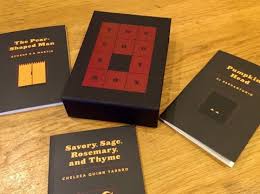
Just in time for Halloween, from the people who brought me The Short Story Advent Calendar comes The Ghost Box.

This is a nifty little box (with a magnetic opening) that contains 11 stories for Halloween.  It is lovingly described thusly:

A collection of chilly, spooky, hair-raising-y stories to get you in that Hallowe’en spirit, edited and introduced by comedian and horror aficionado Patton Oswalt.

There is no explicit “order” to these books; however, on the inside cover, one “window” of the 11 boxes is “folded.”  I am taking that as a suggested order.

Tucked into the bottom of the box is an orange rectangle with the poem “Hallowe’en in a Suburb” by H.P. Lovecraft.

Typically I don’t find poems to be particularly scary.  It’s hard to make rhymes scary.  But Lovecraft does his creepiness pretty well.  This one is written in English Quintain style (A-B-A-B-B).

This poem is more a disturbingly supernatural description of the suburbs around Halloween. (more…)

Read Full Post »

SOUNDTRACK: HANSON-Tiny Desk Concert #659 (October 16, 2017).

It should come as no surprise that Hanson has been around for 25 years.   What comes as a surprise is that not only are they still together, but that they have been together all of these years and have a huge fan base.

As the blurb notes:

The audience for Hanson’s first Tiny Desk concert could be cleanly sorted into two distinct camps: the curious and the committed. The curious were the ones who’d inquired about whether the band would play its 1997 smash “MMMBop” (answer: nope), or wondered what Isaac, Taylor and Zac Hanson have been up to since the ’90s (answer: touring constantly, putting out records, starting their own label, raising families, launching a music festival, developing a line of Hanson Brothers-branded “MMMHops” beer). As for the committed? They were psyched.

For this Tiny Desk Concert the boys (who are now men) play some catchy piano based pop songs.  And their vocals harmonies are frankly, outstanding.   After Taylor mutters “to the bridge, y’all” on the first song 2010’s “Thinking ‘Bout Somethin'” the three of them hit some absolute gorgeous notes.

The middle of the song features a clap along and afterwards Taylor jokes about it: “So um, it’s okay to clap if we ask you to.  I love how you guys are like ‘can we clap?’  You’re the most obedient audience we’ve ever seen.”

They say that 20 years ago “Mmmbop” came out He notes: “that was obviously big” [chuckle].   But Taylor says the key song was on our second record.  It helped us connect with our fans and it’s called: “This Time Around.”

Issac sings the second verse and I have to assume that his voice has dropped quite a bit since they recorded that song.  (Well, actually he was 16, so maybe not.  But Taylor was 14 and Zachary was 11 (which means he started playing with them when he was 6!)).  This song has a classic blues vibe that if you didn’t tell me was Hanson I would have thought it was a lost song from the 70s, maybe.

Zac teases Taylor: “Look at you sweating at your Tiny Desk.”
Taylor: “It feels like a show now, I’m taking things off.”
Zac: “That’s not something we do at a show–you’re sending the wrong message.”

They say that the final song is a perfect message for our band, for this time in our career, for this time in the world–a positive true message about everybody’s place in the world.  Sometimes you need to be reminded that you were born to do something nobody else is going to do.

It’s two guitar and big harmonies.  I like the falsetto moments in the bridge in particular.

I can’t say I’ve become a fan of the band, but I have a lot more respect for them and will no longer think of them as that band of little kids.

As the show ends, Taylor says, “We’ll see you for Christmas, everybody.”  And then a to be continued…

[READ: August 31, 2011] “Black Widows”

This short piece deserves an introduction because it is unlike anything else that Saunders has done in the New Yorker

SKETCHBOOK illustration by Pierre Le-Tan, in the style of Edward Gorey accompanied by a George Saunders poem in the style of Edward Gorey…  The illustration depicts four women and a man near a fire place in the living room of a manor house or castle. The figures in the illustration are wearing fashions from recent collections by Balenciaga, Marc Jacobs and Rochas. The poem describes the people in the illustration.

Okay, got it?  Should you want to see the illustration, click here. (more…)

Read Full Post »

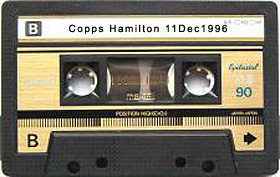
SOUNDTRACK: RHEOSTATICS-Copps Coliseum, Hamilton, ON (December 11 1996).

This is the final show on Rheostatics Live in which the band is opening for The Tragically Hip.

For this show, the intro music is also from The Wizard of Oz, but this time it’s Judy singing “Somewhere Over the Rainbow.”  It’s just one verse before fading out and then guitars fading in for Martin to play “A Mid Winter Night’s Dream.”

Turns out that this setlist is similar to the one from Buffalo with a lot of new songs.  Although there are a few older/more popular songs in places.

The new songs include “Fat” which sounds great of course.  I gather they are maybe sharing a microphone because at the end Dave says “See you in the next song, Martin.”  “Okay, Dave.”  This leads into a perfect version of “All the Same Eyes.”

Martin says “We are the Rheostatics.”  Dave says “We are the Rheostatics, not to be confused with The Howell Brothers (?).  They couldn’t make it but we got their jackets.  It’s nice of you to come out early.  We’re playing selections from our new record. Get it before it’s reduced to clear.”  (You can hear someone laugh on tape).

This is a segue into the single “Bad Time to Be Poor.”  It’s followed by another Tim song, “Claire” with the acoustic guitar opening in place.  There’s another lengthy guitar solo, although it’s not quiet as exciting as some of the other ones.  But Martin was saving up for a spirited version of “California Dreamline.”

They end their set with a rough rocking “Feed Yourself.”  During the spoken part, they slow things down to just a bass and washes of guitar.  It’s a pretty intense ending and a good preparation for The Tragically Hip.

[READ: June 25, 2017] The Story of Canada in 150 Objects

In celebration of Canada’s 150th year, Canadian Geographic and The Walrus created this special issue–a fun way to describe many elements of Canadian culture through “objects.”

The objects are grouped in vague categories.  Some have just a few words written about them while others get a few pages.  Some are humorous, some are more serious.  Most are happy or amusing, some not so much.  And all of it together paints a diverse and complex portrait of the country–as well as teaching this person from South of the border a number of things I did not know.

It’s with comic pride and humility that the first object is politeness (which is not an object at all, of course).  The amusing thing about this article about “politeness” is that while the author of it is very pleased to be so polite, he also can’t wait for his fellow Canucks to forget to be polite so he can rub it in with a extra smarmy “You’re Welcome.” (more…)

Read Full Post »

slowreadSOUNDTRACK: DIRTY THREE-Tiny Desk Concert #245 (October 15, 2012).
dirty-3For a Murakami collection I should really have picked a jazz Tiny Desk Concert.  But none jumped out at my on my list.  So I decided to do something that might be jazzy in spirit, even if it is nothing like jazz at all.

Dirty Three are a three-piece band which consists of violinist Warren Ellis (who works closely with Nick Cave), drummer Jim White (who I had the pleasure of seeing live with Xylouris White), and guitarist Mick Turner (who has released a string of gorgeous instrumental solo albums and worked a lot with Will Oldham).

I’ve liked Dirty Three for years, although I kind of lost touch with them back around 2000.  So it was fun to see that they are still working.  (They’ve released all of 3 albums since 2000).

Jim White plays an eccentric but very cool style of drum–it always feels improvised and random, and maybe it is, but it’s never “wrong.”  Turner is the only one who is keeping the song, shall we say, “stable.”  He’s got the rhythm and melody both with his strumming.  And Ellis is all over the place with melody lines and bowing.

For this Tiny Desk, they play three songs.  Their music is ostensibly instrumental although Warren Ellis is not above shouting and yelling and keening when appropriate.

The first two songs are from their 2012 album and the last one is from Ocean Songs.

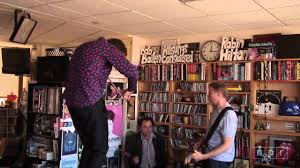
“Rain Song” opens with Ellis strumming the violin while Turner plays slightly different chords.  Then Ellis takes off on a series of spiralling violin rolls.  As always, White is back there waving his arms around with the loosest grip on drumsticks I’ve ever seen.  He plays brushes on this song but the drums are far from quiet.  Meanwhile Ellis is soloing away, yelling where appropriate and doing high kicks when White hits the cymbals.   As the song comes to an end, White is going nuts on the drums and Ellis takes off his jacket (revealing a wonderful purple shirt) .  He starts screaming wildly as he physically gets into his violin playing.

“The Pier” is about realizing that it’s the rest of the world that is driving you crazy.  It’s about “trying to undermine Facebook and realize a new way of communicating with people beyond the internet.”  It’ about… are you ready Mick?  Okay.  “The Pier” is a slower song with some plucked violin.  Ellis climbs up on the desk and dances around as he plays.  This one feels a but more controlled but in no way staid.

For “Last Horse in the Sand,” white switches to mallets and adds a tambourine to his cymbal.  It’s really interesting to watch White play around with things–moving his gear around as he plays.  He switches sticks and seems to be not even paying attention, but without ever really losing momentum or timing.  For this song, Ellis and Turner are the mellow ones while White is just all over the place with his amazing drumming.

I haven’t said anything about Turner because he is really the grounding of the band, while the other two are taking flights of fancy.

This is a wild and untamed set and it’s a lot of fun.  It’s also amusing to watch the audience witnessing this seeming chaos.

[READ: December 16, 2016] Slow Reader Vol. 1

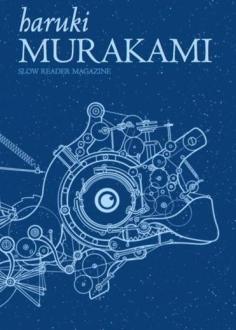
Madras Press had released 16 small books, which I enjoyed reading quite a lot.  I have posted about some and will post about more in the new year.  But word is that they have given up on the small books and have switched their attention to a new magazine/journal called Slow Reader.  The first issue came out this month and it collects stories, essays, poems, illustrations, and other things that center around novelist Haruki Murakami.

Support this small press!  You can order this issue directly (and name your price, although I think the asking price is $6).

From an article elsewhere I’ve learned that future issues will cluster around M.F.K. Fisher, Kazuo Ishiguro, and Patricia Highsmith.

This issue contains essays, fiction and illustrations, some dating back as far as 2000.

CHIP KIDD-cover illustration (wind-up bird)
Chip Kidd is awesome

GRANT SNIDER-Murakami Bingo Board
This bingo is hilariously apt–covering most of the bases of Murakami’s writing: cats, jazz, running, and even a Chip Kidd cover.

JESSE BALL-Sheep Man
A line drawing of a sheep standing upright with the caption “The sheep man’s peculiar tail was never visible to me.”

HARRIET LEE-MERRION-Diner illustration
A nice line drawing of a corner diner

KAREN MURPHY-Sputnik and two moon illustrations
Two simple drawings of Sputnik and two moons.

BEIDI GUO-Hard Boiled Wonderland and the End of the World map
A cool map of the locations of the novel.

DINA AVILA–Murakami Tasting Menu at Nodoguro in Portland, OR
I don’t really get if the menu items are related to the stories but it’s a neat idea that there are foods named after his works. But why are so many called IQ84?

EUGENIA BURCHI–IQ84 menus
A drawing of foods with what I think are character names (I haven’t read the novel yet).

FABIO VALESINI-train illustrations taken from the book trailer for Colorless Tsukuru Tazaki and His Years of Pilgrimage
No idea what the original context is, but it’s a neat, clean drawing of a train station.

JEFFREY BROWN-“In Conversation” What Jeffrey Brown Thinks About
The first piece is an amusing cartoon in which Brown scores a job at an indie bookstore by mentioning Murakami.  The little blurb says that it is an only slightly exaggerated account. There’s also a later picture by Brown of Murakami’s face posted on a bulletin board (with a lost cat flier), that’s really great.

DANIEL HANDLER-“I Love Murakami”
Handler begins his piece by apologizing to dozens of authors before saying that Murakami is our greatest living practitioner of fiction.  He mentions a few books but heaps a ton of praise on Wind Up Bird Chronicles and mentions his excitement at  finally getting Norwegian Wood in English (it had been untranslated for many years).  He wrote this essay in 2000.

YOKO OGAWA-“On Murakami’s “The Last Lawn of the Afternoon” [Translated from the Japanese by Stephen Snyder]
Ogawa writes about a house in her neighborhood which has a lawn that she finds unsettling–it’s perfectly manicured and a pale, cool shade of green.  She is reminded of the Murakami story in which a boy mows a woman’s lawn and she asks him an unexpected question.  Ogawa imagines a woman in that home asking the same kinds of questions.

ETGAR KERET-“What Do We Have in Our Pockets?”
This was inspired by Murakami’s story “On Seeing the 100% Perfect Girl One Beautiful April Morning.”  This story is about a man whose pockets are always bulging with unusual items.  People often say to him, “What the fuck do you have in your pockets?”  And his answer is that he carries things that he imagines the perfect woman needing–a stamp or a toothpick.  It is a wonderfully charming story.

RIVKA GALCHEN-“The Monkey Did It”
Of all of the items in this collection, this is  the only piece I’d read before.  I remembered parts of it (particularly the excerpts from “A Shinagawa Monkey,” and her talking about Colorless Tsukuru Tazaki.  I also recalled her saying that she liked his short stories better than his novels, but that she was perhaps wrong in thinking that.  The one thing I didn’t pick up on last time was that in the beginning of the essay she writes about Toricelli’s Trumpet or Gabriel’s Horn–an item with finite volume but infinite surface area.  She says this perfect describes Murakami’s work.  And I love that she ties it to translator Philip Gabriel who is a gentle and modest translator–perfect for the watery novel.

TESS GALLAGHER-“Murakami and Carver Meet at Sky House”
Before he had written any substantial works, Murakami translated Raymond Carver’s works into Japanese.  Ray was excited and bemused that Haruki and his wife Yoko would travel from Japan to meet with him.  This essay tells us that the following poem came about as Ray tried to imagine how his poems could possibly be appreciated in Japan.  Murakami told him how both the Japanese and American people of the 1980s were experiencing humiliation at being unable to make a decent living.  Gallagher says that if they were to meet today Ray would be awkward about Haruki’s stature.  But he would have loved knowing that Murakami had translated everything he had written.

RAYMOND CARVER-“The Projectile”
This poem is wonderful. It begins with Carver speaking about his meeting with Murakami and then flashing back to when he was 16 and was hit with an ice ball.  It was thrown from someone in the street through a small crack in the window of the car he was riding in–a chance in a million.

RICHARD POWERS-“The Global Distributed Self-Mirroring Subterranean Neurological Soul-Sharing Picture Show”
This is the most abstract and “intellectual” of the essays here.  It speaks of a team of neuroscientists discovering a lucky accident–that neurons in the brain fire when someone else makes a motion that we recognize.  Similarly, in Murakami–representation is the beginning of reality.  He speaks of the parallel narratives in Hard Boiled Wonderland.  He wonders at the universality of dreams and ideas in Murakami.  “But if his own stories are steeped in the endless weirdness hiding just inside everyday life, how then to account for Murakami’s astonishing popularity throughout the world?”

MARY MORRIS-“The Interpreter”
I loved this story.  An American business woman is giving a series of lectures in Japan.  She is assigned a translator who goes with her nearly everywhere.  She is a little annoyed that he is always there, but he is very respectful of her and only speaks when spoken to.  She assumes he is translating her speeches correctly, but during one, the audience laughs where there was nothing funny.  She doesn’t want to disrespect him, but she can’t imagine what he said to them.  In the next one, they are practically doubled over with laughter at what he says.  Finally she has to confront him about it.  He reveals astonishing insights into her personal life.  And the next day he is called away–just as she has begun to feel close to him.

In the author’s note, she says that the she was at an writer’s meeting in Princeton (where she teaches) and Murakami was there eating with them. He was by himself, and she talked to him because she was a fan of his work.  She relates a story of holding up a sign for him when he ran the New York City Marathon.  She says that the part about the translator and his family (which I didn’t mention) is from an actual translator she met in Japan.

AIMEE BENDER-“Spelunking with Murakami”
Bender speaks of trusting Murakami.  She says when the cat started speaking in one of his books, she began to mistrust him.  Nevertheless, she says, she loves a lot of writers but only trusts a few of them.  She’s not trusting Murakami’s honesty or his ability to make her smarter.  Rather, she trusts him like a man with a torch in a cave–someone who is willing to explore–and to be in front leading the way.

SUMANTH PRABHAKER-Editor’s Note
Prabhaker would like to ask the world’s philosophers why some things seem to happen to us in a random fashion.

Read Full Post »

sempleSOUNDTRACK: SISKIYOU-Nervous [CST109] (2015).

cst109covera_258x242This album begins with “Deserter,” in which a choir of children singing over a kind of spooky tone.  And then a loud rumbling bass and scratching on a guitar.  It’s quite different from the previous Siskiyou releases and outpaces the others by several steps.

Once Colin Huebert’s voice kicks in, that familiar Siskiyou sound returns—acoustic guitar and Huebert’s voice which is a mix between a whisper and Win Butler from Arcade Fire.  But “Deserter” features backing vocals and, perhaps most surprisingly, a wild baritone sax solo by Colin Stetson.  But it stays grounded with that cool rumbling bass line.

The second song “Bank Accounts and Dollar Bills (Give Peace a Chance)” opens with an echoed guitar likes some classic 1990s shoegaze music.  The vocals are a cool, intense whisper.  The verses are great and then the chorus adds a piano and his vocals rise into an impassioned wail.  The third song “Wasted Genius” adds a kind of steel drum sound that includes a great melody to the simple and slightly ominous verses.   The middle of the song switches to pummeling drums and a buzzy guitar solo before returning to the mellow verse.

“Violent Motion Pictures” has another cool whispered vocals and quiet guitars that get accented with a low bass and percussion.  There’s a neat section of falsetto vocals that remind me of Pink Floyd over a bouncy melody–before it returns to the verses.  It’s a wonderfully catchy, if brief, segment.  “Jesus in the 70s” has slow guitar lines and atmospheric keys.  “Oval Window” is a bouncy folk song (with a slightly creepy vocal over the top), but its even got a folksy kind of guitar line on it.

“Nervous” is a slow ballad.  “Imbecile Thoughts” is a fun song with stomping drums.  It has a cool ending that leads to the slow building, strings-included nearly 7 minute “Babylonian Proclivities.”  The disc ends with the 1 minute “Falling Down the Stairs.”

This album is really fantastic–an overlooked gem from 2015.

[READ: November 8, 2016] Today Will Be Different

I’ve really enjoyed Maria Semple’s books.  And this one was no exception.

She really conveys the hectic, overstimulated, over scheduled life of middle age parenting.  It helps that her stories are typically set around Seattle and that there’s a lot of excitement, tech and pop culture to throw around, too.

This is the story of a day in the life of Eleanor Flood.  Sarah pointed out, as I didn’t quite realize it, that the story takes place in one day (hence the title) although there are flashbacks that flesh out the story too.

Eleanor is, or perhaps “was” is the better verb, an artist.  She was lead animator (or something–it’s a little confusing) on the successful show Looper Wash.  When the show ended she received an advance to write a book/memoir.  That was eight years ago.

Things have been sprialling out of control for Eleanor for a while, but she vows that today will be different.  She will make a difference. (more…)

Read Full Post »

418SOUNDTRACK: BENJAMIN CLEMENTINE-Tiny Desk Concert #523 (April 18, 2016).

benjI have literally never seen or heard anyone like Benjamin Clementine.  He sits very tall with the piano keys quite low for him.  And he has such an effortless almost careless way of playing and yet his notes are precise and perfect.  He also faces away from the piano and sings more or less to the audience–as if his voice and hands were two different creatures.  And what a voice!

As the first song, “Condolence,” opens he plays the melody with his left hand, leaving his right hand on his lap as he sings with an intense operatic style.  But not operatic exactly, it’s more like a theatrical voice—like he is performing a dramatic recitation. But also singing these intense, powerful notes (with a vibrato that almost seems comical but is definitely not).  He sprinkles in some high piano notes almost as an afterthought, the way he casually places his hands on the keys.  And all this time, he is sitting on a stool and more or less facing the audience.  The song is five minutes long.  It doesn’t exactly seem to have a chorus–there are lyrical parts that are repeated, but it feels less like a conventional song and more like a story set to music.

When the song is over and he speaks.  He seems so shy and quiet, “Hello America.”  He has a very thick British accent (but now lives in France).

For “Gone” his hands seem to dwarf the piano.  The melody is simple and pretty and then he begins singing with just one word, a low “I” held for five seconds with vibrato.  After that, the lyrics are more or less spoken with his thick middle class accent.  He sings the middle section (with the higher piano notes) and seems to be singing in an upper class accent.  After hitting a long note, he speaks a few lines before singing the last word: “gone” with some beautiful piano notes to accompany.

“Adios” is a much more frenetic musically, but it also feels theatrical.  It is 7 minutes long.

After an intense first section about regrets and bad decisions, there is a spoken section in which he talks of angels and then he switches to a high tenor voice singing an operatic section (like the angels).  As the angelic section ends, he says, “I don’t understand them but as always, they come, they sing to me and they leave eventually.”  The intro music is so catchy and the angelic part so unexpected.  The song is unique.  Definitely not for everyone, but really impressive.

[READ: June 6, 2016] “Anhedonia, Here I Come”

This is the second or third story of Barrett’s that I’ve read.  And like previous stories it took me a while to realize it was set in Ireland.  This is of course my own bias as if I lived in Ireland I’d probably assume it was set there.  But I didn’t.

And frankly the location is irrelevant because this story is about a poet and his attempts at coping with the un-understanding world.

Bobby Tallis is a skinny twenty-something.  He lives in an old housing estate that is populated mostly by old people.  He had nothing to do with them.  Really all he does is walk six miles every day so he can buy weed from a schoolgirl (see, this could be anywhere). (more…)

Read Full Post »

« Newer Posts - Older Posts »