Feeds:
Posts
Comments

Archive for the ‘Murder’ Category

SOUNDTRACK: hiatus

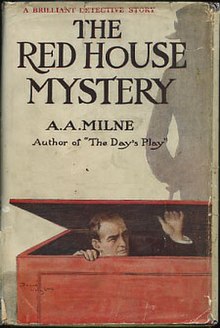
[READ: June 6, 2023] The Red House Mystery

In Peter Swanson’s mystery Eight Perfect Murders, his narrator makes a list of eight perfects murders in fiction–not the best books, just the perfect setup for murder.  These books are:

Agatha Christie’s A. B. C. Murders, Patricia Highsmith’s Strangers on a Train, Ira Levin’s Death Trap, A. A. Milne’s Red House Mystery, Anthony Berkeley Cox’s Malice Aforethought, James M. Cain’s Double Indemnity, John D. Macdonald’s The Drowner, and Donna Tartt’s A Secret History.

And yes, A.A. Milne, the writer of Winnie the Pooh, is one of those authors.  Swanson’s narrator kind of dismisses the story saying that it’s a quaint mystery and that the murder is perfect (meaning the killer would never get caught), but almost with an asterisk.

What’s all that about?

Well, the story is set in an English country manor, the Red House.  The kind of place where other rich folk would come to stay for a few weeks, drinking, playing gold and generally enjoying themselves as rich English folk apparently did at the turn of the century.  The owner of the house is Mark Ablett.  He is a single man.  However, he informally adopted his younger cousin as an opportunity to pay forward a good deed that was done to him when he was a young lad with limited propsects.   The boy (who is now in his late 20s) is named Cayley and is (now that he has been formally educated) more or less Mark’s right-hand man.  Mark doesn’t seem to do anything without consulting Cayley.

Mark is generally liked (he is no snob), but he can go on a bit.  As the book opens, Mark is hosting some people: Major Rumbold, a retired soldier; Bill Beverley, a youngish man about town.  There was also Ruth Norris, an actress “who took herself seriously as an actress and, on her holidays, seriously as a golfer.”  Finally there was Betty Calladine (18 and eligible) and her widowed mother (keen to get her settled).  (more…)

Read Full Post »

[READ: March 10, 2021] Things Are Against Us

I loved Ellmann’s book Ducks, Newburyport so much that I had intended to read all of her books.

So I’ve gone back and read some of her previous novels.  Which I found to be…okay.  They were mildly amusing with some very personal diatribes thrown in to put some passion into these otherwise comic novels.

Then I saw that she had a recent collection of essays, which I thought might be really interesting.

I agree about 95% with everything Ellmann says in this book.  And yet I hated this book more than almost anything I’ve read recently.  And I think I’m not going to bother reading the other novels that I haven’t read yet, since the other two weren’t that great anyhow.

Ellmann’s style in these essays is so unpleasant, so superior and self-righteous, so… (and I hate to use this word because of the anti-feminist implications of it but it is definitionally accurate) strident, that I almost didn’t finish most of the essays (I forced my way through to the end of all of them).  Strident, btw: “presenting a point of view, especially a controversial one, in an excessively and unpleasantly forceful way.  I mean, that is this book to a T.”

In the past, strident women have been very important to many movements.  But hen your arguments are so scattershot, it’s hard for your stridency to be a positive force.

“Things Are Against Us”
In this essay Ellmann all caps the word THINGS every time she writes it.  On the first page (which is half a page not including the title), THINGS appears over 30 times.  The tone is kind of amusing–about how things get in our way and cause us trouble: Things slip out of your hand; things trip you, things break.  Then each following paragraph gets more specific.  Clothes tear, socks don’t stay up.  Matches won’t light, water bottles spill. Then she gets into the body.  In her novel Doctors & Nurses she lists 12 pages of bodily ailments.  So there’s not much new here.  And there’s no real point.  It doesn’t end with any grand idea.  It just stops. (more…)

Read Full Post »

[READ: December 20, 2022] Skelton’s Guide to Suitcase Murders

I admit that I thought this book was called Skeleton’s Guide… which I thought as very funny.

But it turns out that Skelton is a barrister (and this is the second book in the Skelton series).  David Stafford is a British writer who has written largely for TV and theatre until he started writing novels.  He has written plays with Alexei Sayle (for fans of The Young Ones).

This mystery is set in 1929.  That setting allows Stafford to avoid any kind of contemporary details that might help speed the case along.  But it’s written in such a way that you’re not frustrated by it–you can simply get into the nearly 100 year old technology (and lack thereof).

In November 1929, a woman’s corpse is discovered in a suitcase.  She is identified and her husband, Doctor Ibrahim Aziz becomes the prime suspect.  They find some evidence and there is a rumor that she was cheating on him.  So clearly he is guilty.  Especially since he’s not from England–he’s Egyptian.

Arthur Skelton is a barrister.  He’s not 100% successful, but he gives his all in hopeless cases.  So he is called in to represent Aziz.

Skelton is concerned for diplomatic matters if Aziz is executed here.  He is related to a wealthy and well-connected family back in Egypt.

The story, despite dealing with a gruesome murder, has some funny moments.  Skelton’s clerk Edgar is trying to lose weight and is quite miserable. (more…)

Read Full Post »

[READ: January 20, 2023] Doctors & Nurses 

When I requested Sweet Desserts, I also requested Doctors & Nurses. I didn’t know the order of her books, I just picked the two that were the first ones on the list.

Doctors & Nurses is similar to Sweet Desserts in that it is short (although it is actually 50 pages longer) and has short chapters.  But otherwise it is very different.  Desserts was a fairly serious book about two sisters (and a lot of sex).  This book is a farcial romp (with a lot of sex).

Comments online said the cover looked like a chick lit book, but it looks to me more like a cartoon from Playboy from the 1970s.

And it kind of reads like that too.

While Sweet Desserts bounced back and forth between past and present and the focus shifted between the main character and her sister, this story focuses pretty squarely on Jen, a fat nurse who is misanthropic and really seems to hate everyone.

There is one notable and peculiar thing about this book that is never addressed nor explained.  Every pages has SEVERAL words that are written in all capital LETTERS for, and I’m not trying to be obtuse about this, no reason that I can READILY determine.  I admit that I didn’t put a lot of TIME into trying to figure it out, BUT it is very peculiar.

The book opens with a scene of a rock and a gorge and the rock perpetually invading the gorge’s precious space.  It’s remarkably graphic sexually, as far as a rock and a gorge can have sex that is.

But that has nothing to do with the rest of the story (until the every end) which is about a nurse named Jen.  Jen is angry most of the time (the list of thing she hates is extensive).  And the tone is set pretty early. (more…)

Read Full Post »


SOUNDTRACK: FLEETWOOD MAC-“The Green Manalishi (With the Two Pronged Crown)” (1969).

I know this song from Judas Priest, who made a killer cover that they played for years.  Rob Halford’s voice on the song (in their live version from 1976) is incredible.

I didn’t even know there was an “original” until a decade or so ago.  It seemed out of character that Judas Priest would cover a trippy Fleetwood Mac song (of course they also covered Joan Baez, so…).  But wow, this song is a trip.

I mean, the lyrics alone are the stuff of legend at this point.  There’s dozens of places where you can read about the song.  Here’s a few paragraphs from Uncle Stylus.

Peter Green said it’s a song about the corrupting influence of money, which he equated with the devil. In 1969, the huge success of Fleetwood Mac had brought them a considerable income and Green had agreed with the band that they would would give it all to charity. One can imagine that “morning after” moment when he demanded they made good on their idealistic rush of blood. A massive quarrel ensued, and Green never forgave the other bandmembers for reneging on the idea and claimed that this was what inspired the song.

Manalishi is a word that Peter Green made up for the song. The sound of it rolling around the tongue is exotic and menacing, suffused with the mystery of demons and gremlins from a medieval Italian dark night.

Listening now it’s clear that he was really, whether consciously or unconsciously, telling us about his depressive schizophrenia and even the dark persona unleashed within him when he took certain drugs, the “green” of the manalishi being Green himself. It reads like the beginning of a story by Edgar Allan Poe.

The Judas Priest cover doesn’t really follow the original all that much (the ending wailing is so much cooler the way Halford does it).  But the riff here is pretty spectacular (understandable why they’d want to cover it).  Also, it was a big hit in England when it came out, so it’s not like the band was crate-digging for rarities.  I had just never heard of it.

There is something some sinister about the slow menace of the Fleetwood Mac version.  It’s incredible to think that this is the same band who put out Rumours (although really it isn’t, but whatever).

Check out the live from Boston version for some real heaviness.  And marvel that this weird song was a hit.

[READ: November 2022] Collectibles

Evidently Lawrence Block has created several of these anthologies all loosely based around a theme.  This is the first one I’ve read, although I see another one called Playing Games is on the horizon.

This collection is about collectibles.  Most but not all of the stories are crime or mystery based.  A couple have a touch of the supernatural as well.  The term “collectible” is pretty broadly defined from one story to the next, but it’s a decent prompt to let you know what you’re getting.

Lawrence Block – The Elephant in the Living Room (An Introduction)
This is an essay about the book which includes an amusing story about Lawrence’s Uncle Jerry who ha a collection of giraffes.  There were presently none in the collection because he hadn’t found one up to his standards. (more…)

Read Full Post »

[LISTENED TO: September 2023] Battle Bond

I had listened to a couple of different Buroker stories before getting to this second book in this series.

But as soon I started this one, Vivienne Leheny’s narration dragged me back in.  I could listen to just about anything she reads.

So this book picks up where the previous one left off.  Val Thorvald is a 40 -something elf/human assassin.  The elf part helps her heal faster than humans, but she is just as flawed as any other human (some critics say far more flawed).  She is still driving the government loaner Jeep that she requisitioned after Zav (before she got to know him) threw her old Jeep into the upper branches of a very tall tree.

Val has an ex-husband and daughter.  She has left them so that they will be safe.  Her ex-husband kind of understands, but her daughter doesn’t want anything to do with her.  This gives her much angst.

Val has no real friends, so she relies on her magical tiger companion, Sindari, for companionship and some great banter (he knows what’s what).  She “won” Sindari in a battle.  I enjoyed that she is ethically conflicted about “owning” a tiger, but Sindari seems to like her, so I guess it’s okay.  Sindari lives in some other realm but comes when she calls him through a magical charm.

Most of the other characters have returned: Val’s mom is a cool hippie (who once married an elf) with a dog and a guy who lives in a trailer on her property.  That would be Dimitri, a large, imposing dude who make delicate wood works (which can also be used as defensive weapons).  There’s also Zultan a vampire with a massive YouTube presence.  And then there’s Nin, a woman who runs a small food truck and makes magical weapons in her spare time. She’s awesome.  And Val’s boss Willard is still around, providing sage wisdom, hi tech help and other good things.  Willard is still recovering from the magical cancer that the dark elves infected her with.

But this story focuses on dragons.

A dragon, Dob, has come to Earth to harass Zav.   It turns out there’s a power struggle on the home world and Zav’s family has been in charge of things for a long time.  This dragon hopes to prove that Zav is not behaving according to dragon standards.  He is also underhanded and violent–unafraid to harm anyone.  He has kidnapped children. And hikers.  By the middle of the book he has taken over a large but remote area of the wilderness.

The politics of Zav’s homeworld are unfolding in  the story and more will clearly be revealed as the stories progress.  It’s good that Buroker doesn’t throw a ton of world building at us, but gives us glimpses of things.

There are dark elves causing trouble in this book as well.  This involves Nin.  They say that her weapons are encroaching on her business.  Translation: her weapons are much better than theirs but there are more of them to bully an independent woman.  Val helps her.  The discussion of payment is pretty hilarious with Val not wanting to take money but Nin, being a businesswoman, insisting on paying something (which turns out to be food).

The relationship between Val and Zav is expanding (I wish I didn’t accidentally hear a spoiler when I listened to another series) and the humor between them is getting much funnier.  Zav brought Val a poster of himself for Val to practice her axe throwing and Val continues to try to teach him contemporary slang–I love the way Leheny deals with these section–her inflections are perfect.

There’s some really cool moments in the story as well–Val rescuing the children in an abandoned building.  Val and her friends getting stuck under a house of evil cat-shifting humans.  They are memorable and you can really visualize the scenes.

The ending of the story is pretty dramatic.  Val winds up crossing a line (in Zav’s mind) and it instantly puts friction between them.  And what she has done puts her own life in danger.

Buroker must spend all of her time writing as all of these items have come out in roughly the last fifteen years.  I’m not going to listen to everything she’s written I don’t think, but here’s what I’ve started.

Death Before Dragons
almost all written in 2020!

  • Mist and Magic — Book 0.5
  • Sinister Magic — Book 1
  • Battle Bond — Book 2
  • Tangled Truths — Book 3
  • Elven Doom — Book 4
  • The Forbidden Ground — Book 4.5
  • False Security — Book 5
  • Storm Forged — Book 6
  • The Box — Book 6.5
  • Secrets of the Sword I – Book 7
  • Secrets of the Sword II – Book 8
  • Gifts — Book 8.5
  • Secrets of the Sword III – Book 9


Legacy of Magic
1-3 written in 2022, the rest in 2023

this is a spinoff series set
in Death Before Dragons world.
It features a new heroine with a new mystery
and threat that she must deal with, but
it also brings back some of the
characters from the original series.

  • Hammered — Book 1
  • Betrayed — Book 2
  • Trolled — Book 3
  • Tested — Book 4
  • Wrenched — Book 5
  • Fused — Book 6
  • Legacy of Magic Short Stories — Newsletter bonus
  • Wanted — Book 7
  • Cursed — Book 8
Tracking Trouble
2023-2024 (#5 not out yet)
Another urban fantasy series set in my Death Before Dragons and Legacy of Magic world!

  • Marked by Magic — Book 1
  • Bound by Blood — Book 2
  • Driven by Destiny — Book 3
  • A Goblin Christmas — Book 3.5
  • Pursued by Peril — Book 4
  • Tested by Temptation — Book 5


Key to this Linday Buroker audio-verse
Red means I’ve listened to it
Green means I’ve downloaded it
Blue means it’s available on Chirp
Black means it’s not available or is a short book

Dragon Gate
2021-2022
(these books are HUGE)

  • Kingdoms at War — Book 1
  • Art of the Hunt — Book 2
  • Broken by Magic — Book 3
  • Chosen for Power — Book 4
  • Sky on Fire — Book 5
  • Orbs of Wisdom — Book 6


A Witch in Wolf Wood
2021-2022
Set in the made-up town of Bellrock, Washington
bookish introvert heroines and surly werewolf heroes.

  • Mind Over Magic — Book 1
  • Spell Hound — Book 2
  • Any Witch Way — Book 3
  • Hoot and Howler — Book 3.5
  • Moment of Tooth — Book 4
  • Charmed and Dangerous — Book 5
Agents of the Crown
2018

  • Eye of Truth–— Book 1
  • Blood Ties — Book 2
  • Duty Bound — Book 3
  • Elven Fury — Book 4
  • Dragon Tear — Book 5

Haven’t decided on these series yet

Swords & Salt [3]
2013

  • A Question of Honor— Book 1
  • Labyrinths of the Heart— Book 2
  • Death from Below— Book 3
Chains of Honor [4]
2015
You may want to start with the Chains of Honor Prequels,
three novellas that were originally published as the Swords & Salt series.

  • Warrior Mage — Book 1
  • Snake Heart — Book 2
  • Assassin’s Bond — Book 3
  • Great Chief — Book 4

she also has these series:

The Emperor’s Edge Series (9 primary works).

Forgotten Ages /Encrypted series, set in the same world, approximately eighteen years earlier.  (2 primary works)  PLUS:

  • Swords & Salt series, set in the same world, after the events of EE.
  • Chains of Honor series , set in the same world (Nurian Empire)

also

Dragon Blood Series  (8 primary works)

Heritage of Power (5 primary works) is a sequel a few years after this series

AND THESE SCI-FI SERIES

Fallen Empire Series (8 primary works) SCI-FI

  • Fractured Stars Series (1 book, three stories) stand alone but in this same world

Sky Full of Stars (3 primary works)  sequel

Fallen Empire Universe Series (13 books for kindle only) same world

also

Star Kingdom Series (10 primary works) SCI-FI

AND THESE STEAMPUNK SERIES

Flash Gold Chronicles Series (5 novellas)

AND THIS SERIES TOO

Rust & Relics Series (2.5 books)


Read Full Post »

[READ: Summer 2021] The Southern Book Club’s Guide to Slaying Vampires

I loved the name of this book.  The fact that it was put out by Quirk Books was a major plus.

This book was read by Bahni Turpin and she was magnificent.  I was hooked right from the start.  I loved her Southern accents and the way she made each character unique and easily recognizable.

In the preface to the book, Hendrix explains that this novel is a kind of apology for his earlier novel My Best Friend’s Exorcism.   In that novel teenagers were the protagonists and parents were cast as trouble for them.  He felt the need to address the concerns of the parents this time around.

I love the way the characters clearly love their children but are also realistic about them:  “Being a teenager isn’t a number,” says Maryellen. “It’s the age when you stop liking them.”

The story opens in a hilarious way.

It’s 1988 and Grace Cavanaugh had started a book club,  She wanted all of the women in her circle to read the classics.  This month’s book was Cry, The Beloved Country.  Grace was the quintessential Southern woman.  Her house was perfect.  Her thick pile carpets were white and immaculate (the way she inwardly cringes as cheese straws land on the carpet is hilarious).  She did not allow for anything improper.  She expected people to do what was proper.  Like finish the book club book.

The story zooms in on Patricia Campbell.  She needed the book club,  But she did not read the book.

She was given twenty minutes to talk about the book.  And the way she tries to stretch it out is hilarious.  Eventually Grace calls her out on it.  And is very disappointed in her.  Soon enough, though, the other women reveal that they didn’t read it either.

On her way to her car Patricia is stopped by Kitty Scruggs, another book club woman.  She invites Patricia to join the book club that she has just started.  It’s going to be her and Slick Paley, a conservative Christian (with an amazing accent, thank you Bahni) who seems dumb but is far from dumb, and Maryellen, a Yankee transplant (who has a very different accent which is nice to hear).  Eventually, even Grace joins because they are going to be reading the most salacious true crime books they can find.

Each of the women is married and their families are very different.  Patricia’s husband is straight-laced.  Her daughter is just old enough to be sarcastic to her and her son, Blue (that name is explained about 3/4 of the way through the book) has suddenly become obsessed with Nazis.  Basically, she needs these women.

Five years later, the book club is still going and the women feel closer to each other than ever (although Patricia doesn’t feel super close to Grace, because who could, really).  Then one night, a night that Blue didn’t take out the garbage, Patricia walks to where the cans are stored and is attacked.  The assailant is an old woman.  She acts crazy and even though Patricia knows her, she can’t talk sense into her. The old woman bites off part of her ear (which becomes quite a conversation piece, obviously). (more…)

Read Full Post »

SOUNDTRACK: JACK INGRAM, MIRANDA LAMBERT, JON RANDALL: Tiny Desk (Home) Concert #226 (June 21, 2021).

The sight of three people with guitars wearing cowboy hats meant that I wouldn’t enjoy this set.  (At least it was only ten minutes).

Having said that, while there’s something I instinctively dislike about Lambert (she always looks really smug and/or pissed off), her voice is quite nice and not terribly twangy.

I think I’ve heard of Jack Ingram, but possibly not Jon Randall.

After collaborating on “Tin Man” from Lambert’s 2016 record The Weight Of These Wings … the artists spent five days last November recording in Marfa, Texas. In this (home) concert, the trio turns its quarantine album, The Marfa Tapes, into a quarantine Tiny Desk set, complete with a well-appointed desk in the corner of the frame.

They play three mid-tempo songs with pretty guitars, pretty melodies and nice harmonies.

They start with “Waxahachie.”  But in the way that hearing an okay cover of a song makes you want to hear the original, this song made me want to listen to the band Waxahatchee instead.

“Tin Man” (“Our award-winning song,” Lambert jokes. The track won the 2018 Academy of Country Music Award for song of the year) is a fine song. I’m not sure what led it to winning an award, though.

At its conclusion, Lambert lets out a laugh and the trio exchange knowing glances before finishing the show with “In His Arms.”

“In His Arms” is one of Lambert’s favorites on the disc.  It has a pretty guitar melody from Jon Randall (I guess I’m supposed to know which guy was which since they were never introduced).  There’s some really nice harmonies on this song as well.

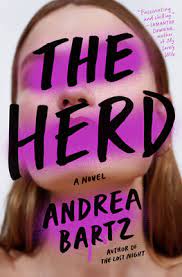
[READ: June 28, 2021] The Herd

Every once in a while I get to see some new books that come into work.  I saw this one and was intrigued by it.  I hadn’t heard of Bartz, but the book sounded exciting.

Then by the time I got around to reading it, I forgot that it was a thriller, and I found myself getting really invested in the characters.  The story was such a delightful book of female empowerment that I was really surprised when it turned into a mystery.

The story is about four women.  Eleanor Walsh is CEO of The Herd, an elite, women-only coworking space.  After making her fortune with a women-friendly cosmetic line, she established The HERd [capitalization intended] as a place where women could work side by side, bouncing ideas off of each other.  She became a feminist icon.  And was accordingly hated by insecure men–including an online group called the Anti-herd.

Mikki Danziger is a college friend of Eleanor’s.  She is an artist, and she creates most of the visuals for The Herd.  She’s a little annoyed that she (one of Eleanor’s oldest and best friends) isn’t on the payroll–Eleanor keeps her as an independent contractor.  But aside from that she is thrilled to share in Eleanor’s success.

As is Hana Bradley.  Hana is the third of the above trio of women who all went to Harvard together.  They have been best friends since college.  Hana is a PR specialist and she has managed to keep Eleanor out of trouble as she works to expand her business.  She is also a n independent contractor.

Hana’s younger sister Katie is also a friend of the others.  They initially took her in as a little sister.  But when Hana went to the West Coast for grad school. Katie filled in the gap and they embraced her as an equal. (more…)

Read Full Post »

SOUNDTRACK: PALBERTA-Tiny Desk (Home) Concert #210 (May 18, 2021).

Palberta has a great name (even if they are not from Alberta).  They are an underground Philly band.  I saw them a few years ago, and this attitude of relaxed yet frenetic fun was evident then as well.

While many of us have gotten better at using technology to feel close to our friends and collaborators over the past year, there’s still no replacement for being in the same room as someone who you swear can read your mind. That’s what it feels like to watch punk band Palberta, whose music makes magic out of repeated phrases sung in tight harmony and charmingly zany pop hooks. For its Tiny Desk (home) concert, shot on a MiniDV and a Hi8, the band crams into Nina’s Philly basement for a set that’s a testament to the group’s tight-knit collaboration and playful exuberance.

The band plays six songs in fifteen minutes (including the time it takes to switch instruments).  Five songs are off of their new album Palberta5000.

The guitar-bass-drums trio is made up of Ani Ivry-Block, Nina Ryser and Lily Konigsberg, and each member sings and plays each instrument. Here, they trade places every couple of songs.  The songs aren’t over-complicated but still manage to surprise at every turn – a true Palberta specialty.

The “frenzied opener” “Eggs n’ Bac'” has a wild instrumental opening which jumps into a faster indie punk sound for most of the song.  All squeezed into less than 2 minutes.  For this song Nina is on bass, Lily on guitar and Ani on drums.  Their sound reminds me of early Dead Milkmen.  Is this a Philly thing?

For “No Way” Nina stays on bass, Lily switches to drums and Ani takes the guitar.  Nina sings lead with the other two giving great tight harmonies.  For these songs the bass lays down the main melody and the guitars play a lot of single note melodies that run counter to the bass.

For the “queasy-yet-sentimental” “The Cow” it’s the same lineup but Lily sings lead on the first verse and Ani sings leads on the second verse.  The staccato guitar style on this song is so unusual.

For the “anxious and melodic” “Big Bad Want” Lily stays on drums and sings lead, Ani switches to bass and Nina gets the guitar.  Ani plays some chords on the bass and you can really see how the guitar plays a repeated pattern while the bass takes more of a lead role.  The call and response for this chorus is really tight.  Nina even plays a guitar solo.

“Sound of the Beat” (from 2018’s Roach Goin’ Down) is “a sweet testament to grooving” and gets a full lineup switch.  Nina sits behind the kit, Ani is back on guitar and Lily is on bass.  This song is really catchy–surely the catchiest thing in this set.  It has a feeling like early Sleater-Kinney.  All three sing harmony lead.

They end with “Before I Got Here” with same line up.  It’s one of their longer songs at over three minutes.  Ani and Lily switch off lead vocals for the fast verses.  After a minute or so, the tempo shifts and the last two minutes are a slow instrumental jam with Ani playing a guitar solo while Lily keeps the melody on bass.

It’s tempting to try to see if one of them is “better” at one instrument or another, but they are all clearly very comfortable on each instrument.  This leads to endless possibilities for songs.

[READ: May 1, 2021] Weird Women

“Introduction” by Lisa Morton and Leslie S. Klinger

Why summarize when they say what this book is about so well

Any student of the literary history of the weird or horror story can hardly be faulted for expecting to find a genre bereft of female writers, at least in its first two centuries. …

Yet there were women writing early terror tales—in fact, there were a lot of them. During the second half of the nineteenth century, when printing technologies enabled the mass production of cheap newspapers and magazines that needed a steady supply of material, many of the writers supplying that work were women. The middle classes were demanding reading material, and the plethora of magazines, newspapers, and cheap books meant a robust marketplace for authors. Women had limited career opportunities, and writing was probably more appealing than some of the other avenues open to them. Though the publishing world was male-dominated, writing anonymously or using masculine-sounding names (such as “M.E. Braddon”) gave women a chance to break into the market. It was also still a time when writers were freer than today’s writers to write work in a variety of both styles and what we now call genres. A prolific writer might pen adventure stories, romantic tales, domestic stories, mystery or detective fiction, stories of the supernatural—there were really no limits.

Spiritualism—the belief that spirit communication could be conducted by a medium at a séance, and could be scientifically proven (despite continued evidence to the contrary)—was widely popular, and so one might expect to find that many writers of this period were producing ghost stories. But ghost stories were just one type of supernatural story produced by women writers at this time. Women were also writing stories of mummies, werewolves, mad scientists, ancient curses, and banshees. They were writing tales of cosmic horror half a century before Lovecraft ever put pen to paper, and crafting weird westerns, dark metaphorical fables, and those delicious, dread-inducing gems that are simply unclassifiable.

ELIZABETH GASKELL-“The Old Nurse’s Story” (1852)
Gaskell wrote primarily about social realism, but she also wrote this creepy story.  The set up of this story is fascinating. A nursemaid is telling a story to her new charges.  The story is about their mother–from when the nursemaid used to watch her.  The story seems like one of simple haunting–strange things are afoot at this mansion.  But there’s a lot more going on.  I love the way everyone is so calm about the broken pipe organ playing music day and night.  Way back then, the children’s mother saw a girl outside and went to play with her.  But it was winter and when they found the child, alone, under a tree, there was no evidence of anyone else being there with her.  That’s when we learn the history of this house and the way the owner treated his daughters.  The ending gets a little confusing, but when you unpack it, there’s some wonderful deviance at hand. (more…)

Read Full Post »
SOUNDTRACK: MANIC STREET PREACHERS-“Die in the Summertime” (1994).

I really liked the Manic Street Preachers in the late 90s.  Perhaps ironically, I learned about them after the strange disappearance of lyricist and guitarist Richey Edwards, and really liked the first few albums that they put out without him.  I went back and listened to their older stuff later, but I still prefer Everything Must Go.

Nevertheless, The Holy Bible (where this song comes from) is a pretty great album.  And “Die in the Summertime” is really cool.  It opens with tribal drums and a nifty almost Middle Eastern sounding guitar riff.  When it kicks in after a brief intro, it’s more raw and heavy than their later stuff–was that Edwards’ influence?

I listened to this song a few times and will clearly have to dig out The Holy Bible for another listen.

Obviously Edwards looms over the band and clearly looms over this story.

The guitarist vanished on 1 February 1995 and is widely presumed to have taken his own life, but a body was never found and there is no definitive proof that he died by suicide.

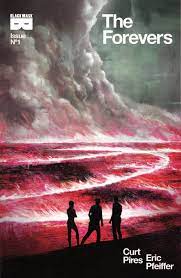
[READ: May 31, 2021] The Forevers

This was a fairly simple (and familiar) story, but it was told in a very interesting way.

Ten years ago seven friends (or maybe not friends exactly) made a pact. They performed a ritual asking for fame and fortune.  And it worked.  They have all become very successful.

Each chapter has a title from a song.  The first is “Die in the Summertime” (3:07) [by Manic Street Preachers].

Ten years later we cut to Jamie Ashby–a strung out superstar singer (who looks an awful lot like the Irish guy from Lost, who was also a strung out rock star).  He is in a bad way.

Then we meet Daisy Cates.  She is a successful model,  But the person who takes her home does not have good intentions for her.

I liked the way their two stories paralleled on the same page with a different background wash of color.

Jamie does a show and when an old geezer says he’s washed up, he punches the guy and makes tabloid headlines,  We find out in the next chapter that the geezer was Robert Plant–ha!

Chapter 2 is “The Drugs Don’t Work”  (5:05) [by The Verve]. (more…)

Read Full Post »

« Newer Posts - Older Posts »