SOUNDTRACK: hiatus
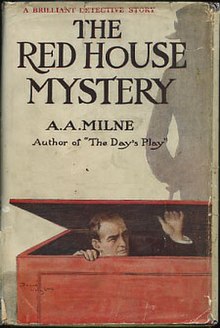
[READ: June 6, 2023] The Red House Mystery
In Peter Swanson’s mystery Eight Perfect Murders, his narrator makes a list of eight perfects murders in fiction–not the best books, just the perfect setup for murder. These books are:
Agatha Christie’s A. B. C. Murders, Patricia Highsmith’s Strangers on a Train, Ira Levin’s Death Trap, A. A. Milne’s Red House Mystery, Anthony Berkeley Cox’s Malice Aforethought, James M. Cain’s Double Indemnity, John D. Macdonald’s The Drowner, and Donna Tartt’s A Secret History.
And yes, A.A. Milne, the writer of Winnie the Pooh, is one of those authors. Swanson’s narrator kind of dismisses the story saying that it’s a quaint mystery and that the murder is perfect (meaning the killer would never get caught), but almost with an asterisk.
What’s all that about?
Well, the story is set in an English country manor, the Red House. The kind of place where other rich folk would come to stay for a few weeks, drinking, playing gold and generally enjoying themselves as rich English folk apparently did at the turn of the century. The owner of the house is Mark Ablett. He is a single man. However, he informally adopted his younger cousin as an opportunity to pay forward a good deed that was done to him when he was a young lad with limited propsects. The boy (who is now in his late 20s) is named Cayley and is (now that he has been formally educated) more or less Mark’s right-hand man. Mark doesn’t seem to do anything without consulting Cayley.
Mark is generally liked (he is no snob), but he can go on a bit. As the book opens, Mark is hosting some people: Major Rumbold, a retired soldier; Bill Beverley, a youngish man about town. There was also Ruth Norris, an actress “who took herself seriously as an actress and, on her holidays, seriously as a golfer.” Finally there was Betty Calladine (18 and eligible) and her widowed mother (keen to get her settled).
As they settled in for breakfast before a day of golf, Mark revealed that he had gotten a letter from his long lost brother in Australia (most people didn’t even know he had a brother). This brother was a wastrel and was no doubt coming to Mark’s place to ask for money. Mark was perturbed by this and told his guests to go about their day without him while he prepared for his brother to arrive.
The house also has servants. They are largely overlooked except for one who overhears a little bit of information.
When Robert shows up, people recognize him as Mark’s brother–they are clearly related, although Robert doesn’t look quite as nice as Mark. Robert is shown into one of the rooms and then moments later, as the above servant is walking past the room, she hears Mark’s voice and then a gunshot.
In a lovely bit of fortuitousness, a new character is introduced around this time. He is Anthony Gillingham. He is also on holiday and decided to get off at this train station “because he liked the look of the station.” He took a room at a local inn and realized that his friend Bill Beverley was staying at the Red House. So Gillingham set off for the Red House to meet up with Bill.
He arrived on the premises as the gun went off. He thought nothing of it–hunting and all–until he got up to the house itself and saw the chaos that was going on inside.
He introduced himself to Cayley and they ran into the room where the gun was fired. It was Robert who was shot and there was no sign of Mark–except for an open window.
Gillingham is something of an amateur sleuth and he sets about looking for clues. The local police seem a little in over their head and Gillingham certainly does most of the real work to solve the case. (Raymond Chandler mocked this story: “English police seem to endure him with their customary stoicism; but I shudder to think of what the boys down at the Homicide Bureau in my city would do to him.”).
It seems obvious that Mark shot his brother and fled through the window. And yet, it doesn’t make any sense. And the more logic Gilligham throws at the crime, the less sense it makes.
Gillingham enlists Bill Beverley as his Watson, and they play at being Sherlock Holmes, with Gillingham discovering little clues here and there–like secret passage and Cayley’s questionable behavior.
After a dredged lake and a visit to the widow’s house (where the learn that the widow wanted to set up her daughter with Mark but that Cayley also fancied her), new ideas are revealed.
The result is pretty satisfying for its cleverness–including, of course, things that the reader would never know while reading the story. But it’s fun to romp around through the mystery with Gillingham and Beverley.
I also enjoyed that they often criticized themselves “you ass,” which seems so out of character for the creator of Pooh.
The story is certainly of its time and is a little slow, but I enjoyed it quite a lot.


Leave a Reply