Feeds:
Posts
Comments

Archive for the ‘History’ Category

SOUNDTRACK: HELIUM-The Dirt of Luck (1995).
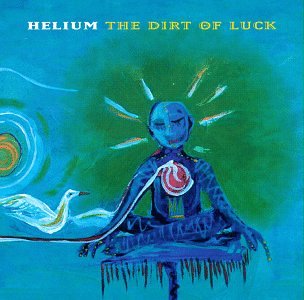
Mary Timony fronted Helium for a few years.  In that time she was recognized as something of a guitar wizard–not in her speed and flash, but in the weird sounds she conjured from the instrument.

She also had very peculiar musical sensibilities (these songs are quite odd) and a cool feminist attitude.  This album features the amazing song “Superball” (one of the best songs of the mid 90s–check out the video and watch the guitarist playing the strings with a screwdriver!  Man I miss the 90s) as well as a number of unpolished gems like “Medusa” and “Pat’s Trick” (the dual vocals are very cool and the dispassionate “oh oh oh” is very interesting, plus I love the lyric about “long-ass curly hair”).

Her singing style is often quite slacker-y, like in the opening of “Medusa”–she’s not always audible, and she often seems like a kind of buzzy sound more than a voice.   She sounds like she’s singing from very far away–seemingly powerful and yet quiet at the same time.

But combine that with the cool scratchy/noisy guitar sounds she gets and she’s pulling off a very cool combination (think Dino Jr without the hooks and killer solos).

Like “Baby’s Going Underground” features some crazy shoegazer guitar washes for most of its 6 minutes which really changes the pacing of the record.  There’s also the great “Skeleton,” a riff so cool that Sonic Youth used it for “Sunday.”

She also has a way with haunting melodies as on the piano  instrumental “Comet #9” and on “All the X’s Have Wings” which sounds very medieval. I think of Timony as a guitarist and yet there is there are lots of keyboards on the album too–mystical keyboards that are fascinating and seem out of character with the guitars, but actually work quite well.   But the prettiest song is “Honeycomb.’  It’s a sweet song with a wonderful melody.  It is followed by the ender “Flower of the Apocalypse” a guitar-based instrumental that is mostly feedback but is also surprisingly melodic.

Helium had mild accolades back in the 90s.  They released a couple of albums and then Mary Timony went solo.  It’s nice to have her playing now with Wild Flag.

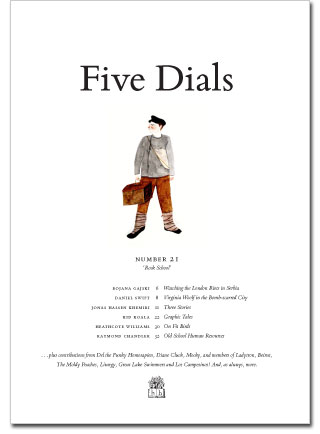
[READ: November 11, 2011] Five Dials Number 21

This is the first issue of Five Dials that I was ready to read when it was sent to me (I’ve been all caught up for a while now).  So that’s pretty exciting!

I was tempted to say that i enjoyed this issue more than other issues, but I have enjoyed most Five Dials issues equally.  But this one is definitely a favorite.

CRAIG TAYLOR–A Letter from the Editor: On Turning 21 and Thinking About Rock Stars and Greece.
The magazine introduction jokes about them now being legal to drink in the U.S. and also about now being old enough to run for M.P. in England.  He also tells us about their “new” section Our Town, which has vastly expanded in this issue.  He also explains that there are many rock stars on hand to give the magazine tutelage (authors that the rock stars enjoy) and three short stories.  He ends with a notice that they have gone to Greece where they are gathering material for Issue 22. (more…)

Read Full Post »

SOUNDTRACK: SUFJAN STEVENS-The Age of Adz (2010).

Sufjan Stevens has released a bunch of albums of beautiful orchestral rock.  It is multi-layered and complex with classical elements and all kinds of cool instruments.

And this album starts out with a beautiful acoustic guitar melody and Sufjan’s delicate vocals.  Although it is a far more stripped down song than usual, “Futile Devices” seems like it is heading in the standard direction.  But anyone who heard Sufjan’s Christmas album number VIII knows that he has been having some fun with electronics.  And they show up with a vengeance on track two, “Too Much.”

All of the multilayered noise that was once orchestral and (some might say) precious has been replaced by a cacophony of gorgeous electronic noises.  The beginning of the song reminds me of the sounds in Skinny Puppy’s “Stairs and Flowers” (how many Sufjan Stevens reviews mention Skinny Puppy?).  The song is nothing like Skinny Puppy once the vocals kick in–it’s catchy and delicate–but those electronics underpin the whole thing, bringing his pastoralia into the twenty-first century.  When I first reviewed this song I didn’t like it but once you get absorbed by Sufjan’s world, it’s an enticing place to be,

“Age of Adz” takes this electronic nonsense even further with an 8 minute brew of strange sounds and choral voices.  But he always manages to throw in some catchy parts, no matter how strange the song gets.

For me one of the highlights of the disc is “I Walked” it features one of my favorite Sufjan things–falsetto vocals in a beautiful but unexpected melody.  And this song has them in spades.  “Now That I’m Older” has a very disconcerting sound–his voice is slowly warbled and mournful.  It’s a beautiful melody that is alienating at the same time.

“Get Real Get Right” returns to his earlier style somewhat (there’s more layers of music, although the electronica is still in place).   “Vesuvius” is a beautiful song and “All for Myself” is another of those great falsetto tracks that I like so much.

“I Want to Be Well” eventually turns into a manic electronic workout in which he repeats the chorus “I’m not fucking around.”

But nothing compares  to “Impossible Soul” a twenty-five minute (!) multi-part suite of electronic chaos.  It’s a fantastic song complete with autotune (used to very cool effect), repeated swelling choruses (it’s like a Polyphonic Spree tribute), electronic freakouts, and acoustic comedowns.  All in a positive, happy message.  I can’t stop listening to it.  “It’s not so impossible!”

Sufjan continues to impress me.

[READ: November 10, 2011] McSweeney’s #9

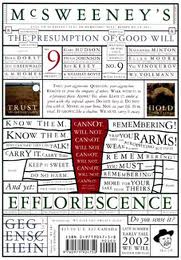
After the excesses of McSweeney’s #8, I was excited to get to the brevity (and urgency) of McSweeney’s #9.  This one is a paperback and looks like the first couple of issues.  The cover is mostly text with a hodgepodge of phrases and pleas.  You get things like: Thankful, Emboldened, The (Hot-Blooded/Life-Saving) Presumption of (Perpetual/Irrational (or More Likely, Irreducibly Rational) Good Will, Efflorescence, Our motto this time: We Give You Sweaty Hugs,” Alternative motto: ” We Are Out Looking,” GEGENSCHEIN (no more), and the promise: “We will Do Four This Year.”

This is the kind of issue that makes me love McSweeney’s.  There are some wonderful short stories, there are some nice essays and there are some dark moments all centered vaguely and tangentially around a theme.  There are some great authors here, too.

The back cover image is called Garden Variety by Scott Greene and it’s a fantastic painting.  You can see it here (navigate through the 2000-2004 paintings, but I have to say I really like the style of all of his work.

There are no letters and no nonsense in this issue.  So let’s get to it. (more…)

Read Full Post »

SOUNDTRACK: OKX: A Tribute to Ok Computer (2010).

OK Computer is one of the best records of the 90s.  Every time I listen to it I hear something new and interesting.  So, why on earth would anyone want to cover the whole thing?  And how could you possibly do justice to this multi-layered masterpiece?

I can’t answer the first question, but the second question is more or less answered by this tribute which was orchestrated by Stereogum.

The answer is by stripping down the music to its bare essentials.  When I first listened to the songs I was really puzzled by how you could take a such a complex album and make Doveman’s version of “Airbag,” which is sort of drums and pianos.  Or gosh, where would you even begin to tackle “Paranoid Android?”  Well Slaraffenland create a bizarre symphonic version that excises many things–in fact half of the lyrics are missing–and yet keeps elements that touch on the original.  But it’s an interesting version of the song and shows  a bizarre sense of creativity.  And that is more or less what this tribute does–it makes new versions of these songs.

Mobius Band make a kind of Police-sounding version of “Subterranean Homesick Alien.”  Again, it radically changes the song, making it a fast and driving song (although I don’t care for the repeated “Uptights” and “Outsides” during the verses).

Vampire Weekend, one of the few bands that I actually knew in this collection (and whom I really like) do a very interesting, stripped down version of “Exit Music, for a Film.  The “film” they make is a haunted one, with eerie keyboards.  Again, it is clearly that song, but it sounds very different (and quite different from what Vampire Weekend usually sound like).

“Let Down” (by David Bazan’s Black Cloud) and “Karma Police” (by John Vanderslice) work on a similar principle: more vocals and less music.  The music is very stripped down, but the vocals harmonize interestingly.  Perhaps the only track that is more interesting than the original is “Fitter Happier” by Samson Delonga.  The original is a processed computer voice, but this version is a real person, intoning the directives in a fun, impassioned way.  There’s also good sound effects.

Cold War Kids take the riotous “Electioneering” and simplify it, with drums and vocals only to start.  It’s hard to listen to this song without the utter noise of the original.  “Climbing Up the Walls” is one of the more manic songs on this collection, with some interesting vocals from The Twilight Sad.

There are two versions of “No Surprises” in this collection.  Interestingly, they are both by women-fronted bands, and both treat the song as a very delicate ballad.  Both versions are rather successful.  Marissa Nadler’s version (the one included in sequence) is a little slower and more yearning, while Northern State’s version (which is listed as a B-Side) is a little fuller and I think better for it.  My Brightest Diamond cover “Lucky.”  They do an interesting orchestral version–very spooky.

Flash Hawk Parlor Ensemble (a side project of Chris Funk from The Decemberists) do a very weird electronic version of the song (with almost no lyrics).  It’s very processed and rather creepy (and the accompanying notes make it even more intriguing when you know what’s he doing).

The final B-side is “Polyethylene (Part 1 & 2),”  It’s a track from the Airbag single and it’s done by Chris Walla.  I don’t know this song very well (since it’s not on OK Computer), but it’s a weird one, that’s for sure.  This version is probably the most traditional sounding song of this collection: full guitars, normal sounding drums and only a slightly clipped singing voice (I don’t know what Walla normally sounds like).

So, In many ways this is a successful tribute album.  Nobody tries to duplicate the original and really no one tries to out-do it either.  These are all new versions taking aspects of the songs and running with them.  Obviously, I like the original better, but these are interesting covers.

[READ: November 5, 2011]  McSweeney’s #8

I had been reading all of the McSweeney’s issue starting from the beginning, but I had to take a breather.  I just resumed (and I have about ten left to go before I’ve read all of them).  This issue feels, retroactively like the final issue before McSweeney’s changed–one is tempted to say it has something to do with September 11th, but again, this is all retroactive speculation.  Of course, the introduction states that most of the work on this Issue was done between April and June of 2001, so  even though the publication date is 2002, it does stand as a pre 9/11 document.

But this issue is a wild creation–full of hoaxes and fakery and discussions of hoaxes and fakery but also with some seriousness thrown in–which makes for a fairly confusing issue and one that is rife with a kind of insider humor.

But there’s also a lot of non-fiction and interviews.  (The Believer’s first issue came out in March 2003, so it seems like maybe this was the last time they wanted to really inundate their books with anything other than fiction (Issue #9 has some non-fiction, but it’s by fiction writers).

This issue was also guest edited by Paul Maliszewski.  He offers a brief(ish) note to open the book, talking about his editing process and selection and about his black polydactyl cat.  Then he mentions finding a coupon in the phonebook for a painting class  which advertised “Learn to Paint Like the Old Masters” and he wonders which Old Masters people ask to be able to paint like–and there’s a fun little internal monologue about that.

The introduction then goes on to list the 100 stores that are the best places to find McSweeney’s.  There are many stores that I have heard of (I wonder what percentage still exist).  Sadly none were in New Jersey.

This issue also features lots of little cartoons from Marcel Dzama, of Canada. (more…)

Read Full Post »

SOUNDTRACK: PUBLIC ENEMY-Fear of a Black Planet (1990).

NPR recently broadcast a PE show from the All Tomorrow’s Parties Festival.  I didn’t know that PE was still touring, so that was a surprise to me.  The show was largely a celebration of Fear of a Black Planet, which meant that I had to go back and listen to the original.

Man, is this a solid album.  The lyrics pack a punch even twenty years later and what is perhaps more amazing is that the sound collages that Terminator X created, which were something of an oppressive sonic assault are now fairly mainstream-sounding (forward thinking or what?).

What I like about this (and most PE) albums, is that  they have little skits between songs, but unlike most rap skits they’re not one-not jokes that you listen to once and then skip every future time.  A wonderful skit (for lack of a better word) is “Incident at 66.6 FM” in which we hear an amazing amount of racist epithets thrown at PE apparently on the radio.  Or the rather disturbing “Meet the G That Killed Me.”  “Anti-Nigger Machine” is a great collage of samples like “Think” and James Brown and a dozen more songs.

“Can’t Do Nuttin for Ya, Man!” is a (sort of) comic song from Flav that is catchy as anything. While “Reggie Jax” is a confusingly titled song that has nothing to do with baseball, but everything to do with funk.

Of course, this disc has some of PE’s best songs as well.  From the awesome “911 is a Joke” to one of the best rap songs ever, “Welcome to the Terrordome” (my favorite story of this song is when I was wearing a  Welcome to the Terrordome shirt and my philosophy professor asked me quite pointedly, “What in the hell is a terrordome.”  That was a fun conversation).  “Terrordome” is still amazing–powerful, musically intense and for all of its lyrical acuity, it still has funny moments….boing.

And of course, “Burn Hollywood Burn” is an amazing critique of the movie industry (and it’s catchy too).  I got Black Caesar back at the crib, right Lar?

I’ve always been a little confused by “Pollywannacracker.”  Not lyrically, but vocally, as Chuck’s (is it really Chuck?) voice is treated in a surprisingly tinny way.  I liked the song more on this listen than any other, I guess in the past it just kind of snuck by me.

The album is a little front loaded with greatness.   “Power to the People” is another powerful song, but it’s not quite as memorable as the other tracks.  “Fear of a Black Planet” has some really cool sounds on it (where did they get that “black man, black woman, black baby” sample?).   “Revolutionary Generation” is a great track in which Chuck and Flav stand up for black women: “R-E-S-P-E-C-T, my sister’s not my enemy.”  Not your average rap subject.

And the last couple of proper songs, “B Side Wins Again” and “War at 33 1/3” are fast paced and furious, but they don’t really have much in the way of a hook.  Nevertheless, lyrically they are really great, and I love to hear Chuck D flow that quickly.

The biggest surprise for me is the censored version of “Fight the Power” (the song that got me into PE in the first place, thanks Spike).  It’s really surprising to me that PE allowed their music to be bleeped–unless it was just for a deliberate radio play (which I can accept).  Although they also list a title as “Leave This Off You Fu*Kin Charts” (did I buy a Columbia House version or something?)

This is an amazing album, one that still sounds fresh and sadly, is still relevant.

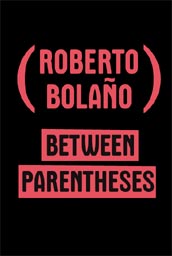
[READ: October 15, 2011] Between Parentheses

I never expected to get so addicted to Roberto Bolaño.  And despite his death, there is no shortage of works coming out in English (that is one of the advantages to reading a translated author–even death doesn’t cease the available materials).  Indeed, this year alone, New Directions is publishing Between Parentheses, and Tres and FSG is publishing The Third Reich (a collection of non fiction, a collection of poetry and a novel respectively).

When I really get into an author, I fall for his or her works, not necessarily him or her as a person (heck, some author are downright jerks).  But there are some authors that I want to know about, personally.  Bolaño is a pretty polarizing figure–he seems obnoxious, his works don’t shy away from very specific opinions, and sometimes it’s unclear what kind of views Bolaño himself has in his works (or if he’s even telling the truth about his so-called truths).  One thing in particular is the constant use of the word “faggot.”  It is used often in 2666 (and I know that is a translator’s choice, but still) and used derogatorily.  Now, clearly the context is everything for something like that.  But it seems to speak badly of Bolaño.  And yet, when reading these essays he is not homophobic in the least.  He is obviously well aware of institutionalized homophobia in Latin America, and he is obviously not supportive of it.

But that’s just one interesting thing about this book.  So let me back up. (more…)

Read Full Post »

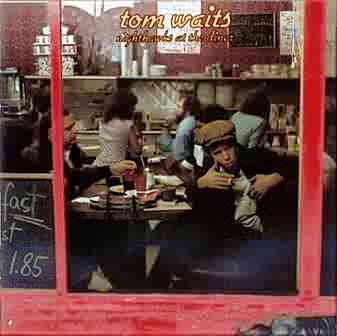
SOUNDTRACK: TOM WAITS-Nighthawks at the Diner (1975).

This is Waits’ third album, a live recording (!) which was actually recorded live in the studio. But not the way most bands record live in the studio. The producers brought in tables and chairs and created a bar-like atmosphere into the (evidently rather large) studio.  Then they invited fans in to watch the performance. Wild, man.

Just as wild is the bebopping and scatting that Waits does here. The opening “Emotional Weather Report” is all kinds of comical phrasing and silliness about himself.  It’s funny and quite enjoyable.  And it makes it feel like a nightclub.  He also introduces mos of his sings with a story, and for most of the songs, the introductions are almost longer than the song.  The two-minute intro to “On a Foggy Night” is full of Tom’s storytelling–but in a much more improv jazzy style.  Indeed, it’s not entirely clear when the intro ends and the song begins.

The intro to “Eggs and Sausage” has the very funny conceit that the food he has eaten in some greasy spoon is pretty frightening.  The veal came down to beat the shit out of his coffee, but the coffee wasnt strong enough to defend itself.  Nice.  “Better Off Without a Wife” he talks about having an evening just to yourself, you know, for pleasure.  We all do it, he says, but I’m not weird about it; I don’t tie myself up or anything.

Overall, this is a fun album.  It’s loose, the crowd is at ease and so is Tom.  It’s long album–about 70 minutes, which might be a little too long, but you get the whole vibe of a night out–good stories and good music.

[READ: September 21, 2011] “Starlight”

This story is four short pieces.  The titles should tell you everything you need to know about the content: “Mrs. Nixon Joins the Final Official Photograph,” “Mrs. Nixon reacts to RN: The memoirs of Richard Nixon,” “Brownie,” and “Mrs. Nixon’s Thoughts, Late-Night Walk, San Clemente”

So, clearly these are four short pieces that delve into the mind of Richard Nixon’s wife, Pat.  I don’t know a lot about her or about Nixon himself, really (I know all the highlights or low lights but I haven’t really ever looked into the man aside from what the sitcoms say about him).

So when I was reading the first excerpt I just couldn’t get into it.  I didn’t know who the people were for sure.  I assumed Ollie was Ollie North, but who knows.  I almost didn’t read any more, I was so uninspired by the first one.  But the next day I decided to try again.  (more…)

Read Full Post »

SOUNDTRACK: PEPPER RABBIT-“Alison” (2011).

Pepper Rabbit had NPR’s Song of the Day on September 19th.  “Alison” opens with a kind of circus organ pumping out a steady, thumping beat.  The beat continues until the quieter stated chorus: “You will know my name.”  The song is, as circuses are, light and bouncy with an air of the sinister floating all around it.  By the second chorus, we learn that “it’s all a game to get you to learn my name.”

The vocals are done in a kind of 70’s piano pop style–a bit high-pitched, a bit echoey– and they help to obscure exactly what’s going on.  But it’s the music that is so charming. 

Even if it’s unclear to me what the intention of the song is (stalker or just lost love) it’s a poppy ditty that will keep your toe tapping.  I’m looking forward to hearing more from them. 

[READ: September 14, 2011] Into the Gauntlet

And so the series ends. 

Or, actually, it doesn’t.  This isn’t really a spoiler because there are more books out in the series.  And I’m not going to say what happens at the end of this book, but for those of you wondering just what the heck is going on here with a Book Eleven coming out eight months after Book Ten, I’ll summarize (with no spoilers).  Book Ten ends the hunt for the clues–the goal is reached.  But at the end of the book, it is revealed that there’s another group, another family, who is also hunting for the Answer.  They hadn’t been hunting alongside the Cahill families, they were apparently watching alongside them waiting to see what would happen before setting their plan into action.  And thus….  Series Two.  

Book 11 is a kind of transitional book that fills in some back story on each of the families and shows Grace’s life.  I’m intrigued to read it, especially since most of the writers from the series contribute to it.

So Book Ten was written by the excellent author Margaret Peterson Haddix.  And this book comes in at 326 pages (over 100 pages longer than any other book in the series).  But Haddix earns her extra pages.  She totally breaks with the set-up of the series so far by following not just Dan and Amy but all of the branches of the family.  We actually get into the heads of all of the competitors (including Eisenhower Holt–who has feelings after all, Natalie Kabra–who is not quite as dim as she appears, and Ian Kabra–who might just be as evil as his mom).  Haddix also introduces a huge surprise in the beginning of the book–a surprise that may not have been such a surprise if I’d been reading the books close together but with this much remove from the early books, I was shocked!  And later on, when she doubles up on the surprise, it’s even more shocking! (more…)

Read Full Post »

SOUNDTRACK: DINOSAUR JR.-Live at the 9:30 Club, Washington D.C. October 8, 2009 (2009).

This was one of the first shows I downloaded from NPR.  I’ve been a fan of Dinosaur Jr. since my friend Al turned me on to Green Mind back in college.

This is an amazing show created by the original Dino Jr. members.  This tour is in support of their second album since reuniting, Farm. This set-list is an outstanding mix of old songs, new songs, Barlow-sung songs and even some songs from when Barlow and Murph weren’t in the band.  (Green Mind is still my favorite album by them).

When the band reunited there was much joy, and I’ve said in reviews of the newer albums, I’m not entirely sure why.  I mean, Dino Jr has always been about Mascis, and it’s not like Barlow is such an unusual bassist (although Murph’s drumming is always solid).  I’ve nothing against Barlow (I love Sebadoh and Folk Implosion) or Murph, it just seems odd to get excited about having them back in the band aside from nostalgic reasons.

Having said that, the band sounds amazing (and yes, Barlow does get to sing on “Imagination Blind”).  What never really came across to me until hearing all of these great songs live was that Mascis has always been a great pop song writer.  These songs are catchy as hell. But Mascis buries them under loud squalling guitars and a voice that is almost whiny, almost off-key, a total slacker voice.  (But you’ll notice it is never actually off-key.  He must work very hard at that.)

By the nd of the show Mascis chastises the audience for not moving (we obviously can’t see what they’re doing), saying he forgets that people don’t move in Washington, D.C.  But during the encore break, NPR host, Bob Boilen, points out that Mascis himself doesn’t move either–he just stands in front of that wall of Marshall stacks (Boilen wonders how he can hear anything anymore).  And looking at the pictures it’s comical the way he looks, surrounded by amps.  The picture above doesn’t fully do it justice, but check out the extra photos at the NPR page.  And while you’re there, listen to this show. It is amazing.  For a total slacker, Mascis can rock a guitar solo like nobody’s business.

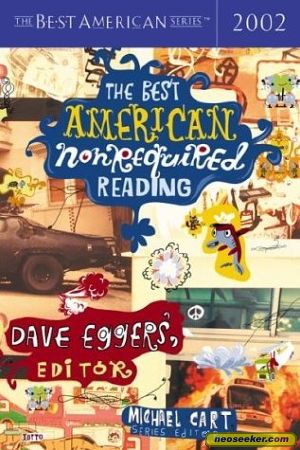
[READ: July 20, 2011] The Best American Non Required Reading

I’d been meaning to read this series for years (yup, Eggers fan), But I have a hard time starting “collections” because I feel like I’d rather be reading a novel.  Nevertheless, I have most of these Nonrequired books, so it seemed like I should dive into one and see what it was like (I don’t think the year really matters all that much–some of the articles are topical but most are not exactly).  Then Sarah said this would be a great book to read on vacation because it’s all short essays, and she was right.  It was perfect for late nights when I wanted something to read but didn’t feel like getting involved in the novel I was reading.

DAVE EGGERS-Introduction
Eggers’ introduction is actually a partial short story about kids who go swimming in pools around town. It reminded me of the opening of Life After God by Douglas Coupland, but of course, lots of kids did that so I’m not saying it was “lifted” from DC.  The story “ends” (it doesn’t really end so much as stop) with an interesting scene between two unlikely kids who get caught.

After this story Eggers includes these three notes about the collection: It’s not scientific, It’s alphabetical, and We had a lot of help with this.  Of the three, it’s the middle one that’s most useful because Eggers says that you shouldn’t necessarily read them in order just because they are printed this way: “In the first half of this collection, you get a good deal of hard journalism, primarily about war and refugees, from Afghanistan to the Sudan, followed immediately by a number of less serious pieces, about malls and Marilyn Manson.  We didn’t group anything by theme , and won’t be offended if you skip around.”  This was good to know (not that we needed the permission of course), but yes, the beginning of the book is pretty heavy. (more…)

Read Full Post »

SOUNDTRACK: JUNE TABOR & OYSTERBAND-“Bonnie Bunch of Roses” (2011).

Two artists that I have heard of for years but who I have never really listened to. This was described in the NPR music review as something The Decemberists might sing.  And indeed, it has a very Decemberists feel to it (which makes sense as this is a traditional song and, evidently, Tabor has been a master of this style for years.  ( I had no idea her voice was so deep–it adds a nice level of malice to this song about Napoleon.

The band is tight as they play this rollicking, dark shanty and Tabor’s voice is haunting (do I detect a similar style to Linda Thompson?) as she sings these lyrics of loss.  The music builds and builds as the song reaches its climax, but what’s neat is that Tabor never really changes her tone.  She is matter of fact, despite how sinister the music becomes.  It’s a very cool song.

I did some research and found out that tabor and the Oysterband got together in 1990 for the album Freedom and Rain, which was a collection of traditional songs as well as covers of Richard Thompson, The Velvet Underground, The Pogues, and Jefferson Airplane (I can’t believe that album is pretty well out of print–it sounds amazing).  This collaboration is more or less a follow-up, with more traditional songs and covers of PJ Harvey, Joy Division and others.

I’m really looking forward to listening to this disc and to what will certainly be the triumphant re-release of their first disc collaboration quite soon.

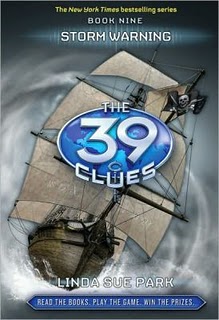
[READ: September 14, 2011] Storm Warning

Book Nine in the 39 Clues series made me feel like a kid again.  I started reading it when I got home from work and I stayed up till way late in the night to finish it.  Unlike when I was a kid, though, I am really suffering for staying up so late last night.

Storm Warning was written by Linda Sue Park, the first woman to write in the series.  And, appropriately, this is a very female-centered book.  We learn a lot about Nellie (finally, her story is explained!), the story focuses somewhat more on Amy than on Dan, there’s more evilness from Isabel Kabra, but most importantly, the clues lead them to two important women in history. 

They head down to the Caribbean–although they are undecided about whether to go to the Bahamas or Jamaica (Dan wants to go to the Bahamas to go to the greatest water park in the world: Oceanus–which is really the Atlantis Water Park) but Amy believes the answer is in Jamaica.  Dan convinces her and they decide to go to the Bahamas and the water park for a few hours of fun.  But the crazy thing is that before they even bought their tickets to the Bahamas, Nellie went into the bathroom and Dan received a message that the Holts were on their way to the Bahamas too.  Could Nellie be ratting them out?

On the flight down, they grill her about what’s going on.  But what happens is that for the first time in the series, we get into Nellie’s head.  Not completely, but we get to hear her thoughts.  So we know that she’s still hiding some truths, but she reveals that she has been working for Mr McIntyre and reporting to him about all of the family’s moves.  She was well paid for her services and she knew that there would be danger, but she had no idea exactly what the kids would be getting up to.  Dan and Amy are stunned.  They are betrayed and furious.  [I have to say I think they totally overreacted–Nellie saved their asses many many times along the way].  They agree to let Nellie come along with them but they’re not going to share any plans with her. (more…)

Read Full Post »

SOUNDTRACK: REAL ESTATE-“Beach Comber” (2009).

I found this song through a fascinating series of clicks.  Yesterday’s song from Real Estate was a pick for Fall.  And next to it was a link entitled Ridgewood, N.J., Why Here? Why Now? I grew up right next to Ridgewood and I spent a lot of time there as a kid.  So it’s pretty exciting to hear that there’s a mini-music scene happening there.  With Senses Fail, Vivian Girls, and Real Estate coming from Ridgewood and Titus Andronicus coming from Glen Rock, Bergen County is totally hip (even my hometown of Hawthorne seems to be considerably cooler than it was when I left ten years ago–there’s a coffee shop!).

Back back to the song.  I don’t enjoy this track quite as much as yesterday’s song from their new album.  It’s missing a little of the fuzz that I really enjoyed from “It’s Real” (I find the picked guitar a wee bit too clean for my tastes).  Indeed, for me, “It’s Real” is a small change but a giant leap sonically.  Neverthleess, the verses and chorus are really quite pretty.  And yes, the song does feel very summery and beachy.

Because they’re from my neck of the woods, I’m giving them the very curious distinction of having their song paired up with a letter from Issac Newton.  Imagine the search results that will bring people here.  Imagine, crazier still, that an image search for this Letter from Newton could produce their album cover.  Woah.

[READ: September 15, 2011 (three hundred and thirty-nine years after publication!)] Letter to the Publisher

What better way to start off a Sunday than with a letter from Issac Newton?  Yes, this is really an article from Issac Newton.  And it’s available pretty freely just by searching for the title words, although JSTOR has a nice searchable version of it available.  (This is the final JSTOR article for a while, after this it’s back to the 21st century).

What I especially loved about this letter was that the “long s” is used throughout the letter (like the word Congrefs in the bill of rights–see right).  It makes it a challenge to read, but that is by no means the only challenge.  According to the introduction, this letter contains “some more suggestions about his New Telescope, and a Table of Apertures and Charges for the several Lengths of that Instrument.”

And if you think that the wording of that is ungainly, try reading the letter itself.  (more…)

Read Full Post »

SOUNDTRACKLOS CAMPESINOS!-“By Your Hand” (2011).

I’ve enjoyed Los Campesinos!’s records in the past and I’m pretty excited about the prospect of a new release.  This song doesn’t deviate too far from their previous releases although to my ear it sounds a bit more musical (more instruments, more vocals) and less abrasive.  The basic elements are still there:great lyrics delivered in a more or less spoken way, followed on its heels by big shouty sections (and the whole band seems to be shouting along on this one).

This song also feels a little warmer, although the lyrics “by your hand is the only end I’ve foreseen” is either really dark or really naughty depending on how well it correlates to the verses.  Regardless, the chorus is catchy and fun to sing and the lyrics are wonderfully twisted.  Los Campesinos! have done it again.

And here’s the video.

[READ: September 16, 2011] “Jean-Baptiste Labat and the Buccaneer Barbecue in Seventeenth-Century Martinique”

I was interested in this article because it talked about the boucan and the buccaneer, and both of these things were mentioned in Book 9 of The 39 Clues.  It was a weird sort of coincidence that the boucan which I had never heard of before should appear in two things that I read about week apart (and then this weekend the Pa Renaissance Faire was pyrate themed!).   I was also interested because of the way this article was presented in the email to us: “if you have ever wondered on what foods a seventeenth-century missionary from the island of Martinique dined, check out this article from Gastronomica. (Hint: They include manatee, lizard, and parakeet)” made it a must-read.

While the article does, indeed make mention of these foodstuffs, it is by no means the extent of the article.  Rather, Toczyski looks at what Labat, a French priest and a missionary, wrote in his extensive chronicle about his stay in the Caribbean.  In particular, she focuses on the amazing breadth and depth of his gastronomical accounts (which includes details about all the meals they ate en route (the ship was amazingly well stocked–they even had a garden on board, which was under guard day and night (!); and then on the island he also talks in loving detail (with recipes) of all of the native dishes that he would eventually consume (including turtles, frogs and the palm worm (see picture at right (the picture and an awesome description of eating the palm worm is here at Boots in the Oven, at the bottom of the page).

(more…)

Read Full Post »

« Newer Posts - Older Posts »