Feeds:
Posts
Comments

Archive for the ‘Free Speech’ Category

americusSOUNDTRACK: FLY PAN AM-Sédatif en fréquences et sillons EP [CST011] (2000).

330px-SedatifsEnFrequencesCover This is an EP that works as a kind of remixes and deconstructs further the debut. There are three songs, the first is fourteen minutes, the second is 11 and the final is 4.  As the Constellation site describes the disc:

This 3-song EP of fractured, tape-infested experiments is an intransigent slab of self-referential auto-criticism. The band was sticking to its agenda of acutely self-conscious musical manipulations, re-working its own materials and assumptions to yield new compositions of uncompromising formalism. Side A is a medley of sorts, consisting of phrases and fragments reconfigured and replayed from their self-titled debut (Fly Pan Am). Various melodies are reassembled and played off of one another, creating an extended live remix with blissful passages of layered guitars, drones, sampled backing vocal lines, and the requisite incidental noise break in the middle of the piece. The result is something like a ‘Stars On 45’-style musical encapsulation of the entire debut record.

“De cercle en cercle, ressasser et se perdre dans l’illusion née de la production de distractions et multiplier la statique environnante!” (“From Circle to Circle, Rehash and Get Lost in the Illusion Born of Production and Increase the Static Distractions Surrounding!”) opens with the sounds of machinery rumbling and then slowing to a stop. The song proper opens with a rapid bass line and squalls of feedback.   Some beautiful guitars play over the noise. More guitars come in along with all kinds of crazy noises—scrapes and scratches, radios and distortion.

The propulsive music stops around 3 and half minutes in and the noise takes over. There’s loud noises and static and all kinds of things. Then the noise shifts to what sounds like someone emptying a bag of ball bearings onto a metal table.  And then maybe making microwave popcorn.  About five minutes later (seriously) a drum starts playing in the background and then a guitar line that references the debut album starts up.  It sounds a bit like the two note guitar from “Dans ses cheveux soixante circuits” with the voices from “Nice est en feu!” thrown on top.  And then at 11:20 that two note half-tone thing from “Dans ses cheveux soixante circuits” resumes, but it’s only for 20 or so seconds before different sounds come to take away the repetitiveness (although the guitars do continue that until the end of the song).  It seems like the band wanted to revisit their debut but also wanted to make sure that it was properly buried under chaos as well.

The second song “Éfférant/Afférant” (“Unrelated / Related”) (11 minutes long) is described as “somnambulist clockwork repetition.” The bass and drums are kinda funky with some simple guitar chords playing in the background. While things do change somewhat throughout song (including notes that seem inappropriate at times), the main source of change is the weird electronic sounds that play over the top. The noise starts to grow louder and louder around 9 minutes and just when it gets unbearable it fades out to the end of the song.

“Micro Sillons” (“LPs”) is only 4 minutes long and it opens with static and noises—different ones in each ear.  After about three minutes of that, the noise mutates into a kind of machine-like hum.

This is definitely a challenging listen.  There are rewards to be had, and it s amazing what good songwriters these guys are, if they’d ever let their songs stay unmolested.

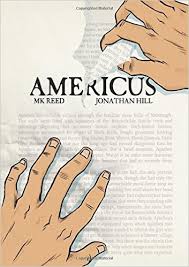
[READ: December 17, 2015] Americus

I didn’t really have any idea what this book was about–the title Americus evokes many different things.

So imagine my surprise to find out that this First Second graphic novel [go First Second!, #10yearof01] tackles the idea of banning books in schools.  It looks at religion, freedom of speech and middle school.

The story is about Neil Barton, an unpopular kid who loves fantasy and books, especially the Apathea Ravenchilde series (such a great name). Neil and his friend Danny race to library after school because the latest volume is out.  Neil is bummed that his library could only afford one copy of the book (budget cuts!) and Danny gets it first.  And as he starts reading, the artistic style switches to the Ravenchilde world (I loved that).

Then we meet Neil’s and Danny’s families.  Neil’s parents are divorced.  He lives with his mom who is harried and exhausted.  Danny’s family is an intact nuclear family, with two younger siblings.  And we learn soon enough that his mother (and father to a degree) are very Christian. (more…)

Read Full Post »

academiaSOUNDTRACK: MARTIN TIELLI-“We didn’t even suspect that he was the poppy salesman.” (2001).

popptI wrote about this album once before, and while I made notes about it after listening to it again, I found out that they were pretty much exactly what I thought of the record four years ago.  So I’m going to simply repost the review here, but I’m going to add some new notes seamlessly intermingled.

Martin Tielli’s first solo disc is a proper solo release: it’s almost all him on acoustic guitar and his gorgeous alto voice.  I hadn’t listened to this disc in a while and I was delighted by how much of the disc I knew so well.

The opening track, “I’ll Never Tear Your Apart” is deceptively simple: beautiful harmonic’d guitars and his gentle voice.  There’s a great video to go with it here.  That is followed by the wonderful “My Sweet Relief” which sounds like a great Neil Young folk song: great verses an a strong chorus.  Lyrically, though, it is all Tielli.  “Double X” highlights Tielli’s beautiful acoustic guitar work.  It’s another great story song, this one about a destitute person hanging under a superstore with a K and an M.

“Voices in the Wilderness” is a simply beautiful song, a lovely guitar melody and Tielli’s high voice singing along.. I also love that the lyric  (mis)quotes Rush very nicely: “‘If you choose not to be free you still have made a choice,’ said a high and squeaky voice.”

“Farmer in the City” is the only track that Tielli didn’t write.  It’s a nearly 8-minute song by Scott Walker.  I had never listened to the original, but having now done so, I find the Walker version to be far superior.  Walker’s voice is so eccentric and wonderful.  So even though I love Martin’s voice, he just can’t compare to the original.   Also find Martin’s version to be just a little spare (the Walker version has lovely strings. Kevin Hearn plays celeste and Selina Martin plays wine glasses on the track.

It’s followed by the delightful “World in a Wall” which uses mice in the wall as a metaphor for a broken relationship (with wonderful detailed lines like: She’s like a mouse, I know she’s around It’s a gnawing sound. Leaves little brown poohs from a little pink bum.”

This is followed by “That’s How They Do It in Warsaw” which is the first really rocking song (it has bass and drums) and a voiceover in Polish by Kasia Zaton.

It’s coupled with a slightly less rocky but still loud track “How Can You Sleep?” (which makes another fun musical allusion, this time about Guided by Voices). It has a co-songwriting credit from Dave Bidini and has a kind of vocal allusion to Bob Dylan, although I doubt it is about him.

“She Said ‘We’re On Our Way Down’” is a song that I really want to enjoy more.  But It is so spare and Martin’s vocal line is so abstract, that I can never really get int it. But the guitar riff is really powerful and cool.  And yet, the song seems to eschew melody but then a gorgeous guitar or vocal line shines through and really sounds brilliant.  “From the Reel” is a beautiful, aching acoustic ballad.

The disc ends with the odd, seven minute “Wetbrain/Your War.”  The first part (wet brain) is kind of slow but it builds into a beautiful dark song about addiction.

This is a really beautiful album, although there are moments when I fell like Martin gets too delicate, it’s amazing to hear just what he can do when he’s on his own.

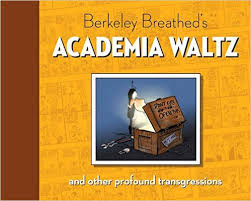
[READ: October 19, 2015] Academia Waltz

Way back a long time ago I was pretty excited to read all of the Bloom County reissue books.  Somehow I only got through Books 1 and 2, although I see now that five volumes were released in total.

Presumably at the end of that run, (which technically ended in 2011) comes this volume.  Academia Waltz is the strip that Breathed wrote back in college.  This book collects some (but apparently not all) of the strips.  It’s odd to not collect them all since there is also an art gallery with all kinds of original pieces (complete with edits and scribbled notes) that duplicate many of the earlier strips.

The first part collects pieces from Academia Waltz the 1979 collection.  The second part comes from Bowing Out, the 1980 Collection. (more…)

Read Full Post »

vonlastintSOUNDTRACKSURFER BLOOD-“Demon Dance” (Live at SXSW, March 27, 2013).

surfer blood

I’ve liked Surfer Blood since I first heard them.  They write catchy, mostly short, poppy songs.  And usually after a few listens, the hooks really grab you.  The strange thing about the band is that the hooks aren’t always readily apparent, which makes their songs sound kind of samey sometimes.

Of course, samey isn’t a bad thing, necessarily.  Surfer Blood is quite distinctive and I tend to enjoy everything they do.  This new song sounds like their other stuff, which is fine.  But the most distinctive thing about the band of probably their singer who sounds like a less-affected Morrissey.

Having also listened to the song from the album I can say that the singer is far harder to understand live, so maybe live is not the best way to hear a new song from them, but for an old favorite, Surfer Blood has a great energy live.

Watch the show here and hear the studio version here.

[READ: March 27, 2013] The Last Interview and Other Conversations

Melville House has published a number of these “Last Interview” books, and as a completist I feel compelled to read them.  I have read criticisms of the series primarily because what the books are are collections of interviews including the last interview that the writer gave.  They don’t have anything new or proprietary.  The last interview just happens to be the last one he gave.   So it seems a little disingenuous, but is not technically wrong.

There’s so far five books in the series, and I figured I’d read at least three (Vonnegut, David Foster Wallace and Roberto Bolaño–the other two turned out to be Jorge Luis Borges–who I would be interested in reading about and Jacques Derrida (!) who I have always loved–I guess this series was tailor made for me).

At any rate, these interviews are from various times and locations in Vonnegut’s career.  There are six in total.  I don’t know if the titles they give here were the titles in the original publications but here’s what’s inside:

  • “Kurt Vonnegut: The Art of Fiction” from The Paris Review, Spring 1977 (by David Hayman, David Michaelis, George Plimpton, Richard Rhodes)
  • “There Must be More to Love Than Death” from The Nation, August 1980 (by Robert K. Musil)
  • “The Joe & Kurt Show” from Playboy, May 1982 (by Joseph Heller and Carole Mallory)
  • “The Melancholia of Everything Completed” from Stop Smiling, August 2006 (by J.C. Gabel)
  • “God Bless You, Mr. Vonnegut” from U.S. Airways Magazine (!!!), June 2007 (by J. Rentilly)
  • “The Last Interview” from In These Times May 9, 2007 (by Heather Augustyn) (more…)

Read Full Post »

stringer SOUNDTRACK: HAIM-“Falling” (Live at SXSW, March 17, 2013).

haim

Haim are three sisters and a drummer.  The sisters play guitar and sing, play bass and percussion and play keyboards.  And yes, they look a lot alike (an a lot like Alanis Morrissette).  But they sound very classic rock–kind of like Heart, with a more modern, noisy twist.

I didn’t really care much for the sound of this song–it seems kind of anemic to me.  The sisters are all quite talented and when the lead singer/guitarist started wailing they were really good.  But the overall feel of the song seemed more high school than rock show–like they couldn’t get the mix right, like the keyboards (which were little bopping notes, rather than waves of music) were the main force behind the song–which I don’t think is true.

Maybe they’d sound better on record, or if they had a better mix on stage.

[READ: March 26, 2013] Like Shaking Hands with God

I had been reading a lot of Vonnegut, but I got a little burnt out by him.  However, when I was checking his bibliography all those months ago, I found that Princeton University had a book that I couldn’t find anywhere else.  Well, given my new employment situation, it was time to take advantage of that connection.  So I went to the Firestone library and grabbed this book (and a few others that I didn’t see elsewhere).

It’s a lot of fuss over an 80 page book, but I’m glad I read it and it did get me back in the mood to read more Vonnegut (I have five books of his left to read, although I believe more posthumous stuff seems to come out all the time).

This book is essentially a transcription of two conversations that Vonnegut had (one public and one private) with the author Lee Stringer and the moderator Ross Klavan.  The first conversation occurred on October 1, 1998 at a bookstore in Manhattan.  The second was a private affair in January 1999  (which was of course, recorded), in which they followed up on some of the same ideas.

Stringer had written one book (Grand Central Winter) when the first conversation took place (he has written two more since).  Stringer says he always admired Vonnegut and Vonnegut talks about how much he liked Grand Central Winter (which Vonnegut wrote a forward to).  GCW is nothing like Vonnegut’s books, it is a serious book about being homeless (Stringer himself was homeless for a long time) and it is real and gritty.  It sounds good, although maybe a little too gritty and real for me. (more…)

Read Full Post »

SOUNDTRACK: PHISH-Live Bait Vol 3 (2010).

This selection of free Phish songs is notable because of a couple of items.

  1. All of the songs were recorded at the Worcester Centrum in Worcester, MA.  Although the first three songs were recorded in 1993, the fourth song was recorded in 1997 and the final track was recorded in 1991.
  2. The first three songs were recorded on New Year’s Eve–technically on New Year’s Day.  The first track actually counts down the seconds until midnight, when the band bursts into Auld Lang Syne
  3. Probably the biggest deal of all: the band plays a version of “Runaway Jim” that lasts 58 minutes and 48 seconds.  That’s right, nearly an hour on one song.  I think if I went to see them live and they did that I’d be pissed, but it sounds great on this recording.  “Runaway Jim” is not one of my favorite songs, but this extended jam is really good–they break into several different sections and it doesn’t feel like a long version of this song so much as a bunch of different jams thrown together.  At one point it almost seems like the band thought they began with “Weekapaug Groove,” but they push back against that.  I’m very curious to know what happened after that song was over, but the end of the disc takes on an early recording of “Llama, ” a song I like quite a lot.

This is yet another great addition to the free Live Phish pantheon of music–I mean, an hour version of one song, how cool!

[READ: August 1, 2012] “Volumes of Knowledge”

Encyclopedias date back thousands of years–Pliny the elder tried to write everything he knew in Historia Naturalis and a Chinese emperor created a similar book Emperor’s Mirror in 220 A.D.  But the art and craft of creating books that contain all the world’s knowledge flourished in the 1700s.  Increased wealth and education in the French bourgeois, a flood of information and a decline of interest in religion all led to the desire to learn more.  The printing press helped to disseminate the information.

It was Denis Diderot, a French enlightenment polymath who best explained the concept of the encyclopedia:

the purpose of an encyclopedia is to collect knowledge disseminated around the globe; to set forth its general system to the men with whom we live, and transmit it to those who will come after us, so that the work of preceding centuries will not become useless to the centuries to come; and so that our offspring, becoming better instructed, will at the same time become more virtuous and happy, and that we should not die without having rendered a service to the human race in the future years to come.

But Diderot recognized the limits of a one-author encyclopedia: “I do not believe it is given to a single man to known all that can be known.”   From 1751 to 1772 he and his assistants edited more than 70,000 articles from 140 authors to create his first Encyclopedie.  Of course having many authors had drawbacks–differences in style, length and quality.  But Diderot shied away from nothing and in many locations the book was banned.  Some of the ideas in the book shook the very foundation of accepted ideas.  And many of the authors hoped to change the world.  Diderot himself even hoped to usurp religion with his knowledge: “It is not enough for us to know more than Christians, we must show them we are better.” (more…)

Read Full Post »

SOUNDTRACK: JAPANDROIDS-“Fire’s Highway” (2012).

I regret dismissing the suggestions of the NPR folks the other day.  As the more I dig into their suggestions, the more I like–seems their selections are better than their descriptions of said selections.  Take this description of the Japandoids’ album: “snarling punk meets the fist-in-the-air anthemics of Born to Run-era Springsteen and his modern-day equivalents in The Gaslight Anthem.”  I’ve never really liked Springsteen (I know, a Jersey boy, too).  I think it’s more about production (and saxophone) than anything else.  So, comparing bands to him is never a sell for me (even if it may be true).  To me, this sounds much more like a low-key Arcade Fire (with literally no pretensions to anything–I mean, there’s only 2 Japandroids).  Granted, Arcade Fire owe a lot to Springsteen too, but they do something different with his sound, which is why I like them.  [I’m not going to be able to argue my way out of this].

Anyhow, this song is a four minutes of punky guitars and a stupidly catchy chorus.  The fact that it’s only two guys makes it all the more remarkable that it sounds like a full band.  And perhaps, the biggest difference for me is the singer’s voice which feels very early 90s alt rock/punk.  Whatever it is, I’m a fan and will certainly be listening to more of this album.

[READ: June 14, 2012] “The Clockwork Condition”

Like most young men of a certain bent, I loved A Clockwork Orange.  I’ve watched it dozens of times and I’ve read the book.  What I especially like about the story is that my feelings about it change as I get older—which, while not the point exactly, is certainly a theme in the story–how age makes things seem different.  The most important thing I learned from this article is that there was an epilogue in the British version of the book that was not available in the American version (or the film).  And it seems to be pretty important.  What a strange thing to leave out.

Incidentally, Burgess wrote the book in 1962 and the film came out in 1973, which is why he was wrote this in 1973.  He says he was asked about Issues that arose from the film.  And he talks a lot about them.

But he also gives a lot of background.  The title of the book comes from the expression “as queer as a clockwork orange” which is Cockney slang for something so weird it subverts nature.  It was a perfect title for an idea he was going to write about—how people suggested using aversion therapy to change juvenile delinquent behavior.

So this article goes on for a pretty long time, raising all kinds of questions.  It’s really articulate and fascinating and really makes me want to re-read the anti-authoritarian novels I read in high school: 1984, It Can’t Happen Here, Brave New World.   He even talks about B.F. Skinner, who proposed that aversion therapy (which is what Alex gets in the book/movie) was wrong and that positive reinforcement was always more effective.  Skinner worked with animals (Burgess jokes about that) and the whole “you get more flies with honey” attitude works better for training animals he says.  The same is true for people.  Besides, aversion therapy removes freewill. (more…)

Read Full Post »

SOUNDTRACK: WILD FLAG-Live at the Black Cat, October 20, 2011 (2011).

It’s interesting to compare this show by Wild Flag with their SXSW show.  This set is longer, but they retain the same raw energy and intensity.  It also sounds as though the tour has been rough on Carrie’s voice, which sounds a bit strained and hoarse (even when she talks!).

They play most of their debut album, but they also throw in a couple of new songs and even a few covers.  Perhaps the most fascinating part is the 15 minute (!) version of “Racehorse.”  There’s a lengthy noodling section as well as a cool part where Carrie goes a little crazy asking about money.

Janet Weiss is absolutely amazing here too.  And the keyboards, definitely complement everything well, but they are always the most notable flubs, and there’s the same one as in the SXSW show (not as bad, but noticeable).

Without a doubt the most interesting thing is the hearing that Mary Timony gives guitar lessons in Washington DC.  She lives there and evidently earns extra cash by doing guitar lessons.  Wow.  How cool would that be?

Check out the show here.

[READ: January 15, 2012] The Influencing Machine

Brooke Gladstone is one of two reporters who works on NPR’s On the MediaOn the Media is an awesome show which dissects things that happen in the world and examines the way the media portrays the events.  They work pretty hard to see who is reporting bias, who is exposing bias and how things are getting out to the average media consumer.  It’s worth anyone’s time to read (it doesn’t take very long).  And it’s also fun and enjoyable.  As anyone who has heard the ending of On the Media: “and edited [dramatic pause] by Brooke” knows, there’s always a smirking grin attached to the program.

When I heard that this book came out I was pretty excited to read it.  And then I promptly forgot all about it.  Lucky for me, my wife can take a hint, and she got it for me for Christmas.

The first surprise of the book is that it is written as a graphic novel–illustrations by Josh Neufeld (who has drawn for Harvey Pekar’s American Splendor).  The funny thing about the illustrations is that I have no idea what Brooke Gladstone looks like (which I rather prefer about my NPR announcers), but I really like the cartoony style of her avatar (which reminds me of Elaine from Seinfeld and which inspired me to draw a kind of similar version on my drawing site.

On to the book.

This book works as a primer for understanding media ownership, media consolidation and media power.  The opening few chapters are going to be nothing new for anyone who has read Chomsky or Vidal on the media.  But since most people haven’t, it’s a wonderful way into some of these thorny issues of who tells us what and why. (more…)

Read Full Post »

I have been getting The Washington Spectator for years and years.  I was delighted with it in the beginning when the editor had the wonderful name of Ben Franklin.  I am delighted now that publisher’s name is Hamilton Fish.  But aside from these two fascinating details, I have always enjoyed the content.  It was thoroughly researched and detailed.  And the little 4 page leaflet always looked like a newspaper in design and style, and it gave it a kind of gravitas–no flashy colors or pictures.

Well, here it is, Vol 37, Issue No 21 and they have finally changed the format.  And not only that, they have created a website and have a Facebook presence!  Welcome to the 20th century!

I say that jokingly because despite these changes (which look great by the way), The Spectator has not abandoned its old school journalism practice.  21st century news is pretty much all flash and brash–style over substance–quick reporting with no concern for accuracy and very little attention brought to retractions (can anyone say “climategate” (I wish they wouldn’t call it that)).  But The Spectator is exactly the opposite, and I am delighted to say that although they are now a lot more accessible, they have not lost any of their tenacity or thoroughness.

The redesign is quite nice.  There’s an image on the front page and now there are pull quotes in red, which stand out nicely on the pale paper.  Although I always liked the pull quote box in the middle off the front page, this new format allows for a couple of different pull quotes as well as an opportunity to mix things up a bit.  (more…)

Read Full Post »

SOUNDTRACK: MC PAUL BARMAN-It’s Very Stimulating (EP) (2001).

So is this guy a joke? Well, he’s very funny.  Very funny, in fact.  But to my ear, not in a novelty sort of way.  He’s got the kind of rhymes that make you laugh but still work upon multiple hearings.  And, yes, Paul Barman is a squeaky, Jewish boy from Ridgewood, New Jersey (again!) and he really can’t rap on the beat and he really doesn’t have much in the way of rhythm, but got awesome skills in the lyrics department and he has production from Prince Paul (that’s the kind of credentials that anyone would like).

The theme of this EP is Paul’s utter failure to get with women (even in his fantasies).  He’s crass and vulgar and yet he’s also quite smart and rather witty (“I think about all the pube I got while reading the Rubaiyat“) .  The music is more or less inconsequential.  As Prince Paul noted, the craziness comes from the lyrics, so you don’t want to overkill the song.  But there’s some great samples and some solid beat work as well.  Nevertheless, we’re here for the words.  So, sample a few of these rhymes:

“The Joy of Your World”

It was time to copulate but we didn’t want to populate
So my bold groin reached for my gold coin proooophylactic
I unwrapped it, you can’t know how I felt
It wasn’t a gold coin condom, it was chocolate Chanukah gelt
The white part crumbled on her tummy and the rest began to melt
Foiled again…..

“School Anthem” or “Senioritis” (this song was renamed for the reissue of the disc it seems)

Homework is tell major lies or plagiarise encyclopedias, so boring
Fresh-faced teachers want to tickle ’em
but a test-based curriculum excludes exploring

I’ll let a mystery gas out of my blistery ass
Just to disrupt the misery of history class

“Salvation Barmy”

She said, “Go get a haircut”
So I showed her my bare butt
Pulled down my Carhartts put my moon in her star-charts

“I’m Frickin’ Awesome” ( I love this especially for the Lila Acheson bit)

It’s nice to be hypnotized by a man you don’t despise yet
He had a type of flow and I can’t quite label it
All I know it made me want to take off my cableknit
Sweater, Oh he better be hetero
I hope they don’t catch us in the Lila Acheson
Wallace Wing when Paulus brings the mattress in–rudely
He backlashed my booty
like I was Susan Faludi over the Grace Rainey Rogers Room rostrum

“MTV Get Off The Air, Pt 2”  (the first two lines are fantastic, but the whole thing is genius).

Smirkin’ jocks with hackysacks
in Birkenstocks and khaki slacks
I’m the hypest lyricist
while they’re like, “What type of beer is this?”

Just wait until the full length for the utter genius that is “Cock Mobster” (how can be s o smart and so stupid at the same time?)

[READ: October 10, 2011] E Pluribus Venom

Like most people, I learned the name Shepard Fairey because of his iconic prints for Barack Obama.   In addition to supporting Obama, I really liked the design of the prints–simple, bold, an easy iconic style (which has since been lifted, morphed and used everywhere).  I know that many of Fairey’s prints actually come from other people’s original photos.  He has a print of Muhammed Ali in this book, and he clearly didn’t take the original photo (I don’t know where it came from).  But since all art is theft, I’m okay with Fairey taking someone else’s work and making something new from it.  I’ve always felt that attribution should be enough if you modify the original enough to call it different (which I feel this print does).  [The fact that he didn’t acknowledge the source does bug me, of course].  But that’s neither here nor there because this book predates all of that.

This book documents events that occurred in 2007.  The E Pluribus Venom show was based largely around two images that Fairey designed to reflect the two sides of capitalism.  The image to the right really doesn’t do any justice to the work itself, but you can kind of see that he created two-sided faux dollar bills.  The front showed all the good things that capitalism can do.  The back showed all of the evils that capitalism causes.  The images resemble dollars, but the text is straightforward in its message.  As with a lot of what Fairey does, it’s blunt and obvious but pretty cool.

As far as I’m concerned, though, this is the least interesting image in the book.  Although I love that they made dollar bill sized prints of these faux dollars and left them scattered around in cities to promote the show.  They way they were folded made them look at a glance like actual currency.  Very cool. (more…)

Read Full Post »

SOUNDTRACK: The Best of Sessions at West 54th, Volume 1 (DVD) (1997).

Back in the 1990s, PBS ran one of their TV series devoted to contemporary music, Sessions at West 54th.  It was primarily, but not exclusively adult alternative music, with a mixture of jazz and country thrown in as well.  I never watched the show when it was on, but I was intrigued by this DVD because it has a number of artists that I liked quite a bit then. I haven’t watched it in ages, and when I watched it recently I was interested to see that I liked some other artists better than the ones I bought the disc for in the first place.

There was a recent radio show on All Songs Considered called Splitsville: Breaking Up with Your Favorite Band.   This is something that I think about from time to time–bands that I loved and no longer do.  Or bands that I loved and then stopped and maybe now love again.  This show dealt with that very issue.  Most amusingly, Robin Hilton, one of the cohosts had this wonderful quote that applies to me (and this DVD) almost directly.

It’s Not You, It’s Me (Bands We Grew Apart From): “I (dug) out my old CD books and dusted them off. And this recurring theme that came back at me, just haunting, I realized it was the whole Lilith Fair crowd. It was so painful. I had Shawn Colvin, Jewel, Sarah McLachlan, Indigo Girls, Paula Cole, Beth Orton. I just listened to that music non-stop. And now, maybe I’m not the sensitive, new-age guy that I used to be.” — Robin Hilton

So, what happened, Robin? The same thing happened to me.  I still love the concept of Lilith, but I really just don’t care about the music anymore.  And much of this DVD caters to the Lilith crowd. But it doesn’t start that way.  It opens with

WYNTON MARSALIS-“Back to Basics” A fantastic jazz number.  Wynton plays some wonderful stuff (I particularly like the “laughing” horns).  It’s a really rousing opener.

SUZANNE VEGA-“Caramel”  Vega is not a Lilith Fair person to me because I learned of her long before then.  This is not my favorite song of hers

RICHARD THOMPSON-“I Feel So Good” It’s funny to me that when I bought this I didn’t know who Richard Thompson was.  It’s always great to hear him rock out like this.

SHAWN COLVIN-“Diamond in the Rough” I like Shawn Colvin, although not as much as most of the other Lilith Fairers.  This is one of her songs that I don’t know very well

ANI DIFRANCO-“32 Flavors” I loved Ani and her self publishing empire.  And her songs were good too.  I saw her in concert once or twice and she totally rocked the house.  Then sometime in the early 2000s she went in a new direction and I completely lost touch with her and pretty much stopped listening to her.  It was nice to hear this song again, although it’s a bit slower than the way I know it.

NIL LARA-“How Was I To Know”  I didn’t know who he was then, I’m still not sure who he is or if he’s still around.  This is a pretty serviceable folk rock song

RICKIE LEE JONES-“Road Kill” I did not care for this song at all.

DANIEL LANOIS-“Orange Kay” this was a wild guitar solo and effects song.  It was really quite different from anything else here.

EMMYLOU HARRIS-“Wrecking Ball” This song had cool harmonies although I’m not a fan of Emmylou in general.

BEN FOLDS FIVE-“Smoke” I love Ben Folds, and this song is wonderful (seeing him play the “strings” of the piano is very cool.  And my god he’s so YOUNG!

KEB’ MO-“Just Like You”  I like Keb’ Mo’ quite a bit and this is a good song by him.

SINÉAD O’CONNOR-“The Last Day of Our Acquaintance”  Sinéad was another of those ladies who I loved before Lilith.  I fact The Lion and The Cobra was one of my favorite albums.  Then she got super political (and put out more amazing music) and then she got really weird.  And I stopped listening.  She’s an odd duck in this show as well (this was in her speaking only in falsetto phase, which is pretty odd.  And she has a little grunted /spoken bit in the middle of the song which is pretty odd too).  But for all of that, man is this song awesome. I haven’t listened to it in a long time, and holy cow I forgot how impactful it is. And live, with the electric guitars and the backing vocalists, it is really amazing.  A definite highlight of the disc.

YO-YO MA “Libertango”  Yo-Yo Ma is pretty awesome.  I wouldn’t listen to a lot of his stuff (I like classical, but in small doses) but man, he rocks the cello.  This is a great piece.

PATTI SMITH “People Have the Power” Patti Smith is a legend.  An icon.  Her early music is amazing.  So why do I hate this song so much?  The sentiment is wonderful, but gah, what a dreadful song.

JANE SIBERRY-“Love is Everything” I really like Jane Siberry.  She’s a strange lady with a quirky but wonderful voice.  This is a beautiful song, but a little slow (I find it works well amidst her other songs, but it’s a bit stodgy on its own).

It’s a fun collection of mellow songs (what I think of as the old PBS/NPR audience, since now they have shows that are much louder).  And it’ always fun to see artists perform in an intimate venue.

[READ: April 12, 2011] “Shock Jock”

This is the first play that The Walrus has published.  It is not so much in Acts as it is in Ten Scenes.  Scenes 1-3 are printed in the magazine, while Scenes 4-10 are only available online.  (Sadly 1-3 are not included online).

This is the story of a political shock jock, a Canadian version of Rush Limbaugh (these were the days before Glenn Beck).  The opening scene shows him railing against everything and nothing.  He proves to be very popular with his fans but when they call him up to tell him that, he abuses them too (but they don’t seem to mind–or to notice).  It seems like a pretty straightforward parody of a radio blowhard.

But the next scene shows him at home, where he is not so much meek as completely incapable of making a decision.  His wife seems like something of a harpy, but it’s clear that she has put up with this ineffectual man for nine years and has just had it with his inability to even communicate.  These two scenes play off each other as somewhat obvious counterpoint and yet, they are strangely compelling enough to keep you reading.  And it’s worthwhile to do so. (more…)

Read Full Post »

« Newer Posts - Older Posts »