Feeds:
Posts
Comments

Archive for the ‘Food’ Category

[ATTENDED: August 15, 2025] Goose

It seems like Goose and Geese both came out last year.  But in fact Goose has been around since 2014 and Geese since 2016–so it’s taken both of them about ten years to get serious attention.

It’s also funny that the bands have such similar names since they are so very different.  We saw Geese open for Vampire Weekend and they were kind of jammy but were decidedly weird.

Goose on the other hand is a pretty conventional jam band.  Four members (guitar (Rick Mitarotonda), bass (Trevor Weeks), keys (Peter Anspach–since 2017), drums (Cotter Ellis-since 2024)

I haven’t been going to very many Free at Noons lately.  It is such a hassle especially for a 30 minute show.  On the other hand it’s an opportunity to see a band (sometimes a really big band) in a small, intimate setting.  Goose, for instance, has sold out Madison Square Garden and is about to play the Mann Center.  I wasn’t even sure if I really wanted to see them, and yet this seemed like the perfect opportunity.

Especially since my office was closed for air conditioning work. (more…)

Read Full Post »

[DID NOT ATTEND: July 31-August 2, 2020] Newport Folk Festival

We went to Newport Folk Festival in 2019.  We’ve had a kind of understanding that we would try to go again.  So this year, when tickets were announced I jumped online and managed to score four of them!

Then it turned out that the weekend would be  massive conflict.

So, after seeing just who would be there, we felt that the whole fest was kind of a big shrug.  And it would be no loss to sell the tickets back.  Fortunately, Newport has a great system where you just put the tickets back in the pool and who ever is next gets them. (more…)

Read Full Post »

SOUNDTRACK: hiatus

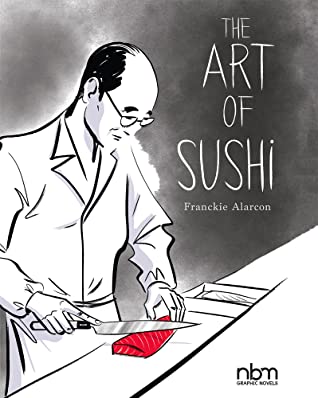
[READ: May 5, 2023] The Art of Sushi

This beautiful hardbound book is a translation of Alarcon’s L’Art du Sishi.  It is a full on graphic novel style documentary about the process of making sushi–as well as fishing, making sake and growing rice and wasabi.  The book is almost entirely black and white with splashes of color on the sushi itself.

Alarcon has a minimalist style that works perfectly to show off a room that allows you to focus on details as well.

Alarcon starts the book with himself in France making sushi.  He’s proud of it but acknowledges it’s not award-winner.  A friend of his says she can put him in touch with Hachiro Mizutani, master sushi chef with three Michelin stars.

After a brief history lesson into how fish were prepared in Japan over the centuries, there’s a page that shows nine varieties of sushi.

Then it’s on to Hachiro Mizutani’s place, which is, in fact a small room in the upper floor of a building–not a large sushiya at all.  I got a kick out of reading that it’s okay to use your hands, that you should never let your sushi fall apart and (for Hachiro Mizutani at least) no photos!

Hachiro Mizutani gives them a chef’s menu.  16 individual pieces in a very specific order, including a dessert sushi made of shrimp paste and egg.  He prepares it right on front of them.  The next day Hachiro Mizutani takes them to the fish market where he discusses how he picks out fish and why so many foreign chefs (French, in particular since the author is from France) wait  too long to pick the perfect fish.  There’s pictures of men cutting up fish (and even using a sword to cut tuna.

The sword discussion leads to a diversion about the greatest knife makers in Japan–a family who have been making swords and blades for generations.  The Oroshi bocho is used to cut tuna.  The blade can be up to 5 feet long and it is forbidden to take it out of is the fish market.  (Although Yakuza do have them).

Hachiro Mizutani tells them about cutting fish and how his apprentices do most of the work but he always prepares the rice to get it just right.  When he was an apprentcice he slept in the restaurant and for the first four years he did nothing but clean the building–never touched a fish or rice.

They tale a 3:30 AM trip on a boat to watch the Japanese fishermen hauling in their catch, some of which they bring to their next stop.  Okada, a modern sushi chef.  He is not afraid to change things up.

This leads to a trip to rice paddies to learn just how many different types of rice there are in Japan alone.

Okada pairs his sushi with sake.  And the sake comes in specially made ceramic cups.  We meet the ceramicist and his brick oven (it’s pretty cool).  Okada, brings out the heads of the fish they are going to eat as well as the sword from the swordfish.

The next day they are off to a sake factory.  Who knew how much went into making sake and how different the various styles can taste.  There’s even a soy ice cream (which is actually really sweet not salty).

Then it’s off to someone’s house while we watch her make eel sushi.  As well as some artist friends who do a fun homemade spread.  There’s a discussion of how seaweed (nori) is processed and what to look for in the best quality.  And finally Alarcon gets to make another sushi–his is laughable (although it looks fine to me).

The last trip involves them going to a Kaiten Sushi–the affordable alternative where the sushi travels on a conveyor belt.  The food is good and somehow affordable (they pay $10, each, I feel like that’s unlikely in the U.S.)/  Although some things are pretty weird even for them=–grilled salmon with melted cheese?

After a quick run through a store of essential sushi items (it is a massive store), the two non-Japanese speakers head to a restaurant to try to order on their own.  But one of the pieces smells fishy and seems off–they shouldn’t eat it.

The epilogue is back in France and shows how things are necessarily different in France.  How more humane fishing practices are being used but also how chefs, even Japanese chefs have differences to contend with,  Like the kind of fish that is available to them.  Takuya Watanabe is a Japanese chef working in France who has earned a Michelin star.  He tells them about actual wasabi (not the horseradish paste most of us are used to), where it grows and why it is so infrequently used.

Finally, it’s off to Yannick Alléno and his L’Abysse, a large restaurant dedicated to sushi.  His main chef is Yasunari Okazaki has been training for years and is not afraid to make traditional sushi as well as contemporary French version of sushi.  Like Tuna tartare with sliced hazelnuts grilled with a blowtorch, or even Strawberries with a sugar crust and nori (there are no desserts at sushiya in Japan).

The book ends with some recipes.  Which are all pretty cool looking but which I’ll never try.

Read Full Post »

[READ: March 10, 2021] Things Are Against Us

I loved Ellmann’s book Ducks, Newburyport so much that I had intended to read all of her books.

So I’ve gone back and read some of her previous novels.  Which I found to be…okay.  They were mildly amusing with some very personal diatribes thrown in to put some passion into these otherwise comic novels.

Then I saw that she had a recent collection of essays, which I thought might be really interesting.

I agree about 95% with everything Ellmann says in this book.  And yet I hated this book more than almost anything I’ve read recently.  And I think I’m not going to bother reading the other novels that I haven’t read yet, since the other two weren’t that great anyhow.

Ellmann’s style in these essays is so unpleasant, so superior and self-righteous, so… (and I hate to use this word because of the anti-feminist implications of it but it is definitionally accurate) strident, that I almost didn’t finish most of the essays (I forced my way through to the end of all of them).  Strident, btw: “presenting a point of view, especially a controversial one, in an excessively and unpleasantly forceful way.  I mean, that is this book to a T.”

In the past, strident women have been very important to many movements.  But hen your arguments are so scattershot, it’s hard for your stridency to be a positive force.

“Things Are Against Us”
In this essay Ellmann all caps the word THINGS every time she writes it.  On the first page (which is half a page not including the title), THINGS appears over 30 times.  The tone is kind of amusing–about how things get in our way and cause us trouble: Things slip out of your hand; things trip you, things break.  Then each following paragraph gets more specific.  Clothes tear, socks don’t stay up.  Matches won’t light, water bottles spill. Then she gets into the body.  In her novel Doctors & Nurses she lists 12 pages of bodily ailments.  So there’s not much new here.  And there’s no real point.  It doesn’t end with any grand idea.  It just stops. (more…)

Read Full Post »

[READ: January 20, 2023] Sweet Desserts

I absolutely loved Ellmann’s Ducks, Newburyport.  It was unlike anything else I had read up to that point.  I also assumed it was her first book because I hadn’t heard of her before and there wasn’t really any talk of her previous books.

But it turns out that she had written many books before Ducks–and they all seem to be very different in style from Ducks.

This novel, her debut, is so radically different as to be almost from a different author.

This is, as I understand it, a semi-autobiographical story.  Well, the entire bio we get from her on the back of the book is “born in Illinois and moved to England, somewhat unwillingly, at the age of thirteen.”  In the novel, the main character is Suzy Schwarz, an American girl who is moved to England when her mother dies.

The book is short (150 pages) and each chapter is roughly three or four pages.   It opens with Suzy as yet unborn and her older sister Franny as the center of attention.  Suzy was sickly when she was born and Franny rather doted on her–although Franny was always clearly the one in charge.

Every chapter has excerpts from other things quoted in it–often without context.   One chapter about the young girls has a recipe for for cooking eels.

The story jumps back and forth between England and America.  In England, when the women are older, they have sex a lot (Ellmann does not hold back on the explicitness, she loves sex and wants women to have lots of orgasms).

There is a lot about food in the book because Fran develops a weight problem (Ellmann talks a lot about women with weight problems).  Later Suzy buys Colossus magazine (a porn about large women) and admires the personal ads: Huge Sue (84-70-73) Where did she fine Size 73 knickers?. (more…)

Read Full Post »

SOUNDTRACK: hiatus

[READ: January 26, 2022] Fixer

I saw this book at work and was attracted by the cover (obviously San Francisco) and that it was about a tech startup company (sort of).

The book is set up with each chapter being about one of the five main characters.

Meghan is a single woman whose life has been one of upheaval.  As we meet her, she has just gotten laid off (with about one third of the firm) of a tech company that has had to resize itself.  She’s not even sure why she works in marketing–she has no real sense of self and would love to be an artist.  But she doesn’t dare risk things for that.  She has also just had a very good date with Diego Garcia.

Diego (Digs) is techie guy with great ideas.  He has been working in the tech field for many years and has brought some of his good college friends to work with his at Del Oro, a startup tech firm with one of the hottest apps out right now.

Kari (he is Norwegian) is Diego’s college friend.  They have been close as anything for many years.  Kari (and his father especially) have very high expectations for Kari. Kari is the more business minded side of Diego–he knows about money and how to get it.  He is passionate about very few things.  One is success.  The other is Kari.

Kira (the similar names are cute, rather than cloying, I think) is his girlfriend of many years.  She is possibly more driven than he is.  She is very successful and expects the best from everyone.  She has known Kari and Diego since college.  She likes Diego but gets a little tired of him.  When Diego starts dating Meghan, she finds her unbearably boring.

The last of their college friends is Ravi.  Ravi is gay, but he has not (and could never) come out to his strict Indian parents (who are back in India).  They would love for him to come home, but he has made a life for himself here. He is actually just about to get married to a woman.  She is his best friend (they’ve known each other forever) and she is a lesbian.  She also needs help with her visa to stay in the country. It solves everything.  Even their serious significant others are on board.  Ravi is very close to Kari as well.  His boyfriend is serious and they imagine settling down someday is gay marriage is ever legalized. (more…)

Read Full Post »

SOUNDTRACK: hiatus

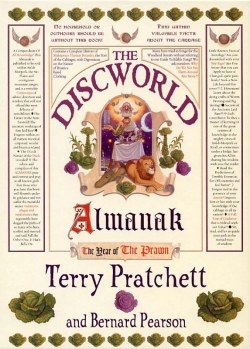
[READ: January 2022] The Discworld Almanak

I assumed that this book would pair well with Nanny Ogg’s cookbook since in Maskerade, there’s a plot point about the Almanak getting published.  But as happens with this sort of thing, this companion book was published five years later.

There’s really nothing in here that’s relevant to any of the plots of the books, so that’s fine.

This diversion is basically an opportunity to explore the lighter side of Ankh-Morpork and astrology.  It also doubles as a journal for whatever year you may wish to use it in (no days of the week are supplied for the two dozen pages of empty calendar dates.

The book has the look of an old fashioned almanac (as you can see by the cover) with lots of little pieces of text in all manner of places.  There’s also old designs and bordered and even a place where you can punch a hole to hang a string so you can put the book in the privy.

As with Nanny Ogg’s cookbook, there are pinned notes from the publisher to the overseer of the book which add an extra level of humor to the proceedings.

The book also sets out the Discworld calendar year–it’s not quite the same as our as it has 400 days an a thirteenth month that no one talks about.

The book starts with a warning that the turtle is likely to turn upside down this year (fear not). (more…)

Read Full Post »

SOUNDTRACK: hiatus

[READ: December 20, 2021] Weird Accordion to Al [Vanity Edtion]

This book came to my work and I said, Hey I have this!  And then I said, but my cover is orange.  What gives?

And then I saw that Rabin, inspired by Al’s Ill-Advised Vanity tour expanded this book.  Or actually, since there is very little information about these books, perhaps he wrote them at the same time and released a shorter and longer version.  But why would he do that?

The first 366 pages are the same but, (and here’s the thing that messed with my head) they are not exactly the same.  Now, I didn’t read the same text in both books and compare them (that would be really insane). But I did flip through the book comparing paragraph and chapter breaks.  The text appears to be the same in both books.  BUT, the paragraphs are not!  For reasons that I don’t understand, in book 1 some pages end with paragraph F, but in book 2, with the same exact text, the page now ends with paragraph E.  Like the spacing of a period threw off all of the justification (Users of Word will know what I’m talking about).

So I’m assuming that both books are the same.

And then the new stuff was added to Book 2 (or taken out of Book 1, whatever).

Starting on page 368 we move on to Other Stuff. (more…)

Read Full Post »

SOUNDTRACK: hiatus

[READ: December 20, 2021] Weird Accordion to Al

After writing the “Weird Al” biography, with “Weird Al” himself, Nathan Rabin dug even deeper into his “Weird Al” fandom to write a detailed account of, as the subtitle says, “Every ‘Weird Al’ Yankovic Album Analyzed in Obsessive Detail.”

“Weird Al” wrote the (short) introduction and then Nathan drops the needle on “Weird Al” Yankovic, Al’s 1983 debut album.

Nathan goes into varying degrees of detail on each of the songs.  Nathan was a rabid “Weird Al” fan from when he was a little kid.  And when he talks about how much he loves Al, you can see his deep abiding appreciation for everything Al has done.

Some songs get a paragraph, nut most get a page or so.  He usually talks about how much he likes (or loves) the song (and occasionally dislikes).  There’s nostalgia in the older songs and jokes and observations about contemporary things as well (Rabin’s politics poke through once in a while.  Good thing he’s a smart guy.

Because he did the Al biography with Al, he presumably got a lot of insight into the man and his work.  So although sometimes his insights seem like maybe he’s reading too much into a goofy parody, perhaps he’s on to things.  Maybe Al’s depth is deeper than rhyming Sharona with Bologna.  Which is not in any way to diminish Al’s intelligence.  He’s obviously very smart, especially as his later songs indicate.

Rabin’s tone throughout the book is smart and snarky.  He talks about the songs and the video (if there is one).  He talks about the production quality (or lack thereof) on the first album.  He references Dr. Demento (because the Dr is essential to Al’s career).  He also references Don DeLillo’s White Noise and says things like “Al is in deconstructionist mode.” (more…)

Read Full Post »

SOUNDTRACKSHELLEY [fka D.R.A.M.]-Tiny Desk (Home) Concert #198 (April 26, 2021).

I’m always puzzled by the FKA in a singer’s name.  Is it part of the singer’s name? Is this singer’s official name Shelley FKA D.R.A.M.?  I don’t think so, I think it’s just for us to know who Shelley used to be.

When D.R.A.M. played the Tiny Desk back in 2017, he made a couple of things clear to us: His playfully dynamic personality was primed for the spotlight, and beneath the catchy hooks, there’s a real singer waiting to come out. For his Tiny Desk (home) concert, he does a complete 180. “It’s like a new beginning. Full circle. So this time, call me Shelley.” he says, following the opening track, “Exposure.” Everything is new. Silk pajamas and slippers replace the trench coat and plush beanie, and thanks to lifestyle changes, he’s slimmed down quite a bit and goes by his government name now: Shelley.

I enjoyed D.R.A.M and his vulgar silliness.  But Shelley is one of those singers who intends to hit every note every time he holds a long note.  He whines up and down the octaves constantly and I hate it.  I know that there are listeners who love this as the blurb admires

The shift from lighthearted melodic hip-hop to full-on R&B crooner shouldn’t come as a surprise to anyone who’s seen him perform live. It feels like it’s his way of saying, “Now that I have your attention, allow me to introduce myself.” We still get glimpses of the “Big Baby” here and there — the charm, a little bit of silliness, and the million-dollar grin — but other than that, it’s grown folks business and vocally flawless performance.

For the Shelley Show, he gathers a groovy band in front of a massive bookshelf and runs through selections, including the premiere of “Rich & Famous” from his upcoming self-titled project, due out on April 29, his late mother’s birthday. If D.R.A.M. was the ploy to break into the music industry, then Shelley is the longevity play.

“Exposure” and “The Lay Down” really accentuate his new vocal style.  But I liked the music of “Cooking With Grease.”  The simple drum beat from Keith “KJ” Glover and then the live viola from Yuli (a highlight throughout).  Sensei Bueno follows the melody on guitar and the song grows from there.

Of the four songs, I liked “Rich & Famous” best.  Trey Mitchell plays a grooving bass line, the backing singers Crystal Carr and David Fuller are ah ha-ing.  Sensei Bueno is wah wahing the  guitar and SlimWav is floating the keys around.  Shelley’s voice stayed low and less whiny.  Is he really going to try to make it with the name Shelley?

[READ: May 10, 2021]  “The Way We Are”

Reading this essay in 2021 was a really uncomfortable experience.  David Sedaris is not afraid of saying a risqué thing or three. But it’s amazing how much things seem to have changed in 13 years.

This essay begins in Normandy with David saying that the city shuts off the water without any warning.  Usually it’s a construction project or something.  It usually happens when David gets up around 10:30, which is practically the middle of the day for Hugh and the neighbors.

What they do at 6AM is anyone’s guess, I only know that they’re incredibly self righteous about it, and talk about the dawn as if it’s a personal reward bestowed on account of their great virtue.

The last time the water went off, David had a coffee problem. In order to think straight, he needed caffeine.  In order to make this happen he needed to think straight.  One time he made it with Perrier which sounds plausible but isn’t.  He tried leftover tea which might have worked if the tea weren’t green.  This time he decided to use the water in a vase of wildflowers that Hugh had picked. (more…)

Read Full Post »

Older Posts »