Feeds:
Posts
Comments

Archive for the ‘Film & TV’ Category

SOUNDTRACK: BILLIE EILISH-“Bury a Friend” (2019).

A lot of the music I listen to is weird and probably creepy to other people, but I don’t necessarily think of songs as appropriate for Halloween or not.  So for this year’s Ghost Box stories, I consulted an “expert”: The Esquire list of Halloween songs you’ll play all year long.  The list has 45 songs–most of which I do not like.  So I picked 11 of them to post about.

There’s a ton of reasons why Billie is an unlikely pop sensation.  I won’t bother going through the myriad reasons, I’ll just talk about the music of this song–a suitably creepy song to kick off a series of Spooky Stories.

The song starts with a muted, almost musical drumbeat and clicks.  Then Billie’s processed voice sings with what I assumed is a slowed down version of her voice singing parallel with her.

After a muttered “come here,” and a screech, the verse starts.  It’s no less creepy and possibly more hypnotic.  It leads to a bridge in which at the end of each features a voice that cries quietly (and then reverses n the next line).

The repeated refrain of “I wanna end me” is probably the least creepy section of the song.

There’s one more part, a quickly spoken line ending with three thumps that lead to the next line.

Then it all repeats.

There’s no prettiness, no poppiness. It’s like a slightly more dancey version of Portishead.  It’s pretty darn cool.

I have no idea why it/she is so popular.  But good for her.

And the video is really freaking creepy too.

[READ: October 17, 2019] “The Foghorn”

Just in time for Halloween, from the people who brought me The Short Story Advent Calendar and The Ghost Box. and Ghost Box II. comes Ghost Box III.

This is once again a nifty little box (with a magnetic opening and a ribbon) which contains 11 stories for Halloween.  It is lovingly described thusly:

Oh god, it’s right behind me, isn’t it? There’s no use trying to run from Ghost Box III, the terrifying conclusion to our series of limited-edition horror box sets edited and introduced by Patton Oswalt.

There is no explicit “order” to these books; however, I’m going to read in the order they were stacked.

Gertrude Atherton had a story in the previous Ghost Box.  I was pretty impressed by it.

This story is also pretty twisted–fans of the macabre should really check her out.

(more…)

Read Full Post »

SOUNDTRACK: TAYLOR SWIFT-Tiny Desk Concert #902 (October 16, 2019).

Most Tiny Desk Concerts are from musicians that few people have heard of.

Not this one!

It’s hard to imagine exactly how it happened that Tiny Desk Concert managed to get Taylor Swift to play.  And to play with just a acoustic guitar and piano.  “It’s just me. There’s no dancers, unfortunately,” she quipped.

I have seen people already complain that Tiny Desk is supposed to be for unknown artists blah blah blah.  But I think it’s pretty awesome that a) Taylor Swift is a fan of NPR and Tiny Desk and b) that this show will bring more notoriety to Tiny Desk and potentially other bands.

Plus–I had no idea that Taylor Swift was not a studio creation–that she’s actually a real and thoughtful person who wrote her own music.

She talks confidently and casually about songwriting and she seems pretty genuinely pleased to be there.

As she settled in for her Tiny Desk, she looked out at the 300-plus NPR employees and guests. “Wow! This is a lot of people in a tiny office!” she said. “I love it!”

She delightfully says, “It’s great to be in DC.  You guys had anything exciting going on in the last couple of weeks?  Any possible changes in play?”

And, hey, she writes good songs, too.

I’ve never really listened to her music–although I love “Shake It Off.”  I haven’t actually heard anything of her new album so this was all new to me.

After introducing herself, she explained her objective: “I just decided to take this as an opportunity to show you guys how the songs sounded when I first wrote them.”

She talks a lot about each song and why she wrote them.

Opening with an acoustic rendition of “The Man,” from her 2019 album Lover, Swift delivered a critique of gender double-standards with a sense of humor (and a perfectly deployed hair toss), Leonardo DiCaprio name-check and all.

She says she has been thinking about the topic for many years and it was something she wanted to write about conceptually for a very long time because we have a bit of double standard issue in our society.  She wondered if there was a concise and catchy way to write a song about this?  So she decided to imagine what her life would be like if she said and did all the same things but if she was a man.

While not an original idea, she tackles it really well.  And I like that she’s using her platform to address the issue

I would be complex
I would be cool
They’d say I played the field before
I found someone to commit to
And that would be okay
For me to do
Every conquest I had made
Would make me more of a boss to you
I’d be a fearless leader
I’d be an alpha type
When everyone believes ya…
What’s that like?

And it’s really catchy too.

At the end of the song she gives her pick to a little one in the audience (to a room full of awws).  Then she switches instruments.

She talks about the process of writing songs–when something comes and its easy, that’s wonderful.  But most days you show up… and the idea doesn’t.  Then you have to know the craft of songwriting–you’re not always going to be inspired and that’s okay.

Turning to the piano for Lover‘s title track, with a smile, she explained the guitar-string scars of the song’s bridge.

She says that she has scars on her hands from playing guitar when she was young–when she played until her fingers bled or when a string snapped and cut her.  In your life you received all kinds of scars–emotional and physical and if someone is going to take your hand, they’d better take your hand scars and all.

It’s a pretty piano ballad and her voice is really pure.

After the song she removes her blazer to reveal a velvet top (she must have been very hot).  “You guys ever had costume changes at Tiny Desk?” She then finds three more guitar picks to give to three other kids, one of whom you can quickly see is pretty darn excited.

Picking up the guitar again for “Death by a Thousand Cuts,” Swift confronted a question that she says has haunted her career: What will you ever do if you get happy?

She receives this question over and over that “has the potential to seriously deteriorate my mental health.”  “What will you ever do if you get happy?  Will you just never be able to write a song again?    She says she used to reply that she started off when she was 12, she was writing songs about things she had no idea what she was talking about.  She wrote songs about heartbreak based on movies and books and character studies.  So she would say, “If stuff is going on in the world maybe she could hey inspiration from that.

But then she really asked herself that question.  “Would I not be able to write break up songs?  I love break up songs!  They’re so fun to write.”  She says she had friends going through breakups and she was watching movie and reading books about breakups and these ideas came to her.  She woke up with heartbreak lyrics in her head and realized “It’s still here!”

Across the song’s run-on thoughts and relentless searching, Swift offered an answer: She’ll continue to excel at crafting superb story-songs.

I rather like her songs on acoustic guitar–even if I’m not much of a fan of break up songs.

Before the final song, “All to Well,” she talks about how she never googles herself–she recommends you not do it either.  But her dad does.  He sends her links to lists that people rank her songs (she finds it very nice that people care enough to do that).  When the Red album came out, she said there’s a song and “I’m the only one who loves this song this much–because it happens to me and its personal.”  But it turns out that this song tops everyone’s favorite list.  “I’m happy that my opinion lines up with your opinion on that.”

I actually didn’t know this song at all–I guess I am really isolated from pop music.

She says, “here’s a sad song about fall.”  It’s very pretty on piano and once again her voice is really great.  I really like the way the words unfold and then reflect back on themselves.  It’s a really wonderfully crafted song.

This Tiny Desk Concert may not introduce Taylor Swift to a lot of people, but it pretty much did introduce me to her music.  And I was really impressed.

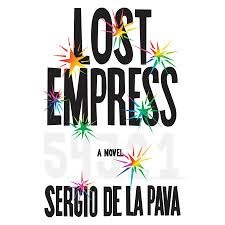
[READ: August 19, 2019] Lost Empress

I loved Sergio De la Pava’s A Naked Singularity. It was complicated and funny and clever and bizarre and thoroughly engaging.

Lost Empress is even better.

There’s a story about a woman running a football team–and being overlooked because she is a woman.

There is a storyline about 911 operators, and the guy who transcribes them.

The third story is about a tough, smart guy who is in jail.  He is his own defense for trying to get out.  And he hatches a plan that involves stealing artwork, the Paterson Falls and the Super Bowl.

I enjoyed it in part because much of it is set in Paterson, NJ.  I grew up next to Paterson and the city has for most of my life been in a state of decline.  Despite all of the great things it has to offer (like the Paterson Falls! which get a shout out in this book), Paterson gets no respect.  This book doesn’t exactly aim to correct that, but it does give the city something cool–a football team.

It also jokes about “what the hell is up with Paterson?”  The city had once tried to rebrand itself in which they staged a contest  for “an official slogan for the troubled city.”  Proposals emerged: “the verifiably untrue, the unintentionally insulting/intentionally insulating, the so vague that sense fails to be created, the rhyme or alliteration for its own sake, and the technically true but not even conceivably relevant.” (more…)

Read Full Post »

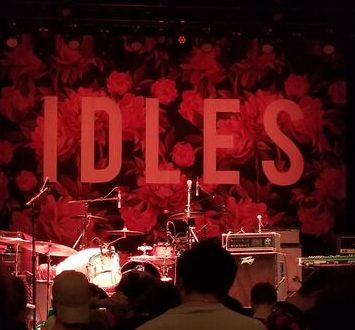
[ATTENDED: October 15, 2019] Idles

I learned about Idles through NPR (of course).  I can recall Bob Boilen talking about their live show (I think at SXSW) and how amazing it was.  He said that they were very high on his must-see list.  And since then I have wanted to see them.  When they announced the show at Union Transfer I bought a ticket immediately.

I never really understand how bands become popular over here.  Most people I know have not heard of Idles.  And yet this show sold out very quickly.  I don’t understand why, given how many other bands that I think are bigger don’t sell out.  Maybe Philly just loves punk.

I know that Philly loves a mosh pit.  And boy did they ever get one.  Well, technically it wasn’t so much a mosh pit as a pogoing, bouncing, swarming mass of bodies.  And lots of crowd surfing–including from the band!

I knew a couple of Idles songs pretty well, but I didn’t know a lot of their songs.  However, I knew their basic style: lead vocalist Joe Talbot kind of speak/sings/screams lyrics of disaffection and the band alternates between quiet sections and full-on mayhem. (more…)

Read Full Post »

SOUNDTRACK: DAN TEPFER-Tiny Desk Concert #885 (August 29, 2019).

Most of the time, a Tiny Desk Concert is an opportunity to see an artist in a quiet almost unplugged setting.  Sometimes, it’s an opportunity to see a band really show off in a close space.  And sometimes a Tiny Desk Concert will blow your freaking mind.

Like this one.

I have never seen anything like this.

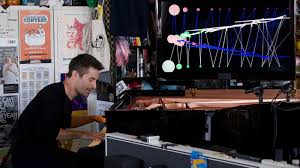
Dan Tepfer has created a program that plays the piano along with him.  It’s for a project he calls Natural Machines.

Watch the keys and you’ll see this Disklavier — a player piano — plucking notes on its own. But it’s not a prerecorded script.

Here’s how it works: Tepfer plays a note, and a computer program he authored reads those notes and tells the piano what to play in response. Tepfer can load different algorithms into the program that determine the pattern of playback, like one that returns the same note, only an octave higher. Another will play the inverted note based on the center of the piano keys. These rules create interesting restrictions that Tepfer says make room for thoughtful improvisation. In his words, he’s not writing these songs, so much as writing the way they work.

Tepfer plays free improvisation–he “makes things up and tries to be present in the moment” but the computer responds to him in real time based on rules.

He says for “Canon At The Octave” theres’ an axis of symmetry on the piano and “everything I play on one side if reflected on the other side.  Super simple, but it leads to musical problems that lead to real music.”

Since he is improvising, he is also reacting to what the computer makes.

He explains that “Tremolo” is when a note is repeated very quickly.  He gives the example of a violin player playing a note quickly.  It’s much harder on piano than a violin and it’s impossible to do more than ten notes at once.

He plays single notes that generate a series of chords playing quickly all at once–it’s really cool to watch the piano take off as if with a mind of its own.

But watching the piano isn’t the only cool thing

To better communicate what’s happening between him and the piano, Tepfer converted these audio-impulse data into visualizations on the screen behind him, displaying in real time the notes he plays followed by the piano’s feedback. [We dive even deeper into this project in a recent Jazz Night in America video piece].

He explains that these improvs are super short versions to show off how the programs work.

“TriadSculpture” is all about harmonic ratios.  Pythagoras discovered that sounds work with whole numbers.  The math behind music.  So Tepfer has mapped numbers as a 3-D object and he has been printing them–even more mind blowing.  The computer program generates these shapes–  everything he plays on his left hand creates those shaped in real time on the screen.

Perhaps the trickiest part here, unlike a human-to-human duo, is that the computer plays along with 100 percent accuracy based solely on Tepfer’s moves. He compares it to dancing with a robot that never misses a beat. Tepfer has to play in kind to keep the train on the tracks, but if he falls out of step, so does the computer.

Fortunately he never falls out of time (or at least it’s hard to tell since it’s all improvised.

The final piece is “Constant Motion” in which he plays a note and the computer responds to it by playing a note either up or down.  This creates a fun fast piece that explores the full range of the piano.  The visuals for it are very cool too.

I’m not sure if this would be fun to see live (at least any more fun than an improvising pianist is) because listening to it you don’t always really know what’s happening or that the piano is doing the work.  But seeing it up close like this is awesome.

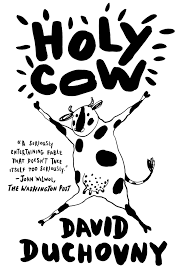
[READ: August 21, 2019] Holy Cow

Like most people, ever since watching The X-Files, I’ve liked David Duchovny (why don’t you love me?).

I watched some of the Red Shoes Diaries just for him.  I watched some of Californication just for him (Didn’t have whatever network it was on, so never watched more than a bit of it).  But I’m always willing to give him a shot because I think he’s smart but goofy.

Enter Holy Cow.

This is Duchovny’s first novel and just what a pitch it must have been.

Hi, this is David Duchovny.  Yup, that one.  I’d like to write an adult book about a cow that wants to go to India once she finds out cows are worshiped there.  Yes, David Duchovny.

I had no idea he had written this book.  I just happened to see it on my library shelf when I was looking for something else.  The book was short and had (terrible) drawings in it and seemed like it would be absurdly funny.

So, with the caveat that if you think that a talking cow buying a plane ticket and going to Jerusalem with a pig and to Turkey with a turkey sounds stupid and juvenile.  Well, you’d be right.  But you’d be missing out on an enjoyable, silly romp if that kept you from reading it. (more…)

Read Full Post »

SOUNDTRACK: DEODATO-Prelude (1973).

I know this artist because of Phish.  For years I thought that they “wrote” the discoey, funky. super cool version of “Also Sprach Zarathustra” which they play at a lot of shows.

I should have realized that the “Deodato” in the credits was the actual arranger of this cool piece, but I guess I never really thought about it.  I’ve no idea where the realization came to me, but once it did I decided  to check out the album from which it comes.

It turns out that Deodato is Eumir Deodato de Almeida (Brazilian Portuguese: [ẽʊ̃ˈmiχ djoˈdatu]; born June 22, 1942) is a Brazilian pianist, composer, arranger, and record producer, primarily in jazz but who has been known for his eclectic melding of genres, such as pop, rock, disco, rhythm and blues, classical, Latin and bossa nova.  Prelude was his first album released in the U.S. (released when he was 31) and eighth overall.  In addition to making over 30 albums, he has also been a producer and arranger on everything from Kool and the Gang’s “Celebration” to Bjork’s albums PostTelegram, and Homogenic

“Also Sprach Zarathustra” begins with twinkling and guitar noises for 30 seconds before the 5-note funky keyboard comes in.  And then about a minute in the horns join to create the familiar Richard Strauss “Also Sprach Zarathustra” crescendo.  Even though that melody is barely a minute long, this version is 9 minutes long with a lengthy funky keyboard solo occasionally punctuated by horns.  It then switches to a more rocking sound with a 70s sounding guitar solo.  It really never loses the funk for the entirety of the piece.

“Spirit Of Summer” is a slow moody song that sounds like it could be the soundtrack to a noir film with slinky horn lines and jazzy bass.  I love the opening and how it then switches to an almost easy listening string section before adding a mellow keyboard solo and a surprising very fast flamenco guitar solo as well.   The song is only four minutes and ends with a flute solo and then a return to the opening horns.

“Carly & Carole” is an easy, mildly funky jazzy number.  There’s lead flute combined with the keys that push the song along.

“Baubles, Bangles, & Beads” is a jaunty five-minute romp that sounds like it would have been very popular at swinging parties in the 1970s.  There’s more flute and keys and two lengthy wild Santana-like guitar solos that run through to the end of the song.

“Prelude To The Afternoon Of A Faun” opens with a mournful flute that sounds a lot like the weird Snoopy interludes when he is the World War I Flying Ace in the old Peanuts cartoons.  The melody is quite nice and is then repeated by several instruments throughout the piece.   After 2 minutes it tuns into a swinging jazzy number with a flute solo and wah wah guitars and a bright trumpet solo.  I see now that this piece was done by Debussy and this is another arrangement.  It is not used in Peanuts although Schulz does reference the song in a strip.

“September 13” ends the disc with an upbeat funky song with groovy bass and keys and wah wah guitars.  There’s a wild mildly distorted guitar solo with fun effects put on it.  It’s a fun way to end an album that is short but really captures a moment in time.

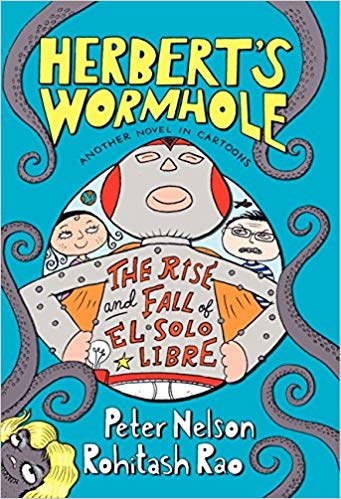
[READ: September 3, 2019] Herbert’s Wormhole Book 2

I accidentally read Book 3 before Book 2.  I am embarrassed that that happened because I am a librarian and I should know better, but I checked on Goodreads and must have read a paperback reprint pub date and though that book 3 was in fact book 2.

Having read book three I basically knew a lot of what happened in book 2.  But primarily this is because in book 3 they make offhanded comments to things they did in book 2.  Incidentally, while I was reading book 3 I thought it was a really fun, bold move on the author’s part to reference adventurers that we hadn’t read about.  That should have dawned on me but I just persisted in believing that the author was being really daring. Oh well.

Knowing what happened didn’t really spoil anything, because the book is silly and funny anyhow.

This book opens with a paneled cartoon recap of book 1.

It’s followed by a hilarious opening sequence in which Alex’s dad has become hooked on video games.  He was trying to bond with Alex over Alex’s love of video games.  But in book 1, Alex’s memory of video games is wiped out.  So now his father is playing them and Alex doesn’t really see the point.  But Alex’s father is now as addicted as Alex was. (more…)

Read Full Post »

SOUNDTRACK: ROSANNE CASH-Tiny Desk Concert #894 (September 23, 2019)

I don’t know all that much about Rosanne Cash (I couldn’t recall how she was related to Johnny).  I also assumed that she would be a country artist.  Yet this set is anything but country.  But I guess the key to that is that her voice isn’t country at all, it’s just good.

This blurb also blows my mind a bit about how quickly (or not) they post concerts.  This show was posted in September but was recorded in January–she had to wait quite a while to see it.

Rosanne Cash and her band arrived at NPR to play the Tiny Desk on a freezing cold, bright sunny day in January — one of those brittle, crystal clear winter days when the snow reflects the sun and there’s nowhere to hide from the light. Her intense performance had that same balance of heat and ice.

Cash plays four songs

most taken from her 2018 album She Remembers Everything, have a lot of emotional heat, but they’re shaped and sculpted by the wry wisdom of age and experience. More than at any time in her career, her spirit and approach to performance these days reflects the influence of her father, the legendary country singer Johnny Cash.

“She Remembers Everything” opens with John Leventhal on with Rosanne on acoustic guitar.  Like most of these songs, it feels slow and powerful–kind of bluesy with a dramatic chord progression.  Mid song, Leventhal switches to guitar and plays a great little solo.

When the song is over she praises everyone: “So attentive.  Like a listening room at the NPR offices.”

Up next is “The Only Thing Worth Fighting” which she co-wrote with T Bone Burnett and Lyra Lynn  This song is not so much country as western-sounding.  There’s more nice guitar work from Leventhal.

Zev Katz on bass and Dan Rieser on drums don’t do anything to single them out except for keeping the songs moving properly.  The bass does do some nice lines, but mostly, these are simple songs which need little accompaniment.

For “Everyone But Me” she takes off the guitar.  This is a lovely piano ballad after which she says, “I don’t know if the young people can relate to this song but it means more as you get older.”

The last song is from her album The River and the Thread.  She says the album won a Grammy and the last time she won a Grammy, Ronald Reagan was president.  From this she plays the cool bluesy “A Feather’s Not A Bird.”

This isn’t the kind of music I enjoyed, but I liked this Tiny Desk Concert a lot more than I thought I would based on what I thought I knew about Rosanne Cash.

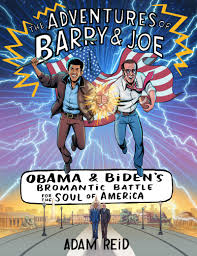
[READ: August 26, 2019] The Adventures of Barry & Joe

After the election that has sent the country spiraling into a level of hell, Adam Reid wanted to do something to make decent-thinking people laugh.

When I saw first saw this, I assumed that Adam Reid was Adam Reed, the creator of Archer and other delightfully dark cartoons.  It took a while for me to realize that he isAdam Reid who is responsible for The Tiny Chef Show.

Aside from that, I don’t really have any familiarity with him.  So that’s kind of interesting, I suppose. (more…)

Read Full Post »

20000 SOUNDTRACK: LOU REED-“A Gift” (1976).

reedThis “soft rock” song features a slow guitar song with shuffle beat as Reed speaks his mind.

There’s not a lot to the lyric (most of which are repeated a few times), but they are either really funny or really obnoxious depending on your take:

I’m just a gift to the women of this world

Responsibility sits so hard on my shoulder
Like a good wine, I’m better as I grow older, and now –
I’m just a gift to the women of this world
It’s hard to settle for second best
After you’ve had me, you know that you’ve had the best
And now you know that– I’m just a gift to the women of this world.

This song comes from his 1975 album Coney Island Baby. Apparently, many of the album’s songs were inspired by and dedicated to Reed’s girlfriend and muse at the time, a trans woman named Rachel Humphreys.  Well done Lou!

[READ: September 10, 2019] “The Women of This World”

Dale and Nelson are married and are living in a house while its owners, a philosophy professor and his wife, are in Munich until next year.  They chose this place away from it all because Nelson is writing a book.

It’s Thanksgiving and they are hosting Nelson’s stepfather, Jerome, and Jerome’s new girlfriend Brenda.

They did not come on Thanksgiving day became Jerome’s ex-wife (Nelsons mother), Didi was coming on Thanksgiving and they’d rather not see each other.

Nelson loved Jerome and felt indebted to him for arriving when Nelson was five and saving him from the life that Didi has planned for him.  Nelson admired Jerome and they still got along very well. (more…)

Read Full Post »

indexSOUNDTRACK: KAWABATA MAKOTO [河端一]-INUI 3 (2005).

a0649002429_16Kawabata Makoto [河端一] is the guitarist and mastermind behind Acid Mothers Temple. The band is hugely prolific. But he still had time to record solo albums. Often times without any guitar.
This was Kawabata’s third solo LP, now available on bandcamp

Third volume in an acclaimed series by the Acid Mothers Temple leader. INUI 3 focuses on Kawabata’s highly personal brand of epic instrumental drone. Performing on bouzouki, sarangi, electric guitar, viola, and ECS-101, Makoto emphasizes the gradual build of monumental sound structures. Running 12 minutes each, “Sui” and “Ken” are darkly spun tales, with wisps of sound keening over a distant backdrop. Recalling the Speed Guru’s lovely 2001 collaboration with Richard Youngs, the 47 minute “Fuku” is based on a hypnotic arpeggio plucked out on the bouzouki over which Gong-style glissando guitar and other zonked sounds are carefully layered.

Sui (12.33) over a drone it sounds like he’s playing a hammered dulcimer, but I gather it is the bouzouki.  There’s a very pretty melody which seems to morph into a reverse-sounding musical style after about 5 minutes.  These pulsing waves slowly shift into washes of synths over the drone.

Ken (12.35) starts was a drone–whether electronic or acoustic is hard to tell.  Waves of sound like waves swoop through this rather relaxing piece.

Fuku (47.08) has more of that hammered bouzouki style of playing.  It’s a lovely melody with a drone behind it.  After 9 minutes the backing chords change the texture of the song.  Around 11 minutes the melody starts to grow slightly discordant as the backing chords start to morph and the bouzouki plays some discordant notes.

The discord seems to weave in an out–never growing too harsh, just enough to give the song some tension.

Around 30 minutes, waves of electronics start to take over, there’s a slightly sinister sound to them.  By the end things get a little intense and it feels like the closing credits to a dramatic film.

It’s amazing that he can keep this up for 47 minutes.

[READ: September 10, 2019] “What I Saw From the Forest”

In this story Charles and Dulcie have been together for a while.  They lost their baby when Dulcie was six months pregnant.  It was nobody’s fault but Dulcie can’t help but try to figure out what she did wrong.

Their relationship has been prickly ever since.

Dulcie hates to drive on freeways–she doesn’t like that she can’t exit when she wants, so they tend to take back roads.  They had been to a party and Charles was too drunk to drive home so Dulcie drove his car.

He woke up when they were rear-ended.  It was a a group of young men with a gun.  They asked for the keys.  Charles gave them the keys and his wallet and then he and Dulcie ran.  The police promised them they would not see their car again.  When Dulcie worried that they would come to their house since the registration was in the car, the policeman said not to worry, “crackheads never did that.”

Dulcie took a few days off (she was a teacher) so Charles drove her car to work.  When he got home she had moved the mattress into the living room.  There was a rat in the bedroom walls.  They could hear it and had gotten used to it because when they told the landlord he said he would take care of it –which means “there’re ten other people in line for your apartment.”

She insisted on leaving the lights on all night.  She even talked about getting an inflatable person to sit in a chair to let people think someone was home.

The next evening as he was driving home, someone threw an egg at his car.  He freaked out until he realized it was Halloween.  They hadn’t bought any candy, so when he got home Dulcie was cowering saying people kept ringing the doorbell and she couldn’t trust anyone.

A week after the holdup, police called to say their car was found. It was in a lot in South Central.  The policeman asked if he was white.  Charles said yes, and the polieman said to go early in the morning before “wake-up time.”  They arrived and the car was stripped–even the steering wheel–so they turned it in rather than having it towed.

Charles took a day off from work.  He drove to a park and sat, thinking.  He realized he could either stay or go.  He had a decision to make.


Read Full Post »

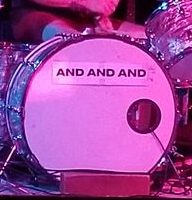
[ATTENDED: September 12, 2019] And And And

When I saw the band that was opening for Built to Spill was called And And And, I knew it sounded familiar.  I knew it was from some work of fiction.  And then it finally came to me that it was from The Commitments. Roddy Doyle’s hilarious book that inspired the movie.

The band is mentioned here:

Jimmy Rabbitte: What do you call yourselves?
Derek: “And And And.”
Jimmy Rabbitte: “And And fuckin’ And?”
Derek: Well, Ray’s thinking of putting an exclamation mark after the second “and.” Says it’d look deadly on the posters.
Jimmy Rabbitte: Psshh…
Outspan Foster: You don’t like it? You think it should go at the end?
Jimmy Rabbitte: I think it should go up his arse.

Excellent.

I instantly loved this band from Portland who were so bold as to take this name (no exclamation points). (more…)

Read Full Post »

[ATTENDED: September 6, 2019] Joanna Newsom

This was scheduled to be a busy concert weekend for me–three days, three shows.

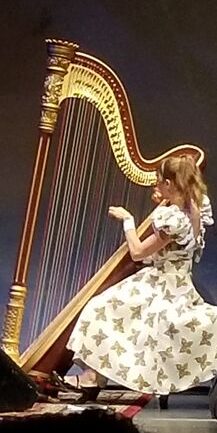
I was glad the first one was a seated, relaxed show of Joanna Newsom playing her harp and piano.  The traffic into Philly was light, until I got into City Center.  I had planned to park on the street (you can find it sometimes), but I wound up driving on a street under construction behind a bus and I watched as the time ticked away.  Finally I grabbed the nearest parking garage and sucked up the $22 fee and then hustled over the theater and managed to get into my seat just as the lights dimmed.  Holy cow.

I had never seen Newsom before, and I suspect that I was quite lucky to see her on this limited run tour because I understand it’s her first solo tour in about 15 years–she’s usually accompanied by… someone else, I guess.  It was also her first tour at all in four years.  She said she was very nervous.  And she did make a few mistakes.  But she was always gracious and self-deprecating about them.  And considering she played about 200,000 notes that night, missing one or two isn’t the end of the world.

She came out to much applause.  I gather that her fan base is pretty intense (the kind who laugh and squeal at any comment the musician makes).  However, unlike other similar fans, these were relatively restrained (it was a rather formal setting after all).  But it was nice to be enveloped in so much mutual love.

The strange thing for me is that I didn’t really know any of her songs before this show.  I knew what she sounded like and I’m sure I’ve heard a song or two somewhere, but I was a Newsom novice.  I just knew it would be an excellent evening.  And so it was.

She came out on stage to thunderous applause.  She had on a beautiful floor-length dress, which–when someone asked her–she said was by California designers Rodarte.  And that they had made four dresses, one for each of her albums. (more…)

Read Full Post »

« Newer Posts - Older Posts »