Feeds:
Posts
Comments

Archive for the ‘Monty Python’s Flying Circus’ Category

SOUNDTRACK: TRIUMPH-Just a Game (1979).
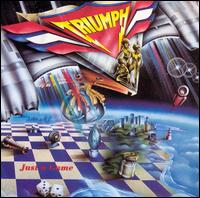
When I was a kid, my love of Rush was followed closely by my love of Triumph (I had a thing for Canadian power trios).  I’ve recently read a bunch about Triumph and was surprised to hear how acrimonious the band was.  Of course, I didn’t care about any of that back in the 80s.

This album was my favorite (even though Allied Forces was their major breakthrough).  In my gate-fold album the inner foldout was an actual board game.  How thoughtful!

It’s funny listening now, how much I liked this album back then because there is definitely some cheese here.  And I could never decide if I liked drummer Gil Moore’s songs or Rik Emmet’s songs best.  “Movin On” is a great hit but the backing vocals and “on and on” parts are kind of wimpy 70s rock–I must have blocked it out while jamming to the guitar solo.

Rik Emmet has since gone on to a successful solo career.  But on “Lay It On the Line,” the song that got me into them (thanks MTV) Rik rocks like he loves this band and this music.  The song features some serious guitar workouts and some impressive vocal acrobatics.

Perhaps, in hindsight, I like Rik’s songs better, as “Yong Enough to Cry” is pretty cheesy (it was fun to sing along to when I was 13 though–even if I never understood Gil’s pain, man).  But all of that was forgiven for the majesty of “American Girls.”  Sure, it’s also a cheesy song, but man it rocks.  As a young kid, I loved hearing the national anthem in the middle of the song.  And that solo is non-stop.

“Just a Game” is a powerhouse of a song although it’s a little long for what it is.  But then there’s the amazing “Fantasy Serenade” just over 90 second of beautiful classical guitar (a direction he’s go in much more after leaving Triumph).  It’s wonderful as a solo and it works as an amazing intro to the majestic “Hold On” (a song about music that doesn’t suck).  Although admittedly, the single version is better without the weird disco instrumental in the middle that really kind of puts a kibosh on the flow of the song.

The album ends with the strange (and quite long for what is it) “Suitcase Blues,” a 3 minute slow blues about touring.  But hey it showcases diversity, eh?

Even though many people compare Triumph to Rush, I think the more likely comparison is actually Kiss.  “American Girls” has a real Kiss vibe towards the end, and the opening chords of “Movin’ On” have a real Kiss feel.  Regardless, they played great metal/rock/prog and I’ll always love them for it.

[READ: February 12, 2012] Ready Player One

Do you like Rush? Do you like Monty Python?  Do you like the 80s?  (not those 80s, but cool 80s like Blade Runner, coin op video games, Family Ties, Square Pegs?)  Then you absolutely must read this book.  Especially if you like Rush, because how often does Rush form a plot point in a book?

Sarah was reading this book and she insisted that I read it (she has really been passing on the good suggestions lately!).  And when I heard her playing Rush a few days after reading this book (and she doesn’t like Rush), I knew I had to read it.

But what is it?  Well, It is basically the story of an online quest to find a secret egg and win a massive fortune.  The egg was placed in a virtual world by its creator, James Halliday.  Halliday was “a nerd uber-deity on the level of Gygax, Garriott, and Gates.”  He created amazing video games and ultimately the most amazing virtual reality space ever: OASIS.  (For Atari geeks, his inspiration for getting into creating video games in the first place was the Atari game Adventure).  Halliday was obsessed with the 19080s (the decade he grew up in), with technology and with geeky movies.  The only way to find this egg in OASIS is to know a thing or two (or 1,000,000) about the man who created it and the decade he loved.

If you were hooked by the first paragraph, you’ve already put this book on hold.  If you were hooked by the third paragraph, you know you have to put this book on hold.  If you’re not convinced yet let me back up.

It is the year 2044.  The earth is in a hellish state–there’s no fuel, there’s no jobs, people live in trailers that are stacked on top of each other.  Life sucks.  Except for OASIS.  OASIS is the virtual world created by Halliday.  At this stage in the world, OASIS is where most people go to school (cheaper and easier to do virtual teaching) and where many people spend most of their lives.  It’s depressing and horrible (and I actually didn’t enjoy the opening chapters all that much because it was really horrible and at a times a bit more caustic than I was expecting–but that changes quite a lot).

So Halliday invented OASIS as an idealized pace.  It was originally a multi-player game but soon became a new place to live, a kind of Eden.  It was free to join and you didn’t have to pay to play.  Although you needed credits to travel (or to build your own buildings or planets or whatnot), you could stay on the main world (which looks a whole hell of a lot nicer than the real world) and just hang out for free.  You can earn points through various achievements which would let you travel (or you could always hitch a ride with a friend) around the worlds.

Anyhow, when Halliday died, as his last will, he created a contest in OASIS.  Anyone who could find the three keys and unlock the three gates would win his entire fortune (billions of dollars) and total control of OASIS.

The protagonist (Wade in the real world, Perzival in the OASIS world) is telling his tale because he was the first avatar to find the first key to Halliday’s Hunt (it took over five years to find the first key).  If you played D&D, this section will make you smile.

When Perzival found the key he was suddenly famous because everyone on OASIS knew it was found.  Prior to this moment, the “leader board” which previously listed only Halliday, now suddenly lit up with Perzival’s name.  (Good thing OASIS avatars are anonymous, right?) (more…)

Read Full Post »

SOUNDTRACK: THE DIVINE COMEDY-BANG goes the Knighthood (2010).

I’ve really enjoyed The Divine Comedy since their earliest Michael Nymanesque music.  I loved the orchestral pop that Neil Hannon seemed to effortlessly create.  His last few records have been less exciting to me.  He has toned down the orchestration and made his songs more subtle.  They’re still beautiful but they’re not always as immediately arresting.  I thought that was true of this album as well, although I found that when I sat down and really listen to the music and words together (what a novel idea) the music played so well with the lyrics that the album overall is easily one of his best.  Although I still prefer the pomp and full orchestration of the earlier music, this newer stuff is very interesting. An artist has got to grow, right?

The new sound is more Tin Pan Alley.  It’s piano with guitars and occasional horns–very limited strings are present at all.  And, as any fan knows, Neil writes wonderful songs about love, and the songs on here are some more great love songs.  The non-love songs span the gamut of ideas–from emotionally wrenching to downright silly.  Neil is definitely a “get to know him” kind of songwriter.  And it’s rewarding when you do.

“Down in the Street Below” is a piano based song that morphs into a jaunty little number after some quiet verses.  It features yet another of his great melodies.  “The Complete Banker” is a jaunty piano song that mercilessly mocks the banking industry.  Not terribly original but certainly fun and lyrically it’s quite clever.  “Neapolitan Girl” is a faster song (reminds me of a Broadway musical or movie instrumental) which is (as they all are) very fun to sing along to).  “Bang Goes the Knighthood” is a musical hall song that is really quite funny despite the somber sound of the music (it’s about a knighted man who indulges in certain proclivities that might cost him what he has).

“The Indie Disco” is the exact opposite, it’s bouncy and shuffly and yet understated as only an indie disco can be (this may be the softest, least excited “yea!” in any song ever.  Name checking Morrissey may not be original but it would be a less real picture without him.  The songs he mentions are kind of dated, but are probably pretty accurate to what gets played in an indie disco these days.  “Have You Ever Been in Love” could be used in any rom-com film montage.  Although maybe it’s too obvious?  Sweetly filled with strings (yes strings).

“Assume the Perpendicular” is a slightly faster song, as befits lyrics, “I can’t abide a horizontal life while “The Lost Art of Conversation” is another bouncy tune with a whistle for an ending!

“Island Life” is one of the first duets I can think of from the Divine Comedy–it sounds like something out of the movie Brazil.  “When a Man Cries” is an emotionally wrenching song.  It seems somewhat out of place for Hannon’s usual topic, but it’s quite beautiful.  The silly fun of “Can You Stand Up on One Leg” is the perfect antidote.  Each verse provides something that’s harder to do than you think.  The final verse offers, “can you hold a singing note for a stupidly long time…. Let’s see how long you can hoooooooooo….oooold on to a note.” For the record, Neil’s note is 29 seconds long….stupidly long!  Is that really him holding that high note for 29 seconds?

The final song “I Like” is a wonderful poppy ditty, in which the full band rocks out (more or less) to another great melody.  It’s a perfect love song (even modernized to include a kind of rhyme with sexy and texting).

Initially I was a little disappointed by this disc, but it really proved to be fantastic.  More, Neil, more!

[READ: December 28, 2011] Is Everyone Hanging Out Without Me?

Is Mindy Kaling a big enough celebrity to write a book (memoir or otherwise?).  To use her own in-book comparison, she’s nowhere near Tina Fey’s level of fame, right? (although I actually think she is funnier).  I mean, she’s a minor character on a popular show.  True, she’s also a writer and producer, but that’s not going to lead you to fame or anything.  The more I read about her in the book, the more I wondered exactly who would know her aside from fans of The Office.

None of that is to say that Kaling isn’t awesome.  She is.  She’s funny and talented and I am thrilled she wrote a book–sometimes within an ensemble your individual voice will get lost.  But I have to wonder how much name recognition she has.  And the book doesn’t do a lot to dispel this sense for me.  I mean, she tells about everything she’s done, and really all she had done was write Matt & Ben (which sounds awesome and which I remember hearing about back in the day) and work (a lot) for The Office.  Not minor accomplishments by any stretch, but not a fame-inducing resume.  Nevertheless, good for her that someone was interested in letting her write a book.  And good for us who read it.  If you are amused by the use of the subtitle of the book (which I am) you will like enjoy the humor here.

I had read some excerpts from the book so I assumed it was all funny essays and whatnot, but it’s not.  It’s actually a memoir with funny essays mixed in.   Of course, Mindy’s life before Matt & Ben isn’t really very “interesting” (the book is very funny during this time of her life, even if she really didn’t do much more than babysit for rich folks and watch Comedy Central).

In the Introduction, Mindy provides a FAQ about the book.  One of the questions is if she is going to offer advice and she says yes.  And here’s the thing, Mindy’s advice is outstanding.  She offers advice about many topics and I don’t think I disagreed with her about anything (except maybe pea coats).  She’s like the voice of reason in a world gone mad and an excellent role model for anyone. (more…)

Read Full Post »

SOUNDTRACK: DAVE BIDINI-“The List” (2007).

This song appears as a bonus track on the Bidiniband album.  But I’ve been aware of it since 2007 when he played it on his solo tours.  It is essentially a list of 4 Canadians who are “killing us, killing us now.”  The list includes Tim Horton’s (purveyor of delicious donuts), Chad Krueger (from Nickelback), Zack Werner (a judge on Canadian Idol), and Stephen Harper (I shouldn’t have to tell you).

But the key to the song is the chorus: “where are the angry young ones….”  This song should become the unofficial song from Occupy Wall Street.  It would be very easy to modify.  Hey Dave, if you’re free you should head on down and serenade these angry young ones.

Here’s a great live version done in a record store in which he is close enough to have a casual chat about the very song he is singing in the middle of the song.

He also ends it a little differently than the original.  It’s catchy and easily adaptable.  Good on ya, Dave.

[READ: November 19, 2011] “Who Wrote Shakespeare?”

No one has traded off of his Monty Python fame as much as Eric Idle.  All of the other Pythons have moved on in one direction or another, but Eric keeps the torch alive (see Eric Idle Sings Monty Python and Spamalot).  He even has a little nod to MP in this essay with the asterisk next to his name which leads to (*Most likely Michael Palin, really).  This refusal to let go of Python has at least kept his wit sharp, as we see in this Shouts & Murmurs.

My main problem (as I’ve said before) with the Shouts & Murmurs is that they are usually too long.  But, as Python knew, keep it short and funny and you’ll succeed.  So this two-column piece never really flags in its simple premise.

Which is that everyone knows that Ben Jonson really wrote all of Shakespeare.  Idle presents a list of all of the famous books that were really written by someone else.  For example, “Simone de Beauvoir wrote all of Balzac and a good deal of ‘Les Misérables,’ despite the fact that she was not born yet when she did so.”   And my favorite: “‘Moby Dick’ was written not by Herman Melville but by Hermann Melbrooks, who wrote most of it in Yiddish on the boat from Coney island.”  The joke about Henry James is very funny and too good to spoil. (more…)

Read Full Post »

SOUNDTRACK: OKX: A Tribute to Ok Computer (2010).

OK Computer is one of the best records of the 90s.  Every time I listen to it I hear something new and interesting.  So, why on earth would anyone want to cover the whole thing?  And how could you possibly do justice to this multi-layered masterpiece?

I can’t answer the first question, but the second question is more or less answered by this tribute which was orchestrated by Stereogum.

The answer is by stripping down the music to its bare essentials.  When I first listened to the songs I was really puzzled by how you could take a such a complex album and make Doveman’s version of “Airbag,” which is sort of drums and pianos.  Or gosh, where would you even begin to tackle “Paranoid Android?”  Well Slaraffenland create a bizarre symphonic version that excises many things–in fact half of the lyrics are missing–and yet keeps elements that touch on the original.  But it’s an interesting version of the song and shows  a bizarre sense of creativity.  And that is more or less what this tribute does–it makes new versions of these songs.

Mobius Band make a kind of Police-sounding version of “Subterranean Homesick Alien.”  Again, it radically changes the song, making it a fast and driving song (although I don’t care for the repeated “Uptights” and “Outsides” during the verses).

Vampire Weekend, one of the few bands that I actually knew in this collection (and whom I really like) do a very interesting, stripped down version of “Exit Music, for a Film.  The “film” they make is a haunted one, with eerie keyboards.  Again, it is clearly that song, but it sounds very different (and quite different from what Vampire Weekend usually sound like).

“Let Down” (by David Bazan’s Black Cloud) and “Karma Police” (by John Vanderslice) work on a similar principle: more vocals and less music.  The music is very stripped down, but the vocals harmonize interestingly.  Perhaps the only track that is more interesting than the original is “Fitter Happier” by Samson Delonga.  The original is a processed computer voice, but this version is a real person, intoning the directives in a fun, impassioned way.  There’s also good sound effects.

Cold War Kids take the riotous “Electioneering” and simplify it, with drums and vocals only to start.  It’s hard to listen to this song without the utter noise of the original.  “Climbing Up the Walls” is one of the more manic songs on this collection, with some interesting vocals from The Twilight Sad.

There are two versions of “No Surprises” in this collection.  Interestingly, they are both by women-fronted bands, and both treat the song as a very delicate ballad.  Both versions are rather successful.  Marissa Nadler’s version (the one included in sequence) is a little slower and more yearning, while Northern State’s version (which is listed as a B-Side) is a little fuller and I think better for it.  My Brightest Diamond cover “Lucky.”  They do an interesting orchestral version–very spooky.

Flash Hawk Parlor Ensemble (a side project of Chris Funk from The Decemberists) do a very weird electronic version of the song (with almost no lyrics).  It’s very processed and rather creepy (and the accompanying notes make it even more intriguing when you know what’s he doing).

The final B-side is “Polyethylene (Part 1 & 2),”  It’s a track from the Airbag single and it’s done by Chris Walla.  I don’t know this song very well (since it’s not on OK Computer), but it’s a weird one, that’s for sure.  This version is probably the most traditional sounding song of this collection: full guitars, normal sounding drums and only a slightly clipped singing voice (I don’t know what Walla normally sounds like).

So, In many ways this is a successful tribute album.  Nobody tries to duplicate the original and really no one tries to out-do it either.  These are all new versions taking aspects of the songs and running with them.  Obviously, I like the original better, but these are interesting covers.

[READ: November 5, 2011]  McSweeney’s #8

I had been reading all of the McSweeney’s issue starting from the beginning, but I had to take a breather.  I just resumed (and I have about ten left to go before I’ve read all of them).  This issue feels, retroactively like the final issue before McSweeney’s changed–one is tempted to say it has something to do with September 11th, but again, this is all retroactive speculation.  Of course, the introduction states that most of the work on this Issue was done between April and June of 2001, so  even though the publication date is 2002, it does stand as a pre 9/11 document.

But this issue is a wild creation–full of hoaxes and fakery and discussions of hoaxes and fakery but also with some seriousness thrown in–which makes for a fairly confusing issue and one that is rife with a kind of insider humor.

But there’s also a lot of non-fiction and interviews.  (The Believer’s first issue came out in March 2003, so it seems like maybe this was the last time they wanted to really inundate their books with anything other than fiction (Issue #9 has some non-fiction, but it’s by fiction writers).

This issue was also guest edited by Paul Maliszewski.  He offers a brief(ish) note to open the book, talking about his editing process and selection and about his black polydactyl cat.  Then he mentions finding a coupon in the phonebook for a painting class  which advertised “Learn to Paint Like the Old Masters” and he wonders which Old Masters people ask to be able to paint like–and there’s a fun little internal monologue about that.

The introduction then goes on to list the 100 stores that are the best places to find McSweeney’s.  There are many stores that I have heard of (I wonder what percentage still exist).  Sadly none were in New Jersey.

This issue also features lots of little cartoons from Marcel Dzama, of Canada. (more…)

Read Full Post »

SOUNDTRACK: TOM WAITS–The Heart of Saturday Night (1974).

What would be more shocking–hearing this and then going to Bone Machine, or listening to Bone Machine and then hearing this. Holy cow. Tom’s voice is so NOT Tom Waits on this record. It kept me thinking of The Eagles or something. The tone, the pacing, I kept expecting him to bust out “Desperado.”  He also has some crazy beat-inspired poetry (what the kids today call spoken-word pieces)  Indeed, these spoken pieces would stay with him in one form or another for his whole career.  But seriously, how much a man can change in thirty years!

Like Closing Time, this album has several different styles.  Primarily, it has a sloppy, bar sound, the sound that Closing Time‘s cover conveyed.  And that sound is all over “New Coat of Paint.”   But there’s also piano ballads.  And those ballads, combined with Waits’ non-gravelly voice, give “San Diego Serenade” and “Shiver Me Timbers” that Eagles’ ballady sound.  And then “Semi Suite” brings back that muted trumpet. 

“Diamonds on My Windshield” is a beat poem set to a walking bass.  It’s clichéd, except that no one actually does it as well as Waits.  And although I don’t really like the blues in general, I enjoyed “Fumblin’ with Blues” quite a bit.  There’s something about Waits’ sloppy (but not) style  that makes the song interesting.  Even though this is considered a classic, this album is just not really my style and it’s one I listen to quite infrequently.

[READ: September 21, 2011] “An Anonymous Island”

This story is translated from Korean by Heinz Insu Fenkl.  

I felt like the heart of this story was completely unoriginal in content; and yet I can’t tell if it is a common story, if it is a kind of folklorish story, if it’s sort of a story from ancient writings or if it’s just something that happens.

The beginning of the story shows a woman listening to her husband.  He is watching the television,bemoaning the fact that anyone can be anonymous these days (this struck me as a funny sentiment given how much everyone in America bemoans the lack of privacy or the fact that everyone is on the internet).  You can get off at one bus stop past your own and no one knows you.  Back when he was a kid everyone knew everyone else, a village was a family.  And as the woman listens, she flashes back.

The flashback is to when she was a teacher in a small village.  A village where everyone is related.  Everyone treats each other with respect and deference.  Except for one man, Ggaecheol.  Ggaecheol is a bum–he has no job, he has no home.  The village tolerates him because he is an idiot and he is impotent.  But whenever he wants a meal, he simply walks into someone’s house and sits down and says, feed me.  Which they do.  Typically he sleeps outside, but when it’s cold, he walks into someone’s house and sits at the foot of their bed.  He says he wants to keep the woman warm, so the men, amused by his impotence, allow this.

There’s an old Monty Python skit in which the town idiot, despite being mocked by all, does great with women.  The punch line, showing the idiot with a couple of hot girls in bed with him: “I may be an idiot, but I’m no fool.”  And so it is with this story.  The bum is sleeping with everyone in town.  (more…)

Read Full Post »

SOUNDTRACK : BLACK MOUNTAIN-Wilderness Heart (2010).

As the Tea Party showed, it’s never too late to pay tribute to Led Zeppelin.  Of course in 2010, it seems really uncool.  So, why not go whole hog?  The opener, “The Hair Song” sounds uncannily like Led Zeppelin, from chord structure to guitar sound.  And then just wait until after a verse or two and you get the guitar solo which comes straight from a Led Zep song.  And, amusingly enough, the duet vocals of Stephen McBean and Amber Webber combine to sound an awful lot like Robert Plant.

It may not be fair to compare them to their forebears, but they seem so intent upon referencing them.  “Old Fangs” sounds a ton like Buffalo Springfield’s “Mr. Soul” (at least they’re fellow Canadians).  But the wonderfully 70’s-style sound of the keyboards raise the track above any mere copycat.

“Radiant Hearts” is a gorgeous acoustic ballad where you can really appreciate the split vocals of McBean and Webber (and which should make you go back to the first two songs to really listen to how great they sound together.  This is that rare ballad that doesn’t feel like a kind of sell out track.

“Rollercoaster” returns to the 70’s-lovin’ with a monster riff (and a solo) that Tony Iommi would be proud of.  But rather than simply bludgeoning us, the riff stops in its tracks and then slowly builds itself back up.  “Let Spirits Ride” moves out of the 70s and sounds a bit like a Dio riff circa 1983.  But there’s some cool psychedelic vocal processing on the bridge (and a massive organ solo) to really mess with your retro time frame.

“Buried by the Blues” is followed by “The Way to Gone.”  They’re both folkie songs (although “Gone” features a re harder edge).  After the heaviness of the first half of the album , these tracks seem like a bit of surprise but they match the album’s retro feel very nicely.  “The Space of Your Mind” reminds me in many ways of Moxy Fruvous’ “The Drinking Song” (you won’t see that reference too much to this album).  Until the chorus comes in, when it turns into something else entirely.

But it’s not all mellow for the end. The title track has some heavy riffage (and great vocals by Webber–she reminds me of some of the guest vocalists on The Decemberists’ The Hazards of Love, although she really sounds like any number of great 70s rock vocalists).  I love the way the track ends.  The disc ends with “Sadie” another folk song (which makes the album half delicate folk tracks and half heavy rockers). It’s a fine song, but the album is kind of ballad heavy by the end, and the teasing drums and guitars just never bring forth the climax I was looking for.

Despite the obvious homages to classic rock bands, (if you can get past that, the album actually sounds fresh (or maybe preserved is a better word) and strangely original.  Like the preposterous cover, the album is preposterous–over the top and crazy.  Yet unlike the cover, the pieces all work together to form a compelling picture.  Obviously it helps if you like classic rock, but there’s nothing wrong with good classic rock, now is there.

[READ: February 14, 2011] Literary Lapses

Despite the cover picture above, I actually downloaded this book from Google Books (and the cover of that one was boring).

So, obviously, reading the biography of Stephen Leacock made me want to read some of his humorous fiction.  True, I also wanted to read Mordecai Richler, but his books are much longer and I wanted this done by the end of February!

So, according to Margaret MacMillan, it is this book, specifically the first story, “My Financial Career,” that solidified Leacock’s reputation as a humorist.  And I can totally understand what she means (without having read the other books, of course).  “My Financial Career” is indicative of the others stories: not laugh-out-loud funny, but clever, kind of silly and very smile-inducing.  The gist is that the narrator is very nervous about going into a bank with his large amount of cash ($56!).  He asks to speak to the manager who thinks he’s Very Important and then proceeds to embarrass himself further. And further. It’s quite amusing.

“A Christmas Letter” is one of my favorite in the book.  It’s a very snarky look at a friend’s Christmas Party, with a great punchline.  And stories like “How to Make a Million Dollars” or “How to be a Doctor” are wonderfully amusing tales in which the narrator mocks the wealthy and “professionals.”

There are 42 stories in this book, so there’s bound to be a few clunkers.  Some were mildly amusing, some were mere trifles, and some are crazily out of date for a 2011 audience.  This book turned 100 years old last year.  (Neat). (more…)

Read Full Post »

SOUNDTRACK: THE DEAD MILKMEN-Metaphysical Graffiti (1990).

You know that it would be untrue, you know that I would be a liar if I were to say to you I didn’t set your house on fire.
You don’t have to be a philosopher to appreciate the joke of this album title (actually that may hurt the joke a little). But the “runes” that accompany the disc are quite amusing.

I haven’t listened to this disc in ages, and it turns out that I remembered about half of these songs really well.  And that’s because half of the songs are really good.  And the other half are, well, okay.

It opens with a children’s chorus which morphs into one of their heaviest rocking (although fairly uninspired) songs, “Beige Sunshine.”  The disc comes into focus with track two: “Do the Brown Nose” a funny song that outlines exactly how to do the titular dance (although at nearly 5 minutes, it’s a bit long).

The single (!) “Methodist Coloring Book”: features Joe Jack Talcum singing (clearly his success with “Punk Rock Girl” had an impact on that decision).  But on this track, he sings with a dark and distorted voice (which pales to Rodney’s dark voice) and is less interesting than his whiny normal singing voice. It’s a good song (and amusing) although as a single it’s less than successful.

I’ve always enjoyed the premise of “I Tripped Over the Ottoman” although I’m not sure it’s a very good song.  While “If You Love Somebody Set them on Fire” is funny and catchy (and astonishingly irritating with the screechier higher register notes in the chorus).

“In Praise of Sha Na Na” makes the valid point that they played at Woodstock and aren’t dead.

Joe Jack’s other songs are the very slow ballad “Dollar Signs in Her Eyes” and the rollicking (and more distorted singing) of “I Hate You, I Love You.”  But the ending tracks “Now Everybody’s Me” and “Little Man in My Head” (which is musically quite a good reggae track) just don’t have a lot of oomph.

However, the final track, “Anderson Walkmen, Buttholes and Howl!” (which parodies a short-lived but much talked about prog rock band) is delightfully twisted.

The problem with the disc overall is the four or five “improv pieces”  They all feature the same bassline, and by the end of the disc you start to cringe when you hear it (especially since the last one is 6 minutes long).  Each one is a mildly funny rant (along the lines of “Stuart” from Beelzebubba, but less focused and less interesting).  Some of them are certainly funny (Earl’s maggots and the “chills me to this day” refrain is pretty good), but they feel like comedy skits that you only want to hear once.

Erlenmeyer Flask!

[READ: April 3, 2010] By Night in Chile

In continuing with my Bolaño obsession, I moved onto yet another of his short books (144 pages).  Interestingly, By Night in Chile is written in a complete different style than the other two titles I’ve recently read (Bolaño is nothing if not diverse).

This is a stream of consciousness reminiscence told by Father Sebastián Urrutia Lacroix.  The entire book is one paragraph (actually that’s not true, the final line of the book is its own paragraph).

As the book opens, Father Urrutia is dying.  But worse than that, he has been disparaged by a wizened youth.  And his entire memory/rant is a response to the accusations of this (unseen by us) wizened youth.

And Father Urrutia uses this opportunity to describe the highlights of his life.  When he was very young he decided to join the priesthood against his family’s objections. There’s a running joke about people calling him “father,” I especially enjoyed the scene where his mother calls him father. (more…)

Read Full Post »

SOUNDTRACK: KISS-Alive! (1975).

This was the first Kiss live album and was the album that broke Kiss worldwide.  I’m not entirely sure why a live album of songs that didn’t sell very well would do better than the original studio albums, but so it was.

And, yes, the live recording is pretty awesome.  It is clearly a collection of greatest hits off their first three records, and the band sounds on fire: the songs are heavier and faster and largely more consistent than some of the odder tracks on the original records.

There has been considerable controversy about whether the album was overdubbed.  Wikipedia lists a few different possibilities for what originally recorded sounds were kept for the disc.  It never occurred to me that the disc might be overdubbed (and honestly that doesn’t bother me all that much).  But since I had the pleasure of watching Kissology recently, and I could see the state of their vocals live, it would surprise me entirely if the vocals were not overdubbed.  Not because the band didn’t sound good live (they did), but because they were very sloppy with their vocals, consistently leaving off the ends of lines and things like that, and the disc sounds perfect.

Of course this is all nitpicking.  Alive! is a fantastic document because the live versions add a lot of punch to the originals.  But on top of that, you get fun extras like the drum solo and banter of the 12 minute “100,000 Years” as well as Paul’s drinking banter: “I know there’s a lot of you out there that like to drink…vodka and orange juice!” (How can you pass that up?).  It’s hard to pick highlights from such a good record, but “She” is a particular one with Ace’s wild guitar pyrotechnics.  Right on to the end, the disc is a rocking good time.

It’s also funny to hear that “Rock And Roll All Nite” is not the final encore; rather it is the next to last track with “Let Me Go Rock n Roll” being the BIG FINISH.  That’s the last time that THAT would happen!

[READ: December 28, 2009] The Elfish Gene

I happened to pass this book in the New section of my library and I loved the title.  I read the blurb, made a mental note of it, mentioned how much I liked the title to Sarah and then more or less forgot about it (although, actually, I still see it every day, as it’s always facing out, cover forward).

Imagine my surprise to see that Sarah got it for me for Christmas!

So, yes, this is the best parody-titled book that is not a parody or a make-a-buck joke book that modifies a popular title.  Rather, it is a memoir of a British guy who spent his teen years utterly absorbed in Dungeons & Dragons.  But I must disagree with the Christian Science Monitor’s review as “laugh out loud funny.”  I only laughed out loud once in the book (the dog walking scene is hilarious), but that’s because I don’t think it was meant to be funny (at least I hope it wasn’t).

I’ve said before that I’m not a big fan of memoirs in general.  I find them mostly to be a big “so what,” and often without the subtlety required for a good novel.  But the topic here was delicious enough for me to dive right in.  And I think that this book, which I absolutely enjoyed, sort of proves my theory.

Barrowcliffe has done nothing worthy of anyone caring about.  He’s just a guy who played D&D, so when checking out the book, you kind of feel, so what?  Plus, the book is completely unsubtle, with him summarizing his attitude over and over and over.  But nevertheless, I could not put it down. I was hooked from the opening and was totally intrigued all the way to the end.  (I even put down the book I had been reading to speed right through this).

And yet, Barrowcliffe himself is so unlikable.  And not, as he suggests, because of the D&D. (more…)

Read Full Post »

propsectI recently received an e-mail from a nice person at Prospect (a British magazine).  The email asked if I’d like to review their magazine.  After being completely flattered, I said, “Of course!”  And then I waited nervously hoping that the magazine was good and that I wouldn’t have to say anything mean about it, because I would.  Oh yes, I would.

ctBut I don’t have to. They grabbed me right off the bat because the c & the t in the title are connected by a little filigree doodad.   I love typography, so that little flourish was a selling point (okay a superficial one, but I liked it immediately).

The “subtitle” of the magazine is “Good Writing About Things That Matter” and it is a totally apt description.  Prospect is a monthly magazine that covers all aspects of society: British, European, American and the world.  And, indeed, the writing is quite good.

In many ways it reminded me of The Walrus, a favorite magazine of mine.  (It’s a weird comparison since The Walrus has only been around for a few years, while Prospect has been around for about 13 (the November issue is number 164, so I’m guessing here), but it’s an apt comparison for its coverage: politics, culture, arts and more.

Because this was a new (to me)  magazine (and because I knew I’d be reviewing it), I decided to read every article.  There were a few that I thought I wouldn’t care much about.  But the writing totally grabbed me.  For instance, the article about Princess Diana (about whom I am indifferent) was fantastic.  It was cynical and funny and totally engaging.  And the same was true for just about every article in the magazine.

Normally I like to have at least two issues to refer to when reviewing.  So there may very well be things about this issue that are different from the others.  So, forgive, please, if I generalize incorrectly. (more…)

Read Full Post »

TNY 12.22&29.08 cvr.inddSOUNDTRACK: SUFJAN STEVENS–Peace! Songs for Christmas Vol. V (2006).

peaceThis EP comes very close to being my favorite; it may even beat vol 3.  In part because the disc is 35 minutes long (still short for Sufjan Stevens but longer than some bands’ full lengths).

Four songs are sort of repeated from other discs.  “Once in Royal David’s City,” “Lo! How a Rose E’er Blooming,” (a pretty piano version) “Jingle Bells” (a bouncy piano version) and “O Come, O Come Emmanuel” (a slow piano version) are short instrumental reprises and act as nice segues between the more meaty songs.

“Get Behind Me, Santa!” is something of a Santa bashing song, but it’s still pretty fun (with some great prog rock synth sounds).  But it is nowhere near as delightful as “Christmas in July,” another original that is totally Sufjan, from start to finish.  It’s a great song regardless of the season.  The pair of “Jupiter Winter” and “Sister Winter” are two originals: one mellow, the other less so.  While I don’t love “Jupiter,” “Sister” is fantastic.

“Star of Wonder” is not the part from “We three Kings” but an original song full of Sufjan’s orchestration.  It is mesmerizing. “Holy, Holy, Holy” is another beautiful rendition of a classic Christmas song (the delicate harmonies are really affecting).  And finally, “The Winter Solstice” sounds just like its title: chilly and spare.

And that completes the box set, one of my favorite Christmas collections.

[READ: January 4, 2009] “Dead Man Laughing”

I have only read On Beauty (and a piece in The Believer to be reviewed later) by Zadie Smith and yet I feel that she has rapidly eclipsed many of my favorite writers.  There is something about her style that is just beautiful to me.  She writes deliberately and powerfully without overembellishing or resorting to anything beneath her.  People often say that they could listen to so and so sing or recite the phone book, their voice is so good (I feel that way about Patrick Stewart).  Well whatever the equivalent for a writer is, that hows I feel about Zadie Smith. (more…)

Read Full Post »

« Newer Posts - Older Posts »