Feeds:
Posts
Comments

Archive for the ‘Authors’ Category

SOUNDTRACK: LAURA MARLING-NonCOMM (May 18, 2017).

I enjoyed listening to the sets from NonCOMM back in May, so I dug into the archives and found out that a lot of sets are still available.  I was especially happy to see this one from Laura Marling.  The end of the blurb says:

You’ll have another chance to witness this fixating performance when Laura Marling comes to the TLA tomorrow night.

And that’s the show I saw.

After a hearty introduction from Bob Boilen, Laura Marling and crew swan-dived right into debut single, “Soothing,” off of her latest album, Semper Femina.

“Wild Fire” is an amazing example of her incredible voice as she speak-sings, whispers, coos and soars all over the verses which come together in the beautiful harmony of “meeeeeee” in the chorus.  This song has a bunch of curses in it, but she kept it clean for this performance.

With a piercing yet still somehow soft gaze cutting through the crowd (I don’t know how she does the thing, but it’s true), Marling unleashed her otherworldly vocals — flawlessly ebbing and flowing with the track’s funkier rhythm.

“Always This Way” is a beautiful song off of Semper Femina.  The guitar melody is delightful and, of course, her voice is outstanding.

“Next Time” has a simple, quiet, guitar melody which allows her voice to just wend all over this song.  When the backing vocals come it it’s quiet angelic.

“Nothing, Not Nearly” has some wonderfully fast vocals that are as fun to try to figure out as they are to sing along to.  It ends Semper Femina and is my favoirte song on the record.  From the main melody to her wonderfully high notes this song is amazing.

She ended the set with “Once” from Once I Was an Eagle, the album that introduced me to her.

This song is very different from the others, but it still sounded great.  When I saw her I wished she’d played ten songs from each album.  Maybe some day I’ll see her do everything.

[READ: September 7, 2019] “The Stone”

This was an otherworldly story about an earthly object.

As a young girl, the main character’s family drove to an island in Lake Superior every summer.  She was wandering in the brush one day when she felt sure someone was looking at her.  There was no one there, but then she saw the stone.

It was smooth and black, half the size of a human skull and rain had carved what looked like two eye holes in it.

She was spooked at first but then was drawn to it.  She brought it back to the vacation home and put it where she slept.  But then she was sure one of her siblings would try to take it, so she hid it in her sleeping bag.

She brought home after the summer and put it in her room. Her mother saw it as she was getting them ready for school in September. Her mom asked if she’d found the rock the summer.  She nodded and, after dinner, hid it in her room. (more…)

Read Full Post »

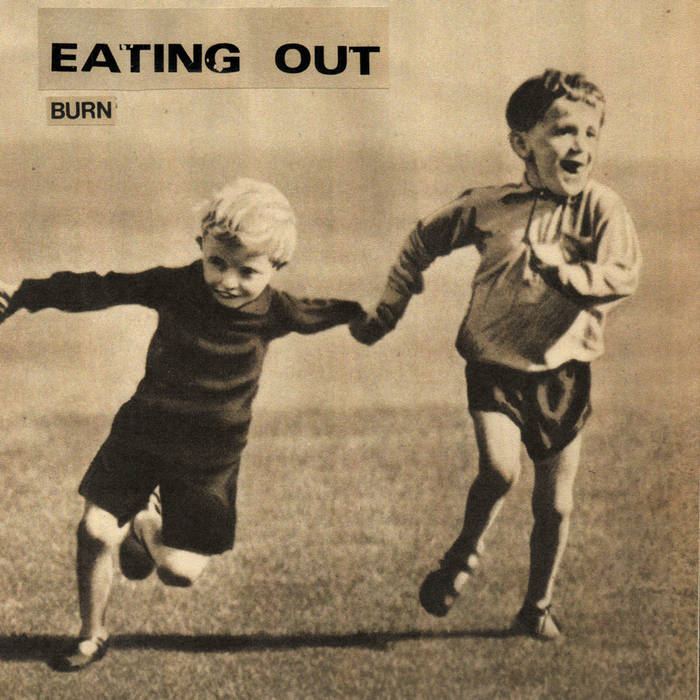
SOUNDTRACK: EATING OUT-Burn 7″ (2013).

Orville Peck has been getting a lot of attention lately.  In his act, he is a masked cowboy and his identity was (for a time) unknown.

It was fairly recently revealed that Orville Peck is actually Canadian musician Daniel Pitout (those tattoos will always give it away).

Pitout is in a couple of bands including Eating Out and Nü Sensae.

Eating Out plays a noisy grunge.  They have a bunch of one-song singles on bandcamp and this 7″ collects three of them.

Pitout is the singer (and he sounds NOTHING like Orville Peck).  I’ve felt like Orville Peck is a joke character because of the insane way he sings.  Hearing this, I’m evening more convinced of it.  But I’m glad he’s in on it.

“Burn” opens with a clean guitar intro followed by the biggest most distorted guitar around.  It’s certainly grunge and not metal and it runs through the verse and chorus.  The middle reintroduces the opening guitar riff and then the big distortion returns.  The song ends with that same clean guitar–it’s reall catchy–before crashing to a conclusion.

“Come Around” has two lead guitars (nicely fuzzed out) and a big fuzzy sound.  The sound reminds me of an updated version of SST bands.

“That’s My Man” closes the 7″ with a quiet intro.  Echoed vocals and a simple guitar melody.  It’s a poppy, almost do-wop melody with a bit of reverb drenched over the whole thing.  The song doesn’t change much, it just gets bigger as it goes along.  It’s probably the least interesting of the three, but it certainly shows Pitout looking to stretch beyond punk and grunge way back in 2013.

[READ: September 2, 2019] “To-Do”

This is a story about feminism, sex, and a woman’s relationship with her mother.

Constance is in front of a crowd of women at Antler’s Bar for Storytelling Wednesday.

She is telling them that her mother had been a beauty.  She had gotten a degree and was successful in a typing pool in New York City.  Although her boss told her that she had to cut her long hair and adopt the stylish updo of the time.  When she refused, her boss called her hysterical.  I can imagine her telling the audience: Do you know the origin of the word hysterical is the belief that the uterus could reach up through the body and and grip the throat.

The women in the audience seem agitated and bored.  Constance tries to win them over by reciting her mother’s to-do list, something she found in her mother’s effects after she died.

She tries to convince them of the significance of post its and to do lists in a woman’s life.

None of the women see it. (more…)

Read Full Post »

SOUNDTRACK: FRENCH, FRITH, KAISER, THOMPSON-“Bird in God’s Garden/Lost and Found” (1987).

The words are a poem by Rumi.   It is a slow droney song that is primarily drums from John French.  Thompson sings in his quieter style.

There are several different versions of this song. There’s an earlier unreleased version with Richard & Linda Thompson that is much quieter.  I especially like this version because after every other verse they brighten things up with a dramatic five note string riff (or maybe it’s Kaiser on the sanshin) that seems to come out of nowhere.

They spice up the middle of the song with a rollicking traditional Irish sounding fiddle melody from Fred Frith’s “Lost and Found.”  (Frith plays violin).  It adds a bit of zing to an otherwise dirgey song.

After about three minutes of the slow thumping there’s a wonderfully rocking instrumental section complete with fiddles and bass playing some wild melodies.

It was recorded on the album Live, Love, Larf and Loaf and also appears on Thompson’s collection Watching the Dark (1993).

[READ: September 1, 2019] “Nell Zink’s Satire Raises the Stakes”

I have really enjoyed the Nell Zink books that I’ve read. I’ve even read an excerpt from Doxology, the book that’s reviewed in this essay.

What I like about this essay though is the summations of her writing and her earlier books.

Schwartz says that Zink looks at life from the fringes.  She then summarizes her three impossible to summarize books in simple and amusing fashion: (more…)

Read Full Post »

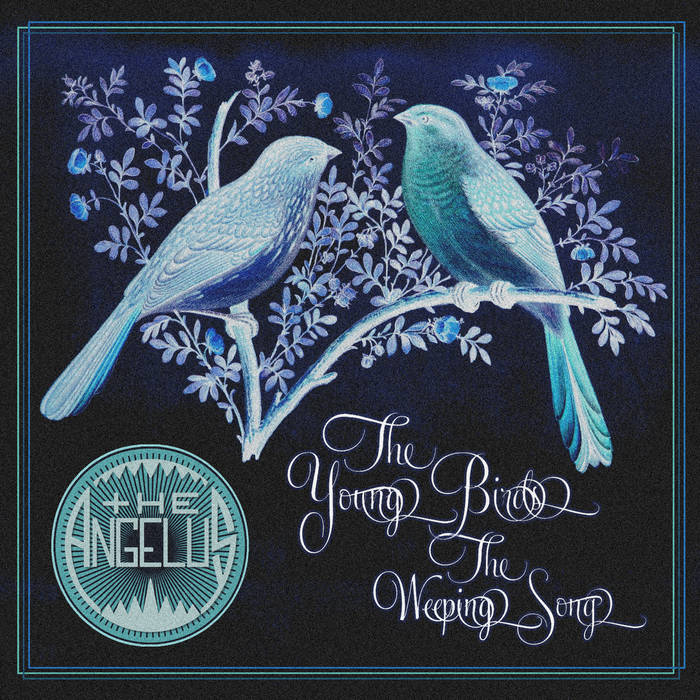
SOUNDTRACK: THE ANGELUS-“The Young Birds” (2019).

Every once in a while I like to check in with Viking’s Choice on NPR’s All Songs Considered.  Lars Gottrich specializes in all of the obscure music that you won’t hear on radio.  For this month, he did a special focus on Patient Sounds. a small label based out of Illinois.

[UPDATE: At the end of 2019, Patient Sounds closed shop. I’m not sure if any of these songs are available outside of Bandcamp].

Lars had this to say about the label

Matthew Sage, who runs the label, knows that dynamic drone, jittery footwork, oddball drone-folk, hypnagogic guitar music and cosmic Americana can exist in the same space.

The second song of the week is by The Angelus.  Lars describes the song:

Redemption often comes at the hands of something bigger than yourself, but as The Angelus’ soul-rattling doom-gaze reminds us, the love of young children will make you humble.

This song starts with crashing heavy chords–cymbals and loud guitars.  But then it settles down to a groovy death riff.  The surprise to me was when the singer began singing.  He has a soft melodic voice which totally changes this from a heavy dark song into a kind of melodic slow heavy song.  The chorus is surprisingly heavy and even ends on a kind of positive mood.

[READ: September 1, 2019] “Class Picture”

This story surprised me because it started

Robert Frost made his visit in November of 1960, just a week after the general election.  It tells you something about our school that the prospect of his arrival cooked up more interest than the contest between Nixon and Kennedy.

If Nixon had been at their school, they would have glued his shoes to the floor.

This is quite a lengthy story and there are a lot of components.  Wolff fleshes out this school very well.  So well, in fact, that I could see this being developed into a novel [It is actually an excerpt from a novel]. Although for the purposes of this story, the plot is dealt with fully.

It also makes me wonder if such a school could actually exist.  Certainly not in 2020, but even in 1960?  Because this school exhibited pride in being a literary institution. Glamorous writers visited three times a year and the English masters carried themselves as if they were intimates of Hemingway.  The teachers of other subjects (math, science) seemed to float around the fringe of the English masters’ circle.

The tradition at the school was that one boy would be chosen to meet the famous author who was coming next.  This year it is Robert Frost.  Each boy would submit an entry (in the case of Frost it would be poetry).  The author himself would select the winner.  And these meetings were a big deal to everyone on campus.

The narrator is very excited but he knows that his poems are subpar–he writes fiction.  He was on the school’s literary magazine board so he was familiar with the other great writers in his class.  There were three.

George Kellogg was a proficient writer of poetry, although the narrator found the boring.

Bill White was the narrator’s roommate.  He’d written most of a novel already and his poems were impressive.

Jeff Purcell was the third.  He was also on the literary magazine and was quick to dismiss others.  Could that translate to his own writing?

The one detour from the poetry angle is about smoking.  The school forbade smoking but a lot of boys did anyway.  The narrator said he loved smoking.  He smoked in storage closets and freezers, steam tunnels and bathrooms.  He even went out for cross-country so he could smoke while running in the woods.

If you were caught smoking you were expelled.  It happened every once in awhile.  A person was sent home just before the Frost Poem deadline.  This made the narrator quit smoking on campus.

The narrator wrote a poem for the occasion but he didn’t think it was good enough.  So he decided to submit an older one on the off chance that Frost liked it.

I won’t spoil the winner, but Frost did come to the school and he read some of his poems aloud.  During the Q&A that followed a master asked a question.  Interestingly he misstated the title of the poem.  He called it “Stopping in Woods” which Frost corrected instantly to “Stopping by Woods on a  Snowy Evening”  The master continued the question asking about iambic lines  Frost says “Good for you, they must be teaching you boys something here.”

The boys all laughed and Frost seemed pleased–had he made a mistake about the master or had he known all along?  The boys were surprised to learn later that Frost was quite funny.

The end of the story shows the winner of the contest questioning the value of his poem.  He felt that Frost mis-read it and that perhaps he won for the wrong reasons.  Should he blow off Robert Frost?  Is he crazy?

I really enjoyed this piece and found myself thoroughly engaged.  If this is part of a novel, I would be very curious to read it.  Turns out it is an excerpt from the novel Old School.

Read Full Post »

SOUNDTRACK: DEATHPROD-“Disappearance / Reappearance” (2019).

Every once in a while I like to check in with Viking’s Choice on NPR’s All Songs Considered.  Lars Gottrich specializes in all of the obscure music that you won;t hear on radio.  For this month, he did a special focus on Patient Sounds. a small label based out of Illinois.

[UPDATE: At the end of 2019, Patient Sounds closed shop. I’m not sure if any of these songs are available outside of Bandcamp].

Lars had this to say about the label

Matthew Sage, who runs the label, knows that dynamic drone, jittery footwork, oddball drone-folk, hypnagogic guitar music and cosmic Americana can exist in the same space.

The first song is by Deathprod.  Lars says:

Deathprod’s first album in 15 years, Occulting Disk, smothers dank, dark drones around the void of your soul, like a frozen hug from a cyborg teddy bear.

This song is 8 minutes long.  It consists almost entirely of a single loud distorted note/chord played on a synth until it fades into distorted crackles.  The note changes, but it is a pretty ominous soundtrack, like the slowest monster approaching you.

[READ: September 2, 2019] Blackbird

This book starts out with a very realistic concern but quickly become supernatural.

Nina was 13 years old and had a vision of an earthquake coming.  Her sister just called her a crazy baby (something the whole family called her). But moments later, the Verdugo Earthquake happened.  She and her family fled, and were almost crushed by a collapsing bridge.

But then a beautiful celestial monster came down and fixed the bridge and saved them.  The creature cast a forgetting spell over everyone, but somehow Nina remembered it all.

Despite the magical creature’s help, Nina’s life went to hell from there.  Her mother and father began fighting.  He began drinking and she died in a car accident while trying to get away from him.  Nina had been a great student but high school became unbearable.  She became “the girl who talked about magic and wizards and paragons.”

Now as an adult, she has a dead end job at a bar, is living with her sister and is sneaking painkillers.

There’s a guy, Clint, who seems to be stalking her at the bar.  I mean, he’s cute, but he’s always there. (more…)

Read Full Post »

SOUNDTRACK: NICOLE BUS-Tiny Desk Concert #882 (August 21, 2019).

Nicole Bus is from Amsterdam.  Everything about her makes it seem like she has been around for a while.  Her style of music, her raspy voice (which makes her sound older than she is) and her choice of instrumentation (the horns and flute melodies sound old school).  But she is an emerging artist:

Nicole Bus’ sound is nostalgic. It’s reminiscent of vintage R&B, yet still feels current, and can transcend age and demographics.

Her style is R&B, but her singing style is far more reggae influenced.  It’s really fascinating.  The first song, “You,” opens with spooky piano from Eugene “Man Man” Roberts and slow horns from Chris Stevens (trumpet) and Aaron Goode (trombone). I love the addition of the flutes from Korey Riker.  More and more I can’t get over how good flutes sound in rock.  Her delivery is quite reggae until she lets out with her powerful raspy voice.  The song is really catchy.

Nicole followed by premiering a new song about women’s empowerment, “Love It.”  Drummer Mark Thomas starts with drums and then switches to hand drums.  Anthony DeCarlo adds acoustic guitar while Jasmine Patton sing high note backing vocals.  I love in the middle of the song when Eugene “Man Man” Roberts play a very 70s-sounding fill on the keyboards.  Riker adds more great flutes.

She ends the set

with “Mr. Big Shot,” an up-tempo banger mixing high-energy rhythms with ragga-influenced vocals.

Nicole plays acoustic guitar and there’s a cool, catchy four note bass riff from Ray Bernard that propels the song along.  Lamarcus Eldridge joins Patton for some great backing vocals.  This melody has been stuck in my head for days now.

I’d never heard of Nicole Bus, but I really enjoyed her set and her energy.

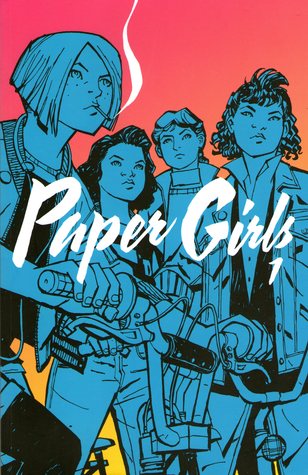
[READ: September 1, 2019] Paper Girls

This book turned out to be so much more interesting than I imagined.

The title was strangely puzzling and the cover had a kind of 1980s look to it.

It didn’t occur to me that “paper girls” meant newspaper delivery girls.

It’s coincidental that this book starts out with the main character, Erin, getting up at 4:40 to deliver papers since that’s almost exactly the same way as Middlewest in which Abel gets up at 4:30 to deliver papers.

Anyhow this story is quite different form that one because it has a cool feminist attitude, although it is also supernatural.

It begins with Erin asleep and dreaming of Christa McAuliffe in heaven.  Then she wakes up at 4:40 and gets ready to deliver the Cleveland Preserver.  It’s also November 1 (1988) as evidenced by The Far Side calendar (nice touch). The calendar has “hell morning” written on it.

Why?  Because at 4:40 on the morning after Halloween there are still hooligans roaming the streets.  One dressed as Freddy Krueger harasses Erin immediately.  But while he is giving Erin a hard time, three girls pull up on bikes and harass right back.  One girl uses some very inappropriate language which Erin (who goes to Catholic school) chastises her for.  The girl, Mac, waits for a thank you. (more…)

Read Full Post »

SOUNDTRACK: TOBE NWIGWE-Tiny Desk Concert #881 (August 19, 2019).

Tobe Nwigwe is the leader, but he shares the spotlight with his backing vocalists all of whom take lead vocal spots at some point.

The thing I like best about this set is that they are all wearing T shirts that say “My First Tiny Desk.”

There’s a wide array of sounds on this Tiny Desk too, from delicate R&B to some abrasive rapping.  I like the abrasive rapping a lot more–he has terrific delivery in that part.

Tobe’s performance was a five-song medley sandwiched effortlessly into a 15-minute block. Launching with “Houston Tribute,” he used clever and evocative wordplay to rap about coming of age in the South. Accented almost hypnotically by a trio of harmonies provided by background vocalists Luke Whitney, David Michael Wyatt and Madeline Edwards, Tobe’s mindful words are like a life hack for those seeking guidance.

The song has a gentle melody with delicate keys from Nic Humes.  The song is a rap, but a soft one.  He speaks quickly but the rhymes are positive and amusing.

My flow a monastery for them extra poor people
That don’t get commentary and get honored rarely
For the guava jelly they produce even though they get thrown fecal
Matter on a platter made by they oppressor
I shatter all the chatter that seem to make us lesser

After about two minutes Lucius Hoskins kicks in some guitar licks.  Then Devin Caldwell throws in some cool deep bass sounds making the song sound very full.

Tobe’s wife, Fat, known for her striking beauty and lead role in the magnificently directed music videos that have paved the way to Tobe’s rapid growth on Instagram. And through it all, young Baby Fat sat silently in her mom’s arms, absorbing the spiritual energy of her dad’s music.

After the song he says, “That’s how you do it June 24” (So it took two months for this to air).  Then he says “Lets teach ’em why the caged bird sings.  “Caged Bird” opens with Aldarian Mayes playing some simple drum thumping before Tobe starts rapping.

LaNell “NELL” Grant gets a lead rap mid song then after another chorus, Luke Whitney takes a high falsetto verse followed by an even higher falsetto from David Michael Wyatt.

Up next is “Against the Grain.”  Madeline Edwards takes the first lead vocal, but Ii love this song for the great raw sound of the bass and guitar and Tobe’s growling rapping delivery.

Aight, I feel like the masses on melatonin when it come to melanin
I grew up melancholy ’cause I ain’t realize that the hemoglobin in my skin
Was connected to a lineage that never ever had to penny pinch

That sound is unlike anything else in the set, although it does segue into “Shine” with more lead vocals from Madeleine.

Throughout the set he offered pleas for listeners to look past inherent hardships and evil and to keep their eyes on the prize, while he reflected on his own decision to go against his Nigerian roots and parental expectations to pursue his dreams of being a rapper.

He is very funny and says, “I’m Nigerian I know a lot of y’all though I was regular black”  For Nigerian parents, if their children haven’t done one of three things they’ve wasted their lives: become a doctor, a lawyer, or an engineer.  So you can imagine when I told my mom that I wanted to be a rapper. She said (in maternal Nigerian accent) Tobe, why are you such a parasite to my life?  Tobe, why do you love poverty so much? Tobe, why re you trying to kill me?

Legends like Dave Chapelle and Erykah Badu were telling me I was dope which is what  “I’m Dope” is about.  David Michael Wyatt sings an impressive falsetto and the song actually does mention that Chapelle and Badu said he was dope.

The credits also cite Igbo Masquerade: art.  I’m not sure what that’s a reference to.

[READ: September 1, 2019] Mystery Science Theater 3000: The Comic

I couldn’t imagine how this comic book would work with the premise of Mystery Science Theater 3000’s movie riffing.  But Joel Hodgson had an idea and it works wonderfully.

The Mads up on the dark side of the moon are still tormenting a guy up on the Satellite of Love.

This book is Netflix-era, so the Mads are now represented by Kinga, Synthia, TV’s Son of TV’s Frank (Max) and the Boneheads.  And joining Crow, Tom Servo and Gypsy on the SOL are Jonah and two small robot creatures that I didn’t recognize (I haven’t watches the Netflix episodes).

I absolutely hate the way Todd Nauck draws the host segments. I can’t stand the mouth designs on anyone, especially Kinga.  They all look like the Joker (is that because this is from Dark Knight comics?) and are horrifying.

But once you get past the art design of the host segments, the premise is pretty great.  Synthia has designed a machine The Bubbulat-r which allows a person to enter a comic book.  They test it out on Max and his favorite book Funny Animals.  Max jumps in as a rabbit can talk to the other characters.

The book explains that there’s a little bubble at the bottom of the word balloon to indicate a line that has been added and is not a line from the actual book.

But when Max comes back he tells us that the cute little bunny is in fact four feet tall with powerful sinewy limbs and reeks of a bizarre musk.

But the key point is that that Kinga has invented a way to do movie riffing from inside the comic.  So Kinga sends them comics and our heroes are inserted into different books. (more…)

Read Full Post »

SOUNDTRACK: KIAN SOLTANI-Tiny Desk Concert #880 (August 16, 2019).

I feel like listeners are more familiar with a violin than a cello.  Violins are everywhere (they’re so portable), but cellos only seem to come out when you need a bigger string section.  I have come to realize that I much prefer the sound of a cello to a violin  The cello can reach some impressive high notes (check out about three minutes into the Hungarian Rhapsody) but its the richness of the low notes that really impresses me,  Or maybe it’s just the historical value of Kian Soltani’s cello

It’s not every day someone walks into our NPR Music offices and unpacks an instrument made in 1680. And yet Kian Soltani, the 27-year-old cellist who plays with the authority and poetry of someone twice his age, isn’t exactly fazed by his rare Giovanni Grancino cello, which produces large, luminous tones. (He also plays a Stradivarius.)

I love Liszt’s Hungarian Rhapsody, and I love this one as well. What is it about Hungary that inspires such wild songs?

The Hungarian Rhapsody, by the late 19th century cellist and composer David Popper, traces its inspiration to similarly titled pieces by Franz Liszt and Johannes Brahms, but showcases a number of hot-dogging tricks for the cello, including stratospheric high notes, flamboyant slides and a specific high-velocity bouncing of the bow called sautillé. Soltani nails all of them with nonchalant elegance, backed with companionable accompaniment by pianist Christopher Schmitt.

He says that that piece was a very extrovert, out-there piece and so from this mode we take it more inward.

To prove he can make his instrument truly sing, Soltani worked up his own arrangement of “Nacht und Träume” (Night and Dreams) by Franz Schubert, replacing the human voice with his cello’s warm, intimate vocalizing.

It’s fascinating to think that this song was musically written for the piano and voice.  But he has taken the vocal track and turned it into a moving (possibly better?) version on the cello.

His parents emigrated to Austria from Iran in the mid-1970s.  He grew up in Austria and loved it as a locus of great classical music.  But he also hold on to his Persian roots.

And in the Persian Fire Dance, Soltani’s own composition, flavors from his Iranian roots – drones and spiky dance rhythms – commingle with percussive ornaments.

This is a wonderful Concert and Soltani’s playing is really breathtaking.

[READ: September 1, 2019] Middlewest

I had heard of Skottie Young as the author of I Hate Fairyland (which sounds like a children’s book but is definitely not).

This book is also definitely not for children (although I see some people think it could be for YA readers).

Abel is a young boy who lives with his abusive father.  His father, Dale, is a real piece of work. Abel’s mother left, so Dale blames Abel and is on him all the time.

As the first chapter opens, Abel has overslept his paper route (the second time in five years).  His father is very angry even if Abel has been getting up at 4:30 every day for five years. As Abel is running late delivering the papers, his friends tell him to blow it off–it’s too late anyway, just go with them to play video games. (more…)

Read Full Post »

SOUNDTRACK: half•alive-Tiny Desk Concert #879 (August 12, 2019).

This is one of the more fun Tiny Desk Concerts I’ve seen.  I didn’t think I knew half•alive but I recognized one of the songs from the radio.  They had just released their debut album, so I guess they are a New Artist.

Formed in Long Beach, Calif. in 2016, half•alive is a band with a clear vision and gift for design, not just in the earworms they write, but in their entire presentation, with often-matching outfits and carefully selected color schemes.

The band, fronted by singer and guitarist Josh Taylor, didn’t try to squeeze in any costume changes, but they do play three songs from their debut album.

 It wasn’t at all surprising to see and hear the care they took to make their Tiny Desk debut a memorable one.

On “RUNAWAY” Taylor sings in a kind of slacker deadpan chattering style (but catchy).  It’s quite a surprise when he sings a rather impressive falsetto in the chorus.   J Tyler Johnson plays a groovy Wurlitzer.  This is the only song with strings (Emiko Bankson: violin; Callie Galvez: cello)

I was really surprised to find that I’d heard “still feel.” before as I didn’t know this band’s name (and never knew what the song was called).  Joshua Taylor plays guitar on this song a wicked wah wah riff.  Johnson switches to bass and plays a cool funky riff throughout.  In fact this song has a massive disco feel and the falsetto vocals in the chorus really sell it

For this song, the strings have been replaced by Jordan Johnson and Aidan Carberry credited with choreography.  For this song one of them reads a book while the other is playing with a Rubik’s cube.

Well before arriving for this performance, the three guys in half•alive asked for the exact dimensions of the space behind Bob Boilen’s desk. Known for their live shows, with elaborate, synchronized dancing and costume changes, the group naturally wondered how they’d pull everything off in such a cozy space.

Their solution? Have the dancers sit for the performance. The choreography, now restricted to the width of two chairs, was incredible. You’ll see how it all works on the final song

The final song is “ice cold.” a new track from the band’s just-released debut full-length, Now, Not Yet.  For this song, drummer Brett Kramer switches Septavox while Johnson is back on Wurlitzer.  Taylor switches to acoustic guitar, but honestly who can even tell what’s happening musically because Jordan Johnson and Aidan Carberry have created an elaborate choreography.  Whenever they are on camera its impossible not to look at them.

I’m not sure if the song is any good, but I’ll be they’re a lot of fun to see live.

[READ: August 31, 2019] Crowded

I’m not sure what attracted me to this book.  The cover was certainly interesting and the visual style was cool.

But I’m so glad I read it because it is a funny (and violent) story that is all an elaborate take on crowd sourcing and social media.

The first chapter opens with a dialogue on the Dfender app. Charlie Ellison has hired Vita to Dfend her.  It turns out that someone has posted a bounty on her head on the Reapr app.

Charlie explains that she started the morning by cleaning her house for a couple who were Padhopping it for the weekend.  Then she drives for both Muver and Drift.  Then she loaned out her car for the day on Wheelsy and rented out a dress on Kloset.  Then she took a job on Dogstroll and on Citysitter *(the children seem unlooked after).  She ended her day by taking a job from Palrent to sit with an old man who feeds pigeons.

She hooked up with a guy at the bar before bed and snuck out in the morning.  That’s when the first person tried to kill her.

It was an old lady with a gun.  Charlie threw her coffee in the woman’s face, took the woman’s little dog and ran away because that’s when the second person tried to kill her.

Vita shows her the Reapr app and that the reward for killing her is over a million dollars. (more…)

Read Full Post »

oct30SOUNDTRACK: NEIL YOUNG-Arc (1991).

arcArc came with Neil Young’s outstanding live album Weld (and then later on its own).  It contains one 35 minute track called “Arc (A Compilation Composition).”

This album was recorded during Neil Young’s tour with Sonic Youth opening (MAN, I wish I had seen that tour).

Because it was 1991 and you couldn’t really look up this kind of information, I just assumed that Neil and Crazy Horse had created some kind of 35 minute jam (even though it doesn’t really sound like all one song, but how closely does one listen to Arc?).

Of course, listening to it now, it is pretty obvious that it’s pieces of shows strung together.  (the subtitle also gives it away, although I don’t think that the subtitle was on the actual disc).

Wikipedia talks about an interview that Neil Young gave in which he says he recorded a film in 1987 called Muddy Track

 which consisted of the beginnings and endings of various songs from his 1987 European tour. Young placed a video camera on his amplifier during the 1987 tour and recorded the beginnings and endings of various songs, and later edited them down into the film’s soundtrack. “It was the sound of the entire band being sucked into this little limiter, being compressed and fuckin’ distorted to hell,”

And in what makes 100% sense, on this 1991 tour,

Young then showed the video to Sonic Youth’s Thurston Moore, who suggested that he record an entire album in a similar manner. However, Arc was not recorded through video camera microphones, as was the case with Muddy Track, but instead was compiled from various professional multi-track recordings made throughout the tour.

So what you get is 35 minutes of noise (not so much feedback, as guitar rumblings that a band might do as a song slowly grinds to a rumbling halt).

You can hear snippets of vocals.  In particular, you can hear him singing “Like a Hurricane” and “Love and Only Love” in what definitely sounds like the end of a take–as the band’s instruments ring out.

There’s occasional moments where the rumble is interrupted by a burst of drums from Ralph Molina or you can clearly hear some of Frank “Poncho” Sampedro’s guitar and univox stringman.

There’s a little bit of audience response.  At the opening of the disc but especially at the 25 minute mark as a song feedbacks out and the crowd cheers before the band puts out  rocking drum-filled cacophonous ending.

At 28 minutes the “song” actually sort of turns into an actual song with Billy Talbot playing a simple four note bass line.  But that doesn’t last too long before another ending is tacked on.

The last few minutes has someone singing “No more pain” and then shouting a story that is somewhat inaudible although I think I hear “mom” and “post office.”

This is certainly not something to listen to much.  But I found it an interesting sonic experience today.  if nothing else, it made me really wish I had seen that 1991 show.

[READ: August 30, 2019] “Beyond the Pale”

I really like Nick Hornby’s music (and book) reviews.  He and I don’t share the same taste, but we have a lot of moments that overlap (he’s more traditional while I’m more experimental).

In many ways it is no surprise that he hated Radiohead’s Kid A, but the amount of savagery he does to it is quite astonishing.

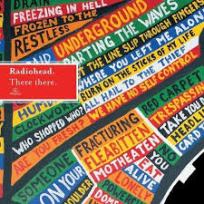
He essentially compares it to Lou Reed’s Metal Machine Music and Neil Young’s Arc.  Not in content, but in the giant middle finger he feels it is to fans of the band.  Although he does admit that Kid A is “nowhere near as teeth-grindingly tedious” as Metal Machine Music.

He feels that the album stems from the idea that fans are interested in “every twist and turn of the band’s career no matter how trivial or pretentious.”  Although a valid question is what has earned Radiohead its huge audience.  I have not figured that one out myself. (more…)

Read Full Post »

« Newer Posts - Older Posts »