Feeds:
Posts
Comments

Archive for the ‘Jonathan Franzen’ Category

peanuts4SOUNDTRACK: BRIAN COURTNEY WILSON-Tiny Desk Concert #76 (August 25, 2010).

bcwBrian Courtney Wilson is not Brian Wilson. Rather, this Wilson sings  lovely religious songs.

This is an overtly Christian performance and as such I did not really enjoy it. Having said that, his voice is terrific and his backing vocalists are subtle and uplifting without overpowering the music.

He sings three songs: “All I Need” “Believe” and “Already Here.”  For some reason, there’s no video for “Believe” so you have to listen to the audio only track to hear it.

[READ: September 29, 2015] The Complete Peanuts 1957-1958

Some new themes emerge in this, the fourth volume of the Complete Peanuts.  Charlie seems to get branded with the “wishy-washy” curse a lot more (except when it’s raining and he’s not willing to give up his baseball game).

The angst is getting heavier now too with Charlie Brown saying “sometimes I think my soul is full of weeds).   Then in April 1958 he says “It always rains on the unloved.”   Even the normally chipper Snoopy (who at one point says “to live is to dance, to dance is to live”) gets a little mopey and introspective “when I was a puppy every day was a happy day suddenly bang, and I’m in my declining years.”

I feel like Lucy and Linus are showing up a lot more.  And Pig-Pen, really a one-joke character is appearing less but has not been forgotten.

I particularly enjoyed the concern that the earth was overpopulated (from Lucy).  And after she says “The earth can’t feed this many people” Linus replies “Why Don’t You Leave?” (more…)

Read Full Post »

zinkSOUNDTRACK: PAUL WELLER-Tiny Desk Concert #457 (July 28, 2015).

wellerPaul Weller is a highly regarded and well respected elder statesman of rock.  Some of his songs with The Jam are my favorite songs from the 80s.  Weller hops from genre to genre quite a lot, and I did not care for The Style Council at all.  So even though he’s been making music forever, I haven’t really paid him much attention.  In this tiny Desk, he brings a fairly large band (6 people (4 guitars!)) to sing an acoustic collection of songs. There’s a drums (just a snare) and a percussionist too. And everyone sings.

His voice sounds fantastic—older but still really strong.

They play four songs. Three are from his new album Saturns Pattern.  Like “Dusk Til Dawn” which is a delightful folk song.  The band sounds really loud, or not loud but big, like there are really 6 people out there.   This is especially true on “I’m Where I Should Be” which also has some great harmony vocals and percussive guitar techniques.  I love how much the harmonies contribute to the song and the general song structure is great.

“Out of the Sinking” goes back to Weller’s most popular album Stanley Road (which I don’t know). It’s a wonderful song.  It showcases Weller’s gruffer vocals and nice finger picking. There’s some more great harmonies from the bongo player.  And the song has a real nice campfire song feel (it reminds me a bit of Van Morrison’s folkier songs).

For “Going My Way” Weller switches to piano. It’s a simple song with some great backing vocals and harmonies, (and hand claps), although I prefer the middle two songs.

I hadn’t really given much thought to Weller in the last few decades, but this set was really enjoyable.

[READ: August 7, 2015] The Wallcreeper

This is Nell Zink’s first published novel (she has another novel, 1998’s Sailing Towards the Sunset by Avner Shats) which I read about that I would love to find, but I don’t think it has ever been published).

I really enjoyed Zink’s Mislaid and wanted to see what her earlier work was about.  There was an article in the New Yorker which gave an interesting background to this story which involved a long correspondence with Jonathan Franzen and resulted in a book that I would suggest is not completely unlike something he might create–expect that it is way shorter and slightly more erratic.

Zink does not follow conventional story structure exactly.  This is not to say that the story is weird or avant garde, not at all.  She just doesn’t like to set things up conventionally.  For instance, the first sentence of the story is: “I was looking at the map when Stephen swerved, hit the rock, and occasioned the miscarriage.” (more…)

Read Full Post »

freedomSOUNDTRACK: CRASH TEST DUMMIES-Jingle all the way… (2002).

ctdEven though the Crash Test Dummies are often seen as a joke band or a one hit wonder (which I guess they are), I’ve liked them for a while (their earlier stuff a lot more than their later stuff, admittedly).  But it seemed like they’d have a fun take on Christmas music.

And it starts out in a comical sort of way with Brad Robert’s deeper-than-ever voice reciting about his life in Los Angeles, where it is warm and sunny at Christmas time.  I like that he rhymes 24th with up north.  The spoken section is quite loud in the mix (it sounds like he is right in your ear).  Unfortunately, that is the case when he starts singing too–he is uncomfortably loud in the mix and it sounds like he is holding back because of it–he doesn’t sound great and his voice sounds more comical than interesting.  Which is a shame because the music (with cheesey keyboards) is great.

Roberts sings lead on about half of the songs.  Ellen Reid sings lead on the other half except for a couple where they split lead duties.

The rest of Robert’s songs include: “Jingle Bells” (which is certainly comical–it sounds like a chain gang song with the “Hey!s” sounding almost like a prison chant).  It’s weird and cool though (even if his voice is once again too loud in the mix).  “God Rest Ye Merry Gentlemen” has his voice mixed much better–he seems to be really singing.  And this version–a loungey/jazzy rendition is much great fun.  “God King Wenceslas” sounds proper (with Reid’s close backing vocals).  It has a pretty penny whistle keeping the song going.

Ellen Reid has a great voice and I love hearing her sing.  But in the first two songs she sings lead on in this disc she sounds like she is singing too slowly.  “O Little Town of Bethlehem” especially sounds like the music is going to pass her up at any minute.  I also don’t like the country vibe of the song.  “In the Bleak Midwinter” is also (intentionally) slow, which I don’t like.  Perhaps I just don’t like this song (although I do think the melody is lovely).  “The Little Drummer Boy” is beautiful and Robert’s bass backing vocals are perfect.  “Silent Night” is done in a countryish style, but I like this version.  Although normally this song can make me cry, this version absolutely does not–too honky tonkish.

The final song, “The Huron Carol” is quite formal and proper–just Reid and a piano opening the song.  It sounds very holy, very pretty.  When Robert’s bass backing vocals come in, it adds more depth to the song.  And it’s a lovely way to end.

[READ: October 30, 2014] Freedom

I read this a couple months ago and then got so caught up in reading other things that I never got around to posting about it.  And that’s a bummer because I really liked the book a lot and I fear that I won’t remember everything I wanted to say about it.

I had read a couple of excerpts from the book in the New Yorker (quite some time ago).  They were helpful in grounding the story for me, but they didn’t prepare me for the breadth of the story.  It follows one family, the Berglunds, through several decades, focusing on each of them in great detail as they navigate through the Reagan, Bush, Clinton, Bush and a smidge of the Obama years.

The Berglunds are a liberal family.  They were among the first white families to move onto their urban street in St. Paul, Minnesota (after white flight to the burbs).  Patty is a charming (some say smug) homemaker and Walter is a lawyer (public defendant, naturally).  They have two kids, Jessica and Joey.  Patty dotes on Joey to an embarrassing degree (Joey is embarrassed by it, Jessica is infuriated by it and even Patty is kind of embarrassed when she really thinks about it).  At the same time she is rather neglectful of Jessica.  Naturally, Jessica becomes quite the success (loves reading, committed to the environment), while Joey rebels and finds all kinds of ways to disappoint them and make money.  (This isn’t a bad thing, but the family has plenty of money and Joey doesn’t need to (especially not the way he goes about it).  Not to mention Walter and Patty are not into the money for money’s sake thing.

The book opens that there was some “news” about Walter. He and Patty had moved to Washington DC two years earlier.  He clearly did something bad (we won’t find out until much later).  But that serves as an introduction to the Berglunds.  And then we go back to see them, years earlier, settling into St Paul. (more…)

Read Full Post »

krausSOUNDTRACK: THE FLAMING LIPS-The Terror (2013).
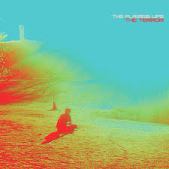
terror After the distortion heavy and heaviness of At War with the Mystics and Embryonic (to say nothing of their other experimental releases), I wasn’t sure what to expect from an album called The Terror.  Yet with a title like that the album is far more invested in psychological terror than in pummeling you with scary noises and music.  The album is more unsettling and spooky with existential dread.

Wayne Coyne has always been a pretty optimistic guy–weird, sure, dealing with feelings of dread, sure, but never so dark and insular.  But I learned that before recording this album and most likely as an impetus to record it,  Coyne separated from his partner of 25 years, Michelle, and Lips multi-instrumentalist Steven Drozd temporarily relapsed into addiction.

In an interview, Drozd says the album is like a crisis of life confidence.  He also says that the uniformity in sonic style was intentional: “Instead of writing songs and then figuring out sounds, we’d write the other way around: create sounds then make songs out of those sounds.”

So the vocals are quite low in the mix, and there is not a lot of “music” in the album.  Rather there are layers of sounds–swishing synths, spiraling noises, percussion effects that seems to almost cover up the vocals, giving it a very claustrophobic effect.  “Look… The Sun Rising” opens the disc.  It is primarily percussion with some noisy sounds and really sharp piercing guitars (that play noisy counterpoint to the soothing chorus of Oh Oh Ohs).  And yet after all of that noise and chaos, the very lovely “Be Free, A Way” surfaces as a quiet introspective song.  There are gentle keyboard notes (not unlike on Yoshimi) that propel this song along.  “Try to Explain” is a pretty song with some unusual sound effects swirling around it (The Lips can’t so straight up pretty, right?).  And yet lyrically, this song, along with the rest, is very dark indeed.

“You Lust” is a 13 minute (!) invocation about various forms of lust.  It opens with the couplet: “You’ve got a lot of nerve/A lot of nerve to fuck with me.”  The middle of the song is a kind of Pink Floydian keyboard workout.  It’s a  lengthy jam that’s kind of samey, but I’ll bet if you can really sit (with headphones) and close your eyes and focus it’s pretty intense.  After about ten minutes of that repetitive claustrophobia, some lightening occurs with sprinkled keyboard notes.

“The Terror” is primarily in Coyne’s falsetto, and it seems gentle until the mechanized noises come bursting forth.  “You Are Alone” is the shortest thing here, under 4 minutes of squeaking noises.  And again, a lovely melody despite the title.  I feel like this song summarizes the album pretty well.  In it, Coyne sings “I’m not alone” while a deeper voice replies, “you are alone.”  Whose voice will ultimately win?

  “Butterfly, How Long It Takes to Die” returns to that abrasive guitar of the earlier tracks, but the main body of this 7 minute song is just bass, keening keyboards and Coyne’s whispered voice.  There’s a recurring synth line that is magical and/or creepy depending on your frame of mind.  It, along with many of the other songs, have a kind of coda that links the songs.  This one is mostly just choral voices, but it twists the ends of the songs in a different direction. “Turning Violent” is a quiet track, in which Coyne sounds nearly defeated until the second half of the song grows louder and more animated with layers of vocals.  The disc ends with “Always There…In Our Hearts” which seems to offer some hope…maybe.  There’s signs of uplift in the melody, and when the drums kick in at the end, it seems to propel the song into a more intense frame of mind.

And lyrically, despite all of the darkness that is always there in our hearts, there is a light peeking out: “always therein our hearts a joy of life that overwhelms.”

Although most reviewers find this album unremittingly bleak, I find the music to be beautiful in an aching sort of way–a beautiful way to deal with pain (better than getting the same tattoo as Miley Cyrus, anyway).

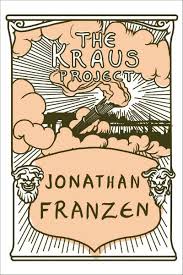
[READ: October 31, 2014] The Kraus Project

The title page of this book read: The Kraus Project: Essays by Karl Kraus translated and annotated by Jonathan Franzen with assistance and additional notes from Paul Reitter and Daniel Kehlmann.

So just what is this thing anyhow?  Well Karl Kraus was a German writer (1874-1936) whose main contributions to letters were some essays and a newsletter Die Fackel (The Torch).  The authors compare the newspaper (favorably) to a blog (while also complaining about what blogs have done to letters).  He started Die Fackel in 1899 and he continued to direct, publish, and write it until his death.  He used the paper to launch attacks on hypocrisy, psychoanalysis, corruption of the Habsburg empire, nationalism of the pan-German movement, laissez-faire economic policies, and numerous other subjects.  For the first ten or so years, Kraus was the editor, accepting contributions from around the German speaking word.  But in 1911, he became the sole contributor to the newsletter.

He also wrote many essays (he did not care much for fiction), including the two main ones that compression this book: “Heine and the Consequences” (1910) and “Nestroy and Posterity” (1912).  The book also includes two follow up essays: “Afterword to Heine and the Consequences” and “Between Two Strains of Life: Final Word to Heine and the Consequences” (1917) and a poem: “Let No One Ask…” (1934).

The essays themselves are quite brief.  Despite the first coming in at 135 pages, note that the left pages are all in German (so reduce 135 by half), nearly all of the English pages are filled with footnotes (reduce by half again) and some of the footnotes run for several pages.  So the essay could be said to be about 25-30 pages.

The same is true for all of the pages in the book.  The left sides are in German (except the footnotes) and most pages are split in half because of the footnotes.  Which means that Franzen and friends write far more than Kraus did.  Ultimately, this book is actually three things: It is a collection of Kraus’ essays with Franzen’s fine translation; it is an explication of Kraus’ attitude and about life in Germany during Kraus’ life and finally it is an insight into Franzen as a young man living in Germany and why Kraus was so appealing to him.

The first part: Kraus’ essays. (more…)

Read Full Post »

harper septSOUNDTRACK: LINDA THOMPSON-“Love’s for Babies and Fools” (2013).

lindaAfter two pop songs, here’s a major bummer from Linda Thompson.  Thompson is a fascinating figure.  She was married to Richard Thompson and made many albums with him.  They split very acrimoniously and them Linda suffered from psychogenic dysphonia, which rendered her incapable of singing.  She stopped singing for 11 years.  Now with botox injections into her throat she can sing again, but cannot perform live. She released an album n 2002 (Richard played guitar on a track) and another album in 2007.  Now’s she’s back and Richard plays on this song as well.

In the grand tradition of folk music, Linda’s lyrics are achingly straightforward and powerful:

My father is a traveler, he has a cuckold’s luck,  my mother is a queen but her hands are tied with blood. I’ve a brother in the graveyard, my sister has the blues.  I care only for myself.  Love’s for babies and fools.

The guitar work is beautiful, the song itself is beautiful and depressing at the same time.

Linda’s voice has always been unique—almost otherworldly and yet ordinary at the same time.  It’s strange and mesmerizing.  Welcome back Linda.

[READ: October 1, 2013] “A Different Kind of Father”

This is an excerpt from a new book by Franzen. The book itself is fascinating.  It is a translation of a “Nestroy and Posterity” a somewhat obscure essay from 1912 by the Austrian satirist Karl Kraus.  Franzen’s book is called The Kraus Project and in addition to the translation, Franzen includes a ton of footnotes that are all personal, like this one.  The book is 300 some pages and it sounds like the majority of it is footnotes.  [For those who like to keep track of Franzen’s connections to David Foster Wallace, of course this collection with footnotes does make one think of DFW.  Interestingly, Franzen talks about a book he was writing in 1981 (long before he met DFW which had a main character whose name was Wallace Wallace Wallace].

This footnote (no context is given) is all about the concept of thriving as a man by surpassing your father.  Be that literal or figurative (or literary).  In the case of Kraus, Franzen says, he is denying false paternity.  It was believed that Kraus was the literary son of Heinrich Heine, but Kraus tries to annihilate Heine by dismissing his successes and impugning his character.  However, Johann Nestroy was also a precursor to Kraus but Nestroy was a somewhat neglected and undervalued one, and so Kraus seeks to place Nestroy as his surrogate father. (more…)

Read Full Post »

[ATTENDED: October 4, 2013] Richard Thompson at the McCarter Theatre

Back again for the (semi) annual Richard Thompson show at the McCarter Theatre.  RT himself said this was his 15th year playing there more or less every year.  And it seems like quite a lot of the concertgoers were multi-year attendees.

This time, Richard Thompson’s son Teddy opened.  About fifteen years ago I saw Teddy open for Richard in Boston.  That set was really enjoyable and I bought Teddy’s debut album.  But I haven’t thought all that much about him since (he has released a number of albums since 2000).

I spent some time at this show thinking about how strange it must be to tour with your father if he is a guitar wizard.  Teddy is not a guitar wizard and doesn’t try to be one.  [There’s an article that I’m going to be posting about in a few days by Jonathan Franzen which  deals with coping with successful fathers, so it was on my mind].  Indeed, in an article from a few years ago, Teddy said that at first he never listened to his parents music because it was folkie and he like rock.  But after a while: “I started to be more aware of how much people loved [my parents],” he said. “When I started doing (music) for a living, I felt, ‘I’m not as good a guitar player as my dad. My voice isn’t as good as my mother’s.'”  His mother is Linda Thompson who does have an amazing voice.  So it must be intimidating to be on with a guy that is so good and so beloved.

But Teddy has a great voice as well (more powerful than Richard’s), he sounds a bit like Neil Finn from Crowded House.  Teddy played about a dozen songs.  I actually didn’t recognize any of them, but I enjoyed them all.   As I said his voice is strong–and is really the selling point, because while the melodies are very good, they are also rather simple.  I don’t know that anything was as catchy as the songs by his dad, but of course plays a very different style of music–a kind of country folk with an occasional hard edge (both Thompsons only played acoustic guitar for this show).

I don’t know what their relationship is like (I always assume that famous (relatively) people’s children hate them.  But it was clear that Richard was proud of his son when he came out.  (more…)

Read Full Post »

lp8.1SOUNDTRACK: TYPHOON-“Dreams of Cannibalism” (2013).

typhoonNPR was steaming this album for a while.  Now they’re giving away this song.

Typhoon is yet another band that has a crazy amount of people in it (between 12 and fourteen) and they have a vast array of instruments in play at any one time (Horns, violins, xylophones, electric guitars and mandolins for example).

At the same time, Singer Kyle Morton’s vocals are distinctive enough and are used like an instrument as well as to deliver lyrics.  This gives them quite a unique sound.

The song opens with an array of horns slowly building to a simple guitar melody.  The verses are somewhat quiet with occasional punctuations of band (and great backing vocals).  But as the song progresses, more instruments kick in (horns adding a melody line).  I really like the way the end of the song shifts direction totally, bringing in a complex instrumental section with interesting time shifts and even better backing vocals..

I enjoyed the whole album while it was streaming.  And while I can’t say that this song stands out more than the other songs, (I think “Artificial Light” is probably the best,) it represents the sound of the band pretty well.

[READ: September 2013] Lucky Peach Issue 8

I haven’t been reviewing Lucky Peach issues in their entirety because they are mostly about food and cooking and recipes and I don’t really have anything to say about that (I enjoy the articles a lot, but I don’t need to comment on them).

But I wanted to bring special attention to this issue because of the way it is presented.  This is the Gender Issue.  It has two covers (see the “female” cover tomorrow) and the magazine must be flipped over to read the different genders.

It’s not often that I think of food and gender as being connected, but there are some really interesting articles in here that talk about not only food itself, but about the people who prepare it.  Like the fact that most big name chefs are men even though cooking has traditionally been “women’s work.”

The women’s side of the magazine has these interesting articles: (more…)

Read Full Post »

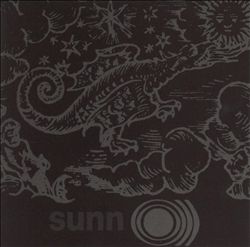
SOUNDTRACK: SUNN O)))-Flight of the Behemoth (2002).

I hadn’t really heard Sunn O))) until this record (which may not be typical as they collaborated with Merzbow on this one).  I knew that Sunn O))) played loud droney “music.”  And so it is here.  On “Mocking Solemnity” (9 minutes) and “Death Becomes You” (13 minutes) (which meld into each other seamlessly), the songs are mostly slow drones on electric guitar.  The chords are heavy and heavily distorted and they ring out for a few bars–not until the chords die naturally, there is a kind of pacing involved, but for a few bars until the chords are played again (often the same chord).  This is for those who thought Metal Machine Music was too complicated.

On paper this sounds unimpressive (or downright awful, depending) but in reality it is a very physical experience (if played loud enough).

The staticy noise of “Death” melds into track 3 “O))) Bow 1” which adds what sounds like radically modified piano playing a kind of melody.  It’s about 6 minutes and it really changes the tone of the record to suddenly add an atonal racket to the almost calming drone of the bass.  But by the middle of the song, the piano becomes what sounds like a chainsaw.  Merzbow mixed that track and  “O))) Bow 2” which is 13 minutes of the same slow pulsating noise.  It’s not exactly soothing.

The final track is “F.W.T.B.T.” a “remake” of “Metallica’s “For Whom the Bell Tolls.”  I can’t hear a thing that sounds like the original, but that’s what makes a cover interesting.  Although admittedly around the four and a half minute mark there’s some faster chords (for this band anyhow) that could be Metallica-like.  There are also drums (and vocals, although I have no idea what they are saying) on this ten-minute workout.

Not for the faint of heart (or fans of melody).

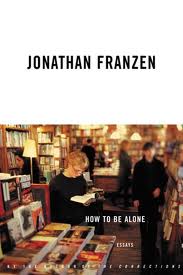
[READ: November 17, 2012] How to Be Alone

I read most of the articles in this book already.  But I read them over two years ago, so I thought it would be safe to wade into the world of Franzen again.  What I find most interesting about the title of this book is just how many of these articles are about being alone, wanting to be alone or feeling like you are alone.  Obviously that is by design but it seems surprising just how apt the title proved to be, especially given the variety of subjects  his father’s brain, being a novelist, the US Postal Service, New York City.

I’m not going to go into major detail about each article this time, although I am providing a link to the earlier review–my feelings didn’t really change about the pieces (except that from time to time I got a bit exhausted at his…whininess?  No, not that exactly…maybe his persecution complex.  But I will give a line summary about each one just to keep everyone up to speed.  The four pieces that I hadn’t read before I will give a few more words about.

One overall feeling is that when Franzen isn’t writing about the state of the novel (which he is very passionate about) his articles are well researched well documented which is kind of surprising given the state of panic he seems to be in the novel articles.  It’s also kind of funny how out of touch these articles seem (some are almost 20 years old and are kind of laughably outdated), but it’s also funny to see how poorly his predictions panned out.  The death of the novel is rather overrated (just see the success of his own Freedom.

So the book contains: (more…)

Read Full Post »

SOUNDTRACK: KISS-Animalize (1984).

This year, 1984, was the first time that I saw Kiss live.  Sadly I remember more about the opening band (Loudness) asking if New York was having a good time (and the fans screaming that we were in New Jersey). But I still have my booklet from the show and I do remember a few things from the show (again, sadly they were not in makeup).  So this album holds a special place for me, even though in retrospect it’s not as good as Lick It Up.

“I’ve Had Enough (Into the Fire)” starts the album off with a bang—blistering solos from new guitarist Mark St. John.  But, as with Lick It Up, the album for me is overshadowed by the (massive) single.  “Heaven’s On Fire.”  It’s such a lame little sing-along (and yes I do remember that song from 1984 show—Paul really milked it).  But man it’s such a bad song.  Musically, “Burn Bitch Burn” is interesting, but what were they thinking with those lyrics “I want to put my log in your fire place…burn bitch burn?”  That’s a far cry from “I am the doctor of love.”  “Get All You Can Take” is, to my knowledge, the first time Kiss has said the word fuck in a song (“What fucking difference does it make?” Is sung by the deeper response voices in the chorus.  It’s a catchy song with an interesting riff.  “Lonely is the Hunter” has a kind of 70s southern rock feel.  It also seems to be calling back to some earlier songs in the style of singing—which only reminds you how much better the earlier song was.   The band is relying a lot on call and response vocals on this album.  And they’re okay but seem like a something of a crutch..

“Under the Gun” continues as another sort of generic fast rocker from this era.  “Thrills in the Night” is one of my favorite songs on the disc–it sounds so much like Kiss of the 70s.  And with Paul’s vocals and the guitars, this could have come off of his solo album.  “While the City Sleeps”  is a fairly uninspired Gene song.   None of these songs are bad, really, they’re just not as exciting as they might be.  “Murder in High Heels” has more of that 70s rock swagger that Gene likes to pull off.  It’s just not always clear that the 70s swagger rock works well with the heaviness of other songs on the record, like the band wasn’t sure which direction to go in.  So even though this disc is the one that brought me back to Kiss, it has some good songs, but it doesn’t really hold up all that well.

[READ: August 1, 2012] Desperate Characters

David Foster Wallace, Jonathan Franzen and Tom Bissell have all championed this book.  Bissell was instrumental in getting it republished once it went out of print.  Franzen wrote the introduction to the newly published version.  David Foster Wallace blurbed the book: “A towering landmark of postwar Realism….A sustained work of prose so lucid and fine it seems less written than carved.”  It was also on his syllabus.  Zadie Smith has also written favorably about Fox’s fiction.

So why did it take me so long to read this book?  (I read the original version, which is what the library had.  I’m curious about Franzen’s introduction and will get to it eventually).

S. knows Paula Fox as a children’s author, which surprised me even more when I read the grittiness of this book.

It is submerged in downtrodden New York City of the late 60s, where people throw garbage out their windows, where racial tensions run high and where everything feels dirty.  This powerful description late in the book sums up the attitude about the City:

They drove through miles of Queens, where factories, warehouses, and gas stations squeezed up against two-story, two-family houses so mean and shabby that, by contrast, the ranks of uniform and tidy tombstones rising from cemetery islets that thrust up among the dwellings seemed to offer a more humane future. Sidewalks, brutal slabs of cracked cement, ran for a block or two, then inexplicably petered out, and along the center of the tarmac streets, short lengths of old trolley tracks occasionally gleamed among the potholes. Here and there, the skeletons of a vast new apartment complex sat on the rent ground; tree roots and rocks and earth rolled up around its foundation. Cries of boredom and rage were scrawled across the walls of factories, and among these threats and imprecations, invitations and anatomy lessons, the face of an Alabama presidential candidate stared with sooty dead eyes from his campaign posters, claiming this territory as his own. His country, warned the poster – vote for him – pathology calling tenderly to pathology. [For those ignorant of history like me, that candidate was George Wallace.  This was his third time running, this time as part of the American Independent Party].

But that’s just the descriptions.  What is this story about?  Simply, it is about Otto and Sophie Bentwood, a successful childless couple living in Brooklyn.  Otto is a lawyer, and, Sophie is a successful translator (I liked that Sophie was employed and not “just” a housewife).  But Sophie hasn’t felt up to translating lately and Otto’s successful practice hits a bump when long time partner Charley decides to leave to work on more important causes.

Otto is rather cut off emotionally–Charley has been his friend and partner for decades yet he can barely muster a proper goodbye when he steps out the door.  And while Otto and Sophie are mostly happy, he has more or less pushed her into the arms of another man.  She looks back on this brief affair with fondness.  However, the fact that the affair is never suspected and the fact that it ended the way it did are just more indignities that Sophie has to suffer.

But what sets off the action in the story is an act of kindness.  Sophie sees a cat that is hanging around the alley behind their brownstone.  Amid the people throwing garbage out the window and hanging up sheets to act as curtains, Sophie decides to do a nice deed for this cat.  She brings it some milk. It hungrily laps up the milk and when Sophie goes to pet it, it bites her really hard on the hand.  And literally the rest of the story follows the swelling of her hand. (more…)

Read Full Post »

SOUNDTRACK: ULVER-Shadows of the Sun (2007).

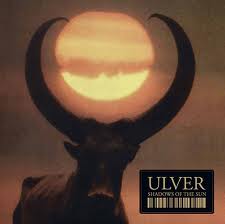
I really wanted to like this album because of the cover–which is striking.  I know, I know, never judge…  My initial reaction to the disc was kind of poor.  I’ve followed Ulver’s progress through their many incarnations, and it’s not entirely surprising that they should make an entirely ambient record.  It just strikes me as an odd release–mellow and almost lullaby-ish but also a little creepy (the voice mostly).

But at the same time, musically it’s quite pretty.  And while it wasn’t a very good listen for a car trip to work, it was actually really perfect for listening to at work–where headphones allowed for hearing so many nuances.

There’s not much point in a song by song listing, as the songs are similar–washes of music with slightly distorted, deep vocals.   But there are some interesting musical choices that make each song unique, and consequently better than a lot of ambient in which all of the songs use the same musical palette.  “All the Love” employs piano and come cool electronic sounds near the end.

“Let the Children Go” is a much darker song (with drums!).  “Solitude” is the most melodic song of the bunch.  It reminds me of Black Sabbath’s “War Pigs” (which should tell you something about the overall tone of the album).  It has a noticeable vocal line (and really audible lyrics, which are quite melancholy and more emotional that I would have expected: “You just left when I begged you to stay.  I’ve not stopped crying since you went away.”

Another observation.  At times when he actually sings, the vocals sound a bit like XTC–“Shadows of the Sun” in particular.  And since that song has pianos it’s not inconceivable that this could sound like XTC (although not really).

With the right atmosphere, this record proves to be a very impressive listen.  Kristoffer Rygg’s vocals really suit the mood and, all in all, it does reflect the album cover rather more than I initially thought.

[READ: March 18, 2012] The Marriage Plot

I had put this book on hold a few months ago.  And I was ninety-something on the list, so I didn’t think too much about it.  I looked the other day and I was 10.  Yipes.  How was I going to read this 400 page book  in three weeks while also reading Gravity’s Rainbow??

Well, amazingly, The Marriage Plot worked as a nice foil to GR. It is a supremely easy read.  It is completely uncomplicated.  And, it actually has some unexpected parallels to GR–specifically, two of the characters travel to Europe, one on a pilgrimage the other on a honeymoon, and they travel to Paris, Geneva, Spain, Zürich, and even Nice.  There is literally no connection between these two books (although Mitchell does bring Pynchon’s V along with him), but it was fun to see new people go to the cities that Slothrop has been traveling to for very different reasons.

I powered through the book, reading large chunks and staying up way too late both because I liked the book and because I wanted to get it back on time (beware the library police!).  And there really is something about finishing a book quickly, it really keeps the story and characters fresh and makes the experience more enjoyable.

But on to the book.

This book centers around three people in a kind of lover’s triangle.  The woman at the center is Madeleine (and yes there are wonderful tie-ins to Madeline the children’s book series). The two men are Leonard and Mitchell.  All three of them are graduating from Brown in the mid 80s.

I identified with the book immediately because Madeleine is an English major (as was I).  She studies the Victorian era [and I had just read the piece by Franzen about Edith Wharton] and is on track to write her thesis on this era.  The title of the book comes from this section–novels written at that time were especially focused on marriage–if a woman did not marry, she was more or less doomed, and so the plots centered around her quest to find a suitable mate.  As Franzen noted in the above article, Wharton and some of her predecessors sounded the death knell for the “marriage plot” and Madeleine was going to do her thesis on that.

As the pieces of the triangle fall into place we learn (skeletal at first with much detail added later) that Madeleine and Mitchell were very good friends initially.  So good, in fact, that she invited him back to her parents house for a vacation.  He was head over heels in love with; however, out of fear (mostly) he never acted on the opportunities she gave him, and she thought that he wasn’t interested in anything more than friendship.  Basically, he blew it (although he doesn’t learn this until much later–I can relate to this all too well). As the story opens, she has just woken up, hungover, smelling of a party, with a mysterious stain on her dress.  She knows she did something with someone last night but she’s not sure what.  Not atypical college behavior.  But the kicker is that it is graduation morning and her parents are ringing the doorbell of her dorm right now. (more…)

Read Full Post »

« Newer Posts - Older Posts »