Feeds:
Posts
Comments

Archive for the ‘David Foster Wallace’ Category

houseSOUNDTRACK: LAURA VEIRS-Tiny Desk Concert #49 (March 1, 2010).

lauraI have decided to contradict myself.  I simply cannot keep up with the regular release of Tiny Desk Concerts (sometimes 3 a week), so I’m going to focus on these older recordings for a while and occasionally devote a week or two to new ones.  we’ll see how that works out.

I only know Laura Veirs’ name, but not really anything she’s done.  So I wasn’t really sure what her “solo” work would sound like.  Well, she has a delightful voice and she writes really pretty songs.

She also offers one of the most dramatic screw ups I’ve seen in a live performance. She opens her song “Carol Kaye” with this lovely melody–just her and her guitar.  And then after about a minute, her band comes in with a beautiful harmony–in the wrong key!  The introduction of their voices is so dramatic (to go from her gentle voice to this huge chorus) was really amazing.  So much so that I didn’t quite realize they were in the wrong key at first.  Turns out that Laura put her capo on the wrong fret and it wasn’t until the keyboardist played the right note that they all sounded off.  And his mouth drops opens as he stares at Laura.  She laughs and says “you looked like this terrified Muppet.”

They play the song again, this time perfectly–and the harmonies are truly lovely.  As is the violin that swirls throughout the song.

“When You Give Your Heart” is another lovely song in which Viers’ voice and the violin play the same lilting melody.

“Sun is King” has some more lovely (that’s the word to describe her, clearly) harmonies–she has picked a tremendous backing band.  And they sound great in this small setting.

It’s hard to believe that the whole set (miscue and all) is only ten minutes long.

[READ: May 1, 2015] House of Leaves

I read this book when it came out in 2000.  I had the “2 Color” edition which the t.p,. verso explains has as features: “either house appears in blue or struck passages and the word minotaur appear in red (I had the blue version).  No Braille.  Color or black & white plates.”

The Full Color edition (which is the same price, amazingly) differs in this way:

  • The word house in blue, minotaur and all struck passages in red
  • The only struck line in Chapter XXI appears in purple
  • XXXXXX and color plates

So basically the full color edition isn’t really that big a deal although the three or four full color plates are much nicer.

Why do I have both?  Well, I bought the two color when it came out and then I won a free book at the library and there was this full color edition, so I brought it home.  I was amused to find that the previous owner had deciphered a clue in the back of the book (the first letters of sentences spell out a secret message).  She (it looks like woman’s handwriting) wrote out the secret message, which I appreciated as I didn’t feel like figuring it out.

ANYWAY.

This book had a huge impact on me when I read it.  Although I forgot a lot of the details, the overwhelming effect of the book has stayed with me an I never forgot the central conceit of a house that opened secret passages and expanded or contracted at will.  For, make no mistake about all of the accolades, this is a horror story.  One accolade, from Bret Easton Ellis: “One can imagine Thomas Pynchon, J.G. Ballard. Stephen King and David Foster Wallace bowing at Danielewski’s feet, choking with astonishment, surprise, laughter awe.” [Ellis will not be bowing apparently, and actually I can’t imagine Pynchon bowing before anyone].  It’s a very cool horror story with all kind of textual experimentation and twists and turns, but it’s still a pretty damned scary story.

The experiments are many and varied and they begin right from the start, as the title page lists Mark Z. Danielewski’s House of Leaves by Zampanò with an introduction and notes by Johnny Truant. The forward from the editors notes: “The first edition of House of Leaves was privately distributed and did not contain Chapter 21, Appendix II, Appendix III or the index.

This is all nonsense of course. (more…)

Read Full Post »

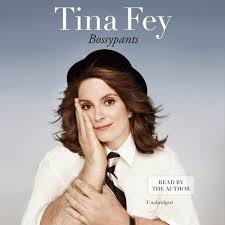
[LISTENED TO: April 29, 2015] Bossypants

bossyAfter listening to Amy Poehler’s audio book, it made me want to listen to Tina Fey’s book.  Sarah had read the book and said it was very funny, but I imagined that the audio would be even funnier.  And boy was it ever funny.

And here’s where I apologize to Tina Fey.  I had always heard her spoken about in such lofty terms as the funniest writer, the golden child (insert various rave here), and I wound up holding her to an unfair standard.  I never found her funny enough for me.  She made me laugh, but, for instance, I thought Mean Girls could have been…more somehow.  After listening to this, I realized what the problem was for me.  I always felt like her stuff could have been more pointed or something, but I realize that given the media she works with she was unlikely to “get away” with anything more pointed–certainly not on Saturday Night Live or 30 Rock.  Rather, she did lots of subtly feminist (or sometime over the top feminist) jokes that I didn’t really appreciate for what she was doing.  But when she lets loose in this book it is really amazing to hear what she herself–not a team of writers–has to say.  Of course, having said that, and having listened to the book, I absolutely need to rewatch 30 Rock (although I never cared for the Tracey Morgan or Jane Krakowski characters) and maybe even some old Weekend updates.

But, I already know Tina’s response to me, because she says it in the book.  And, it talks about something Amy Poehler once said.
(more…)

Read Full Post »

5dials31SOUNDTRACK: BEACH SLANG-Tiny Desk Concert #431 (April 10, 2015)

beachslangI had never heard of Beach Slang before watching this Tiny Desk Concert.  Evidently they are a new band with only a couple EPs out.  The write up says they are a punk band.  But in this Tiny Desk show, it’s just lead dude James Snyder and his guitar.

He plays four songs.  They are all sort of jaunty acoustic songs.  They are almost anthemic, but not quite.  The strangest thing is Snyder’s super-raspy singing voice, especially since his speaking voice is gentle and his laugh is kind of high-pitched. He is very funny and nervous when he talks, which I enjoyed quite a bit.

Exploring a little their bandcamp site, I see that they do a cover of the Psychedelic Furs’ Love My Way, and that sound is pretty apt.

Their recorded versions are heavier and actually sound a bit like the Goo Goo Dolls.

This is a brief but enjoyable set.  I find him so charming that I like it more than I might normally.

[READ: April 1, 2015] Five Dials 31

It has been quite a while since I’ve read a Five Dials.  And that’s no fault of the magazine–its all on me.  I always think, I’ll just put it off till I have time, and then I realize that I can always find something to read…so I just need to actually make time for Five Dials because it is totally worth it.

So this issue came out about a year ago.  Maybe that’s not too bad?

It begins with the contributors page and is followed by the Unable to Contribute page which lists five journalists who are currently in prison (find out more at the Committee to Protect Journalists).  Page 5 is a Table of Contents which I feel they haven’t done before.  It has a cool drawing on the bottom.  All drawings from this issue came from The Public Domain Collection of the British Library.

Then there’s a Frequently Asked Questions page.  Many pertain to corresponding with Five Dials, but others, well: (more…)

Read Full Post »

krausSOUNDTRACK: THE FLAMING LIPS-The Terror (2013).

terror After the distortion heavy and heaviness of At War with the Mystics and Embryonic (to say nothing of their other experimental releases), I wasn’t sure what to expect from an album called The Terror.  Yet with a title like that the album is far more invested in psychological terror than in pummeling you with scary noises and music.  The album is more unsettling and spooky with existential dread.

Wayne Coyne has always been a pretty optimistic guy–weird, sure, dealing with feelings of dread, sure, but never so dark and insular.  But I learned that before recording this album and most likely as an impetus to record it,  Coyne separated from his partner of 25 years, Michelle, and Lips multi-instrumentalist Steven Drozd temporarily relapsed into addiction.

In an interview, Drozd says the album is like a crisis of life confidence.  He also says that the uniformity in sonic style was intentional: “Instead of writing songs and then figuring out sounds, we’d write the other way around: create sounds then make songs out of those sounds.”

So the vocals are quite low in the mix, and there is not a lot of “music” in the album.  Rather there are layers of sounds–swishing synths, spiraling noises, percussion effects that seems to almost cover up the vocals, giving it a very claustrophobic effect.  “Look… The Sun Rising” opens the disc.  It is primarily percussion with some noisy sounds and really sharp piercing guitars (that play noisy counterpoint to the soothing chorus of Oh Oh Ohs).  And yet after all of that noise and chaos, the very lovely “Be Free, A Way” surfaces as a quiet introspective song.  There are gentle keyboard notes (not unlike on Yoshimi) that propel this song along.  “Try to Explain” is a pretty song with some unusual sound effects swirling around it (The Lips can’t so straight up pretty, right?).  And yet lyrically, this song, along with the rest, is very dark indeed.

“You Lust” is a 13 minute (!) invocation about various forms of lust.  It opens with the couplet: “You’ve got a lot of nerve/A lot of nerve to fuck with me.”  The middle of the song is a kind of Pink Floydian keyboard workout.  It’s a  lengthy jam that’s kind of samey, but I’ll bet if you can really sit (with headphones) and close your eyes and focus it’s pretty intense.  After about ten minutes of that repetitive claustrophobia, some lightening occurs with sprinkled keyboard notes.

“The Terror” is primarily in Coyne’s falsetto, and it seems gentle until the mechanized noises come bursting forth.  “You Are Alone” is the shortest thing here, under 4 minutes of squeaking noises.  And again, a lovely melody despite the title.  I feel like this song summarizes the album pretty well.  In it, Coyne sings “I’m not alone” while a deeper voice replies, “you are alone.”  Whose voice will ultimately win?

  “Butterfly, How Long It Takes to Die” returns to that abrasive guitar of the earlier tracks, but the main body of this 7 minute song is just bass, keening keyboards and Coyne’s whispered voice.  There’s a recurring synth line that is magical and/or creepy depending on your frame of mind.  It, along with many of the other songs, have a kind of coda that links the songs.  This one is mostly just choral voices, but it twists the ends of the songs in a different direction. “Turning Violent” is a quiet track, in which Coyne sounds nearly defeated until the second half of the song grows louder and more animated with layers of vocals.  The disc ends with “Always There…In Our Hearts” which seems to offer some hope…maybe.  There’s signs of uplift in the melody, and when the drums kick in at the end, it seems to propel the song into a more intense frame of mind.

And lyrically, despite all of the darkness that is always there in our hearts, there is a light peeking out: “always therein our hearts a joy of life that overwhelms.”

Although most reviewers find this album unremittingly bleak, I find the music to be beautiful in an aching sort of way–a beautiful way to deal with pain (better than getting the same tattoo as Miley Cyrus, anyway).

[READ: October 31, 2014] The Kraus Project

The title page of this book read: The Kraus Project: Essays by Karl Kraus translated and annotated by Jonathan Franzen with assistance and additional notes from Paul Reitter and Daniel Kehlmann.

So just what is this thing anyhow?  Well Karl Kraus was a German writer (1874-1936) whose main contributions to letters were some essays and a newsletter Die Fackel (The Torch).  The authors compare the newspaper (favorably) to a blog (while also complaining about what blogs have done to letters).  He started Die Fackel in 1899 and he continued to direct, publish, and write it until his death.  He used the paper to launch attacks on hypocrisy, psychoanalysis, corruption of the Habsburg empire, nationalism of the pan-German movement, laissez-faire economic policies, and numerous other subjects.  For the first ten or so years, Kraus was the editor, accepting contributions from around the German speaking word.  But in 1911, he became the sole contributor to the newsletter.

He also wrote many essays (he did not care much for fiction), including the two main ones that compression this book: “Heine and the Consequences” (1910) and “Nestroy and Posterity” (1912).  The book also includes two follow up essays: “Afterword to Heine and the Consequences” and “Between Two Strains of Life: Final Word to Heine and the Consequences” (1917) and a poem: “Let No One Ask…” (1934).

The essays themselves are quite brief.  Despite the first coming in at 135 pages, note that the left pages are all in German (so reduce 135 by half), nearly all of the English pages are filled with footnotes (reduce by half again) and some of the footnotes run for several pages.  So the essay could be said to be about 25-30 pages.

The same is true for all of the pages in the book.  The left sides are in German (except the footnotes) and most pages are split in half because of the footnotes.  Which means that Franzen and friends write far more than Kraus did.  Ultimately, this book is actually three things: It is a collection of Kraus’ essays with Franzen’s fine translation; it is an explication of Kraus’ attitude and about life in Germany during Kraus’ life and finally it is an insight into Franzen as a young man living in Germany and why Kraus was so appealing to him.

The first part: Kraus’ essays. (more…)

Read Full Post »

lostscrapSOUNDTRACK: THE XX-Coexist (2012).

coexGiven my proclivities towards noisy fast rock, there is no reason that I should like The XX, and yet I like Coexist quite a lot. It is such a spare album, but Romy’s voice is fantastic—so sensuous and breathy–that she can totally handle a song that is nearly a capella. So a song like “Angels” whose music consists pretty much entirely of a beautiful echoey guitar (and virtually nothing else except for some occasional soft percussion) is engrossingly intimate and not at all boring. In fact when that simple percussion eventually comes in, it’s like a revelation of sound accompanying her.

What also keeps the album interesting is that she is not the only singer (so there’s something for everyone). “Chained” has Oliver’s breathy, sexy voice as he more or less whisper/sings the lyrics. It has slightly more complex arrangements (meaning the drum is constant and there are quiet waves of synths). “Fiction” slowly builds with an ominous muted guitar motif and echoed chords. But when the chorus kicks in, that muted guitar grows loud and it’s almost overpowering (relatively, of course).   “Try” brings in a spooky kind of keyboards that is slightly unsettling under their mellow hushed duet of vocals.

The diversity of simple sounds that Jamie xx adds to each song are revelatory.  Even though each song is quiet and intimate, the sounds that he uses are so very different within that limited palate.  So “Reunion” sounds like a steel drums, before adding pulsing bass beats. “Sunset” has a slinky guitar and “Missing” introduces as drumbeat that is like a heart beat.  “Tides” has one of the loudest drum beats on the record, alternating with a delicate guitar line.

The simple bass line adds a really funky quality to “Swept Away.”  And when the claps and keyboard hits come in it feels almost like a dance song.

This is a great album for quiet nights and headphones.  Even if the songs seem to be mostly about lost love, it has a calming effect that is really enjoyable.  I’ll have to check out their debut as well.

[READ: September 30, 2014] The Lost Scrapbook

Some fans of David Foster Wallace speak well of Evan Dara (at least that’s how I’ve heard of  him).  I was unfamiliar with him and the fascinating story he has built around himself.  Evan Dara appears to be a pseudonym.  As one writer put it: “Hell, we don’t even now who Evan Dara is. Apparently, he is a male American in his 30s living in Paris.”  This, his debut novel, has attracted attention not only for being really weird, but for being really good.

What was fun about reading this was that I knew there were strange things afoot in the book, but I didn’t know what exactly (I really like to go into a book completely blind if I can).  So when the book started out with a conversation in which no character names were given (or even how many there were), I was prepared.  And while I didn’t really know what the subject they were talking about was, I figured that would be fine as well.  Then when four pages in the all caps word YIELD seemed to signal a change of narrator/perspective/something, I thought, okay this is what I’m in for.

Then I noticed that every paragraph which wasn’t conversation (with an em dash) was preceded by three ellipses (and ended with same).  A few pages later there’s an all caps TOW-AWAY ZONE which introduces another shift.

And somewhere around page 14 a sort of plot begins to form (although it’s unclear whether or not any of the earlier sections have anything to do with this one).  A man is shot…or not?  But then after the KEEP DOOR CLOSED section break, a new story develops.  A man with a Walkman (I was trying to decide if this was deliberately retro or intentionally set in the 80s, but that was unclear to me) is driving along to meet a man named Dave (at last a name!).  Dave is a filmographer who has been collecting fireflies for a video project.  And just as we near a kind of resolution of this section, it morphs, unannounced, mind you, into something else entirely–a discussion of music, specifically Beethoven and his decision to rework limited material into multiple variations.  It is fascinating and engaging and very well-considered, but it too ends before anything can be “resolved.” (more…)

Read Full Post »

bonusSOUNDTRACK: DAN MURPHY-“Drinion” (2013).

danmurphyI never would have guessed that there would be a song called “Drinion.”  But there it was, on Dan Murphy’s album, Undisclosed Location.  Now, I don’t know anything about Dan Murphy.  In fact, when I looked him up there also seems to be a country music singer named Dan Murphy (or maybe he is the same person?).

Anyhow, Undisclosed Location is mostly jazz piano.  “Drinion” is instrumental (so there’s no clue for me about why it is called this–if it has any connection  to The Pale King or what).  There’s no levitating that I can hear.

I do hear a bit of the “All Things Considered” theme (the jazzy version, naturally), in part of it.

I like jazz piano a bit but I’m not knowledgeable about it at all.  So, this was a fun find, and an enjoyable 6 minutes of jazz.  Thanks Dan.  Can you really be a country singer, too?

[READ: September 8, 2014] Pale Summer Week 9 (Notes & Asides and Bonus chapters)

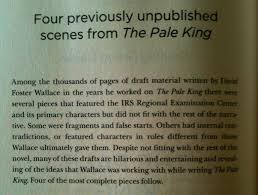
As has been stated many times, The Pale King was unfinished.  It was assembled by editor Michael Pietsch. Pietsch decided, based on the evidence given to him, what this book would look like.  It’s an unimaginably daunting and thankless task, especially given how many ideas DFW was tinkering with.  The Notes and Asides not only change the book, they change characters, emphasize nonexistent plot lines and basically make it seem like perhaps what we have here is but a small fraction of the overall work (rather than seemingly like a mostly completed book with a few pieces left out).

The final ten pages of the hardcover edition collects these notes and collates them in section by section fashion, with some overall notes about the book included at the end.

Since the notes are just notes, I’m not going to really go into them (otherwise I’ll just be copying the notes), but I would like to stress some that I think are interesting or revealing about what we might have gotten had he finished the book. (more…)

Read Full Post »

backSOUNDTRACK: TOADIES-“Summer of the Strange” (2012).

summerstrageToadies had a hit (which is still played on “Modern Rock” radio today) in 1994 called “Possum Kingdom.”  I really liked the song because the tempo was way off kilter and the lyrics were inscrutable (“Do you wanna die?” “So help me Jesus.”).  And the singer had a screamy kind of voice that sounded like he might be unhinged.  It was a very improbable hit and yet there it was.  And then Toadies went away.

When I heard that they had put out other albums I was surprised, so I looked them up and saw that they got into all kinds of legal grief with their record label during the (abandoned) release of their second album.  And they basically broke up for like ten years. And then they got back together and then re-recorded their delayed album and then put out the album that this song is on.

I’ve only listened to couple of songs from Play.Rock.Music.  I didn’t like the one with the horns (that may have been a remix actually), but overall the albums sounded quite Toadies-like.  And this song (with the very weird–perhaps too intentionally weird) contained some of the craziness of that first single.  It opens with a simple bass and drum set up.  Then there’s some odd ball vocals and some fuzzy smattering of guitars.  Then the guitars roar in and the chorus is strangely catchy, and the lead vocalist sounds like he still might be a bit unhinged.

By the end of the song, the guitar solo is a wild affair and the rest of the band is noisy and distorted and a little sleazy and you kind of leave the song feeling just a bit dirty–a perfect Toadies song.

[READ: September 1, 2014] Pale Summer Week 8 (§48-§50)

Because I was on vacation, I didn’t notice that the Pale Summer group read had stayed on an earlier chapter and were just getting the read rolling again.  So, I’m already ahead of the spoiler line.  But since I have this post written and I’m anal retentive, I’m going to post my final sections on the originally slated date (okay a day late for Labor day).  But as a concession to everyone else, I’m going to save the end pages and my thoughts on the book for next week.

So this week’s post is about the end of the book proper.  And next week will contain the comments from Pietsch at the end of the book as well as the additional materials that were included in the paperback.

A lot of information is handed out in these first two sections.  However, it’s not entirely clear what happened. And as with the unfinished book we’re left wondering if any more of the story would have clarified anything. (more…)

Read Full Post »

reySOUNDTRACK: ECHO & THE BUNNYMEN-“The Cutter” (1983).

echoI’ve never been a huge Echo & The Bunnymen fan, but I do like their greatest hits.  This is one of them, and it’s a song I’ve liked from pretty much the minute I heard it.  Ian McCullough has a Jim Morrison vibe in his vocals, and there are interesting Eastern melodies and pieces thrown into the song (like in the intro).  These give it an unconventional feel, even though the main melody is pretty straightforward.

I have no idea what the song is about–I sing along without really thinking about it.  And the “spare us the cutter” chorus, complete with screechy guitar chord is pretty dynamic.  As is the loud drum change during the “drop in the ocean” part.

By the end of the song the drums seem to sound bigger, and the fills really propel the song to the end.  It’s a fine song by a band that I’m not sure I need to hear more of.

[READ: August 25, 2014] Pale Summer Week 7 (§46-§47)

After the pile of small chapters that last week gave us, this week offers just two.  One is a very lengthy discussion between two characters.  The other is another piece of the Toni Ware puzzle.  I enjoy the way the first of these sections balances the medical, the emotional and the supernatural.  And it makes me laugh that Drinion’s supernatural bit is never addressed directly in any way–it just is–as assuredly as Rand’s psychological problems just are.  But I do find it interesting that more people have talked about Rand’s problems than Drinion’s (even though his is as fascinating as he himself is dull).
(more…)

Read Full Post »

tpk5SOUNDTRACK: INTERIOR DISPOSITION-“Fornix” (2008).

Critical Injuries Five Years of RehabilitationIt was challenging to find a related song for this week’s reading, although frankly a band called Interior Disposition would fit with just about any DFW passage.  But having a song called “Fornix” paired nicely with the computer problems that the author faced this week.

From the online information, it seems like Interior Disposition is a metal band.  And yet when I tracked down their full album and listened to a bit it’s largely trippy outer space noodling, or as one of the sites labels them: dark ambient.  There’s bubbling sounds and sounds of what I think of as deep space.  It is strangely relaxing and yet with a hint of tension all the way through (so yes, dark ambient is a pretty good sum).

Okay a little more digging tells me that the band is actually a guy, Oleg Hurvatov, who is Russian and also records under several other aliases: the wonderfully named Exploplasmatic Coagulation, and the puzzling Lanceolaria Im Licht Der Laterne

“Fornix” is only 1:46 and is probably a good introduction to the band/album.  If you like the 2 minute sound, the rest is pretty darn similar, just much longer.

[READ: August 18, 2014] Pale Summer Week 6 (§35-§45)

This weeks read was mostly a series of smallish sections.  some of them are entertaining, some of them provide interesting insights into the organization of the Service and of some of the characters.  And some of the sections are just downright funny.  The more I read of this book this time, the more bummed I am that it was never finished.  I even just wish I knew how much more he had planned.  There’s potential for this book to have spiraled out to 800-900 pages, there just seems to be so many things he could have followed up on–the Sylvanshine transformation to mastering RFI; the whole business with the infant, I love it; learning more about Mr. X (although likely there wouldn’t be much more about him); and of course what led to David Wallace leaving the Service and what compelled him now to write about it (which I don’t think is really addressed).
(more…)

Read Full Post »

tpk6SOUNDTRACK: BOREDOMS (various).

borepageBoredoms are an experimental noisy band from Japan.  I am completely unqualified to talk about them as I only know snippets of their output.  But I have always been intrigued by them.  Lead dude Yamataka Eye has been the main impetus behind the band.  And it seems like exactly the kind of noise/music one might play if one were horribly bored.

Yoshimi P-We is the longest serving drummer with the Boredoms.  She is the “Yoshimi” in the title of The Flaming Lips’ album Yoshimi Battles the Pink Robots.

Over the years they have gone from outright nose (listen to the track “Bubblebop Shot” from Soul Discharge or “We Never Sleep” from Onanie Bomb Meets the Sex Pistols which is mostly screams and drums) to a more ambient (but still noisy) style. They performed a live show with 77 drummers  on 7/7/07.

They’ve even changed their name to V∞redoms.

Here’s an interesting clip of the band from All Tomorrow’s Parties in 2012, being a lot less noisy but still pretty weird.

[READ: August 11, 2014] Pale Summer Week 5 (§27-§34)

There were a few things in this week’s reading that seemed to contradict other things in the reading.  This is not surprising as Pietsch says that there were things that he knew DFW would eventually change.  The notes at the back of the book (yes, I peeked, bit no spoiler here) say that there were different possible plotlines for some of the characters and even a duplication of a weird character trait.   But it’s funny to see it evolving in front of you.

In §27, Sylvanshine seems to be able to control his Random Fact Inference somewhat–and he seems to be using it rather than being inflicted by it.  This is either a big change or a cool development in Claude’s life.

There is also what I think is an actual mistake: two people have the same number: 907313433 (see §30).

In another “unfinished” issue, the surveillance in §29 is one of those situations that would certainly have been explained in greater detail (or had another scene about it).  I initially assumed they were doing surveillance for deadbeat companies (maybe for new vehicles), but there are indications (in later sections) that perhaps something else is going on, maybe to do with the Glendenning/Lehrl issue that Reynolds and Sylvanshine are talking about in §30.

One thing that I hadn’t explicitly noticed earlier, but which comes out in Cusk’s section below is the idea that “more information is not better.”  While this seems to be very true for their job, it can certainly be a debilitating world view and I wonder if that is at play as well. (more…)

Read Full Post »

« Newer Posts - Older Posts »