Feeds:
Posts
Comments

Archive for the ‘Yuck!’ Category

lastman2 SOUNDTRACK: THE xx-Tiny Desk Concert #265 (February 11, 2013).
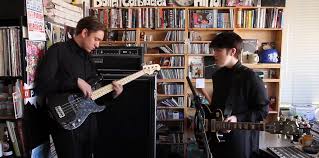
xxI have really come to like The xx quite a lot.  And this Tiny Desk Concert is easily one of the best instances of them.  It is just the two of them, singer-guitarist Romy Madley Croft and singer-bassist Oliver Sim She [No beats from member Jamie Smith, who opted to hang back at the hotel].  She sings and plays a very echoing guitar and he plays a very spare bass (also echoed).  Her voice on “Angels” is whispered but not quiet—she sounds amazing. Everything about the performance is clear and beautiful

The only bad thing about the Concert is that they only play 2 songs (and for less that 7 minutes total!)

The blurb says that one of the things that makes this show especially great is that “the setting and band configuration robs them of cover.  [There is] no shroud of darkness or bright lights pointed outward to blunt the crowd’s stares. Throughout their characteristically compact seven-minute performance, Croft and Sim avoid eye contact, as they visibly try to ignore the huge throng and cameras positioned maybe 10 feet away from them.”

When Oliver sings the middle verse on “Sunset” it is a wonderful, stark (and sexy) moment.   When she starts playing the guitar again after the brief bass interlude, it sounds magical.  And their duet at the end is amazingly powerful (especially for something so quiet).

[READ: December 17, 2016] LastMan 2

This book was originally written in French (and called Lastman there as well).  These editions were translated by Alexis Siegel.

The art is black and white (and grayscale) and the characters are what I can only describe as very French looking. The faces are very minimal, with some of them looking almost bleached out but for eyes and a mouth.  Some of the men are rather grotesque-looking while the one woman is a knockout.  (Unlike the first book, this one is slightly more explicit–nothing actually shown, but Richard runs through the town naked and he and a woman are in bed together).

This book picks up where the previous one left off.  Adrian takes on Gregorio.  And Adrian is able to knock him out of the ring.  Adrian wins!  This means he must now fight Elorna, his friend.  Gregorio is humiliated at losing and he is rather mean to Elorna.  And during the match, Elorna bursts into tears and flees the ring, forfeiting and letting Adrian and Richard go to the semifinals.

They are up against Alyssa and Haldes (Haldes is preposterously large and Alyssa is covered by a scarf on her face).  Things get weird in this one when Alyssa recognizes Richard (I won’t say from where).  I’m not exactly sure what happens to her, but she is eventually dragged out of the ring by Haldes–more or less forfeiting as well.

So our heroes are going to the final. (more…)

Read Full Post »

lastman1 SOUNDTRACK: BLACK PRARIE-Tiny Desk Concert #262 (January 14, 2013).

blakcpBlack Prarie is 3/5 of the Decemberists (that seems like a hint directed at Colin Meloy, ha ha).  No actually they are a kind of folk-country band “started by Chris Funk and Nate Query, who wanted an outlet for some of their rootsy, mostly instrumental string-band wanderings.”  Jenny Conlee from the band has also joined on accordion.  That leaves Annalisa Tornfelt’s who sings “sweetly countrified vocals and [plays] violin.” I feel a little bad for the other guys in the band who are not mentioned, but I don’t know their names either.

They play three songs.  “Dirty River Stomp” is a fun instrumental with prominent accordion in the beginning and then a banjo solo and then a violin solo.  It is indeed a big stomping song.   I love the way the song sounds like it has built to an ends but there is a small accordion coda tacked on.

For “Nowhere Massachusetts” there’s a switch from banjo to guitar.  The opening section of the song sounds so much like Guster’s “Careful” that I was sure that’s what song this was.  But indeed, it is not and it goes in a very different direction after that intro.  Coincidentally, Guster also has a song that about Massachusetts (“Homecoming King”).  But this sounds really nothing like Guster once the song starts—there’s accordion and slide guitar and fiddle and of course the vocal melody is very different.

Jenny introduces “Richard Manuel” with “We’re gonna rock this out.  We’re gonna bring it.”  It turns out to be a fairly slow, quiet song.  But with some intense lyrics.  And again there is some great accordion work on this track.

As the show fades out there is much excitement about tote bags, although I’m not sure who is getting what.

[READ: December 15, 2016] LastMan 1

This is the final series of older First Second books that I hadn’t read yet.  I brought home this book 1, some time ago, but when I saw that there were six volumes and that they’d all be released relatively quickly, I figured I’d just wait until they were all out and read them closer together.

This book was originally written in French (and called Lastman there as well).  These editions were translated by Alexis Siegel.

The art is black and white (and grayscale) and the characters are what I can only describe as very French looking. The faces are very minimal, with some of them looking almost bleached out but for eyes and a mouth.  Some of the men are rather grotesque-looking while the one woman is a knockout.  (The book is safe for younger teens, with just a cleavage and an underwear shot, although the whole book is about fighting).

So the story is a little confusing (at least in Book 1).  The main plot is not at all confusing, but the context is never given, so we must try to piece it all together,

Set in an unamed village, the 184th annual Tournament of the Realm is coming up.  We first meet young Adrian who is practicing for his first competition tomorrow.  His teacher is Mr Janesen (with a full head of blond hair and a goatee) and while he is hard on them, he seems fair.  He tries to get Adrian to really harness his powers for the battle. (more…)

Read Full Post »

2010 SOUNDTRACK: ANTIBALAS-Tiny Desk Concert #243 (October 4, 2012).

antibAntibalas (Spanish for “bulletproof”) is a Brooklyn ensemble.  Eleven members turned up for the Tiny Desk.  And they are quite the ensemble.  There are trumpets, saxophones, two guitars, a bass and a ton of percussion.  There’s a percussionist/keyboardist wearing a lucha libre mask (!) and the lead singer (singing in English and some other language) has what looks like tribal paint on his face. (He also plays conga and cowbell).

The blurb states:

There just aren’t many bands like Antibalas. These are jazz players making dance music: Their music is big and fun, and their guiding spirit is Fela Kuti, the brilliant big-band leader and Nigerian Afrobeat pioneer. Afrobeat is a musical style featuring nearly endless songs, mixing funk and jazz, grooves and riffs, with the rhythm carried by not only the drums, but everyone. Everyone — horn players, bass players, guitarists — plays rhythm in Afrobeat music.

It’s one thing for a big group to make a big sound — and, sure, Antibalas does that — but what stands out is the subtlety of this ensemble; the way the horns weave in and out of each other, sometimes complementing and at other times inspiring and creating musical conversation between players. That extends to all the players, from vocals to guitar. When you start to listen to that conversation and you hear that build in a rhythm, it’s so powerful, so full of joy. If they come to your town, drop what you’re doing and go see them. Wear dancing shoes.

They play two songs, but they are long and full of rhythm.  “Dirty Money” runs just under 6 minutes. I really like the way the horns seems to echo and answer each other during the slow sections.  While the whole band sings the backing voices.  And when the masked guy switches from percussion to keyboards, it’s got a  groovy 70s sound coming out of that machine.   All of it is anchored by the bass, keeping a steady rhythm.  One of the trumpeters switches to trombone for a solo as well.

“Him Belly Go No Sweet” has an even funkier feel–lots of percussion and staccato horns slowly working with each other to create a big sound.  Even though there’s plenty if music in this song it’s impressive how much they use silences—things are never quiet (there’s always a bass line or percussion) but for such a big outfit they can really get things to quiet own.  The end half of the song sees the band singing “go up  go down” while the lead singer seems to improvise a whole bunch of stuff.

It is, indeed, hard not to dance to this.

[READ: July 10, 2016] “Baptizing the Gun”

This was a very dark story and, if nothing else, it made me never want to go to Lagos, Nigeria.

The story is told in first person by a priest.  He is not wearing his collar and is driving a borrowed VW Beetle through the traffic of Lagos.

As the story opens, a woman is screaming because a thief just pulled an earring out of her ear–tearing her earlobe. He is caught and, astonishingly, “ringed with tires, doused in petrol, and set ablaze.”  Even though there is barely any fuel to be had “there’s always enough for the thief.”

The priest believes his trip was a success and many parishes have promised his parish in the Niger Delta money and materials.

But on his way back (at 18:03) the car dies in traffic. (more…)

Read Full Post »

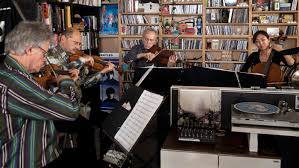
 socks kronosSOUNDTRACK: KRONOS QUARTET-Tiny Desk Concert #322 (November 25, 2013).

2013 was the 40th anniversary of Kronos Quartet.  I first heard of them about eight years after they started with their cool arrangement of “Purple Haze.”  And then I learned that they were like a sponge, soaking up and playing music from all over the world: In just one year they released albums with tango, songs by South African composers, Polish composers, jazz musicians and so much more.

I have many of their releases, although I realized I more or less stopped listening to new stuff from them around the turn of the century (since when they have released some 16 albums!).

Well, amazingly, the Quartet is still the same original players (except for the cellist–the cello is like Kronos’ drummer as they seem to replace her every couple of years).

They play three pieces here and the three range the gamut from dark and broody to rather sweet to quirky.  In other words, typical Kronos.

For more info:

The musicians —  David Harrington (violin) and longtime members John Sherba (violin) and Hank Dutt (viola) and new (as of 2013) cellist Sunny Yang — could reminisce over more than 800 new works and arrangements they’ve commissioned in 40 years. But instead, the new-music train pushes ever onward to new territories. They remain a living, breathing world-heritage site for music.

Now in the midst of its 40th-anniversary tour, Kronos brings to this Tiny Desk Concert a new arrangement, a work from a new album and, for Kronos, something of a chestnut, a piece the group recorded a whopping five years ago.

“”Aheym” (Yiddish for “homeward”) was written for Kronos by Bryce Dessner; a member of the Brooklyn rock band The National, he studied composition at Yale. The music thrives on nervous energy, pulsating with strumming and spiccato (bouncing the bow on strings) while building to a tremendous fever.”

I love this piece. It is intense and dramatic with its 4-3-3 bowing from all four members.  There’s an interesting cello melody with pizzicato strings from the rest.  The overall melody seems somewhat circular with different instruments taking on different leads.  But this song also plays with some interesting bowing techniques.  In addition to the spiccato (about 4 minutes in), the players drag the bow for momentary scraping and scratching sounds.

Another wonderfully dramatic moment comes at 7 minutes where each musician takes a turn bowing his or her note while the violin plays a super fast series of notes.  The song builds and build in dramatic until it gets to about nine and  half minutes and it reaches its powerful ending.

“Lullaby,” opens with plucked cello notes and strummed viola.  “It is a traditional song with Afro-Persian roots (from the group’s Eastern-flavored 2009 album Floodplain), [and] is woven from different cloth altogether. Colorful tones that lay between our Western pitches are threaded through the music, anchored by a gorgeous solo from violist Dutt; his contribution takes on the warm and weathered sound of a grandmother singing to a child.”  It is slow and moody and beautiful.

Harrington introduces the final piece by saying it’s by a performer that no one had heard of–including, until recently, even himself.

“Kronos caps off the concert with another hairpin turn, this time to a fresh arrangement of “Last Kind Words,” a little-known blues song from around 1930, recorded by singer and guitarist Geeshie Wiley. In Jacob Garchik’s exuberant arrangement (which Kronos premiered this fall), interlocking strums and plucks provide a kind of rhythm section, while Harrington’s violin stands in for the now-forgotten blues singer.”

There’s lots of plucked notes from everyone–including plucked bent note on the viola which gives it a real “early” guitar sound.  While I don’t know what Geeshie sounded like, so I can’t compare the violin to her vocal, the whole thing sounds great together.  In fact the whole thing is unlike any string quartet I’ve heard–so different and wonderful.

I’m going to have to bust out so Kronos CDs.

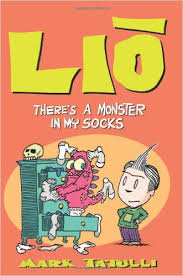
[READ: September 10, 2016] There’s a Monster in My Socks

I’ve been quite puzzled about the publication history of the Liō books.  And this just adds another layer of confusion.  This book covers the exact same time period as Happiness is a Squishy Cephalopod which was published in 2007.  The difference is that Cephalopod placed all of the strips in order, while this one seems to move things around quite a bit (the thinner format also means that it can’t quite handle the single panel strips very well.   But more egregious is that this volume (remember, the one printed after the previous one) prints the Sunday color strips in black and white.

The book also leaves some of the strips out.  It covers the date range from May 15, 2006 – Feb 16, 2007 (Cephaolopod went to May 23), but while it has the Feb 14 strip, it does not have the Feb 15 strip.  Weird.

So, basically this is an inferior version of the same book, but the publishers presumably wanted the books in this more friendly size (or some other nefarious reason).

I’ll include the review of Cephalopod below.

And, here’s the current list of existing Liō books. It’s a shame that there are years and years of strips thus far uncollected. (more…)

Read Full Post »

luchSOUNDTRACK: THE CRISTINA PATO TRIO-Tiny Desk Concert #305 (September 21, 2013).

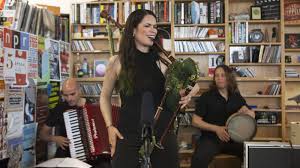
patoI didn’t know who Cristina Pato was or what instrument she played.  So when the show started (without visuals), I assumed she was the accordionist (because the show starts with some wild accordion music).  But in fact, Pato is playing the bagpipe.  Pato’s instrument is the gaita, a Galician bagpipe, and her roots lie in traditional Galician music — though she also boasts graduate degrees in classical piano, music theory and electronic composition.

I love the sound she band gets together with the funky staccato accordion notes and the wild racing pipes.  They are very jazzy and very idiosyncratic.  Her percussionist uses several different types of drums—the ubiquitous box drum and a hand held drum as well as various shakers and other sound makers.

They play three songs.  It’s interesting how much of the first song is taken up without the bagpipes—there’s lenghy sections where the accordion has the floor and she is just happily dancing around.  And the accordionist is amazing.  he plays all kinds of different styles and gets an amazing range of sounds out of that one instrument. He wails!  Of course I see now that the song is actually written by the accordionist: “Victor Prieto: ‘Mundos Celtas.'”  So it’s no wonder that she is happy to sit back and let him shine.  (Prieto , like Pato, is a native of the town of Orense in Galicia).  While he is playing, she whoops and hollers to get everyone pumped.  But once she gets her instruments going she is a nonstop blur of fingers and wild notes.  I particularly like that she has a section where the note is slightly flat and she continues to slowly raise it until it gets in pitch.  I also love–due to the nature of the bag pipes–that she can scream and whoops while still pressing air out of the bags.  And at the end of the song, she is just wild with fast notes.  It’s a very intense piece.

The second piece “Traditional/Cristina Pato: “Alalá Re-rooted” starts with her singing.  She is unmiked so you can’t really hear her, but I don’t really enjoy her singing as much as her playing so it’s okay.  I do love the interesting sounds the percussionist Shane Shanahan (Shanahan is American, but is also a longtime member (with Pato) of Yo-Yo Ma’s Silk Road Ensemble) is making.  Overall, this is a fairly dissonant piece—with her sounding almost like a free jazz players (but on pipes rather than sax).  I do love near the end where she almost seems to get a harmonic overtone on the pipe.  It’s a great moment—but fairly weird how the song just sort of fades away before seguing into the final song.

Victor Prieto & Emilio Solla: “Muñeira For Cristina” this song seems to be all about percussion with lots of drumming and a very noisy tambourine that Pato plays.  She gets the crowd clapping along and then  when she and Prieto play the same awesome riff together,it sounds great.  I love watching her shake the finger part while she’s playing it, to get a cool almost whammy bar sound out of it.  The song totally rocks and the whole set with the unlikely combo of accordion and bagpipe is startlingly wonderful.

[READ: April 20, 2016] Comics Squad: Lunch!

I really enjoyed the first Comics Squad book and I was delighted that a second one came out.  I just recently saw that a third one is coming out the summer–I love that it is called Detention and is coming out on Independence Day.

Like the first collection, this one is edited by Jennifer L. Holm and Matthew Holm (Babymouse/Squish) and Jarrett J.  Krosoczka (Lunch Lady).

But the rest of the line up is quite different this time around, which is cool–allowing other artists to shine.  This time there are stories from Cece Bell (El Deafo) ; Jason Shiga (a great indie artist who does some kid-friendly and some decidedly not kid friendly books) ; Cecil Castelucci & Sara Varon ; Jeffrey Brown and Nathan Hale (his own series of historical stories).

Like the previous book, the Holms and Krosoczka sprinkle the book with comments and interstitials from Babymouse and Lunch Lady. (more…)

Read Full Post »

index SOUNDTRACK: LYLE LOVETT-Tiny Desk Concert #257 (December 10, 2012).

lyleLyle Lovett was the first country musician I ever enjoyed.  And that came mostly from his Large Band recordings.  Lovett, while clearly of the country ilk, is a different kind of country—perhaps it’s because his country comes from Texas.  He is not afraid to bend genres and sing about whatever is on his mind (with a great, unique voice that eschews country flavors.

For this tiny desk it is just Lyle and a fiddle by Luke Bulla.

One of the things I’ve always liked about Lyle is his sense of humor. He doesn’t write funny songs, but some of his songs are funny.  And he himself is very funny–very deadpan–which he demonstrates amply here.

And, according to the blurb, he’s also rather humble

Lovett not only showed up at NPR Music’s offices without an entourage, but also booked his Tiny Desk Concert himself, emailing us out of the blue to express his interest. (Our reply: “We would only agree to have you perform a Tiny Desk Concert if it’s under any conceivable circumstance.”)

So it’s appropriate that Lovett would open this performance at the NPR Music offices by performing “Cowboy Man,” the first track on his 1986 debut: He may be a music-industry veteran, but in many ways, he’s starting over. With a fresh-faced accompanist in fiddler and backup singer Luke Bulla, Lovett gives a loose, engaging performance that feels like both an introduction and a victory lap.  He follows “Cowboy Man” with two songs from 1989’s Lyle Lovett and His Large Band, so this is no mere promotional appearance.

He’s charming right up front.  After the “Cowboy Man,” which sounds great, he looks up and laughs, “thank you very much,” with a sense of wonder.  He starts right into the second song and then stops and stop again and then says “I just about got it.”  He plays the melody for a few bars and the violin comes in and they play a few bars together and then, I gather, Lyle screwed up because he kind of smiles over at Luke and then stops playing and says “you sure you want to play that?”

Everyone laughs, some tension is broken.  And he looks up at everyone.

“This is…it’s kinda weird, right?”  Someone shouts out “Good weird!”  He laughs, “Good for sure, no question.”

Then he picks up a CD off the desk and says, “Just one of those chance meetings.”  He holds up the CD, “Iris Dement, she was just right here.”  To much laughter.  Stephen, who booked the show shouts, “We’ve got all those inventoried, so don’t even think about it.” Which cracks everyone up.

Then he tells a story about meeting Iris’ daughter  He asks them is they know about the Cayamo Folk Cruises.  No one replies so he says “It’s a popu….it’s not that popular.”  He says it is a festival on the water (it must have been one of the first music cruises).  He describes it and says its fun a deal.  And then stops and says “I don’t know why we’re talking about it.”  Then they remind him about Iris Dement’s daughter.

His story about her is very funny, told in a great deadpan way:  I saw this cool chick, about ten years old, leaning against the elevator.  Wearing skinny pants and a hat.  She looked at me in that skeptical way, and I said, so you in a band?  She rolled her eyes, gave me a sideways look.  She said, No.  So I said, Well, you oughta be.  She said, My mom’s in a band.  Who’s your mom?  She said Iris, just like that.  She was cool.

Finally starts playing “If You Were To Wake Up” again and jokes, “Pretend like this is going well.”  It is, the song is very pretty with gorgeous violin.

The final song is “Good Intentions”  He looks at Luke and says. “Play it just…do it however you want.”  Lyle starts the song,  “It’s a sunny day in Sunny…” and he stops and looks at Luke and says “Don’t mess me up anymore, alright?”  To more laughter.  It’s one of his great songs–jazzy and with swell lyrics.  There’s even a plucked violin solo.

I have loved Lyle and his Large Band, but I also like him in this small duet as well.

[READ: January 21, 2015] “Youngthing”

Boy I hated this story.

It is the story of a young Somali thug (nicknamed Youngthing) who has been conscripted into a the Shabaab-led insurgency.

He is sent on a mission for the insurgents.  He is meant to secure (steal) a house for the group.

He doesn’t pay attention, winds up going to wrong place and inadvertently “captures” the wrong house.

There is an innocent old man living there.  We see the story from the man’s point of view we see for half of the story; we see it from Youngthing’s point of view for the other half).  The old man doesn’t realize the trouble he is in right away.  He even manages to convinces Youngthing that everything will be okay. (more…)

Read Full Post »

 doubledownSOUNDTRACK: JAKE SCHEPPS’ EXPEDITION QUARTET-Tiny Desk Concert #187 (January 19, 2012).

jakeJake Schepps’ Expedition Quartet is a somewhat unusual string quartet in that the instruments are violin and upright bass (normal) but also guitar and banjo.  And so the songs have a classical feel–melodies repeated in a fugue style, but with the prominence of the banjo, it feels more like a folk song.  The violin takes on a kind of fiddle sound.  And that’s interesting enough, but it’s the story of the music that they are playing which makes it even more fascinating:

About 100 years ago, Béla Bartók was traipsing through his native Hungary (Romania and Slovakia, too) with a bulky Edison phonograph, documenting folk songs and dances. There’s a priceless photo of the young composer, his contraption perched on an outside windowsill with a woman singing into the horn while anxious villagers stare at the camera. By 1918, Bartók had amassed almost 9,000 folk tunes. He made transcriptions of some; others he arranged for piano, while elements of still others found their way into his orchestra pieces and chamber music.

This was the country music of Eastern Europe, and its off-kilter rhythms and pungent melodies continue to captivate music lovers and musicians like Colorado-based banjo player Jake Schepps, who has recorded an entire album of Bartok’s folk-inspired music.

For this concert, with fellow members of Expedition Quartet — violinist Enion Pelta-Tiller, guitarist Grant Gordy and bass player Ian Hutchison, they played a Bartók hoe-down of sorts.

They play three pieces:

“Romanian Folk Dances: ‘Stick Game'”  Bartók (arr. Flinner).  This is a quieter piece with moments of bounce.  Indeed, Schepps doesn’t feel like the leader of this group because everyone shares the spotlight.  The guitar takes a lengthy solo–its got a very jazzy feel (which is a little weird on an acoustic guitar).  The violin takes a pizzicato solo, which is neat.  When Schepps finally does do a solo it’s not a showoffy banjo solo, it just fits in well with what everyone else is playing.

“For Children (Hungarian Folk Tunes): ‘Stars, Stars Brightly Shine'” Bartók (arr. Schepps).  This is a slower tune and it is much shorter as well—it doesn’t really lend itself to soloing.  Although the violin takes on the lead melody and it sounds mournful and beautiful.

“Mikrokosmos No. 78 / ‘Cousin Sally Brown'” Bartók / traditional (arr. Schepps).  Before this track, when someone tells Schepps that No 78 is his favorite of the Mikrokosmos, he says that he prefers 79.  The bassist says that 79 has gotten too commercial.  The end of the song has a tag of “Cousin Sally” a rollicking traditional dance number.  The four seems to play somewhat at odds with each other briefly and when they all rejoin for the end—it’s pretty great.

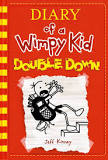
[READ: December 27, 2016] Diary of a Wimpy Kid: Double Down

I keep expecting the quality of the jokes in the Wimpy Kid books to decline.  But rather, this book was not only hilarious, but it worked really well as a book, too.

What I mean is that, I know that the Wimpy Kid series is online and that Kinney does a new story every day (or at least he did , I don’t know if he still does).  These books had always been taken from the online site (and I assume they still are).  But somehow, this book has jokes that circle back to jokes earlier in the book.  There’s at least a half a dozen callbacks which makes this book more than just a collection of diary entries…it’s a perfectly contained unit with a satisfying ending.

(more…)

Read Full Post »

2016-12-05-21-06-09SOUNDTRACK: LUCIUS-Tiny Desk Concert #261 (January 7, 2013).

I’d published these posts without Soundtracks while I was reading the calendars.  But I decided to add Tiny Desk Concerts to them when I realized that I’d love to post about all of the remaining 100 or shows and this was a good way to knock out 25 of them.

luciusThis Tiny Desk Concert has a wonderful blurb:
We brought Lucius to the Tiny Desk because I fell in love with one joyous, catchy song: “Don’t Just Sit There.” That’s all I had to go on — I’d never seen the group live — and though I expected fun, we also got fabulous. Not only are Jess Wolfe and Holly Laessig a winning singing duo, but their charisma and charm helps turn good pop songwriting into an endearing performance.

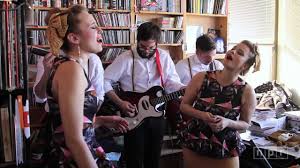
The two singers are dressed identically–although they don’t really look much alike, they appear almost identical up there (and I’m not sure who is who).  The three men in the band: Danny Molad, Peter Lalish and Andrew Burri fill out the group with guitars and drums and are also dressed identically–in crisp white shirts and suspenders.

“Go Home” starts out slow with a rattling slide guitar and simple percussion.  The two women sing slowly over the bassline.  It’s a pretty, nice song.  And then the chorus kicks in and while the song doesn’t really get all that much bigger, their voices soar incredibly, in close harmony. It is a remarkable change in texture in the song and they instantly won me over.

It segues into “Don’t Just Sit There” which is a beautiful song with a slightly faster quiet section.  But again, the chorus “did you find love” just soars with their great harmonies.  I can see why Bob fell for them.

“Turn It Around” starts out with an “aha ha” and claps and a more poppy singing style.  And I find that while I like Lucius overall there are parts that I really don’t.  Like the beginning to this.  And yet, once again, when they get to that chorus “looking through the wrong end,” the song is super catchy and wonderful and I find myself singing that part a lot.  Even with the minimal backing guitar and drums, it sounds great.

After the third song, they get high-fives and Bob asks if they want to do another.  Usually, they edit out this type of thing, but it’s really fun to watch the band discuss what song they should play as they sort their percussion parts out.  I loved watching them go through Bob’s box of interesting percussion instruments until they found good ones.

When they finally get around to the song, “Genevieve,” it is a bouncy percussion-filled fun song.  Of the four, it’s my least favorite but that’s because it doesn’t really soar like the other ones do.  But it’s still fun.

[READ: December 21, 2016] “Circumstances Of Hatred”

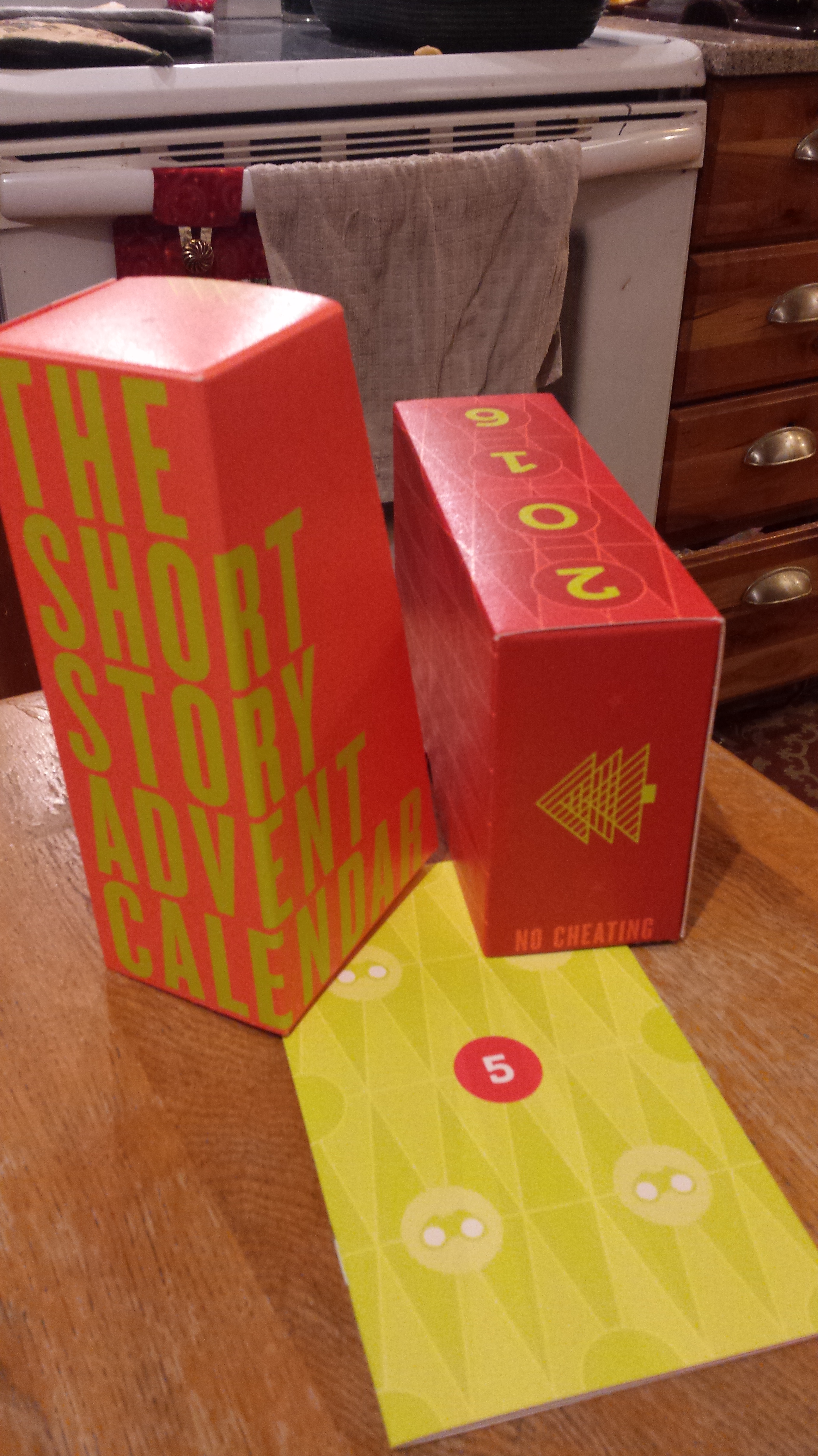
Near the end of November, I found out about The Short Story Advent Calendar.  Which is what exactly?  Well…

The Short Story Advent Calendar returns, not a moment too soon, to spice up your holidays with another collection of 24 stories that readers open one by one on the mornings leading up to Christmas.  This year’s stories once again come from some of your favourite writers across the continent—plus a couple of new crushes you haven’t met yet. Most of the stories have never appeared in a book before. Some have never been published, period.

I already had plans for what to post about in December, but since this arrived I’ve decided to post about every story on each day.

There’s a fantastic plot point in this story that I don’t want to spoil.  And that makes it really hard to talk about the story.

But I really enjoyed it a lot.  And I can reveal the basic setup.

It had been 17 years since Nicholas was in his grandfather’s house.  And now that his grandfather was dead, Nicholas was willed the man’s property.  So he and his new wife Ann leave their current place in Victoria and head out to Halifax to make a new life in their new house.

Ann hated Halifax–the cold, the gray, the wilted produce.  And she hated the house. (more…)

Read Full Post »

thrilignSOUNDTRACK: ADIA VICTORIA-Tiny Desk Concert #545 (June 30, 2016).

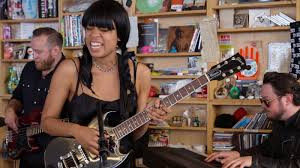
adiaAdia Victoria has a rough, raw voice that goes well with her simple, exposed guitar sound.  The blurb says her music “carries the singular perspective of a Southern black woman with a Seventh Day Adventist upbringing, who never felt like she’d fit in.”

She sings three song, mostly in a great, raspy voice.  For “Stuck in the South” she actually seems to be gritting her teeth as she sings: “I don’t know nothing ’bout Southern belles / but I can tell you something ’bout Southern hell.”  When the first verse ends, and her band kicks in, it adds such interesting textures.  A distorted bass and a lead guitar playing quietly distorted sounds.  This song is really captivating.

“And Then You Die” with its swirling sounds and keyboards has a very distinctly Nick Cave feel–gothic in the Southern sense of the word.  Indeed, the first verse is spoken in a delivery that would make Nick proud. This is no to say she cribbed from Cave but it would work very well as a companion song  I really like the way it builds, but the ending is so abrupt–I could have used some more verses.

After the second song the band heads away and Bob says “They’re all leaving you.”  She looks at them and growls, “Get off the stage!” to much laughter.

She sings the final song “Heathen” with just her on acoustic guitar.  It is a simple two chord song.  It’s less interesting than the others, but again, it’s the lyrics that stand out: “I guess that makes me a heathen, something lower than dirt / I hear them calling me heathen, ooh like they think it hurts.”

I’m curious to hear just what Adia would do with these songs when she’s not in this Tiny format.  I imagine she can be really powerful.

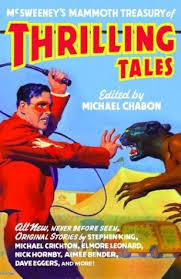
[READ: November 23, 2016] McSweeney’s Mammoth Treasury of Thrilling Tales

For some reason or another I have put off reading this McSweeney’s volume for many years.  This is technically McSweeney’s #10, although it was also released in this printing from a  major publisher. Sadly for me, my McSweeney’s subscription had expired sometime around here so I’ve never actually seen the “official” Volume 10 which I understand has the exact same content but a slightly different cover.

One of the reasons I’ve put off reading this was the small print and pulpy paper–I don’t like pulpy paper.  And it was pretty long, too.

But I think the big reason is that I don’t really like genre fiction.  But I think that’s the point of this issue.  To give people who read non-genre fiction some exposure to genre stuff.

Interestingly I think I’ve learned that I do enjoy some genre fiction after all.  And yet, a lot of the stories here really weren’t very genre-y.  Or very thrilling.  They seemed to have trappings of genre ideas–mystery, horror–but all the while remaining internal stories rather than action-packed.

Which is not to say I didn’t enjoy anything here. I enjoyed a bunch of the stories quite a bit, especially if I didn’t think of them as genre stories.  Although there were a couple of less than exiting stories here, too. (more…)

Read Full Post »

kickass2 SOUNDTRACK: DEQN SUE-Tiny Desk #476 (October 5, 2015).

deqnDeqn Sue and her producer Kelvin Wooten play three songs at this Tiny Desk Concert.  And although she is the name and voice of the set, I’m more impressed by him.  He is sitting in front of a keyboard, holding a bass guitar.  He plays the bass, loops it and then plays it live again.  While the bass is looping he;s playing keyboards and all the while there’s percussion and other sounds that he’s programmed.

NPR had played “Bloody Monster” a while back.  It’s a wonderful kiss off song about a person that she thought was a friend until she called her “nigger” (which is addressed in the second verse).  The chorus is surprisingly poppy:  “Shimmy shimmy cocoa pop, you’re a crazy bitch.  I don’t even like that word, but for you I think it fits.”  It’s fun and bouncy.

The second song is “Flame.”  She says it’s the only song she’s written about love–most of her songs are more socially aware.  It’s got a cool bass line, although I don’t like her voice on this song.  She seems to sing better when it’s louder and faster.

“Magenta” is the first song they wrote together.  She explains that magenta is about the color you feel when you’re not specifically one: you’re not pissed, so you’re not red, you’re not sad so you’re not blue and you’re not scared so you’re not yellow.  You’re a mixture–magenta.  Each verse starts with her singing “I am a color” in a deep distorted voice.  It’s pretty cool.  The song is interesting and has some cool ideas in it.

Overall though I’m not all that impressed by her.  I feel like she’s close to being amazing, but hasn’t quite gotten there yet.

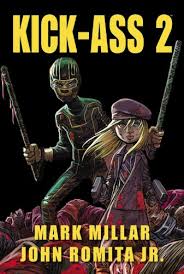
[READ: February 1, 2016] Kick-Ass 2

This book picks up right where the last one left off.

Hit Girl is still training Kick Ass (and beating the crap out of him), but she might have to give up.  Her mom is really fragile right now and if something happened to her, it would kill her mom.

And then we see that Red Mist has returned and set up a superhero brawl in Manhattan streets.  But that’s coming in the near future. The rest backtracks a bit.

Dave has joined a superhero gang–like a real-life X-Men called Justice Forever.  He is friends with a guy named Doctor Gravity (who claims that he has made a pole that can increase gravity (actually it’s a baseball bat wrapped in tinfoil). (more…)

Read Full Post »

« Newer Posts - Older Posts »