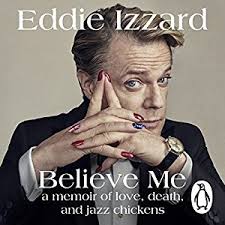
When I saw that Eddie Izzard had a book out I was pretty interested to read it. I have loved his stand-up since 1997 or 1998 and I was lucky enough to see him on his Circle Tour (on the date they recorded it!). I have been keeping up with his career and trying to see him in whatever he does (although I like my comedy more than drama and he has certainly made the shift towards drama in recent years).
I thought an autobiography or memoir by him would be pretty interesting (even if he claims to be boring). But when I saw that he read the audiobook, I knew I had to give it a listen (even if it was 12 discs)!
Amusingly, there was a long delay at the library. The lady at the counter (who is not the librarian–we librarians know the difference) said if I knew his voice, I could just read the book to myself in his voice. It was an amusing thought, and I possibly could do that, ….yes, but Eddie’s voice is just so fantastic that it never would have worked properly. Plus, he throws in easily an extra hours worth of footnotes and rambles that aren’t in the print book! That’s right, an extra hour’s worth of nonsense if you do the audio. True you don;t get to see the pictures, but it’s a fair trade-off.
Well the book finally came in and I had plenty of driving time to make short work of this 12 hours behemoth. And I laughed and laughed. And cried and cried.
Because while Eddie Izzard is an action transvestite (transgender, now) and one of the best stand-ups around, he is also an extremely warm and thoughtful person. He worked very hard to become the success he is. And he has used his fame to do some absolutely wonderful things for humanity–including raising millions of dollars. Not bad for an atheist who is sometimes in girl mode and sometimes in boy mode. (more…)
SOUNDTRACK: JOSHUA BELL & JEREMY DENK-Tiny Desk Concert #568 (September 30, 2016).
After hearing a pianist and then a violinist, it was fun to hear a duet of the two.
Joshua Bell and Jeremy Denk are masters of their crafts. Although I did not know that:
Bell and Denk have been chamber-music partners for 10 years, and they’re a bit wound up on Brahms these days. They’ve released a new album, For the Love of Brahms, and they’re performing the music, along with that of Brahms’ friend Robert Schumann, in concerts.
They play three pieces, two Brahms, and one Schumann. And they all sound spectacular.
Brahms: Violin Sonata No. 3, IV. Presto agitato
“You gotta love Brahms,” Joshua Bell says, a little short of breath. He’s wiping sweat from his brow after the big rock ‘n’ roll conclusion to the composer’s D minor Violin Sonata. Bell and the astute pianist Jeremy Denk play it with all the turbulence and tenderness Brahms demands, and it’s an invigorating way to open this Tiny Desk concert. [I love that the focus jumps back and forth from violin to piano, with interesting riffs and trills from one then the other. I also love the way the melodies seem to creep around and sneak up on us].
Schumann: Romance, Op. 94, No. 2
Contrasting with the fiery Brahms, Schumann’s Romance, Op. 94, No. 2 unfolds like a song without words. Bell makes his 1713 Stradivarius sing, capturing the bittersweet tone of the music. When the theme comes around for the second time, he lightens bow pressure for a more intimate, almost whispered disclosure.
Brahms (arr. Joachim): Hungarian Dance No. 1
Another of Brahms’ close friends figures prominently in Bell and Denk’s final offering. Violinist Joseph Joachim was something like the Joshua Bell of Brahms’ day, as well as the man for whom the composer wrote his Violin Concerto. Joachim’s gift to Brahms was creating piano and violin arrangements of the composer’s Hungarian Dances. Brahms’ Hungarian Dance No. 1, powered by a sweeping theme and chugging piano topped with pearly descending runs, whisks you to a smoky café where gypsy fiddlers battle for supremacy. Starting off on the low G string, Bell’s tone is as rich as dark chocolate, the feeling a touch wistful. [I really love Hungarian dances. It seems like every composer’s take on Hungarian music is excellent. I love how the violin plays a very simple yet dark melody and the piano sprinkles in all of these descending notes in a fairly dramatic scale. And then of course as all the dances do, it speeds up, careening around in wild abandon and fun. Wonder what made Hungary such a lively place].
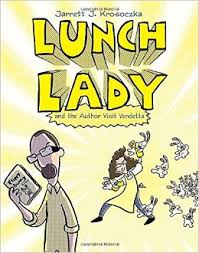
[READ: June 13, 2016] Lunch Lady and the Author Visit Vendetta
I rather like that the Lunch Lady books are sequential and mildly dependent on each other. Of course you can read them in any order you like, but reading them in the proper order allows you to see some continuity between books.
In the previous book, Dee mentioned that the author of the Flippy Bunny series was coming to the school. And in this book he does.
The kids are super excited that Mr Scribson is going to be there to read and sign books. He is something of a primadonna though as he is upset that the reading will be taking place in the gym. After his presentation, he signs books, but when Hector brings him a very old copy of the book Scribson says “I don’t sign opened books.” Hector who has always love the Flippy Bunny books is devastated). (more…)
SOUNDTRACK: IMANI WINDS-Tiny Desk Concert #277 (May 29, 2013).
For some reason this video and audio has been removed from the NPR site (no explanation is given). But I found it elsewhere and was able to really enjoy it.
But they have left up the blurb:
When Igor Stravinsky began composing The Rite of Spring, his ballet for vast symphonic forces, he could hear the music in his head but couldn’t quite figure out how to write it down. It was just too complicated.
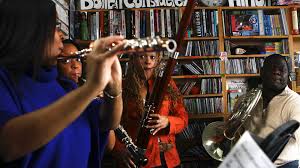
Today, 100 years after The Rite‘s premiere, the fearless musicians of Imani Winds make it all sound remarkably easy, given that they’ve condensed Stravinsky’s massive walls of sound down to just five instruments: bassoon, clarinet, flute (doubling on piccolo), oboe and French horn.
Make no mistake: Many of the jagged rhythms and crunching chords remain viscerally intact, albeit on a more intimate scale. As the group huddled behind Bob Boilen’s desk, bassoonist Monica Ellis noted the opposing ratios, saying, “It’s apropos in some strange way that we are playing one of the most massive pieces in some of the smallest instrumentation in one of the smallest settings that it could possibly be played in.”
The setting might be small, but in this clever arrangement by Jonathan Russell, we learn that a wind quintet, when called upon, can make a mighty and sonorous wail. Just listen to how the Imanis cap off “Dances of the Young Girls” with the entire quintet in full cry (at about 4:30 into the video). The bassoon repeats a fat bass line while the clarinet runs its snaky scales. The piccolo, in piercing chirps, serves as a foil to a frenzied oboe and snarling “whoops” from the French horn.
But not everything in The Rite is all pound and grind. Stravinsky’s transparent introduction, almost impressionistic, is a fluttering aviary of winds — even in the original — with individual colorings for each instrument. It’s all rendered beautifully here by Imani Winds, musicians brave enough to play David to Igor Stravinsky’s imposing Goliath.
This concert is fascinating to watch (and listen to) because even though this piece is familiar (to me) in theory, it’s apparent that I don’t really know it. And I can see why this piece was so controversial when it came out–it is weird and chaotic and almost random at times. I imagine that seeing it as a ballet might make it more cohesive, but it’s still pretty out there.
I love that the bassoon seems to be the primary instrument–one that doesn’t typically take center stage.
The group breaks up their selections into three primary chunks.
Selections from The Rite of Spring:
For “Introduction” the bassoon is the primary instrument playing the initial melody. Then the clarinet and oboe give the whole thing an unsuaul sound–to say the least. The French horn actually works as the the bass for this part. It’s also neat watching the flautist switching between flute and piccolo. I’m not sure when the second part “Augurs of Spring” begins, but I assume it’s when the bassoon repeats that initial melody and then the French horn plays a staccato bass note. The music sounds kind of threatening but whimsical at the same time.
Somewhere in here “Dances of the Young Girls” begins. I assume once the piccolo starts chirping and swooping. And then the band grows very loud before abruptly stopping.
The second segment she describes as incredibly picturesque. “Ritual of Abduction” begins nosily with almost total chaos from all the instruments–the piccolo stands out as sharp and piercing. As with the other segments, I’m not sure when “Spring Rounds” begins, but I have to wonder if this is when the music seems to go circular and then slow down. There are low notes from the French horn while someone is playing accent notes that sound, not off, but dissonant–providing stark contrast with the rest of the slow movement. There are some blares of music from the French horn as well.
I’m guessing that “Dancing Out of the Earth” begins with the fast bassoon melody: up down up down up down up down with trills and swirls from the flutes and clarinet. It rises and rises very dramatically and then stops.
They tell us that it’s not possible to play the entire ballet so they have taken the “greatest hits” and for this show it’s the greatest hits of the greatest hits. Consider it a deconstruction with five instruments. But it still evokes the spirit of this sacrificial dance.
She talks about how controversial this was in 1913, “when ballet was meant to be about… I was going to say flamingos…. fairies swans, the other water animals.” This is the final moment the virgin who sacrifices herself dances herself to death. And they are going to exemplify trombones and timpani and all that loud stuff (the French horn player laughs and says “Grr I am trombone”).
“Sacrificial Dance: The Chosen One” begins with a three note melody–again it is somewhat threatening. There’s lots of little fast runs by the French horn with accents from everyone else. It stops dramatically at one point and then resumes with so many different melodies. And then comes the surprise ending with a rising flute line and then a low end from the horn.
Without taking away anything from Imani Winds, I ‘m sure this performance doesn’t do the whole thing any justice. But it is amazing to imagine how much more there is to it. And it is amazing that these five instruments can evoke so much. It’s an uncomfortable and somewhat shocking first listen. It’s amazing that is over 100 years old, although it sounds so contemporary.
I don’t know why it’s not on NPR any more. I found it on YouKu (whatever that is). I have been able to watch it twice but on two other times I was unable to watch it. So keep trying, it’s worth the effort.
[READ: May 5, 2016] The Boy in the Dress
David Walliams is best known (if he is known at all) as the tall one on the sitcom Little Britain.
I had no idea he wrote books (he has done over half a dozen children’s books), and I was happy to start with this, his first one.
This book is illustrated by Quentin Blake, who is best known (if he is known at all) as the illustrator for the Roald Dahl books. So his simple, somewhat sloppy, style might look familiar.
The story is, as the title suggests, about a boy who wears a dress. And the story is very funny–not because it makes fun of him for wearing a dress, oh no. In fact, I love the story for going out of its way to show that it is normal that a boy might want to wear a dress. (more…)
SOUNDTRACK: SON LITTLE-Tiny Desk Concert #496 (December 18, 2015).
I know of Son Little, although only vaguely. WXPN has played his song “The River” quite a lot, although I don’t think I’ve heard anything else.
For this Tiny Desk Concert, he’s really stripped down–just his acoustic guitar, a percussionist (Jabari Exum playing a djembe with accoutrements) and a backing vocalist, his sister Megan Livingston. His playing is even pretty stripped down–his chords are minimal, almost more like accents for most of the songs (although he does play louder from time to time).
As such, this really celebrates his voice which is strong and almost gospel-like.
He plays three songs. “Lay Down,” is a quiet soulful song with perfectly spare accompaniment. When it ends, everyone seems adorably shy with Little saying, “just mildly awkward enough.”
“Your Love Will Blow Me Away When My Heart Aches” is a bit bigger–Little sings a bit louder and plays louder chords, but it is still quite minimal.
He ends with “The River” which is certainly stripped down from the radio version. It opens with some claps and he encourages everyone to clap along although “If you’re like clap challenged then maybe… don’t–you know who you are.” The song has that bluesy rock feel even in this understated form. And while I like the original better, this is a great version–that quiet clapping and percussion is really nice.
[READ: July 26, 2016] The Complete Peanuts 1981-1982
So far the 1980s see Schulz settling into a few consistent themes in his strips–regular motifs that he mines over and over again. Although it’s interesting to see how they have morphed over the decades.
Patty is constantly falling asleep in school (and getting D minuses), Snoopy continues to write funny/bad jokes and gets rejection letters about his books (this is usually pretty funny but it’s also surprising as Snoopy is usually the “successful” one); Snoopy also plays a lawyer a lot in these strips.
1981 begins where 1980 left off with Patty loving the story of Hans Brinker. 1981 also has a lengthy section about Valentines Day (a subject that gets more emphasis in some years than others), although this year Sally is the major protagonist (and her Sweet Babboo her object). 1982 also has a Valentine’s Day with Sally–she gets her hand stuck in the Valentine’s Day cards box.
Schulz used to do bible instruction which is why he quotes it so much. And he occasionally peppers his strips with religious commentary. There’s a joke about school prayer–Patty has to go up to the board and when her teacher falls ill she shouts “school prayer works, Marcie.” There’s an amusing joke that Snoopy used to teach Sunday School at the Daisy Hill Puppy Farm.
Although the running jokes are funny, I love when he gets a new idea. Like the a fun twist on the dog ate my homework joke when Snoopy as the WWI pilot steals Sally’s homework claiming it is the enemy’s secret papers and he eats them.
Sometimes Schulz gives a one-off joke that’s just silly and funny like when Woodstock “poofs” a dandelion and it “poofs” him back. (more…)
SOUNDTRACK: LAND LINES-Tiny Desk Concert #494 (December 11, 2015).
Land Lines are a trio from Denver. They have a drummer, a synth player and a cellist/lead singer. Although their music is pretty spare and simple, I find them really compelling.
On “Wreckage,” Martina Grbac plays the cello with her fingers, strumming chords on the neck of the instruments in a way I’ve not seen anyone play before. Grbac sings quietly and her voice–echoing and effects-laden–reminds me of someone from the 1990s, although I can’t exactly pinpoint it (maybe a Cocteau Twins vibe? but not quite). James Han plays really interesting chords and textures on the keyboard. Sometimes he adds melody lines, and other times, like at the end of this song, growing washes of sounds. Ross Harada’s percussion is also fun for the complex and different sounds he adds to the songs.
“Anniversary” has a similar vibe withe that cello chord playing. The opening keys play simple echoing notes which add a nice atmosphere to the acoustic chords and percussion.
For the final song, “Fall or Fall,” Grbac plays a rapidly bowed cello (which has such a different sound than the other songs). The bass is provided by the synth (a good sounding bass). I love the way her voice contrasts the keyboard chords. The chord progressions throughout the song are interesting and I really like the unexpected sounds that close out the song.
I’d never heard of Land Lines, but I liked this show enough to listen to it a bunch of times. I’ll have to check out their other songs as well.
[READ: July 9, 2016] The Complete Peanuts 1977-1978
I feel like this era is when I would have read Peanuts the most, although I have no recollection of any of these strips.
The covers of the books don’t necessarily depict who will be prominent in the collection, but Peppermint Patty on the front does equal a lot of Patty inside. While Peppermint Patty continues to do very poorly in school, she does get some witty remarks like “What was the author’s purpose in writing this story? Maybe he needed the money.”
We see a return of Truffles in January which also introduces Sally calling Linus her Sweet Babboo for the first time. “I’m not your Sweet Babboo!” Truffles is very excited to see Linus and vice versa but it kind of ends with unanswered questions because, in one of the first times this surreal gag was introduced, Snoopy flies in as a helicopter–a joke used many more times in the future–to sort of interrupt the whole saga.
Snoopy also pretends to be the Cheshire Cat a few times.
It has been a while since Linus has built anything outstanding (something he used to do a lot as a precocious child). Well, in Feb 1977 he builds a snowman of Washington crossing the Delaware (to show up Lucy’s George Washington snowman with a little sword). (more…)
SOUNDTRACK: DAVE BIDINI—The Paramount Moncton, NB [audience & soundboard recordings] (July 29, 2007).
This final show has two different recordings at the Rheostaticslive site, an audience recording and a soundboard. The soundboard recording is cleaner and I suppose better, but the audience recording is a little more fun because you can hear the audience responding to Bidini’s comments and jokes.
For the reading he asks if people want London or Finland, and so he reads Finland. He reads the funny story about trying to get a cheap 30 pound flight to anywhere only to get hit with a huge fine for having too much stuff. The section ends with a funny moment when a Finnish audience member compliments him: Your voice is excellent! Dave is excited since that’s not something he hears to often. The man follows up with: “You pronounce English very well.”
He plays seven songs all on acoustic guitar. Three of the songs are Rheostatics classics: “Fat,” “Me and Stupid” and “My First Rock Show.” I feel like hearing “Me and Stupid” in this setting really let me get the lyrics better–I never really understood the middle section. All three songs sound good in this format.
The “solo” songs are the same four: “Song Ain’t Good,” “The List” “The Land is Wild” and “The Ballad of Zeke Roberts.”
While talking to the crowd he mentions seeing signs on the road: “Free PEI Spuds for Cheap Trick” and “Red Sox nation welcomes Aerosmith.” He mentioned them in the previous days’ show as well, but in this show it sounds like someone claims to have written them (or at least seen them) but we never learn what they are all about.
He sounds great and the audience is responsive. Of the three, I like this show the best.
[READ: November 10, 2015] Home and Away
My triumvirate of Bidini books ended with this one.
I had never heard of the Homeless World Cup (which is kind of the point of the book, that no one has). But as you can imagine, knowing that that’s what this book is about you can be prepared for a pretty sad book.
Bidini follows a small group (4 players, including one woman) of Canadian homeless soccer players as they travel to Australia to play in the 2008 Homeless World Cup.
We meet the four players on the Canadian team and learn all about how they became homeless (a variety of reasons, but drugs feature prominently). These people were able to get above their bad situation, most of them through the joy of playing soccer–a cheap game even for the homeless.
The Homeless World Cup gathers homeless players from around the world to play in small venues on a small pitch. (more…)
SOUNDTRACK: BELA FLECK, EDGAR MEYER, ZAKIR HUSSAIN-Tiny Desk Concert #70 (July 26, 2010).
Bela Fleck is a rather legendary musician, and yet I realized I don’t really know that much about him. And somehow I never knew he was a banjo player (that’s a pretty serious omission on my part). I had never heard of the other two musicians, although they are apparently world-class masters of the bass fiddle and the tabla.
I also didn’t expect this Tiny Desk Concert to be so interestingly world-musicy.
This set is only two songs but each is about 7 minutes long and they are both very cool (and from the album The Melody of Rhythm).
Fleck’s playing is amazing, with a tone that is often unlike a standard banjo sound. And I absolutely love the tabla–I am fascinated by this instrument. The first song, “Bubbles” is an amazing demonstration of Fleck’s banjo. About midway through he is playing in a decidedly middle eastern style (which works great with the tabla). And when the bass starts getting bowed around 1:50, it adds an amazing richness to this already cool song. There’s a cool bass solo (I love that the tabla pauses a few times during the solo). The ending is just wonderful.
Before the second song, “Bahar” (which means “springtime”) they talk about being nervous, which is pretty funny. This song opens with the bass fiddle’s bowed notes (including a very very high note). This one seems to be a more solo-centered, with some elaborate work from Fleck after the introduction. And the tabla solo, while brief, is really cool to watch. I prefer the first song, but the more traditional nature of the second song is a nice counterpart to the first.
[READ: August 24, 2015] Grantland #12
I enjoyed this issue as well. This was mostly the spring and summer of 2014, which sounds so long ago, and yet so many things seem so current.
CHUCK KLOSTERMAN-“The Life and Times of Kiss”
I love this article about Kiss. And I wrote about it back here.
WESLEY MORRIS-“Poison Candy”
This is about the disastrous state of female comedies. It focuses on the movie The Other Woman which is ostensibly a female centered comedy but is entirely other.
BILL SIMMONS-“Sterling’s Fold”
A drumming down of Donald Sterling. It’s hard for me to believe that this happened over a year ago.
ZACH LOWE-“Building the Brow”
An article about Anthony Davis of the Pelicans, who is proving to be better than anyone imagined. (more…)
Karl Ove mentions many bands in this book, but the deLillos are the only Norwegian band that he plays. They sing in Norwegian and play sprightly, jangly guitar pop–they would fit in very well with some of the lighter alt bands from the late 80s and early 90s.
I have no idea what they’re singing about (well, the title translates to “love” so I guess I know what they are singing about.
The singer has a high, delicate voice and there’s some interesting harmonies. I really like the way the song transitions from verse to chorus with the picked guitar notes–very catchy.
It comes from their second album, Før var det morsomt med sne (Beforeit was funin the snow), which along with their first was quite popular and was reissued with a bonus disc in the 90s. Having said that I see that Amazon has one copy of the disc and no album cover listed. Worse yet, I can’t find many other songs online (Spotify lists the album, but I can’t get it to play).
Sorry, deLillos (even searching for you gives us more Don DeLillo than you guys).
[READ: June 24, 2014] My Struggle Book Four
I started including the British edition page numbers because at my work we received both editions of the book, and I received the British one first so I grabbed it and started reading. I noticed the page numbers were quite different (the British book is taller and the print is quite bigger, although this doesn’t explain why the previous books have fewer pages).
I had been interested in the differences between editions from the get go. I had enjoyed the American editions, but I enjoyed reading this British edition more (bigger print?). But when I noticed on one of the pages that the word “realise” was spelled as I typed it, it made me wonder if the American edition changed that to the American spelling. [Actually, I see that Don Bartlett lives in Virginia, so perhaps he translates it into American first]. While I wasn’t about to go into a deep inspection of the topic, when I saw the American edition on a shelf at work, I had to do a little comparison.
And what I found out was that even though Don Bartlett is the (amazing) translator for both editions, someone (perhaps Bartlett himself?) is translating the American into British (or vice versa). I looked at a couple of pages and noticed these changes from British to American:
BRITISH EDITION = AMERICAN EDITION
Pack it in, now = Give it up, now
roll-up = rollie [about hand rolled cigarettes]
looked daggers at = gave her a dirty look
a complete prat = completely useless
is that possible? = really?
to cook and wash up = cooking and doing the dishes
I had got = I’d gotten
had penned = had written
and yes, realised = realized.
Other than select phrases, every word is exactly the same. So somebody goes through the books and changes them to British english idioms and spellings. That’s fascinating.
I also see that this is the first book I had not read an excerpt from first. Not that it would have made any difference as to whether I read the fourth one. I couldn’t wait to get my hands on it.
So book four is set in Håfjord, a town in Northern Norway near Finnsnes (a five hour flight away–okay I had no idea Norway was so big!). Karl Ove is 18 and has decided to become a grade school teacher there for one year. The tax breaks are great if you teach, and he plans to teach and write his masterpieces and then get out. He has no interest in teaching, but the town is small (most grades are 3-7 students), so he figures it can’t be too hard.
As in most of Karl Ove’s books, the stories jump around and flash back and do not stay all in this one time, but it is largely set in this locale.
My first thought was that I have never read a story with as much semen (both nocturnal emission and premature ejaculation) in my life. It is a strange take away from the book, but there it is. Karl Ove is 18 and really wants to have sex for the first time. About 3/4 of the way through the book he reveals that he never masturbated (it just never occurred to him, apparently, and at 18 he’s too old to start–what!?). As such, he seems to have wet dreams every night. And every time he gets near a woman, he has an orgasm too soon. He is horny all the time–it’s a bit disconcerting.
And since I mentioned that, I don’t know if Karl Ove’s life is typical of Norway, but I am shocked by the number of women who take their clothes off around him (he may have never had sex, but he was about to on at least a half-dozen occasions). And he says that all through school (from around age 13 and up) it was common place for the boys to lift up the girls’ shirts and kiss and or fondle their breasts. It is mind-boggling to me. And the 16 year olds all seem to be having sex all the time–this may be skewed from Karl Ove’s perspective, but that’s what I now believe happens in Norway.
But while sex is the main theme of the book–sex, sex sex, there is more to it.
Karl Ove’s parents have split up and his father has started drinking in earnest. The dad has remarried and has just had a baby. Incidentally, I was also shocked to read that Karl Ove’s father, who is an abusive stodgy old man who is cranky and mean and abusive and all the stuff that we read about in the other volumes was only 43 at the time that Karl Ove was 18. So the old man who I pictured as a gray-haired curmudgeon in this book is actually younger than me. Great.
In Håfjord, Karl Ove is teaching kids who range from age 13 to 16. It’s disconcerting to read about him thinking lustful thoughts about his students, until he reminds us that for most of the students, he is only 2 years older than them. I am pleased to say that he behaves himself (except in his mind) with all of the students. There’s even a really interesting flash forward to eleven years later when he runs into two of them again.
He proves to be a pretty decent teacher it seems. The kids mostly like him (the girls all think he is hot) and he is young and tries to make it fun (he himself hated school and everything about it). He even seems to help out an awkward boy (although that is never resolved). We see him teaching, trying to interact with the kids and generally being a pretty good guy.
Until the booze comes out.
For in addition to semen, this book is chock full of alcohol. Before graduating from gymnas (high school), Karl Ove basically stopped caring about anything. He spent most of his time drunk. It is astonishing the amount of drinking he does–it’s practically like an Amish Rumspringa how crazy he goes. But even in this retrospective look, he talks about how much he likes it, how it loosens him up and makes him less nervous.
But really he just spends most of his time drunk, hungover or sick. He even got into the hash scene for a while. He was living with his mom at the time and she was appalled at the way he acted–especially when he threw a party which trashed their house. She even kicked him out for a time.
He seemed to be over the drink in Håfjord, but it turns out that there’s precious little else to do except drink up there, especially when it grows dark for most of the day. So there is much drinking–he only misses class once or twice because of it but he comes very close a lot.
The irony that he is appalled at his father’s drinking, while drinking so much himself, is apparently lost on him.
The other main preoccupation with Karl Ove is music. He talks a lot about his great taste in music (he reminds me of me–a little insufferable). Back when he was in gymnas, he spent a lot of time discussing his favorite bands and favorite songs. He got a job (at 16) writing reviews for a local paper (holy crap, jealous!) and then later gets a job writing a column for another paper. For the previous book I listed a lot of the bands he mentioned, and I wish I had written them down for this one. U2 features prominently (this is 1987, so I’m guessing Joshua Tree), but also Talking Heads, a Scottish post-punk/new wave band The Associates and their album Sulk which he describes as “an utterly insane LP.” he and his brother really like The Church and Simple Minds (before they got so commercial). He also has a whole thread in which he makes connections with albums:
Briano Eno, for example, started in Roxy Music, released solo records, produced U2 and worked with Jon Hassell, David Byrne, David Bowie, and Robert Fripp; Robert Fripp played on Bowie’s Scary Monsters; Bowie produced Lou Reed, who came from Velvet Underground, and Iggy Pop, who came from the Stooges, while David Byrne was in Talking Heads, who on their best record, Remain in Light, used the guitarist Adrian Belew, who in turn played on several of Bowie’s records and was his favorite live guitarist for years. (64).
He also specifically raves about “The Great Curve” from the Talking Heads album, and of course, he raves about the first Led Zeppelin album as well.
Music is a huge part of his life (and he dresses accordingly too). It’s unclear whether the kids think this is awesome or not, but he may be a bit too much for some of the locals. The locals are mostly fishermen (which makes sense), and Karl Ove is a bit intimidated that he is so wimpy compared to them–one of the women even teases him about his tiny arms.
But his main focus is writing. He writes a few shorts stories (to my knowledge he has never published any of them). We see some excerpts and they seem fine–he fancies himself Hemingway. But he also mentions a bunch of Norwegian authors (I love when he does that). Sadly again, not too many of them have been translated into English. [I really hope that some mega fan creates a database of all of the bands and authors he mentions]. He also talks briefly about his first novel which alludes to his time teaching here. I happened to read a small summary of said novel (Out of the World) and feared that it spoiled what was going to happen. But, in fact there does appear to be a difference between his fiction and non-fiction.
The book moves very quickly–from party to party, from failed sexual attempt to the next, even from his staying up all night long trying to write. And most of the time he comes off as kind of a dick–he is also very self-critical, which somehow tempers that dickishness.
As with the other books I cannot figure out exactly why I am so addicted to his writing. I brought the book home on Thursday night and finished it (all 548 pages of it) Monday night. This really completes the picture of himself as he moved from childhood to adulthood and really lays the foundation for whatever is to come next. Early in the book he talks about the books that he loved at that age, books that talk about the move from childhood to adulthood. And thus, this book becomes something of a bildungsroman as well. Although whether or not Karl Ove actually grew up at the end of this book will have to wait until volume 5 (which I have to assume is still another year away as there is no information about it online at all!).
For ease of searching, I include: Hafjord, For var det morsomt med sne.
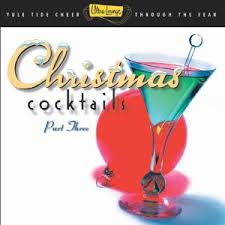
SOUNDTRACK: ULTRA LOUNGE: CHRISTMAS COCKTAILS Part Three: Yule Tide Cheer Through the Year (2005).
The final part of the Ultra Lounge Christmas set certainly sees them running out of steam. There’s far fewer songs and the total running time is nearly 20 minutes shorter. But that doesn’t mean there aren’t some great tracks here.
CARMEN McRAE-“Baby It’s Cold Outside” a fun opening with some talking before the song between Carmen and Sammy Davis Jr. Davis is really silly through the song (and she seems to be laughing him). BING CROSBY-“Frosty The Snowman” wonderful. LENA HORNE-“Santa Claus Is Comin’ To Town” a trippy opening in which Horne was “in the milky way.” Then the song kicks in—a fun version overall. Strangely she switches “bad or good” into “good or bad.” JOHNNY MERCER-“Jingle Bells” a fun hopping version with plenty of swing. There’s even extra lines (“there’s nothing new about jingle bells”).
WAYNE NEWTON-“Let It Snow! Let It Snow! Let It Snow!” Female vocalists again (I thought Newton was a singer?), but nevertheless, it’s a fun version. NANCY WILSON-“That’s What I Want For Christmas” a pretty song, that I didn’t know before. I really dig Nancy Wilson. DEAN MARTIN-“Winter Wonderland” delightful, I do love the Deano. BILLY MAY-“Do You Believe In Santa Claus?” – Billy May’s deep dark rather scary voice presents this weird song. It’s funny and a little spooky what with the crazy way it ends.
PEGGY LEE-“White Christmas” this version is too for me. AL MARTINO-“Rudolph, The Red-Nosed Reindeer” this is a nice version, though. RAY ANTHONY-“A Marshmallow World” a lovely version of this fun song. LOU RAWLS-“Have Yourself A Merry Little Christmas” Rawls has finally won me over. I like this song by him. JULIE LONDON-“I’ve Got My Love To Keep Me Warm” slow and jazzy but too slow for me. NAT KING COLE-“Buon Natale (Means Merry Christmas To You)” a fun song quaint and cute and one you don’t hear very often. JUNE CHRISTY-“Sorry To See You Go” I don’t know this song, it’s more of a New Year’s song. Swet and bouncy. Although not my favorite ending to the discs.
So that’s the Ultra Lounge mixes, easily my favorite way to spend a holly day.
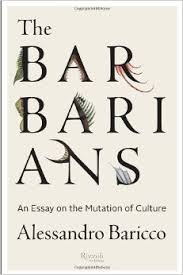
[READ: December 24, 2014] The Barbarians
This was the final Baricco book I planned to read this year and it’s a good way to end the year–reflecting on the past but planning to move forward.
It’s nonfiction so I didn’t really know what to expect. But I certainly didn’t expect the story in the beginning of the book. Baricco explains that he really wanted this book to be translated into English (especially for the American market where he felt it would be particularly on target) but he couldn’t find anyone to publish it. And he didn’t want to go self publishing. He ultimately found a friend in New York, owner of Eataly who agreed to foot the cost. They did the work and then Random House distributed it.
So Stephen Sartarelli translated it. The book is a fun and interesting look at the barbarians who are ruining our culture and destroying our soul. But Baricco is very careful to point out that just because they are ruining things, it doesn’t mean that they are making things worse or doing it maliciously. He uses several specific instances in which the barbarians have changed something held sacred and made it, if not better, then different and often more enjoyable.
This book was originally written as a series of newspaper articles in 2006 (not sure exactly when). He says it was fun to see feedback as he was writing each installment (each “chapter” is about four pages). (more…)
I can’t get over how much I’ve been enjoying this album for the last two years. Father John Misty is J Tillman from Fleet Foxes.
This disc is a gentle folk album with vaguely country leanings. The arrangements are spare and yet the verses and choruses are so great to sing along to. “Funtimes in Babylon” has this infectious chorus: “I would like to abuse my lungs, smoke everything in sight with every girl I’ve ever loved. Ride around the wreckage on a horse knee deep in mud. Look out, Hollywood, here I come.” “Nancy from Now On” has a great propulsive chorus with oohs and tinkling bells and pianos and Misty’s engaging falsetto.
I was introduced to this album by “Hollywood Forever Cemetery Sings” which opens with the super catchy line, “Jeeeeesus Christ, girl.” I love the big crashing drum sound he has here. “I’m Writing a Novel” is a fun romp, with the great line “I’m writing a novel because it’s never been done before.” “O I Long to Feel Your Arms Around Me” introduces a great organ sound. It’s a full song at only 2 and a half minutes.
“Misty’s Nightmares 1 & 2” opens with a slide guitar and turns into a stomping song with more Ooohs and a great chorus. “Only Son of the Ladiesman” has a great chorus with the fun couple: “I’m a steady hand, I’m a Dodgers fan.” “This is Sally Hatchet” has cool guitar blasts and a great bridge.
“Well You Can Do It Without Me” is a countrified 2 minute stomper. “Tee Pees 1-12” is a big stompin’ honkey tonk song with fiddles and slide guitar. The disc ends with “Everyman Needs a Companion” a slow ballad with a great piano melody and a fun to sing along with verse and chorus.
I love the lyrics on this album, especially the song “Now I’m Learning to Love the War” a slow ballad with a great story:
Try not to think so much about
The truly staggering amount of oil that it takes to make a record
All the shipping, the vinyl, the cellophane lining, the high gloss
The tape and the gear
Try not to become too consumed
With what’s a criminal volume of oil that it takes to paint a portrait
The acrylic, the varnish, aluminum tubes filled with latex
The solvents and dye
Lets just call this what it is
The gentler side of mankind’s death wish
When it’s my time to go
Gonna leave behind things that won’t decompose
In addition to all of the great music on here, the CD packaging is fantastic with that great cover, done in a cardboard gatefold sleeve including two huge books full of words and drawings and lyrics and everything. I’m really looking forward to his next release.
[READ: September 14, 2014] Grantland #10
Despite my being in the middle of reading several other things, I was looking for a short article to read the other night and grabbed my Grantland 10. And, of course, once I started, I couldn’t stop. I put everything else on hold and blasted through this issue.
And so all of my loves and hates are the same with this issue. I never know how anything they talk about nearly a year ago turned out, which stinks. And yet I get so wrapped up in the writing that I don’t care. I’m not sure what it is about the writing for Grantland that i enjoy so much. It is casual but knowledgeable. Often funny but not obnoxiously silly. And I suppose that now I feel like I’m in on all of the secret stuff they talk about so I’m part of the club. I fear that if I were to ever go to the website I would get sucked into a black hole and never emerge.
I often wonder how they choose what goes into the book. This issue has some new writers and the surprising absence of some regulars. I wonder what went on there. And as always, the book could use some editing and maybe actually listing the urls of the links that were once in the online version. But I think I’m talking to deaf ears on that one.
This issue covers October-December 2013 (that’s ten-twelve months ago! Some of this stuff feels ancient!)
 When I saw that Eddie Izzard had a book out I was pretty interested to read it. I have loved his stand-up since 1997 or 1998 and I was lucky enough to see him on his Circle Tour (on the date they recorded it!). I have been keeping up with his career and trying to see him in whatever he does (although I like my comedy more than drama and he has certainly made the shift towards drama in recent years).









 I Just Read About That...