Feeds:
Posts
Comments

Archive for the ‘Sex’ Category

SOUNDTRACK: LATETIA SADLER–“There’s a Price to Pay for Freedom (And It Isn’t Security)” (2012).

What a treat to see Latetia Sadler as the song of the day from The Current (Minnesota Public Radio).  Latetia Sadler is the voice of Stereolab.  She has a new album coming out called Silencio and this is the first single.

It’s hard to say whether or not the song “sounds” like Stereolab, because Stereolab sounds different all the time.  But this is definitely not your bubbly Stereolab.

The song opens with some dreamy slow synths which morph into some dreamy guitars.   There’s no vocals for over a minute (which makes it seem like it might be an instrumental.  When Latetia’s voice comes in (backed by a deep male voice (very un-Stereolab) the music pulls back almost entirely and Latetia’s peculiarly inflected words [ree-uh-li-TEE] come to the fore.  It’s hard to believe that such a dreamy song would be about what the title suggests it’s about.  But how about this for a stinging (if oblique) final line: “Happy to identify with a reflection in merchandise.”

I prefer Stereolab’s bubblier music to their more dreamy, languid songs.  This one is nice, and because of her voice, it’s intriguing.  But I’d need a beat more oomph to want to get a whole record.

[READ: July 6, 2012] “An Abduction”

Tessa Hadley is rapidly turning into one of my favorite authors.  I only know her from reading New Yorker stories and I really must expand beyond these glossy pages.

This story was really fantastic.  I loved how the title has one meaning–the obvious meaning, which is even stated in the story–at the beginning, but by the end, the meaning changes to something else.

And what a great opening to a story: “June Allsop was abducted when she was fifteen, and nobody noticed.”  Shocking!  Then Hadley contextualizes this oversight: “This happened a long time ago, in Surrey, in the nineteen-sixties, when parents were more careless.”  Hmm.

So Jane was home from boarding school–her older brother was studying for college, her younger sister was not yet in boarding school and still had friends locally.  So, yes, Jane was bored.  She tried her best to have fun, but was really stumped.  When her father drove down the driveway past her and she accidentally hit his car with the ball from her Jokari set (paddle ball), the only fun she was having was destroyed.  Her father drove off in a huff.

Driving past him on the road was a two-seater convertible with the top down and three long-haired boys driving.  Her dad scowled at them, but paid them no mind.  Which is a shame as they are the abductors of young Jane. (more…)

Read Full Post »

SOUNDTRACK: K’NAAN-“Wavin’ Flag” (2009).

Like most people in America I don’t know much about K’naan.  This is despite the fact that this song (in a modified form) was the anthem for Coca-Cola and the 2010 World Cup and was HUGE (except in America where we like one and ignore the other).  There’s an article about K’naan in the July/August issue of The Walrus.  He is a Somali-born Canadian rapper and he is looking to break into the US market.

And that’s as much as I knew of him.  So imagine my surprise upon listening to this song to realize that it is an acoustic-pop song not unlike Coldplay (lots of Whoa-ohs) set to a martial beat.

It’s a catchy anthem indeed–made perfect for an event with lots of waving flags like the World Cup.  However, the original lyrics are impressive (and talk obliquely about his life in Somalia).

Out of the darkness, I came the farthest Among the hardest survival
Learn from these streets, it can be bleak Accept no defeat, surrender, retreat

So many wars, settling scores Bringing us promises, leaving us poor
I heard them say ‘love is the way’ ‘Love is the answer,’ that’s what they say

And yet the chorus is pretty uplifting:
When I get older I will be stronger They’ll call me freedom just like a wavin’ flag And then it goes back, and then it goes back And then it goes back, oh
Chorus aside, these lyrics aren’t exactly going to sell product, so it’s not surprising that the Coca Cola Celebration Remix has changed some lyrics:
Saying forever young Singing songs underneath the sun Let’s rejoice in the beautiful game
And together at the end of the day, we all say
Although this lyric could have been in either version
In the streets our heads are liftin’ As we lose our inhibition
Celebration, it surrounds us Every nation, all around us
And the chorus remains the same.
The remix is a bit more interesting musically.  The original is just him on an acoustic guitar with some drums.  It reminds me of Bob Marley (and references “Buffalo Soldier”).  The remix has a really cool drum intro.  It’s beefed up throughout as well.  I guess it’s easy to say it’s a sell out (but well, duh), but it’s still as catchy as the original without being too obnoxiously overproduced.  And heck, maybe people learned a bit about Somalia from it.  Stranger things have happened.

[READ: July 4, 2012] “And They Danced by the Light of the Moon”

Some stories are one thing at heart.  No matter how much you gussy them up and make them look all fancy, they’re always going to have heavy metal T-shirts under their formal wear (I should know).

And so it with this story set in the 70s in the Quebec town of Val de Loups (the fact that it is set here changes enough of the story that although the story is not atypical, it is at least in an unfamiliar setting (to me)).  Jules knows that he is in love with Manon.  Manon doesn’t know anything about love.  Jules is an only child, living in a trailer park, trying not to get beaten by his father. Manon is the youngest of 11 children (her mother kept trying until she had a girl).  She is beautiful with golden ringlets and a magical laugh and she is under the constant supervision and protection of her ten massive brothers (one is a wrestler, three work in the mines).

Jules is an intelligent boy who always gets in trouble.  He’s a class clown because he likes it when people pay attention to him, although he doesn’t really have any friends per se (when he gets in trouble, they aren’t there with him).  His last prank was an invitation to the aliens–spray painted in the school parking lot.  This gets him kicked out of the upcoming dance (even though he did a lot of the getting it setup).  He’s really bummed because Manon said she’d go with him.  Manon likes him because of the way he can roller skate.

Despite not being allowed into the dance, they meet up outside the building and go to a house in town where Jules is plant-sitting.  With the right music, the right lighting, the right setting, this would be a joyous romp of explored sexuality and post-dance bliss.  But this is Val de Loups, where no one leaves, where everyone is trapped. (more…)

Read Full Post »

SOUNDTRACK: BUILT TO SPILL-“Carry the Zero” (1999).

For a time, before the bands each took off, I lumped Built to Spill, Death Cab for Cutie and Modest Mouse into a pile of bands I really liked but wasn’t always sure who was who.  They each have melodic sections, noisy sections and high pitched singers.  (It also turns out that both Modest Mouse and Death Cab for Cutie cite Built to Spill as a big influence).  The big difference between the three is that Built to Spill’s Doug Martsch is a guitar god—he does amazing solos which is why his songs are so long (their Live album features a 20 minute version of Neil Young’s “Cortez the Killer.”

I have no real idea what this song is about, but I love it.  It’s catchy and fun with a great melody.  And, in this case it kind of ties in to JR, because JR is all about making money but his basic math is shaky.  In the same way, carrying the zero won’t do anything in basic math.  Although “you have become a fraction of the sum” is a nice refrain.

This was the song and album that introduced me to Built to Spill and I love it.  Great 90s alt rock.

[READ: Week of June 25, 2012] JR Week 2

And since there are no paragraph breaks, week two picks up mid-flow.  However, this proved to be a good breaking point because almost the entire read for this week is about Mrs Joubert and her class on their field trip to the New York Stock Exchange.  And Edward Bast is steamrollered into doing (and paying for) everything.   Gaddis’ style completely allows for the miscommunication and ease with which Bast is overtaken by Joubert and Gibbs.  While it certainly calls into question Bast’s ability to stand up for himself, it also shows how easily one can be pushed into doing things (although in real life I suspect you’d just say “wait a minute, I can’t,” at some point).  It’s still very funny and the action moves along so quickly that it works perfectly with the flow.

The scene begins with Mrs Joubert herding the kids onto a car and then talking to Mr Bast.  He apologizes for what happened yesterday,  Of course, he is talking about his disastrous TV meltdown but she thinks he means the loss of the bag of money and its turning up 3 pennies short.  Through a series of unsubtle hints from Mrs Joubert, Mr Bast winds up joining their trip to the city.  He had business to conduct in Manhattan so he was going in anyway, but now he’s roped in with the kids.  There’s a lot of sexual tension on this trip–the boys are watching women bend over and Mr Bast keeps pressing his body again “her unyielding thigh.”

Then we get our first really big scene with JR.  In this scene he and a friend (unnamed as far as I can tell) are going through all of their free mail publications and doing trades.  Everything the boys try to trade is a load of crap (a word count on “crap” would be very high indeed). So the kids start looking through their brochures: K’ung-p’a, piano lessons, rare coins, scientific method builds powerful muscles,government surplus (a Tank that turns out to be an airplane gas tank (ha)), How to Make Big Profits Overseas, selling shoes, etc.  There’s some very funny back and forth as smart-assed kids will do (he really has young kids’ dialogue down very well), like :What are you gonna do where it says “married” or what are you gonna do when it says shoe size and you put yours? (more…)

Read Full Post »

SOUNDTRACK: EAST OF THE WALL-“False Build” (2011).

Viking picked this song back in September of 2011 as his song of the week (or however often he posted then).  I’d never heard of East of the Wall, despite their New Jersey pedigree.  (I know I don’t know every band from New jersey, but usually by the time a band has three records out I’ve at least heard of them).

This song is just over five minutes long and the vocals don’t come in until about three an a half minutes.  By the time the vocals come in, we’ve had three or four different stylistic changes.  And, by  the time the vocals have been with us for a minute it’s possible that there are four vocalists in the band.

It opens with some clean guitars playing an open (but slightly off) chord progression.  Over that comes a slightly distorted guitar and a bass playing mostly the same notes but just enough to be notably different.  Then add some drums so the song is builds very nicely.  The solo gets more and more complicated and when the drums rumble in for a climactic progression…the songs shifts into a kind of loud heavy rock/almost funk.  A new more angular solo plays over the funk riffs and it all works wonderfully.  Then the song becomes a rapid fire snare drum metal song and that’s where the vocals kick in.  I assume this is all one vocalist but who knows.  For the sake of argument I’ll pretend they are all different.

The first vocalist is a screamer–hard to understand but fitting in perfectly with the now heavy riffs.  He doesn’t say much before the second vocalist comes in.  This section of the music is mellow and kind of prog rocky and the vocalist fist perfectly–actually crooning along with the melody.  Until vocalist three comes in with a kind of cookie monster vocal which is interspersed with a different cookie monster vocalist.  By the quarter to 5 moment the first vocalist comes back, and there’s more screaming until the song ends.  It’s chaotic and cool and keeps you on the edge of your seat.  I wonder what they’re singing about.

Wow.  If I’m this exhausted writing about it, imagine how they must feel playing it.  I’m going to have to check out more from them.

[READ: June 28, 2012] “Another Life”

This story is disconcerting in that the first paragraph is a page and a half long.  And it works very well stylistically.  The whole first paragraph concerns a man (the husband) as he returns from a party for father-in-law.  He’d rather not have gone to at all, but since he is also sick and on medication, he takes the opportunity to leave early.  He arrives back at the hotel and sits down to read Rousseau’s Discourse on the Origin of Inequality.  (Holy crap!).  He can’t focus on the book so he decides to go down to the hotel bar (with the book) just to mix things up.

There are a few people in the room, but he sits alone at the bar.  The bartender (whose name is later revealed to be April P) is very nice and chats as she serves him.  She sees his book and asks what he’s reading.  He’s a bit embarrassed, because she’s never heard of Rousseau.  But she says that she reads everything and her favorite is Emily Dickinson.  He is thrown by her choice of authors and by the fact that he can’t think of anything clever to say about Dickinson.  He fumbles a bit.  She remains nice but is clearly unimpressed. (more…)

Read Full Post »

SOUNDTRACK: INVISIBLE GUY BLOG (2012).

Jonas from Invisible Guy contacted me about a project he’s working on.  I’m not quite the right fit for it, but I had to check out his site to see what he was all about.  As his About page explains; “This blog is generally a platform for unknown bands to get promoted and interviewed.”  That’s pretty awesome in itself.  But as I browsed the site, I saw that in his post Invisible Guy recommends: 80s Post-Punk – 1982 (Part II) he includes not only The Birthday Party but also The Virgin Prunes.  Much respect there (especially for someone who wasn’t alive when those records came out!).

But the bulk of his site is full of really obscure bands (lots of bands that I’ve never heard of).  He interviews band members (sometimes in Swedish!) and has quite an impressive list of publications that he’s worked for.

So head on over to Invsible Guy for a wonderful collection of punk and hardcore music as well as some iconic (and really obscure) new wave and post-punk tunes.  He’s also got some great stuff on death metal too.  Not bad for a site that’s only a few months old.  Invisible Guy has a lot of samples and videos as well as a bunch of streaming music from unreleased or just-released albums (like this demo from the Swedish band Regimen called Välkommen hem).

And here’s a video for the Swedish stoner metal band Skraeckoedlan.  The song is “Apple Trees” and no you can’t understsnad the words because they are in Swedish.  I love that.

It’s a great site.

[READ: June 15, 2012] “A Psychotronic Childhood”

The more I read Colson Whitehead, the more I like him, not just as a writer, but as a “person” (the person he presents to us anyhow.  Although I met him briefly at a convention and he was super friendly and very nice).  This essay shows that he and I occupied some of the same headspace when we were kids (we were born in the same year)—watching sci-fi and horror movies on Channel 7 & 11 after school and on the weekends.  Of course, I didn’t really get into horror movies until much later them him (his first time was when his parents took him to  a horror film in the theater at the age of 5).  FIVE!

These early horror movies really shaped his outlook.  He lists about 70 movies in this article, of which I have seen at least half (although more from MST3K than actually sitting through them unaccompanied) and his summaries about them (four or five parenthetical words) are apt and often hilarious:

  • Food of the Gods (giant chickens rain pecking doom on a small island)
  • Alien (an outbreak of tummy trouble among space miners)
  • Demon Seed (rom-com about a horny computer that wants to impregnate Julie Christie)
  • The Devil’s Run (A negligible and mind-numbing film, notable only for the utter ineptitude of its attempt to cash in on the brief occult-movie fad that followed Rosemary’s Baby and The Exorcist.

The Devil’s Run is the first movie he saw, back in 1975, in the theater.  He says that there was something good in it, that it really captured the element of terror when your loved one turns on you.  And he tapped into this for his novel Zone One.

Then he reflects back on 1981, when his family bought a VCR and he and his brother would head to Crazy Eddie (remember Crazy Eddie?) to rent 5 movies for the weekend (I didn’t even know they rented movies!).  The movies were inevitably 4 horror movies and one mainstream film.  And the family would gather by the TV and watch together.  How wholesome!  Except when you read what they were watching (I can’t IMAGINE my family watching these together when I was a kid–even now, Sarah hates horror films).   This is getting into the era of Friday the 13ths and Halloweens as well as classics like Terror Train, Prom Night, Slumber Party Massacre, Silent Night, Evil Night, Mother’s Day and My Bloody Valentine (“not even the holidays, hallmark or otherwise were safe”). (more…)

Read Full Post »

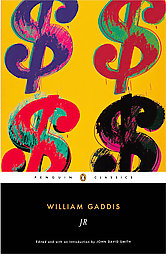
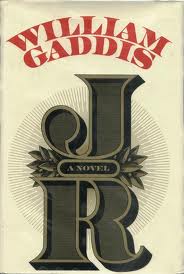
The edition I’m using.

SOUNDTRACK: RICHARD WAGNER-“Ride of the Valkyries” (1856).

Possibly the most famous piece of music from any opera (known for a billion reasons other than the opera itself).  This song was introduced to be by Bugs Bunny.  And then cemented in my consciousness in Apocalypse Now.

It’s really impossible for me to listen to it without seeing helicopters dropping napalm.

I’ve never seen it performed before.  Most of us think of it as an instrumental, but there are vocals, and they add a lot to the performance.  I also didn’t realize that the whole first minutes is a prelude to the third Act–with a darkened stage.  I just watched this version by the Danish Royal Opera in which the setting is updated.  The Stage is amazing and it’s a pretty powerful image, that won’t leave me head too soon.  And of course, the women sound phenomenal.

Smells like victory to me.

[READ: Week of June 19, 2012] JR Week 1

And so begins the saga of JR.  A little of my background:

I read JR about a decade ago.  I recall the structure and some of what happens, but not enough to actually remember anything ahead of time, plotwise.

Usually for these weekly group reads, I post fairly detailed recaps of the book.  And usually I do that because there’s so much going on in a large book, that it’s one way for me to keep track.  JR is going to be a little different.  If you’ve gotten this far in the book, you’ll notice that there’s not a lot of plot going on.  There’s a few scenes with lots of dialogue and maybe something comes of it, maybe not.  So, I’m certainly not going to try to recap everything that happens in the dialogue, nor am I even going to try to figure out who said what or even who is in every conversation–I’m not even sure that’s possible.  But I am going to talk about each scene a bit and see if I can pick out anything that seems important.

The book strikes me as being like an unedited film.  Or like a Picasso–Gaddis wants to show you everything, and let you pick out the important bits.  And so the book feels like a boom mike has been inserted into a room or scene.  We’re not really sure who everyone is, or even who is talking at a given moment.  But we hear everything that’s said. And then the boom mike pulls out and the camera pans somewhere else and the boom mike goes down and we hear some more.  It’s not always clear even that a scene has shifted–although usually a dense paragraph of prose indicates a shift in scene.

As far as characters, it’s not clear if anyone mentioned early on is going to stay with us through the book.  It’s clear that JR will be here (although his first real scene is right after my spoiler line for this week).  There’s also the Bast family who will no doubt play some ind of important role.  Then there’s a lot of teachers as well. (more…)

Read Full Post »

SOUNDTRACK: JACK WHITE-“Sixteen Saltines” (2012).

I really liked the first White Stripes album.  After that things were just a little too samey to me.  So I pretty much stopped listening to him.  This new album is all the rage (as is everything he does), and this is a song that NPR picked as one of their favorites of the year so far.

And as with everything Jack White does, it’s immediately fun.  It’s also simple as anything, with a raw and aggressive sound–just like everything else he does.  I usually don’t mind when an artist plays the same stuff over and over, I mean it’s called a signature after all, but for some reason it bugs me with him.  Or maybe I just don’t like him as a “person.”

Anyhow, I can’t deny that this song is fun (the vocals done in a kind of R&B vein (sounding like Michael Jackson a bit?) and the addition of keyboards half way through are a nice touch.  But I can’t say that I’ll remember the song much after it’s over.

[READ: June 16, 2012] “Black Box”

I have been meaning to read Jennifer Egan’s A Visit From the Goon Squad for quite some time.  But in the meantime, I’m happy to have read this short story, which I assume is nothing at all like her novels.

“Black Box” is written in a series of small numbered black boxes.  And each box contains a number of statements in the second person.  It’s a striking and unusual way to concoct a story.  I didn’t really think it would be all that intriguing because the tone is so matter of fact and instructional.  But I was thrilled with how much of a story Egan created out of this style.  And, yes, it is a full story.

So Box number one begins: “People rarely look the way you expect them to, even when you’ve seen pictures.”  Then, “The first thirty seconds in a person’s presence are the most important.”  Then, “If you’re having trouble perceiving and projecting, focus on projecting.”  Then, “Necessary ingredients for a successful projection: giggles; bare legs; shyness.”

So, what is this?  instructions?  advice?  quips to live by?  Well, it turns out that they are instructions to a “beauty.”  And this beauty is working for her country, to take down a bad guy.  She is a spy, although not a professional spy, she’s just a beauty doing her country’s work.  The instructions show (in a very unexpected way) how the story unfolds: “‘Shall we swim together toward those rocks?’ may or may not be a question.”  And so, “you” and your Designated Mate swim to an island where sex in inevitable.  “Begin the Dissociation Technique only when physical violation is imminent.”  For indeed, “you” are married, but your husband approves of this mission, for the good of United States and the world.

As the story unfolds, the reader realizes that this is not just a beautiful woman who has been called into the service of he country, but something a little more. “If you are within earshot of his conversation, record it.”  Well, how will she do that one wonders.  “A microphone has been implanted just beyond the first turn of your right ear canal.”

Cool. (more…)

Read Full Post »

SOUNDTRACK: PHISH-The Man Who Stepped Into Yesterday (1987).

This record was created by Trey Anastasio as his senior project at Goddard College.  The thesis included an essay piece and this collection of songs (recorded by Phish) relating this epic tale from the band’s fictional land of Gamehendge.  It was never officially released, but since Phish is so free with the tape trading, it is pretty widely available online (heck, even Wikipedia has a link to the Lossless SHN download of the album).

This release is legendary in the band’s history because they have played all of the songs from this album many times in their live shows (some much more than others, of course).  And while they have more or less played the Gamehendge saga a few times in concert, I’d always wondered what the original story was all about (many songs have since been added to the saga as it grew larger).

So here in all its tape-hissy glory is the original.  My first thought is that I guess it was hard to get good sound recording equipment in 1987 (or else this is a multi-generational copy—the “white cassette” from a year earlier sounds better).  And there seems to be a few flubs in the narration (which could be from copying).  I actually surprised he didn’t use a more authoritarian voice for the narration.

For fans, this is fun to hear because of that narration.  Live, the narration varies all the time, not always explaining what is going on the same way (some live narrations are far better and much more interesting).  But here you get it straight from the source.  The narration is accompanied by rather pretty instrumental music (which varies depending on who he is speaking about).  But for those of us who know all of these songs, the biggest surprise is finding out that “AC/DC Bag,” “The Sloth,” and “Possum” were part of the story (or maybe the biggest surprise is learning from the narration what the hell an AC/DC bag is (a robotic, mechanized hangman, of course).

The story is pretty interesting (Wilson and the Helping Friendly Book and all that), although by the end it loses itself a bit.  And I’m not really sure that “The Sloth” and “Possum” fit into the story at all.   But hey, he was a college senior when he wrote it, one can forgive a little sophomoric nonsense, right?

[READ: June 11, 2012] “The Republic of Empathy”

This is the first fiction I’ve read of the sci-fi issue.  I’m not sure if it’s supposed to be sci-fi, because it’s not really, at least not in terms of genre (I’d say sci-fi fans would object to the designation of sci-fi for this).  But it is futuristic and neat.  I especially enjoyed the humor and the construction of the story—Lipsyte is usually good for both of these.

It begins with William.  Williams is married to Peg.  Peg wants to have a second child as a gift for their first child (who has just grown out of the new baby smell).  William thinks this is crazy, but Peg says it’s a dealbreaker.  The next day William, who works for a flip-flop company, smokes a joint with an ex-cop friend, Gregory on the roof of their building.  On the roof across from them, they see two men fighting. And then one falls of the roof—splat.

Gregory says he’s seen this before but that William will be traumatized.  And he is in his dreams, but he’s even more traumatized when he dreams that his wife is pregnant and they already have two kids.  Oh, and that the neighbors, the Lockhorns, masturbate each other in the living room with the windows open.

Section two is from Danny’s point of view.  Danny is Gregory’s son.  Every few weeks Gregory is dating a new, younger lady.  This one is only a few years older than Danny.  It’s gross (and Danny feels like a bad YA narrator as he relates the story).  This is all before (I assume) Gregory comes out of the closet.  Because William knows that he’s gay in the above scene. (more…)

Read Full Post »

SOUNDTRACK: THE GREAT GAMBLE-Book One (2012).

My friend Matt has worked at a school in Pennsylvania for years. He wrote to tell me that a few kids who graduated from his school had formed a band and have released a CD.  It’s streaming (and downloadable) on bandcamp at their site.

I have lots of friends in bands, and I’ve listened to lots of demos, so I wasn’t expecting very much.  But the first thing I noticed when I listened was how good this sounds–professional and, yes, like a “real” album.  This isn’t just a bunch of guys jamming in their garage.  What makes this even more striking is that the music is heavy progressive metal–not something you just whip out in a quick take.  This is complicated, interesting music.  I’m hearing a kind of Dream Theater meets King’s X vibe going on.  And man, it’s really good.

This is multi-step heavy rock (complete with a synth player/violinist!). The only song that is less than 9 minutes is the 90 second introduction called “The Marketplace.”  Otherwise, we’ve got three songs over ten minutes and one over 16!  Who even knew young bands did stuff like this anymore?

Al Joseph plays lead guitar and sings lead vocals.  His guitar speed is very impressive and his vocals sound not unlike Dug Pinnick from King’s X (noticeable on the opening track, especially) .  Matt Weaver plays violin and keyboards.  The keyboards offer more than just a fuller sound.  On “Release the Kraken” they provide some cool sci-fi sound effects.  At about five minutes in, “Release the Kraken” slows down to a quiet middle section that really showcases Steve Michael’s drums.  And then comes the blistering guitar solo.  It’s followed quickly but a slight diversion and then a wholly different style of solo.  It’s really something.

If “Release the Kraken” wasn’t a good enough prog rock title, how bout “Legends of the Symmetria.”  This one has a very Dream Theater feel for the opening.  But the vocals sound very different–dual vocals with great low harmony.  There’s a cool pre-chorus (I guess) at about 3 minutes.  This song is definitely a heavy one.  At about 4 minutes, the song slows down into a pretty classical guitar section,where Chris Joseph on plays bass gets to show off a bit (although he seems to be the most understated of the 4 players).  There’s some great drumming at the end of the song, too.

“The Ghost of Three Reflections” is a slow builder of a song.  There’s some quiet parts (with beautiful harmonies) and a guitar solo that sounds clear and perfect (I’m hyping the production so much because it sounds so good).  The guitar solo section in this one strikes me as something that might suit two guitarists better–maybe two more different styles of soloing, but he pulls it off well, especially when by the end, he has shifted to a very different style, and the music changes along with it).  I love the bass section at the 8 minute mark, which reminds me of something Rush might have done back in the mid 70s.  The song kind of merges into “Breach At Fort Mycenae” which opens with the same kind of staggered sound as the end of the previous song.  The violin gets an airing in the middle of this song and it’s a cool treat.  I could definitely use more violin in these songs, although maybe little bits are a treat.  There’s a few times when I don’t like the production choices–maybe there needs to be a bit more music behind some of these solos so it doesn’t just sound like two players soloing against each other.

The disc ends with the big one, the sixteen minute, “The Sleepwalker Pt. 1 – Tears of Dagon” [I love that it’s a Part One and it’s 16 minutes long].  When the vocals kick in at about 3 minutes, the harmonies are gorgeous.  I love the bass guitar break at 5 minutes.  Although there’s something about the keyboard sound that I don’t like–maybe they’re not big enough?  But I love the crazy guitar solo at the 9 minute mark of this track (I’m a sucker for dissonant scales).

This is an amazing debut CD and I hope these guys go far (they’re going from Scranton to Boston for school, but I hope they can go further than that).  They are tight as a drum, stopping and starting perfectly, keeping all of the rhythms and time changes perfectly.  They really have done their prog rock homework.  The only gripe is as I’ve said, some sections don’t feel “big” enough.  If you’re going to write a 16 minute song, you don’t want sections that sound small–you want your backing guitars or bass guitars to be a little louder so it sounds like the song is still going.  But other than that, there’s not much room for improvement.

I downloaded their CD, (and yes, I paid for it…that will help with college, eh?).  But my real complaint is that on the computer, the album cover is awesome–if you look at it from an angle, there’s a whole scene behind the large logo (try it, it works here too).  But when you print it out, you lose all of that.  The images are there, but the effect is gone.  This is a band that calls out for full color packaging and maybe even a gatefold sleeve!  (The bottom of the cover says Ο υπνoβάτης which means The Sleepwalker).

Good jobs guys!  You’ve done NEPA proud!

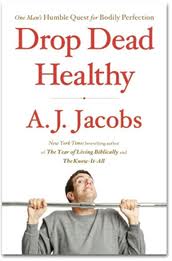
[READ: May 15, 2012] Drop Dead Healthy

Sarah got me this latest A.J. Jacobs book for my birthday.  At first I didn’t think I wanted to read it because I feared what a book all about being in good shape would be—nagging, obnoxious, making me feel bad about my vices. But I should have leaned from all of my A.J. Jacobs experience that he is completely NOT about that.

Jacobs occasionally enters into preposterous forays of Self-Improvement.  In the first book of his I read, The  Guinea Pig Diaries, he tried various weird experiments to see what it was like to be a woman, radically honest, a unitasker, etc.  His other books have been about self-improvement.  He read the encyclopedia from A-Z, he did a year trying to live like out of the bible (I will get to these eventually).  In this book, he is on a quest to be the healthiest person in the world.

It’s an impossible task.  And, frankly, a foolish one.  But he decides he will take two years and focus on individual parts of his body one month at a time.  I’m going say right up front I feared that this book would make me feel bad about all the things I don’t do for myself.   But well, a) Jacobs is a funny writer, so at least you’re laughing.  b) Jacobs is either in bad shape or plays up his badshapedness so that the average person doesn’t feel too bad off.  c) He is so over the top in his quest that no one would ever think about doing all of the things, but we can take what he learned and apply little bits to ourselves.  What is nice is that he tries to get two if not balanced opinions then perhaps fringe opinions to balance out–trying one extreme then another to see which work.

He Breaks His Categories Down thusly: stomach (eating right, the perfect food), the heart, the ears (the quest for quiet), the butt (avoiding sitting too much), the immune system (germs), genitals, nervous system, lower intestine (better bowels), adrenal gland (lowering stress), brain, endocrine system (removing toxins), teeth, feet, lungs, skin, inside of the eyelid (sleep), bladder, gonads, nose, hands, back, eyes, and skull.  Each category is designed to be a month-long workout of that organ/item–some things he keeps doing after the month is over making his workout regime something like 5 hours a day.  And at the beginning of each month he lists the stats for what he accomplished.

I’m not going to talk about all of his body parts, but I will mention a few that i enjoyed the most. (more…)

Read Full Post »

SOUNDTRACK: EFRIM MANUEL MENUCK-Plays “High Gospel” [CST078] (2011).

Efrim Manuel Menuck was a co-founder of Godspeed Your Black Emperor and the main force behind A Silver Mt. Zion.  In some ways it seems odd that he would release a solo album, but I guess Silver Mt Zion is enough of a collective for him to want to do his own thing.  Efrim has been singing a lot more on Silver Mt Zion records, and I find his voice to walk a fine line between interesting and annoying–well, not so much annoying as inappropriate to the music he makes.  For this solo disc, though, there’s something different about the music that works well with his voice.  There’s eight songs on the disc.  Some of them are pretty much unlistenable, but others are really enjoyable.  The opener “our lady of parc extension and her munificent sorrows” is 7 minutes long and has the kind of epic feel of his previous bands, but there’s a lot more keyboard (making cool space sounds).  Meanwhile, “a 12-pt. program for keep on keepin’ on” is described as a “hauntingly processed field recordings and ominous tape-delayed sound-sculpture.”  That’s true for the first minute or so, but after that it’s mostly just an unpleasant cacophony…that lasts nine minutes!  And while it’s great that it was all done with analogue equipment, that doesn’t make it any more listenable.

“august four, year-of-our-lord blues” is a much more enjoyable instrumental, slow vibrated notes, a real western sound.  Efrim sings again on “heavy calls & hospital blues” and his angsty, hesitant voice works very well on this piano ballad.  “heaven’s engine is a dusty ol’ bellows ” is a 2 minute instrumental/introduction that sounds a lot like the guitar opening from Radiohead’s “Electioneering.” “kaddish for chesnutt” is a slow, mournful dirge.  It’s quite moving.  It’s 7 minutes long, and the length is saved by the second half where the chanted vocals bring the song back from the edge.

“chickadees’ roar pt. 2” is mostly feedback noises and squeaks.  It’s less unpleasant than other instrumentals, but it’s not something you’d seek out.  Although it does work as an introduction to the closer: “i am no longer a motherless child.”  After about 2 minutes of dissonant introduction, the group begins singing an uplifting ending hymn.

So this boils down to a self-indulgent solo project, with a few tracks that are among his best.  You can stream it here.

[READ: May 22, 2012] “Mrs Blue”

I really enjoyed Joshua Ferris’ first novel.  So I thought I’d see what else he had written. He has a number stories published but most of them are unavailable for free reading at this time.  Thanks to my JSTOR account I was able to read this one from The Iowa Review.

This was  pretty confusing story–and since its one of his first, I don’t really know what else to compare it to in his work.  There’s all kinds of disturbing images and as you delve more deeply into the story, the images turn more disturbing but in different ways.

It opens with a youngish boy being seduced by Mrs Blue, a teacher in his school.  He warns her about the dangers of unprotected sex and she says that she’s the one who convinced the PTA to hire the guy who gave the lecture, so she knows all about it.  He’s 13 and he keeps telling her he doesn’t want to (her locations of choice include under a railroad car and in a burned out building).  Each paragraph or so is set off by a star, indicating a new section.  So section 2 has the narrator and Gus (friend? brother?) go to the track where Mrs Blue runs laps. Gus walks his dog, Mr Yackley, while the narrator (whose name is Woodrow Williams) talk about Cole Porter and how she’s looking for a new “daddy.” (more…)

Read Full Post »

« Newer Posts - Older Posts »