Feeds:
Posts
Comments

Archive for the ‘Revenge’ Category

vamplove SOUNDTRACK: DO MAKE SAY THINK-You, You’re a History in Rust [CST045] (2007).

rustYou, You’re a History in Rust feels very different from DMST’s previous album.  That record felt kind of insular and tight.  This one feels expansive and experimental.  Like the first song which has multiple sections that feel completely unrelated and which are only connected by silence.  Or the fact that there are lyrics in a song, or even a fairly conventional song.

“Bound to Be That Way” This song opens in a peculiar way.  There’s a drum rhythm, that slowly builds and some piano chords are laid over the top. This goes on for about 45 seconds and then fades out.  And then a new melody–completely different–with horns and guitar peeks its way out. And then it too fades.  Then around 2 minutes a pretty guitar melody comes through followed by big crashing distorted drums. Eventually a new riff enters the song and it really starts grooving.  It’s fantastic, but it too is just a portion of a song which ends at around 4:30.  And then another new section comes in. Then acoustic guitar riff is counterpointed by some horns.  The final melody is the catchiest one of the bunch and it ends this strange song on a high.

But if that was strange, “A with Living” offers the biggest shock to fans of the band.  There are words in this song!  And they are sung! Words were co-written and sung by Alex Lukashevsky and the Great Lake Swimmers’ Tony Dekker.  Akron/Family also joins in doing “oohs” and “ahs.”  It opens with rumbling drums and then the singing begins.  The song has a conventional verse chorus verse structure with big horns.  It’s catchy (the vocals are great).   But it’s also a 9 minute song and at 4 and a half minutes the song moves way from the melody and enters a lengthy instrumental section with deep rumbling guitars.  The chorus of voices returns briefly before the mellow guitars lead us to the end.

“The Universe!” is one of my favorite DMST songs.  It rocks and rollicks.  It has two notes and then five bashing chords.  Repeated several times.  It’s one of the most straightforward songs they’ve done.  It has screaming guitar solos and a cool sliding bass. It’s also very raw sounding, with all kinds of noise floating around it.  And just like that, it’s gone.  Seguing into the quiet, “A Tender history in rust” which opens with processed guitars or keyboards, layered upon each other.   There are voices fighting through (saying all kinds of sounds—including laughing), before it switches to a pretty acoustic guitar riff.  It’s a delightfully conventional folk melody–another unusual addition for the band.

“Herstory of Glory” has another pretty acoustic guitar melody with some rattling drums (in the right ear).   Then there’s a rumbling bass and distant voices before more and more instruments add to the beautiful song–pianos, trumpets, claps.

“You, You’re Awesome,” is the shortest song on the disc at under 4 minutes.  It opens with slow electric guitars and a e-bowed solo.  After a minute or so, the rest of the band comes in with a slide guitar and banjo making a kind of sloppy folky romp.

“Executioner Blues” is another favorite.  Its 8 minutes long with some lovey guitar riffs and sounds.  It opens with some big guitars and a repeating riff.  A martial drums enters the song and keeps it moving until the next big section.  Horns repeat a similar melody and then a romping bass guitar takes over.  More instruments kick in making the song noisy and slightly distorted.  There’s piano trills, glockenspiel, electric guitar, noises and more.   and the instruments all go up the scale slowly for a few bars and then play a punch of staccato notes.  It’s rather dramatic.  After several permutations of this, they just keep going up and up the scale until the reach the top and then they gradually descend again.  The last minute is a series of quiet bass notes, as if everyone has totally come down from that intensity.

“In Mind” is a quiet disc closer.  A simple guitar melody, it is joined by banjo and trumpet.  Then some bass lines come in followed by a very distorted chorus singing “When you die, you’ll have to leave them behind/You should keep that in mind/When you keep that in mind, you’ll find a love as big as the sky.”  The disc ends with some quite banjo plucking.

This disc goes all over the place and really explores different avenues.

[READ: February 10, 2016] Vampire Loves

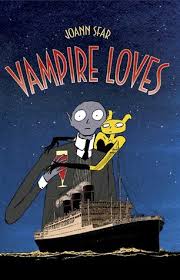
Joann Sfar created Little Vampire (and apparently about 100 other comics, some of which have been translated into English by Alexis Siegel and published by First Second).  Of the things I’ve read by him, (and there have been a few) I enjoyed this the most.  It seems like a lot of his books (like Little Vampire) are for kids, bu this one is absolutely for adults (there;’s curses in it and talk of sex and everything).

There are four stories in this book (I just learned that Sfar has written six in total, so maybe there will be more translated). After the third book in this collection, there’s a question as to whether or not Ferdinand, the vampire in this story is Little Vampire.  There’s a little drawing of Little Vampire which says that Ferdinand is him.  “But vampires don’t grow up!  No, but they can grow little.  Ferdinand was me before!  You mean that before being little you were grownup? Yes.”  So there’s that sorted.

“Could Cupid Care Less?” starts us off with Ferdinand the vampire’s woes.  His girlfriend, Lana, (a kind of plant creature) has just come back.  She cheated on him, but turns the conversation around to say that it is his fault–if he weren’t so jealous he never would have found out.  He freaks about this and she storms off again.  Furious, he sets off for his nightly feeding.  Ferdinand is a nice vampire–he takes little sips and only with one fang so it looks like mosquito.  While he is feeding on a woman, a red-haired vampire storms in and shows him how to do it right.  She is a vixen with an ankh necklace and after feeding, she comes on to Ferdinand hard.  She says she likes old, proper-looking vampires–not goth wannabes.  She brings him back to her house but before they can do anything, her sister walks in.  She’s also red-haired and has a shapely figure and actually has more in common with Ferdinand.  And that’s when we learn that the first woman’s name was Aspirine and her sister’s name is Ritaline (ha!).

All of the stories cut back and forth to different sections.  So we cut over the Lani who is staying with the Tree Man.  He is trying to hit on her, but she’s having nothing to do with it.

We return to Ferdinand where he just can’t get rid of Aspirine, even when he wants some alone time.  He can’t get a woman he wants and can’t get rid of the ones he doesn’t.

“Mortal Maidens on My Mind” opens with a Japanese woman meeting Ferdinand in Paris and falling for him.  They do all kinds of things together and she even writes home about him.  But Ferdinand had to return home and that was the end of that.

We cut back to the Tree Man who is still pining for Lani but is having no luck with her.

Back home, Ferdinand runs into the man who slept with Lani, Michael.  He also argues that it was Ferdinand’s fault that things wound up as they did.  He says that he was just looking for fun.  He didn’t want to hurt anyone, so why did Ferdinand have to get involved?  After a fight Ferdinand leaves to go to a bar where he tries to hook up with a woman but it all falls apart.

Then we cut to a man who has created a golem.  He wanted the golem to do bad things, but the golem is so kind that he couldn’t possible have made the him do the evil things he planned.

The postscript of the story contains a few notes on the protagonists of this story which sort of retroactively tries to make sense of the seemingly disparate story lines and lets us know how these characters belong here.

“Lonely Hearts Crossing” shows Ferdinand on a cruise.  But first we meet a woman named Alas, and her spiritual ghost-creature-friend named Sigh.  Alas is looking to score with the captain of the ship (who is the invisible man).

Meanwhile Lani is going shopping with Tree Man.  He has become her buddy and he can’t get out of it.

On the ship, Ferdinand runs into a werewolf who turns into a wolf when he sees a girl.  He only transforms back if he can kiss a girl.  But he is a such charming creature that he has no problems scoring–much to Ferdinand disgust and amazement.

The story turns very exciting as there are armed criminals on board and a shootout.  And by the end of the story Ferdinand is making out with the spirit ghost creature (who teaches him how to go through walls which turns them both kind of ghostly for a time).

“Moonstruck Post Mortem” ends the book with Ferdinand trying to pick someone else up.  His conscience is bothering him lately though so he manages to get rid of it.  The woman is interested in him but already had two boyfriends so she kind of blows him off.

The scenes shifts to Ferdinand at the police station.  He’s not n any trouble.  in fact, the police would like him to help with their investigation of suspicious murders.  Since he’s nocturnal they figure he can look at night.  That’s how police work, right?

Ferdinand decides to go out drinking again. He meets a woman he likes, but she seems disinterested. So he quickly moves on and finds a  creature who is into him.  But he is quickly utterly disgusted by her.  And the first woman just came back. Oh no!

Frustrated, he leaves and goes to see the dentist–because the dentist has some secret information about the investigation. But before he will give the information to Ferdinand, he needs to give him a compete check up.  By the end, he tells Ferdinand not to get involved. And as the story progresses and the criminal is found…  Ferdinand is shot and thrown into a hole!  Can Ferdinand’s conscience come to the rescue?

The whole story concludes with Ferdinand going back to find Ritaline (but of course finding Aspirine instead).  She offers to let him bite her–but when one vampire bites another it’s “catastrophe.”

It’s a totally nuts book but very funny.  Another fun book in my #10yearsof01 February.

I think the reason I don’t enjoy the Sfar books as much as I might is because they are printed so small.  I don’t know what the original size was, but the format makes everything feel really squished.  This makes the dialogue hard to read and means you can’t see all of the details that well.  I think if these books were bigger it would really help their appeal.

Read Full Post »

little vamopSOUNDTRACK: DO MAKE SAY THINK-Winter Hymn Country Hymn Secret Hymn [CST025] (2003).

hymnThis album, at least according to the liner notes, seems to be broken into three sections, as the title suggests.  Although there is no explicit attachment of a particular hymn to the songs, there is a gap between the listings, giving each section three songs.

“Federica” is 9 minutes long and opens with a very lovely slow guitar melody.  Then the drums crash in and the song doesn’t change so much as intensify.  At around 3 minutes the song pauses before a loping bass adds to the mixture and the songs gets bigger and bigger, and even a little funkier. When the distorted guitar comes in at 5 minutes, it’s hard to believe it’s basically the same song all along.  It builds to a cacophonous explosion and then settles down again. A new style emerges—slow and plaintive with mildly distorted guitars. But they can’t stay muted for long. The distorted guitar comes back and forces the song forward with some distorted bass and other noises until it resumes a reprise of the original guitar melody.

“War on Want” is only 2 minutes long.  It is mostly strings that seemed to be looped in some way.  There haven’t been a lot of strings in DMST records so far, so this is new.  They drift slightly out of tune as they introduce the 3rd song “Auberge le Mouton Noir.”  The song opens with some crackling noises and some pretty, slow chords. which resolve into a simple riff.  The song builds, growing faster with a great propulsive beat. I like that it switches back and forth between the chords and the guitar riff.  Is that a slightly out of tune bass guitar before the ringing guitar solo takes over?

The second section begins with “Outer Inner & Secret.”  It’s ten minutes long and opens with an interesting bass line and guitar motif. It’s quiet and insistent, kind of dreamy. After exploring some quieter avenues some feedback squalls float in and out.  About 4 minutes in the song builds, but it quickly recedes only to build again and recede once more.  For the third build the drums kick in and the song launches in a louder direction for a few measures.  But just as you think it’s going to take off for a while, it settles down and then comes back to a quitter style with martial beat and keyboards.   The remainder of the song switches between loud building guitarists and quitter moments with just bass and drums.  For the last-minute or so horns burst forth and then the music drops away except for the horns, which end the song with a plaintive melody.

The 4 minute “107 Reasons Why” is a slow horn & guitar melody song.  There’s some interesting sounds that play over the top of the delicate melody, including a nice horn line.

“Ontario Plates” is 7 minutes long and opens with very jazzy drums and bass–it’s rather noir with a quiet saxophone.   Once the sax plays over the top it just increases the jazziness. DMST has always had a jazz feel but this one really pushes it about as far as the band has gone. The drums start to come to the fore and I love the way about 3 minutes in the drums morph into something else and the song almost imperceptibly switches into a new song entirely. The bass takes over and a new riff enters the piece. About 5 minutes in, the song switches to a very bright and uplifting motif–big horns, bright guitars and a catchy riff.  It’s quite lovely.

The third section opens with “Horns of a Rabbit.”  This song introduces big drums and kind of electronic bass sound.  About two minutes in the noise beaks through—bashing guitars and intense drums.  It even includes a pretty wild guitar solo. I like how the song (which is only 4 minutes (kind of disintegrates on itself before merging into the two-minute “It’s Gonna Rain,” which may indeed be simply the sound of rain on a tin roof.

The final track, the 7 minute “Hooray! Hooray! Hooray!” opens with some synths sounds—unlike anything else on the record.  And then a pretty guitar intro mixes with some lovely horns.  It’s probably the most delicate thing they have created.  After 3 minutes the occasional guitar swirls grow louder and it grinds it way to a happy and uplifting keyboard riff.   Then a bunch of surprises for DMST: A slide guitar plays a little solo and then, most surprisingly, a chorus of voices sings the melody.  The ending slide guitar sounds like it could come from Mercury Rev or The Flaming Lips.  If you listen closely, you can hear people shouting Hooray! in the background.

This album feels a bit more claustrophobic than their others, and while I like pretty much all of the songs, I really like their other albums more.

[READ: December 20, 2015] Little Vampire

Joann Sfar is responsible for the Sardine comics which I kind of liked but mostly didn’t (I think that may have been because of the uglyish drawing style).  But here Sfar has another series called Little Vampire.  (I also just learned that Joann Sfar is a man, so apologies earlier, but I think that’s an understandable mistake).

This book collects three stories into one volume, all translated by Alexis Siegel.  Each story is about 30 pages.  And they follow the “life” of little vampire.  He is a sweet boy with a bald head, big eyes and pointy ears.  He lives in a castle with call all kinds of undead people including his dog Phantomato (he is bright red and rather devious) and several other monsters.

“Little Vampire Goes to School” introduces us to the home where the monsters live.  As the undead are partying, Little Vampire comes down and says he wants to go to school.  The others are horrified, but he won’t give up the idea. He says he’s bored and wants to meet other children (most of the undead are adults).

Little Vampire’s mother (who is strangely pretty in her weird design) and the other elders allow him to go to school, but he can only go at night when it is closed.  So the undead come and all attend school with him.  The class is taught by The Captain of the Dead who is an old dead pirate. (more…)

Read Full Post »

deogrataisSOUNDTRACK: JOSH RITTER-Tiny Desk Concert #119 (April 11, 2011).

ritterNot too many performers mention the actual day that they are performing their Tiny Desk Concert.  But Ritter mentions Valentine’s Day twice during his set so I thought I’d post it on Valentine’s Day even if the actual date of the posting is much later.

I don’t really know Ritter, I’ve heard of him, but I’m not too familiar with him.  Nevertheless, I was quickly won over by him.  He is charming and polite and is certainly having a good time (he even laughs at some lines in his songs).

His first song “The Temptation Of Adam”sounds vaguely familiar.  The melody is very catchy and his voice is strong and excellent.  Lyrically the song is quite interesting.  I especially loved this section: “We passed the time with crosswords that she thought to bring inside/ ‘What five letters spell apocalypse?’ she asked me/ I won her over saying, W.W.I.I.I.’/ She smiled and we both knew that she misjudged me.”

“Lark” is a faster song, but still very folksy and clever.  I love that although the melody is fairly simple, the way he plays it (with very fast fingerpicking) makes the song sound more complicated.  “Rattling Locks” is a dark minor chord song, louder and heavier than the other two.

The site says there is an audio only track called “Pale Blue Eyes,” but I can’t find it.  For the last track, his 2003 song “Kathleen,” he introduces the song by saying, “I think Valentine’s Day is the most awkward self-imposed holiday — even worse than New Year’s — so this is an awkward song.”  It’s a louder song, with Ritter’s voice reaching great intensity.  It’s a great way to end the set.

[READ: February 14, 2016] Deogratias

Here’s another story that I would never have read if it were not for First Second’s #10yearsof01 challenge.  The thought of reading a story about the genocide in Rwanda just seems to depressing to undertake.  And yet in the spirit of reading things outside of your comfort area, I decided to read this this weekend.

And I am incredibly glad that I did.

I feared that this story would be one of rampant genocide–struggle and death and mutilation and everything else that I could imagine.  But rather, what Stassen has done is created a story about how the toll of genocide can impact one person.  Yes, it affects him directly and the story is incredibly sad, but it was a very different story than I expected, and it was so personal that it made it more tragic without having the oppressive unreality of millions of dead people in the plot.

The introduction alone is worth reading, as translator Alexis Siegel gives a brief summary of the Rwandan tragedy.  I’ve always found the conflict to be really hard to grasp.  Hutus and Tutsi, a privileged minority, a brutal majority.  The back and forth was so hard to grasp, and the names of the tribes were similar as well.  It is hard for a lazy person to keep straight.

But I found Siegel’s explanation to be succinct and very effective. (more…)

Read Full Post »

resist3SOUNDTRACK: CHARLIE SIEM-Tiny Desk Concert #134 (June 15, 2011).

siemWhen he was 3 years old, Charlie Siem heard violinist Yehudi Menuhin play Beethoven’s Violin Concerto. That was all it took to inspire him to pursue the violin. Siem studied at Eton and the Royal College of Music, and now he plays one of Menuhin’s old violins—a stunning 1735 Guarneri del Gesu.  Upon describing this centuries old instrument he says “it helps me a lot when I’m doing my… little thing.”  He is also greatly amused when NPR’s Stephen Thompson asks if he can borrow it.

Siem recently discovered that he’s related to the 19th-century Norwegian violin virtuoso and composer Ole Bull. So he started off his Tiny Desk show with Bull’s bucolic Cantabile.  His introduction is great.  He says that Bull was a precursor to Paganini, who emigrated to the States and set up a colony on Pennsylvania.  He calls him a “really crazy guy.”  It’s a beautiful piece with occasional really high notes.  This violin seems to have an unreal sound to it, bringing it what sounds like harmonic notes or something.

Paganini’s Introduction and Variations on Paisiello’s “Nel Cor Piu”  (an aria from a now-forgotten Paisiello opera), contains a grab bag full of violin special effects.  This is just incredible.  His fingers move faster than can be believed.  There are trills all up and down the neck, there’s pizzicato plucking with his left hand (how?).  In a section of “harmonics” he even whistles the final note.  It’s amazing to watch.

Leopold Godowsky: Alt Wien (“Old Vienna”) (arr. Heifetz)  This is a lovely piece with lots of high keening notes in an arrangement by the incomparable Jascha Heifetz.

It’s amazing that Siem can be so good and yet somehow I’d never heard of him.  His kind of virtuosity is amazing.  And, as it turns out he’s a total hunk with a deep resonating actor’s voice as the pages of Italian Men’s Vogue magazine.  He’s also the 2011 spokesman for Dunhill, the men’s fashion house.  The write up says that for his Tiny Desk Concert appearance, you could say Siem dressed “casual, but with an understated elegance,” right down to his left-hand pinky, with its pink-painted fingernail.

I definitely need to hear more from him.

[READ: December 8, 2015] Victory

This final book in the trilogy sees the culmination of French Resistance against the Nazis.

We learn in the introduction that it has been four years since the occupation began and although victory seems within sight, things have been getting worse.  There’s hardly any food or resources and the Nazis are growing even more angry and vicious.  On June 6, 1944 the Allies landed in Normandy.  But they had a lot of fighting to do before they could liberate Vichy.

As this book opens we see Paul called into the prison because of his drawings.  He looks older now (a great detail on the drawing) and he finds it much easier to lie to the guards.  After an interrogation, Lucie’s father–the policeman we saw in the previous book who seemed to turn a blind eye to Paul’s activity–accuses him of sneaking around to see Lucie.  Paul catches on quickly that the man is helping him and when they are free together, Paul learns that there are people on his side who he never suspected. (more…)

Read Full Post »

resist2SOUNDTRACK: SIERRA LEONE’S REFUGEE ALL STARS-Tiny Desk Concert #118 (April 6, 2011).

sierraSierra Leone’s Refugee All Stars are famous for their story.  Its members met in refugee camps during Sierra Leone’s civil war and formed a band to spread joy during an otherwise difficult time.  But the band’s music is what has stood the test of time.  Ten years, two albums and an award-winning documentary later, these eight men are still riding that upbeat reggae groove.

The band consists of three drummers (all with hand-held drums) and one percussionist.  There’s 2 guitars (one electric and one acoustic) a bass and everybody sings.  Their music has a reggae feel, although it’s not exactly reggae, I don’t think.

“Jah Come Down” opens the show. The acoustic guitar keeps the melody while the electric guitar plays a riff throughout.  Occasionally the bass comes in with a cool line or two adding a nice low end.

“Living Stone” has a different singer (the percussionist).  His vocals are a bit more mellow, as this song is.  It’s amazing to see the age range of the players.

“Tamagbondorsu (The Rich Mock The Poor)” is the final song.  It opens with a guitar lick that reminded me of Paul Simon’s Graceland until i re-thought and realized that Graceland sounded like this.

The songs are fun and lively, perfect for dancing (as the singer does during the long instrumental outro).  Most reggae sounds the same to me, and these three songs do tend to blend together quite a lot.  But the music is fun and the players’ skill is undeniable.

Here;s to ten more years.

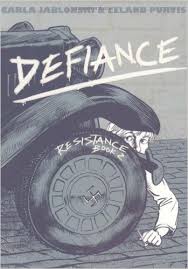
[READ: December 4, 2015] Defiance

This book is set three years into the Nazi occupation of France.  Things are sort of the same but worse for the residents of Vichy.  Neighbors inform on neighbors, and some residents collaborate with the Germans (and are more successful because of it).  And then in 1943, a new French-based Nazi police force called the Milice begin keeping watch over their own people

This aggressiveness causes more resistance, of course. And Paul has been drawing detailed and insulting pictures and posting them all over town (which is making the Milice quite upset).

Of course the kids are taking more aggressive stances now, too.  Some say that the posters are causing more harm because it makes the police mad.  But other kids’ parents have joined the police–some of whom are nice to the kids.  Even Paul’s sister, Marie, believes what her teachers say about Marshall Philippe Pétain (there’s a lesson about Pétain at the end of the book) and his governance.  And no one is going to say anything about the Resistance.   (more…)

Read Full Post »

resistSOUNDTRACK: LUISA MAITA-Tiny Desk Concert #100 (December 26, 2010).

maitaI’ve not heard of Maita.  The NPR write up speaks about the electronic flourishes and deep grooves of her songs.  Felix Contreras worried that their stripped down ensemble (only guitar, bass and fascinating bongos) would have a hard time creating that sound.

And in one way they do.  Except that it’s clear they didn’t even try.  Rather, they play a simple, but engaging kind of mellow Brazilian dance music.  In the first song, “Ai Vem Ele,” the guitar and bass play the same grooves except when they each take some meandering moments.  The percussion keeps a quiet but steady rhythm and Maita sings vocals and accent notes all over the place to keep the song interesting.  I really enjoyed at the end of the song when the bassist played exactly the vamping solo that she was singing.

“Alento” is a much faster song, with quickly sung lyrics.  It allows for rapid guitar playing and more uptempo feel.

They only play two songs (about 8 minutes long), but it really shows the kind of range she is capable of.

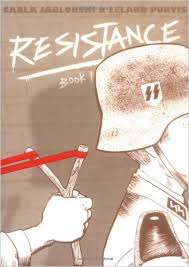
[READ: December 1, 2015] Resistance

This First Second graphic novel is about the Nazi occupation of France.  It’s not exactly light reading and yet Jablonski has taken this incredibly dark story and found an excellent and compelling narrative about one family who works as part of the resistance to fight back against their oppressors.

This is the first book in a trilogy and I am curious to see what the next two books bring as this story was nicely wrapped up but there are so many more stories which could be told.

Jablonski also helpfully sets up the situation in the introduction.  She explains how France was split in two as a result of the armistice agreement.  She gives a very brief but powerful explanation for why they would agree to splitting their country in half.  Paris and the upper portion of France became Occupied while Vichy and the southern part of France were “Free” (but still with a large Nazi presence).

This story is about an average family.  Paul Tessier and his parents and little sister live in the free part of France. Paul is an artist, and I love the way Purvis juxtaposes Paul’s art with what is actually happening (placing Paul’s “drawing” in the middle of the action so we know he is observing everything. (more…)

Read Full Post »

[ATTENDED: November 19, 2015] Zoyka’s Apartment

zoykaI was offered free tickets to this show.  I read a brief review, saw the word “farce” and decided it would be fun to go to it.

This play was written by Mikhail Bulgakov, an author I’ve heard of but know little about.  Turns out that all of his plays were banned by the Soviet government.  Including this one, even though it was not an anti-Soviet play.  After the banishment, he wrote to Stalin requesting permission to emigrate, but was denied.

As this play opens, there is a lectern at which an announcer reads a 1990 review of the play by Frank Rich in the New York Times (which you can read here).  Perhaps the most fascinating thing that I heard from the review was this:

Boris A. Morozov’s production of Mikhail Bulgakov’s ”Zoya’s Apartment” at the Circle in the Square. Mr. Morozov is resident director of the Maly Theater in Moscow. His New York cast is headed by such actors as Bronson Pinchot.

Since Pinchot is my new favorite audio book reader, I immediately paid attention. (more…)

Read Full Post »

bleachersSOUNDTRACK: MARTIN TIELLI-The Hudson, Hamilton, ON (January 28, 2006).

hamilton After the flurry of solo activity, the Rheos released their final album and toured and then broke up.  Dave Bidini said that Tim Vesely wanted to quit in January 2006. Who knows exactly when that was made clear or how this solo show from Martin came about.

It’s only 29 minutes long.  When he comes out someone asks where he came from. So who knows what’s going on.

The recording is too loud and feels kind of harsh. But he says “I’m gonna try some songs on you.”

I think the entire set is him solo although it sounds like there may be an extra guitar on “My Sweet Relief” and “I’ll Never Tear You Apart.”  He doesn’t mention anyone though, so maybe he’s just awesome.

There’s only 7 songs “Digital Beach” (an unusual Rheos cover by itself).  Then six songs from his debut album.  “World In A Wall” which is great (but again, kind of harsh sounding), “Waterstriders (The Bridge)” “My Sweet Relief” “I’ll Never Tear You Apart,” a rocking “That’s How They Do It In Warsaw” and “Wetbrain.”

It’s a brief show with very little chatter, but it’s interesting to hear him do many of these songs solo.  Given that he tends to play songs from newer albums I can’t help but wonder if this was actually an older concert.

[READ: June 15, 2015] Bleachers in the Sun

Every now and then a big pile of short plays comes to my desk.  The ones that sound interesting I’ll give a read–it usually doesn’t take too long.

This one is about 4 eleven year old girls (in the play the performers are adults).

The blurb on the back says “Why would adults go to see a play about eleven-year-olds?  Possibly because none of us ever really stop being eleven.  [This play] holds a mirror up to grown ups to darkly illuminate the world of modern adolescent girls, which is just like ours, only amplified.”

Okay, well, yes it sort of does that,  But the mirror was so dark that I found the play less than illuminating. (more…)

Read Full Post »

[LISTENED TO: December 29, 2014] Jasper Dash and the Flame-Pits of Delaware

delWe are now hooked on the Pals in Peril series.  This, the third book, promised to be the funniest and weirdest yet.  I mean, look at the title.

But this book proved problematic for us for two somewhat related reasons.  The first is that we usually listen to longer books like this when we have a lot of driving to do.  We didn’t have any major big drive ahead so we wound up listening in small chunks, which was a little confusing.  The kids were able to follow quite well, but after a couple of weeks some details are bound to get lost.  The second reason is that this book is long.  It was a 6 hour audio book as opposed to the 3 hours of the other two books.

The brevity of Whales on Stilts was a real treat.  In it, Anderson wrote that he didn’t like to write action scenes because they were all the same.  Same with chase scenes.  But in this book, he has our heroes slogging through the wilderness for literal days (and almost an entire disc).  It got a little samey, I feel–especially since we were listening in small chunks at a time.

This is not to say that the book wasn’t enjoyable. There were hundreds of hilarious moments in it.  Even in the duller sections, he often threw in an absurd joke (or ten) that made me laugh.  So maybe if we had listened all at once this would have held up better.  But honestly it was only the middle that was kind of trudging (when they were trudging) because the beginning and end were great.

This happens to be another book where reading it would have been entertaining in other ways–the characters of Delaware have virtually no vowels in their names.  Mark Cashman (who did another awesome job reading) does a fine job saying their names, but I had to find a print copy in the library because I needed to know how these crazy words were spelled.

So, what happens? (more…)

Read Full Post »

locke6 SOUNDTRACK: HAPPY FLOWERS-“All I Got Were Clothes Christmas” (1986).

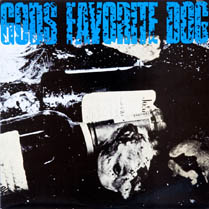
godsAfter all of this mostly respectful Christmas music, I had to throw in one crazy stupid ugly horribly song.  But that’s mostly because I forgot it existed until I stumbled on it the other day.  The Happy Flowers were a terrible band (seriously).  They were the kind of band that seemed to blossom in the late 1980s which don’t seem to exist anymore (for better or worse).  They were beyond noise, this was just a crazy noisy pile of sound with screamed lyrics that have nothing to do with the music.

I loved them.  But not really, because they were terrible.  But it was fun to know that people not only made music like this but that it could find a record label (and presumably an audience).  I used to enjoy playing their songs on my radio show.

The Happy Flowers were two guys from Charlottesville, VA.  They were in another band (the Landlords) so presumably they could play their instruments, although I don’t know that band at all.  Their stage names were Mr. Horribly Charred Infant, (drums, vocals) and Mr. Anus, (guitar, vocals), so you have a sense of what we’re dealing with here.  And yet you really can’t be prepared for it.

This song is basically just feedback and two adult men screaming about how they wanted to get toys for Christmas but all they got was clothes.  For four minutes.  And it made it onto the above compilation, God’s Favorite Dog, with Big Black and the Butthole Surfers.

If your Christmas didn’t live up to your expectations, perhaps you need to hear this.  Or perhaps not.

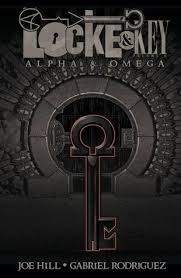
[READ: December 29, 2014] Locke & Key 6

I knew I couldn’t hold out until the new year to finish this series.  I was compelled to keep going.  There was nothing I could do to hold back, as if some kind of spirit kept pulling me towards the books.

And the ending did not disappoint.  Well, it did disappoint a little in that so many people ended up dead.  I couldn’t believe how many people who I grew to care about were killed in various ways.

There’s really no time for flashbacks in this book, although we do get occasional look-backs.  We see the Locke kids make up with the friends that they have alienated. We also see that the kids’ mom has been sober for 30 days (this whole series takes place over a much longer time than it seems).

We also see Rufus come to say goodbye to the Locke family. While he is waiting for Bode to come up from the water, Rufus sees Bode’s ghost who tells him that the person in Bode’s body is not him but is actually Scout.  Rufus immediately attacks Bode when he arrives.  This send Rufus to the same institution that Erin Voss is in.  While he’s in there we see him already making plans to escape.  And it turns out that Erin Voss is able to communicate with him (sort of) and she is able to help in her own way. (more…)

Read Full Post »

« Newer Posts - Older Posts »