Feeds:
Posts
Comments

Archive for the ‘Research’ Category

dfwreadSOUNDTRACK: CHRISTIAN SCOTT aTUNDE ADJUAH-Tiny Desk Concert #477 (October 9, 2015).

aacsChristian Scott aTunde Adjuah and his septet play what he calls stretch music: “the particular type of jazz fusion he’s up to: something more seamless than a simple collision of genre signifiers.”

They note that even his appearance stretches traditional jazz: “You may note that he showed up in a Joy Division sleeveless T-shirt and gold chain.” It’s sleek and clearly modern, awash in guitar riffs, but also bold and emotionally naked.

Christian Scott aTunde Adjuah (not sure how to abbreviate that) is a trumpeter and he can hit some loud powerful and long –held notes.   It’s funny that when he bends over the trumpet grows quieter—those ic really are direction-based.

For the first song “TWIN” he does some impressive soloing over a simple and cool beat—piano and delicate guitar riffs (there’s also an upright bass and drummer).   After his lengthy solo there’s a flute solo that also works perfectly (if less dramatically) with the background music.  (Christian plays tambourine during her solo).  He says that this song is about being a twin.  His brother, Kyle Scott is a film director and for whom Christians scores the music.  Christian also explains that he comes from an African-American and Native-American background and that this song has rhythms as a sort of history of his family that touches on Mali, Senegal Gambia and The Ivory Coast and makes its way to the Caribbean, Cuba and into New Orleans.

He’s pleased to play the Tiny Desk Concert for an audience that appreciates “Music that has nutritional value.”

For the second song, “West of the West” he brings on a young alto-saxophonist who plays with his drummer in a different band. The song opens with a rocking electric guitar solo and then the jazzy band kicks in behind it.  The instrumental features a couple of solos by the saxophonist, the pianist and the bassist.

“K.K.P.D.” is a dramatic song for which he gives a lengthy back story.  Many years ago in his home of New Orleans, he was stopped by New Orleans police late at night for no reason other than to harass and intimidate him.  he was coming back from a gig.  He resisted and was in a serious situation and was seriously threatened—the story is long and very affecting, especially given how articulate (I know, terrible word, but true) and calm he is about retelling this horrifying story.  His pride almost made him do something ill-advised, but instead he channeled that pent-up frustration into a piece of music whose long-form title is “Ku Klux Police Department.”

He adds that we see things on TV about inner cities or the ninth ward and we believe them to be true.  Like that the neighborhood is happy that the police are clearing out the youth there.  We begin to think that the narrative is true, although the people who live there can tell you otherwise.  Despite the title and the origin, the is song is designed to reach a consensus to move forward –not to build derision or hate.  He says that we have to start working on that now, because if it doesn’t start now then our children will continue to inherit this situation.

It opens with a noisy guitar wash and fast drums.  It’s quite noisy and chaotic although it resolves very nicely into an almost sweet piano-based song with slow horns.  The middle of the song ramps up with some intense soloing from Christian.  I love how that segues into a very different section with an electronic drum and delicate piano.  Chritsian’s next solo is much more optimistic.  The final section is just wonderfully catchy.

When he introduces the band, he points out just how young some of his newest members are: Drummer Corey Fonville (another new member) used a djembe as a bass drum, and also brought a MIDI pad so he could emulate the sound of a drum machine; Lawrence Fields, piano; Kris Funn, bass; Dominic Minix , guitar (21 years old); Braxton Cook, saxophone (24 years-old) and Elena Pinderhughes, flute: 20 years old!

I don’t listen to a ton of jazz, but I really liked this Tiny Desk Concert a lot.

[READ: July-October 2016] The David Foster Wallace Reader

I’ve had this book since Sarah bought it for me for Christmas in 2014.  I haven’t been in a huge hurry to read it because I have read almost everything in it already.  And some of that I have even read recently.  But this summer I decided to read some of my bigger books, so this was a good time as any.

One of the fascinating things about reading this book is the excerpting in the fiction section.  I have never really read excerpts from DFWs longer books before.  And once you decontextualize the parts, you can really appreciate them for themselves rather than as a means to the end of the story.  This is especially true of the excerpts from Broom of the System and Infinite Jest.  But also just reading some of these sections as a short story makes for an interesting experience.

It was also very interesting to read the non-fiction all together like that.  These pieces come from difference anthologies, but they have thematic similarities  So, placing them together like that allows for really comparing the stories.

And of course, the selling point for most DFW fans is the teaching materials in the center of the book–an opportunity to look into the man’s mind at work shaping younger minds.

I have written about virtually everything in this book already (title links refer back to previous posts), so mostly these are thoughts about the pieces themselves and not a part of a whole. (more…)

Read Full Post »

humanSOUNDTRACK: ROOMFUL OF TEETH-Tiny Desk Concert #404 (November 10, 2014).

teethRoomful of Teeth is an acapella group (with a drum on the first song).  The singers  all tend to sing notes (or words) in a rather unsettling style.  As the blurb says, “Mix a bit of yodeling with Tuvan throat singing, add in a pinch of Sardinian cantu a tenore, fold in compositions from cutting-edge composers and you have the vocal group Roomful of Teeth. This eight-voice ensemble, which includes the 2013 Pulitzer Prize-winning composer Caroline Shaw, is gleefully dismantling the traditional definition of ensemble singing right before our ears (and teeth!)…. The agility of the voices and multicolored blend they achieve are extraordinary.”

And that’s all so accurate.  Everything is kind of unsettling and strangely beautiful. But definitely unsettling.

The first song was written by Australian Wally Gunn and is called “The Fence Is Gone.”  There are so many different sections.  It reminds me a lot of the middle of Pink Floyd’s Atom Heart Mother.  With singers having an almost atonal operatic movement.  But in between lyrics, the vocalists are largely singing going “oh ha” or just “bah bah.”  It’s really fascinating.  And the more I listen to it the more I wonder how they know just what (somewhat unusual) note to sing.  The blurb adds: “verses emerge from an infrastructure of “oh-ha” syllables and a simple drum pulse, ending with women’s voices, tight in harmony, like a chord from a Casio keyboard.”  That Casio remark is pretty spot on.

Before the second song, one of the men says that the “women are going to so do a song.”  The men leave and Rinde Eckert’s “Cesca’s View”  begins with a kind of yodeling (really good yodeling). After which the three remaining women sing a beautify low melody very hymn-like.  Then the yodeling comes back (with some beautiful high notes at the end).  Then they all come together to do the the yodelling melody very pretty harmonies.  The blurb adds “In Rinde Eckert’s “Cesca’s View,” imagine a lonely cowgirl on some windswept plain. Estelí Gomez gets her yodel on, beautifully, while the three other women vocalize in close, barbershop-style harmony. It literally ends on a high note.”  When the four are singing together, it’s really pretty.

The final song was written by the founder of the group, Brad Wells.  “Otherwise” features some very intense bass notes from the men and high notes from the women.  The blurb says “Warm, rounded tones in male voices contrast with a steely sheen from the women and a high drone like a Tibetan singing bowl. The harmonies take a tangy, almost Bulgarian turn, then we get something truly otherworldly. A pulsing, slightly creepy Sardinian “bim-bom” vocalise buzzes like a gigantic cicada.”   The Bulgarian comment is really spot in as the women absolutely sound like the Bulgarian choirs.  And that “bim bim bom” section is so alien and otherworldly.  I love when they throw in some  little “hey ya” mixed in.  But the most amazing thing has to be “Dashon Burton’s operatic baritone [which] soars above it all.”  His voice is really intense.

At first I didn’t really like their music, but after a few listens I could really appreciate what they were doing.

[READ: May 1, 2016] Human Body Theater

Maris Wicks is the illustrator for another First Second non-fiction book I loved called Primates.  I thought her drawings were perfect (and also really cute).  And she has done it again. Never have brains and bowels and viruses and allergies been so adorable!

But despite the cuteness of the drawings (and the title), this is a real, genuine nonfiction book about the human body.

Wicks covers just about everything you might want to know about how our bodies work.  It is geared toward children (she does discuss reproduction, but in very basic terms), but it is full of so many details that I think many adults will find they learn things from this book.  I know I sure did. (more…)

Read Full Post »

feynman SOUNDTRACK: LARA ST. JOHN-Tiny Desk Concert #530 (May 9, 2016).

laraWhen Lara St. John released her first CD it made ripples because of the way she appeared on it (presumably topless).  But if that was a stunt to get people to listen, it was a good one because the music on it was phenomenal (and the disc sold very well).  St. John is masterful on the violin and has released a dozen or so CDs of herself playing.

I have never seen her play before and it is a marvel watching her fingers  fly (and slide) all over the neck of the violin (including some absurdly high and fast notes).

The first piece is “Czardashian Rhapsody.”  It is an amazing mashup of two songs by Martin Kennedy: Czardas, the most familiar Hungarian melody for violin and Hungarian Rhapsody No. 2, the most familiar Hungarian melody for piano.  He merged them into a real barnstormer.  It’s 6 minutes of switching back and forth between the familiar melodies and very gypsy-esque sections (and some very long held notes).

The song is 6 minutes of musical acrobatics.

Although this is billed as St. John’s show, much recognition must go to her pianist Matt Herskowitz who is also magnificent.

St. John clearly has a sense of humor since she named her new album Shiksa.  She says the album actually has ten different titles because every culture has a word for “big Canadian chicks” like herself.

The second piece is “Sari Siroun Yar” by Serouj Kradjian.  She says it was the first song she heard when she went to Armenia in the lat 1980s.  It is a bittersweet Armenian troubadour song.  While this song is much more mellow than the first, it still showcases some amazing playing on both musicians’ parts.  The opening notes she plays high on the fret board which gives the violin a very different sound–almost breathy.  And the main melody is quite lovely.

The final song is once again a wild one.  “Oltenian Hora” is one that St. John arranged herself.  It plays off a catalog of violin tricks, St. John explains, practiced by traditional Romanian gypsy fiddlers: rapid-fire whistles, bird calls and slithery harmonics, all in a variety of off-kilter rhythms.  I’ve never seen some of the things she does on the violin (those bird calls are amazing).  And by the end she is bowing so hard the bow seems about to break.  It is way intense and really awesome.

I’m not sure I’ve ever seen a violinist get out of breath from playing so hard before, but she deserves all of the applause.

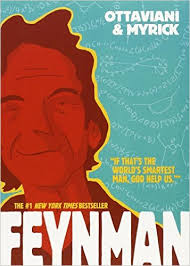
[READ: March 15, 2016] Feynman

This is a graphic novel biography of Richard Feynman.  Ottaviani worked as a nuclear engineer, programmer and reference librarian, so you can trust him.

I have respected Richard Feynman for years.  I have a few of his books, although I can’t say I have read them intensely.  I knew that he was considered an amazing professor–making really intense subjects easier for the layman to understand.  And many of his lectures are available as audiobooks.

But there was so much about him that I didn’t know.  And this biography (which runs nearly 300 pages and is jam packed with information) covers nearly all of it.  Including excerpts from his own publications and attaching a massive bibliography for more works by and about Feynman. (more…)

Read Full Post »

gunner SOUNDTRACK: AND THE KIDS-Tiny Desk Concert #452 (June 30, 2015).

Ikids hadn’t heard of And The Kids before, but I was intrigued by their name and the lead singer’s look (is that a tattoo on her lip?).

But I didn’t like the way the first song started with a modified military “Glory Glory Hallelujah” musical refrain–it seemed strangely forced, especially for the first song I’d heard by them.  Although I may have liked it better if I knew the band better. It was a weird way to start.

Especially since I ultimate liked “Glory Glory.” (I am hearing a chorus of “I’ve been picking up floor milk” which is as fascinating as whatever the lyrics really are).  The drummer has great harmony vocals that really adds something to the song. I also love at around 2 and half minutes when the song turns into something very different—faster guitars with lead vocals by the drummer.  And even the bassist who has been quiet thus far chimes in with another layer of voices (and some interesting bass lines). It’s very cool.  So the song which started out kind of shaky really rocks out at the end.

The band trio, with a singer/guitarist, bassist and a great drummer.  There’s something about the lead singer’s guitar–it seems really big (maybe it’s just the head of the guitar?).  And the sound that the drummer gets is really great too—it may just be this recording, but the snare is really sharp.

For “All Day All Night” the drummer busts out a glockenspiel. It has a kind of shouted chorus that borders on dissonance but isn’t quite.  I like the way the song slows down (with the guitarist playing keyboard as it builds back up), the drummer plays the glockenspiel and the drums at the same time.  And the all three start singing with interesting harmonies. The ending whoo hoos are sharp and distinct as well.

“Cats Were Born” has a very interesting lyric: “The cats were born to kill for fun.”  But perhaps even more interesting than the words are the yodels and screams and yips that punctuate the song.  What’s also strange is the way the bassist seems so reticent to look goofy while the other two are wild.   The guitarist busted out a small four string guitar for this song which sounds really distinct. And the drummer really shines.  Through many of the songs she’s playing rim shots which is a distinctive sound in itself, but when she switches over to a faster style for the middle section, it’s really intense.

I don’t think any bands has gone so far from me not thinking much of them to being really won over by the end of their Tiny Desk.

[READ: February 26, 2015] Gunnerkrigg Court [1-14]

I discovered this book through my Goodreads account.  It was suggested because, well, I don’t recall, it had something to do with schools and supernatural and graphic novels or whatever.  There was also one that was suggested for Sarah (it was about boarding school and tea) which turned out to be Japanese softcore porn, so beware the Goodreads suggestions.

Although there was nothing to beware of with this book.

I actually thought Sarah would like it more because she loves boarding school fiction.  But she gave up on the book after a few stories.  Interestingly I almost did as well. It wasn’t that it was bad, in fact we both enjoyed the beginning.  But it was the kind of book that once you put it down, you didn’t feel compelled to pick it up again.  Perhaps because each chapter feels so self-contained–with no real cliffhanger–that it seemed like the stories were done.  And while the stories were good they weren’t awesome…so.  She gave up, but I continued

And I’m glad I did. (more…)

Read Full Post »

houseSOUNDTRACK: LAURA VEIRS-Tiny Desk Concert #49 (March 1, 2010).

lauraI have decided to contradict myself.  I simply cannot keep up with the regular release of Tiny Desk Concerts (sometimes 3 a week), so I’m going to focus on these older recordings for a while and occasionally devote a week or two to new ones.  we’ll see how that works out.

I only know Laura Veirs’ name, but not really anything she’s done.  So I wasn’t really sure what her “solo” work would sound like.  Well, she has a delightful voice and she writes really pretty songs.

She also offers one of the most dramatic screw ups I’ve seen in a live performance. She opens her song “Carol Kaye” with this lovely melody–just her and her guitar.  And then after about a minute, her band comes in with a beautiful harmony–in the wrong key!  The introduction of their voices is so dramatic (to go from her gentle voice to this huge chorus) was really amazing.  So much so that I didn’t quite realize they were in the wrong key at first.  Turns out that Laura put her capo on the wrong fret and it wasn’t until the keyboardist played the right note that they all sounded off.  And his mouth drops opens as he stares at Laura.  She laughs and says “you looked like this terrified Muppet.”

They play the song again, this time perfectly–and the harmonies are truly lovely.  As is the violin that swirls throughout the song.

“When You Give Your Heart” is another lovely song in which Viers’ voice and the violin play the same lilting melody.

“Sun is King” has some more lovely (that’s the word to describe her, clearly) harmonies–she has picked a tremendous backing band.  And they sound great in this small setting.

It’s hard to believe that the whole set (miscue and all) is only ten minutes long.

[READ: May 1, 2015] House of Leaves

I read this book when it came out in 2000.  I had the “2 Color” edition which the t.p,. verso explains has as features: “either house appears in blue or struck passages and the word minotaur appear in red (I had the blue version).  No Braille.  Color or black & white plates.”

The Full Color edition (which is the same price, amazingly) differs in this way:

  • The word house in blue, minotaur and all struck passages in red
  • The only struck line in Chapter XXI appears in purple
  • XXXXXX and color plates

So basically the full color edition isn’t really that big a deal although the three or four full color plates are much nicer.

Why do I have both?  Well, I bought the two color when it came out and then I won a free book at the library and there was this full color edition, so I brought it home.  I was amused to find that the previous owner had deciphered a clue in the back of the book (the first letters of sentences spell out a secret message).  She (it looks like woman’s handwriting) wrote out the secret message, which I appreciated as I didn’t feel like figuring it out.

ANYWAY.

This book had a huge impact on me when I read it.  Although I forgot a lot of the details, the overwhelming effect of the book has stayed with me an I never forgot the central conceit of a house that opened secret passages and expanded or contracted at will.  For, make no mistake about all of the accolades, this is a horror story.  One accolade, from Bret Easton Ellis: “One can imagine Thomas Pynchon, J.G. Ballard. Stephen King and David Foster Wallace bowing at Danielewski’s feet, choking with astonishment, surprise, laughter awe.” [Ellis will not be bowing apparently, and actually I can’t imagine Pynchon bowing before anyone].  It’s a very cool horror story with all kind of textual experimentation and twists and turns, but it’s still a pretty damned scary story.

The experiments are many and varied and they begin right from the start, as the title page lists Mark Z. Danielewski’s House of Leaves by Zampanò with an introduction and notes by Johnny Truant. The forward from the editors notes: “The first edition of House of Leaves was privately distributed and did not contain Chapter 21, Appendix II, Appendix III or the index.

This is all nonsense of course. (more…)

Read Full Post »

krausSOUNDTRACK: THE FLAMING LIPS-The Terror (2013).

terror After the distortion heavy and heaviness of At War with the Mystics and Embryonic (to say nothing of their other experimental releases), I wasn’t sure what to expect from an album called The Terror.  Yet with a title like that the album is far more invested in psychological terror than in pummeling you with scary noises and music.  The album is more unsettling and spooky with existential dread.

Wayne Coyne has always been a pretty optimistic guy–weird, sure, dealing with feelings of dread, sure, but never so dark and insular.  But I learned that before recording this album and most likely as an impetus to record it,  Coyne separated from his partner of 25 years, Michelle, and Lips multi-instrumentalist Steven Drozd temporarily relapsed into addiction.

In an interview, Drozd says the album is like a crisis of life confidence.  He also says that the uniformity in sonic style was intentional: “Instead of writing songs and then figuring out sounds, we’d write the other way around: create sounds then make songs out of those sounds.”

So the vocals are quite low in the mix, and there is not a lot of “music” in the album.  Rather there are layers of sounds–swishing synths, spiraling noises, percussion effects that seems to almost cover up the vocals, giving it a very claustrophobic effect.  “Look… The Sun Rising” opens the disc.  It is primarily percussion with some noisy sounds and really sharp piercing guitars (that play noisy counterpoint to the soothing chorus of Oh Oh Ohs).  And yet after all of that noise and chaos, the very lovely “Be Free, A Way” surfaces as a quiet introspective song.  There are gentle keyboard notes (not unlike on Yoshimi) that propel this song along.  “Try to Explain” is a pretty song with some unusual sound effects swirling around it (The Lips can’t so straight up pretty, right?).  And yet lyrically, this song, along with the rest, is very dark indeed.

“You Lust” is a 13 minute (!) invocation about various forms of lust.  It opens with the couplet: “You’ve got a lot of nerve/A lot of nerve to fuck with me.”  The middle of the song is a kind of Pink Floydian keyboard workout.  It’s a  lengthy jam that’s kind of samey, but I’ll bet if you can really sit (with headphones) and close your eyes and focus it’s pretty intense.  After about ten minutes of that repetitive claustrophobia, some lightening occurs with sprinkled keyboard notes.

“The Terror” is primarily in Coyne’s falsetto, and it seems gentle until the mechanized noises come bursting forth.  “You Are Alone” is the shortest thing here, under 4 minutes of squeaking noises.  And again, a lovely melody despite the title.  I feel like this song summarizes the album pretty well.  In it, Coyne sings “I’m not alone” while a deeper voice replies, “you are alone.”  Whose voice will ultimately win?

  “Butterfly, How Long It Takes to Die” returns to that abrasive guitar of the earlier tracks, but the main body of this 7 minute song is just bass, keening keyboards and Coyne’s whispered voice.  There’s a recurring synth line that is magical and/or creepy depending on your frame of mind.  It, along with many of the other songs, have a kind of coda that links the songs.  This one is mostly just choral voices, but it twists the ends of the songs in a different direction. “Turning Violent” is a quiet track, in which Coyne sounds nearly defeated until the second half of the song grows louder and more animated with layers of vocals.  The disc ends with “Always There…In Our Hearts” which seems to offer some hope…maybe.  There’s signs of uplift in the melody, and when the drums kick in at the end, it seems to propel the song into a more intense frame of mind.

And lyrically, despite all of the darkness that is always there in our hearts, there is a light peeking out: “always therein our hearts a joy of life that overwhelms.”

Although most reviewers find this album unremittingly bleak, I find the music to be beautiful in an aching sort of way–a beautiful way to deal with pain (better than getting the same tattoo as Miley Cyrus, anyway).

[READ: October 31, 2014] The Kraus Project

The title page of this book read: The Kraus Project: Essays by Karl Kraus translated and annotated by Jonathan Franzen with assistance and additional notes from Paul Reitter and Daniel Kehlmann.

So just what is this thing anyhow?  Well Karl Kraus was a German writer (1874-1936) whose main contributions to letters were some essays and a newsletter Die Fackel (The Torch).  The authors compare the newspaper (favorably) to a blog (while also complaining about what blogs have done to letters).  He started Die Fackel in 1899 and he continued to direct, publish, and write it until his death.  He used the paper to launch attacks on hypocrisy, psychoanalysis, corruption of the Habsburg empire, nationalism of the pan-German movement, laissez-faire economic policies, and numerous other subjects.  For the first ten or so years, Kraus was the editor, accepting contributions from around the German speaking word.  But in 1911, he became the sole contributor to the newsletter.

He also wrote many essays (he did not care much for fiction), including the two main ones that compression this book: “Heine and the Consequences” (1910) and “Nestroy and Posterity” (1912).  The book also includes two follow up essays: “Afterword to Heine and the Consequences” and “Between Two Strains of Life: Final Word to Heine and the Consequences” (1917) and a poem: “Let No One Ask…” (1934).

The essays themselves are quite brief.  Despite the first coming in at 135 pages, note that the left pages are all in German (so reduce 135 by half), nearly all of the English pages are filled with footnotes (reduce by half again) and some of the footnotes run for several pages.  So the essay could be said to be about 25-30 pages.

The same is true for all of the pages in the book.  The left sides are in German (except the footnotes) and most pages are split in half because of the footnotes.  Which means that Franzen and friends write far more than Kraus did.  Ultimately, this book is actually three things: It is a collection of Kraus’ essays with Franzen’s fine translation; it is an explication of Kraus’ attitude and about life in Germany during Kraus’ life and finally it is an insight into Franzen as a young man living in Germany and why Kraus was so appealing to him.

The first part: Kraus’ essays. (more…)

Read Full Post »

gulpSOUNDTRACK: PET SHOP BOYS-Elysium (2012).

220px-PSB_ElysiumPet Shop Boys are known for big dancey singles.  And so perhaps it’s something of a surprise to get this album which is pretty but certainly low key.   It’s not like they haven’t written low key songs before, but there’s very little to get up and sing about here.

Which is not to say the album is bad.  It’s actually very good once you accept the lack of big songs.

Of course, having said that, there are one or two anthemic tracks, but the album overall is more introspective (unlike their album Introspective).  The title, Elysium refers to the afterlife where those chosen by the gods would live a happy (after)life, indulging in whatever they had enjoyed in life.  Yes, mortality is on Tennant’s mind.

“Leaving” opens the disc with a great chorus, which leads to this somber opening verse: “Our love is dead but the dead don’t go away.”  And that certainly sets the tone–nice synth rock, but nothing to loud and frenetic.  “Invisible” is a similarly low key song.   This is one of their quiet ballads, with just touches of synth melody: “I’m here but you can’t see me, I’m invisible.”  It’s a definite downer of a song but it’s very pretty.

Of course all that I said about mellow low key albums is belied by the third track: “Winner.”  This was written in time for the 2012 Olympics in London and it is very much an anthem about, well, winning.  It’s kind of obvious (although lyrically it is more in depth than many similar songs), but the melody is just simple and uplifting–(just what you’d want for Olympic documentaries).

“Your Early Stuff” is a much darker song–it is a song written to a “washed up” performer: “you’ve been around but you don’t look too rough and I still quite like some of your early stuff.”  It’s funny but also tender.  “A Face Like That” is the closest thing to a dance single on the album–it’s fast and synthy and the vocals are echoed and repeated.  But even the verses are more low-key than you might expect from the chorus.  “Breathing Space” is another pretty ballad.

“Ego Music” is another faster song, with a very funny premise: “ego music–it’s all about me.”  It’s a slight song but good for a laugh.

“Hold On” also aspires to anthemicness, but it is slower than a typical PSB anthem.  It also has a synth line that is vaguely classical.  Although of all the songs, this one is lyrically the most tautological:  “Hold on, there’s got to be a future or the world will end today.”  “Give it a Go” is a slower, simpler track. Not too memorable, although the chorus is bouncy and catchy h.

“Memory of the Future” has a great synth line and Tennant’s cool accompanying vocals–it’s a classic PSB song and one of my favorites on the disc.  Although I don’t love “Everything Means Something,” the final song, “Requiem in Denim and Leopardskin” is a great ending–slow but very catchy and rather wry and funny.

So this album overall is certainly more, dare I say it, “mature” for the Pet Shop Boys, but they haven’t lost any lustre in songwriting.

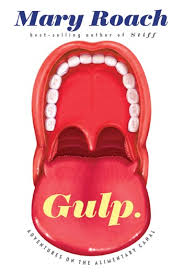
[READ: Summer 2013] Gulp

Yes, that date is correct, I read this book over a year and a half ago.  I meant to write about it then, but I loaned it out to someone and I like to have the book nearby when I write about it.  So I put it off and put it off and now that I have the book back, I will do my best to remember whatever I can about it.

But the thing about this book is that it was so memorable, I won’t have much trouble writing about it anyhow.

Mary Roach investigates the physical properties of eating from pre-digestion through to the end.  And she does it with thorough research and a boatload of humor (sometimes gross out humor, although she warns that that is not her intent–“I want you to say, ‘I thought this would be gross, but it’s really interesting.’  Okay, and maybe a little gross.” (19).

She begins with the nose.  Most people know that the nose contributes tremendously to your sense of taste.  But Roach really explicates how much.  She speaks to a woman, Langstaff, who is a professional sniffer and who is currently staffing the Olive Oil taste Panel at the Olive Center.  She is training novices to be be better at tasting flavors.  But Langstaff herself for instance rarely drinks beer for pleasure even though she is an expert at tasting it.

The most amusing (or not, depending) information here is that there are people who were paid to taste cat food.  Yes.  And that humans prefer cat food with a tuna or herbal flavor over those that taste “rancid,” “offaly,” “cereal” or “burnt.”

Fortunately, the second chapter shows that it is actually dogs who test the dog food.  It turns out that dogs and cats really shouldn’t enjoy dry dog food (cats and dogs are not grain eaters by choice).  Dry dog food was created as a means of convenience for people (and as a way to stop tinning food during the war).  As for your pets, “pet foods come in a variety of flavors because that’s what we humans like, and we assume our pets like what we like.  We have that wrong.  ‘For cats especially…change is often more difficult than monotony.'” (43).  Some other pet observations: cat’s can’t taste sweet (although dogs can and rodents are slaves to it).   (more…)

Read Full Post »

tpk5SOUNDTRACK: INTERIOR DISPOSITION-“Fornix” (2008).

Critical Injuries Five Years of RehabilitationIt was challenging to find a related song for this week’s reading, although frankly a band called Interior Disposition would fit with just about any DFW passage.  But having a song called “Fornix” paired nicely with the computer problems that the author faced this week.

From the online information, it seems like Interior Disposition is a metal band.  And yet when I tracked down their full album and listened to a bit it’s largely trippy outer space noodling, or as one of the sites labels them: dark ambient.  There’s bubbling sounds and sounds of what I think of as deep space.  It is strangely relaxing and yet with a hint of tension all the way through (so yes, dark ambient is a pretty good sum).

Okay a little more digging tells me that the band is actually a guy, Oleg Hurvatov, who is Russian and also records under several other aliases: the wonderfully named Exploplasmatic Coagulation, and the puzzling Lanceolaria Im Licht Der Laterne

“Fornix” is only 1:46 and is probably a good introduction to the band/album.  If you like the 2 minute sound, the rest is pretty darn similar, just much longer.

[READ: August 18, 2014] Pale Summer Week 6 (§35-§45)

This weeks read was mostly a series of smallish sections.  some of them are entertaining, some of them provide interesting insights into the organization of the Service and of some of the characters.  And some of the sections are just downright funny.  The more I read of this book this time, the more bummed I am that it was never finished.  I even just wish I knew how much more he had planned.  There’s potential for this book to have spiraled out to 800-900 pages, there just seems to be so many things he could have followed up on–the Sylvanshine transformation to mastering RFI; the whole business with the infant, I love it; learning more about Mr. X (although likely there wouldn’t be much more about him); and of course what led to David Wallace leaving the Service and what compelled him now to write about it (which I don’t think is really addressed).
(more…)

Read Full Post »

tpk6SOUNDTRACK: BOREDOMS (various).

borepageBoredoms are an experimental noisy band from Japan.  I am completely unqualified to talk about them as I only know snippets of their output.  But I have always been intrigued by them.  Lead dude Yamataka Eye has been the main impetus behind the band.  And it seems like exactly the kind of noise/music one might play if one were horribly bored.

Yoshimi P-We is the longest serving drummer with the Boredoms.  She is the “Yoshimi” in the title of The Flaming Lips’ album Yoshimi Battles the Pink Robots.

Over the years they have gone from outright nose (listen to the track “Bubblebop Shot” from Soul Discharge or “We Never Sleep” from Onanie Bomb Meets the Sex Pistols which is mostly screams and drums) to a more ambient (but still noisy) style. They performed a live show with 77 drummers  on 7/7/07.

They’ve even changed their name to V∞redoms.

Here’s an interesting clip of the band from All Tomorrow’s Parties in 2012, being a lot less noisy but still pretty weird.

[READ: August 11, 2014] Pale Summer Week 5 (§27-§34)

There were a few things in this week’s reading that seemed to contradict other things in the reading.  This is not surprising as Pietsch says that there were things that he knew DFW would eventually change.  The notes at the back of the book (yes, I peeked, bit no spoiler here) say that there were different possible plotlines for some of the characters and even a duplication of a weird character trait.   But it’s funny to see it evolving in front of you.

In §27, Sylvanshine seems to be able to control his Random Fact Inference somewhat–and he seems to be using it rather than being inflicted by it.  This is either a big change or a cool development in Claude’s life.

There is also what I think is an actual mistake: two people have the same number: 907313433 (see §30).

In another “unfinished” issue, the surveillance in §29 is one of those situations that would certainly have been explained in greater detail (or had another scene about it).  I initially assumed they were doing surveillance for deadbeat companies (maybe for new vehicles), but there are indications (in later sections) that perhaps something else is going on, maybe to do with the Glendenning/Lehrl issue that Reynolds and Sylvanshine are talking about in §30.

One thing that I hadn’t explicitly noticed earlier, but which comes out in Cusk’s section below is the idea that “more information is not better.”  While this seems to be very true for their job, it can certainly be a debilitating world view and I wonder if that is at play as well. (more…)

Read Full Post »

tpk4SOUNDTRACK: NEGATIVLAND-“Nesbitt’s Lime Soda Song” (1987).

limeThere are multiple references to Nesbitt’s soda in this book.  I am unfamiliar with Nesbitt’s except in this funny little song from Negativland (on their album Escape from Noise).  I have always liked this song, perhaps because it is so simple (and is an actual song) amidst the chaos of the album.

A simple strummed guitar introduces this quaint song about everyday frustrations:

We spent a lovely summer, my wife Elaine and me,
We bought us a great big motor home, with a shower and TV,
We was camping and having a great time, watching Brokaw on Today,
Till a bee flew into the Nesbitt’s Lime Soda, and we had to throw it away.

Now most of the time I’m a peaceful man, but I lost my temper that day,
Just one last bottle of Nesbitt’s Lime Soda, and we had to throw it away.

I’m including the second verse not only because of the sodas listed, which I find endearing, but also because of the phrase “good old Mountain Dew” which reminds me of something DFW would say:

I brought a case of Nehi, and Double Cola, too,
A half a dozen Upper 10’s, and good old Mountain Dew,
I bought a quart of cola-a, to get me through the day,
But just one bottle of Nesbitt’s Lime Soda, and we had to throw it away.

I think most of the Nesbitt’s in the story is orange (that was their big seller) but Nesbitt’s did actually did have a Lime (or I guess Lemon-Lime) soda as well

[READ: August 4, 2014] Pale Summer Week 4 (§23-§26)

After last week’s massive 100 page section inside of one person’s head, it’s nice to get back to some of these smaller sections.  I’m particularly pleased to have another David Wallace section, as I find his the most entertaining.

§23

This is a brief First person section that begins: “Dream:”  Rows of foreshortened faces, many blank doing endless small tasks. It was his psyche teaching him about boredom.  He was often bored as a child, but that boredom was not actual boredom.  Back then he worried and fretted a lot, feeling the “sort of soaring, ceilingless tedium that transcends tedium and becomes worry” (253).  It was anxiety with no object.

He was the nervous delicate son, as opposed to his brother, the gifted driven son whose nightly piano practice coincided with their father’s return from work.  I section that says “after the incident with my own son” (254) reminded me that someone suggested that “Incarnations of Burned Children” may actually fit into this book and it seems like that could be applicable here, although I shudder to think it.  In psychotherapy he realized that his family was Achilles.  His brother was the shield and he was the heel. His father was a warrior, but his mother’s role was unclear. (more…)

Read Full Post »

« Newer Posts - Older Posts »