Feeds:
Posts
Comments

Archive for the ‘Religion’ Category

SOUNDTRACK: OKX: A Tribute to Ok Computer (2010).

OK Computer is one of the best records of the 90s.  Every time I listen to it I hear something new and interesting.  So, why on earth would anyone want to cover the whole thing?  And how could you possibly do justice to this multi-layered masterpiece?

I can’t answer the first question, but the second question is more or less answered by this tribute which was orchestrated by Stereogum.

The answer is by stripping down the music to its bare essentials.  When I first listened to the songs I was really puzzled by how you could take a such a complex album and make Doveman’s version of “Airbag,” which is sort of drums and pianos.  Or gosh, where would you even begin to tackle “Paranoid Android?”  Well Slaraffenland create a bizarre symphonic version that excises many things–in fact half of the lyrics are missing–and yet keeps elements that touch on the original.  But it’s an interesting version of the song and shows  a bizarre sense of creativity.  And that is more or less what this tribute does–it makes new versions of these songs.

Mobius Band make a kind of Police-sounding version of “Subterranean Homesick Alien.”  Again, it radically changes the song, making it a fast and driving song (although I don’t care for the repeated “Uptights” and “Outsides” during the verses).

Vampire Weekend, one of the few bands that I actually knew in this collection (and whom I really like) do a very interesting, stripped down version of “Exit Music, for a Film.  The “film” they make is a haunted one, with eerie keyboards.  Again, it is clearly that song, but it sounds very different (and quite different from what Vampire Weekend usually sound like).

“Let Down” (by David Bazan’s Black Cloud) and “Karma Police” (by John Vanderslice) work on a similar principle: more vocals and less music.  The music is very stripped down, but the vocals harmonize interestingly.  Perhaps the only track that is more interesting than the original is “Fitter Happier” by Samson Delonga.  The original is a processed computer voice, but this version is a real person, intoning the directives in a fun, impassioned way.  There’s also good sound effects.

Cold War Kids take the riotous “Electioneering” and simplify it, with drums and vocals only to start.  It’s hard to listen to this song without the utter noise of the original.  “Climbing Up the Walls” is one of the more manic songs on this collection, with some interesting vocals from The Twilight Sad.

There are two versions of “No Surprises” in this collection.  Interestingly, they are both by women-fronted bands, and both treat the song as a very delicate ballad.  Both versions are rather successful.  Marissa Nadler’s version (the one included in sequence) is a little slower and more yearning, while Northern State’s version (which is listed as a B-Side) is a little fuller and I think better for it.  My Brightest Diamond cover “Lucky.”  They do an interesting orchestral version–very spooky.

Flash Hawk Parlor Ensemble (a side project of Chris Funk from The Decemberists) do a very weird electronic version of the song (with almost no lyrics).  It’s very processed and rather creepy (and the accompanying notes make it even more intriguing when you know what’s he doing).

The final B-side is “Polyethylene (Part 1 & 2),”  It’s a track from the Airbag single and it’s done by Chris Walla.  I don’t know this song very well (since it’s not on OK Computer), but it’s a weird one, that’s for sure.  This version is probably the most traditional sounding song of this collection: full guitars, normal sounding drums and only a slightly clipped singing voice (I don’t know what Walla normally sounds like).

So, In many ways this is a successful tribute album.  Nobody tries to duplicate the original and really no one tries to out-do it either.  These are all new versions taking aspects of the songs and running with them.  Obviously, I like the original better, but these are interesting covers.

[READ: November 5, 2011]  McSweeney’s #8

I had been reading all of the McSweeney’s issue starting from the beginning, but I had to take a breather.  I just resumed (and I have about ten left to go before I’ve read all of them).  This issue feels, retroactively like the final issue before McSweeney’s changed–one is tempted to say it has something to do with September 11th, but again, this is all retroactive speculation.  Of course, the introduction states that most of the work on this Issue was done between April and June of 2001, so  even though the publication date is 2002, it does stand as a pre 9/11 document.

But this issue is a wild creation–full of hoaxes and fakery and discussions of hoaxes and fakery but also with some seriousness thrown in–which makes for a fairly confusing issue and one that is rife with a kind of insider humor.

But there’s also a lot of non-fiction and interviews.  (The Believer’s first issue came out in March 2003, so it seems like maybe this was the last time they wanted to really inundate their books with anything other than fiction (Issue #9 has some non-fiction, but it’s by fiction writers).

This issue was also guest edited by Paul Maliszewski.  He offers a brief(ish) note to open the book, talking about his editing process and selection and about his black polydactyl cat.  Then he mentions finding a coupon in the phonebook for a painting class  which advertised “Learn to Paint Like the Old Masters” and he wonders which Old Masters people ask to be able to paint like–and there’s a fun little internal monologue about that.

The introduction then goes on to list the 100 stores that are the best places to find McSweeney’s.  There are many stores that I have heard of (I wonder what percentage still exist).  Sadly none were in New Jersey.

This issue also features lots of little cartoons from Marcel Dzama, of Canada. (more…)

Read Full Post »

SOUNDTRACK: MOGWAI-Batcat (2008).

“Batcat” is one of my favorite Mogwai songs.  The melody is intense and the drumming is wonderful.  I picked up this single for the B sides (which will undoubtedly be collected somewhere one of these days anyhow, but that’s okay. 

It was very hard to pass up a song called “Stupid Prick Gets Chased by the Police and Loses His Slut Girlfriend”  Given that the song has “Chased” in the title, this is a surprisingly slow tune.  It builds slowly over a series of keyboard waves.  There’s also a slow guitar melody that keeps the piece grounded.  It’s one of their more subtle songs, which again, is rather surprising given the title.

“Devil Rides” is quite jarring in that it features vocals by Roky Erickson.  I don’t really know anything about Roky.  I picture him as a large, unkempt man with crazy hair and a beard.  His voice is otherworldly and seems to be maybe just a wee bit off from what the music is playing.  It’s a strange track and works very well with Mogwai’s history of slightly off-kilter vocalists. 

[READ: November 3, 2011] The Discomfort Zone

After reading The Corrections, I planned to read one of Franzen’s earlier novels.  But they were all quite long (even his debut!) and I wasn’t ready to get so immersed yet.  Then I found The Discomfort Zone in the biography section of the library.  It was less than 200 pages and seemed like just the thing.  It turns out, however, that I had read most of it already.  Three of the pieces were published in slightly different form in the New Yorker: “The Retreat,” (here as “Then Joy Breaks Through”) “The Comfort Zone,” (here as “Two Ponies”) “Caught” (Here as “Centrally Located”) and one “My Bird Problem” (here as “My Bird Problem”) which appears to be unchanged. 

That leaves two essays that were new to me: “House for Sale” and “The Foreign Language.”

The collection works as something of a biography, although really it’s not–it’s a collection of essays about his life, but I don’t think I would go so far as to say biography.   The book also doesn’t follow a chronological order. (more…)

Read Full Post »

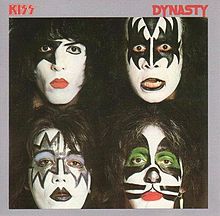
SOUNDTRACK: KISS-Dynasty (1979).

I was pretty excited to buy this album when it came out–a new Kiss album that wasn’t solo albums!  Woo hoo!  And the fact that it was disco?  Well, even though I said I “hated disco,” I didn’t really know what disco sounded like then (and really, aside from the middle “I Was Made for Lovin’ You” it’s not really a disco record) and plus my other favorite band was the Village People (and really, that makes a lot of sense–tw0 bands in over-the-top costumes talking about sexuality that I totally didn’t understand).

So, this album is hard for me to be critical about because it was such an essential part of my childhood, especially “I Was Made for Lovin’ You.”  I love it, and yet I can listen critically and appreciate that it’s really not that good.

But I’ll move on to the other songs.  “Sure Know Something” and “Magic Touch” really don’t seem that out of place chronologically with, say, the Kiss solo albums–they sound an awful lot like something off of Paul’s album.  So, despite the sort of slinky 70’s bass on “Sure Know Something”, they can’t have been that much of a surprise.  The guitar solos are short but have some interesting Ace sounds (I like the harmonics on “Magic Touch”).  It seems that while the other guys were embracing disco, Paul was keeping the Kiss sound alive.

Then there’s the Ace songs.  “2,000 Man” made total sense as an Ace song. I had no idea it was a Rolling Stones cover until fairly recently (and I like Ace’s version much better).  “Hard Times” feels like the sequel to “New York Groove.”  Not the music so much although maybe a little, but the lyrics–now that he’s in the city here’s what happened–the gritty reality. It’s one of Ace’s great, lost songs.  And check it out, Ace sings on three songs here!  (Guess having a #1 hit wasn’t lost on the Kiss powers).  “Save Your Love” has a cool descending chorus and a nice bass feel to it.  Ace certainly wins on this record.

Peter got only one song, “Dirty Livin'”.  In fact, this is the only song that Peter had anything to do with (his drums were re-recorded by Anton Fig).  It reminds me (in retrospect) of the Rolling Stones disco era even more than “2,000 Man,” the backing vocals remind me of something like “Shattered.”  I always liked this guitar solos on this (cool feedback).  Although I liked the song (along with the rest of the album), I don’t think it holds up very well.

Gene only gets two songs.  It amuses me how little he has to do with these late 70s albums even though he is always the leader of the band.  I always liked “Charisma” (I had to look the word up back then) even though it is, admittedly, rather discoey and really not very good.  It is fun to ask “What is my…charisma?”  But “X-Ray Eyes is the better Gene song on this record.  It harkens back to earlier Kiss songs and even has a bit of menace in it.

So, Dynasty was a huge hit for the band.  And they even got to mock it in Detroit Rock City the movie.  Cynical marketing ploy or genuine fondness for disco?  Who would ever know.

[READ: November 1, 2011] “The Brief Wondrous Life of Oscar Wao”

Readers of this blog know that after finding an author I like, I will try to read everything that he or she has written.  Close readers will know that if a writer is reasonably young and reasonably unpublished, I will try to read his or her uncollected work as well.  Well, I really enjoyed Oscar Wao the novel, so I decided to see what else Díaz had written. There’s really not a lot, to be perfectly frank.  There’s his short story collection Drown and a few fiction pieces published here and there (mostly in the New Yorker) and a few non-fiction pieces as well.

So this “short story” from the New Yorker (with the same title as the novel) is in fact an early, mostly the same, version of the Oscar story in the novel.  The thing here is to note the date: 2000(!).  The novel came out in 2007.  So, Junot had been working with this character for easily five years (giving time for the publishing industry to get a book out and all). The remarkable thing the is just how accomplished and polished this piece is and how much of it was used in the novel.

I’m curious to know whether this was written as a short story (it’s quite a long short story) or if it was always intended as a part of a novel.  Interestingly, when you read this story by itself and you realize that it is pretty much all of Oscar’s story in the novel, you realize just how little of Oscar is actually in the novel.  The novel is about Oscar, obviously, but it is really about his family and the fukú that was placed on them by the Trujillo clan.  Oscar is sort of the touchstone for the fukú, and the person whom the narrator knows most intimately but his story is also brief. (more…)
Read Full Post »

SOUNDTRACK: COLIN STETSON-New History Warfare, Vol. 2: Judges [CST075] (2011).

When you learn that Stetson played saxophone for Tom Waits, it makes perfect sense.  The middle of the second song, “Judges” sounds like the instrumental break for any of Waits’ newer songs.  Of course, once Stetson starts really wailing you realize that Stetson doesn’t need Waits’ lyrics to tell a story. With just one big-assed bass saxophone, Steston can say quite a lot.  He plays with circular breathing, meaning that he doesn’t have to stop to take a breath, he breathes in through his nose and out through his mouth at the same time (this is of course impossible).  The bass saxophone weighs some 20 pounds and is massive and Stetson makes it sound like everything from an oil tanker to a field of runaway horses.  Oh, and he also has pretty melodies and songs that sound longing.

This disc is part two of a trilogy, but this is the first of his records that I bought (thanks to a release via the folks at Constellation–I wonder if they will redistribute Pt 1).  There is a story that runs through these discs, although honestly, I’m not entirely sure what it is.  But that doesn’t matter to me, what matters is Steston’s amazing skills.

There are evidently a couple of overdubs on this disc, but for the most part it is just him and his saxophone (and 24 microphones).  The microphones were placed all over the room, on the instrument itself (to pick up the clacking of the keys) and even on his throat (when he makes those “voices muffled by a pillow” sound, that’s the throat mike picking up voice–singing while he is playing (which is impossible)).

The album features a couple of spoken word sections by Laurie Anderson, whose clipped, non-inflected voice gives this otherworldy music an even more otherworldy feel.  And there’s two songs sung by Shara Worden.  Other than that, it’s just the man himself.

Prepare to be amazed by this man’s talent.  But also prepare to be a little frightened by what you hear.  This is not timid music by any stretch.  There’s some scary stuff on this record, especially if you listen in the dark.  More especially if you listen loud (which you absolutely must do to hear all the nuances).  On first listen, this may sound like a noisy jazz record, but the more you get into it, the more amazing it becomes.

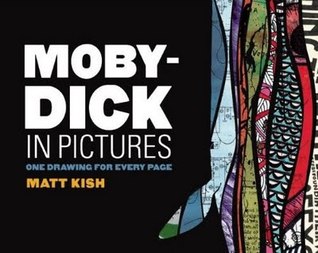
[READ: October 11, 2011] Moby Dick-in Pictures

Matt Kish has accomplished an amazing thing.  He has drawn a picture a day (more or less) to accompany every page of the 552 page paperback version of Moby-Dick.  He takes a small passage from each page and renders an image for it.  One thing this book is not is an illustrated version of Moby-Dick.  It doesn’t purport to be.  You won’t get the whole story from this book.  It’s not a cheat sheet for high school students.  If you haven’t readMoby-Dick, this will give you a taste for the story–almost like a preview for a movie.  And hopefully it will compel people to read the original.  If you have read Moby-Dick, this is a wonderful companion.  Not only will the pictures give you fascinating insights into the story (and into Kish, of course), but seeing sentences excised from the book to stand alone makes you aware of the book in ways you just aren’t when you’re reading it as a novel.

Kish admits he is not an artist, which while not false modesty, is certainly selling himself short.  He has an awesome style of illustration.  I am especially excited by his vast pictures with small details (lots of pages where there are small circles with lines in them or, for instance, the details on Queequeg’s face) and when he uses bold lines to create vast, weighty iconic pictures.  Here’s one example of his awesome use of multiple straight lines.  I mean, it’s gorgeous.

But I also love the whole conceit that an artistic shortcoming for him has turned out to be an absolute boon.  Kish says he cannot render the human form and so he made the conscious decision to make the seamen more like avatars than people.  It’s daring and a little odd, but it works wonders.  I admit that I was a little less than excited by the very first page of the book–I was disconcerted by Ishmael and his utter lack of features. (I actually like the way he is rendered later in the book better–call it an artistic growth).  But by the time her gets to Queequeg, or the  gorgeous Tashtego  it’s obvious that his decision was genius.  Just take a look at the marvel that is is Ahab (left).  First off, the colors are amazing.  As are the details of the whale in the corners.  But look at him–he’s a metal machine–shiny and tough–part ship, part whale.  Look at the awesome shading and detailing of the blue “coat” that he’s wearing.  He’s even got the badge of Moby-Dick on his belt!  And then there’s the pegleg–the most beautifully drawn pegleg ever.  It’s really stunning.

Now you’re also noticing that there’s all kinds of diagrams behind Ahab.  Kish used to work at a bookstore and he hated seeing old pages of books thrown away (he has since become a librarian, which makes sense–although as I librarian I learned that librarians are actually quite cavalier about throwing away old books once they are beyond use).  So he brought these pages home.  And, given the density of the layers of meaning in Moby-Dick, he decided to draw his pictures on these old pages.  So on virtually every page you can see something in the background.  Most of the time they are these circuital diagrams, which are wonderful. But there are several drawings where the found pages are pages of text from books.  And I have to say if these were serendipitous findings then he has amazing fortune.  Some of the pages tie in so perfectly it is wonderful.

Like the page that is headed “Cetology” and is from what, a textbook on whales?  Or several other pages that I wish I had taken notes on, because they were really wonderfully chosen.  He even has a drawing on a title page of Moby-Dick. I have to ask, did he really find that or did he buy it for the project? (more…)

Read Full Post »

SOUNDTRACK: MC PAUL BARMAN-It’s Very Stimulating (EP) (2001).

So is this guy a joke? Well, he’s very funny.  Very funny, in fact.  But to my ear, not in a novelty sort of way.  He’s got the kind of rhymes that make you laugh but still work upon multiple hearings.  And, yes, Paul Barman is a squeaky, Jewish boy from Ridgewood, New Jersey (again!) and he really can’t rap on the beat and he really doesn’t have much in the way of rhythm, but got awesome skills in the lyrics department and he has production from Prince Paul (that’s the kind of credentials that anyone would like).

The theme of this EP is Paul’s utter failure to get with women (even in his fantasies).  He’s crass and vulgar and yet he’s also quite smart and rather witty (“I think about all the pube I got while reading the Rubaiyat“) .  The music is more or less inconsequential.  As Prince Paul noted, the craziness comes from the lyrics, so you don’t want to overkill the song.  But there’s some great samples and some solid beat work as well.  Nevertheless, we’re here for the words.  So, sample a few of these rhymes:

“The Joy of Your World”

It was time to copulate but we didn’t want to populate
So my bold groin reached for my gold coin proooophylactic
I unwrapped it, you can’t know how I felt
It wasn’t a gold coin condom, it was chocolate Chanukah gelt
The white part crumbled on her tummy and the rest began to melt
Foiled again…..

“School Anthem” or “Senioritis” (this song was renamed for the reissue of the disc it seems)

Homework is tell major lies or plagiarise encyclopedias, so boring
Fresh-faced teachers want to tickle ’em
but a test-based curriculum excludes exploring

I’ll let a mystery gas out of my blistery ass
Just to disrupt the misery of history class

“Salvation Barmy”

She said, “Go get a haircut”
So I showed her my bare butt
Pulled down my Carhartts put my moon in her star-charts

“I’m Frickin’ Awesome” ( I love this especially for the Lila Acheson bit)

It’s nice to be hypnotized by a man you don’t despise yet
He had a type of flow and I can’t quite label it
All I know it made me want to take off my cableknit
Sweater, Oh he better be hetero
I hope they don’t catch us in the Lila Acheson
Wallace Wing when Paulus brings the mattress in–rudely
He backlashed my booty
like I was Susan Faludi over the Grace Rainey Rogers Room rostrum

“MTV Get Off The Air, Pt 2”  (the first two lines are fantastic, but the whole thing is genius).

Smirkin’ jocks with hackysacks
in Birkenstocks and khaki slacks
I’m the hypest lyricist
while they’re like, “What type of beer is this?”

Just wait until the full length for the utter genius that is “Cock Mobster” (how can be s o smart and so stupid at the same time?)

[READ: October 10, 2011] E Pluribus Venom

Like most people, I learned the name Shepard Fairey because of his iconic prints for Barack Obama.   In addition to supporting Obama, I really liked the design of the prints–simple, bold, an easy iconic style (which has since been lifted, morphed and used everywhere).  I know that many of Fairey’s prints actually come from other people’s original photos.  He has a print of Muhammed Ali in this book, and he clearly didn’t take the original photo (I don’t know where it came from).  But since all art is theft, I’m okay with Fairey taking someone else’s work and making something new from it.  I’ve always felt that attribution should be enough if you modify the original enough to call it different (which I feel this print does).  [The fact that he didn’t acknowledge the source does bug me, of course].  But that’s neither here nor there because this book predates all of that.

This book documents events that occurred in 2007.  The E Pluribus Venom show was based largely around two images that Fairey designed to reflect the two sides of capitalism.  The image to the right really doesn’t do any justice to the work itself, but you can kind of see that he created two-sided faux dollar bills.  The front showed all the good things that capitalism can do.  The back showed all of the evils that capitalism causes.  The images resemble dollars, but the text is straightforward in its message.  As with a lot of what Fairey does, it’s blunt and obvious but pretty cool.

As far as I’m concerned, though, this is the least interesting image in the book.  Although I love that they made dollar bill sized prints of these faux dollars and left them scattered around in cities to promote the show.  They way they were folded made them look at a glance like actual currency.  Very cool. (more…)

Read Full Post »

SOUNDTRACK: DINOSAUR JR.-Live at the 9:30 Club, Washington D.C. October 8, 2009 (2009).

This was one of the first shows I downloaded from NPR.  I’ve been a fan of Dinosaur Jr. since my friend Al turned me on to Green Mind back in college.

This is an amazing show created by the original Dino Jr. members.  This tour is in support of their second album since reuniting, Farm. This set-list is an outstanding mix of old songs, new songs, Barlow-sung songs and even some songs from when Barlow and Murph weren’t in the band.  (Green Mind is still my favorite album by them).

When the band reunited there was much joy, and I’ve said in reviews of the newer albums, I’m not entirely sure why.  I mean, Dino Jr has always been about Mascis, and it’s not like Barlow is such an unusual bassist (although Murph’s drumming is always solid).  I’ve nothing against Barlow (I love Sebadoh and Folk Implosion) or Murph, it just seems odd to get excited about having them back in the band aside from nostalgic reasons.

Having said that, the band sounds amazing (and yes, Barlow does get to sing on “Imagination Blind”).  What never really came across to me until hearing all of these great songs live was that Mascis has always been a great pop song writer.  These songs are catchy as hell. But Mascis buries them under loud squalling guitars and a voice that is almost whiny, almost off-key, a total slacker voice.  (But you’ll notice it is never actually off-key.  He must work very hard at that.)

By the nd of the show Mascis chastises the audience for not moving (we obviously can’t see what they’re doing), saying he forgets that people don’t move in Washington, D.C.  But during the encore break, NPR host, Bob Boilen, points out that Mascis himself doesn’t move either–he just stands in front of that wall of Marshall stacks (Boilen wonders how he can hear anything anymore).  And looking at the pictures it’s comical the way he looks, surrounded by amps.  The picture above doesn’t fully do it justice, but check out the extra photos at the NPR page.  And while you’re there, listen to this show. It is amazing.  For a total slacker, Mascis can rock a guitar solo like nobody’s business.

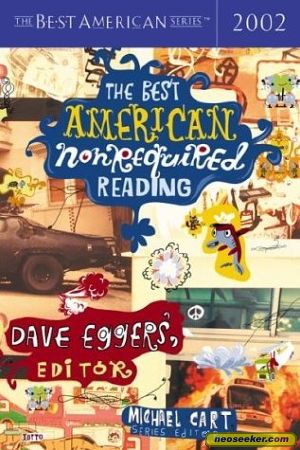
[READ: July 20, 2011] The Best American Non Required Reading

I’d been meaning to read this series for years (yup, Eggers fan), But I have a hard time starting “collections” because I feel like I’d rather be reading a novel.  Nevertheless, I have most of these Nonrequired books, so it seemed like I should dive into one and see what it was like (I don’t think the year really matters all that much–some of the articles are topical but most are not exactly).  Then Sarah said this would be a great book to read on vacation because it’s all short essays, and she was right.  It was perfect for late nights when I wanted something to read but didn’t feel like getting involved in the novel I was reading.

DAVE EGGERS-Introduction
Eggers’ introduction is actually a partial short story about kids who go swimming in pools around town. It reminded me of the opening of Life After God by Douglas Coupland, but of course, lots of kids did that so I’m not saying it was “lifted” from DC.  The story “ends” (it doesn’t really end so much as stop) with an interesting scene between two unlikely kids who get caught.

After this story Eggers includes these three notes about the collection: It’s not scientific, It’s alphabetical, and We had a lot of help with this.  Of the three, it’s the middle one that’s most useful because Eggers says that you shouldn’t necessarily read them in order just because they are printed this way: “In the first half of this collection, you get a good deal of hard journalism, primarily about war and refugees, from Afghanistan to the Sudan, followed immediately by a number of less serious pieces, about malls and Marilyn Manson.  We didn’t group anything by theme , and won’t be offended if you skip around.”  This was good to know (not that we needed the permission of course), but yes, the beginning of the book is pretty heavy. (more…)

Read Full Post »

SOUNDTRACKLOS CAMPESINOS!-“By Your Hand” (2011).

I’ve enjoyed Los Campesinos!’s records in the past and I’m pretty excited about the prospect of a new release.  This song doesn’t deviate too far from their previous releases although to my ear it sounds a bit more musical (more instruments, more vocals) and less abrasive.  The basic elements are still there:great lyrics delivered in a more or less spoken way, followed on its heels by big shouty sections (and the whole band seems to be shouting along on this one).

This song also feels a little warmer, although the lyrics “by your hand is the only end I’ve foreseen” is either really dark or really naughty depending on how well it correlates to the verses.  Regardless, the chorus is catchy and fun to sing and the lyrics are wonderfully twisted.  Los Campesinos! have done it again.

And here’s the video.

[READ: September 16, 2011] “Jean-Baptiste Labat and the Buccaneer Barbecue in Seventeenth-Century Martinique”

I was interested in this article because it talked about the boucan and the buccaneer, and both of these things were mentioned in Book 9 of The 39 Clues.  It was a weird sort of coincidence that the boucan which I had never heard of before should appear in two things that I read about week apart (and then this weekend the Pa Renaissance Faire was pyrate themed!).   I was also interested because of the way this article was presented in the email to us: “if you have ever wondered on what foods a seventeenth-century missionary from the island of Martinique dined, check out this article from Gastronomica. (Hint: They include manatee, lizard, and parakeet)” made it a must-read.

While the article does, indeed make mention of these foodstuffs, it is by no means the extent of the article.  Rather, Toczyski looks at what Labat, a French priest and a missionary, wrote in his extensive chronicle about his stay in the Caribbean.  In particular, she focuses on the amazing breadth and depth of his gastronomical accounts (which includes details about all the meals they ate en route (the ship was amazingly well stocked–they even had a garden on board, which was under guard day and night (!); and then on the island he also talks in loving detail (with recipes) of all of the native dishes that he would eventually consume (including turtles, frogs and the palm worm (see picture at right (the picture and an awesome description of eating the palm worm is here at Boots in the Oven, at the bottom of the page).

(more…)

Read Full Post »

SOUNDTRACK: MEGAFAUN-“Get Right” (2011).

I’ve never heard of Megafaun before, but this song is just wonderful.  It’s an 8 minute blast of psychedelia that covers and sometimes obscures a beautiful poppy song.  I hear overtones of Dinosaur Jr (but more for J. Mascis’ seemingly lazy style than for his crazy guitar riffing) and a bit of the Lemonheads in the folky pop feel.  Throw in a dose of My Bloody Valentine for the waves of sound and you get a perfectly lovely track.

The opening is a fairly simple, straightforward melody.  And his voice is so familiar-sounding.  There’s some cool squeaky/feedbacky guitars layered over the top of a hazy distorted sound.  By about four minutes, the song turns into an instrumental, with a guitar solo that comes in an out of the hazy chords.

This is a great song, and although the NPR write-up says this is the longest track, I imagine the rest must be equally as exciting.  Preview it on NPR.

[READ: September 1, 2011] “Asleep in the Lord”

This is a story about Mitchell, a formerly unhelpful person who never changed a diaper or helped a sick friend.  He has decided to change that, so he goes to Calcutta with the intention of joining Mother Teresa’s mission (and just how many stories involve Mother Teresa these days?—she even makes an appearance in the piece!).  He’s reluctant to do anything majorly gross, but he’s happy to hand out medicines (for what good they do).

After a few days, Mitchell is still somewhat surprised by his decision to go to Calcutta at all.  Then he meets Mike and Herb.  Herb is following the Bhagwan, but Mike is less grounded in who he is following here in India .  He came here because the economy tanked back home and he wanted somewhere to hide out for a few years.   As we learn more about Mitchell, we see that his intentions are understandably confused.  For really, like Mike, he also came to India to wait out the recession.   However, unlike Mike, he honestly did come to seek some kind of spiritual guidance.  Mike seems to be here for the easy sex–he has a picture of a young woman from Thailand who wanted “to marry him.”   (more…)

Read Full Post »

SOUNDTRACK: NEIL YOUNG-Trans (1982).

By most standards this Neil Young album is a disaster.  It’s so bad that despite updating his entire catalog and releasing all kinds of bootleg concerts, he has never issued this disc on CD in the States.  So, just what’s so awful about this disc?

Well, mostly it’s awful as a Neil Young disc.  Meaning, if you like Neil Young (either flavor: country/folk or hard rock/grunge) this disc is a big fat HUH??  Neil Young has gone all synthy?  And not just synth but computerized synthy–sometimes his voice is utterly like a computer.  It’s a travesty, it’s a shame, it’s an incredible surprise.  Unless you listen to it without thinking of it as a Neil Young record.

But after all that introduction, the biggest surprise is the first song.  You’ve been prepped for this weird album full of computer nonsense and you get the fairly standard (if a little dull) rockabilly type music of “A Little Thing Called Love.”  It’s a pretty standard Neil Young song for the time.  Hmm, maybe the album isn’t that weird.

Well, then comes “Computer Age” and the keyboards kick in.  Interestingly, to me anyhow, this is the year that Rush released Signals.  Signals was the album where Rush fans said Woah, what’s with the keyboards guys.  Similarly, “Computer Age” makes you say, geez, was there a sale on keyboards in Canada?  The keyboards are kind of thin and wheedly, but the real surprise comes in the processed vocals (Rush never went that far).  The vocals are basically the 1980s equivalent of auto-tune (no idea how they did this back then).  Because the song is all about the computer age it kind of makes sense that he would use this weird robotic voice.  Sometimes it’s the only voice, although he also uses the computer voice as a high-pitched harmony over his normal singing voice.

“We R in Control” sounds like it might be a heavy rocker (anemic production notwithstanding) until we get more computer vocals.  Again, conceptually it works (its all about the dominance of CCTV), but it is pretty weird as a Neil Young song.

And then comes yet another shock, “Transformer Man.”  Yes, THAT “Transformer Man,” except not.  This original version of the song is sung entirely in a processed super high pitched computer voice that is almost hard to understand).  The only “normal’ part of the song is the occasional chorus and the “do do do dos.”  It sounds like a weird cover.  Sarah, who loves Neil Young, practically ran out of the room when she heard this version.

“Computer Cowboy (aka Syscrusher)” continues in that same vein.  Musically it’s a bit more experimental (and the computer vocals are in a much lower register).  Although I think it’s probably the least interesting of these songs.

Just to confuse the listener further, “Hold On to Your Love” is a conventional poppy song–no computer anything (aside from occasional keyboard notes).  Then comes the 8 minute “Sample and Hold” the most computerized song of the bunch and one of the weirder, cooler songs on the disc.  It really feels like a complete song–all vocodered out with multiple layers of vocals, not thin and lacking substance like some of the tracks.  It opens with personal stats (hair: blonde, eyes: blue) and proceeds through a litany of repeated “new design, new design” motifs.

This is followed by a remake of “Mr Soul” previously only on Decade.  This is a new vocodered-harmonies version of the song.

The biggest failure of the disc to me is “Like an Inca” it’s nine minutes of virtually the same guitar riff.  The chorus is pretty wonderful, but it’s a very minor part of the song itself.  It is fairly traditional Neil song, I just wish it were much shorter.

So, this travesty of a disc is actually pretty interesting and, for me, pretty enjoyable.  Most of these synthy songs sound kind of weak but I think that has more to do with the production of the time. I’d love to hear newly recorded versions of these songs (with or without the vocoder) to see what he could do with a great production team behind him.

Trans is not a Neil Young disc in any conventional sense, but as an experiment, as a document of early 80s synth music, it not only holds up, it actually pushes a lot of envelopes.   I’m not saying he was trying to out Kraftwerk Kraftwerk or anything like that, but for a folk/rock singer to take chances like this was pretty admirable.  Shame everybody hated it.

[READ: July 5, 2011] Five Dials 19

Five Dials 19 is the Parenting Issue.  But rather than offering parenting advice, the writers simply talk about what it’s like to be a parent, or to have a parent.  It was one of the most enjoyable Five Dials issues I have read so far.

CRAIG TAYLOR & DIEDRE DOLAN-On Foreign Bureuas and Parenting Issues
I enjoyed Taylor’s introduction, in which he explains that he is not very useful for a parenting issue   That most of the duties will be taken on by Diedre Dolan in NYC.  They are currently in her house working while her daughter plays in the next room.  His ending comment was hilarious:

Also, as is traditional at most newsweeklies, someone just put a plastic tiara on my head and then ran away laughing at me.

I resist Parenting magazines, from Parents to Parenting to Fretful Mother, they all offer some sound advice but only after they offer heaps and heaps of guilt and impossible standards.  So I was delighted to see that Five Dials would take an approach to parenting that I fully approve of.  Dolan writes:

Nobody knows what works. Most people just make some choices and defend them for the next 18 to 50 years – claiming nurture (good manners) or nature (crippling shyness) when it suits them best.

And indeed, the magazine made me feel a lot better about my skills (or lack) as a parent. (more…)

Read Full Post »

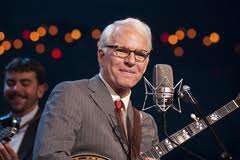
SOUNDTRACK: STEVE MARTIN & THE STEEP CANYON RANGERS-“Athiests Don’t Have No Songs” (2010).

We watched this Steve Martin performance on Austin City Limits last night.  Who knew that Steve Martin (yes, that Steve Martin) won a Grammy in the bluegrass category!  I’m not a huge fan of bluegrass–basically I like it enough for a few songs, but a half an hour is a bit much.

Nevertheless, Steve Martin is an amazing banjo player.  Anyone who has his comedy albums from the 70s knows that.  He used to play banjo between jokes (“Oh…death and grief and sorry and murder).  Now he tells jokes between banjo songs (the joke about the Grammy is very funny).

This song does not feature his amazing banjo playing but it is very funny indeed.

I just love the crazy notes that Martin hits near the end, which sounds so out of tune and yet fit very well together.

[READ: July 27, 2011] Five Dials 18b

The bulk of this short special issue is the five poems by Michael Robbins, a poet with whom I am unfamiliar.  The only other items included here are Craig Taylor’s Letter and Laurence Scott’s Currentish Events about Galliano and Gaddafi.  Since Five Dials issues are of varying sizes to begin with, it was unclear why this issue was a “b” and not the next issue, but Taylor sets us all straight.

CRAIG TAYLOR-A Letter from the Editor: On Spring and Robbins
They got into the publishing gig to be able to comment on things as they occur.  So this special issue is designed to usher in Spring and to introduce the world to the new poet whose title “Aliens v Predator” so impressed them that they asked him for five more. (more…)

Read Full Post »

« Newer Posts - Older Posts »