Feeds:
Posts
Comments

Archive for the ‘Religion’ Category

SOUNDTRACK: PARTNER-Tiny Desk Concert #744 (May 18, 2018).

I know of Partner from the All Songs Considered podcast.  Their song “Everybody Knows” (about being high) is pop-punk catchy and really funny.

That’s the only song I knew from them, but I assumed this Tiny Desk would be of a rollicking hilarious similar vein.

Imagine my surprise to hear them do pretty much everything but pop-punk.  There’s a theme song, a country song, a song for Céline Dion and a song that makes the lead singer cry:

This is one of the sweetest, funniest and most endearing Tiny Desk performances I’ve seen. From the moment they began playing, it was clear best friends Lucy Niles and Josée Caron, who perform as the Canadian rock band Partner, were there to leave their mark and have a whole lot of fun doing it.

Known for their sense of humor, joyful spirit and screaming riff rock, Partner opened their Tiny Desk not with their guitars plugged in, but with kazoos and a goofy little piano piece they dubbed the “Tiny Desk Theme.” Dressed like she was in an ugly sweater contest, Caron bounced along behind the keys with a beaming smile while the group (including drummer Brendan Allison, Kevin Brasier on keys and Daniel Legere on guitar) sang, “It’s the best Tiny Desk!”

The theme song is but a minute long and will hopefully be used for every future Tiny Desk endeavor.  It comes complete with bopping piano, kazoo and cowbell.

The impish left turns didn’t stop there. Immediately following the makeshift theme, Caron peeled off her sweater (revealing a Tegan and Sara T-shirt) and grabbed an acoustic guitar as the band broke into “Tell You Off” its first-ever country song, a track they’d premiered at a live show just days earlier.

Lucy Niles picks up the bass and plays a simple riff.  The rest of the band joins in (with Legere playing a very country guitar solo).

They could barely contain their laughter while singing “Tell You Off,” a boom-chicka story song about giving a good tongue-lashing to anyone who gets in your way:

“I heard what you said about my dog / that he shit on your lawn / well that’s not my fault / say it to my face or I’ll be pissed off / I’ll come over to your house and tell you off.

The third song is the one that Caron hope Céline Dion will sing.  She says it was inspired by a poem that her boss wrote.  “It’s a bad ass poem about going to down to hell to face your greatest fears and to reclaim a peaceful life for yourself.  The life that you deserve.”

In addition to playing a great rocking solo, Caron sings the final verse in French (for Céline to sample).

Partner closed out its set with a surprisingly emotional version of “Creature In The Sun,” a reflection on appreciating the gift of just being alive.

Caron plays a cool intro riff with a guitar slide.  And the song is the most rocking of the bunch.  And then

About halfway through the song, Caron took a moment to tell the audience why it was so special to them. Choking back tears, she said she wrote it about freeing the mind of desire. “It’s a very healing place… And you can just experience the fullness of life. I just wanted to… remind everyone that that stuff is right there with you all the time.”

It’s surprisingly emotional and Caron is clearly embarrassed at her emotional outpouring, but the audience is receptive and she still manages to play that great slide guitar apart tat the end.

And, to break some of the emotional tension the drummer hits a nice cowbell sound at the end.

This is a very surprising set, and one that I imagine is unique in their live performances.

[READ: May 21, 2018] “The Long Black Line”

This is the story of Jesuit Priesthood, circa 1954, and a man trying to join.

Finn is described this way: “priests were still thought to be holy, and Finn…Well…”

When Finn is close to completing his term of study one of the Brothers, Brother Reilly who is manuductor (he who leads by the hand) seems to think poorly of Finn.  Reilly wrote in his diary that Finn seemed self-important.  And then Brother Reilly went to confess these thoughts.  Brother Reilly’s superiors felt that Reilly was not suited to the role of manuductor and therefore it was useful for him to be given the task.

Father Superior told them: “feelings are always to be distrusted.  The good Jesuit may feel excited or depressed, but–remember–he never shows it.  He is never singular. He disappears into the long black line [of priests]….  If you feel sad, smile.  If you feel elated, exercise self-restraint.  If you dislike someone, pray for him.” (more…)

Read Full Post »

SOUNDTRACK: DESTROYER-Live at Massey Hall (July 10, 2014).

Destroyer is Daniel Behar (who is also part of New Pornographers and other bands).  Usually, Behar is surrounded by a lot of other people when he plays.  His music tends toward the symphonic.

But for this show (his first time at Massey Hall), it is just him with his acoustic guitar.

In the introduction he says that he gave up playing the guitar a long time ago, but he couldn’t just do a set with him signing a capella so….  He observes that he’s been playing with an 8 piece band–they solo forever and I’m barely singing anymore.  So this is quite something.

He seriously downplays the show saying he doesn’t even really like “guy with guitar” music, he’s more into Sinatra or the Stones.  “This is an anti-advertisement for the show I’m about to play.”

He plays songs from throughout his catalog.

“Foam Hands” is not that different, although I do prefer the recorded version.  In this version, though, I like the way he plays the end chords loudly and dramatically and the way the song abruptly.

“Chinatown” is a much bigger song on record with backing vocals and a rather cheesy sax throughout.  So I like this version better.

He introduces “Streets on Fire” this way: “Here’s a song I wrote 20 years ago.  Showing off because lots of you couldn’t write songs twenty years ago because you didn’t know how to say anything.  Couldn’t play guitar.  Didn’t know the chords didn’t know words.  Pathetic.

The song is from his debut when it was just him and a guitar.  This version sounds 100 times better.

“European Oils”  I love this song from Rubies and I especially love the orchestration of it.  So while I enjoy this stripped down version I’ll take the record.

The original of “Your Blood” is a romping fun song (also from Rubies).  This is slowed down but still nice.  And of course I enjoy that my daughter is mentioned; “Tabitha takes another step.”

“Savage Night at the Opera” has a great bass sound in the original, although this stripped down is very nice.

“Farrar, Straus and Giroux (Sea of Tears)” is a quiet song (the original has drums and piano but’s not that different from what’s here).  It’s quite pretty as is the whole set.  A real treat for fans of Destroyer.

[READ: May 3, 2018] “The Boarder”

This story was translated from the Yiddish by the author.  Singer died in 1991, so I’m not sure if this is a recently found story or an old one that has just been published..

This is a simple story about a pious man and a non-believer.

Reb Berish is the pious man.  He eats only twice a day; he prays for many hours a day.  He had recently retired from his business in fabric remains and had little to do.  Over the last forty years, his wife had died, his son had died and his daughter had married a gentile in California.

He didn’t want to live alone so he took in a border, Morris Melnik. Melnik paid $15 a month, but that wasn’t the point.  Berish was taking pity on the man who had literally nothing left in his life–no family, no job, no God.  Melnik was a heretic; a nonbeliever.

He mocked Berish for praying “to the God who made Hitler and gave him the strength to kill six million Jews.  Or perhaps to the God who created Stalin and let him liquidate another ten million victims.”

It sounds like the premise for a sitcom, but this story does not do that. (more…)

Read Full Post »

 SOUNDTRACK: ÌFÉ-Tiny Desk Concert #736 (April 29, 2018).

ÌFÉ is from Puerto Rico.  Creator Otura Mun has a fascinating history as to how he wound up creating this band:

Otura Mun started out in the world as Mark Underwood, a Goshen, Ind., native whose parents were Mennonites and who managed to snag a coveted spot on the University of North Texas’ drumline. But that was before a flight mixup landed the percussionist, composer, DJ and producer with a free trip to Puerto Rico. Two years later, he moved permanently to the island, became a Yoruban high priest and began creating electronic music that channeled the African diaspora.

Woah.

So ÌFÉ (pronounced ee-faye) combines traditional Afro-Cuban drumming and chanting with a kind of Jamaican dancehall sound.  Midway through the set, Mun explains that he drilled holes into the traditional acoustic drums and has attached electronics to them, essentially making them triggers, but with the traditional acoustic sound as an overtone.  It’s pretty amazing.

The group’s debut album, IIII+IIII, (pronounced “Edgy-Og-Beh”) is a fresh electronic take on tradition that’s winning over even the most devout practitioners of the western African-based spiritual ceremonies that form the base of their music. That’s hard to do with ritual music.

Although interestingly, for the first song “House of Love (Ogbe Yekun),” they play acoustically.

For their turn behind the Tiny Desk, Otura Mun and his ensemble unplug their drums for their first tune, an acoustic version of their “House of Love (Ogbe Yekun)”.

This acoustic sound is quite compelling in itself.  Yaimir Cabám plays a beautiful acoustic guitar (pretty, simple chords) and sings, I believe wordlessly.  Meanwhile, the rest of the band plays various percussion: simple electronic percussion and shaker and various hand drums.  Anthony Sierra on congas keeps the rhythm.

After a verse, Otura Mun joins in on vocals (with deep backing vocals from Beho Torrens).  It’s a quiet, soothing song with occasional punctuation from the drums.  When the melody finally changes after 4 minutes, it sounds like a massive shift even if it’s just a few notes.

“Prayer for Oduduwa (Para Meceditas)” opens with bells and shakers and some interesting electronic splashes before the massive amounts of electronics take over the song.  I believe Rafael Maya joins them and was not their for song one.

The sound of the second song here is what startled me when I heard the band’s debut CD last year: the parts normally performed on Afro-Cuban bata drums and chekeres are electronically treated for a traditional prayer for the deity Oduduwa.

They sing in a traditional chanting style including an awesome low chant (from Torrens) that sounds otherworldly.

By the last tune, “Bangah (Pico Y Palo),” the electronics have created a sonic playground that plays perfectly against the battery of Afro-Cuban rhythms.   “Bangah,” focuses on a reflection of the Orisha Ogún, the owner of war in the religion, whose main tool is the machete.

Mun says he wanted to play urban music you could improvise and to use percussion as the basis–Cuban rumba combined with Jamaican dancehall.  He demonstrates some sounds and then a deep rumbling bass: “we got your nasty subs that you know from that the stuff that’s nasty.”

The song is a shout out to those struggling against the vestiges of colonialism still prevalent in Puerto Rico.

They begin the song with a “breathe in” [inhale] let it out Ahhh!

I love the way the various voices are processed.  Torrens sound deeper and Cabám’s voice sounds alien and like it is three voices at once.  The various lines are interspersed with interesting vocals sounds: grunts and screams that punctuate the verses.

It’s a very cool set.

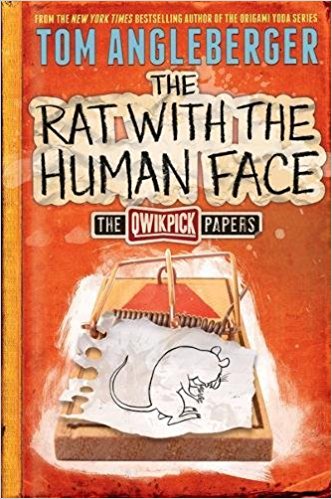
[READ: March 19, 2018] The Rat with the Human Face

In 2014, Angelberger’s first book The Qwikpick Adventure Society was reissued as Poop Fountain.  He then wrote two more books in this trilogy.

This is the second book (written in 2015) and it opens with this

This is the second of three stacks of papers this guy found in a storage room at the old Qwikpick gas station in Crickenburg.  The guy, who asked me not to use his name, called me because one of my old newspaper articles was in the first stack.  (You know I was a reporter before I wrote the Origami Yoda books, right?)

Then he reminds the readers that this book is set in 2000–kids didn’t have iPhones or smartphones.  They didn’t have phones at all and cameras took forever to charge the flash and they drained the batteries fast.

So the entire Qwikpick Adventure Society: Lyle, Marilla and Dave is back, but this story begins with bad tidings–the Qwikpick Adventure Society was disbanded after this adventure.  (more…)

Read Full Post »

olymmpSOUNDTRACK: LOGAN RICHARDSON-Tiny Desk Concert #734 (April 23, 2018).

Logan Richardson is a jazz saxophonist.

I’ve been down on saxophones lately, but I do really like the sound he gets.  I’m a bit more impressed by the rest of his band, though.

Since I don’t know Richardson, I’ll let the blurb speak for me, with some of my comments.

Richardson ‘s latest project, Blues People,  … was derived from the early slave calls that inspired the earliest American jazz and blues musical traditions. Here at the Tiny Desk, the saxophonist revisits that history with four remarkable songs from the album, all performed with a hope that our country’s future will be less painful than its past.

“80’s Child” is a reflection on the decade Richardson was born. Its colorful melody complements the band’s energetic fusion groove. Continually pushing forward with momentum and anticipation, its 8/8 time signature moves seamlessly into 10/8 to create an intensity that is both focused and free.

I love the opening guitar work (by Igor Osypov) which sounds very un-jazzy to me–you could hear an alt-rock sound being built out of that.  While Igor is doing a simple but pretty guitar solo rhythm guitarist Justus West keeps the rhythm work with some interesting whammy bar bending.   About three minutes in, drummer Ryan Lee gets some great little improv moments.  I really enjoy the song even if I find myself tuning out the sax and listening to the guitar.

Richardson notes, “The desk is tiny but it’s mighty.  I have a tiny saxophone that I forgot to bring.”

The next groove, “The Settlement,” maintains a similar tone and features DeAndre Manning slapping on his funky bass.

This song feels more jazzy to me–prominent sax with jazz guitar chords.  But I do love the jazz/prog rock section with the slap bass and the guitars following suit.  I definitely tune out the sax to listen to the great riffage from the strings

While the band is ringing out the last notes of the song, Richardson introduces the next

The song gently segues into the only vocal piece, “Black Brown & Yellow,” a lovely reminder that racial diversity is something to celebrate.

They do a short chant of “Black, brown and yellow is beautiful.”  It’s a pretty, almost sensuous song sung first by West and then joined by everyone else.

I love that I am now quoting someone quoting some else about this last song:

“Anthem (To Human Justice)” ends with brilliance best described by my colleague Nate Chinen, “By design, too, Richardson’s alto saxophone often functions more like a lead vocalist than as a virtuoso solo instrument. He’s a good conduit for soaring, plaintive melody…. And however the band surges or thrashes around him, there’s a feeling of urgent communion in this music.”

The backing music is once again excellent and interesting, with cool time changes a nifty guitar solo (while the second guitar is doing some other cool stuff too) and some great bass work.  I really like the way the whole band jams it out at the end–the band sounds great and Logan’s sax is right there with them soloing the whole time.

I feel like this is jazz for people who don’t like jazz.

[READ: March 17, 2018] Olympians 10

I’m still not sure how many books O’Connor has planned for this series, although in his introduction he talks about saving his favorite books for the end, so I assume there are at least two more (although 12 seems reasonable).

Here’s the summary of the man himself:

George O’Connor is a massive geek and Greek scholar.  He has done lots of research for these books, including going to Greece and visiting sites and antiquities as well as comparing all manner of ancient stories to compile the most interesting pieces. He explains that since these stories were orally passed down, they were modified over the years.  He doesn’t change the myths, he merely picks the story lines that are most interesting to him.  And then he adds a lot of humorous modern touches (and dialogue) which keep it from being at all stuffy.

O Connor’s drawing style is also inspired by superhero comics, so his stories are presented in a way that seems much more like a super hero than a classical hero, which is also kind of fun.

Each book ends with an author’s note which is hugely informative and gives plenty of context.  It also has a bibliography, but more importantly, it has a list of notes about certain panels.  Do not skip these notes!  In addition to providing a lot of insight into the myths of the characters themselves, there are a lot of funny comments like “Greeks raced in the nude (point and laugh)” which really bring new depths to the stories. (more…)

Read Full Post »

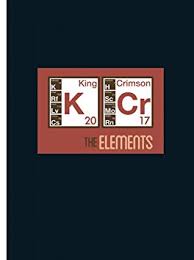
SOUNDTRACK: KING CRIMSON-The Elements Of King Crimson – 2017 Tour Box (2017).

The (so far) final Tour Box (although the band is still touring in 2018) is notable for having what might be the definitive collection of live “Lark’s Tongue in Aspic” recordings–Parts I to IV (and more) from different eras.

But that’s disc two.  Disc one continues with the sampling of the band’s career.

Disc 1 opens with “Wind.”  Although each “Wind” extract seems a tad different.  This one is all talking, no wind.”   (extract)  talking no wind.

Next comes an a capella first verse of “21st Century Schizoid Man.”  It’s just Greg Lake singing really loud before seguing into the rest of the song, this time from 2015.  It’s a great version.

Continuing like the other boxes, there’s an instrumental edit of “In The Wake Of Poseidon,” which is quite lovely.

This disc has a number of Mel Collins flute improvs taken from various Lark’s Tongue recordings in 2016.  Each one is wonderful and I could listen to his flute all day.

Another recording of “Peace,” this time with in a rehearsal that ends with Jakko cracking up because of something that Gavin has done (with lots of bad words bleeped out).

It’s followed by a stellar recording of “Cirkus” from 2016.  This is the first time played since 1972 and it sounds much more intense and complex than the version on the previous box.

It’s followed by an abridged instrumental recording of “Islands” and a 2015 live recording of “Easy Money” (complete with sound effects–I loved hearing this live the first time.

“Suitable Grounds For The Blues” is a 2015 rehearsals that ends when someone calmly says “It was Harrison, sir.  He made me laugh, sir.  He did the drum fill out of Hawaii 5-0 twice.

“The Great Deceiver” from 1974 sounds tremendous and I hope this means they might be busting it out for the 2018/19 tour.

“Asbury Park” is a live recording. It’s a fast and rollicking instrumental edited down to fit nicely with a terrific 2016 recording of “One More Red Nightmare.”

There’s a 2015 rehearsal of “Meltdown” and then a jump to an alternate (instrumental) mix of  “Thela Hun Ginjeet.”  I normally love these instrumental mixes, but i find that this song really uses the words wonderfully and I miss them.

The only other track from this era is a 1982 recording of “Heartbeat” which is insanely catchy and I can;t believe wasn’t a hit.  The disc ends with a 2008 performance of 1984’s “Sleepless” which sounds really 80s (the bass in particular) even though it was recorded in 2008.  I’ve often thought that Adrian Belew makes King Crimson sound like The Talking Heads, and that seems to be true with this song.

The disc ends with the intermission and photography announcement from 2016 concerts.

Disc 2 is the Lark’s Tongue disc, but it doesn’t start with it.  It opens with 2004’s “Form No. 1” with strings guitars and a Tony Levin groove.  Then there’s a version of “THRAK ” from the Thrak sessions.

The disc has several tracks called “Keep That One Nick” which are some early recordings and dialogue.  Each one is about 4 minutes long of guitars or drums or the whole band recording primarily parts of LTIA.

When the series starts, we’ve got a

2015 recording of “Larks’ Tongues In Aspic Part I” followed by a
1974 recording of “Larks’ Tongues In Aspic Part II.”

after a Nick recording of percussion (in which the drums sound like child’s toys and like Bruford is hitting everything in the studio, they continue the series with a

1984 recording of “Larks’ Tongues In Aspic Part III.”  This is my least favorite Part–I can;t get over how much I’m disliking the 1980s recordings, especially since  Discipline is one of my favorite KC albums.

after a recording jam of Part II (keep that one, Nick) there’s a

1999 recording of “Larks’ IV ConstruKction” where you can see the connection to the LTIA series in this song.  Then comes a

2003 recording of “Larks’ Tongues In Aspic Part IV” which sounds great once again.

It’s followed by a 2016 recording of “Level Five” which is sort of an unofficial Part 5 to LTIA.

Presumably these are Fripp’s favorite versions of the series. So there.

The disc and set ends with a radio advert for the Larks’ Tongues In Aspic album because who even knew they made radio adverts for albums.  It’s a great piece of history.

I imagine there will be a 2018 box, as the band has taken a few months off and is getting ready to start touring Europe and Japan through the end of the year.  And who knows, one more trip back to the U.S. in 2019?  Yea, I’d be ready to see them once more time by then.

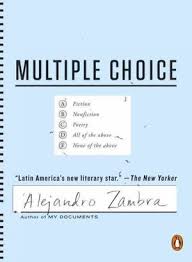
[READ: February 1, 2017] Multiple Choice

I have really enjoyed Zambra’s stories a lot.  As with most of Zambra’s work, this one was translated from the Spanish by Megan McDowell and I thought it was terrific.

As it turns out almost half of this book has been previously published: “Reading Comprehension: Text No. 1” (New Yorker, July 6 & 13, 2015) and “Reading Comprehension: Text No. 3” (Harper’s, July 2016).  In total, there are three Reading Comprehension texts in the book, as well as a few other types of “test questions.”

The original of this book was called Facsímil, and it uses “the structure and questions of the Chilean Academic Aptitude Test as its organizing principle. Called both a work of parody and poetry, Multiple Choice examines the role of the education system and standardized testing in promoting compliance to authoritarian rule.”

Since this book is set up like test there are 5 parts to work through.  (more…)

Read Full Post »

SOUNDTRACK: KING CRIMSON-The Elements Of King Crimson – 2014 Tour Box (2014).

When King Crimson reunited in 2013, they prepared to tour as a seven piece behemoth the following year.  There would be three drummers, two guitarists, bass and horns.

And they were totally reinvigorated.

To celebrate this tour, Fripp and his minions created this Elements Tour Box, a 2 -disc set dedicated to displaying the elements that made up the band from the beginning until now.  It was made up of alternate takes, excerpt (lots of excerpts), live recordings and rehearsals from the entirety of the Crimson canon, including some of the 2014 shows.

It is a treasure trove for Crimson fanatics.  But it is also an excellent resource for anyone looking to explore the Crimson underworld without buying $150 boxsets.

The discs follow a vaguely chronological overview, starting in 1969 and moving on through 2008.  But there are 2014 takes of old songs thrown in as well–some sound better than others, but overall the quality is quite good.

The first disc covers 1969-1974.  It opens with
“Wind Extract,” which is the sound of Fripp’s mellotron being turned on back in 1969.
“I Talk To The Wind” is an instrumental version of the second song on ITCOTCK.  Purists will be able to tell how many things are different between this version and the actually-released product, but in a nutshell, this is the album version with no vocals.  It’s really interesting to focus just on the music and not the words for a change.  The song is quite pretty, with lots of flute.

“Cadence and Cascade” is from In the Wake of Poseidon and no one involved in the recording remembered Greg Lake singing a version of it.  Guest vocalist Gordon Haskell sang the album version.  Then someone recently found this “guide vocal” version of Lake singing it for apparently the first and only time.

The boxes often contain brief excerpts like this one–fifteen seconds of Fripp’s classical sounding guitars from “Cirkus.”  This is kind of an acoustic bridge before we hear the full song recorded in 1971 on the Lizard tour.  This song in particular sounds very dated live and the middle “circus sounds” sections are 70s crazy.
“Hoodoo (extract)” is a 2014 rehearsal that’s all of 20 seconds which segues into a raucous recording of Fripp playing a wild guitar solo for “Sailor’s Tale.”  It’s wild and really shows Fripp throwing everything he can at the song.
“The Talking Drum” is an early alternate mix which sounds great to me.  It gets really crazy by the end.

The “Lark’s Tongues in Aspect I” excerpt is from 2014 and is just Mel’s flute for 2 minutes.  It’s followed by a 1972 extract that’s just violin and dulcimer and harp.

This turns into a great new mix of the 11 minute “Fracture.”
After a minute of gorgeous harmonics by Fripp from “Fallen Angel,” we get a full, gorgeous 6-minute instrumental version of the song.  Because Crimson songs are so complicated and so carefully constructed, they are one of the few bands whose songs can have lyrics removed without them falling flat.
There’s a weird-sounding version of “21st Century Schizoid Man” from 1974, which sounds so very mid-70s in the recording style.  It seems somewhat slapdash compared to the utter tightness of the 2014 band.  The disc ends with Mark Charig’s cornet recording for the end of “Starless.”  On the proper release they use Mel Collin’s saxophone, but the cornet sounds delightful.

Disc two covers 1981-2008.

  This is pretty much the Adrian Belew era.  Belew was not invited back for the new incarnation, so that’s a little awkward.

It begins with an alternate take of the instrumental “Discipline.”  After a 45 second drum intermission, there’s a track called “Manhattan (Neurotica)” which is an instrumental version of “Neurotica.”  I love that the opening guitar sounds like sirens and car horns.
A minute and a half of the middle of “Neal and Jack and Me” is followed by the Steven Wilson mix of “Sleepless (Bearsville)” with an incredibly 80’s sounding slap bass from Tony Levin.

Then there’s a recording session of “Sex, Sleep, Eat, Drink, Dream.”  We hear lots of stops and starts, bass only, guitar parts and someone repeating “this is tough, tough shit.”
There’s a live version of “THRAK” followed by a minute of Fripp soloing around “Larks Tongue” called “Venturing Into Joy.”

This is followed by two tracks from Fripp’s side ProjeKcts,  “The Deception of the Thrush” is performed live by ProjeKct Four in 1998 with big thumping almost splatting-sounding drums.  Then there’s a trippy and ambient early version of “Heaven & Earth” by ProjeKct X.

After a scorching “Level Five” from 2008, there’s a minute long drum solo which would ultimately morph more fully into “The Hell-Hounds of Krim” and then two tracks from A Scarcity of Miracles.  “Separation” is an edited version of the bonus track (the disc label calls it something else).  And there’s an alternate take of “A Scarcity Of Miracles”–still long and a little too jazz-lite for me.

This is a really solid collection of all eras and styles of Crimson.  And it also showcases the various parts coming together.  A great production all along.

[READ: January 19, 2018] Monsters of the Ivy League

This book collects a series of Ivy League graduates and puts them in context with a they have a lot of support for all of their declarations.  Each entry gives a brief (biased) biography that highlights their flaws, outrages and downright unforgivable behavior.

So, rather than rewrite summaries of these assholes, I’ll present a grid with the shortcut (and some choice tidbits).  You can find the book and read the details for why our Ivy leagues have bred so many shitheads, including current miscreants:

Samuel Alito, Ben Carson, Ann Coulter, Ted Cruz, Laura Ingraham, Henry Kissinger, Dr. Oz, trump, and many more.

The introduction says that the term Ivy League refers to a bunch of football teams. (That’s why it says “league”).  The League was formed in 1954 to formalize the sporting relationship between eight teams: Brown, Columbia, Cornell, Dartmouth, Harvard, Univ of Penn, Princeton and Yale.

Of course, no one goes to these schools for sports, they go to find the best future contacts for your budding careers.

But read this book and remember:

An ivy education doesn’t force you to become a hideous person, but it doesn’t necessarily prevent it, either.

What follows is a smart-shopper warning to those applying, a count-your-blessings consolation to those who have been rejected and a watch-your-back caution to those already attending.

(more…)

Read Full Post »

[LISTENED TO: September 2017] The Hitchhiker’s Guide to the Galaxy complete radio series

The history of the Hitchhiker’s Guide to the Galaxy is almost as convoluted as the story itself.

Douglas Adams (with help from John Lloyd) wrote the radio story in 1977.  It aired in 1978.  A second season aired in 1980.

Adams wrote the novel based on the radio series in 1979.  And then the second book The Restaurant at the End of the Universe in 1980.

Then they made the TV show.

Apparently Adams considered writing a third radio series to be based on Life, the Universe and Everything in 1993, but the project did not begin until after his death in 2001.  The third, fourth and fifth radio series were based on Life, So Long, and Thanks for All the Fish and Mostly Harmless which were transmitted in 2004 and 2005.

It’s interesting and a little disconcerting how different the radio play is from the story of the book. There are a lot of similarities of course, but some very large differences.

The first series obviously leaves a lot out from the book, since the book wasn’t written yet. (more…)

Read Full Post »

[ATTENDED: March 16, 2018] Emo Philips

I don’t really know all that much about Emo Phillips.  I know that he was kinda popular in the 1980s, but I didn’t know he was still doing stand up–I’ve mostly known him through his association with Weird Al.  Emo was in UHF as the shop teacher who (spoiler) cuts his fingers off.

Well, apparently Emo has been plugging away all this time and has remained friendly with Al.  So for Al’s Vanity tour, he asked Emo to open.  Emo even made a joke about this.  He said that during the filming of UHF, he asked Al when the two of them might tour together and Al said (mockingly) “when donald trump is president.”

Emo’s comedy is really dark but–delivered in his bizarre manner that goes somehow beyond deadpan–it makes his jokes really hilarious. (more…)

Read Full Post »

SOUNDTRACK: ALEX CLARE: Tiny Desk Concert #715 (March 7, 2018).

Alex Clare’s band is clearly having a beard-growing contest.  The drummer (Christopher Prendergasp) isn’t playing but everyone else suggests the stakes are high.  The bassist (Christopher Hargreaves) is winning.

Vocalist and songwriter Alex Clare is yet another soul disciple from the UK, and his visit to Bob Boilen’s desk is the perfect setting to bask in the power of his voice.

The first song, “Three Hearts,” is a love song dedicated to the moment he heard the heartbeat of his first child coming from his wife’s sonogram. Backed by a tight four-piece band, Clare’s tale of his family’s road to domestic tranquility captures the joy as well as the uncertainty of impending parenthood.

Lyrically it’s okay and sweet, it just sounds fairly typical.  Especially musically.  I thought we;d be getting 20 minutes of straight ahead soul with a little less charisma than The Commitments.

Next is “A song called ‘Love Can Heal.’  True story.”  The guitar (Jordan Peters) is far more interesting on this song.  In fact I found myself enjoying the guitar more than Clare’s voice.  I love the cool guitar licks at the end and the nifty harmonic note that ends the song.  Although, having said that, his voice is quite powerful.  And he shows it off even more on the next song.

In “Caroline,” he inhabits the words with passion and heartfelt pleading, bringing to mind some of the best soul shouters, completely lost in the sentiment of the lyric.

That is very true, he is completely swept up in this song (even he says it’s not about anyone in particular).

I really like the guitar on the final song “Open My Eyes.”   I like the whole vibe of this song–the way the song unfolds and the backing vocals as well.  Indeed I feel like each song has gotten a better as the show progressed.

While I found his music to be fine–nothing I’d go out of my way to listen to but I wouldn’t turn it off either. I found his backstory far more interesting:

The British singer-songwriter released his debut album, The Lateness of the Hour, on Island Records last summer. But the label soon discovered how serious Clare was about his faith [he is an Orthodox Jew, which I didn’t know when I made the beard contest joke] — especially when it came to the sabbath and high holy days, on which Orthodox Jews are forbidden to perform.

“When I signed to Island — you know, obviously a shomer Shabbos Jewish person — I don’t think they quite realized what that means,” Clare says. “I got offered a tour at Pesach, at Passover, and couldn’t perform.”

The offer Clare turned down was a slot opening for Adele. About four months later, he was dropped from Island’s roster, having failed to generate significant album sales or radio play. As Clare was figuring out his next move, he received a call from Microsoft, which was interested in using his song “Too Close” in a commercial. It was a deal that would make the song a hit and restart his career.

He doesn’t play that song here, which is too bad.  And the poor percussionist’s name is never given.

[READ: February 28, 2018] “Violations”

This is a story about writing stories and how autobiographical they are or are not.

It is written in close third person.  And the first sentence is really, really, really long.

It begins, “He had wanted to make sure she wouldn’t write about him…” and then it goes on in his mind about why he didn’t want to be written about and narcissism and all that kind of thing.  The short of it is that he never asked her not to write about him, but he never stopped craving assurance that she wouldn’t (and there’s a long entangled reason why not).

The “she” is his now ex-wife.  She moved out but he still gets her mail.  And she has not written about him.  He tries to get her mail to stop coming but he doesn’t cancel her magazines–especially the one that she always wanted to be published in but had never been. (more…)

Read Full Post »

McSweeney’s 49: Cover Stories: Contemporary writers reimagining classic tales (2017)

SOUNDTRACKBIG K.R.I.T.-Tiny Desk Concert #714 (March 5, 2018).

A while back I downloaded one of Big K.R.I.T.’s mixtapes and rather liked it.  Since then he seems to have become pretty huge and I feel like he has really expanded on his style.

K.R.I.T. sings/raps three songs from his new album.

4eva Is a Mighty Long Time, a double album in which he covers everything from blessings to depression while plumbing the carnal and spiritual depths of his own duality. All three songs performed here come from side two, titled after his birth name Justin Scott.

The first song “Mixed Messages” is really thoughtful.  He sings and raps

I gotta whole lotta mixed messages / in my songs am I wrong / to feel this way
I got me a lover but I still wanna cheat / I wanna be saved but its fuck the police
i never really liked the fake shit / but I’m attracted to the fake ass and fake tits
i really wanna sing but id better rap

K.R.I.T.’s backing band, which includes Burniss Travis II on bass and Justin Tyson on drums, also features on keys Bryan Michael Cox — the hitmaking producer and songwriter behind a slew of Billboard chart-toppers. Together, the trio delivers stripped-down versions of the latest thought-provoking material in Big K.R.I.T.’s catalog.

Introducing the second song, “Keep The Devil Off” he says his grandmother introduced him to gospel.  She brought him to church and “she would wake me up when i fell asleep saying wake up you gotta hear this.”  He sings beautifully.  And then the rapped verses are really well structured.

And when he stops to pay homage to his church-going grandmother before performing “Keep The Devil Off,” it’s clear that everything she instilled in him is keeping him alive, too.

Definitely in these times we need to keep the negativity away–keep the devil off.

His grandmother was clearly very important to him.

Big K.R.I.T. has kept her spirit alive through his music since his breakout mixtape, K.R.I.T. Wuz Here, which he released in 2010, the same year she died.  So it only makes sense that he would bring her with him for his Tiny Desk concert.

Halfway through his three-song set at NPR Music headquarters, K.R.I.T. stops to pull out an old-school tape recorder — the same one his grandmother would use to record him singing and reciting poetry as a child. “I have to feel like my grandmother was my first mix engineer,” he says before pressing play to reveal him and his brother as kids singing a duet of R&B crooner Donell Jones’ 1999 slow burner, “Where I Wanna Be.”

He plays the tape and cracks up listening to it.  He gets the audience to sing the refrain with his younger sell.  And then his grandmother introduces he and his brother as an R&B singer, “but I’m sticking with the rap thing.”

It’s a sublime interlude — one that resonated so strongly with K.R.I.T. that he had to start his last song, “Bury Me In Gold,” over to catch the proper beat. “I’m super emotional from this, too,” he says, laughing in a moment so genuine it was only right to leave it unedited.

He says “Bury Me in Gold” is not about gold really, it’s about having something so that in the event he gets to heaven he’ll give everything away.

He tells us to remember that peace of mind and your soul are more important than gold.

I’ve always enjoyed thought provoking rap and K.R.I.T.’s lyrics combined with his voice really work wonders.

[READ: May 29, 2017] McSweeney’s 49

It has been a long time (three years or so) since the previous McSweeney’s volume.  During that silence, the publishing house went non-profit and that seems to have taken up a lot of their resources.  They even address this a bit in the interdiction to this book.

But regardless of the reasons why, it is great to have them back.

As the subtitle says, this is a book of “cover stories.” What that means is a little vague–the contemporary writers model their story after a classic story.  I try to compare it to music covers, although in music covers the music and words are typically the same with some kind of variations.  Typically, the words are the same but the music is different.  I liked to flip this idea on its head for describing these stories in that the words are different by the music is the same.

Since I don’t know most of the original stories here I don’t know how similar these are to the originals–same character names?  Same ideas?  Same plot?  I don’t know.  And perhaps it would affect the way I read these stories if I was familiar with theory original pieces.  But without knowing them, these just turned out to be good stories from good writers.

Interspersed between the stories were poems and, in a wonderful commentary on our current shitty president and the cowardly house of representatives who on the day I finished this voted to strip 24 million people of health care, are comparisons of classic historical figures’ speeches with the petty garbled tweets of out current crap in chief.  Can we impeach this motherfucker already?  And send the whole lot of them to jail, please.  #ITMFA

As many McSweeney’s do, this one opens with letters.  And of course they aren’t really letters at all, even if they are addressed to McSweeney’s.  Many deal with cover songs, but a few are much more serious, political and right on.

WAJAHAT ALI writes from Camp FDR in Washington DC where he and his fellow prisoners were finally able to cobble together WiFi.  Ali explains that the Executive Order was inevitable the ban, the vetting, the registry were all just prelude. The need to protect against terrorism outweighs the individual rights and the rights of American Muslims…read the Supreme Court decision.

NICK JAINA writes about the Sept 23, 1970 episode of The Johnny Cash Show in which Ray Charles appears and plays “Walk the Line” and then “Ring of Fire.”  The letter states that the creator of “Ring of Fire” is actually mis-attributed.  The story is that June Carter wrote it after seeing a page in her uncle’s book of Elizabethan poetry.  But Johnny first wife claims that Johnny wrote it while drunk about a certain female body part: “all those years of her claiming she wrote it and she probably never knew what the song was really about.”  Then it reverts back to Ray Charles’ performance with an unseen band playing behind him–especially a great baseline–and as the song ends he lets out one last shudder and cackle like he just invented the orgasm.  “Johnny returns to the stage looking like a man who just watched someone have sex with his wife but was so in awe of how good he was at it that he could only thank him.”

ROBIN TERRELL talks about trumpmania in the Czech Republic from the perspective of a black woman, lesbian, child of civil rights activists, mother of a black man living in Prague.  The look in the eyes of people after the election: The U.S. is going to fuck us over again.  It stunned Europeans that the U.S. could generate someone fouler than Europe’s own crop of white male extremists.  She is now a refugee from her own country.  #RESIST #ITMFA

KIMBERLY HARRINGTON says she always believed that even in the darkest times humor has its place.  But lately she’s been bursting into tears rather than cracking a smile.  She hopes she can find things to laugh at–even death in these horrible times.

MARY MILLER says that for the longest time she thought her uncles wrote “Stagger Lee.”  Her uncles were musicians who wrote songs but also threw some covers into their shows.  She believed that “Stagger Lee” was one of theirs. She realizes that they are not famous and that no one will remember them–but she promises them that she will remember them.

RICK MOODY writes at length about Elektra’s 1990 tribute album Rubaiyat: Elektra’s 40th Anniversary.  I remember it coming out and I remember not getting it because it was too expensive. But Moody talks about what a great conceit this collection was to have contemporary artists cover classic songs.  He also talks about how the tribute album was quite popular in the 1990s (was it ever).  Some thought: He loves Bjork, but he thinks of the Sugarcubes as a cheeseball imitation of the B-52s (and that their “Motorcycle Mama” is pretty bad.  He mentions a few great tracks, like Kronos Quartet covering “Marquee Moon,” Metallica doing “Stone Cold Crazy,” and even a Howard Jones cover of “Road to Cairo” by the cult hero David Ackles.   But he says fully half of the collection is bad, some of it even awful–not worth its list price at the time but it has a great number of masterpieces on it.

Will Buttler (from Arcade Fire) wishes to make some amusing corrections: some errors during concerts, and apologizing for singing “I’m So Bored” with the USA because he is not.

ARIEL S. WINTER-This is an interesting philosophical question wondering whether or not Marty McFly actually created “Johnny B. Goode.”  How could he cover it before Chuck Berry had released the original.  As a child this blew her mind.  This facile beginning then goes on to say that before recorded music the notion of a cover didn’t really exist.  And indeed in the 1950s people recorded songs without concern for copyright.  It’s also true that when Chuck Berry plays Johnny B. Goode live, it’s not considered a cover of his original.  She concludes by that the Back to the Future is probably the first time she ever heard Johnny B. Goode.  So Marty McFly’s is the original to her (as it is to all the kids at the dance).  So in addition to a song having an original for the performer there is also an original for the listener.  Anyone who has loved a song for years before finding out that it’s a cover has had that experience.

INTRODUCTION BY THE EDITORS

This introduction talks about how the first time they did a “cover story” was in 1999 in issue 4.  Rick Moody covered Sherwood Anderson’s “The Egg.”  They had been planning to do an entire issue of covers as far back as two years ago and then things happened in the McSweeney’s universe to delay it.  And now : this issue is being born in a moment of racial, social and economic reckoning and imminent fascism…into a country that looks much different from the one in which it began, fronted now by a mean and disingenuous imitation of a president.   As such: Tucked between these thirteen beautiful renditions of thirteen classic stories are instances when a cover is not an homage but rather a perversion of its predecessor”  And by that they offer examples of eloquent speeches by former leaders and then tweets from our pervert in chief.

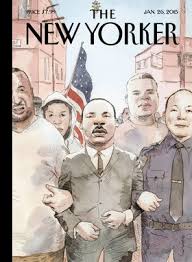
GARY BURDEN-excerpt from Nobody Knows (an autobiography)

Gary Burden created the cover images for this issue.  I had no idea who he was, but this autobiography tells me just how interesting a fellow he was.  He has been responsible for some of the most iconic album covers of the last 60 years!

These excerpt shows his origin story–he was 8 on December 7, 1941 and he has had vivid memories of WWII.  When he was 16 he joined the Marines.  But he was restless, got involved in bad things, was dishonorably discharged and got mixed up with even worse people (he says he can’t believe the things he did back then).  In 1964 he met “Mama” Cass Elliot. They spent a lot of time together and this opened him up to meeting all kinds of people: David Crosby, Stephen Stills, Graham Nash.  Eventually he met and hung out with Jim Morrison and designed Morrison Hotel (a fascinating story that).  In one of the nicer things I’ve heard someone say he says that Jim was a real poet, someone who was unafraid of delving deeply into life irrespective of the personal cost.  Then he met Neil Young. He says that Buffalo Springfield has been his favorite band and then one day Neil came to Mama Cass’ house in his 1948 Buick Hearse.  He was also hanging around when CSN decided to become CSN&Y and then he and Neil became friends. and Neil sold him his house in Topanga.  Eventually he made the cover art for After the Gold Rush (and he gives a little story about the old lady there on the cover).  I’m kind of curious to read this whole book now, especially if it includes album covers.

EMILY RABOTEAU-“The Babysitter” after “Some Women” by Alice Munro
This is the story of a babysitter for Mrs Fagan.  She is a young girl and her employer is very rich and locally famous.  And quite eccentric (she went to East Africa and allegedly witness the Ark of the Covenant and then wrote a controversial book about it).  But in their town she was known as the white lady with black kids (Maya 3, Eddie 10 months old).  The story reflects back on the babysitter as child (she is now the same age as Mrs Fagan was when the babysitting began.  The babysitter’s mother is kind of jerk and is very sarcastic about this babysitting arrangement.  She is also a very strict Jehovah’s Witness, so when the narrator gets her first period rather than tell her mom, she just takes products from Mrs Fagan.  As the story opens Mrs Fagan’s son has just arrived and that changes the dynamic in the house.  How will Mrs Fagan take it when the narrator accidentally sets fire to the kitchen? I really enjoyed the way the end of the story plays on the notions of memories and the impact people have on others.

MEGAN MAYHEW BERGMAN-“The Lottery, Redux” after “The Lottery” by Shirley Jackson
“The Lottery” seems like a pretty easy story to cover–I think everyone knows everything about it and it has been covered in things like The Hunger Games in their own ways.  I don’t know if this story references the original (with the redux),  for this story the people of the island of Timothy were exiled from America fifty years earlier for crimes against the environment.  They were gathering on July 27th, the day of the lottery.  And indeed the lottery is a death sentence, although it’s not entirely clear why.  Interestingly, the story is more about the girl chosen and what her life up to that point has been like.

ANTHONY MARRA-“The Tell-Tale Heart” after “The Tell Tale Heart” by Edgar Allan Poe
This story doesn’t diverge all that much from the original except for the wonderful modern twist on the beating heart.  It’s hard to say more without giving things away but I loved the modernization.

JESS WALTER-“Falling Faintly” after “The Dead” by James Joyce
I didn’t know all that many stories before hand, but I knew this one very well and this is wonderful homage.  It is not in any way rewriting the story–it’s a very different story, but it alludes to the Joyce story and directly mentions it and it is quite clear where the connection between them is.
Michael is a writer.  He is married with kids but has moved temporarily out to New York to write for this new police procedural.  The show is doing well and the female star is quite beautiful.  They bond over cigarettes–she is foreign and smokes like a European, he recently started again.  As stories like this tend to go, Micheal gets the wrong idea about this young, hot actress.  And given that she is not American she misunderstands the subtleties of his behavior (which isn’t very subtle admittedly).  But he wants her to know that his story is a tribute to Joyce’s “The Dead.”  When he talks about the dead she thinks he means real dead people and is pretty freaked out.  This leads to a restraining order and a police intervention–not how he thought his life in New York would go.  What doe sit have to do with “The Dead”?  Well they are standing smoking in the snow as it gently floats to the ground falling through the universe, faintly falling.

LAUREN GROFF-“Once” after “Wants” by Grace Paley
I loved the way this story started.  I saw my enemy at the beach.  With that as a groundwork we slowly learn just how this woman has an enemy (it’s an old boyfriend’s mother) and how they have grudgingly begun to respect each other decades after the two broke up. I really enjoyed this short piece.

ROXANE GAY-“Men on Bikes” after “Rape Fantasies” by Margaret Atwood
I can’t imagine what the original of this story is.  The actual story of this is pretty peculiar itself.  Basically, the men in town have all started riding bicycles everywhere.  It started when one of them was arrested for drunk driving.  He didn’t lose his license but his wife took it away from him.  He dug out a bike and began riding it.  She thought he looked ridiculous, but when another man had his license taken away, they began riding together.  It was quite a sight, although I’m not sure what the point of it was.

NAMWALI SERPELL-“Company” after “Company” by Samuel Beckett
I like Beckett, and I know that he can be confusing.  I don’t know what “Company” is about so I have no idea how it relates to it, but man I did not get this at all.

It was confusing and really long.  It is broken into many small sections which might be connected.  The first is about the brightening which happened although many people missed it. Then we learn about the ship which is electro epidermal, which is cool but not really explained  and then the story turns into a quest for melanin and just when you think it’s a sci-fi story, it becomes a story about race.  There is a pale man tied to a tree hitting a sack (pound pound).  There’s a lot of vomit.  If the white man inseminates even one person, finding pure stem cells is impossible.  Dark skin marked you as  lucky when the darkening came.  But then she says the mission is over.  There’s more vomiting.  A fellow is supposed to be invisible in the village but Pound sees him.  There’s more vomit, a section titled rape, where Pound rapes Lila every once in a while and then who the hell knows what happens at he end.

KIESE LAYMON-“And So On” after “Hills Like White Elephants” by Ernest Hemingway
Weeks ago 64 black folks changed the world.  You are the 11th.  Aside from the direct address to the reader the story is pretty straightforward and interesting.  Chanda Stewart was 8th, the narrators research assistant was 9th and Doug E., Chandra’s boyfriend was 1st.  They are at a fancy restaurant, Chandra, the narrator and you.  She swears that Doug is a porn star, but the narrator argues that having 1089 twitter followers and awkward consensual sex with a few white women filmed on an iPhone 2 in his fake Timberlands, blue knee brace and yellow wrist bands makes you a porn participant, not a star.  The story comes down to which side the narrator is going to choose.   sides or run for our lives.  Because while they were talking, Doug E. and about sixty young black kids were marching down the street.  To the school.  They each had an ax and a shovel.

MEG WOLITZER-“If You’re Happy and You Know It” after “A Perfect Day for Bananafish” By J.D. Salinger
I haven’t read this Salinger story in a long time, so I don’t really know how it connects to this, but I really enjoyed it.  I enjoyed the way that it was written which was a little confusing but in an intriguing way.  Set in a hotel on Miami there is the young woman in 609 who arrived with her new husband.  She’d sent him off to the beach.  We see her telling her parents that he is taking it easy, but they want to know if he is taking the Klonopin.  Later that night in the lobby, a four year old girl, Chloe, is in the lobby of that hotel watching a man play piano.  The man is a guest also and he is playing and really getting into it.  Another boy asks if he can play This Old Man and the player jokes about the boy calling him old.  But Chloe asks if he can play “If You’re Happy and You Know It.”  He says he might be happy but he may not know it. She is puzzled by that.  He says she is breaking his heart.  We soon realize that the pianist is the Klonopin man, and while things don’t get dark exactly, they certainly get strange.  And Chole’s parents have foisted her off on a poor babysitter the whole time.  This was one of my favorites in the book.

T.C. BOYLE-“The Argentine Ant” after “The Argentine Ant” by Italo Calvino
I can’t imagine what the original story is like, but this one from Boyle was really icky and really fantastic.  Its’ a fairly simple premise–a family moves to a rental property in Argentina, only to find that it is swarming with ants.  The ants are everywhere–even crawling all over their baby.  They run to the next door neighbor’s house only to see that they know about the ants and might have a secret weapon.  But mostly they just seem to be putting their furniture in jugs of water–presumably as a deterrent.  There is also an Ant Man who might be fighting the ants or who might actually be bringing more.  What is great about the way Boyle writes this is that the guy renting the house is working on an academic theorem that his wife thinks is rather frivolous.  And that tension underpins everything.

ALICE SOLA KIM-“One Hour, Every Seven Years” after “All Summer in a Day” by Ray Bradbury
Again I don’t know the original, but this story was great, and also weird. The weird part is that the story seems to start over multiple times. And that’s because there is a kind of time travel component to it.  The title refers to how often the sun comes out on Venus.  There is a girl, the main character, named Nargit. She was born on Earth and so she saw the sun.  The other kids are pretty angry at her for it (as if it’s her fault).  They are abusive to her, and the time travelling is the girl’s attempt to protect her younger self.  Many things go wrong but they bring about different results.

CHRIS ABANI-“Sleepy” after “Sleepy” by Anton Chekhov
This story was pretty horrific.  Kemi, a sixteen year old black girl who is now an orphan is working for a white family.  The family has two little children, one of whom is a baby.   The family is horrible to Kemi.  Pretty unrelentingly horrible.  Kemi is tired and never gets a break and the baby cries all the time.  She can’t soothe the baby and the family blames her for her failures.  Her exhaustion builds and builds until you pretty much know the ending several pages before it happens.

TOM DRURY-“The Yellow Wallpaper” after “The Yellow Wallpaper” by Charlotte Perkins Gilman
I know the original story although not super well.  But this version feels almost exactly the same. I honestly can’t tell what the difference is (without having re-read the original again to compare).   Jane and John are renting a place on an island for the summer.  John thinks Jane is not strong and keeps her hidden away in a room with yellow wallpaper.  He more or less runs everything in her life until she starts seeing people through the wallpaper.  You know things can’t go well from there.

POETRY:

REBECCA LINDENBERG-“Having a Coke with You” after “Having a Coke with You” by Frank O’Hara

MATTHEW ZAPRUDER-“Poem for Keats” after “Ode to a Nightingale” by John Keats

STEPHEN BURT-“A Nickel on Top of a Penny” after “Piedra Negra Sobre Una Piedra Blanca” by César Vallejo

BRIAN TURNER-“The Metaphor Program” after “The Red Wheelbarrow” by William Carlos Williams

STEPHEN BURT-“Roofers” after “The Armadillo” by Elizabeth Bishop

MATTHEW ZAPRUDER-“Poem on the Occasion of a Weekly Staff Meeting” [the first two lines are taken from “A Poem on the Occasion of the Consecration of Sandford and Shippon Churches” by Rev. F. Wilson Kittermaster, 1855]

STEPHEN BURT-“Suspense” after “To Brooklyn Bridge” by Hart Crane

KEVIN MOFFETT-“Second Wonder”-a monologue that will air on The Organist.
I found this puzzling at best.

PATTY YUMI COTTRELL-excerpt from Sorry to Disrupt the Peace
I read this book not too long ago.
This except was about two young children who invented a game called “Confession” in which the boy confesses his real or imagined sins to his sister.

~~~~~

The comparison quotes are called Great Speeches from History vs. the Tweets of Donald J. Trump:  I can’t bring myself to write any of the jerks tweets.

Mahatma Gandhi from the “Quit India” speech, 1942 vs. a Feb 4 2017 tweet

Abraham Lincoln’s “The Gettysburg Address” 1863 vs. a Feb 18 217 tweet (about fake news)

Martin Luther King Jr from “Letter from Birmingham Jail” vs. Feb 21 2017 (crowds planted by liberal activists)

Frederick Douglass from “The Hypocrisy of American Slavery” 1852 vs. Feb 6 2017 (negative polls are fake news).

Franklin D. Roosevelt, inauguration speech 1933 vs. Jan 22, 2017 (including all my enemies)


The bad thing about this issue is that the last four or five stories were all real downers, making it a pretty tough slog.  But I loved the idea, and I liked that they found the time and space to point out how stupid trump sounds and looks and is.

For ease of searching, I include: Cesar Vallejo

Read Full Post »

« Newer Posts - Older Posts »