Feeds:
Posts
Comments

Archive for the ‘Racism’ Category

mikesplace SOUNDTRACK: MONIKA-Tiny Desk Concert #529 (May 6, 2016).

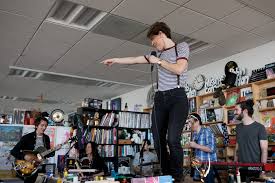
monikaMonika is a superstar in her native Greece (her full name is Monika Christodoulou).  She is a charming woman with a big voice and a bigger stage presence.  She incorporates theatrical notions in her performance too (the fact that she has a shirt that looks like a mime’s kind of encourages that idea): “throwing” stars, flying, sleeping.

It is hard to believe that the blurb says used to sing sad songs, as she is so fun and bouncy.  But there’s this biographical note:

her recent transition from singer of sad songs to purveyor of upbeat jubilance came after she nearly lost her life in a boat fire; she had to swim eight hours in the dark to safety without food or drinkable water. These days, it’s all about a great band grooving, her joyful voice, and that infectious smile.

Wow.

She sings four songs.  The first, “Yes I Do,” opens with what I assume is a lyric about the then current moment: “24th of March has arrived and I think it’s Thursday?  Washington is beautiful out there but we don’t really care.”  It has a kind of circus opera feel.  And Monika’s voice is a marvel–powerful and beautiful with a good range.

monika2For the second song, “Shake Your Hands” she asks if everyone is ready to dance a little.  She climbs up on the desk and as she sings the slow opening, when she gets to the “I love you” moment, she sings without the mike and is as loud as when she uses it.  Once the song kicks in, it has a big disco beat: wah wah’d guitars and a funky bass line.  She encourages everyone to sing along: “Even if you don’t understand, just repeat, okay.”  The song ends with a very fun extended ending of staccato chords.

“Hand in Hand” has a kind of gospel quality (a big group sing along of the opening lines), although it is a brief, transitional song before “Secret in the Dark” begins.  She straps on a guitar for this final song which has a discoey riff and a fuzzy keyboard sound.  It’s really fun.

I’d never heard of Monika, but she seems like the kind of pop/dance star that would be really fun to see live.

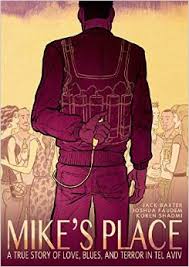
[READ: April 1, 2016] Mike’s Place

Somehow I missed that word in the subtitle: True.  I didn’t realize that this was a true story until the very end.  The story was really good before I knew that and it makes it even more amazing after I found the truth.

In Tel Aviv, Israel, John Baxter (Jack), a filmmaker has come to cover a story.  He goes into a local bar called Mike’s Place for a meal.  He is greeted warmly and is told that there is live music every night of the week.  They proudly state that Mike’s is a place where people of all stripes comes to congregate and do anything but talk about politics.

It turns out that there are already people making a documentary about the subject who John came to cover (Marwan Barghouti) so Jack  decides to give up. (more…)

Read Full Post »

41116 SOUNDTRACK: SERATONES-Tiny Desk Concert #522 (April 15, 2016).

seraThis Seratones show totally rocked!  And it was a nice change of pace from the slower bands who have been on the Tiny Desk lately.

The lead singer and guitarist is A.J. Haynes.  She plays guitar with a pick on her thumb and has a very clean guitar sound.  Her voice is really lovely—powerful and strong and covering multiple styles from Grace Slick to PJ Harvey.  The blurb says

Haynes grew up singing in the Brownsville Baptist Church, learning to sing out to and hit that back wall without a microphone.

And that’s apparent from the ease she has at singing.  The rest of her band is really great too.  Continuing the blurb:

bassist Adam Davis heard a lot of American rock’s greatest guitarist, Jimi Hendrix, as well as the amazing voice of Janis Joplin. The rest of the band is rounded out by the drumming of Jesse Gabriel, who is spare but there with a sharp backbeat, while guitarist Connor Davis rocks with lyrical grit.

Although I had to laugh because Haynes seems to be having so much fun while her bandmates are rather stonefaced.

They play three songs and they are all great.  “Don’t Need It” rocks out like nobody’s business.  Haynes is a charismatic (and adorable) lead singer with a big afro and a great smile.  “Get Gone” has a much more bluesy sound.  I like the way she delivers the line: “Suns coming out like you knew it would.”  After each verse she gives a big high-pitched “ooh oooh.” And then comes back with a growly low voice.  I love that she’s alternately belting out notes and then singing falsetto.

“Chandelier” has a great funky groove.  When the song sorta stops and just the drums kick in she gives a delightful giggle.

I was really delighted with this band whom I’d never heard of before and I definitely want to check out their recently released debut album.

[READ: April 11, 2016] “The Burglar”

I enjoyed the way that this story was structured.  One paragraph at a time with a dot in between them.  This allowed for a strange juxtaposition of time, with some things happening simultaneously and others possibly out of sequence.

There are several characters in the story.  There is a the burglar (known primarily as “he”); there is the wife who is waiting for exterminators to come to the house–she’s out and hopes to get home before they do).  There is the husband, who is off at work.  His job is fascinating, he’s writing his first script for a TV pilot.  The producers of the show want it to be edgy and different.  The character he is working on (the only person named in the story) is Emmet Byron Diggs, who is falsely accused of killing his wife.  Emmet is black, but the producers don’t want him to think about that as he develops the character.

The story rotates through these characters.  We see the scriptwriter and the producers talking about the show: a time travel show in which Emmet is going to start killing people.

The burglar encounters a dog in the house and tries to figure out how to deal with it.

The wife is racing to get home.

And Emmett is also walking down a street checking out the twenty-first century world he’s in.

Okay so the burglar is in the woman’s house.  But she hears him upstairs and assumes he is the exterminator.

And then the burglar hears her and tries to figure out what he’s going to do.  He calls out, “Just the cleaning crew.”  he berates himself for saying such a weird thing and she thinks its weird that the exterminator would call himself the cleaning crew.

And that’s when the phone rings and it’s the exterminators calling to say they’ll be late.

How does this real-life scenario play out at home while her husband is trying to create a similarly fictionalized setting on the page?

The stories even began to overlap somewhat with action in both stories taking place in a kitchen.  By the end of the story it’s not entirely clear what’s even happening, at least to me.  And yet despite or because of this confusion, I really loved the story.  It was intense and strangely funny at the same time.

Read Full Post »

silence THEE SILVER MT. ZION MEMORIAL ORCHESTRA & TRA-LA-LA BAND-13 Blues for Thirteen Moons [CST051] (2008).

330px-13_Blues_for_Thirteen_MoonsThis album opens with 12 tracks of a kind of feedbacking noise.  The total time for this is about a minute before track 13 begins.  And this album feels very different from the more acoustic Horses.  Whereas Horses felt acoustic and organic, this album is noisy and raucous and very electric.  After the 12 brief tracks there are four lengthy ones that comprise the album.

“1,000,000 Died to Make This Sound” starts with scratched notes and pizzicato strings.  The choir quietly begins singing the title “one million died to make this sound.”  Their voices grow louder and then at about 3 minutes in there’s a great bowed riff that introduces the more rocking section–a guitar “solo” and drums as that bass riff continues.  About mid way through the song it takes on a real rocking feel–the guitars rock out and the steady beat keeps up.  The song feels sloppy and intense–like they couldn’t wait to get this out.  I would describe the song as fun (except that it’s pretty bleak).  Efrim’s voice sounds a bit like Johnny Rotten or some other British punk) on this song and the punk style suits it well.  I really love the way the violin-swells make the riffs even bigger until about 9 minutes when the song shifts dramatically again and it feels like a Crazy Horse jam–big, sloppy, noisy guitars.  The song reaches a sort of natural stopping point as the music all fades away and the voices resume–I love the choir of voices at the end of the song (although perhaps Efrim’s voice could be a tad quieter?  Efrim’s voice seems to be a polarizing thing for fans of this band.  I’m even polarized about it on different songs–sometimes I think it’s too much, but other times I think it works well.

“13 Blues for Thirteen Moons” is 16 minutes long.  It begins with thumping drums and bass before Efrim’s voice comes chanting in.  The song is noisy and chaotic–lots of drums and cymbals and then the backing vocals start a call and response with the lead vocals.  The song continues in the same vein–with a refrain of “I Just Want Some Action” but then around 5 minutes a big distorted guitar plays a kind of concluding riff before a quieter guitar begins a new section with some quiet picking.  And its in this section that the album title is sung.  This quiet guitar section goes on for quite a while with Efrim shouting various parts–and then second voice joins him.  It’s unusual that the band will play the same riff through so much of a song, but it’s a good riff.  The whole band picks up the riff as it grows louder and more rocking.  The final two minutes are filled with feedback and quiet guitars with Efrim shouting syllable after syllable until it feedbacks to an end.  It’s a pretty intense song.

“Black Waters Blowed/Engine Broke Blues” opens in a much quieter way with slow revered guitars.  The vocals are also slow and accompanied by a lone cello.  But after a minute and a half chaos erupts in the song–feedback squalls and wild guitars accompanied by chaotic drumming make the song sound like it is tripping over itself , but it soon resolves to a quiet part like the intro–this time with two singers.  The song builds again, with the chaotic drums fighting for dominance over the string section.  But they both cede again to the quieter vocals once more.  The band then acts in concert building the song and allowing the vocals to continue.  And after a musical interlude, the vocals begin again over a quiet organ.  And this next section builds as strings accompany the louder vocals and the drum gets a pounding martial beat.  The final section, which appears to be the “Engine Broke Blues” is a repeated refrain of “Building Trainwrecks in the Setting Sun.”

The final song “BlindBlindBlind” also opens quietly, with a simple guitar motif.  As the vocals continue, a ringing guitar and a feedbacking guitar join the song (each in a different ear).  And then a violin adds to the melody.  About 4 minutes in, the melody shifts to an organ heavy section with the lead vocal followed by backing vocals.  A pizzicato section begins next.  What’s interesting is that the vocal melody hasn’t really changed this whole time (in this song Efrim again sounds a bit like a British punk rocker).  At around 7 minutes, the song turns towards the end, with strings and drums.  This end bit is my favorite part on the record, not only for the melody, but for the excellent backing chanting.  The backing vocal melody is very cool in itself–I love when they add the high notes–repeating the refrain “Some hearts are true” over and over.  A guitar solo interrupts the proceedings for a bit and then they resume singing all the way to the end.  It’s a very cathartic conclusion.

For this album, the lineup stayed the same although Eric Craven replaced Scott Levine Gilmore on drums.

Back in 2009, I wrote a post about this album.  It’s pretty brief and mostly talks about the singing.

[READ: March 1, 2016] The Silence of Our Friends

This was the final First Second book that I had in a huge stack that I took out from the library.  I had been putting this book off because I was nervous about reading it.  Nothing pretty is going to happen in a Civil Rights book and I had to prepare myself for it.  Obviously, the era is staggeringly important–even more so today with the kind of political rhetoric being shouted around.  That’s not why i didn’t want to read it.  I was afraid about how ugly this book might get.

But in fact, this book doesn’t go in that direction at all.  It is a factual story and while it looks at racism, it also shines a light of hope on race relations. It’s another excellent graphic novel from First Second [#10yearsof01].

What I did not know is that this story is based on actual events–the author’s father was a journalist in Texas during a serious Civil Rights confrontation.  And his father was able to help offset a travesty of justice.  He risked his career and even his own safety to do the right thing.

Set in Houston in 1968, we see some kids playing army in the yard.  This is also during Vietnam, so that’s probably not a very uncommon sight.  When the kids go inside, their mom is watching the Saigon execution on TV.  She is horrified and begins crying. The talk that night is of the atrocities of war. (more…)

Read Full Post »

[ATTENDED: April 3, 2016] David Cross

cross I have enjoyed David Cross since the old days of Mr. Show, and the as Tobias on Arrested Development and even in Alvin and the, well, actually I’m just happy for him that he got a lot of money for it.

When he released his previous stand up album, Bigger and Blackerer, Sarah and I listened to it in the car on a long trip and we had tears in our eyes from laughing so hard.

So when I heard he was touring I thought it would be fun to see him live.  And, yes, it was.

But we ran into a few bumps along the way.  We had to leave very late because our babysitter had car trouble.  She arrived just late enough that we weren’t sure if it was worth still driving the hour to Philly.  We decided if traffic was terrible we would just stop somewhere and have dinner instead.  I even called the Theatre to see if there was an opening act (nope) and if the show really started at 7:30 and not 8 (yup, he would start at exactly 7:30).  Traffic was light and the GPS said we’d get to the garage at 7:35.  I missed the turn for the alley that our garage was on, and then we got slightly lost on the walk from garage to theater and as we got there at 7:40… there were still a whole bunch of people milling about in the lobby.  And then they flashed the lights telling us to get to our seats.  We missed nothing!

And we even got to tsk at people who arrived later than us.  Cross even joked that he would wait to start his joke because “it’s not fucking distracting or anything” when people are being seated.  I was frankly shocked that people seemed to still be arriving around 8PM! (more…)

Read Full Post »

boothSOUNDTRACK: SOFA-New Era Building 7″ [CST001] (1997).

sofaSofa was a band that is notabkle for being the first band released on Constellation Records.  They had some releases before that but then guitarist Ian Ilavsky started Constealltion where they released their final 7″ and CD before disbanding.

This 7″ has two songs, “Canyon (Fade)” and “With It” which do not appear on their CD Grey.  if you know the band, these songs fit in perfectly with thie sound–low throbbing bass, noisy buzzy guitars and spoken/sung deep vocals.

“Canyon (Fade)” opens with tribal drum beats and a low rumbling bass (which reminds me a bit of early Cure and other goth bands), but with a bit of a heaver edge.  The singer has a deep speaking style of singing. I’m not really sure what he’s singing, but it adds a great tone to the song.  About midway through the song the guitar (which has been mostly scratchy and noisy) breaks out with some harsh feedback squalls that kind of overpower the song. But then the bass fights back.

Of the two songs, I prefer “With It.” The bass rumble is super cool, low and wicked sounding. And the drums a are bit more spare. The guitar is playing some occasional notes while the singer mumbles his way through whatever he’s talking about. It’s a totally atmospheric piece—you can just picture where this noir thing is happening.

Just before the chorus comes in, his voice gets louder, the guitars start squalling and feedbacking and a rather high pitched “withit” punctuates the noise, after which the deep voice seems to moan.  It’s pretty cool.

I really enjoyed how the bass doesn’t really change for the whole song except in a couple of places where it places a similar yet distinct bass line. It’s neat and changes the tone of the song briefly.  At 2 and a half minutes the song stops abruptly and then the guitar notes resume to get the song started again.  Groovy noise.

Shame the band disbanded.

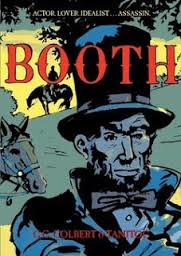
[READ: February 6, 2015] Booth

Here’s another First Second book for February #10yearsof01.  And what better day to post a book about John Wilkes Booth?

I really didn’t know much about John Wilkes Booth except for the obvious–he shot Abraham Lincoln and shouted sic semper tyrannus.

Well, this book take a relatively sympathetic look at the life of the world’s most famous assassin.  This is not to say that the book endorses what Booth did or anything like that–no hate letters please.  It just looks at Booth as a human who had opinions and acted on them.

Thankfully, Colbert does not show Booth’s life in a vacuum so we get proper context for what he did and we also hear the opinions of the people who were also opposed to him.   But it is fascinating to see the things he believed and what forced him to act on his beliefs. (more…)

Read Full Post »

deogrataisSOUNDTRACK: JOSH RITTER-Tiny Desk Concert #119 (April 11, 2011).

ritterNot too many performers mention the actual day that they are performing their Tiny Desk Concert.  But Ritter mentions Valentine’s Day twice during his set so I thought I’d post it on Valentine’s Day even if the actual date of the posting is much later.

I don’t really know Ritter, I’ve heard of him, but I’m not too familiar with him.  Nevertheless, I was quickly won over by him.  He is charming and polite and is certainly having a good time (he even laughs at some lines in his songs).

His first song “The Temptation Of Adam”sounds vaguely familiar.  The melody is very catchy and his voice is strong and excellent.  Lyrically the song is quite interesting.  I especially loved this section: “We passed the time with crosswords that she thought to bring inside/ ‘What five letters spell apocalypse?’ she asked me/ I won her over saying, W.W.I.I.I.’/ She smiled and we both knew that she misjudged me.”

“Lark” is a faster song, but still very folksy and clever.  I love that although the melody is fairly simple, the way he plays it (with very fast fingerpicking) makes the song sound more complicated.  “Rattling Locks” is a dark minor chord song, louder and heavier than the other two.

The site says there is an audio only track called “Pale Blue Eyes,” but I can’t find it.  For the last track, his 2003 song “Kathleen,” he introduces the song by saying, “I think Valentine’s Day is the most awkward self-imposed holiday — even worse than New Year’s — so this is an awkward song.”  It’s a louder song, with Ritter’s voice reaching great intensity.  It’s a great way to end the set.

[READ: February 14, 2016] Deogratias

Here’s another story that I would never have read if it were not for First Second’s #10yearsof01 challenge.  The thought of reading a story about the genocide in Rwanda just seems to depressing to undertake.  And yet in the spirit of reading things outside of your comfort area, I decided to read this this weekend.

And I am incredibly glad that I did.

I feared that this story would be one of rampant genocide–struggle and death and mutilation and everything else that I could imagine.  But rather, what Stassen has done is created a story about how the toll of genocide can impact one person.  Yes, it affects him directly and the story is incredibly sad, but it was a very different story than I expected, and it was so personal that it made it more tragic without having the oppressive unreality of millions of dead people in the plot.

The introduction alone is worth reading, as translator Alexis Siegel gives a brief summary of the Rwandan tragedy.  I’ve always found the conflict to be really hard to grasp.  Hutus and Tutsi, a privileged minority, a brutal majority.  The back and forth was so hard to grasp, and the names of the tribes were similar as well.  It is hard for a lazy person to keep straight.

But I found Siegel’s explanation to be succinct and very effective. (more…)

Read Full Post »

bpSOUNDTRACK: GRIMES-“Kill v. Maim” (2015).

grimesI don’t know Grimes very well at all.  When I first heard this song I didn’t really know what to think, but after repeated listens, I think it’s great.

It opens with a synth riff (and air horns) and one of Grimes’s many voices (this one is kind of childlike).  But by the end of the second line, she screams “they don’t know me” and that seems to set up the various personas in this song.

It’s the pre-chorus that I find so catchy–sung like the cheerleader chant “B-E-H-A-V-E aggressive.  B-E-H-A-V-E nevermore.”  And then the super fast chorus (with her voice lifted to an incredibly high pitch).

There’s a slower section with what I assume is her natural voice (which is quite lovely).  But it’s soon back to the fun chorus.  I need to hear more from her, but if this is her only good song, that’s okay.  It’s angry and you can dance to it.  Welcome to 2016!

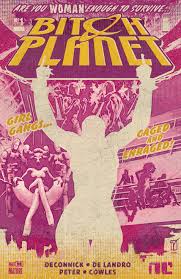
[READ: December 20, 2015] Bitch Planet

This series is a great manifesto for the new year–don’t take shit from anybody.

Kelly Sue DeConnick is a force to be reckoned with.  In addition to presenting Captain Marvel as a woman (in the amazing series of that name) and making some other cool looking series that I intend to read, she has created this feminist masterpiece.  Bitch Planet addresses violence and injustice against women and the whole “prison culture” that is always titillating for men.  It pushes Orange is the New Black to even further extreme that a comic book can.

Designed in a retro style by Valentine De Landro, the book comes complete with ads for “crap” in the back of each issue.   Which you may actually be able to buy. (more…)

Read Full Post »

academiaSOUNDTRACK: MARTIN TIELLI-“We didn’t even suspect that he was the poppy salesman.” (2001).

popptI wrote about this album once before, and while I made notes about it after listening to it again, I found out that they were pretty much exactly what I thought of the record four years ago.  So I’m going to simply repost the review here, but I’m going to add some new notes seamlessly intermingled.

Martin Tielli’s first solo disc is a proper solo release: it’s almost all him on acoustic guitar and his gorgeous alto voice.  I hadn’t listened to this disc in a while and I was delighted by how much of the disc I knew so well.

The opening track, “I’ll Never Tear Your Apart” is deceptively simple: beautiful harmonic’d guitars and his gentle voice.  There’s a great video to go with it here.  That is followed by the wonderful “My Sweet Relief” which sounds like a great Neil Young folk song: great verses an a strong chorus.  Lyrically, though, it is all Tielli.  “Double X” highlights Tielli’s beautiful acoustic guitar work.  It’s another great story song, this one about a destitute person hanging under a superstore with a K and an M.

“Voices in the Wilderness” is a simply beautiful song, a lovely guitar melody and Tielli’s high voice singing along.. I also love that the lyric  (mis)quotes Rush very nicely: “‘If you choose not to be free you still have made a choice,’ said a high and squeaky voice.”

“Farmer in the City” is the only track that Tielli didn’t write.  It’s a nearly 8-minute song by Scott Walker.  I had never listened to the original, but having now done so, I find the Walker version to be far superior.  Walker’s voice is so eccentric and wonderful.  So even though I love Martin’s voice, he just can’t compare to the original.   Also find Martin’s version to be just a little spare (the Walker version has lovely strings. Kevin Hearn plays celeste and Selina Martin plays wine glasses on the track.

It’s followed by the delightful “World in a Wall” which uses mice in the wall as a metaphor for a broken relationship (with wonderful detailed lines like: She’s like a mouse, I know she’s around It’s a gnawing sound. Leaves little brown poohs from a little pink bum.”

This is followed by “That’s How They Do It in Warsaw” which is the first really rocking song (it has bass and drums) and a voiceover in Polish by Kasia Zaton.

It’s coupled with a slightly less rocky but still loud track “How Can You Sleep?” (which makes another fun musical allusion, this time about Guided by Voices). It has a co-songwriting credit from Dave Bidini and has a kind of vocal allusion to Bob Dylan, although I doubt it is about him.

“She Said ‘We’re On Our Way Down’” is a song that I really want to enjoy more.  But It is so spare and Martin’s vocal line is so abstract, that I can never really get int it. But the guitar riff is really powerful and cool.  And yet, the song seems to eschew melody but then a gorgeous guitar or vocal line shines through and really sounds brilliant.  “From the Reel” is a beautiful, aching acoustic ballad.

The disc ends with the odd, seven minute “Wetbrain/Your War.”  The first part (wet brain) is kind of slow but it builds into a beautiful dark song about addiction.

This is a really beautiful album, although there are moments when I fell like Martin gets too delicate, it’s amazing to hear just what he can do when he’s on his own.

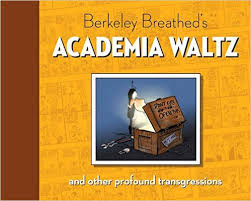
[READ: October 19, 2015] Academia Waltz

Way back a long time ago I was pretty excited to read all of the Bloom County reissue books.  Somehow I only got through Books 1 and 2, although I see now that five volumes were released in total.

Presumably at the end of that run, (which technically ended in 2011) comes this volume.  Academia Waltz is the strip that Breathed wrote back in college.  This book collects some (but apparently not all) of the strips.  It’s odd to not collect them all since there is also an art gallery with all kinds of original pieces (complete with edits and scribbled notes) that duplicate many of the earlier strips.

The first part collects pieces from Academia Waltz the 1979 collection.  The second part comes from Bowing Out, the 1980 Collection. (more…)

Read Full Post »

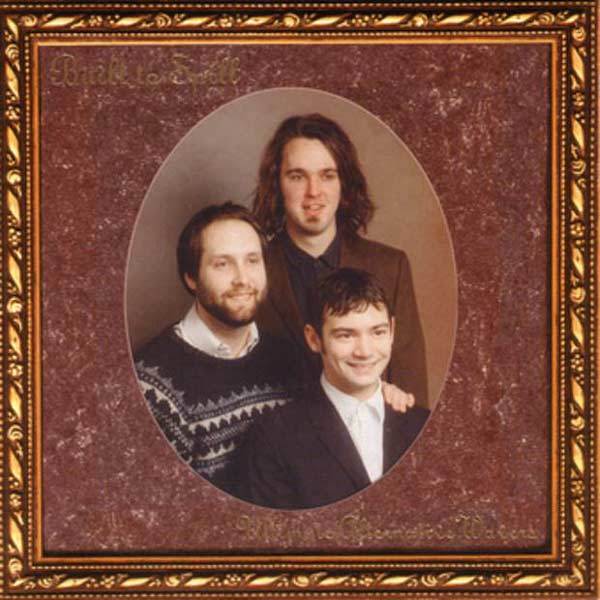
dfwSOUNDTRACK: BUILT TO SPILL-Ultimate Alternative Wavers (1993).

Bts I am going to see Built to Spill this Friday.  I was supposed to see them back in 2001, but then some bad things happened in New York City and their show was cancelled (or I opted not to go–I see on Setlist that they did play that night).  Since then, I have enjoyed each new album more than the previous one, so I am really excited to see them.

I thought it would be interesting to revisit their earlier records.  In reading about the band I learned that Doug Martsch was in Treepeople (which I didn’t know and who I don’t really know at all).  I also learned that his plan for BtS was to have just him with a different line up for each album.  That didn’t quite work out, but there has been a bit of change over the years.

Their debut album is surprisingly cohesive and right in line with their newer material.  It’s not to say that they haven’t changed or grown, but there’s a few songs on here that with a little better production could easily appear on a newer album.  Martsch’s voice sounds more or less the same, and the catchiness is already present (even if it sometimes buried under all kinds of things).  And of course, Marstch’s guitar skill is apparent throughout.  The album (released on the tiny C/Z label) also plays around a lot with experimental sounds and multitracking.  When listening closely, it gives the album a kind of lurching quality, with backing vocals and guitars at different levels of volume throughout the disc.

But “The First Song” sounds like a fully formed BtS song–the voice and guitar and catchy chorus are all there..  The only real difference is the presence of the organ in the background.  “Three Years Ago Today” feels a bit more slackery–it sounds very 90s (like the irony of the cover), which isn’t a bad thing.  The song switches between slow and fast and a completely new section later in the song.  “Revolution” opens with acoustic guitars and then an occasional really heavy electric guitar riff that seems to come from nowhere.  The end of the song is experimental with weird sounds and doubled voices and even a cough used as a kind of percussion.

“Shameful Dread” is an 8 minute song.   There’s a slow section, a fast section, a big noisy section and a coda that features the guys singing “la la la la la”.  Of course the most fun is that the song ends and then Nelson from The Simpsons says “ha ha” and a distorted kind of acoustic outro completes the last two minutes.

“Nowhere Nuthin’ Fuckup” is one of my favorite songs on the record.  There’s a sound in the background that is probably guitar but sounds like harbor seals barking.  I recently learned that the lyrics are an interpretation of the Velvet Underground’s “Oh! Sweet Nuthin.”  They aren’t exactly the same but are very close for some verses.  The rest of the music is not VU at all.  In fact the chorus gets really loud and angular.  I love the way the guitars build and then stop dramatically.

“Get a Life” opens with a wild riff that reminds me of Modest Mouse (who cite BtS as an influence), but the song quickly settles down (with more multitracked voices).  I love how at around 4 minutes a big swath of noise takes over and it is resolved with a really catchy noisy end section.  “Built to Spill” starts out slow and quiet, and grows louder with a catchy chorus.  In the background there’s all kinds of noisy guitars and superfuzzed bass.

“Lie for a Lie” is pretty much a simple song with s constant riff running throughout.  The verses are catchy, but the middle section is just crazy–with snippets of guitars, out of tune piano, a cowbell and random guitar squawking and even shouts and screams throughout the “solo” section.  “Hazy” is a slow song with many a lot of soloing.  The disc ends with the nine minute “Built Too Long, Pts 1,2 and 3”  Part 1 is a slow rumbling take on a riff (with slide guitar and piano).  It last about 90 seconds before Part 2 comes in.  It has a big fuzzy bass (with a similar if not identical riff) and wailing guitar solos.  Over the course of its five or so minutes it get twisted and morphed in various bizarre ways.  With about 30 seconds left, Chuck D shouts “Bring that beat back” and the song returns, sort of, to the opening acoustic section.

While the album definitely has a lot of “immature” moments (and why shouldn’t the band have fun?) there’s a lot of really great stuff here.

btstix

[READ: September 26, 2015] Critical Insights: David Foster Wallace

It’s unlikely that a non-academic would read a book of critical insights about an author.  Of course, if you really like an author you might be persuaded to read some dry academic prose about that author’s work.  But as it turns out, this book is not dry at all.  In fact, I found it really enjoyable (well, all but one or two articles).

One of the things that makes a book like this enjoyable (and perhaps questionable in terms of honest scholarship) is that everyone who writes essays for this collection is basically a fan of DFW’s work.  (Who wants to spend years thoroughly researching an author only to say means things about him or her anyway?).  So while there are certainly criticisms, it’s not going to be a book that bashes the author.  This is of course good for the fan of DFW and brings a pleasant tone to the book overall.

For the most part the authors of this collection were good writers who avoided a lot of jargon and made compelling arguments about either the book in question or about how it connected to something else.  I didn’t realize until after I looked at the biographies of the authors that nearly everyone writing in this book was from England or Ireland.  I don’t think that makes any difference to anything but it was unexpected to have such an Anglocentric collection about such an American writer (although one of the essays in this book is about how DFW writes globally).

Philip Coleman is the editor and he write three more or less introductory pieces.  Then there are two primary sections: Critical Insights and Critical Essays. (more…)

Read Full Post »

mislaidSOUNDTRACK: AROUND THE WORLD IN 80 DAYS-Euphoria (2014).

euphoriaI found out about Around the World in 80 Days when they started following me on Instagram.  I’m not sure which photo it was that interested them, or if they just follow lots of people, but I was intrigued that they are a post-rock band from Yekaterinburg, Russia.  They formed in 2009 and have a few releases out (EPs, mostly).  You can hear all of them on their soundcloud page (and other places).  This was their first full length album.

Their bio says

Around the World in 80 Days is a three-piece band formed in 2009. It’s impossible to compare their music with anything. The guys just play whatever they want and don’t care about genres, styles and cliches.

I appreciate the sentiment, but it’s not impossible to compare them.  They have elements of Mogwai and Explosions in the Sky in their swirling post-rock instrumentals.  But they definitely add elements that those bands don’t.  There’s some heavy metal riffs in “Racing the Light” and some more poppy elements in “Inside Me.”

 I typically try to listen to an album a few more times before I post about it, but I was so interested in this band that i wanted to get the word out right away.  I’ll certainly be listening more intently to their output over the next few days.

[READ: May 24, 2015] “Mislaid”

I read an excerpt from this book in Harper’s a few months ago.  And then I found the full book at work.  Huzzah!

I had said that I didn’t know how long this novel could be because the excerpt seemed so complete.  And in a sense I was right.  Except that the book went so much further than the excerpt led me to imagine.

The excerpt was about Peggy Vaillancourt.  She was born in 1948 in Virginia.  A transformative event leads her to believe she must be a lesbian (something unspoken of at the time).

She winds up going to Stillwater College, a female-only school in the middle of nowhere Virginia.  She loves poetry and wants to be a writer.  She meets the poet-in-residence Lee Fleming.  Fleming was a local boy with wealthy parents.  His father believed himself to be as “queer as a three dollar bill.”  It was his father who put him in a cottage on the family’s property across the lake from Stillwater College.  Everyone in town also assumed he was gay, and there was much talk and consternation about it, although everyone assumed he was fine while he was by himself in that cottage.

The college asked Fleming to be a teacher (he canoed to work every day).  Instead of a salary he asked them to create a literary magazine called Stillwater Review, which became a success.  Many other famous New York poets came to Stillwater to be charmed by the idyllic Stillwater (and all the young girls). (more…)

Read Full Post »

« Newer Posts - Older Posts »