Feeds:
Posts
Comments

Archive for the ‘Parenting’ Category

6616 SOUNDTRACK: YANN TIERSEN-Tiny Desk Concert #219 (May 21, 2012).

yannYann Tiersen scored the soundtrack to Amélie.  But he also writes and sings lovely chamber-pop music.

The first song “The Gutter”  opens with Tiersen playing a swirling violin melody accompanied by an acoustic guitar, a ukulele and keys.  Tiersen doesn’t sing, but the lead singer’s voice is yearning and delightfully accented as well.  (No names are given for the rest of the band).  I liked the way the song built in intensity even while his voice retained that quiet style of singing.

For the second song, “Monuments” everyone switches around.  Tiersen plays a lead 12 string acoustic guitar, the ukulele player is on keys and all four sing harmony lead.  You can tell that Tiersen is not American because of the way the word “Monuments” is sung “all monYOUments…” which adds an exotic flavor to the song.  The delicate keyboard sounds float nicely over the acoustic guitars.

They stay with this lineup for “Tribulations.”  The singer from the first song and the acoustic guitarist sing lead.  And everyone else joins on harmony.  “The Trial” opens with the four singing a beautiful “ooh” in harmony.  Then the other three sing a complex backing vocal while Tiersen sings lead.

There’s some really lovely melodies in this concert.

[READ: January 12, 2017] “Where is Luckily”

The June 6 & 13, 2016 issue of the New Yorker was the Fiction Issue.  It also contained five one page reflections about “Childhood Reading.” 

Having a child is like rereading your own childhood.

Galchen has a young daughter and that daughter has a some favorite stories.  One is a Moomin (which I love), another is a Piggy & Gerald.  Galchen says that if you read children’s book enough times, “they start to seem like Shakespeare.”

But she says that her daughter doesn’t read in a linear fashion.  “What happens next” doesn’t seem to cross her mind.  She reads them more like eternal landscapes: “In that sense, nothing is happening, and she reads for that nothing.” (more…)

Read Full Post »

6616 SOUNDTRACK: CHUCK BROWN-Tiny Desk Concert #217 (May 16, 2012).

chuckI’m puzzled by a few things with this Tiny Desk Concert.  The first is a note that This story originally ran on Sept. 28, 2010.  The second is the note that Chuck Brown, the Godfather of Go-Go music, died Wednesday. In 2010, he brought his full band to the NPR Music office — and put on a party like no one else.

That isn’t confusing in itself, but I have to wonder why it took them two years to air this concert, which is quite a fun rave up.  Are there other shows they didn’t air?

Okay, so I had no idea who Chuck Brown was.  And the blurb anticipated that

The name Chuck Brown might not mean a whole lot to people outside the Washington, D.C., area. … In D.C., Brown is widely known, even revered, as the Godfather of Go-Go, a title he’s held since the late ’70s. Though he started out as a jazz guitarist, Brown invented go-go, a style that incorporates funk, jazz, R&B, hip-hop and dancehall, and has mostly stuck with it ever since.

So, Go-Go, huh?  I never heard of that either.

No one in D.C. can really explain why go-go hasn’t traveled beyond the city’s environs — we love it here, it’s all over our commercial R&B and hip-hop radio stations and, at least when I was in high school, a go-go in a school’s gym was the most packed party of the weekend. Chuck Brown is a local hero. A few days after he played our offices, Brown and his whole band played at the Redskins’ stadium for the halftime show.  So to have Brown play a corner of our office — not a 90,000-capacity football stadium — was like a dream come true for a lot of NPR staffers. Sweat started pouring immediately, between the 11 musicians (that’s congas and a stripped-down kit; saxophone, trumpet and trombone; two backup singers and a rapper) and all the go-go-heads in our building.

Brown played four songs for about 25 minutes.

Go-go is mostly about the groove, though, and Chuck Brown just settles in and leans back. He showed up looking like a million bucks in a vest, Dior shades and his signature hat, and then he did what he does best — get the crowd on his side and hand its members something to dance to.

Go-go is based on a syncopated beat and the use of congas in addition to drums.  So “Senorita” is like a combination of reggae salsa and 50s singing (I can’t help but think he sounds like Frank Zappa when Zappa does his rather funny voice).  The song is slow but smoldering and fun to sing along to.  There’s a Santana guitar vibe too.

“Chuck Baby” is the hip hop element of his music.  His rapper is not very inspiring though.  She seems a little stiff.  And the song is a little flat when he’s doing the call and response–he sounds cool and seductive and they sound more bored than “naughty.”

Before the third song everyone starts chanting “wind me up chuck!” which he lets everyone know www.windmeupchuck.com is his website. “Wind Me Up!” / “Bustin’ Loose” starts with lots of call and response.  “Bustin’ Loose,” is a funky song with very James Brown accents and everyone singing the refrain: “Gimmethebridgenow, gimmethebridgenow.”  The song has been a hit in D.C. since 1979.  The backing vocalist on this song feels a bit looser (apparent as she sings “I feel like bustin’ loose).

The crowd was yelling out requests, too: “Chuck Baby” and “Run Joe,” a go-go cover of the Louis Jordan song.  “Run Joe” / “It Don’t Mean A Thing.”  “Run Joe” has a Jamaican flair “Policeman is on the premises.  What is he doin’ here?”  His guitar playing is really inspired throughout the set, but especially at the end of this song.   He does a lot of playing the same melody as he sings.  The song segues into a version of “It Don’t Mean a Thing” in which he slips in “It don’t mean a thing if it ain’t got that go-go swing.”

This set was really a party.  And Brown was just full of energy.

[READ: January 12, 2017] “Surrendering”

The June 6 & 13, 2016 issue of the New Yorker was the Fiction Issue.  It also contained five one page reflections about “Childhood Reading.” 

This reflection beings with Vuong explaining that his family moved to the U.S. from Vietnam when he was two.  He was an ESL student from a family of illiterate rice farmers who saw reading as snobby.

When he entered kindergarten, he found himself immersed in a new language.  He quickly became fluent in speech but not in the written word.  In fourth grade his class was given an assignment to write a poem in honor of National Poetry Month.  Normally his poor writing skills would mean that he was excused from such assignments.  He would spend time copying sentences out of books in the classroom.  But this time he decided to be ambitious and write a poem. (more…)

Read Full Post »

2008_10_13SOUNDTRACK: HALEY BONAR-Tiny Desk Concert #570 (October 11, 2016).

Haley Bonar was born in Canada but raised in the U.S.  She haleyis a folksinger with a country leaning (but without the twang).   For this Tiny Desk, Haley plays acoustic guitar and sings lead.  She had a keyboardist who sings great harmonies.  And behind them there’s a guy playing electric guitar (with great echoed effect), a bassist and a drummer.

“Hometown” has a great catchy chorus (well, and verse too).  It’s upbeat but melancholy at the same time.  There’s a very cool echoed slide guitar solo in the middle of the song.

Bonar doesn’t speak much, expect to joke about the appropriateness of the second song.  “Jealous Girls” is slower and moodier.  (“Jealous girls don’t have no fun unless they’re sure they’re the only one).  The middle section of this song is really cool, the way it changes the mood.  She doesn’t play guitar on this one, but there’s some great lyrics at the end of the song:

And you turn up your guitar
In another shitty bar in another shitty town
And you wonder when you’ll wake up
Yeah you wonder when you’ll wake up
From this long distance daydream of
Playing while girls scream
Alone in a hotel
Like piss in your ice cream

I love that the way this end part is sung and played it seems like it’s going to transition to another part.  But that’s just the end.

“Called You Queen” is a fast folkie song.  I really like her delivery on the verses. The chords for the chorus are fairly obvious but are really catchy anyway.  It’s a really good song.  The abrupt ending (with a hint of echo on the guitar) is spectacular

I didn’t know Bonar before this set, but i really liked it.

[READ: March 9, 2016] “Gold Boy Emerald Girl”

Yiyun Lee had a story in a 2008 May issue of the New Yorker as well.  I have enjoyed pretty much all of her stories. This one was quite different from the others in that the whole story has a feeling of inevitability to it.  And yet it was a kind of gentle inevitability that almost didn’t seem to be there.  Or something.

The story is about two adults, Siyu, 38 and Hanfeng 44.  The opening paragraph tells us that she was raised by her father and he was raised by his mother.

Siyu knew Hanfeng’s mother because she was a Professor and Siyu worked for her a while ago.  But the Professor is now retired and Hanfeng has moved back home after a stint in America to live with her.

And we see now that the Professor has set the two up on a date.

The story is told in a very gentle, unhurried way, as befits the story of these two who have taken their time with thee lives. (more…)

Read Full Post »

6916SOUNDTRACK: GIRL IN A COMA-Tiny Desk Concert #190 (January 30, 2012).

girlcoma I was planning on writing only about recent Tiny Desk Concerts for a while, but Nina Diaz’s (Aug 2016) Concert informed me that she was the singer of the band Girl in a Coma who are presently on a hiatus while Nina tours some solo material.

So I went back and watched this Tiny Desk to see the origins of Diaz’s music.

Girl in a Coma is a three-piece with Nina Diaz on guitar and vocals, her sister Phanie Diaz on drums and Jenn Alva on bass.  The blurb suggests that the band plays punk–typically loud crunchy guitars (although I listened to the recorded version of “Smart” and it doesn’t really sound very different from this version).  So I didn’t get that.

At any rate, the trio sounds great in this setting.  The percussion is simply tambourine and a shaker.  And Alva’s bass is really melodic and lovely playing more than just the same notes as the guitar.

“Smart” is really catchy (although Diaz does some weird things with her voice late in the song).  “Knocking At Your Door” has a fast, almost metal sounding guitar (albeit acoustic here).  But it’s the bass (which is not doing anything crazy) that takes center stage with the melodies she plays.

Before the final song Nina says it feels like show and tell or something.  And while she’s saying this, the other two switch places, with the drummer coming up front and the bass sitting in the back.

“So” has a pretty traditional folk song structure.  The reason for the switch of seats comes in the second verse when Phanie plays the melodica.  It’s a pretty song and Diaz’s voice is really nice.

I really can’t imagine them being a punk band at all, frankly.

I’m also going to point out what Diaz looks like here for contrast of what she looks like in her solo show four and a half years later.  In 2012, she’s wearing dark jeans and a v neck sweater (stripes in the purple family).  Her hair has bangs and a long braid on the side.  And she has no obvious makeup on.  Keep that in mind for the next post

[READ: November 1, 2008] “Tits-Up in a Ditch”

I read this story back in November 2008 and just couldn’t get into it.  I tried several times and could not penetrate the barrier that I felt Proulx was creating.  Well, here it is 8 years later and I tried it again, and not only did I finish it, I sort of enjoyed it.  Even though it, like everything else I seem to have read from Proulx was incredibly depressing.

The story is about Dakotah.  Dakotah’s mother abandoned her when she was a baby and left her own parents to take care of her.  They resented their daughter and Dakotah from the start.  They were harsh and uncaring towards her (although it could be prairie love, I suppose).  The grandparents are named Verl and Bonita Lister (Proulx has fun with names in her stories).

Verl and Bonita are hardscrabble, religious folks who don’t have a lot of joy.  Well, Verl had moments of happiness but probably no joy–he rode hard and then injured himself.  But he was stuck because during the 1980s in Wyoming oil companies came in and took away all the workers.

Verl gives us the title of the story when he says “Had me some luck today.  Goddam cow got herself tits-up in the ditch couple days ago.  Dead, time I found her.”  See, charming people. (more…)

Read Full Post »

manualSOUNDTRACK: LUCY DACUS-Tiny Desk Concert #553 (July 29, 2016).

lucyI didn’t realize that I knew Dacus, but I’ve heard and loved her song “I Don’t Wanna Be Funny Anymore” for months (I just never knew she sang it).

In this Tiny Desk Concert, the songs have a really gentle feel (she plays electric guitar without a pick, using her fingers to gently pick out the melodies.  Although on record, the songs are a bit sharper.  But it’s her that is so intriguing.  A lazy comparison is Sharon Van Etten, but she has that kind of tone and delivery.

“I Don’t Wanna Be Funny Anymore” has a super catchy vocal melody and simple steady rhythm.  But it’s the way the electric guitar swirls around and her voice sounds dry and disinterested (and yet it clearly isn’t).  She’s not posing as a cynical youth, she is full of regret.  The last line is “That funny girl doesn’t want to smile anymore.”  When the song is done she says, “I always tend to smile after that line.”

Before the second song she asks if anyone else’s biggest fear is having a runny nose on Tiny Desk?  She says she woke up with a runny nose, but its fine now.

I like the way “Direct Address” opens with her gentle strumming which gets really fast as she ramps up to a quick vocal delivery on each verse.   But even when she sings fast, her voice is almost like a deep intense whisper.  Once again, the last line is great: “I don’t believe in love at first sight / maybe I would if you looked at me right.”  The song ends with some cool swirling guitars.

Before the final song she tells everyone there that the NPR workers kind of have the coolest job ever and she envies them all–a little bit.

“Green Eyes, Red Face” is a slower song with an interesting, subtle melody.  Another great lyric: “I see the seat next to yours is unoccupied and I was wondering if you’d let me come and sit by your side.”  I love the way the guitar kind of bursts forth for the solo by Jacob Blizard.  This song is the most like SVE here, although you’d never mistake one for the other.  The middle of the song has some really great riffs juxtaposed with the bass.

I like how this lyric quite a bit: “With your green eyes on my red face” and I get a kick out of how she plays her last chord.  And as it rings out she rests her hands on top of her guitar patiently waiting for the song to fade out.

I’m really entranced by her voice.  But one of the most telling things is at the end of the show just as it fades out.  When talking about their show that night, she says “we’ll be a lot louder.”

I’d be interested to hear that.

[READ: November 21, 2016] A Manual for Sons

Back in 2014, I ordered all 16 books from Madras Press. Unfortunately, after publishing the 16 books they seem to have gone out of business (actually they are switching to non-fiction, it seems). They still have a web presence where you can buy remaining copies of books.  But what a great business idea this is/was

Madras Press publishes limited-edition short stories and novella-length booklets and distributes the proceeds to a growing list of non-profit organizations chosen by our authors.  The format of our books provides readers with the opportunity to experience stories on their own, with no advertisements or miscellaneous stuff surrounding them.

The format is a 5″ x 5″ square books that easily fit into a pocket.

Proceeds from Barthelme’s book go to the The University of Texas MD Anderson Cancer Center.

Okay I’ll say it.

I don’t really get Donald Barthelme.  I know that’s sort of the point of his writing–it is all anti-writing, a reaction against the novel.  But I also don’t get things like this “story.”  (It turns out it is an excerpt from a larger novel, but that still doesn’t really help).

So this “manual” is designed for sons to learn all about the different kinds of fathers there are and how to deal with them.  It states that it was translated from the English by Peter Scatterpatter.

The manual lists the different kinds of fathers: Mad fathers, fathers as teachers, falling fathers, etc.

And it’s not really helpful and it’s not really funny, and I have to wonder what keeps things like this from just ending.  How does Barthelme know when his bizarre list of things is actually done?

Some examples:

Mad fathers stalk up and down the boulevard, shouting.  Avoid then or embrace them or tell them your deepest thought–it makes no difference.

Fine, that’s good.  But then he says to notice if their dress is  covered in sewn-in tin cans or if they are simply barking (no tin cans).  If they are barking

Go up to them and, stilling their wooden clappers by putting your left hand between the hinged parts, say you’re sorry.  If the barking ceases, this does not mean that they have heard you, it only means they are experiencing erotic thoughts of abominable lustre.

What the hell?

And what to make of this “some fathers are goats, some are milk, some teach Spanish in cloisters.”

Or this: “The best way to approach a father is from behind, thus is he chooses to hurl his javelin at you he will probably miss.”

There’s an alphabetical list of fathers names which all start with  A and end with Albert.  (And the list is pretty unexpected with names like: Aariel, Aban, Abiou, Aeon and Af.

The most successful section to me was the “Sample Voice” part.  It gave three examples of a crappy dad–abusive and unsympathetic and very masculine.

The “colors of fathers” was presumably modified from a book about horses as each color is a horse color.

There’s a disturbing section about incest and then about the penises of fathers.  And finally a discouragement to patricide.

I just don’t get it.

Rick Moody provides some answers in his Afterword.  He gives some context for this story and some of his favorite bit of this manual (which was originally published in a dark book called The Dead Father.  He says he really related to this story because one of the sections opens “If your father is named Hiram or Saul” (and his father had one of those names).

He puts Barthelme in context with Gaddis and describes this manual as hilarious.

Guess you had to be there.

Read Full Post »

 doubledownSOUNDTRACK: JAKE SCHEPPS’ EXPEDITION QUARTET-Tiny Desk Concert #187 (January 19, 2012).

jakeJake Schepps’ Expedition Quartet is a somewhat unusual string quartet in that the instruments are violin and upright bass (normal) but also guitar and banjo.  And so the songs have a classical feel–melodies repeated in a fugue style, but with the prominence of the banjo, it feels more like a folk song.  The violin takes on a kind of fiddle sound.  And that’s interesting enough, but it’s the story of the music that they are playing which makes it even more fascinating:

About 100 years ago, Béla Bartók was traipsing through his native Hungary (Romania and Slovakia, too) with a bulky Edison phonograph, documenting folk songs and dances. There’s a priceless photo of the young composer, his contraption perched on an outside windowsill with a woman singing into the horn while anxious villagers stare at the camera. By 1918, Bartók had amassed almost 9,000 folk tunes. He made transcriptions of some; others he arranged for piano, while elements of still others found their way into his orchestra pieces and chamber music.

This was the country music of Eastern Europe, and its off-kilter rhythms and pungent melodies continue to captivate music lovers and musicians like Colorado-based banjo player Jake Schepps, who has recorded an entire album of Bartok’s folk-inspired music.

For this concert, with fellow members of Expedition Quartet — violinist Enion Pelta-Tiller, guitarist Grant Gordy and bass player Ian Hutchison, they played a Bartók hoe-down of sorts.

They play three pieces:

“Romanian Folk Dances: ‘Stick Game'”  Bartók (arr. Flinner).  This is a quieter piece with moments of bounce.  Indeed, Schepps doesn’t feel like the leader of this group because everyone shares the spotlight.  The guitar takes a lengthy solo–its got a very jazzy feel (which is a little weird on an acoustic guitar).  The violin takes a pizzicato solo, which is neat.  When Schepps finally does do a solo it’s not a showoffy banjo solo, it just fits in well with what everyone else is playing.

“For Children (Hungarian Folk Tunes): ‘Stars, Stars Brightly Shine'” Bartók (arr. Schepps).  This is a slower tune and it is much shorter as well—it doesn’t really lend itself to soloing.  Although the violin takes on the lead melody and it sounds mournful and beautiful.

“Mikrokosmos No. 78 / ‘Cousin Sally Brown'” Bartók / traditional (arr. Schepps).  Before this track, when someone tells Schepps that No 78 is his favorite of the Mikrokosmos, he says that he prefers 79.  The bassist says that 79 has gotten too commercial.  The end of the song has a tag of “Cousin Sally” a rollicking traditional dance number.  The four seems to play somewhat at odds with each other briefly and when they all rejoin for the end—it’s pretty great.

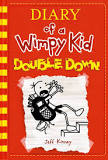
[READ: December 27, 2016] Diary of a Wimpy Kid: Double Down

I keep expecting the quality of the jokes in the Wimpy Kid books to decline.  But rather, this book was not only hilarious, but it worked really well as a book, too.

What I mean is that, I know that the Wimpy Kid series is online and that Kinney does a new story every day (or at least he did , I don’t know if he still does).  These books had always been taken from the online site (and I assume they still are).  But somehow, this book has jokes that circle back to jokes earlier in the book.  There’s at least a half a dozen callbacks which makes this book more than just a collection of diary entries…it’s a perfectly contained unit with a satisfying ending.

(more…)

Read Full Post »

CV1_TNY_11_01_10.inddSOUNDTRACK: THE OH HELLOS-Holiday Tiny Desk Concert #588 (December 19, 2016).

ohhellosThere was a time when a band played one Tiny Desk Concert and that was it.  That tradition has been broken twice before on special occasions.  But this time, the distance between shows was just over a year.  What gives?

Well, in addition to the band being pretty sick last time, The Oh Hellos have released The Oh Hellos’ Family Christmas Album and are on the Christmas Extravaganza Tour.  so what better group to do a holiday Tiny Desk Concert?

The band plays four songs.  Their EP is full os interesting folky transitions that sound nothing like the main songs, but which flow into them seamlessly.  Like “Deck the Halls” which has a rocking intro and rocking chords on the downbeats.  There’s also fun bluegrass fiddles and banjo.  I really like how the music of the song sounds so different from the traditional version and yet when they actually sing it, it is spot on.

Then a wild shift in tone to a beautiful acoustic rendition of “Mvmt III: “Silent Night, Holy Night”” sung by Maggie Heath.  The opening guitar melody is really different and interesting–enticing and unexpectedly morphing into the traditional song.  Once the main part of the song is done, they switch to a kind of oh ho oh ho chant–folky and warm.

For the next song Tyler says that its a tradition in their extended family that for the holidays they eat a lot and then break out the hand chimes.  He says they are going to sing the one verse of “Jingle Bells” that everyone knows.  Bob asks if there are more.  Tyler’s not sure. They play some kind of hand bells (and Bob gets one too) while everybody sings.

The final track is “Mvmt IV: “Every Bell On Earth Will Ring.””  It opens with another cool rolling guitar intro on acoustic guitar which is followed by the electric guitar.  And the song morphs into “Joy to the World.”  The harmonies are outstanding.  And once again, you’d never guess the song by the guitar parts.  The middle  rocks out in a very fun way until it shifts to a section of “I Saw Three Ships” sung by Maggie.  With about 1 minute left snow starts falling from the ceiling as they shift to “O Come Let Us Adore Him.”

It’s a pretty fantastic Tiny Desk Holiday show. And their album seems like it might be a fun addition to any holiday music collection.

[READ: July 19, 2016] “Blue Roses”

I’ve never read anything by Hwang before so I don’t know what her stories are typically like.  But this one has such a distinctive narrator that I wondered if she normally writes like this.  The story is the first person from an older Taiwanese lady, Lin.  She is opinionated and judgmental and, I think, most often wrong.

Linstarts by saying she had asked her daughter if she might invite her friend Wang Piesan over for Christmas Dinner.  The daughter says she doesn’t know this woman, so no.  This gets Lin so mad that she more or less refuses to talk to her daughter for most of the rest of the story.

It was bad enough that her daughter said no but then her husband suggested “if you want to invite her maybe you should host.”  Lin is outraged: “I’ve waited your whole life for you to invite me to dinner.  Now you want to take it back?”  To make things worse her daughter called back the next day to ask if she would babysit that night.  Lin is appalled: “She didn’t realize that anything had happened between us.”

Lin said no and also that she also wouldn’t be going to Christmas Dinner now. (more…)

Read Full Post »

2016-12-05-21-06-09SOUNDTRACK: RUFUS WAINWRIGHT-Tiny Desk Concert #237 (August 20, 2012).

I’d published these posts without Soundtracks while I was reading the calendars.  But I decided to add Tiny Desk Concerts to them when I realized that I’d love to post about all of the remaining 100 or shows and this was a good way to knock out 25 of them.

rufusPreceding his sister by a few months at the Tiny Desk was Rufus Wainwright.  I love Rufus’ delivery and style.  I really like his voice too.  The problem is I don’t really like his music all that much.  I wish I did, because I love hearing him sing.  But for some reason it doesn’t do anything for me.  We even saw him live (on a bill with Guster and Ben Folds) and left half way through his set because it’s such a different energy than the other two.

But I love this little bit of information about this show:

We’d never tried to squeeze a piano behind the Tiny Desk, but when I saw a chance to have Rufus Wainwright play here, I wouldn’t — and he probably wouldn’t — have had it any other way

That’s particularly funny because now some five years later they have had all kinds of things behind his desk.

He plays three songs on the piano.

“The Art Teacher”is a sad story about, yes an art teacher.  Really listening to the lyrics (full of art references) makes the song come alive.

Before the second song, he says I’m promoting my new album Out of the Game…yes, you may applaud if you wish.  Covers a lot of genres of music, one is, briefly, country.  Today is a lazy hazy day in the South–while we’re near the South.

“Respectable Dive”is a slow song (the country song, but not sounding country here) and again, the lyrics are great.

“Montauk” is about several people.  His daughter Viva Katherine Wainwright Cohen and his fiance.  Viva’s bilogical mother is Lorca Cohen who is Leonard Cohen’s daughter.  The last verse is about “my mother, the great Kate McGarrigle” (Rufus’ father is Loudon Wainwright III).

This song is, as the blurb says:

Wainwright at his best. The piano lines flow with forward motion in a Philip Glass way, and there’s also a hauntingly beautiful story. Wainwright sings to his daughter Viva, [imagining her] grown up and visiting her two fathers in Montauk, a small community on the eastern tip of Long Island.

So I am torn between really liking his voice but feeling that his delivery is a little too slow to fully understand the great lyrics.  There’s so much greatness in his stuff, and yet I can’t find my way in.

[READ: December 20, 2016] “Defamer”

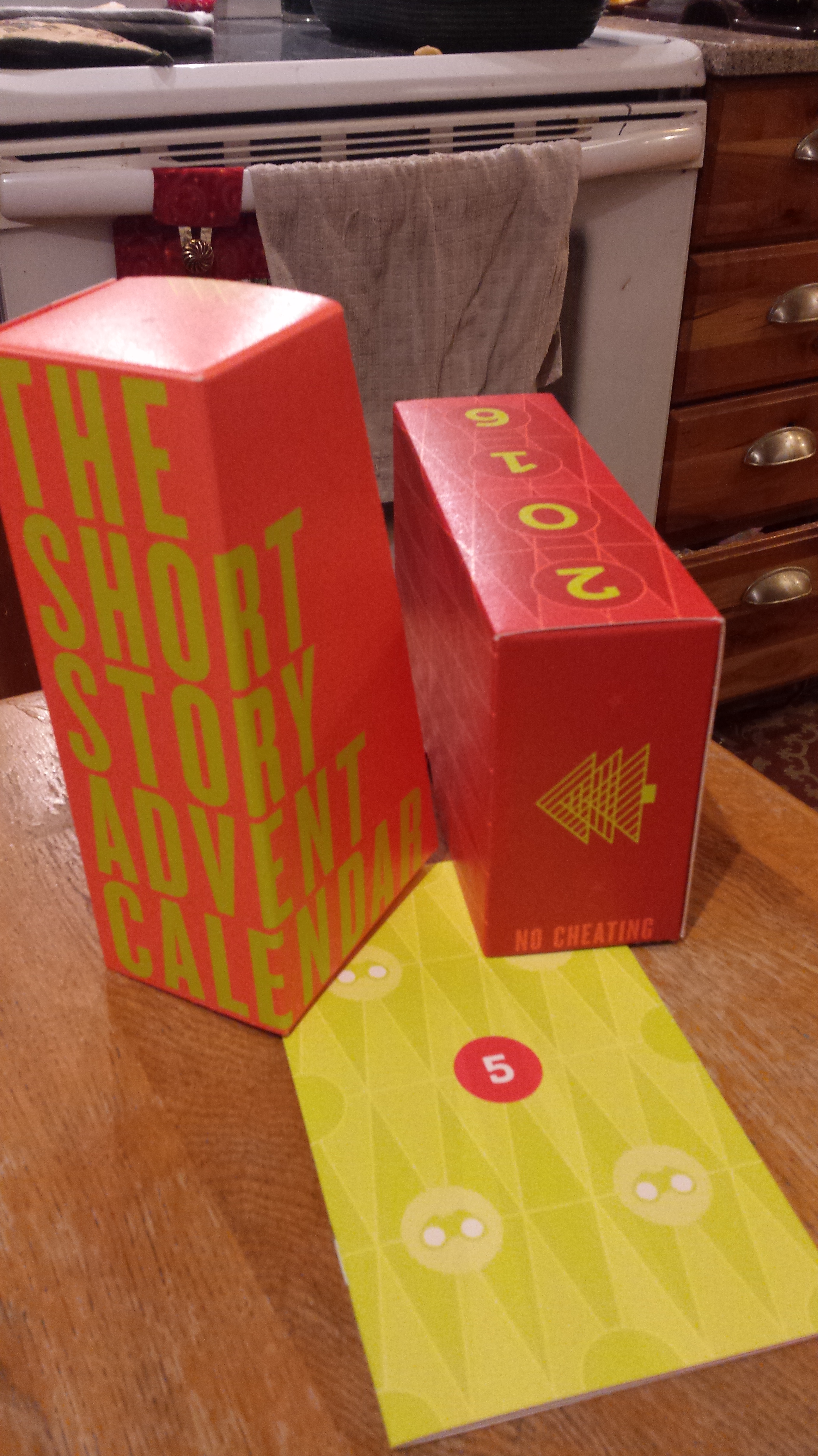
Near the end of November, I found out about The Short Story Advent Calendar.  Which is what exactly?  Well…

The Short Story Advent Calendar returns, not a moment too soon, to spice up your holidays with another collection of 24 stories that readers open one by one on the mornings leading up to Christmas.  This year’s stories once again come from some of your favourite writers across the continent—plus a couple of new crushes you haven’t met yet. Most of the stories have never appeared in a book before. Some have never been published, period.

I already had plans for what to post about in December, but since this arrived I’ve decided to post about every story on each day.

I really liked yesterday’s story and I really liked this one as well, even though it is very different.

This is a the sad story of a woman named Birdie.  Boy oh boy everything goes wrong in her life.  She works at an office.

Big boss takes a four-hour lunch.  He has suffered no major disasters in his life.  [He and his wife plan] their vacation to Maine a year in advance.  This is one way to live.

Birdie works in a corner cubicle near Bog Boss’ office… [She] makes $20,000 a year forwarding emails to people who make $15,000 a year.

Birdie assumes that her boss is having an affair on his four-hour lunches.  But one day she see him during his lunch break working at a deli, frantically making sandwiches for customers.  Nothing makes sense. (more…)

Read Full Post »

2016-12-05-21-06-09SOUNDTRACK: JANET FEDER-Tiny Desk Concert #233 (August 6, 2012).

I’d published these posts without Soundtracks while I was reading the calendars.  But I decided to add Tiny Desk Concerts to them when I realized that I’d love to post about all of the remaining 100 or shows and this was a good way to knock out 25 of them.

federJanet Feder is an amazing guitarist.  I enjoyed the simple act of her picking out the notes in a chord and simultaneously using her pinky to play harmonics on two different strings.

But beyond that she has a great sound. In part it’s the guitar which is a nylon-string baritone electric! But it’s also because of the way she prepares her strings—she gets interesting bell sounds and other rattling noises.  These aren’t the focus of the song,  just the accents of them.

The first song is not an instrumental, it’s called “Angles And Exits.” She says that she was used to not singing since she primarily played classical music.  But she has enjoyed adding voice to her songs.  Her voice is soft and delicate.  The song works with words, but it would probably be fine without them.

It looks like she has some kind of thing on the first fret on the high strings—so an open notes gets that bell sound.  She says that these additions to the guitar have allowed her to have fun playing the guitar again.

She describes what she does on the second song “Heater.”  She puts a device on her string to make a great sound.  Although even after she describes it I don’t understand how it works.  She begins the song by pulling on what sounds like an uncoiled guitar string ratcheting it tighter ad tighter.  When she finally gets to the melody, her playing is excellent—all over the guitar but not really flashy, just interesting.  The melody in the slow part at the end is enchanting.

“I Hear Voices” opens with harmonics and a rattling on the strings—a neat combination of heavenly notes and noise from an alligator clip on the strings.  It’s a mesmerizing and very cool sound and a beautiful song too.

[READ: December 16, 2016] “The Heaviest Dress”

Near the end of November, I found out about The Short Story Advent Calendar.  Which is what exactly?  Well…

The Short Story Advent Calendar returns, not a moment too soon, to spice up your holidays with another collection of 24 stories that readers open one by one on the mornings leading up to Christmas.  This year’s stories once again come from some of your favourite writers across the continent—plus a couple of new crushes you haven’t met yet. Most of the stories have never appeared in a book before. Some have never been published, period.

I already had plans for what to post about in December, but since this arrived I’ve decided to post about every story on each day.

This is the story of a young Jewish girl returning to her home in Montreal after some time in New York City.

The girl’s parents died when she was five and she had lived with her Aunt Rita and Uncle Mort ever since.  She felt that their house was never hers, and so it never grew mundane.  In the past year she had moved to New York City to go to fashion school. (more…)

Read Full Post »

2016-12-05-21-06-09SOUNDTRACK: SOUAD MASSI-Tiny Desk Concert #231 (July 15, 2012).

I’d published these posts without Soundtracks while I was reading the calendars.  But I decided to add Tiny Desk Concerts to them when I realized that I’d love to post about all of the remaining 100 or shows and this was a good way to knock out 25 of them.

souadSouad Massi has a fascinating story:

Born in Algeria to a Berber (Kabyle) family in 1972, Massi grew up in the capital city of Algiers. On her way to rehearsals with her rock band as a teenager, men used to spit at and harass her for wearing jeans and toting a guitar. When civil war erupted in 1992, life became even more dangerous for Massi: After she released her first album, she was targeted for assassination by Islamic fundamentalists.  Now based in Paris, she’s since become one of the major musical stars of the Arab world: Massi has sold hundreds of thousands of albums across Europe and North Africa,

She sings unflinching, deeply intimate songs in a mix of North African Arabic, Berber and French

Since I don’t know what she’s singing I’m going to use some of the blurbs

  • “Raoui” (Storyteller) is a beautiful delicate song with lyrics like: “Every one of us has a story in his heart… Storyteller, tell us stories to make us forget our reality. Leave us in the world of once upon a time.”
  • “Ghir Enta” (No One but You)  has a faster tempo–Confessional love songs like “Ghir Enta”bear little resemblance to the sappy sentiments that dominate Arab pop ballads. There’s a trembling note of fragility within: “Now you’re by my side,” she sings, “But tomorrow, who knows? That’s how the world is — sweet and bitter at the same time.”
  • “Amessa” (A Day Will Come) a much faster track in which she says she needs help with the rhythm, which the crowd provides.  You can still feel the North African undercurrent which propels the song that was sung in Arabic in the beginning and in Berber in the second part
  • “Le Bien et le mal” (The Good and the Evil)  is a pretty, slow song with lyrics like: “There are people who lament over their destiny, people who cry on their own tombstones while they are still alive … There are people who grow old before their time. We’re fed up with this life.”

Massi’s voice is really lovely on top of it.

[READ: December 14, 2016] “Blue Light, Red Light”

Near the end of November, I found out about The Short Story Advent Calendar.  Which is what exactly?  Well…

The Short Story Advent Calendar returns, not a moment too soon, to spice up your holidays with another collection of 24 stories that readers open one by one on the mornings leading up to Christmas.  This year’s stories once again come from some of your favourite writers across the continent—plus a couple of new crushes you haven’t met yet. Most of the stories have never appeared in a book before. Some have never been published, period.

I already had plans for what to post about in December, but since this arrived I’ve decided to post about every story on each day.

I have read an enjoyed J. Robert Lennon’s stories in the past.  But as with yesterday’s story, this one had the potential of being very dark indeed.

This is the story of a 7-year-old boy.  When his baby sister is born he is quite jealous of her.  But he soon grows affectionate towards the little creature who stares at him so intently and for so long.

One night, when the boy can’t sleep, he goes downstairs to his parents. They let him sit with them for a while in front of the TV. The parents fall asleep but the boy does not.  And on comes a real-crime show.  In this show, which the boy is mesmerized by, a man breaks into a house and kills an entire family, including a baby. (more…)

Read Full Post »

« Newer Posts - Older Posts »