Feeds:
Posts
Comments

Archive for the ‘Tiny Desk Concert’ Category

resistSOUNDTRACK: LUISA MAITA-Tiny Desk Concert #100 (December 26, 2010).

maitaI’ve not heard of Maita.  The NPR write up speaks about the electronic flourishes and deep grooves of her songs.  Felix Contreras worried that their stripped down ensemble (only guitar, bass and fascinating bongos) would have a hard time creating that sound.

And in one way they do.  Except that it’s clear they didn’t even try.  Rather, they play a simple, but engaging kind of mellow Brazilian dance music.  In the first song, “Ai Vem Ele,” the guitar and bass play the same grooves except when they each take some meandering moments.  The percussion keeps a quiet but steady rhythm and Maita sings vocals and accent notes all over the place to keep the song interesting.  I really enjoyed at the end of the song when the bassist played exactly the vamping solo that she was singing.

“Alento” is a much faster song, with quickly sung lyrics.  It allows for rapid guitar playing and more uptempo feel.

They only play two songs (about 8 minutes long), but it really shows the kind of range she is capable of.

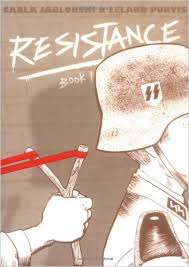
[READ: December 1, 2015] Resistance

This First Second graphic novel is about the Nazi occupation of France.  It’s not exactly light reading and yet Jablonski has taken this incredibly dark story and found an excellent and compelling narrative about one family who works as part of the resistance to fight back against their oppressors.

This is the first book in a trilogy and I am curious to see what the next two books bring as this story was nicely wrapped up but there are so many more stories which could be told.

Jablonski also helpfully sets up the situation in the introduction.  She explains how France was split in two as a result of the armistice agreement.  She gives a very brief but powerful explanation for why they would agree to splitting their country in half.  Paris and the upper portion of France became Occupied while Vichy and the southern part of France were “Free” (but still with a large Nazi presence).

This story is about an average family.  Paul Tessier and his parents and little sister live in the free part of France. Paul is an artist, and I love the way Purvis juxtaposes Paul’s art with what is actually happening (placing Paul’s “drawing” in the middle of the action so we know he is observing everything. (more…)

Read Full Post »

dramaSOUNDTRACK: SHARON JONES AND THE DAP-KINGS-Tiny Desk Concert #497 (December 21, 2015).

sharonTo end out the Tiny Desk Christmas season, I chose this year’s entry.  And for this year’s Christmas show, they went all out.  There’s lights strung around the office, there’s twinkling gold tinsel behind them, presenting a wall of glitter, and a sign that says Dappy Holidays.

I don’t love Sharon Jones and the Dap-Kings (I often feel like I am the only person who doesn’t).  I’m not a big fan of the blues or of soul music, so there is that.  But then I heard her blues version of “Silent Night” and it is a travesty.  “Silent Night” is a beautiful tender song.  If done right, it can make you cry.  But this is just dreadful. You don’t make “calm” a ten syllable word.  You don’t sing “talkin ’bout a Silent Night.”  You don’t make this song fun.  You don’t show off you crooning skills with this song.  You just sing it.  Perfectly.

When she’s not tinkering with classics, though, Jones has some good fun with two originals.  The first is the fun “8 Days of Hanukkah” She sings about all the things they’ll do on each day–spin the dreidel, roll out the latkes, and the best: “we’re cooking up the brisket the kosher butcher sold my uncle Saul,”  It’s a lot of fun (when the horns launch into the dreidel song amid their jamming it’s a good time).  This is the kind of soul that I like–lots of swinging horns and good times.

And Sharon herself seems like a fun person–she asks for help remembering the lyrics to the final song and plays it off in a fun way.

“Big Bulbs” is another original.  It’s also funny with the lyrics, “Baby you got them big bulbs flashing in your windows tonight.”  IT seems like it’s a double entendre but I don’t really think it is, it’s just fun.

Despite my aversion to the first song, she totally won me over with the second two songs, and I’d happily add those to any holiday mix.

[READ: December 10, 2015] Drama

I really enjoyed Telgemeier’s Smile and Sisters.  But I enjoyed Drama even more.

This story is an ode to everyone who works behind the scenes at the drama club.  But it’s also a chance for the stars to shine and the shy kids to come out too.  All done in Telgemeier’s delightfully simple yet effective drawing and storytelling style.

Callie is in love with the drama club.  She works late on sets, she loves seeing things come to completion.  She also knows she has no talent to be on stage.

And things are good.  Until the drama arises.  Greg and Matt are her friends.  Greg is a little older and Callie has a crush on him.  When Greg tells her that his girlfriend Bonnie broke up with him, she is pretty excited.  And they share a kiss.  But from that moment on, not only does Greg avoid her, but Matt is a jerk to her, too.  Not bad for the first few pages. (more…)

Read Full Post »

books SOUNDTRACK: PRESERVATION HALL JAZZ BAND-Tiny Desk Concert #328 (December 21, 2013).

peshallThis show is tangentially Christmassy.  I mean, it does feature a tuba player in a Santa Claus outfit, after all.  But the music isn’t Christmassy per se (except for one song).

Rather, the Preservation Hall Jazz Band does what it does best–play fun dancey jazz songs.  There’s trumpet (and trumpet solos) and trombone, there’s saxophone and piano and most importantly, there are two, count em, two tubas!

“Sugar Plum” is their instrumental version of a holiday song (about the sugar plum fairy).  It’s a fun bouncy swinging song.  “I Think I Love You” has vocals, and they are fine, but it makes the band swing a little less.

“Happy Holiday” is indeed a Christmas song, and a nice one with sweet lyrics.  It’s also got a lengthy some trade off trombone and saxophone solos.

The final song, “Dear Lord,” sees the Santa tuba player removing his instrument and taking over as lead singer (and commenting that he’s from the South Pole which is why he is so hot).  This final song seems to be a familiar one with people singing and clapping along as he blesses everyone from South Pole to North.

[READ: December 23, 2015] The Haunted Man and the Ghost’s Bargain

This is the final book in the Christmas Books collection. And it does return to the Spirit of Christmas more than the previous stories did.

As I learned from the previous story, the plot is quite simple but its length comes primarily from Dickens’ intense amount of detail (and lots of humor).

The story focuses on Mr. Redlaw.  Redlaw is a chemist and a kind man.  But he is beset upon by sadness at all of the things that have happened to him in his past.  One night he is visited by a spirit (who seems to be something of a version of himself, maybe?).  The spirit tells him that he can help to “forget the sorrow, wrong, and trouble you have known.”  Basically he proposes that he will remove all of the bad memories Redlaw has ever had.  And if he accepts this proposal, he will also be able to do this to everyone else that he meets.

This seems like a good deal–no bad memories!  So he accepts. (more…)

Read Full Post »

basoonSOUNDTRACK: THE MUSIC TAPES-Tiny Desk Concert #182 (December 20, 2011).

musictaopesJulian Koster released an album in 2008 called The Singing Saw at Christmastime.  It was a complete CD of Christmas songs played on the saw.  That should tell you that Koster is an unusual fellow. But that doesn’t prepare you for what he unleashes during his Tiny Desk Concert with The Music Tapes.

Koster has a very high-pitched voice (I have a recording of him doing “I’ve Got My Love to Keep me Warm,” which is almost unbearable.  His singing is really close to the fine line of unique and bad (and I imagine for many it crosses the line). He’s also got a fascinating way of looking at things and of storytelling.  So this Tiny Desk show winds up being quite long (20 minutes) with quite a lot of different things going on.

First he tells a lengthy story about his great grandpa.  And how his great grandpa told him that baby trees can walk.  But they are tethered to the ground by an umbilical cord. And when we cut them down, we sever the cord.  And a Christmas tree is adorned and worshiped for two weeks and then set free to roam the earth.  It is a warm and strange and delightful.

Then he and a second member of the group play “The First Noel” on two saws.  It’s weird ad wonderful.  At the end of the song he has his saw bow, and Bob says he didn’t know a saw could bow.  Julian says they do and in fact that singing saws sing by themselves but we encourage them by petting them and placing them in our laps.

I don’t enjoy everything Koster does, so the second song “Freeing Song For Reindeer,” a banjo based piece about a tired old reindeer transporting Santa is slow and kind of sad and not my thing.

But then he tells a story of growing up with all kinds of culture and Holiday traditions which leads into a version of Gavin Bryars’ “Jesus Blood.”  I enjoy the original and didn’t know what to expect here.  They begin with a tape loop of an old man singing the song (possibly the one Bryars used, but I don’t know).  And then Koster starts playing the banjo with a bow.  And then a second guy does the same. Then the percussionist stars playing the toy piano and the noises build.  He switches from piano to trumpet and plays along.  Meanwhile the second banjo player switches back to the saw for the end. It’s really quite a lovely performance.

“Takeshi And Elijah” is another slow and keening banjo based song.  It’s pretty long, I don’t really like it, but by the end, as it builds with trumpet and toy piano, he ends the song sith a puppet Santa doing a tap dance as percussion.  It’s a great ending to an okay song.

The final song is “Zat You, Santa Claus?”  It’s played on bowed banjo and sousaphone.  It’s a fun and crazy rendition.   It’s one of the weirdest Tiny Desk shows and certainly the weirdest Christmas set.

[READ: December 5, 2015] The Bassoon King

I really liked Rain Wilson in The Office, but I haven’t seen him in much else (I forgot he was in Six Feet Under and Galaxy Quest) . I wanted to like Backstrom, but it got cancelled before we even watched an episode.

So why did I check out this memoir of an actor I like a little bit?  Well, primarily for the title.  The Bassoon King had an absurd ring that I really gravitated towards.  When I saw there was an introduction by Dwight Kurt Schrute, I knew this would be a good book.

The introduction (by Dwight) is very funny.  I love Dwight and I love thinking to myself “FALSE!” whenever I disagree with someone.  Dwight wondered why anyone would read a biography of a young semi-famous actor.  “Fact. NO. ONE. CARES.”  But then says he doesn’t care either because he is making a lot of dollars per word for this thing.

Rainn begins his memoir by making fun of his big head (especially when he was a baby).  It’s pretty funny.  And then he describes his hippie family and his weird name.  His mom changed her named from Patricia to Shay in 1965.  She wanted to name Rainn “Thucydides.”  But his dad always liked Rainer Maria Rilke.  Now, they lived pretty close to Mt Rainier, so they went for Rainn (“Tack an extra letter on there for no apparent reason”). (more…)

Read Full Post »

books SOUNDTRACK: MATT WILSON’S CHRISTMAS TREE-O-Tiny Desk Concert #99 (December 20, 2010).

trreoMatt Wilson is a jazz drummer.  And he joined forces with Paul Sikivie on bass and reedman Jeff Lederer on saxophone, clarinet and piccolo.

Wilson is a great drummer and he normally plays standard (if wild) jazz.  But for this group (the name is an indicator of the silliness), they play a spirited and fun set of Christmas songs–some of them crazy and unrecognizable and others simply fun and jazzy.  And despite the fact that Wilson does some amazing things with just a snare and a cymbal, it’s hard not to say that the show belongs to Lederer.

“Hark the Herald Angels Sing” starts out pretty straightforward.  The initial melody is present and then Lederer goes off on a lengthy solo in the middle.  “O Come All You Faithful” is a sing-along in which Lederer plays a very slow staccato line on clarinet for the audience to sing along with.  It’s Sikivie’s steady bass that keeps the crowd in line.  Meanwhile Wilson is playing his brushes on everything–his snare, a desk, anything that comes along.  It’s good fun with everybody really getting into it by the end.  “O Come, O Come, Emmanuel” starts out slow with Lederer’s sax laying down a smooth melody line and then drifting into his own space.  It’s quite pretty if unusual.

“Angels We Have Heard on High” is audio only and it begins with a rattling of jingle bells and Lederer’s skronking sax (I’d actually like to see that part–it seems like the most interesting visual songs are the ones left off the video).  Then he starts playing a sax melody (although nothing like “Angels” normally sounds).  There is some notation of “Angels” by the end, but it’s very minimal.  The most unlikely Christmas song ever (well, until what comes next).

The final song is a version of Handel’s “Hallelujah Chorus” and it is completely unrecognizable.  It opens with skronking sax noise and martial drums.  Aside from a few seconds where the bass plays a part of the familiar melody, the rest is mostly noise.  As the song draws to a close Matt starts playing the four note “ha – leh – lu – jah” on the snare, he then starts hitting that rhythm on everything–the rim, the bookcase, he even grabs a mug off the shelf and plays it on that.  It’s pretty funny and clear that Wilson is having a grand old time.

This nonsense ends when Lederer picks up the piccolo and plays a fun if silly version of “We Wish You A Merry Christmas,” which is very slow despite Matt’s super fast drumming.

It’s a funny, silly good time and an unexpected way to sing Christmas carols.

[READ: December 18, 2015] The Battle of Life

This book is the third of four in the collected Christmas Books.  This book is very tangentially related to Christmas (although he did publish it as a Christmas book) as one section takes place at Christmas time.

The thing that I really caught on to while reading this is that Dickens’ stories were really written for a very different time.  His books unfold slowly.  I find that I like to read fast (as many others do, I suspect), and I think the reason people dislike Dickens is because he really forces you to slow down.  But if you do slow down, you can really appreciate his descriptions and his humor.

This story begins on a battlefield.  And Dickens tells us all about the battle that took place here and all the people who died here.  For several paragraphs he goes on about it.  And then you learn that the battle has nothing to do with the story–except as an underpinning to the attitudes of people who live there.

Rather, the story is set on the battlefield many many many years later (and has nothing to do with the battle).  For this is a love story, after all. (more…)

Read Full Post »

1967 SOUNDTRACK: JULIAN LAGE TRIO-Tiny Desk Concert #140 (July 7, 2011).

lageJulian Lage is a jazz guitar prodigy.  he normally plays with a quintet but for this set he brought only a trio which includes bassist Jorge Roeder and percussionist Tupac Mantilla.

This was my first exposure to Lage and he does some really impressive lines and riffs.  He plays a hollow-bodied electric guitar that sounds an awful lot like an acoustic guitar. He does some phrasings that are really pretty or really interesting

But I was more impressed with Mantilla on percussion.  He uses thick brushes, he uses his hands on bongos and cymbals.  He uses his hands on his body–playing his lap and chest).  He even uses little dusts brooms (which must be unwieldy).  He’s also got some kind of drum (perhaps a loose snare?) with a great sound and even a bell.

They play three songs.  “Welcoming Committee” is a new song not recorded as of then.  At the end of the song, they all laugh as an office phone rings the end.  Julian is a sweet funny guy with some interesting stories about his songs.

“However” is an upbeat bouncy song (with some less noodling).  Interestingly, it was written by their saxophonist who is not playing in the trio today.

Before introducing the final song “Untitled (No. 24)” he says he started a blog for inspiration–to get people to bounce ideas off each other–healthy peer pressure with incentives for song writers.  The most recent one was a song a day for 30 days.  This was number 24.  (Hhe jokes that the first 23 sucked).  It’s a really fun piece that doesn’t feel incomplete at all.

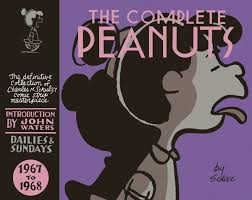
[READ: December 8, 2015] The Complete Peanuts 1967-1968

It’s 1967 and Schulz has had huge success with Snoopy’s Red Baron plots.  In December 1966 The Royal Guardsmen made a song called “Snoopy Vs the Red Baron” which made it to number 2 on the charts.  So The Red Baron plot takes over a lot of this year.  And while I enjoy seeing him like that and I get how it’s funny, I don’t really like it all that much–the jokes are too samey for me.  But despite all of the Red Baron excitement there are other things going on this year too.  Like the introduction of the Easter Beagle.  And of Franklin!

The kids get involved in many different sports this year.  In Feb 1967 Lucy begins arm wrestling (and beating) everyone.  She even takes on the Masked Marvel (Snoopy).  In Oct 1967 Snoopy plays hockey for the first time (I think).  He references Bobby Hull).  Later in Jan 1968 all the kids play hockey together.  Lucy beats everyone up and say how much she likes the game.  And at one point Snoopy smiles and is missing teeth.  In Oct 1968 Snoopy shoots and scores (on his doghouse) and says “they’re not sleeping well in Montreal tonight.”

In December 1967 Snoopy considers going to the Olympics in France for his ice skating.  He says he misses skating with Sonja Henie).  In April 1968 Snoopy is going to the Masters in Augusta.  When that doesn’t work out (we never see him there), later in April Snoopy is a wrist wrestler who is going to go to Petaluma for the world competition.  (There are many jokes about Petaluma).  Snoopy is disqualified because he has no thumbs.

In August 1968 Snoopy says “jogging is my thing.”  And in Nov 1968 we learn that Snoopy has a pool table but that Minnesota Fats won’t play him.

And of course there is baseball.

Peppermint Patty comes back in March 1967 to play against Charlie’s team.  She has a new player, Jose Peterson, who doesn’t really hang out in the strip for very long, but who is an awesome slugger.  In November of 1967, there’s a reference to the lousy New York Mets.  I didn’t realize it but at the time of this strip, the New York Mets were a recent expansion club with a terrible record.

In summer of 1967 Charlie and snoopy return to camp and they see Peppermint Patty is there.  Patty strikes out Charlie a whole bunch and says she considered letting him hit one but he wouldn’t want that, right?

In march of 1968 snoopy takes over as manager and is really mean.

And of course, Snoopy has a lot going on too.  We learn that August 10 is Snoopy’s birthday.  He also says a lot of things are gauche.

In a very funny skit, in May 1968 Snoopy watches a bird chomp a worm and then says “I’m going to be very very very very very very very very sick.”

June 1968 introduces Lila again, and how Snoopy pines for her.  Then in August she writes to Snoopy again.  And finally on Aug 24 we meet Lila for the first time.  Lila is a girl in the hospital.  But it’s not until the end of the month that we learn that Lila was Snoopy’s previous owner who lived in an apartment and had to get rid of him.  AND THAT’S ALL THAT’S SAID ABOUT IT!

On a lighter note, in March Snoopy pretends to be a piranha for a few strips.  In April 1967 there’s some Cheshire cat jokes from snoopy (who is only a smile)  April 1968 sees the first mention of the Easter Beagle (Lucy doesn’t believe Linus who is the only one to see him).

Linus and Lucy pop up a lot of course.  They revisit a lot of the same ideas with variations.  In August Linus’ grandma agrees to give up smoking to get Linus to give up his blanket.  He thinks she’ll never do it, but he goes through the real withdrawal.

In Dec 1967 Lucy ups her psychiatrist booth’s price to 7 cents (winter rates).  And then as the book ends in Dec 1968, Linus is taking shorthand notes for her.

Father’s Day this year had Peppermint Patty writing a card.  She says that her dad calls her a “rare gem,”  This phrase is used as a joke in the strip and then a few more times.

It seems like summer is a good time for new things as well.  There are two weeks of strips starring Peppermint Patty at camp!  She is a counselor of littler kids.  There is a little girl who looks like Marcie but isn’t (her name is Clara).  And then later that week another little girl, Sophie, calls her “Sir.”

And then July 31, 1968 introduces Franklin!  He and Charlie play at the beach for a few days.

Religion pops up from time in the strips, especially with quotes from the Bible.  But in March 1967, Violet asks Charlie if they go to church.  He says yes, but she says her family “used to…now they belong to a coffee house.”  And in April Schulz revisits the “here’s the church gag.”

[From the Peanuts wikia] On February 8, 1963, Sally watches while her big brother uses his hands to illustrate that old rhyme: “Here’s the church…here’s the steeple…open the door…and see all the people!” After carefully examining his closed fingers, she announces, “It looks like a rather small congregation!” Four years later, on April 8, 1967, Sally watches as Linus delivers the same rhyme…and then she provides an almost exact response: “Sort of a small congregation.”

Most of the strips are totally timeless, with me even thinking that I read some of them when I was much older than I did.  I can’t say as I remember a lot of specific strips, but I always remember the one from Dec 5, 1968 (which is from before I was born, so I obviously read it in a collection).  Peppermint Patty says that it snowed last night Her dad says that “when it snows you should always take a slice of bread out for the birds.”  She places a whole slice on the bird’s head.

I think the timelessness of the strips are what make reading these volumes so much fun.

In May 1967, Charlie asks Linus if he wants to be the first man on the moon.

In July 1967, the bird (unnamed yet) has “long hair” and Snoopy calls him a bird hippie.

Charlie writes to his pencil pal in Nov 1967 and says, “According to what I read, your country hates my country and my country hates your country.  I don’t hate you, and I don’t think you hate me.  I think about this a lot.  It makes sleeping at nigh very difficult.”

In Jan 1968, the girls are going to have a “crab-in.”

Dec 18 1968 Snoopy has a sled and Charlie looks at it and says “Rosebud?”

In June 1968, Snoopy says he thinks he is in love with Twiggy.

In August, Snoopy says that you never hear anyone sing “Chloe” anymore (although which song that is, I’m not sure.  Perhaps the Al Jolson one).

In Nov, Snoopy says he is feeling groovy (the Simon and Garfunkel song came out in 1966).

There are references to the election year with the birds holding ups signs that say ? and !!  Snoopy say he’ll vote for the one with the paw print on it.

My two favorite jokes in the book have to do with math.

Sally is trying to learn her times table and guesses answers like “Four-thousand six? elventy-twelve? fifty quillion? overly-eight?  twiddelty-two?”  Then she  asks “Am I getting close?” And Charlie responds, “Actually it’s kind of hard to say.”

In Dec 1968, Peppermint Patty says she loves numbers.  “Twos are sort of gentle, threes and fives are mean, a four is always pleasant.  I like sevens and eights too, too but nines always scare me.  Tens are great.”  When a classmate asks if she has prepared her division homework, she says “Nothing spoils number faster than a lot of arithmetic.”

~~~~

In my edition the May 1 strip is repeated instead of the May 3rd strip! (The missing strip will apparently be printed at the end of the next book).

John Waters give the best foreword yet.  He actually references strips in this book!

He says he became obsessed with peanuts when he had mono in 6th grade.  He loves the depression paranoia and delusions.   But John was all about Lucy.  He loves her politics, her manners “Get out of my way!” her narcissism and her rants.   He says he has a niece named Lucy and Schulz got the expression perfect when she yells “No” on page 61.

He also says that for the most part the strips don’ age at all (with a few exceptions).  He talks about Lucy shouting “police brutality” at Charlie as a crossing guard!  He also says that Schulz was criticized for including the minority characters (which is shocking).  Waters is also fascinated by characters like Roy who are rarely if ever heard.

Pig-Pen was an inspiration for Dingy Dave in A Dirty Shame; Divine cutting up her daughter’s jump rope in Female Trouble is inspired from a Peanuts strip.

He sums up with the attitude that Peanuts presents:

You are dealt a hand.  Deal with it.  But most importantly he teaches all ages that if you can learn to laugh at the things that cause you the most pain, you will be the strongest of all.

Read Full Post »
 puckettSOUNDTRACK: MARIACHI EL BRONX-Tiny Desk Concert #226 (June 21 2012).

bronx Mariachi El Bronx is an L.A. based band which plays Mariachi music.  They wear the full mariachi outfit (suits with great designs on them) and have traditional instruments.

According to Felix Contreras, NPR’s Alt Latino dude, their mariachi is quite authentic.  The biggest surprise to me is that the band started as a punk band.  So the lead singer is a bald Caucasian fellow and the accordionist has red hair!  That obviously doesn’t matter, it’s just surprising, especially since their music feels like the genuine article.

They play three songs,

  • “Revolution Girls”
  • “Everything Dies”
  • Norteño Lights”

And they have trumpets playing, a great violin solo on the first track and the big fat bass instrument on all the songs.  Mariachi is pretty much always fun, and this is no exception.

[READ: December 5, 2015] Desmond Pucket and the Mountain Full of Monsters

This sequel to the first Desmond Pucket book pushes Desmond’s love for scaring people (and making monsters) to a logical extreme.  But it also adds a romantic interest and a back story for his nemesis, Mr Needles.

I said that the first book surprised me with its ending, but there weren’t too many surprises in this one.

The book begins with Desmond showing us his Top Secret Master Plan, which involves giving Tina Schimsky a note asking if she’ll go on the Mountain Full of Monsters Ride during the school trip.

But before he can get her the note, class bully Scot Seltzer steals it.  We get a brief story about how Desmond and Scott used to be good friends and how they became enemies (which is pretty funny).   He gets the note back, but when he gets to Crab Shell Pier and is ready to put his plan into action, he is grabbed my Mr Needles, the school disciplinarian. (more…)

Read Full Post »

serafinaSOUNDTRACK: JACKIE EVANCHO-Tiny Desk Concert #130 (May 23, 2011).

jackieI’d never heard of Jackie Evancho, even though she apparently was viral for a while.  Jackie was (at the time of this taping) 11 years old.  And she has an amazing operatic voice.  Not like, oooh, the 11 year old can sing, but like holy cow, that voice comes out of an 11 year old?

Her voice is beautiful in the audio format, but you really have to watch that voice come out of this adorable little girl (while she sings Handel’s “Ombra Mai Fu”) for it to really blow your mind.  Especially when she giggles at the end.

For what I am sure are licensing reasons, there is only one video available, but there are three songs available to download.  “Lovers” comes from The House of Flying Daggers (one of her favorite movies).  If you have watched her sing, it is staggering to imagine her singing this song (which is intensely grown up).

The third song is Sarah McLachlan’s “Angel” and she sounds so much more “mature” than McLachlan’s more passionate version.  It is uncanny to watch this girl sing.

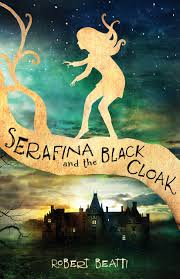
[READ: December 6, 2015] Serafina and the Black Cloak

I saw this book reviewed and it was talked about as being the next big franchise for Disney.  Since our library had it in I thought I’d read it before it took off.

To my knowledge it hasn’t taken off yet, but I’m glad I’m ahead of the curve.

This book has many dark elements including a very violent, scary opening that I feel makes this an unlikely children’s book series.  Maybe tweens, but certainly not for young readers.

I brought the book for Sarah because it is set in Biltmore Estate (Sarah’s mom had just visited there and Sarah would like to go).  I think she was intrigued until I read the next paragraph which talked about a lot of supernatural elements (she was intrigued for different reasons then).

So Serafina is the daughter of the man who works on the “Edison machine” in the basement of Biltmore.  He doesn’t want the Vabnderbilts’ to know he lives there and doesn’t want them to know about Serafina at all.  All Serafina knows is that her mother is dead and her pa is all she has left.  So he hides her and tells her she is the CRC, the house’s chief rat catcher.  Despite her living conditions, she doesn’t feel any ill will towards the Vanderbilts.  She has never really interacted with them so she has no opinion of them.  She just thinks they are fascinating.

Serafina has very keen senses, especially in the dark–she can catch mice an rats like no ones business and she thinks that everyone else is loud and clumsy.  She also has amber eyes and only four toes and she is able to move her body into uncannily small spaces.

Her father, protective of her and of his livelihood, tells her to never go out except at night.  And she must also never go into the forest which is magical and dangerous. But Serafina is constantly drawn to the forest,

Then one night she hears someone walking around and a little girl scream.  The man is in a black cloak and she watches as he grabs the girl, says she won’t be hurt and then proceeds try to…do something to her.  Serafina tries to help, but she is thwarted and soon the little girl  screams and is gone.

She tries to tell her pa but he doesn’t believe her–he doesn’t want to hear anything about supernatural nonsense.  He even gets mad that she was out and about.  Finally when word gets out that the girl is missing, the house organizes a search party and Serafina runs into a boy, Braeden (a terribly unlikely name for the time, I must say).  Braeden is the nephew of the Vanderbilts.  Braden is an orphan , and his aunt and uncle have taken him in.  But he is a loner and spends more time with his horses and dog.  He is intrigued by Serafina because she is obviously a loner too.

They wind up going on a coach ride together only to get trapped in the woods.  That’s when Braeden believes what Serafina has seen (because he has seen it too).  And they know they have to capture this man in the black cloak.

But how can the two people who aren’t even supposed to talk to each other work together on such a thing.  And who can the evil person be?  An outsider or one of his uncle’s friends?

The mystery wasn’t set up as a mystery–we learn who we think is the bad guy about half way through the book.  But there’s still the matter of catching him.  And then learning the secret of the cloak.  And the secret of the forest.

I also enjoyed the part about the catamount.  I have a personal funny story about catamounts and have never seen them in a story before.  I’ve also never heard of them as having mystical powers (or that the name was derives from Cat-a-mountains) either.  Which was cool.

Although there were elements of this story that were kind of samey to other stories like this, there was much originality.  And by the end of the story I was totally hooked.

And best of all, the ending feels like an ending, not a set up for a part 2.  I can’t quite imagine how they will make a series out of it, but I’ll certainly read book two if it comes out.

Read Full Post »

pipbartrSOUNDTRACK: TURTLE ISLAND QUARTET-Tiny Desk Concert #111 (February 26, 2011).

turtleTurtle Island Quartet (there’s no explanation for their name) are a quartet who play an interesting hybrid/jazz crossover. This is most evident in cellist Mark Summer’s playing.  Half the time he bows the strings but the other half he plays like an upright bass (including a percussive elements when he slaps the strings).

“Model Trane,” the opening tune is a John Coltrane-inspired piece, propelled by Summer’s running bass lines Despite the more classical set up (and three violins) it feels very jazzy.  It runs about 4 and a half minutes.

The band leader is David Balakrishnan who has written most of the songs.  He describes the second song, “Monkey Business,” as “loosely based on a sardonic view of Darwin’s theory of evolution.”  I don’t quite know what that means (it’s an instrumental after all), but it’s neat the way the music is all over the place stylistically.  The most notable moment comes when they quote (and fugue) “Strangers in the Night.”  Although other parts of the song remind me of the music in Bugs Bunny cartoons.

The final song has the funny title “Groove in the Louvre.” He says it was inspired by Django Reinhardt.  I don’t know enough Django to know if that is evident here, but there is plenty of soloing going on.  There’s jazzy fiddles (Balakrishnan plays a baritone violin on this song).  There is very jazzy bass (and even a bass solo on the cello) as well as classical elements.  The song is 8 minutes long.

They are definitely an unexpected quartet.

[READ: June 1, 2015] Pip Bartlett’s Guide to Magical Creatures

Pip Bartlett is a young girl (yes I was surprised that Pip was a girl, especially since it didn’t say so until nearly the end of the Prologue).  She can speak to magical creatures–unicorns, silky griffins, fuzzles–but no one believes her (because no one else can).  This is a drag because she loves magical creatures and her Aunt Emma is a veterinarian of magical creatures (people know magical creatures exits, they just don’t think people can talk to them).

The Prologue sets up that Pip loves unicorns but she never really encounters them.  Pip is an authority on magical creatures because she has read (and carries with her) Jeffrey Higgleston’s Guide to Magical Creatures.  She has actually been annotating it as she learns more stuff than is in the guide.  (The guide is good it’s just incomplete).  Then on field day, a classmate brings in four of her show unicorns.  Pip talks to them and discovers that they are incredibly vain and show-offy.  One of them demands that she ride her so that she can show off as much as the other unicorns.  So Pip does (against her better judgment) and all chaos reigns.  Pip is then sent to live with her Aunt for the summer.

As mentioned, Aunt Emma is a vet for magical creatures, and Pip is pretty excited to see them all.  Emma’s daughter Callie is less than thrilled.  She works in the vet’s office for long thankless hours.  And she is crabby when Pip sees her.  Within a few minutes, a couple of exciting things happy, though. (more…)

Read Full Post »

gryphosnSOUNDTRACK: FLACO JIMENEZ-Tiny Desk Concert #250 (November 12, 2012).

flacoFlaco Jimenez has been playing button accordion for almost six decades.  He’s played with The Rolling Stones, Bob Dylan, Dr. John, Los Lobos, Willie Nelson and Ry Cooder.  His grandfather started playing an accordion in cantinas and family parties along the Texas/Mexican border around the late 1800s. Then Flaco’s dad, Santiago Jimenez Sr., carried on the family tradition when he released his first record in 1936.

The accordion that Flaco uses is so tiny and yet he is all over the place with it–fingers flying everywhere.  The NPR site describes his longevity as lying in the short bursts of improvisation in between verses.  He will actually not playing anything for a measure and then fly when it’s his turn.   He is accompanied by bajo sexto player Max Baca, who keeps a great rhythm and accompaniment.

They play three songs.

  • “Margarita”  was written by Flaco’s dad in “nineteen hundred and throw it away.”
  • “La Paloma”  is a fun instrumental.
  • “Cada Vez Que Cae La Tarde”  sounds German (many of these original melodies were but they had changed the lyrics to Spanish).

Before this final song he asks if they want a honky tonk (he plays a little riff), but he changes his mind and says lets polka.

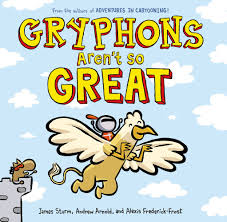
[READ: December 9, 2015] Gryphons Aren’t So Great

I hadn’t kept up on my plan to read all of the First Second books, so as the year draws to an end, I decided to grab a few of the kids books, which I figured would be quick and would allow me to check off a few on the list (since they keep publishing more, I have to keep up).

I found two books by the creators of Adventures in Cartooning, a series of book which I haven’t read but which look like a lot of fun.

These two books are tiny graphic stories for very little kids–the art and story are very simple.  And they are both really fun.

Gryphons Aren’t So Great continues the story of the knight (actually the two stories are completely separate and can be read in either order).  As this story opens, the knight is riding Edward super fast down a hill.  When they get to the end…they jump! (more…)

Read Full Post »

« Newer Posts - Older Posts »