Feeds:
Posts
Comments

Archive for the ‘Tiny Desk Concert’ Category

S2008_01_21OUNDTRACK: BASIA BULAT-Tiny Desk Concert #106 (January 24, 2011).

basiaFor some sad reason, this video cuts off about half way through the second song, so you need to watch it on YouTube instead.  Basia Bulat is a Canadian singer of Polish descent.  She’s adorable and plays weird instruments.  What’s not to like?

The first song “The Shore” is done entirely on a pianoette–she may be the only singer to play one.  The pianoette is a zither-like instrument with a strummed section and a hammered section.  Her voice is low and breathy.  And when, during the second verse, her backing band’s harmonies come in, it’s quite breathtaking.

The second song is done on guitar. It’s a Polish folks song–she says it was a big hit in the 60s in communist Poland.  She sings it in Polish and says it was a great way to learn her Polish words and pronunciations.  “W Zielonym Zoo” means “In The Green Zoo.”  It’s cute how happy and smiley she is as she explains this song.  It begins with just her on guitar and it’s quite a delight when Holly Coish on ukulele, Allison Stewart on viola and Ben Whiteley on bass join in.

pianoetteHer brother Bobby Bulat joins her on percussion for “Heart Of My Own.”  This song is louder and more dramatic and a lot of fun. The final song  “In The Night” is one she normally plays on the autoharp (see, unusual instruments) but she didn’t have it so she plays a rollicking guitar version with the full band (there’s some great violin solos in it).  Just before it starts she says that if it sucks, don’t use it.  It doesn’t suck at all.

I really like Bulat’s music a lot and this is a great way to witness it up close.  And here’s a picture of a pianoette.

[READ: January 8, 2015] “Ash Monday”

I wasn’t sure how much I would like this story (same old intro from me) because I didn’t like the main character (or one of the two main characters).  Dill is a delinquent.  He’s 13 and with a car (well, he has the car, he just cant drive it).  And hes loves the smell of gasoline.

When his mother tells him to goes outside to light the grill (as he does most nights–his mom doesn’t cook in the house apparently), he puts gasoline in it to light it up.  On this night he discovers a rat in the grill, so he takes the opportunity to dose the rat with the gasoline and set it on fire.  (If you’re squeamish, there is also the death of hundreds of chinchillas although that is from natural causes).

We don’t learn much about Dill’s mother except that her husband is gone and she is looking to date someone new.

The scene cuts to the next door neighbor, Sanjuro Ishiguro (Dill calls him “Itchy-goro” and once called him a motherfucking gook).  Ishiguro is a respectable businessman.  He works long hours often getting to work before everyone else.  And although he gets along with his workmates, he is definitely not one of them.  They like to ask him about sports when they know he knows nothing about it. (more…)

Read Full Post »

1.14.2008 SOUNDTRACK: IRON & WINE-Tiny Desk Concert #105 (January 21, 2011).

irionwineI have enjoyed Iron & Wine, but not extensively.  I knew that it was more or less a Sam Beam project (until recently, as the band has since grown in size).  And I knew that he sang beautiful folk songs. I did not know that he was such an amiable and sweet fellow.

For this Tiny Desk, Beam plays four songs.  Three are from his then new album, Kiss Each Other Clean, and they are great.  Beam’s voice sounds fantastic and his playing is excellent too.

After the first song, “Half Moon,” Bob Boilen asks him when he has time to write songs and Beam replies that he has less and less time.  He has to get up early to take the kids to school, so he works like a day job for song writing.

For the second song, “Big Burned Hand” he begins with the capo on fret five and then switches it to fret four apologizing that it’s early.  It’s another beautiful song.  At the end he apologizes for the word “fucking” in the final line (“the lion and the lamb are fucking in the back row”) but says that no other word would have had the same impact.  He doesn’t use words like that lightly in his songs.

He says that “Tree By The River” is a song he had been writing for ten years.  He was afraid it was always turning out saccharine, but thinks he finally got it.

Before playing the final song, Robin Hilton requests an old song (I can’t hear it) which Beam says he will butcher.  Robin says he will die happy if Beam plays it, but Beam says he’ll die unhappy if he plays it badly.  So instead, the final song is an older one, “Naked As We Came,” which has become a set-ender for the band.   Stephen Thompson says it’s great to hear this in this stripped down acoustic format instead of the full band version that has been common now.

And speaking of the full band, when Kiss Each Other Clean came out, the full band of Iron & Wine performed it live on WNYC (you can hear all four of these songs with the full band). And NPR has archived that performance, which you can download here.

[READ: January 7, 2015] “Wakefield”

I have always intended to read more from Doctorow, but he always seems to fall off my radar.  So I don’t know how this compares to his other works.  I really enjoyed it even if I felt like I had to suspend my disbelief a number of times in what was otherwise a somewhat realistic story.

Realistic or not, I really loved the conceit behind it.  The narrator and his wife of many years have had a fight about something stupid.  He went off to work as usual, but on the way home strange things happened.  First there is a problem with is train and he winds up arriving home much later than usual.  And then he finds there’s a power failure (it was interesting to read this right after Updike’s power failure story last week).

He gets out of his car and sees that there are raccoons behind the garage so he chases them away.  When he goes upstairs in the garage he sees that there are baby raccoons there too.  He chases them away and, since the power is still out and he is mentally taxed, he sits in a tattered rocking chair.

He only wakes up the next morning.  And he knows that his wife will never believe the truth. (more…)

Read Full Post »

SOUNDTRACK: BALLAKE SISSOKO AND VINCENT SEGAL-Tiny Desk Concert #104 (January 17, 2011).

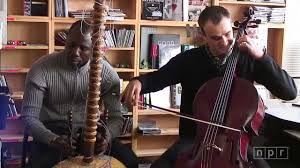
moomin 1sissokoBack in April 2010, another kora player with the same last name (Yacouba Sissoko) played a Tiny Desk Concert with Regina Carter.  Sissoko plays the kora and he is mesmerizing to watch (and to listen to).  Vincent Segal plays the cello and he does things with that instrument which I’ve never seen anybody do before.  It’s a great duo.

Together, the play some beautiful music.  On the first song, “Chamber Music,” Sissoko provides both the lovely backing music as well as some fast plucking.  And Segal keeps up and often outplays his partner.

For the second song, “Balazando,” Segal plays the cello like an upright bass and even plays a little bass solo (including some harmonics).  Then when Sissoko starts playing Segal, plays such high notes that it sounds almost like a flute and even has a Chinese feel to it.

Before the third song starts watch as Sissoko tunes the kora (by twist ting the ropes that hold the strings in place).  “Niandou” opens with Sissoko playing a fast melody (with an up close camera to really show his fingers).  Then Segal play a lovely riff of high notes on the cello.  The song ends with a very fast section–some quick bass playing on the cello followed by some very fast bowing before returning to the slow opening.

The fourth song features some cool harmonic bowing, the likes of which I’ve never seen on a cello before.  The end of the song sees Segal strumming the bowl like a guitar–he can do it all.

Together, they make some beautiful music.

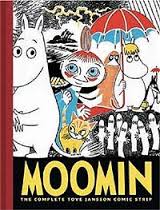
[READ: January 5, 2015] Moomin Volume 1

Inspired by reading the D&Q 25th anniversary book, I decided to check out the books that have been sitting in the children’s section of my library every time I go–Moomin!  They are oversized and lovely books and since I’ve paused on Peanuts I thought I’d read some Moomin–which I have never read before.

It was fascinating to read in the D&Q 25th Anniversary book that Moomin started because Jansson tried to draw the ugliest creature she could think of.  And it eventually morphed into the adorable round creature that we know as Moomin.

This book contains four stories.  I feel like the strips are printed like an every day four panel strip.  Each four panel strip is signed and numbered (but not dated) and most of them (but not all) read like they have a punchline at the end.  So I’m not entirely sure what to make of the publishing run.  Although the front pages state that it originally ran in the Evening News, London 1953-1959.

The four stories are Moomin and the Brigands, Moomin and Family Life, Mooim on the Rivera and Moomin’s Desert Island. (more…)

Read Full Post »

july2015 SOUNDTRACK: THE GHOST OF A SABER TOOTH TIGER-Tiny Desk Concert #92 (November 17, 2010).

goastt  The Ghost of a Saber Tooth Tiger is a band created by Sean Lennon and Charlotte Kemp Muhl.  I really liked their most recent album so I was pretty interested to hear this much earlier Tiny Desk Concert.

I love this acoustic pairing.  Lennon plays the acoustic guitar (and sings and sounds a bit like his father’s more delicate side.  Meanwhile, Charlotte plays a ton of instruments and sings as well.

The show starts with them talking about tambourines and how they are unavoidably loud (so Sean’s is on the floor).

“Jardin du Luxembourg” has some great chord changes and Charlotte’s lovely accordion (with a kind of French flair).  As with all of these songs, there’s interesting lyrics like, “people say your brain is like cream cheese it takes the shape of anything you please.”  At the end of the song, Charlotte comments that she tried to play the accordion quietly but if she does it sounds like it has emphysema.  Sean says that she just learned to play it ten days earlier.

For “Schroedinger’s Cat” she switches from accordion to melodica and xylophone.  Charlotte sings harmony along with Sean.  There are more interesting lyrics here too (trippy ones, of course).  It references Socrates, Aristotle, Dorian Gray and many more cultural touchstones.

On “Dark Matter, White Noise,” Charlotte plays bass (and sings lead on alternating verses).  The chorus is gorgeous again, with a sort of minor key tone.

“The World Was Made For Men”  is the first song they ever wrote together.  Again, they sing together and sound fantastic.

At the end of the show, he threatens to do a 2 hour tambourine solo.

GOASTT is really something.  I am bummed that they opened for a band I wanted to see this summer but was unable to attend.  I hope the two bands tour again together this year.

[READ: January 6, 2015] “Nice Insane”

This was the second short piece in this issue of Harper’s.  I don’t know Seth Price.  This is an excerpt from his novel Fuck Seth Price.

Generally, I dislike reading excerpts, although sometimes they make you want to read the full novel.  That did not happen in this case, though.

This excerpt focuses on the “moment of inspiration that had rejuvenated his [presumably Seth’s] painting career, making him rich but ultimately leading him to reject contemporary art.” (more…)

Read Full Post »

july2015 SOUNDTRACK: THE HELIGOATS-Tiny Desk Concert #98 (December 15, 2010).

heligoat I thought that I would have written about all of 2010’s Tiny Desk shows last year, but it turns out that I missed two.  This was one and tomorrow’s will be the second.

According to the blurb, Stephen Thompson says that this was the 100th Tiny Desk Concert.  I have counted all the shows (twice) and using my counting method, I found this to be the 98th show.  So either this was aired out of order or they never aired two shows.  I have noticed that I’ve been off on all of their milestones, so something is up (and I’m pretty sure it’s not my counting).

Chris Otepka is the Heligoats. He has another band called Troubled Hubble, but Heligoats are his acoustic unplugged band.

In addition to singing unusual songs (he’s a songwriter for whom lyrics are very important (if not always comprehensible)), he tells some elaborate stories between songs.  His stories seem spontaneous, although I expect that they are not (especially the cremation story)

“Goodness Gracious” is a slower song (although he somehow makes a really full sound with just his (small) acoustic guitar).  There’s some great lyrics and twists of phrase in this song.  And his voice is quite nice, too.

“I’m Pretty Sure I Can See Molecules” is a song he says he started writing when he was 8 years old.  He says he liked pushing his fingers back into his eye sockets to see what kind of fractals appeared.  He gives a lengthy explanation about this phenomena which he says is the cause of floaters.  All of this is an introduction to this uptempo song.  I really like the somewhat “off” chord he plays between chorus and verse.

Before “A Guide to the Outdoors,” he talks about cremation and the metal parts in his body.  And about having his will explain about his robotic existence.  The song seems to be a letter written to the person who has found his dead body?  It’s surprisingly upbeat though.

The final song, “Fish Sticks,” is my favorite.  It is about a man named Carl Beakman who gets a grant to protect a wetland for migratory birds (I suspect all of this is nonsense, but whatever).  I like the way the song has super fast strumming and the bouncy chord progression in the verses.

The Heligoats require close listening, and the songs are worth it.

[READ: January 6, 2015] “A Little Bottle of Tears”

As part of last year’s push to read a lot of books, I blew off most of my magazines.  So this year I’m going to get back to all the issues I missed and I’m going to try to keep up with my subscriptions going forward.

I’m starting with the Harper’s that I hadn’t read in 2015 and then I’m going to move on to the errant New Yorkers.

I’m starting with this story.

I haven’t really liked any of Diane Williams’ stories.  I find them maddeningly elliptical.  She has some excellent sentences and turns of phrase but as for an entire story, I’m always left wondering what I just read.

This is a short piece about how people could have better friendships if they weren’t so old. (more…)

Read Full Post »

17208SOUNDTRACK: RAPSODY-Tiny Desk Concert #498 (January 5, 2016).

rapsAs part of my New Year’s resolution, I’m going to try to keep up with the Tiny Desk shows as they happen.

This is the first Tiny Desk Concert of 2016, and I’m afraid it was pretty disappointing.

Rapsody is a rapper, but I feel like she doesn’t have a lot of flow.  Or if she does, it’s kind of slow and meandering.  There was nothing really captivating about her style.  And her rhymes weren’t all that exciting either.

“Godzilla” is a very pro-God song (the twist on God and Zilla is interesting), but the song isn’t that inspired.  She spends most of the song asking people to clap (the room is full of students from Howard University).  Her rhymes are just not that interesting in this song.

Her second song (with a horrific cheesy sax solo throughout) has a great premise–a song about the boys who have grown up too fast because they lack strong black fathers.  The problem with it is that a song like this, which could be powerful as a message, has a chorus of “I been the motherfuckin ….”  Which ain’t going garner much airplay.

“Hard to Choose” is about being a black female in hip hop.  She wanted to be a good role model for young girls.  Once again, her flow isn’t that exciting and her rhymes don’t really  do much for me.  Of course, she disses hipsters who don’t understand, and I guess that’s me.

Rapsody has some great messages.  I wish her a lot of success and I hope that her positive messages are heard by millions.  I just wont be listening.

[READ: January 5, 2015] “Outage”

As part of my new year’s resolution, I’m going to read all of the old New Yorker stories from 2008-2015 to fill in any gaps (I’ve missed about 50 stories in seven years).  In a few months I should have all of the stories from 2008-2016 (or close to the current story as possible) read and posted.  How exciting!

This was something of a perfect short story and a great way to start the back issues.

I don’t read a lot of Updike, for no particular reason.  So I don’t really know if this is the kind of thing he typically writes.   But the way it was constructed and the details he put in made this story seem so effortless and very true.

Set in the suburbs of Boston, Brad Morris is working from home when a storm comes through the area.  The weatherpersons had made a huge deal out of it since they are “always eager for ratings-boosting disasters.”  But the actual weather seemed to be on and off heavy rain.

And then just as the storm seemed to be over, the power went our.  The description, “the house seemed to sigh, as all its lights and little engines, its computerized timers and indicators, simultaneously shut down.”  That is exactly right. (more…)

Read Full Post »

rhineSOUNDTRACK: HMSTR-Tiny Desk Concert #413 (December 24, 2014).

hmstrThe only thing I could think of to pair with a complete telling of Wagner’s Ring Cycle (aside from the entire thing itself, which… forget about it), was the smallest, most inconsequential music I could find.

Enter HMSTR.

HMSTR played the Tiny Desk Christmas show in 2014.  And really, they must be seen to be believed.  Not because they are spectacular, but because the joke isn’t really very funny if you just listen to the music.

Starting with some bizarre synth sounds, after 20 seconds the songs bursts into a lo-fi punk anthem.  It’s all buzzing guitars and a simple synth over some majorly lo fi drums.  There’s even a somewhat catchy “chorus” section.  After a minute, the guitars fade and sleigh bells signal the end of the song.

So whats the joke?  See for yourself

All in a tiny Tiny Desk setting.

[READ: May 20, 2015] Richard Wagner’s The Ring of the Nibelung

Yes, this is a massive graphic novel depicting Wagner’s “Music Dramas.”  The text was translated by Patrick Mason and then Russell adapted the whole thing to fit his story.

Everyone loves “Flight of the Valkyries,” but hardly anyone has listened to the entire Ring (it’s 4 operas and 15 hours long).  Except for the Bugs Bunny version, of course.  I have been interested in the Ring for a long time, but I wasn’t willing to devote that much time to it either.  So this book is perfect. (more…)

Read Full Post »

1969  SOUNDTRACK: ABIGAIL WASHBURN-Tiny Desk Concert #101 (January 3, 2011).

abigailAbigail Washburn had plans to study law at Beijing University in China.   Before she left, she bought a banjo—she wanted to take something to China that was American.  Then Washburn went on a road trip to study the banjo and to learn some tunes. She found her way to the Augusta Heritage Center in West Virginia, then to North Carolina and then Kentucky to the International Bluegrass Association. It was there that she sat down with a few women to play music, and right then and there was offered a record deal. She blew off China ans has made a career as a banjo player–typical story.

In the ten years since then, she has been to China (with her banjo) where she learned Chinese folk music.  She now mixes American bluegrass and folk with Chinese folk music.  For this Tiny Desk, she plays three songs with her band Rob Hecht on fiddle, Jared Engel on bass, Jamie Dick on drums and Kai Welch on keyboards and trumpet.  She uses two different banjos, a normal sized one and, om the final track, a great big-bottomed one.

The first song “City of Refuge” she says is done in hop high tuning (in case you were interested).  It’s fun seeing how fast her right hand is moving while her left hand is fairly still and her vocals are fairly slow.

“Taiyang Chulai” is a traditional Chinese song meaning “The Sun Has Come Out and We Are So Happy.”  She sings in Chinese (and plays no banjo).  Her Chinese sounds amazing (and it’s really funny to see her speaking/singing it).  She says that taught American folk music in China and learned that she needed to do arm gestures since all Chinese folk songs have accompanying arm movements.  She also wore armbands which her grandma made for her.

“Bring Me My Queen” is the final song.  I found it interesting that her songs are rather slower than the Chinese song, at least in tempo.  This song is even slow for a banjo song.  But it’s quite beautiful.  In addition to being a great banjo player, Washburn has a lovely voice, too.

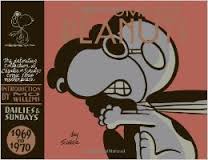
[READ: December 8, 2015] The Complete Peanuts 1969-1970

I was excited to get to this book to see which strip was published on my birthday (it’s sort of like seeing the headlines from the New York Times on your birthday).

Well, sadly, my strip was kind of boring–part of an annual be kind to animals or national dog week or something like that.  Nothing life-changing or earth-shattering.   Good grief.

I also decided that I’m taking a break from Peanuts for a time.  I have really enjoyed what I’ve read, but I need a breather.  I have read twenty some years of the strips over the last few months and, even if Schulz never rested, he didn’t condense twenty years into a few months either.  So sometime later in 2016 I’ll resume the books.

This book is notable for revealing Woodstock’s name!  I feel like that was the last big revelation that we’ll see for a while.  I am curious to see if the 70s added any new characters. (Well, there is Marcie.  I wonder when she comes along).

1969 starts out with Lucy saying that this is her year, “it’s all mine.”  Although a few days later she asks for a refund.  Lucy finally gets fed up with Schroeder and not only kicks his piano but throws it into the kite eating tree.  In March of 1970, Lucy says “I’m a new feminist.”

There’s a lot of Lucy/Snoopy rivalries.  In May 1969 we see the first an only reference so far to tether ball–Lucy is great at it (until Snoopy beats her).  There has been a somewhat recurring joke about Lucy beeping Snoopy on the nose (which he hates).  She does it in April and says it has been 384 days since she did it last (I wonder if anyone confirmed that).  In June, Charlie and his family go on vacation and Lucy is in charge of Snoopy (and she is particularly harsh).

Los of things happen to Snoopy this year.  As is per usual, Snoopy is skating in the winter time.  He is planning to win trophies (skating with Peppermint Patty–although she has to break the news that she is not interested).  He is also in preparation (in March 1969) to be the first beagle on the moon (wearing an astronaut helmet).  Surprisingly, there is no acknowledgement when the first man does land on the moon.

In April 1969, Snoopy goes on a two-week journey looking for his mom (but doesn’t find her).  In July of 1969 Snoopy takes up roller derby (for a very brief time).  In September of 1969 Snoopy finishes his first novel and submits it for publication. But he is rejected!  In Sept 1969 there are a lot of football jokes involving Snoopy and the little bird (the bird being too small to move a football of course).  March 1970 shows the return of the Easter beagle.

1969 sees a lot of talk of “Head Beagle.”  First Frieda reports Snoopy to the Head Beagle for not chasing rabbits.  Later Snoopy is appointed Head Beagle but can’t handle the workload.

In the summer of 1970, Snoopy goes to give a speech at the Daisy Hill puppy farm and a riot breaks out with tear gas!  And in September 1970 Snoopy wears a cooper bracelet to cure his arthritis.

In July 1970 Snoopy reveals a good truism “If you think about something at three o clock in the morning and then again at noon the next day you get different answers.”  Also in July is the first mention of “The Six Bunny-wunnies” fictional series of books.

For a few weeks in August of 1970 Snoopy pretends to be a grocery clerk (butter 28¢, bread 39¢, eggs 59¢, tea 79¢).

Lots of things seem to happen on the baseball field this year.

And in April 1969 Charlie Brown’s team wins two games in a row–neither team could make it so they both forfeit (Franklin is on one of those teams).  Later in June of 1969 Snoopy wins the Rookie of the year award for the baseball team.

In March of 1969 Linus make a sports drink which “replaces the body stores and prevents and diminution of vitally needed electrolytes and nutrients.”  (Gatorade was invented in 1965 and became popular with athletes in 1967).

Some great moments in this book:

In May of 1969 (on the baseball mound, of course) the team is talking about the costs of college “it can cost almost sixteen thousand dollars to go to college.”  The joke comes that Charlie is hoping for a baseball scholarship and every one busts out laughing.

In May of 1969 the school nurse is going to weigh them and Linus says he’s going to as about his hurting shoulder, “never pass up a chance to get a little free medical advice.”

In August, Linus’ gramma says she’ll donate $10 to his favorite charity, “ten dollars is a lot of money.”  (He ultimately decides not to accept).

In July of 1969 the little red-haired girl moves from Charlie’s street!  And Charlie never says anything to her.  Later in December 1969 Linus Charlie and Snoopy go skiing (on a school ski trip).   Charlie sees the little red-haired girl and falls off the ski lift.

Charlie makes a funny joke when he offers to shovel Lucy’s snow.  He asks for a quarter and she says “What if it snows tomorrow and covers up our walk again.  Do we get our quarter back?”  He replies, “No by then I will have spent it on riotous living.”

Peppermint Patty gets a lot of strips in these two years.  In Nov 1969 she talks about school: “I signed up for Folk Guitar, computer programming, stained glass art, shoemaking and a natural foods workshop.  I got spelling, history, arithmetic and two study periods.  I learned that what you sign up for and what you get are two different things.”  (I would TOTALLY sign up for those classes too).

She returns a lot in 1970–she’s a great character allowing Schulz to explore all different kinds of kids and ideas.  In the beginning of 1970 she is called to the principals’ office because she’s not allowed to wear sandals to school any more.  She cries and calls Charlie Brown for advice.  It takes Snoopy to kiss away her tear to snap her out of it.  The strip series ends with Franklin saying, “All I know is any rule that makes a little girl cry has to be a bad rule.”

Patty also says that she got an F on a test because she has a big nose–if a teacher doesn’t like your looks there’s nothing you can do.  Franklin looks at the paper and says “you turned in a blank test paper.”  She sighs, “there’s nothing you can do.”

In December 1970 Peppermint Patty invites Snoopy to a “turn about dance” (where the girls ask the boys).  They have a good time until a boy asks who her weird-looking friend is.  She punches him out and feels guilty about it until Snoopy says he had a great time and he’s the one who bit the chaperone.  Their friendship is great.

In Sept 1970 Patty has a crisis–thinking she’s not beautiful  (then Snoopy gives her a kiss).  The following week her dad gives her a dozen roses and says that the boys will be calling on her when she grows up and he wants to be the fist one in her life to give her a dozen roses.  It brought tears to my eyes.

In June of 1970, Peppermint Patty asks to borrow Charlie Brown’s glove for a kid on her team named “Thibault.”  Which leads to Charlie asking “Thibault?” at least twice.  Then Thibault (who has sideburns), refuses to give the glove back.  But Charlie Brown is happy by this because Thibault accuses him of “thinking you’re better than us.” And Charlie gleefully says “Me?  Better than someone else?”

1969 ends for Charlie when he buys a ticket to a sports awards dinner.  He gets a seat right next to Joe Shlabotnik…who never shows up.

This strip really sums up why Charlie Brown is so likable.  On October 26 in which Linus describes an amazing football game in which a team makes an amazing come from behind victory with seconds left in the game .  He describes the great plays and then Charlie’s response is “How did the other team feel?”

Sally is starting to become a more fully developed character–opinionated but often horribly wrong.  In May of 1970 she buys a fish tank saying “This is the age of aquariums.”  And she has no tolerance for school.  In Sept 1970 she asks why they have to learn all of these things in school.  Why does she have to learn the names of rivers?  “I’ve never even seen a river!  They could at least take me to see a river.”  Later she writes a theme for school, “If I had a pony:”  “If I had a pony I’d saddle up and ride so far from this school it would make your head swim.”  Then she crumples it up and says “That’ a good way to get a D-minus.”  In Nov she shows the class a document that is written by “an actual caveman.”  The punch line: “Show and Lie is my best subject.”

The best Great pumpkin joke comes in Oct 1970 when Lucy says “Santa Claus has elves to help him…what does the great pumpkin have, oranges?”

There are a couple of topical jokes.  In July 1970, when it rains during a game Lucy starts singing “Raindrops Keep Falling on My Head” (which was a hit in early 1970).  And in December 1970, the kids use a Ouija board which had been released as a game earlier that year.

And then on June 22, 1970 the little bird reveals his name to be Woodstock!  (strangely it was a year after the concert).  With a name he acts no differently.  In Nov 1970 Woodstock tries to fly south but gets lost.  So Snoopy walks with him.  After a week they get grabbed by a girl who say “Ma, I found a stray dog!”  Then Snoopy is tied up for a few days while Woodstock tries to rescue him.

The year ends with Sally doubting whether you really have to be good for Santa to bring you presents “the old rascal is bluffing…I know that [he] will bring me presents whether I am good or not.”  Then on Christmas Day, ”I was right!”

This was a great book, with some excellent strips and character developments.

Mo Willems, beloved children’s author, wrote the foreword.  Mo says he started his career by selling black market drawings of Snoopy and Charlie Brown in second grade.  He learned that even bullies liked Charlie Brown.  He says he could utterly relate to Charlie’s world, “For me, an immigrants kid, recently plopped into the middle of a small school in the insular world of uptown New Orleans, Charlie Brown was the only one who understood how confused and unhappy I felt.”

He says he aspired to Linus-ness: to be wise and kind and highly skilled at making gigantic structures of playing cards.  But he knew he was always a Charlie brown.  “Sometimes when I am in a deep funk and feel like my life if is an uphill battle…I try to stop and imagine someone reading the comic strip of my frustrated life and laughing.”

All of his characters are an homage to Schulz in some way.  And the greatest lesson her learned from Schulz, is “never let the characters know they are funny.”

He concludes by saying that Peanuts isn’t Art… it’s better.  He toured the Charles M. Schulz Museum and Research Center and held an original comic but he found it anti-climatic.  They were too precious to be enjoyed…they became Art.  The magic that you get from having them in a book or newspaper was missing.

Read Full Post »
resist3SOUNDTRACK: CHARLIE SIEM-Tiny Desk Concert #134 (June 15, 2011).

siemWhen he was 3 years old, Charlie Siem heard violinist Yehudi Menuhin play Beethoven’s Violin Concerto. That was all it took to inspire him to pursue the violin. Siem studied at Eton and the Royal College of Music, and now he plays one of Menuhin’s old violins—a stunning 1735 Guarneri del Gesu.  Upon describing this centuries old instrument he says “it helps me a lot when I’m doing my… little thing.”  He is also greatly amused when NPR’s Stephen Thompson asks if he can borrow it.

Siem recently discovered that he’s related to the 19th-century Norwegian violin virtuoso and composer Ole Bull. So he started off his Tiny Desk show with Bull’s bucolic Cantabile.  His introduction is great.  He says that Bull was a precursor to Paganini, who emigrated to the States and set up a colony on Pennsylvania.  He calls him a “really crazy guy.”  It’s a beautiful piece with occasional really high notes.  This violin seems to have an unreal sound to it, bringing it what sounds like harmonic notes or something.

Paganini’s Introduction and Variations on Paisiello’s “Nel Cor Piu”  (an aria from a now-forgotten Paisiello opera), contains a grab bag full of violin special effects.  This is just incredible.  His fingers move faster than can be believed.  There are trills all up and down the neck, there’s pizzicato plucking with his left hand (how?).  In a section of “harmonics” he even whistles the final note.  It’s amazing to watch.

Leopold Godowsky: Alt Wien (“Old Vienna”) (arr. Heifetz)  This is a lovely piece with lots of high keening notes in an arrangement by the incomparable Jascha Heifetz.

It’s amazing that Siem can be so good and yet somehow I’d never heard of him.  His kind of virtuosity is amazing.  And, as it turns out he’s a total hunk with a deep resonating actor’s voice as the pages of Italian Men’s Vogue magazine.  He’s also the 2011 spokesman for Dunhill, the men’s fashion house.  The write up says that for his Tiny Desk Concert appearance, you could say Siem dressed “casual, but with an understated elegance,” right down to his left-hand pinky, with its pink-painted fingernail.

I definitely need to hear more from him.

[READ: December 8, 2015] Victory

This final book in the trilogy sees the culmination of French Resistance against the Nazis.

We learn in the introduction that it has been four years since the occupation began and although victory seems within sight, things have been getting worse.  There’s hardly any food or resources and the Nazis are growing even more angry and vicious.  On June 6, 1944 the Allies landed in Normandy.  But they had a lot of fighting to do before they could liberate Vichy.

As this book opens we see Paul called into the prison because of his drawings.  He looks older now (a great detail on the drawing) and he finds it much easier to lie to the guards.  After an interrogation, Lucie’s father–the policeman we saw in the previous book who seemed to turn a blind eye to Paul’s activity–accuses him of sneaking around to see Lucie.  Paul catches on quickly that the man is helping him and when they are free together, Paul learns that there are people on his side who he never suspected. (more…)

Read Full Post »

resist2SOUNDTRACK: SIERRA LEONE’S REFUGEE ALL STARS-Tiny Desk Concert #118 (April 6, 2011).

sierraSierra Leone’s Refugee All Stars are famous for their story.  Its members met in refugee camps during Sierra Leone’s civil war and formed a band to spread joy during an otherwise difficult time.  But the band’s music is what has stood the test of time.  Ten years, two albums and an award-winning documentary later, these eight men are still riding that upbeat reggae groove.

The band consists of three drummers (all with hand-held drums) and one percussionist.  There’s 2 guitars (one electric and one acoustic) a bass and everybody sings.  Their music has a reggae feel, although it’s not exactly reggae, I don’t think.

“Jah Come Down” opens the show. The acoustic guitar keeps the melody while the electric guitar plays a riff throughout.  Occasionally the bass comes in with a cool line or two adding a nice low end.

“Living Stone” has a different singer (the percussionist).  His vocals are a bit more mellow, as this song is.  It’s amazing to see the age range of the players.

“Tamagbondorsu (The Rich Mock The Poor)” is the final song.  It opens with a guitar lick that reminded me of Paul Simon’s Graceland until i re-thought and realized that Graceland sounded like this.

The songs are fun and lively, perfect for dancing (as the singer does during the long instrumental outro).  Most reggae sounds the same to me, and these three songs do tend to blend together quite a lot.  But the music is fun and the players’ skill is undeniable.

Here;s to ten more years.

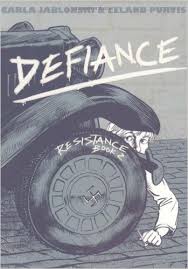
[READ: December 4, 2015] Defiance

This book is set three years into the Nazi occupation of France.  Things are sort of the same but worse for the residents of Vichy.  Neighbors inform on neighbors, and some residents collaborate with the Germans (and are more successful because of it).  And then in 1943, a new French-based Nazi police force called the Milice begin keeping watch over their own people

This aggressiveness causes more resistance, of course. And Paul has been drawing detailed and insulting pictures and posting them all over town (which is making the Milice quite upset).

Of course the kids are taking more aggressive stances now, too.  Some say that the posters are causing more harm because it makes the police mad.  But other kids’ parents have joined the police–some of whom are nice to the kids.  Even Paul’s sister, Marie, believes what her teachers say about Marshall Philippe Pétain (there’s a lesson about Pétain at the end of the book) and his governance.  And no one is going to say anything about the Resistance.   (more…)

Read Full Post »

« Newer Posts - Older Posts »