Feeds:
Posts
Comments

Archive for the ‘Feu Therese’ Category

clowns SOUNDTRACK: LE FLY PAN AM: N’écoutez pas [CST031] (2004).
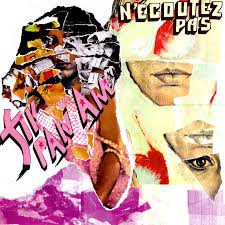
flypanam31N’écoutez pas (Do Not Listen) was the third and final full length album from Constellation’s Fly Pan Am (or in this case Le Fly Pan Am).  There are several short tracks on the disc as well as two 11 minutes songs

“Brûlez suivant, suivante!” (Burn Next, Next!) Opens the disc and hints that it’s going to be a standard rock album—4×4 drums and a dense buzzy electric guitar.  And even when the song proper starts, there’s chanted worded in French and some noisy guitar—its very far from the bass and funky glitchy stuff of previous albums.  The song has very conventional element—a drum break where one might clap along and what sounds like people singing lalalalalala, but all under a veneer of noise and decay that makes it anything but poppy.  There’s a deep voice speaking insistently in French and way in the background a person screaming.  So, really it’s rather unconventional, but within a relatively “normal” framework.  “Ex éleveurs de renards argentés” (Ex breeders silver foxes) is the noise of completely detuned guitars getting plucked and strummed for 30 seconds until a piano plays a chord and all else stops.  It seems like a song will begin but, no, more noises—industrial waves and cars honking takes over.  And then a cacophony of voices begins talking all over each other (including a couple in English).  It’s all over after about 2 minutes.

“Autant zig-zag” (As much zig-zag) is a totally apt name for this song.  This is the first 11 minute track.  After a minute or so introduction, the song comes in with a propulsive bass (not funky at all like the last album) and the song feels like it’s ready to rock.  And it does.  It keeps up this rhythm for a bit and then shifts to a new part with wordless vocals.  There’s even a call and response section with sung words and ooh ooohs as response.  The song shifts to a kind of pummeling section that continues for several minutes until the end.  It contains pretty much everything the band does.  “Buvez nos larmes de métal” (Drink our metal tears) is a noise collage with dramatic movie soundtrack type music played behind the static and distant voices and noises.

“Pas à pas step until” (Step by Step until) has a commanding one, two, three, pause, four, riff going on that is at once catchy and noisy.  The song proper comes in with whispered singing and a wild bass line.  Alexandre St-Onge contributes his wonderful chaos to this song which has some really catchy backing vocals in it

“…” opens side two with what sounds like a voice repeating Fly Pan Am over an over amidst the sound of someone else chewing.  It segues into “Très très ‘retro'” “Very Very ‘Retro’” is the other 11 minute song.  It has two guests, Dominique Petrin on vocals and Tim Heck on electronics.  The song opens with a high-pitched bass and some great counterpoint rhythms.   There’s more hidden vocals throughout the song  Around three minutes in, the bass gets funky.  This runs on for several minutes with some interesting sound effects thrown in until there’s a loud pop and silence.   And then another pop and organ music takes over.  At about 9 minute the song resumes the funky bass line. Again, the band has crammed a lot of stuff into this song.

“Vos rêves revers” (Your dreams setback) has a nice bass sound with some ringing guitar notes.  There’s whispered vocals that sing a melody of sorts.  It’s a fairly conventional song—catchy and bouncy with vocals and everything (true they are whispered and hushed vocals but they do follow a melody line).  At about 4 minutes (of 6), the songs crashes unto itself with the drums and the guitars seeming to fall apart

“Ce sale désir éfilé qui sortant de ma bouche” (This dirty tapered desire coming out of my mouth) has a deep echoing drum kick which keeps a beat.  In the distant background a keening voice kind of follows the melody.  The disc ends with “Le faux pas aimer vous souhaite d’être follement ami” (The false not love you madly want to be friend).  It’s a one minute song with sliding guitars and rock drums which propel this to as close to punk as the band has gotten.  There’s chanting and excitement and fun and then the whole song unravels after about 40 seconds at the end with a sloppy piano denouement.

And that was it from this avant-garde band. The members went on to make lots of other music, Jonathan Parant went on to form Feu Thérèse. Felix Morel has played drums with all kind of interesting bands including Et Sans.  Roger Tellier-Craig has been in Et Sans and Set Fire to Flames among others.  And Jean-Sebastian Truchy has played in several bands including Avec le soleil sortant de sa bouche.

[READ: February 6, 2016] City of Clowns

In the afterword to this book, Alarcón explains how it as written.  He lived in Lima, Peru for a year, teaching.  But while he was there, he had writer’s block.  So he moved to a farmhouse in the middle of America–pure solitude.  And there he wrote the story “City of Clowns” (which I read back in 2013 in the New Yorker) in English.  Sheila Alvarado talked to him about turning the book into a graphic novel.  And so it was completed (after much labor, he says) in a slightly condensed Spanish edition to be released in Spain.  And then, eventually, it was translated into English again, from the Spanish graphic novel.

Since the story really doesn’t change from the short story version, I’m going to put my original comments here:

It opens with Oscarcito going to the hospital because his father died the night before.  He finds his mother mopping floors because his father’s bill was unpaid.  And in that very first paragraph, she introduces her son to Carmela—the woman whom his father left them for.  She was mopping the floor with Oscarcito’s  mother.  He is confused and enraged by this.

His half brothers are also there.  He had never met them before, preferring to stay away from his father’s other life.  But he saw them in front of him and clearly saw that they were related to him.  But the most galling thing was that although he was the oldest of all the children, they were clearly the chosen children—after all, his father stayed with them.

Then we learn about his father’s life.  He was born in Cerro de Pasco and moved to Lima when his young family was still young.  He worked hard in semi-legitimate businesses and then brought his family to the city.  Young Oscarcito, age 8, loved it.  But his mother hated missing her family in Cerro de Pasco.  And now they were living with his father who was practically a stranger. His father worked hard and succeeded, but he was rarely home.

Between flashbacks to his father’s story we see that Oscarcito is now a reporter for the local newspaper and he has been asked to write about the clowns that are prevalent around the city.  Oscarcito is on a bus when a clown approaches.  The clown is pelted by water balloons but still manages to climb aboard the bus and peddle his wares—gaining a few coins for his “act.”  Oscarcito is not interested in the subject and puts it off.

So he travels to his mother’s house to see how she is doing, but a neighbor there tells him she has been living with Carmela since his father got sick.  His mother was embarrassed by this and asked the neighbor not to say anything to him.

His mother had been a cleaning lady since they moved to Lima.  She worked for the Azcártes, a wealthy local family who treated her very well and treated Oscarcito practically like their own son.  Oscar was even sent to a nice school where he was welcomed until they realized where he was from.  Gangs would steal anything from anyone, and were called Piranhas.  And that became Oscar’s nickname at school.  And soon he was made fun of by just about everyone, but especially by one boy.

A flashback then shows that Oscarcito went to work with his father doing construction on a few occasions—they worked very hard on expansions of people’s houses—working hard and working well and making good improvements.  But all the while, they were waiting patiently until they could rob them of all of their fine things.

So when he found his father was working for the father of the boy who made fun of him, he wanted in, and he stole the boy’s suit.

Finally, after putting off his article for ages, Oscarcito meets and interviews a clown.  And that clown tells him how he started and invites him along.  And Oscarcito does.  He finds that he likes the anonymity of the job.

All of the threads come to a head as the story reaches its close—where Oscar will confront his mother and deal with his newfound joy at being a clown.

The ending was very powerful and I enjoyed this story immensely.

There are few details from the original story that have been changed (and I amended my comments accordingly).

There is also an extra scene added of him dating a girl named Carla who walked on stilts.  There’s an erotic moment which is really interesting and which brings a whole new level of fascination to Oscar’s clown life.

Obviously the biggest change is Alvarado’s illustrations.  She does an excellent job recreating these scenes much as I imagined them.  I really  enjoyed the way she worked within the mens’ professions–putting words on bricks as his father was laying them, hanging papers up to dry with text on them, and using excellent distinctions of black and white to show the different settings in Oscar’s life.

The biggest change I think is the depiction of Oscar in his clown suit.  It’s nothing like I imagined and is all the better for it.  Alarcón says that now this is “its true and definitive form” of the book, and I imagine that this is what I will think of when I think of the story.

For ease of searching, I include: Daniel Alarcon.


Read Full Post »

clockworkSOUNDTRACK: FEU THÉRÈSE-Ça Va Cogner [CST049] (2007).

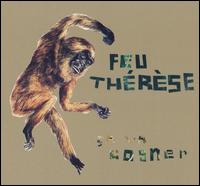
feu2Bands change sounds from one album to another all the time, but few as radically as this one. From weirdo psychedelic band to French new wave pop band, from 6 minute instrumentals to 2 and 3 minute songs with vocals.


At times the album feels like Kraftwerk meets Serge Gainsbourg (which I know is an unfair reduction, but when your singer mostly talk/sings in a deep French voice, the comparison is apt.  And yet the album is fairly poppy and catchy as well.

“A Nos Amours” opens the disc with three minutes of synth happiness. It even has a section where the music drops out and the bass resumes its place.  Recall in their debut that at 4 minutes of each song something radically different happened.  Now the songs just end. “Visage Sous Nylon” features the more Kraftwerk sound—but it’s an almost organic Kraftwerk (which I know makes no sense but there it is). “Les Deserts des Azurs” has a kind of Tangerine Dream feel with washes of analog synths.

“Le Bruit du Pollen La Nuit” has a weird kind of synthy 70 s rock feel but the music almost drops out entirely (but not quite) while the vocals (in French) are spoken. It feels like it’s mocking and serious at the same time.  It’s also got a discoey chorus singing “You’re just a just a just a pretty boy!”

“Nada” has a synthy almost disco feel.  “Ça Va Cogner” is just over 5 minutes long and consists of various delicate swells of synths.  I kept waiting to hear The Beach Boys “Wouldn’t It Be Nice” burst forth from the waves, until about half way in when it turns into a simple delicate melody and a children’s chorus. “Les Enfants” is a simple ditty with hummed lyrics.  It’s poppy and catchy as anything

“Ferrari en Feu Pt. 2” is a fast synth songs with slap bass. (Part 1 was on the debut and sounded nothing like this).  “La Nuit Est un Femme” is a slow synth track with a female backing vocals over a sung male lead. The end of the song adds some loud textures to this otherwise sweet song bringing in some really interesting tensions.  The disc ends with “Laisse Briller Tes Yeux Dans le Soleil,” a synthy instrumental that ends with cheesy charm.

This album is really wonderful–surprisingly catchy and dancey and yet exotic enough to not sound like anything else that (most) people are familiar with.  All of the Constellation albums are streaming on their site, but this one is especially worth checking out.

[READ: April 15, 2014] Tales from the Clockwork Empire Book 1

I was very intrigued by this book because of the steampunk nature and because I have a strange fascination with clockwork ideas–a technology that is precise and interesting yet which never really took off beyond clocks and small toys because other technologies were more powerful

I thought that the cover was kind of interesting with this gigantic metal head holding ball.  But on closer look the man in the ball was very poorly computer rendered and that should have been a tip off.  For all of the people in the book have this same unfinished-rendered look.  It looks a lot like storyboards of unfinished versions of Pixar films.  I mean, really cheesy and really unfinished and really unsettling. This is especially noticeable on the rendering of Napoleon Bonaparte in the “end credits” of the book.

I hate to harp on the graphics, but this is a graphic novel after all.  All of the non human elements looks fine, many look even better than fine, bordering on photo realistic.  But the humans all seem ugh, creepy and stiff and just dropped on top of these scenes.  It is terribly distracting and may even make the dialogue feel stiffer than it actually is.  Because the dialogue felt very stiff and mechanical as well.

It is the kind of story that seems historically accurate in the details and works very hard to let you know that it is accurate.  Indeed, in the end of the book Duerden goes to great lengths to show the accuracies in the writing.  But there’s so little flow in the dialogue that it seems like a lecture.  Basically the entire book feels like, not a first draft, but like the draft before the final draft.  Like the book is going to go back to have a final polish to make the dialogue breezier and make the pictures look better.

This is all a shame since I haven;t eve talked about the story yet. (more…)

Read Full Post »

half pastSOUNDTRACK: FEU THÉRÈSE-Feu Thérèse [CST040] (2006).

feu1Feu Thérèse is a band created because of the hiatus of Le Fly Pan Am.  They offer a melange of styles, as befits the visual arts origins of several of the members.  And yet, there is a solid rhythm section that grounds the band in a wonderful way.

“Ferrari en Feu” opens with 3 minutes of pulsing waves of synths and electronic bird-call-like sounds. It’s unclear exactly what you’re listening to and it seems like the whole album will be a kind of ambient collection.  Then a proper rock song kicks in with chords and notes and drums–it has a cool psychedelic vibe and feels very late 60s.  “Mademoiselle Gentleman” has pulsing bass notes and staccato guitars with a layers of distorted laughing throughout (there’s no “singing” on the first two songs). At around 4 minutes (out of 6) the feedback squalls too and a simple steady beat.

“Tu n’avais qu’une oreille” seems like a traditional song–with singing (in the Serge Gainsbourg, dirty old man style of whisper/singing) which has a middle section that is quite conventional (with ahh ahhs) but again at 4 minutes, the song shifts into a faster drumming section (with more spoken words).  But then a lengthy trippy guitar solo shatters the mellowness.  “L’homme avec couer avec elle” starts with what sounds like horns.  At around 4 minutes in turns into a kind of western but with a crazy clarinet solo accompanied by sped up noises that sound like Pink Floyd’s Ummagumma.  There’s more psychedelic Pink Floyd styles on the final track, “Ce n’est pas les jardins du Luxembourg.”  The song opens with “drips” that sound like “Echoes.”  And then there’s more Ummagumma birds/animals (possibly distorted seagulls?).   At (yes) 4 minutes it turns into a trippy psychedelic organ based song (with Indian music as well).  The song is 12 minutes and leaves no sound unheard.

The music is experimental but it is not terribly “difficult.”  It’s actually quite a fun album which demands multiple listens.

[READ: April 24, 2014] Half Past Danger

The tagline for this book (which is presented like a movie in a number of ways) is Dames. Dinosaurs. Danger.  And the cover features a giant Nazi flag in flames.  Sounds like pulp genius to me.

And so it is.  Stephen Mooney has been an artist for some great graphic novels over the years and this is his first book that he wrote on his own, based on a labor of love–having Nazis fight dinosaurs.  Like a dream come true.

So obviously, this is a story of an alternate past.  Set in 1943 in the South Pacific, an Army battalion is tracking an area when they discover a secret Nazi base.  There are not supposed to be any Nazis this far east, and yet there they are.   Sergeant Tommy “Irish” Flynn is surprised but he gets his team ready to take pictures and prepare a report.  But that loud rumble sounds like the biggest tank they have ever heard.  And then out steps a T-Rex (in a great reveal).  The T-Rex wipes out all of Irish’s company.  Irish escapes with a few photos and little else.

We jump cut to two months later where Irish is drinking in a bar in New York City.  In walks General Noble of the USMC and Elizabeth Huntington-Moss of British MI6.  They request his service.  He tells them to fuck off.  Actually no, he doesn’t.  This is a PG13 story, there’s a few “shite”s and an occasional “damn” but it is squarely in the realm of comics–implied sex, a lot of blood and a few mild words.  A brawl ensues, in which a Japanese fighter helps out Noble & Moss.  And soon Irish is recovering and being told what’s going on.  After some string reluctance, Irish agrees to go back to the island.

Noble proves to be a supremely tough and string fellow.  The Japanese soldier has defected to the U.S. after the non-respectful attack on Pearl Harbor.  And Moss is an enigma.  As they approach the island, there is plane trouble and a wonderfully cool scene in the water (which I won’t spoil but the art and graphics are terrifying and wonderfully drawn and colored–Mooney did the colors for the first chapter, while Jordie Bellaire did the other five).  (more…)

Read Full Post »

SOUNDTRACK: FEU THÉRÈSE-Ca Va Cogner [CST049] (2007).

I struggled ever so much over what disc to attach to this book review, thinking that any disc would be seen to have some correlation to Obama.  So, why not just go all out: a Canadian indie band that sings in French!

This is Feu Thérèse’s second disc.  It comes from Constellation records, home of noisy, lengthy, downbeat records.  In fact, Feu Thérèse is chock full of some of the big names in the Montreal underground: Alexandre St-Onge plays with noisy bands like Shalibi Effect and Jonathan Parant comes from noisy bands like Le Fly Pan Am.  So, how did all of these factors possibly unite to make this disc?

Ca Va Cogner sounds like a analog synth party from 1980!  The whole ensemble would be completely and utterly cheesy if the secret ingredient (which I cannot identify) did not make the whole thing work so well.  The whole disc seems to be washed over with these groovy synths. I want to make comparisons to Kraftwerk, but that seems a little too cold.  All of these songs are warm and soft, there’s even a children’s chorus on one of them.  Other songs are instrumental, or have minimal singing.  And “Le Bruit Du Pollen La Nuit” has a wonderfully smutty sounding spoken word track that recalls, of course, Serge Gainsbourg at his naughtiest (although I have no idea what this song is actually about).

I think what saves the disc from just being an 80’s French Europop band is the guitar and bass interplay.  Those two guys take a lot of the sounds that they’ve mastered in their respective bands, and play them beneath all of the synths.  It undercuts the intentional cheesiness of the keyboards with some awesome textures, and really brings everything to a remarkable whole.  This probably won’t be anybody’s favorite disc, but it is very enjoyable, and worth tracking down, especially if you’re a Francophile.

[READ: October 15, 2008] The Audacity of Hope

Since I’ve been for Obama since the beginning, I figured I ought to read his book.  It seemed especially apt now, since the McCain campaign is saying that we don’t “know anything about” Obama. Well, if you read this book, or, I suspect his OTHER autobiography, you could learn quite a bit about him.  Unlike some other people who don’t grant interviews, hmmm.  Okay, I had thought I would be able to review this book without referencing the current campiagn or the upcoming election, but it is simply impossible.  Please deal with my Partisan Review. (more…)

Read Full Post »