Feeds:
Posts
Comments

Archive for the ‘Black Flag’ Category

SOUNDTRACK: BLACK FLAG: The Process of Weeding Out (1985).

Fans of Black Flag were (justifiably) freaked out by this EP.  It’s a four songs that clock in at almost 30 minutes (from the band who gave us the one-minute long hit “Wasted”).

This album is all instrumental and it provided Greg Ginn yet another outlet for his experimental guitar workouts (see also: Gone, October Faction, Saccharine Trust, Tom Troccoli’s Dog etc.)

So what you get is Kira’s fantastic and unusual bass riffs (she did amazing work with Black Flag), Bill Stevenson’s intense (and cymbal fueled) drums and Greg Ginn’s what the hell? guitars.  I’ve always found Ginn’s guitar work to be somewhat off.  It always struck me that maybe he didn’t exactly know how to play the guitar.  And yet he was always right on with his riffs and chords, it’s just that his solos never conformed to any standard version of guitar solo I’d ever heard.

So this EP comes across more as fee jazz than punk.  “Your Last Affront” is 9 minutes of chaos all under-girded by an interesting if unconventional riff.  It’s followed by the two-minute “Screw the Law” a much faster song, with an intense riff repeated for much of it.  The last 30 seconds or so has some screaming solos from Ginn, but of all the tracks, this is probably the most user-friendly.

The second side has the title track starts with a lengthy solo from Ginn.  A few minutes in, Stevenson’s drums come clacking around the place and Kira is somewhat relegated to the back as her bass is steady but not that exciting.  Until about 3 and a half minutes in, when the band takes over and Kira plays a super cool riff and when Ginn joins in, the song is really solid.  “Southern Rise” ends the disc with 5 minutes of relative quiet.  Although the main instrument appears to be the drums.

The whole things sounds like they were jamming in Greg’s garage.  And I’ll bet lots of fun was had in that garage.

[READ: March 15, 2011] three items about what didn’t make it into Infinite Jest

In honor of The Pale King’s release this week, I’m doing this post on Infinite Jest-related stuff.  This is all of the stuff that we lay people have access to without going to the Wallace archives to find all of the cool DFW stuff.

After finishing IJ this summer, I found out that it was initially much much longer (I think around 300 pages longer).  I grew mildly obsessed with wondering what had gotten cut.  And I had to wonder, if you have an 1100 page book, what difference would an extra 500 pages make, really?  Initially, I thought that the things that were cut were just minor changes, but then I heard about fairly large things that were removed.  And I dreamed of a “director’s cut” of the book.  That will never happen, and that’s fine (I’m less obsessed now).  But these little glimpses into scenes that didn’t make the book are fascinating.

And all told, they confirm that most of the cuts were minor, although there were some large scenes that were left on the cutting room floor. (more…)

Read Full Post »

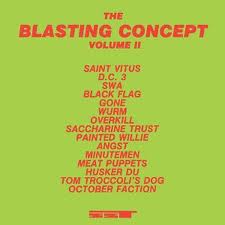
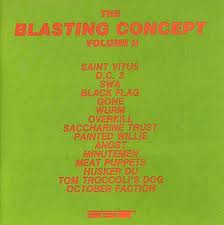
SOUNDTRACK: THE BLASTING CONCEPT Volume II (1985).

I listened to this collection of (then) old and new SST artists almost nonstop the summer I bought this.  I remember my friend Al disliking it quite a bit–except for Hüsker Dü, of course.  (I wonder if he would change his mind about any of it now).

This LP was a kind of transition record from the standard bearers of SST (Black Flag, Hüsker Dü, The Minutemen) to the then new young bands (DC3, Angst, Gone).  The Allmusic review dismisses the disc out of hand, but I think that the disc has held up very well.  I didn’t follow SST records too closely in the 90s so I’m not sure what they were doing, but for whatever reason, most of the bands that the average listener hasn’t heard of were dropped (and sadly most of those discs are long out of print, some never released on CD at all–MP3s do appear to be available). The exception of course is any band that Greg Ginn played in (which is most of them, actually), which he of course has kept in print on SST.

SAINT VITUS-“Look Behind You” This song opens the disc and seems to introduce right away that SST is no longer just a punk label.  This is a very metal sound with a wah wahed and fuzzed out guitar all the way through.  It’s mixed in a weird way (which could be SST), which undermines the real heaviness and actually adds some cool effects.

DC3-“Theme From an Imaginary Western” as mentioned, an awesome track.

SWA-“Mystery Girl” a fuzzy distorted track.  It’s heavy, but not very heavy.

BLACK FLAG-“I Can See You” is one of those Black Flag tracks that is all about Greg Ginn’s weird guitar.  He plays a simple melody out of tune with crazy guitar solos over the top.  Rollins is on vocals which are mostly spoken here.  It’s a bizarre throwaway kind of song that I really like.

GONE-‘Watch the Tractor”  This is a wonderful instrumental.  High speed with a great riff that propels about half of the song.  The other half is a heavy kind of mosh that breaks up the proceedings nicely.  This is one of the few bands that no one has heard of from thee days of SST that actually have the album still in print (because Greg Ginn is on it).

WURM-“Death Ride” is not a very good song, but one which I always liked for its simplicity and stupidity. The screamed chorus is really catchy.

OVERKILL-“Over the Edge”  This is not the famous metal band Overkill, but a different metal band named Overkill who got shuffled aside by the (arguably) better, bigger one.  This is the only song I know from this Overkill (now known as Overkill L.A.) and I really like it.  It has a great riff and vocals like Lemmy.

SACCHARINE TRUST-“Emotions and Anatomy” is one of several odd, improvised tracks on this compilation. It seems like perhaps everyone is playing his own thing and the lyrics are some strange little rant.

PAINTED WILLIE-“The Big Time” is more raucous style of song, reminiscent of earlier SST recording.  The most interesting part comes at the end with the falsetto voices threatening to take over the song.  They play a kind of sloppy punk-lite that would likely be very popular today.

ANGST-“Just Me” After DC3 this is my second favorite unknown song on the album.  It has a great bass line with some angular guitars over the top.  It actually sounds a lot like later Hüsker Dü, and there’s nothing wrong with that.

MEAT PUPPETS-” I Just Want to Make Love To You” I’ve like the Meat Puppets for ages.  And this absurd cover of the blues song is one of the oddest songs this odd band has recorded.  The solo sounds like it comes from under a volcano.  It’s not a great song (and should probably be two minutes shorter), but it is kind of fun.

MINUTEMEN-“Ain’t Talkin’ ‘Bout Love” The always awesome Minutemen engage us with this awesome cover of Van Halen’s “Aint Talkin’ ‘Bout Love.  In 1 minute they undermine all of the overblownedness of the original.  Check out the live version here.

HÜSKER DÜ-“Erase Today” This is simply fantastic.  This is an early punk song of theirs.  Catchy and fast and wonderful.

OCTOBER FACTION-“I Was Grotesque” Another weird improv piece.   It’s filled mostly with drums and strange rantings–kind of beatniky.  Here’s a live show from the band from 1984.

TOM TROCCOLI’S DOG-“Todo Para Mi”  This song has a cool riff. Although Troccoli’s voice is questionable at best.  It more or less devolves into a nonsense jam and is too long at 6 minutes.  It’s not a great way to end the album, but maybe it’s last for a reason.

[READ: March 21, 2011] “Who Am I?”

I have been hearing about Demetri Martin for a few years now.   How he’s the hot new comic. And yet I’ve never come across anything he’s done (even though I think Comedy Central repeated his shows practically on the hour when they first aired). So this short piece is my first exposure to him.  I’m going to assume it is not a fair representation of his comedy as he is normally a stand up and writing is not the same as stand up.  (That’s not to say it’s not good, just that it’s not his natural medium).

This was a short piece in the New Yorker’s Shouts and Murmurs section. It asks and answers the titular question “Who Am I?” (more…)

Read Full Post »

SOUNDTRACK: DC3-“Theme from an Imaginary Western” (1985).

This song comes from the SST compilation The Blasting Concept Volume II, which came out in 1985.  I bought it on vinyl and was psyched when it came out on CD.   This version of an old Mountain song was one of my favorite songs on the disc (I don’t even know the Mountain version very well).

DC3 was the brainchild of Dez Cadena, former singer for Black Flag.  They put out a couple of albums and then disappeared.  And yet all these years later this song has stayed with me.  For a singer from Black Flag, this song is remarkably poppy (and features a lengthy keyboard solo!).  The real treasure of this song for me comes at the first chorus.  When the band sings “Oh the sun was in their eyes…” the vocals begin in a disparate, perhaps minor key harmony, and then merge into a perfect harmony.   It gets me every time.

DC3’s records have never been released on CD, and the vinyl is out of print. There’s a live CD out, but I’ve never heard it.   So, as far as I can tell, this is the only studio song available in the world.  Maybe the albums are terrible, but DC3 will always be great because of this one track.

Oh, and someone posted it on YouTube

Thanks!

[READ: March 22, 2011] Consider David Foster Wallace [essays 13-16]

This is the final batch of essays from this collection about David Foster Wallace.  The first is about Oblivion and the last three are about his non-fiction.  Perhaps it’s because I have been reading his non-fiction a lot lately (or maybe I enjoy reading essays about nonfiction more than fiction) but I found these to be the most enjoyable essays in the book.

As I’ve stated with each post, because I don’t have a lot to say about the pieces (I’m not an academic anymore), I’m only going to mention things that I found puzzling/confusing.  But be assured that if I don’t mention the vast majority of the article it’s because I found it interesting/compelling/believable.  I don’t feel comfortable paraphrasing the articles’ argument, so I won’t really summarize. (more…)

Read Full Post »

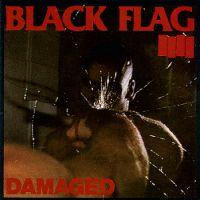
SOUNDTRACK: BLACK FLAG-Damaged (1981).

I’ve liked Black Flag since I bought Loose Nut on vinyl way back when (1985, the year punk broke for me).  And those four bars were iconic to me even before I had heard a note (although I just learned they are supposed to represent a flag waving).

And this is where their legend really took off.  So a few things I never knew about this album until I looked them up recently.  1) That’s Rollins on the cover punching the mirror.  2) He didn’t really punch the mirror (it was smashed prior and the blood is fake).  3) I knew that Black Flag existed for a while before Rollins’ arrival and that they’d had a series of singers before him.  But I didn’t realize what a their first EP (Nervous Breakdown–Keith Morris on vocals) came out in 1978, their second EP (Jealous Again–Ron Reyes on vocals–credited as Chavo Pederast (he left the band in the middle of a live show, so they changed his name to that rather offensive one)) came out in 1980.  Their third EP (Six Pack –Dez Cadena on vocals) came out in 1981.  Rollins joined a few months after that and Damaged–their first full length–came out in December 1981.

“Rise Above” is a wonderfully angry song.  The gang vocals of pure empowerment work so well with the chords.  It’s still effective thirty years later.  “Spray Paint” goes in the other direction: rather than an uplifting, catchy chorus, it’s a deliberately angular chorus that’s hard to sing along to (even for Rollins).

“Six Pack” represents the more “popular” side of the band.  And it is a wonderfully funny single.  I just can’t decide if it’s serious or ironic (see also “TV Party”).  These two dopey songs are great to sing along to and are simply awesome.  (Fridays!)

The rest of the album turns away from the lighthearted tracks.  “What I See” is a really dark moment on this album.  And the negativity is unusual especially given Rollins’ later penchant for lyrics about fighting back.  True, Rollins didn’t write these lyrics.

“Thirsty and Miserable” is a blast of noise with some of Ginn’s first real guitar solos (which Guitar World says is as one of the worst guitar solos in history…and I say really? that’s the solo they pick?  Ginn has done some pretty outlandishly bad solos over the years…of course the whole list is questionable at best).  “Police Story” is a simple but effective description of the punks vs cops scene at the time.

“Gimme Gimme Gimme” seems childish, but that’s clearly the point.  “Depression” is a super fast track.  (Trouser Press considered Black Flag America’s first hardcore band).  “Room 13” is an odd musical track, with pretty much no bass.  It’s just some roaring guitars and drums and Rollins’s screams.  This track stands out because Chuck Dukowski’s bass propels most of the songs here.

“No More” sounds “typically” hardcore: very fast with the chanted chorus of “No More No More No More No More.”  “Padded Cell” is also fast (and is pretty hard to understand) except for the “Manic” chant, but the following track “Life of Pain” features what would become a signature Greg Ginn sound…angular guitars playing a riff that seems slightly off somehow.  Compelling in a way that’s hard to explain.

It’s funny that a band that plays as fast as they did also released some pretty long songs. “Damaged II” is almost 3 and a half minutes long.  It has several different parts (and a pretty catchy chorus).  And the final song “Damaged I” is a kind of crazed rant from Rollins;  It’s one of his scariest vocal performances; he sounds really deranged.  Especially when it sounds like he just cant think of anything else to say so he just screams maniacally.  But his vocals are mixed behind the music as if he’s trying really hard to get heard.  There’s very little else on record like it.

It’s a wonderful end to an intense disc, and the beginning of a brief but powerful career.

[READ: March 25, 2011] The Life of Polycrates

I’ve been reading Connell for a few years now.  In fact, the first time I posted about his work came with a blistering dismissal of his story “The Life of Captain Gareth Caernarvon” in McSweeney’s 19.  That story is included here, and upon rereading it, I learned two things:

  • One: context is everything.
  • Two: I was totally and completely wrong in that original review, and I take it back.

But before I explain further, some background about this book.  This is a collection of eleven stories, eight of which have appeared elsewhere.  Unfortunately there’s no dates of publication included so I don’t know how old any of these stories are.

The other thing I’m fascinated about is Connell himself.  I’m not the kind of reader who wants to know a ton of details about the author, but I like a little bit of bio (or a photo) when I read someone.  The only bio that is consistently presented about Connell is that he was born in Santa Fe, New Mexico.  I’m fascinated by this because so many of his stories are set in Europe.  So I have concocted a master biography about Connell’s life and how he has lived and toured extensively in Europe, studied theology (and found it wanting) and investigated all of the world’s darker corners.

It’s this latter aspect that really altered my perception of Connell’s writing.  I’ve liked the last few things that he’s written, but I fear that I was not looking at him through the proper lens.  And this relates back to bullet point one above.

Connell writes in a world not unlike H.P. Lovecraft–a world that is unconventional, dark and more than a little twisted.  And yet, unlike Lovecraft, there is very little of the fantastical in his stories.  Rather, his characters reside in our own world (with a little chymical help from time to time), but they are all real.  They’re just not characters most of us choose to associate with.  So, reading that first story in McSweeney’s, where it was so different from all those others, I found it really distasteful.  In retrospect, I’m not going to say that it is meant to be distasteful, although some of his stories are, but it was certainly not a pleasant story by any means.

The other fascinating thing to note about this book is that all of the stories are written in short, Roman Numeraled segments.  So the title story has 35 segments.  But even some of the shorter ones has twelve or thirteen segments (sometimes a segment is just a few lines long).    I actually enjoy this style (especially when the segments introduce something totally new into the story–which many of these do). (more…)

Read Full Post »
SOUNDTRACK: KISS-KISSology: The Ultimate Kiss Collection, Vol. 2: 1978-1991 DVD (2007).

In addition to containing Kiss Meets the Phantom, this DVD contains concert footage, music videos and some interviews.  We see Peter Criss being interviewed on CNN (!) by a woman in a tank top (ah, the early days of 24 hour news) about leaving the band.   Of course, this doesn’t hold a candle to the actual music video for “Shandi” one of the cheesiest of cheesy Kiss videos.

This early 80s period is one of disco, operas and unmasking, and it is generally considered their low point.  I however, happen to enjoy this weird period.  While I acknowledge it’s not very “good,” I enjoy it much more than their mid-80s makeup-fee period.  (The often maligned The Elder has a weird kind of charm of the over-extended-effort).  So, I am of course sad that it is so under-represented here.  Although we do get a few clips from the long defunct show Fridays (I wish they would have shown more of the show itself, as it bought us Larry David and Michael Richards (and is mentioned in Black Flag’s “TV Party”, but that show seems to be locked away in a vault somewhere).

Disc 2 features an Australian tour during 1980, where the Aussies go crazy for them, and the band plays accordingly.  There’s also the final (or one of the final) shows they did with makeup.  And then the first show the did without makeup (1983).  And, naturally we see the highly undramatic “unmasking” on MTV, a hilarious attempt at TV news by the ever-flappable J.J. Johnson.

The concert in 1987, (The Crazy Nights Tour) is pretty bad.  This was a time when the band still played the early makeup songs, but they seemed to care so little about them, that it’s kind of embarrassing (Paul’s contempt for singing “Love Gun” in a way that even vaguely resembles the original is rather shocking).  Even Ace is phoning it in at best.  (Of course, Gene is a ham from the start so he’s always on).

After watching that last show I was not looking forward to the final Detroit show (The Hot in the Shade tour–a disc I liked more than most of the late 80s discs, even if the cover conceit of a sphinx with glasses is about as lame as you can get), but I was surprised at how great the band sounded.  They seem energized and like they were having a lot of fun.  Bruce Kulick definitely rocks hard (although I am a little disappointed that he felt compelled to change some of Ace’s signature guitar solos).  And it ends the disc on a very high note.

The collection ends with the death of drummer Eric Carr.  Which is certainly a downer, but seeing the shows that he played in are definitely a high point.  I’m fairly certain, however, that I can’t bring myself to watch Vol. 3 of this collection.

[READ: Week of March 22, 2010]  2666 [pg 513-564]

More deaths. I am starting to get worn down by all the murders (and I can see that I am. not. alone.) and by the cavalier attitude of the police (which is either a coping mechanism for them or just a case of simply not caring).  I am very much looking forward to Part 5!

However, there were some breakthroughs this week! One of the murderers was captured and found to be a member of Los Caciques [blackbird?] gang.  [UPDATE: 6/27/2012:  Thanks to Oscar in the comments for the update on what <<cacique>> means.]

Amidst the usual murders was a suicide.  Perla Beatriz Ochoterena, a teacher, wrote that should couldn’t take it anymore.  Juan de Dios Martínez talks to Elvira Campos about it, but they didn’t come to a valid explanation.  Was it because of the dying girls? Would that drive anyone to kill herself? (more…)

Read Full Post »

nySOUNDTRACK: SONIC YOUTH-Goo (1990).

gooI’m not sure exactly why this Sonic Youth album was the first one I really got into.  I assume it’s because I was working at the radio station and probably got a bit of hype about their switch to DGC records.
And, say what you will about DGC being a major label, DG had some really great taste at the dawn of that label.

Goo and Dirty are sort of lumped into a kind of sellout phase for SY.  But  Goo is certainly harsher than Daydream Nation, and yet it also seems to flirt with the mainstream (with Chuck D appearing on it, and “Goo” having something resembling a sing-along chorus”).

Yet “Mary-Christ”  has a crazy background vocal section.  Kool Thing, the one with Chuck D, has a catchy enough chorus but the squealing guitars are very harsh.

Lee’s “Mote” is probably the catchiest song on the disc, although really the middle section has these sort of smooth songs like “Mote” and “Disappearer.”  But with “Mildred Pierce,” you get the scariest , most abrasive ending to a song you can imagine (and from what starts as a really pretty instrumental too).  And “Scooter and Jinx” is pretty much just a minute full of noise.

While 1991 may have been the year that punk broke, it’s Goo, complete with its Raymond Pettibon cover that sent punk, kicking and screaming, mostly screaming, into the mainstream.  All ready for Nirvana to smash the door wide open.

I just looked up Raymond Pettibon and learned that he is Greg Ginn’s brother.  Ginn founded Black Flag and of course Pettibon (whose real name is also Ginn) did virtually all the artwork.  I would even daresay that it was Black Flag that propelled Pettibon into underground fame…  he even outlasted the band that gave him his fame.  Wow, thanks Wikipedia.

[READ: July 5, 2009] “A Guide to Summer Sun Protection”

I don’t normally mention the Shouts & Murmurs one-page items from the New Yorker, but since Zev Borow is in pretty much all the McSweeney’s I’ve been reading, I thought I’d bring him up again. (more…)

Read Full Post »

changeSOUNDTRACK: HÜSKER DÜ-New Day Rising (1985).
new dayAfter Zen Arcade, who would have guessed that Hüsker Dü would finally release a regular album…not live, not an EP, not a double record, just a standard platter of 40 minutes of music.

For the longest time, “New Day Rising” was one of my favorite songs.  I think its simplicity combined with its basic absurdity really struck a chord with me.  It starts with a  pummeling drum and then is all distorted guitars chugging away at a single chord while Bob Mould screams, really screams “new day RI-sing” over and over again.  The chord changes from time to time and eventually Grant Hart busts in with backing chanting and hollering while Mould gets even more berserk with his screams.  And then it ends.  Just like that.  Two and a half minutes of noisy bliss.

That fuzzy guitar is a really a trademark of Hüsker Dü, something I tend to forget when I think about the songs themselves.  I’m not sure what Mould did with his settings, but his guitar is always loud, kind of tinny and heavy on the distortion.  It’s a good way to mask some simple pop songs as raging punk.

And the songs on New Day Rising are quite poppy. Grant Hart continues his great songwriter streak with “The Girl Who Lives on Heaven Hill” and the ridiculously poppy “Books About UFOs,” while Mould’s pop side is really starting to peek through: “I Apologize” and “Celebrated Summer” hit some great poppy strides (and the distorted guitar is toned down a little bit too).

There’s also another favorite: the weird and creepy “How to Skin a Cat.”  It’s something of a nonsense/throwaway song and yet the music is so weird that they must have had a lot of fun playing it.  “Feed the cats to the rats and the rats to the cats and get the cat skins for nothing.”  The song also makes me think of SST records in general.  If you follow music labels, SST was the home to some seminal punk bands like Black Flag and Hüsker Dü, but they also had a lot of weird punky-California bands.  And all the records have a similar soud quality.  “How to Skin a Cat” to me is the encapsulation of the SST sound.

SST is also a thorn in everyone’s side because they won’t release any of the Hüsker’s disc for remastering. I wonder what a remastered Hüsker disc would sound like? Would it still be as noisy and tinny?

[READ: July 3, 2009] Change Your Underwear Twice a Week

When we went visiting my brother-in-law in Vermont, he took us to an awesome local bookstore called Brown Dog Books.  Sarah and I made sure to do our part for the local economy.  One of the books that I bought was this one.  Tim was also very interested in reading it, as would anybody else who grew up in the 60s and 70s.

As the subtitle suggests, this is a book that looks at a number of the filmstrips shown in grade school. (more…)

Read Full Post »

nevermindSOUNDTRACK: THE FLAMING LIPS-Yoshimi Battles the Pink Robots (2003).

yoshimiHow do you follow up the fantastic Soft Bulletin?  If you’re The Flaming Lips, you simultaneously pull back and push forward.  I often thing of Yoshimi as Bulletin part 2 but that’s really not right or fair.  Yoshimi has a more Pink Floyd vibe: it’s quite mellow and folky.  But nothing the Lips do can be completely commercial, so you get things in every song that add immensely to the sound, yet prevent it from complete accessibility.

The opening song “Fight Test” begins with an ominous voice saying “The test begins…  NOW!!” with loud distorted crashes, and yet it quickly turns into one of their most delicate and catchy songs.  The only nod to peculiarity is the watery bass lines that fill the song.  It’s a mystery why this song wasn’t huge.

The next track, “One More Robot” is a delicate song reminiscent of Radiohead with the walking bassline and soft vocals.  This leads to the fabulous title track “Yoshimi Battles the Pink Ropbots Pt 1.”  In which yes, Yoshimi disciplines her body to take on the evil machines.  It’s another shoulda-been single, with strumming acoustic guitar and more of that fabulous fat bass. ” Pt 2,” on the other hand is a noisy cacophonous march depicting the fight.  It includes Yoshimi P-We from the Boredoms and OOIOO adding appropriate shrieks and screams.

Two more delicate songs follow: “In the Morning of the Magicians” is one of their longer songs and is quite mellow.  It also features a very lengthy instrumental section with more of that awesome bass.  “Ego Tripping at the Gates of Hell” is the most techno sounding song I can think of by the Lips.  It seems like maybe that touring work with Beck influenced them a bit.

“Are You a Hypnotist??” is a little louder and plays with the ascending chord progressions that Wayne does so well.   An uplifting track, with fun, interesting notes thrown in.  “It’s Summertime” has some great rubbery bouncing bass noises in the beginning, and it slowly morphs into a heavenly chorus.

The real highlight is “Do You Realize??”  It’ a song that goes from happy to sad to happy all in the space of a few lines.  But musically it is uplifting, with choruses and swelling orchestration.  I gather this was used for some ads, but I’m just surprised it wasn’t everywhere!

“All We Have is Now” is another delicate song, with gentle verses sung in an impossibly high falsetto.  The chorus is the most interesting part, with great bass notes interrupting the reverie.  The album ends with a gorgeous instrumental “Approaching Pavonis Mons by Balloon (Utopia Planitia)” which is an apt title (Pavonis Mons being a volcano of Mars) and it sounds quite interstellar.

What’s most notable about this album is that there’s nothing that stands out as peculiar from the rest of the record (except “Yoshimi Pt 2”). It’s a very  constant record, mellow and comforting.  And yet I’m not going to call it safe, because it’s not.  I don’t know if it made as many critical lists as Bulletin, but I know it sold better, and it seems like a really good place to start for latter days Lips.

[READ: February 18, 2009] Never Mind the Pollacks

After reading several Pollack stories in McSweeney’s I discovered that he had written a novel. This novel.

With an awesome title! Most of the awesomeness is purely luck that his name is Pollack (Never Mind the Debraskis doesn’t have the same ring). (more…)

Read Full Post »

SOUNDTRACK: BE YOUR OWN PET-Get Awkward (2008).

Be Your Own Pet are a bunch of young kids from Nashville.  Get Awkward is their second album.  According to the liner notes, two of them were born in 1988 and one of them in 1990.  1990!  They play three-chord punk music which focuses primarily on having fun and partying.  I like to think that Black Flag’s “TV Party” might be an influence, but really they sound more like The Muffs than anyone else.   Jemima Pearl is one of those surprisingly cute punk singers who explode in a gruff gravelly voice (although never TOO rough or gravely) which makes all the proceedings quite fun.

The songs are short (only 2 songs are over 3 minutes), fast, and generally fun.  Song titles like “Food Fight,” “Zombie Graveyard Party!” “Bitches Leave” and “Bummer Time” should give you some sense of what the songs are about.  I’m led to believe their first album was a bit more aggressive (enough to get Thurston Moore to sign them to his Ecstatic Peace record label).  But this one keeps pretty well to the three chords (and occasional guitar riff) and fun shouting and singing.

It seems like every few years there’s a new young punk band who takes up the mantle of punk rock and BYOP were the most recent (although their web site says the just broke up).  And it’s cool for young kids to have a new young band to look up to.  Much like the theme of the book below, if you’re over 25 you ‘ll probably just think that this band is ripping off [insert your favorite brash young punk band here] but really who wants to listen to 40 year olds singing about parties and whatnot.  So, if you’re looking for a new young band, then, check them out.  There’s not too much new about them, but then, that’s not the point, is it.

And according to Wikipedia, three tracks were removed because they were deemed too violent (!).  Maybe the album is well suited to this book after all.

[READ: September 16, 2008] Little Brother

I have to get this out of the way:  READ THIS BOOK!  It is fantastic and it will motivate you like nothing I’ve read.  READ IT READ IT READ IT.

Okay, I feel a little better.

I read an interview with Cory Doctorow in American Libraries, the magazine of the American Library Association.  It was a short interview about this book, and he said such great things in a few paragraphs, that I immediately went to work and checked out the book.   And, wow, what a fantastic book.

This may be the kiss of death for any young reader, but Little Brother is an important book.  And everyone should read it.  And yes, I know it is fiction, but fiction can be a very powerful tool for waking people up to injustice.  Upton SInclair’s The Jungle was instrumental in the creation of the Meat Inspection Act and the Pure Food and Drug Act of 1906, which established the Food and Drug Administration.  Not bad for a work of fiction, eh? (more…)

Read Full Post »

« Newer Posts