 SOUNDTRACK: DC3-“Theme from an Imaginary Western” (1985).
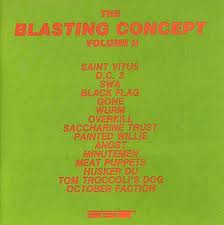 This song comes from the SST compilation The Blasting Concept Volume II, which came out in 1985. I bought it on vinyl and was psyched when it came out on CD. This version of an old Mountain song was one of my favorite songs on the disc (I don’t even know the Mountain version very well).
DC3 was the brainchild of Dez Cadena, former singer for Black Flag. They put out a couple of albums and then disappeared. And yet all these years later this song has stayed with me. For a singer from Black Flag, this song is remarkably poppy (and features a lengthy keyboard solo!). The real treasure of this song for me comes at the first chorus. When the band sings “Oh the sun was in their eyes…” the vocals begin in a disparate, perhaps minor key harmony, and then merge into a perfect harmony. It gets me every time.
DC3’s records have never been released on CD, and the vinyl is out of print. There’s a live CD out, but I’ve never heard it. So, as far as I can tell, this is the only studio song available in the world. Maybe the albums are terrible, but DC3 will always be great because of this one track.
Oh, and someone posted it on YouTube
Thanks!
[READ: March 22, 2011] Consider David Foster Wallace [essays 13-16]
This is the final batch of essays from this collection about David Foster Wallace. The first is about Oblivion and the last three are about his non-fiction. Perhaps it’s because I have been reading his non-fiction a lot lately (or maybe I enjoy reading essays about nonfiction more than fiction) but I found these to be the most enjoyable essays in the book.
As I’ve stated with each post, because I don’t have a lot to say about the pieces (I’m not an academic anymore), I’m only going to mention things that I found puzzling/confusing. But be assured that if I don’t mention the vast majority of the article it’s because I found it interesting/compelling/believable. I don’t feel comfortable paraphrasing the articles’ argument, so I won’t really summarize.
THOMAS TRACEY-“Representations of Trauma in David Foster Wallace’s Oblivion”
I’m planning on re-reading Oblivion again in the not too distant future. But since it’s been a few years, this essay didn’t resonate immediately with me.
Nevertheless, Tracey gives enough context for me to remember the scenes that he details. And so, it’s easy to relive the moments in the story and to look into the trauma that he is discussing. It was an effective essay. And more than anything else, it made me want to re-read Oblivion sooner than later (which wasn’t his intention, but is a nice side effect).
CHRISTOPH RIBBAT-“Seething Static: Notes on Wallace and Journalism”
This was one of my favorite pieces in the book specifically because it addressed an issue that I’d never really put a name to, but which I am utterly fascinated by. It discusses the difference between what is (unfortunately) termed New Journalism and New New Journalism.
It concerns the difference in style between the New Journalists like Hunter S. Thompson and Normal Mailer who went on a sort of balls out aggressive in your face style of journalism and the “New New Journalists” like DFW or Jon Kraukauer or Lawrence Weschler who, to quote from the Robert S. Boynton Book, The New New Journalism:
use the license to experiment with form earned by the New Journalists of the sixties to address the social and political concerns of 19th century writers such as Lincoln Steffens, Jacob Riis and Stephen Crane (an earlier generation of “New Journalists”), synthesizing the best of these two traditions. Rigorously reported, psychologically astute, sociologically sophisticated and politically aware, the New New Journalism may well be the most popular and influential development in the history of American literary nonfiction.
I sort of enjoyed that earlier style of journalism for its in-your-faceness; however, now that I’m a bit more mature, I find the writing to be rather immature. And I wonder what some of those NEw Journalist’s pieces would look like if some of the NEw New Journalists were to re-write them. This article affected me personally more than the others because even though it is certainly an academic topic it’s something I could relate to on a regular basis. Very cool.
PAUL JENNER-“Don’t Compare, Identify: David Foster Wallace on John McCain”
I’m planning on re-reading the McCain article when I get to CtL in the near future. (I wonder if the text of McCain’s Promise (the book) is exactly the same as the text in CtL). Obviously, DFW had no way of knowing this when he chose to write about McCain, but his run for Presidency again in 2008 really gave DFW’s article extra resonance.
This essay was thoughtful and raised a lot of questions and issues about McCain without being an overtly political essay.
DANIEL TURNBULL-“This is Water and the Ethics of Attention: Wallace, Murdoch and Nussbaum”
I acknowledge that I have never read Martha Nussbaum and have only read one novel by Iris Murdoch (The Red and the Green, which I liked very very much, but which has no bearing whatsoever on this essay).
Nevertheless, I related very directly to this article because it puts forth a position that I personally have held for sometime: that questions of ethics and morality are dealt with more effectively through fiction than non-fiction. Indeed, I have always felt that fiction is more profound that non- when it comes to many things. This essay uses Murdoch (who writes fiction and non-fiction) as another resource and also uses Nussbaum (who is a philosopher) to give support to the argument.
It’s nice to feel validated.
————-
So, that’s the end of the essays in this book.
Overall, I found the entire collection to be very manageable for non academics. True there were one or two that were certainly more cerebral than others (which is inevitable and not a bad thing by any means). Since the preface talks about how these essays will refrain from over-intellectualization, I believe it succeeds.)
Having said all that, this is obviously a very niche publication. And no one who has not read DFW should start by reading these essays. (Although, truth be told, the four essays here could work as an introduction to his short stories and non-fiction–especially given that many people know of DFW because of his non–fiction more than his fiction).
I respect people who can make compelling arguments–when I was a grad student I enjoyed writing papers like this. I have no reason to do so any more (and no I won’t write one for fun), but it’s enjoyable for me to poke my head back into this world once in a while.


Leave a Reply