Feeds:
Posts
Comments

Archive for the ‘New Yorker’ Category

SOUNDTRACK: MY MORNING JACKET-It Still Moves (2003).

I discovered My Morning Jacket through their awesome live album Okonokos.  Most of that album comprised songs from their previous disc, Z.  But there were a number of tracks from this record as well.  So I was thrilled to put this in for the first time and recognize a number of these epic tracks (4 songs are over 6 minutes).

It Still Moves is a soaring, gorgeous record of folk rock plus.  Some of their tracks are rooted in Americana, but they have wonderful touches of psychedelia and soaring sounds (choruses, guitars, voices).  It’s a great combination that never settles into one style of sound, and as much as it stays out of the reach of commercialism, it embraces catchiness.

And for an album that seems like it might resist the average listener, there’ some amazing stuff here.  The opening three songs are absolute stunners–catchy and interesting.  “Magheeta” is a slowish opener; “Dancefloors'” has a great riff and ends with a cool boogie of horns and pianos; and “Golden” is a shuffle song with terrific harmonies.

“Masterplan” is the first really slow song, but it has a dramatic buildup that is wonderful.  It’s followed by the first of the soaring guitar songs on the disc.  “One Big Holiday” opens with a cool tight guitar riff which turns into a soaring guitar riff of joy.  The second one is “Run Thru” which is one of my favorite songs of the past few years.  It opens with a slow soaring guitar riff that is totally catchy.  By midway it turns into a dancey discoey song for a few measures and then returns with the great riff.  It’s excellent.

“I Will Sing You Songs” is a 9 minute slow boiler of a track.  It’s very slow, almost lazily paced, but it’s never dull (credit Jim James’  amazing voice for keeping the whole proceeding interesting).  “Rollin’ Back” opens a bit like “Waiting for the Worms” from Pink Floyd the Wall (soaring oooh ooohs), but quickly settles into a slow roots song.

The end of the disc is a bit slow and meandering (the last song especially is practically a sleepytime ballad) but it works for the overall feel of the disc.  The whole enterprise is a bit long–it’s hard to listen all at one setting.  But nevertheless, it’s a great record with some amazing songs ion it.

[READ: May 9, 2011] “He Knew”

I rather enjoyed the last story by Antrim that I read, but I didn’t care for this one at all.  And that was pretty much because I didn’t care about the characters at all.

The story is about an out of work actor, Stephen (who is on antidepressants) and his very tall wife Alice (who is on Valium).  They’re sort of pathetic and it’s not even entirely clear if the like each other (or is that the anxiety speaking?).  She accuses him of wanting to sleep with every woman he talks to, and he looks longingly at most other women he sees. (more…)

Read Full Post »

SOUNDTRACK: CITY AND COLOUR Live at the Sasquatch Festival, May 29, 2011 (2011).

City and Colour have a new album coming out soon.  So it’s kind of surprising that this seven-song show is three songs from their previous album, two from their first album, a cover, and only one new track (“Fragile Bird”).

This is the first time I’ve heard City and Colour live with a band (most of the recordings I have by them are just Dallas Green solo).  It’s nice to hear how powerfully they work together (giving some of those songs an extra push).

Despite the brevity of the set (and the amusing banter about airport etiquette) you get a pretty good sense of what the “pretty-voiced guy” from Alexisonfire can do on his own.   I found the cover, Low’s “Murderer,” to be a really perfect choice–one that suits the band and their slightly-off harmonies, rather well.

I’m looking forward to their new release–“Fragile Bird” is another beautiful song.  But in the meantime, this is a good place to hear what they’ve been up to.

[READ: early June 2011] 2011 Fiction Issues

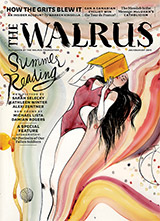
Five Dials seems to always generate coincidences with what I read. Right after reading the “”Summer’ Fiction” issue from Five Dials, I received the Fiction Issue from the New Yorker.  A few days later, I received the Summer Reading Issue from The Walrus.

I’m doing a separate post here because, although I am going to post about the specific fictions, I wanted to mention the poetry that comes in The Walrus’ issue.  I have no plan to write separate posts about poetry (I can barely write a full sentence about most poetry) so I’ll mention them in this post.

The main reason I’m drawing attention to these poems at all is because of the set-up of The Walrus’ Summer Fiction issue.  As the intro states: “We asked five celebrated writers to devise five guidelines for composing a short story or poem. They all traded lists–and played by the rules.”  I am so very intrigued at this idea of artificial rules imposed by an outsider.  So much so that I feel that it would be somewhat easier to write a story having these strictures put on you.  Although I imagine it would be harder to write a poem.

The two poets are Michael Lista and Damian Rogers.  I wasn’t blown away by either poem, but then I don’t love a lot of poetry.  So I’m going to mention the rules they had to follow. (more…)

Read Full Post »

SOUNDTRACK: JÓNSI-Go (2010).

Jónsi is the lead singer from Sigur Rós. This is his first solo album and, honestly it’s not radically different from Sigur Rós (were we expecting trip hop or something?).   However, within the confines of the type of music that Sigur Rós play (swirling orchestral songs), Jónsi’s solo disc is kind of different.  And the difference comes in tone.

For while Sigur Rós records are orchestral and swirly, the are also kind of dark and moody.  Jonsi’s songs are more upbeat.  They’re ethereal both in style and tone.

I’m also surprised to see just how short these songs are.  They feel like they are very long (epic in a good way) but in fact, only two songs go over 5 minutes–most are in the mid fours.

There’s no question that if you dislike Sigur Rós you will not like this record. Jónsi’s voice is the same after all–gorgeous sweeping, helium sounding and out of this world.  But if you doubted whether Jónsi could work without his mates in the band, you need not worry. This album is a beauty.

[READ: May 19, 2011] “The Trusty”

I didn’t think I would like this story.  It concerns a subject that I generally don’t have a lot of interest in: chain gangs in the south.  And yet, Rash’s writing was excellent and the story was quite compelling.

The Trusty of the title is named Sinkler.  Sinkler is a prisoner on the chain gang–he stole money from a business and got 5 years.  He has served 18 months with very good behavior and has been given the unofficial title of Trusty, which means he can do things like walk a mile up the road to the next farm house to see if their well has water for the men on the gang.

And this is what he does.  They are working on a road and have moved far enough past their current source of water that Sinkler offers to walk up to the next house to bring water back.  When he arrives, the door is answered by a young woman (between 18-22–Sinkler himself is in his 20s).  She is standoffish and unmoved by him.  She is also married–her (much older) husband is plowing the field.  She agrees to give Sinkler two buckets of water if, at the end of the day he agrees to leave one bucket there as payment.

Sinkler agrees and decides that he would like more than water from the young woman.  And over the next few weeks he returns every day and tries to win her over.  And Lucy begins to sweeten on Sinkler. (more…)

Read Full Post »

SOUNDTRACKDINOSAUR JR-Beyond (2007).

This was Dino Jr’s reunion album of the original line up.  And it sounds like the band had hardly gone away.

The opening tracks showcases the diversity of Dino Jr’s dynamic: a heavy, fast poppy number and then a “ballad” (Mascis style) and then a more heavy chugga chugga song.

By the middle of the album the band loosens up even more.  “Been There All the Time” has that kind of sloppy (but really not sloppy, they are actually very tight) sound of great Dino.  “I Got Lost” is the inevitable falsettoed Mascis track.  It’s slow and unusual for the rest of the disc, but it really showcases the band’s diversity.

The most notable things about Dino are Mascis’ voice (a kind of slacker pseudo-whine) and his wild guitar soloing.  And they are prominent here.  Mascis’ voice sounds great (of course, if you didn’t like it then, you wont like it now), and his songwriting is top notch.

I am actually more partial to the Dino Jr albums after Barlow left (blasphemy!–although even I admit the diminishing returns on the last few discs).  But on this disc, the band sounds totally revitalized and the songs are uniformly great.

Lou Barlow gets two songs.  They sound very Barlow: a bit slower but very catchy.  As I wondered about Farm, I’m not sure what would make Barlow return to Dino since the band still feels like Mascis’ band with Barlow getting a few songs.  I mean, they sound great together on the disc, but it’s clear that Mascis is the star here.  But whatever the reason, it’s a wonderful return to form and one of those rare reunions that really works.

[READ: May 18, 2011] “The Cat’s Table”

The combination of this title and the accompanying picture (a large cruise ship) was very confusing to me.  It turns out that the Cat’s Table is what a passenger on the cruise ship calls the table that they are assigned because it is as far from the Captain’s table as you can get.

The story opens in the third person as it describes a young boy (aged 11) who is seen boarding this large cruise ship which is travelling from Colombo, Ceylon to England (a 21 day journey).  The boy is traveling by himself to meet his mother.

After that brief section, the story switches to first person, from the boy’s point of view.

I was shocked to read that this eleven year old boy was dropped off on a cruise liner with no adult supervision.  But it turns out that there are several boys on board who are his age, and he even knows one from his school.  Coincidentally, his neighbor Emily, the closest thing he has to real family, is also on board. (more…)

Read Full Post »

ATTENDED: WEIRD AL YANKOVIC-Live at the State Theater, New Brunswick, NJ May 19, 2011 (2011).

I’ve seen “Weird Al” live three times now and I have never been disappointed by the show.  The first year my friend Matt and I waited out by the bus and got the bands’ (minus Al’s) autograph.  The second time we waited even longer and Al had an autograph (and picture taking) session in the theater after the show (how cool is that?).

This year, Sarah and I didn’t wait around afterwards (kids at home) but the show was still great.  Al made a joke after the first song thanking his opening act, Technical Difficulties. (There were indeed 45 minutes of technical difficulties before the show, but Al’s joke made us quickly forget it–and, kudos to the State Theater: I ordered my tickets online from their site and the day after the concert, the theater owner sent an email apologizing for the delay. Classy!).

Sarah had never seen him perform before, so she was pleasantly surprised by the set selection.  I was also surprised by the set selection because he pulled out a few older, more obscure tracks (“Frank’s 2000″ TV” (!), “You Don’t Love Me Any More”–complete with Al smashing a guitar!).  But he also dazzled with some new tracks from his forthcoming album.

The set opened with the polka medley (“Polka Face”).  This is the first polka medley that I didn’t know any (well almost any) of the sped up songs, but it’s always a treat to watch them play it live.  The one complaint with the show was that the sound in the theater wasn’t very good (which is surprising given that it’s an old theater) so it was hard to make out a lot of the words, especially to the new songs–and what’s Al without the lyrics?).  But his new song “I Perform This Way” (parody of Lady Gaga’s “I Was Born This Way”) was fantastic (Al was dressed up like a cartoon peacock).

Yes, costume changes.  One of the most entertaining things about Al’s shows is the costume changes.  For all of his big video hits, he comes out dressed like the video (the band does as well, although it’s a bit more subtle).  So, we get the Amish garb in “Amish Paradise,” the Michael Jackson red jacket for “Eat It”–(another surprise) and, my personal favorite, the fat suit from “Fat.”  One of the funniest costume changes was for a song that will sadly not be released on the album (but you can hear and download it here), “You’re Pitiful,” in which he wore multiple T-shirts (about 5) which all expressed some kind of funny comment (anyone know who was the face on one of the shirts?) and finally ended in a Spongebob Squarepants shirts and tutu.

So how does he do all of these costume changes? In between songs, when the band runs offstage, they play wonderful video clips.  Some of the clips are from his TV shows, some are faux documentaries, and the best are interviews that Al splices together (you can see a whole bunch here) which are hilarious and surprisingly mean-spirited.  I wish he would release them (and any other AlTv segments) on DVD, but I imagine that no one would ever give permission for that–check out the Kevin Federline one, for instance.  But they’re all pretty great.

The crowd was also totally into it (including the guy behind us with an Al wig (and a Harvey the Wonder Hamster).  And the age range was fantastic–from kids to grandparents.  My only hope is that my kids are old enough to come to a concert next time he comes around.

Oh and a brief word about his band.  He’s had the same four guys with him for years and years and years.  Rubén Valtierra is the newest member of the band and he’s been with them since 1991.  Jim West (guitar), Steve Jay (Bass) and Jon “Bermuda” Schwartz (drums) have been with Al since 1980.  They are tight as a drum, can play incredibly diverse styles at the drop of a hat (check out “CNR” which sounds exactly like The White Stripes) and they all seem to have a lot of fun on stage (see them jump in the air on “Fat” or the crazy vocal-only solo at the end of “Yoda”

–which I think is longer than ever and totally mind-blowing).

[READ: May 21, 2011] This is a Book

I recently read Martin’s “This is Me” in the New Yorker. “This is Me” is, along with about 100 other things in This is a Book.  I also heard Demetri Martin on NPR a few Sundays ago and he read a few short things from This is a Book.  And they were quite funny.

Indeed, the funny things in this book are really very very funny.  It seems to work that the shorter the item, the bigger the laugh.  Conversely there are a number of longer, extended jokes which just go on and on, like a Saturday Night Live sketch that just won’t end.  Those quickly lose their humorous value.  Fortunately  there aren’t too many of those in here.

What makes me smile a lot about the book are the jokes he plays with book conventions.  So the title page says “This is a book by Demetri Martin called This is a Book by Demetri Martin.”  Or the previous page:

Also by Demetri Martin

*

*Nothing yet.  This is his first book.

The book opens with “How to Read this Book.”

If you’re reading this sentence then you’ve pretty much got it.  Good job.  Just keep going the way you are.

I’m not going to spoil the rest of the book (or talk about each piece).  But I will mention some real highlights: (more…)

Read Full Post »

SOUNDTRACKFLAMING LIPS-“Two Blobs Fucking” (2011).

As I understand it, the Flaming Lips will be releasing an EP a month for the next twelve months–all in an unusual manner.  The first track, “Two Blobs Fucking” comes as a 12-part free video download.  Like with their album Zaireeka (which had 4 discs that you were supposed to play simultaneously to get the full effect), this song  comes as 12 separate audio tracks.  According to the online instructions, you’re supposed to get 12 friends with iPhones to each download a section and to play them at exactly the same time.  I don’t have an iPhone (or 12 friends that I could get in the same place at the same time to listen to a song), so I did the next best thing: I used YouTube Downloader, converted the tracks to WAV and then mixed them with Audacity.

I have received many CDs over the years that have mixing technology where you can play certain tracks and not others, but it’s very rare that I play around with them.  This whole process was easy enough that I made 20 different mixes of the song.

The “full” version is a fascinating amalgam of noises with a very cool riff that opens the track.  About midway through, the whole song is taken over by noise–a distorted squealing noise–for a few seconds.  And then the song continues as it was with gentle washes of sound.

The twelve tracks include the main riff, the riff as done by “voices” (doh doh doh), there’s a few noise (guitar) tracks and some noise (animal sound) tracks.  There’s a drum and percussion track as well as the vocal track.

The lyrics are a brief story about Wayne finding a dumpster from a factory which makes and discards manikin body parts.

It’s a weird track.  It’s not their best by any means, and the lyrics are hard to hear for the most part (unless you isolate them, of course).  But having now listened to it so many different ways, I’ve rally grown fond of it.  The riff itself is as I said, simple, but very cool.

It’s a neat experiment and nice that it was free (unlike their second release–a USB drive that is buried inside a candy skull which costs $150).

[READ: May 23, 2011] “Deniers”

This is, as far as I can tell, the first short fiction piece that Lipsyte has had published (please correct if I’m wrong), aside from that really short piece in The Revolution Will be Accessorized.  I enjoyed The Ask quite a lot, and I was excited to read more from him.

This piece, as the title implies, plays around with types of denial.  But it is self-denial that they experience.  The main character is Mandy, an adult whose father, Jacob,  is still alive but who has recently been put into a nursing home.  The opening of the story is more about Jacob.  More specifically, it’s about how Jacob relates (or doesn’t) to Mandy.  Jacob is a holocaust survivor, but he has barely said one word about it (or, really, anything) to Mandy.

Through a series of flashbacks, we see Mandy’s childhood with this distant father.  We also see what happened between Jacob and his wife–a fascinating story of duplicity on almost everyone’s part (and which is wonderfully encapsulated by the picture that accompanies the story (a Shell station lit up at night with the light from the letter “S” unlit). (more…)

Read Full Post »

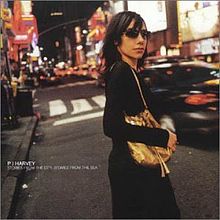
SOUNDTRACK: PJ HARVEY-Stories from the City, Stories from the Sea. (2000).  

When this disc came out it was greeted with rounds of praise.  And it’s easy to see why.  It’s a mature album and it seems very New York City (or, perhaps, more specifically, it seems very Patti Smith–“Good Fortune” practically has Smith singing–I mean the way she says “Little Italy” could have been sampled from Smith).

And after the somewhat wispy Is This Desire and the stopgap Dance Hall at Louse Point, it was great to hear PJ back in full swing. These songs are stripped down (but not raw like her early albums) and most of them pack a punch.  And I just read this quite from PJ  in Q Magazine:

I want this album to sing and fly and be full of reverb and lush layers of melody. I want it to be my beautiful, sumptuous, lovely piece of work.

And it is.  It’s very commercially successful. And it was commercially successful without compromising herself.

“Big Exit” and “Good Fortune” are wonderful rockers, catchy without being predictable.  “A Place Called Home” continues in this vein, with a somewhat slower, moodier piece.  It also exhibits some of her higher register (in the bridge), but for the most part she sings in the deep voice she’s been known for (Uh Huh Her came next, and then she switched over to the higher pitch on White Chalk).

“One Line” even made it on the Gilmore Girls (paragons of good musical taste).

“Beautiful Feeling” is a slow brooding number.  Typically, I find that I don’t like these songs from PJ, but this one is fantastic.  It’s followed by the noisy “The Whores Hustle and the Hustlers Whore” which is very dark lyrically.

Midway through the disc, we get a surprise Thom York from Radiohead sings the lead vocals on “This Mess We’re In” (PJ does backing vocals) and it shows that Yorke sounds great doing anything.  It’s a great song.  “You Said Something” is the first real upbeat moment on the disc, with some nice acoustic guitars.  And it’s followed by the absolutely rocker, “Kamikaze” which harkens to some of the noisier aspects from her earlier records (especially her screaming vocals).

The back half of many PJ albums seem to lose momentum, but not this one: “This is Love” is another great single, catchy with some simple but cool sounding guitars.

“Horses in My Dreams” is one of long (5 minute), slow numbers.  It is a kind of languid piece, which I admit I don’t like all that much.  (I find that PJ’s slow pieces aren’t dynamic enough).  But the album closer “We Float” (at 6 minutes, I think the longest track she’s done) is the kind of moody piece that Harvey does right.  There’s some simple drums and piano that comprise the verses, but when she gets to the chorus, the song perks up with her gorgeous singing “We Float.”

Confusingly, the whole album seems like it is more from the “City” than the “Sea” (“We Float” being the exception), but that’s okay.  It’s a wonderful album and the start of another great decade for PJ.

[READ: late March 2011] discussing The Turing Test

Occasionally things converge in my reading life. And sometimes things converge rapidly.  I had just read an article by Adam Gopnik in the New Yorker that discussed machines becoming (or surpassing) humans.  The timing of this coincides somewhat with the appearance of Watson on Jeopardy! so it’s not entirely surprising to see it.  Watson proved to be very good on Jeopardy!, but that seems mostly because it can buzz in more quickly.  The real test for a computer’s “humanity” is what has been termed “The Turing Test.”

Gopnik’s summary of the Turing Test:

If a program could consistently counterfeit human language in an ongoing exchange, then, many theorists have argued, the threshold of language would have been crossed, and there would be no need for more games to conquer. This is the famous “Turing test,” named for Alan Turing.

The next night I read a story by Ryan Boudinot (in The Littlest Hitler).  The story is not current at all, and yet he also mentions the Turing test.

The third article is another book review.  The subtitle is “What will happen when computers become smarter than people?”  Again, given everything that’s happening in the world technology-wise, it’s not a total surprise, and yet the items are all quite different and it was interesting to read them all so close together. (more…)

Read Full Post »

SOUNDTRACK: SHARON VAN ETTEN-Live at SXSW (2011).

Sharon Van Etten has a lot of sessions at NPR.  Not too many are downloadable, but this one is.  This is a fascinating set because it’s a special breakfast show for KUT. (See in the picture she’s doing Java Jive).  (She also plays a show later that night, but it’s not available here).

The set is four songs (all from Epic) on acoustic guitar.  The really different thing about this set than any of the other things I’ve heard from her is that her voice sounds really gravelly (like she just woke up–which she may have, almost all of her between song banter is about how it’s early–it’s either endearing or annoying).  Normally, Sharon has a really amazing voice–high and soaring.  This time it’s much  raspier.  But the interesting thing is that it works well.  She never misses a note and it brings an interesting growly tone to these (somewhat) angry songs.

It’s a great (although brief) set.

[READ: March 30, 2011] “Mont Royal”

This is a very brief (three column) story that reads like a stream of consciousness piece.  And that is appropriate because it not only references Ulysses, it actually quotes the end of the novel.

There are many fascinating things about this story.  First off, it is written in direct address: “When I moved to the city, ladies, …” but we never find out who the ladies are.  Second, it begins with the humorous idea that the narrator–upon moving to Montreal–believed for many years that the cross on the to of Mont Royal was a plus sign (he is an engineer). (more…)

Read Full Post »

SOUNDTRACK: ROBYN-Body Talk Pt 1 (2010).

Robyn’s Body Talk albums got a lot of praise in 2010.   When I looked at them online, they were really cheap (and considered EPs), so I bought Pt 1.  I was disappointed when I first listened because it seemed like such a sparse album, that I felt there wasn’t much to it.  (Oh, and before I continue, yes, I knew that Robyn was a big time pop singer, but reviewers that I respected–like Sasha Frere Jones raved about the albums).

The opening song “Don’t Fucking Tell Me What to Do” is a really strange song.  The verses are simply Robyn stating that different things are killing her.  It’s strangely compelling despite the repetitiveness.  There’s virtually no music (eventually a single keyboard line keeps a bare melody.  And then the titular chorus.  After two listens I found that I really liked the song even though the first time I heard it I totally blew it off.

“Fembot” is the first proper song, and it’s a simple twist on the stereotype of “woman as robot” since she, the fembot, embraces her sexuality (over a very simple catchy pop melody).  “Dancing On My Own” is an even better song.  Fuller, more complex and with a great chorus.  Two songs seemed like they’d have been destined for Glee: “Cry When You Get Older” & “Hang with Me” they’re a bit too pop for my liking.

The second half of the disk is where it gets odd and interesting.  “Dancehall Queen” has Robyn (a Swedish sing mind you) singing in a Jamaican dancehall accent–which, since I’m infrequently exposed to it, I really like).  It’s super catchy (and I love when she sings “the riddim goes boom boom boom”).  “None of Dem” is another odd song, with a great minor key transition in the chorus and music by Royksopp.

The disc ends with “Jag Vet e Dejlig Rosa” a sweet lullaby sung in Swedish.

The entire EP displays her impressive vocal range and styles.  And even though I really didn’t like it at first it has not only grown on me but gotten my to consider getting Pt 2.  (She released Body Talk Pt 1 (an EP) and Pt 2 (an EP) and then Body Talk which is a combination of some of 1 & 2 with more songs thrown in–a cash in, in my opinion).

[READ: April 30, 2011] “The Good Samaritan”

This was a rather dark story that explores people’s generosity and gullibility.

I was confused through the whole story because the main character’s name was Szabo, and I couldn’t figure out if the ethnicity of the character made a difference (I don’t think so) or even if that was his first or last name.  But that’s a very minor criticism of an otherwise thoroughly engaging story.  I was particularly delighted that while I thought Szabo was going to be a certain kind of character, he turned out to be something else entirely.

As the story opens, it reveals Szabo’s land.  He doesn’t like to call it a ranch (the word is abused by developers), rather he calls it “the property.”  I kind of assumed this story would be about a downtrodden rancher, but that turns out to not be the case at all.  Szabo owns and runs “the property” as a not-very-lucrative side business.  He grows racehorse-quality alfalfa hay for a handful of grateful buyers (he sells in small amounts which most dealers won’t).  It’s true he barely breaks even, but he loves it.  He loves everything about the property–the planting, the reaping and especially the John Deere, which he treats like a baby.

Then one day the baby bites back.  While climbing on the tractor, Szabo slips and dislocates his shoulder.  He calls on his secretary and she assists him to the hospital.  His secretary, Melinda, is from his “real” job, and she is a saintly woman. I was delighted that the story went into so much detail about his “other” life and this woman who helps him.  Szabo’s main career is as a kind of middle man for parts.  He used to manufacture them, but he learned where the money was and took advantage of it  Now he sits in an office (and “the property” is his release).  But Melinda is his saving grace.  She knows everything about him and what he wants and their history together is wonderfully explained. (more…)

Read Full Post »

[READ: September 24, 2001 & May 9, 2011] Talk of the Town

After 9/11, I read everything about the incident (like the multiple comics that came out).  About a week after 9/11 my friend Al and I went down to Hoboken and absorbed the decay (and I can’t help but wonder if that’s why I’ve developed adult asthma).  My 9/11 story is no more compelling than anyone else’s and may even be far less compelling (you can read a snippet at Al’s blog, should you care to).  Anyhow, when this issue of The New Yorker came out (with the amazing cover that you can’t really see here–the towers are in a shiny black that reflects the light), I read all of these accounts and recollections.

I came upon them again recently when I was doing a New Yorker search for Jonathan Franzen.  I recently read all of his New Yorker entries, but when I saw that he had one that was part of this 9/11 issue, I decided to put it off.  It was reasonably close to the ten-year anniversary of 9/11, and I told myself I’d wait until then to reread and see what I thought.

And then President Obama gave the order to capture and kill Osama bin Laden (hooray!) and that seemed like a far more propitious reason to go back and re-read these articles.  Now I can feel a bit lighter about the whole thing (just a bit, but a bit can be a lot).  And so, here’s a somewhat facile reaction to these reactions.

I’ll preface by saying I can’t imagine what it must have been like to write something, anything at that time.  Some people respond well to pressure and tragedy and perhaps that’s what happened here.  I can’t help but wonder how paralyzing it must have been for other writers (as it was for most people).  So that these writers had the wherewithal to write anything coherent is pretty amazing.  And the fact that the could express the range of emotions that they do is extraordinary. (more…)

Read Full Post »

« Newer Posts - Older Posts »