Feeds:
Posts
Comments

Archive for the ‘Funny (ha ha)’ Category

[ATTENDED: December 20, 2013] A Christmas Carol

headerI had never seen A Christmas Carol performed.  I was, of course, familiar with the story–from the original (the Patrick Stewart audiobook is amazing) and from the many, many versions of it that have been performed in cartoon and live action formats.

We took the kids as this is a holiday classic and we thought it would be fun for all of us.  And we were right.  Except–this version is at times quite scary and (as my son pointed out) quite loud.  I didn’t find it terribly loud, although the scary bits were considerably louder than other bits.  And yes, the ghosts were certainly scary.  (I had actually warned him that the ghost of Christmas Future would be very scary, but it proved to not be the case, although it was really frikkin cool).

And I must say I was charmed immediately–as soon as the kids ran out on stage in period costume, singing songs and being very Christmassy, I was hooked.  (more…)

Read Full Post »

shameSOUNDTRACK: REGINA HELCHER YOST-“Up on the Housetop” (2008).

winstonI am introducing my selection of new (to me) Christmas music with this bizarre (and topically appropriate) entry.  I heard this song on NPR’s Holiday music show from 2008 (it’s in the 2009 show as well, but the 2008 version includes the CD opening!).  So Winston is, apparently, the pug on the cover.  And this version of “Up on the Housetop” (a song I didn’t recognize but have since heard other version of which makes this even stranger) is a (mostly) instrumental one.

The main melody is played on a tin whistle with flute, accompaniment.  But that’s not the only accompaniment, because Winston chimes in throughout the song.  He makes barks and growls and whines and, at the very end of the song he barks in tune with the beat (or should I say his barks were placed in time with the beat).  Despite how goofy it is, the whistle is done very well and the song is actually quite pretty.

Normally NPR tells you a lot about the artists that they play, but not a word was given about Regina.  Here’s what I found out about this CD: “A fun CD featuring beautiful traditional Christmas flute melodies played by internationally acclaimed flutist Regina Helcher Yost and accompanied by her pug dog, Winston to help support the Pug Rescue of North Carolina.”

Amazon has samples of tracks online.  While I think this track is cute, “The 12 Pugs of Christmas” may be the most interminable version of that interminable song I have ever heard (and I only heard 20 seconds of it).  But there you have it.

Ho Ho Woof.

[READ: December 6, 2013] Dog Shaming

Typically by the time a blog gets a book, the blog has outlived its usefulness, or funny-ness.  I don’t know how long Dog Shaming has been around (not very long I don’t think).  I only visited the site once, but I was delighted by the premise and the entries.  So when I saw this book at the library I knew I had to check it out.

This is the perfect blog-into-book thing.  There is a very brief introduction which explains the origins of the site (something I never bothered to find out online).  It also talks about what a huge phenomenon Dog Shaming is (I guess).  And implies that the site will live forever (I think it’s good they got a book deal when they did).

But snarkiness aside, this book is really frikkin funny.  Evidently it is largely photos that were unused on the site (I’m not sure why they were unused, as it implies that one or the other was not good enough for the photos), but whatever, it’s nice that the book isn’t just the web site.  It also says that there are fan favorites from the site included.  As I said I’ve only visited once, so I don’t know which is which. (more…)

Read Full Post »

goof5SOUNDTRACK: THE HIPWADERS-Dewey Decimal System (2007).

hipwadersA bouncy bass line introduces this song about the Bookmobile crashing into your house.  The librarian gives him a card and teaches him how to use the library.  The bridge is very sweet, especially compared to the silly, bouncy “Dewey Dewey Dewey Dewey Dewey decimal system” part.

Then the clever song teaches you the basic categories of the Dewey Decimal System.    That section musically reminds me of School House Rock.  It’s kind of a harsh switch from the School House Rock section to the Dewey Dewey section, but that Dewey part is so catchy that it’s a fun change.

It’s an enjoyable song (and informative too).  This song appears on the WXPN Kids Corner CD.

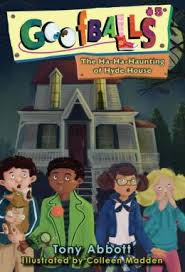
[READ: October 23, 2013] Goofballs #5: The Ha-Ha-Haunting of Hyde House

Goofballs #5 continues this enjoyable series.  This one seemed to be even funnier than the others (more jokes per page!).  I enjoyed this joke which was if not laugh out loud funny is certainly smile-worthy: “The official Goofball definition of toddler is someone too short to reach a doorknob but not too short to reach a cupcake.”

What was also funny, but strange funny, was that lead Goofball Jeff Bunter started finding clues without evening having a case.  Jeff is heading to the library for Fun Day for the toddlers.  But when he sees a woman walking out of store with pink balloons, he deems it  a clue. How can that possibly be?  Well, he is the detective, after all.

It’s also nearly Halloween.  And of course the other Goofballs are there.  Brian is there in a tuxedo (which he imagines he can wear for Halloween.  He also has a top hat that is way too big for him (although he assumed that since he brain is so big it should have fit).  And the other Goofballs and Goofdog are there to help out, of course. (more…)

Read Full Post »

tj amalSOUNDTRACK: SIGUR RÓS-Ágætis Byrjun (1999).

AgætisByrjunCoverIn this book, Amal is listening to Sigur Rós and TJ says “Sounds like nature vomiting.”  This is not a totally inaccurate description of the band, but I mean it in a good way.  Weaver says one of her friends described the band this way and while she disagrees, she thought the quote was too good not to include.  This was Sigur Rós’s first well-distributed album (and the one that shot them into the stratosphere.)

The disc opens with “Intro” (it’s funny to think of a 9 minute symphonic track as needing an intro, but there ya go).  I believe the song is backwards music.  The vocals may be backwards, but it’s so hard to tell.  It morphs into “Svefn-g-englar” which is just stunning (and reviewed a few days ago).  “Starálfur” opens with a beautiful string section over some washes of keyboards.  It’s a pretty melody.  Then the middle of the song switches to what sounds like an unplugged electric guitar strumming. The “solo” is a big string section, and the song ends abruptly with more of the unplugged guitar.  It’s an amazingly different kind of song.

“Flugufrelsarinn”  opens with noisy guitars that don’t sound like guitars.  Although overall this is the most conventional songs.  It’s got a steady beat and Jonsi’s vocals are mixed pretty loud and (relatively) deep.  “Ný batterí” opens with quiet horns for 90 seconds.  Then a bass line emerges.  At 2:30 the vocals kick in and the song builds gentle swells until the really loud drums kick in–its a great use of drums for drama.  “Hjartað hamast (bamm bamm bamm)” opens with a harmonica and a Hammond organ!  It’s got drums and loud guitars with lots of bass and, again, Jonsi’s more growly vocals—there’s unexpected diversity in sound for this track. Especially when the guitars roar into distorted crackling.

“Viðrar vel til loftárása” was also reviewed with the above single.  “Olsen Olsen” opens with distant vocals and drums then some very loud bass guitar.  “Ágætis byrjun” is a mellow ballad, with acoustic piano and guitars.  There’s nothing over the top or dramatic about the song, it’s a pretty standard ballad (except that it’s 7 minutes long).  And it works as a perfect ending to the disc.  There is actually a final track called “Avalon.”  It is electronics and other noises—a clear denouement for the record.

This is an amazing statement of what the band is all about.  It’s over 71 minutes, and the shortest song is 6:46, except for Avalon and Intro (4:01 and 1:36 respectively).  And they would perfect this palate over their next several albums.

[READ: September 24, 2013] The Less Than Epic Adventures of TJ and Amal Volume 1

This book came across my desk the other day and I was instantly attracted to the style of drawing.  And then I read the summary: “In one night Amal calls off his arranged marriage, comes out to his parents, goes on a bender and wakes up next to a dreadlocked guy named TJ. Who says they’ve agreed to travels across the country together.”  Who could pass that up?

And man, is it an enjoyable story.

I was right about the art, E.K. Weaver is a masterful artist, conveying a great range of emotion with her characters.  She also has an excellent rendering skill for places and locations.  The streets and highways are recognizable and the occasional scenes of nature are very pretty as well.

But I was also won over by the story.  It opens with Amal storming out of the house, heading to a bar in Berkeley and blacking out.  When he wakes up, a white, dreadlocked, hippie dude is making eggs in his kitchen and smoking.  Amal is confused about the guy, pleased about the eggs and pissed about the smoking.  But he has too much else going on for him to worry too much about this guy who seems nice enough, and obviously didn’t kill him or steal from him (although Amal has to confirm that they didn’t have sex).

And then TJ, for that is the dreadlocked man’s name, explains that they are both heading east (Amal’s sister is graduating from Brown and TJ keeps mentioning Graceland, but that doesn’t seem to be where he is going) and last night Amal agreed to drive him if TJ paid for everything.  TJ proves to be very cool about it—allowing Amal to back out if he wants to, but Amal says he’ll do it.  He gets some stuff together and off they go.

On the road trip we learn a bit about Amal—how his parents arranged his marriage and have now disowned him because he is gay.  We don’t learn very much about TJ though.  And while he seems to be on the up and up—he indeed pays for everything and is very generous, there are some shifty-eyed moments where we know something is unusual with the guy. (more…)

Read Full Post »

bothfleshSOUNDTRACK: SIGUR RÓS-Von brigði [Recycle Bin] (1998).

recycleAfter releasing their first album, Sigur Rós was approached by Icelandic musicians to remix the album. And thus came Recycle Bin.  I realized too late that I really just don’t like remix albums all that much–they’re mostly just faster drums plopped on top of existing songs.  And such is the case here.  Despite the interesting musical pedigrees of the remixers, there’s nothing anywhere near as interesting as on Von itself.  There are ten tracks, but only 5 songs.

”Syndir Guðs” gets two remixes:

Biogen keeps the bass but adds some more drumlike sounds.

Múm removes the bass, adds some wild drums and trippy textures and reduces the 7 minutes to 5.  It is quite pretty but very far from the original.

“Leit að lífi” gets three remixes

Plasmic takes a spacey 3 minute wordless noodle and turns it into a heavy fast dance song with speedy drums, big bass notes and with spacey sounds.

Thor brings in some fast skittery drums and keeps the spacey sounds (which sound sped up).  And of course bigger bass noises.

Sigur Rós recycle their own song into a dance song by adding funky bass and drums.

“Myrkur” gets two remixes.  the original is a fast-paced groovy track.

Ilo begins it as a spacey non-musical sounding piece.  After two minutes they add a beat of very mechanical-sounding drums.  It’s probably the most interesting remix here.

Dirty-Bix adds big, slow drums.  It keeps the same melody and vocals as the original but totally changes the rhythm and texture of the song, (removing the guitar completely).

The remaining three songs get one remix each.

The original “18 Sekúndur Fyrir Sólarupprás” is 18 seconds of silence.  Curver turns it into “180 Sekúndur Fyrir Sólarupprás” and makes a muffled drum beat and some other samples from the album, I think.  It constantly sounds like it is glitching apart until the end where it practically disintegrates–an interesting remix of silence.

“Hún Jörð” 7 min Hassbræður increases the drums and adds a more buzzsaw guitar sound and makes the vocals stand out a bit more.

“Von” has delicate strings and Jónsi voice.  The remix by Gusgus adds low end bass and drums making it a thumping rather than soaring track.

I prefer the original, but I much prefer their next album to the first one.

[READ: end of October to early November 2013]  original articles that comprise Both Flesh and Not

As I mentioned last week, I decided to compare the articles in Both Flesh and Not with the original publications to see what the differences were.  I had done this before with A Supposedly Fun Thing… and that was interesting and enlightening (about the editing process).

This time around the book has a lot more information than the original articles did.  Although as I come to understand it, the original DFW submitted article is likely what is being printed in the book with all of the editing done by the magazine (presumably with DFW’s approval).  So basically, if you had read the original articles and figured you didn’t need the book, this is what you’re missing.

Quite a lot of the changes are word choice changes (this seems to belie the idea that DFW approved the changes as they are often one word changes).  Most of the changes are dropped footnotes (at least in one article) or whole sections chopped out (in others).

For the most part the changes were that the book version added things that were left out or more likely removed from the article.  If the addition in the book is more than a sentence, I only include the first few words as I assume most readers have the book and can find it for themselves.  The way to read the construct below is that most of the time the first quote is from the original article.  The second quote is how it appears in Both Flesh and Not.  At the end of each bullet, I have put in parentheses the page in BFAN where you’ll find it.  I don’t include the page number of the article.  And when I specifically mention a footnote (FN 1, for example), I am referring to the book as many times the articles drop footnotes and they are not always in sync.

Note: I tried most of the time to put quotes around the text, but man is that labor intensive, so if I forgot, it’s not meant to be anything significant. (more…)

Read Full Post »

bomarsSOUNDTRACK: SIGUR RÓS-“Ný batterí” (2000).

nyThe single opens with “Rafmagnið búið” a kind of brass introductory piece.  There’s lots of horns building slowly, growing louder but not really playing a melody.  By the end of five minutes, it segues into “Ný batterí” which opens with horns as well.  Then the bass comes in, a slow, deep rumble of simple melody.  After 4 and a  half minutes, the drums are a powerful counterpoint to the sweet melody.

“Bíum bíum bambaló” is a slow piece (aren’t they all) that is mostly percussion.  Apparently it is an Icelandic lullaby.  The final track, “Dánarfregnir og jarðarfarir” was a theme used for death announcements on Icelandic radio.  I love the way it builds from a simple melody into a full rock band version and then back again.  It’s very dramatic.

Both tracks were used in the film Angels of the Universe (and appear on the soundtrack).

That certainly makes this single less interesting than the first one (although I’m not sure that the soundtrack was readily available at the time).

[READ: December 1, 2013] Breakfast on Mars

This is a collection of 38 essays (and an introduction by Margaret Cho).  It also includes an introduction geared toward teachers–an appeal that essays do not need to be dull or, worse yet, scary.  The editors encourage teachers to share these essays with students so they get a feel for what it’s like to write compelling personal nonfiction.  The introduction proper gives a brief history of the essay and then talks about the kind of fun and funny (and serious) essays that are included here.

This was a largely fun and largely interesting collection of essays.  When I grabbed it from the library I didn’t realize it was essays (I was intrigued by the title and then looked at the author list and immediately brought it home).  I know it says essays on the cover, but I chose to ignore that apparently.  When Sarah saw the authors (she knows more of them than I do) she had to read it first.  This proved to be a great counterpoint to the very large novel that I was reading at the same time.

The essays each take on different topics.  And what I liked was that before each essay, they include the question that inspired the essay.  I have included the questions here. (more…)

Read Full Post »

gb4SOUNDTRACK: MOONA LUNA-“Vamos! Let’s Go!” (2012).

Moona_Vamos_cover-300x267This song opens with a surf guitar lick and then is dominated by keyboard chords.

The first verses are sung in Spanish (by a delicately voiced woman).  The chorus of “vamos, let’s go” is super fun and easy to sing along to.  But the second half of the song is sung in English (I assume it’s the same words–my Spanish is okay).

It’s a simple song, catchy as anything and you learn some Spanish too!  And check out how cute that cover is.

I also just learned that Moona Luna is a side project of the band Pistolera whom I’ve heard of but not heard.  This one came on the Kids Corner 25th Anniversary CD.

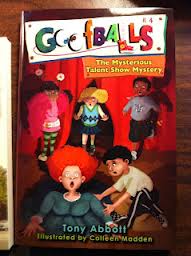
[READ: October 23, 2013] Goofballs #4: The Mysterious Talent Show Mystery

Goofballs #4 proved to be my favorite of all of the Goofballs because the main new character in the book is a redhead named T. (just like my daughter!)  [I secretly believe that Tony Abbott read our blog and saw a picture of T. and decided to name a character after her–even if it was C. who was the one who read all the Droon books with me].

Our four goofy sleuths Jeff Bunter, Mara Lubin, Kelly Smitts, and Brian Rooney are of course present and this time they are preparing for a talent show.  This year’s new director of the talent show is T. Rinkle, a genuine goofball in her own right.  For one thing, she has scheduled the Talent Show for Friturday!  And worse yet, no matter how good (or bad) someone’s talent is, Ms Rinkle tells them that they are great.

But then things get really weird–things start happening which seem like the Talent Show will never happen.  A giant tuba goes missing, the costumes come back in all the wrong sizes and the scripts are missing pages.  What is going on? (more…)

Read Full Post »

gb3SOUNDTRACK: LUNCH MONEY-“Ate too Much of My Favorite Food” (2009).

lunchmoneySurely everyone has experienced this horrible feeling–you love some kind of food so much that you eat too much and get sick.  My example was peanut butter Rice Krispie treats, an invention that I assume was my mothers.  They were sooooo good.  But I have never eaten them since that day (over 30 years ago.  In fairness, no one has offered them to me either).

So this is a fun song–opening with snapped fingers and a solo female voice before the horn fueled simple melody comes in.  I enjoyed the way the “ba ba ba” section turned into baba ghanoush.

There’s a shout-out section about the foods that did you right and wrong.  My only quibble with the song is that the foods that they list are really strange–foods that no one thinks of as their favorite foods–zucchini??, creamed spinach??.  Even gummy bears?  Where’s the heavy foods that kids actually overeat?

Lunch Money has another song called “I Love My Library” that I may have to check out.  This one came on the Kids Corner 25th Anniversary CD.

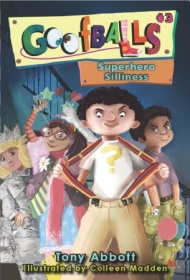
[READ: October 25, 2013] Goofballs #3: Superhero Silliness

This book introduced me to a word that I evidently should have known for some time: derder.  A derder is the cardboard roll inside of toilet paper or paper towels.  You put your lips up to it and go “der der der” and it’s a musical instrument.  Seriously.

But what does that have to do with Superheroes?  Well, in this case, plenty.

The kids are on line at Pizza Palace, the site of their very first mystery (which we never saw).  Luigi, the owner, had named a pizza after them for their brave deeds–cheese, garlic, pineapple and peanut butter.  And now it was one year after that deed and he was adding a new mystery topping.  Everyone was waiting to see what it would be when a lino pulled up to the line and called the Goofballs over.  It is Randall Crandall’s driver and he says that Randall Crandall needs their help.

Randall has the world’s largest collection of derders and he is afraid that someone is planning to steal it.  He is having a superhero costume party and he fears that the thief will try to steal them during the party. Will the Goofballs come dressed in original superhero costumes and catch the thief?

Will they ever! (more…)

Read Full Post »

[ATTENDED: November 14, 2013] Much Ado About Nothing

much adoDespite all of my reading, I am fairly ignorant of Shakespeare. I’ve read or seen most of the big ones, but I don’t know a lot of his works first hand.  As a young reader I realized that reading Shakespeare was hard—as, really, any play with dozens of characters tends to be.  It’s not easy to keep character straight when there are no descriptors about them.  So I more or less gave up on reading Shakespeare and decided I would watch him when I could.

When the Princeton University theater offered us tickets to see Much Ado About Nothing, it seemed a great opportunity to brush up.

This was a student production, and I have to complement all of the students on their wonderful performances.  They never broke characters, and their Shakespearean dialogue was flawless (as far as I know).  What I found interesting was that it took about fifteen minutes before I was absorbed in the dialogue and understood, well, about 45% of it.  Well, maybe 60%.  They did speak a little fast sometimes.

What was incredibly helpful about the dialogue was…the actors.  Duh.  But really, the language comes to life when you see people actually performing the lines (making Shakespeare’s bawdy jokes that much more bawdy).  And while some of the performances seemed almost over the top, I have little doubt that that is how it was performed back in the day—why would they go for subtle when there’s jokes about sex? (more…)

Read Full Post »

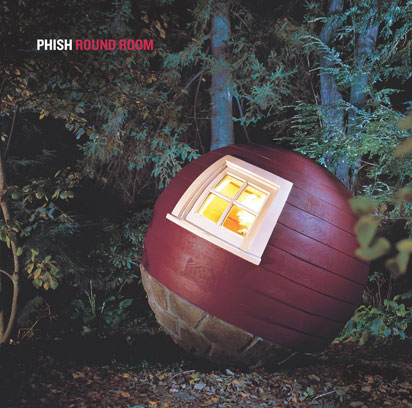
wallsSOUNDTRACK: PHISH-Round Room (2002).

round After Farmhouse, Phish went on a hiatus.  No one knew it would be quite so brief, but there was really a feeling that they were done.

And then they quietly released Round Room in 2002.  And it bursts forth with an 11 minute song.

“Pebbles and Marbles” has an interesting riff—complex and pretty.  And when I listened to it again recently I didn’t really quite recognize it.  But that’s because it’s nearly 12 minutes long and the really catchy part comes later in the song.  At around 5 minutes, the catchy chorus of “pebbles and marbles and things on my mind” announces itself.  And it is a good one.

“Anything but Me” is a pretty, mature song that is slow and piano heavy.  “Round Room” is a boppy little ditty (clearly a song written by Mike).  It is sweet and a little weird.  “Mexican Cousin” sounds a lot like a cover (maybe an old song by The Band) except for the solo which is very Trey.  It’s a funny, silly ode to Tequila.  “Friday” is a slow six minute song with two sections.  The verses are spaced out a bit, delicate riffs that are mostly piano once again.  The middle section is sung by Mike (which makes it more mellow somehow).

“Seven Below” is an 8 minute song.  It has another great riff (and the intro music is cool and bouncey).  When the vocals come in, it’s got gentle harmonies as they croon the sweet song).  Most of the 8 minutes are taking up with a guitar solo.  “Mock Song” is another of Mike’s songs.  This one seems to be a random selection of items sung to a nice melody.  Then when the chorus comes it’s quite nice, how this is a “just a mock song.”  The first verse is sung by Mike, then Trey does a kind of fugue vocal with different words in verse two.

“46 Days” opens with funky cowbells and turns into what seems like a classic rocking folk song—few words but a great classic rock melody (complete with 70s era keyboards).  “All of These Dreams” is a mellow piano piece, another mature song.  “Walls of the Cave” has an interesting piano melody that opens the song. The song is nearly ten minutes long and the middle part has a nice flowing feel to it.  There’s also a few sections that are separated be drum breaks—something that doesn’t often happen in Phish songs.  When the third part opens (to almost exclusively percussion, their vocals all work in a very nice harmony.  It’s a long song but with so many parts it always stays interesting.  “Thunderhead” is another piano-based song with some guitar riffs thrown on top. But it is largely a slow, mellow piece.

“Waves” is an 11 minute song with long instrumental passages.  It also begins with a kind of Santana feel to it, but it is a largely meandering song, with a simple melody that they stretch out for much of the song.  So this album proves to be an interesting mix of long jams and mellow ballady type songs.  It seems like Phish had a big mix of things to let loose.

[READ: November 1, 2013] If Walls Could Talk

This book reminds me of the work of Mary Roach—exploring a topic in great detail and including lots of amusing insights.  The two big differences here are that Worsley is British and that she goes back very far in British history to give us this fascinating information about the development of certain rooms of the house.

Worsley begins with the bedroom.  She looks at the furniture—the history of the bed from lumps with straw to fantastically ornate full poster beds that were made for kings who might never actually use them.

Then she moves on to more personal matters—sex (including deviant sex and venereal disease); breast feeding (for centuries mothers felt they were not equipped to take care of and nurse their own children, hence wet-nurses) and knickers (royalty had an entourage designed specifically to assist with underthings).  Indeed, privacy was an unknown thing in olden times.  Even royalty was expected to receive people in all of the rooms in the house.  Initially the bed chamber was for their most intimate friends, not just for sleeping.

The section on old medicine was also fascinating, they believed that it was vaporous miasma that did you more harm than say, excrement-filled water.

The section on Sleep discusses what was also in a recent article by Gideon Lewis-Kraus—that there were two sleep times at night.  With no electricity there was no artificial light to keep people up late so they would go to sleep early, wake up in the middle of the night (the best time for conception of children) and then sleep again. (more…)

Read Full Post »

« Newer Posts - Older Posts »