Feeds:
Posts
Comments

Archive for the ‘Funny (ha ha)’ Category

coralSOUNDTRACK: SACKVILLE-These Last Songs (1997).

lastsiongs Sackville released two full length albums.  This was the first. They’d added a second guitar which gave their songs a bit more texture.  But they still had a kind of gritty folk music sound.  I saw the term “urban country” used to describe them, which is strangely apt.

“Sydney Mines” is a slow folk song with a quiet slow guitar motif.  I love the descriptive lyrics: “In the dead of winter in Sydney Mines they take their cars out on the ice.” The song is accented by a slow, scratchy violin that comes in after the first verse.  But the chorus gets rocking and kind of fun/sloppy with the drums really taking over.  The vocals don’t really change the laconic style but they do get noticeably louder.  “Clothesline” retains that slowness although the verses have a bit more sing-song quality.  And once again the chorus bursts into life with a raw violin and loud drums.

The excellent guitar riff that opens “Good Citizen” is quite a change—the song picks up speed (and the vocals sound very different–clipped and quick).  It’s a great alt folk song.  The chorus is lurching and interesting as well.  “Upstate” has an early 1990s guitar line and pounding chords at the end of each verse.  The juxtaposition of his voice with this electric song works nicely.  “Tie Back Yr Hair” returns to the slow style of the earlier songs although this melody is mostly led by the violin.  “Lines and Barriers” is a slow ballad, mostly guitar—it reminds me of Syd Barrett.

“The Frame-Up’ has more loud drums and quiet creaking violins.  Nearly four minutes in, the violin takes over with a staccato refrain that gets the song sounding more intense.  “Bender” adds a pleasant surprise with guest vocalist Genevieve Heistek taking lead vocals.  The music is much the same but her voice changes the overall style of the music quite a bit.  The addition of fuzzy static at the end adds an alt-rock touch.  “Invisible Ink” has the prettiest violin melody yet, an unscratchy ascending melody that complements the slow guitars.  And just as it seems to be another slow ballad, the 3rd minute ramps up the electric guitar and the song soars for about 20 seconds before returning to that main melody.

“Her Ghost Will One Day Rise Again” has the most country feel of the album—the violin is much more fiddle than violin and the simple melody is very catchy, but in a drunken hillbilly kind of way rather than a country song proper (which means a I like it better).  On “Border Towns” he sounds the most like the lead singer from Social Distortion.  This is a lurching kinda punk y song, although it’s the chorus that really has that Social D feel—a slow catchy chorus in which his delivery is uncanny.  “Pioneers” ends the disc with a downbeat song with really catchy lyrics: “It’s hard to be a pioneer” in the keening voice of the 12-year-old protagonist.

Given the popularity of alt-country, Sackville was sadly ignored.

[READ: June 10, 2016] Coral Reefs

Wicks created the Human Body Theater graphic novel (also from First Second), which I absolutely loved.  This book is part of First Second’s new Science Comics series, in which they take a good hard look at scientific things and present a ton of information in a fun cartoony format–easily digestible chunks with awesome pictures that convey a lot of information.

I loved the dinosaurs one for just how much new information I’d learned from it.

This book has a really inspirational forward about scuba diving which I thought was by wicks (and I wondered how she was so scholarly AND an artist), but it was actually by Randi Rotjan from the New England Aquarium (and is still inspirational).

I didn’t know a ton about coral reefs going into this book and man, is it full of information about them: how they grow and form (yes, they are animals), who lives among them and what we can do to protect them. (more…)

Read Full Post »

peanuts-1995SOUNDTRACK: TINARIWEN-Tiny Desk Concert #184 (January 5, 2012).

tinariwenTinariwen are a band from northern Mali, whose members met in the training camps of Col. Moammar Gadhafi. Much has been written about them and their story, which is pretty amazing.  I’m only going to talk about this Tint Desk Concert.

Typically, they play an interesting electric guitar kind of trance music.  But for this one they were all acoustic.  As Bob Boilen notes, they are his “favorite electric-guitar-based band on the planet.”  But he says he was:

“initially worried and disappointed when I learned that it was coming to play the Tiny Desk as a trio carrying acoustic guitars. My heart sank a bit more when the three Tuareg musicians from the Sahara arrived in jeans and polo shirts instead of the beautiful, flowing robes I’d seen them wear on stage so many times.

But they switched clothes and they do not disappoint on acoustic guitar.

I don’t know their music all that well, but it feels like the acoustic nature of this show is even more soothing and trance inducing.  The two acoustic guitars interweave–one playing lead (which is mostly hammered notes–not a “solo” per se) and the other strumming.  The percussion is the sound of two hands rubbing, clacking (with a cigarette lighter) and pounding (for bass drum) a large gourd.

The songs tend to be almost looping.  Like they could go on forever.  There’s no real verse chorus structure that I can tell.  It’s more of a meditative sound.

All of the vocals are in Tamashek and I have no idea what the songs are about.

On “Adounia” both guitarists sing and the voices sound very traditional, almost atonal. “Takkest Tamidaret” opens with a more conventional sounding guitar lick, but it’s all so quiet in the mix, that you can’t tell how much his fingers are moving.  The lyrics are a bit slower, but still in that droning style.  I love the way “Tenhert”  has a a cool riff from the lead guitar–one that probably sounds more intense on electric guitar.  He sing/speaks incredibly quickly.  “Tahlamoyt” is a much slower song with the lyrics pretty much all spoken word.

The “Mali sound” is pretty distinctive and Tinariwen are great proponents of it, spreading it around the world for all to hear.

[READ: June 8, 2016] The Complete Peanuts 1995-1996

I was under the impression that these last few volumes of books would show a serious drop in quality.  I had assumed that with the amount of product the Peanuts characters were sponsoring that these strips would be more cute.  But that is far from true.  I enjoyed this book as much if mot more than some of the other recent volumes.

I was also surprised to discover that I really enjoyed the Sunday cartoons more than the dailies.  In the past I haven’t really gotten big laughs form the Sundays–it seemed like the big stories and jokes were in the dailies and the Sundays were unrelated one offs with varying degrees of punch.  But I enjoyed a dozen or so in this book.

One of the major additions in this book is the inclusion of a slightly older Rerun.  He is now mobile and even heading to kindergarten (I love that he is aging while the others aren’t).  But rather than using Rerun for obvious cute child jokes (he’s no longer riding the back of his mom’s bike) Rerun is now making funny “outsider” observations about the world of Peanuts–he is constantly disenchanted with the way  things are going and with the belief that people are always lying to him.  There are also a ton of strips of him trying to shoot a basketball and failing miserably.  Schulz has always tended to take an idea and run and run and run with it, but this one is pretty good for the number that he uses it. (more…)

Read Full Post »

sempleSOUNDTRACK: SISKIYOU-Nervous [CST109] (2015).

cst109covera_258x242This album begins with “Deserter,” in which a choir of children singing over a kind of spooky tone.  And then a loud rumbling bass and scratching on a guitar.  It’s quite different from the previous Siskiyou releases and outpaces the others by several steps.

Once Colin Huebert’s voice kicks in, that familiar Siskiyou sound returns—acoustic guitar and Huebert’s voice which is a mix between a whisper and Win Butler from Arcade Fire.  But “Deserter” features backing vocals and, perhaps most surprisingly, a wild baritone sax solo by Colin Stetson.  But it stays grounded with that cool rumbling bass line.

The second song “Bank Accounts and Dollar Bills (Give Peace a Chance)” opens with an echoed guitar likes some classic 1990s shoegaze music.  The vocals are a cool, intense whisper.  The verses are great and then the chorus adds a piano and his vocals rise into an impassioned wail.  The third song “Wasted Genius” adds a kind of steel drum sound that includes a great melody to the simple and slightly ominous verses.   The middle of the song switches to pummeling drums and a buzzy guitar solo before returning to the mellow verse.

“Violent Motion Pictures” has another cool whispered vocals and quiet guitars that get accented with a low bass and percussion.  There’s a neat section of falsetto vocals that remind me of Pink Floyd over a bouncy melody–before it returns to the verses.  It’s a wonderfully catchy, if brief, segment.  “Jesus in the 70s” has slow guitar lines and atmospheric keys.  “Oval Window” is a bouncy folk song (with a slightly creepy vocal over the top), but its even got a folksy kind of guitar line on it.

“Nervous” is a slow ballad.  “Imbecile Thoughts” is a fun song with stomping drums.  It has a cool ending that leads to the slow building, strings-included nearly 7 minute “Babylonian Proclivities.”  The disc ends with the 1 minute “Falling Down the Stairs.”

This album is really fantastic–an overlooked gem from 2015.

[READ: November 8, 2016] Today Will Be Different

I’ve really enjoyed Maria Semple’s books.  And this one was no exception.

She really conveys the hectic, overstimulated, over scheduled life of middle age parenting.  It helps that her stories are typically set around Seattle and that there’s a lot of excitement, tech and pop culture to throw around, too.

This is the story of a day in the life of Eleanor Flood.  Sarah pointed out, as I didn’t quite realize it, that the story takes place in one day (hence the title) although there are flashbacks that flesh out the story too.

Eleanor is, or perhaps “was” is the better verb, an artist.  She was lead animator (or something–it’s a little confusing) on the successful show Looper Wash.  When the show ended she received an advance to write a book/memoir.  That was eight years ago.

Things have been sprialling out of control for Eleanor for a while, but she vows that today will be different.  She will make a difference. (more…)

Read Full Post »

odddicksSOUNDTRACK: CARLA BOZULICH-Boy [CST102] (2014).

carlaI listened to this disc casually a few times and never really got into it.  But when I listened with headphones and focused on it, there was a lot of good stuff about it.  The music is really spare and it’s kind of hard to grab onto anything on a casual listen.  As with much of what Bozulich does, she’s very free form—there’s usually a melody but it’s not up front.  But careful listening pulls out what the songs are designed to do.  It’s not always rewarding listening as her stuff is certainly abrasive, but I was pleased to hear some really cool sounds on the disc.

“Ain’t No Grave” is an impressionist song made up of a few bass notes and a  lot of voices.  There’s Bozulich singing and peaking and a male singing low notes with her during the chorus.  About half way through, the song adds complicated drumming and a sprinkling of keys—all impressionistic stabs at rhythm and melody.  It’s a difficult track and certainly a difficult opening track, but the catchy parts are intriguing the way they emerge from the chaos. “One Hard Man” opens with percussive drumming and Bozulich’s repeated refrain of “one hard man.”  Noisy guitars are added between verses and the thumping is strangely catchy.   “Drowned to the Light” is mellower with quiet instruments and delicate singing.  It’s the first “pleasant song” on the disc despite the menacing tone.  The chorus introduces a pretty melody both in vocals and violin.  It follows a murder ballad style.

“Don’t Follow Me” is mostly spoken word with percussion and accents of keyboards although the chorus does add a melody to the voices.  It’s amazing how simple chords and a backing voice can really add something to what is such a spare song.  The song ends with a  cool refrain of “spinning dreams spinning dreams” that builds nicely.  “Gonna Stop Killing” opens with sound effects and backwards rolling tapes.  But the vocal melody is the catchiest so far with a great chorus of rising notes and Bozulich’s aching voice and hammered dulcimer.  The middle section even has a fairly conventional melody line.  It’s unexpectedly pretty given the lyrics.

The second half of the disc seems to coalesce into a more melodic and song-structured  half. “Deeper Than the Well” has scratching guitars and deep slow  bass with the lyrics “I wish that I could fuck up the whole world.”  It’s menacing but catchy and seems to lurch along with only Bozulich’s voice keeping the song going.  “Danceland” opens as a slow bluesy song with quiet verses and a simple three note bass line.  But it’s joined by a really surprisingly catchy chorus “if we could spin under the light in  dance….land.  It was always night in dance….land.”  The middle section is a little weird until it resolves to that familiar chorus again.  The song really seems to slowly unfold with quieter moments leading to if not louder ones, then certainly fuller moments.   “Lazy Crossbones” adds some keyboards to the main melody.  It has one of the stranger catchy melodies that I can think of—quietly and slowly sung “hey hey it’s a parade.” But the organ sound is so unlike anything else it really stands out.  “What Is It, Baby” begins as a kind of slow, almost bluesy type of song until the big chords kick in for the chorus (which I imagined someone like Elvis singing).  The middle of the song has a soaring “ooooh” section which sounds quite unusual for her.  The ringing chords sound so vivid.

The disc ends with “Number X” an almost entirely instrumental 4 and a half-minute track.  The song starts slowly with meandering guitar notes and an interesting yet menacing melody underneath.  A nearly four-minute build up leads to Bozulich reciting a kind of poem that ends with the disc.

Bozulich consistently explores unusual territory and while this will never get played on any radio, it is more friendly than some of her other releases.

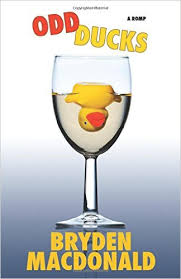
[READ: April 1, 2016] Odd Ducks

Odd Ducks is a play commissioned by the Nova Scotia playhouse.  It is set in Tartan Cross, Nova Scotia.

There are four characters, all in their 40s. Ambrose Archibald, he is unemployed but charming and a total narcissist; Mandy Menzies was the high school beauty queen but she is in a bad marriage now, a naive sweet woman. Estelle Carmichael is Mandy’s friend and housekeeper–she had a crush on Mandy in school and has sworn off men forever.  Freddy Durdle is Ambrose’s only friend but even he is fed up with Ambrose’ behavior.

The play opens with Ambrose out in the woods trying to find himself.  And after a few minutes of soul searching and a minor fright he has succeeded.  He is pontificating about himself when Estelle comments that she can’t listen to this crap anymore.  She tells him he is full of it.  To which Ambrose says, I forgive you. (more…)

Read Full Post »

oddduck1SOUNDTRACK: SAM LEE-Tiny Desk Concert #470 (September 11, 2015).

samlee Sam Lee has a fascinating voice, it reminds me of Nick Drake, but more… powerful.  He has Drake’s timbre and somewhat unusual delivery–sort of a stage-ready musical delivery.  But aside from his voice, what makes Lee so interesting is that for these three songs, possibly for all of his songs, he “has dedicated himself to preserving centuries-old folk songs of the U.K. and Ireland, particularly from “outsider” communities like the Roma (Gypsies) and the Scottish and Irish Travelers.   He and his bandmates–ukulele player and vocalist Jon Whitten, violinist and vocalist Flora Curzon, and percussionist and vocalist Josh Green–put these ancient songs in thoroughly 21st-century arrangements that feel creative, fresh and surprising, but also deeply human.”

“Over Yonders Hill” opens with that ukulele and Lee’s voice–I was quite surprised when I first heard it all together, but it works quite well.  And then the fiddle kicks in, playing some lovely swirling solos.  Then Lee adds a tiny harmonium, and that wheezy tone adds perfectly to the feeling that you might be out by a campfire   The song keeps building with backing vocals from the drummer.  As the song nears its end the violinist adds her haunting backing voice to the proceedings.

He explains that he goes around the country recording old singers—the keepers of these old traditional songs.  So the second song, “Lovely Molly” he learned from an old Scots traveler—a song of an old plow boy going to war.  They do this one a cappella and their harmonies are beautiful.

He learned the final song, “Goodbye My Darling” from a horse dealer in Kent–an old gypsy man.  It is about men being sent off to penal servitude in the United States and Australia and the injustice done to those incarcerated.  It is also played on that tiny harmonium which looks like a laptop.  As the harmonium fades away the violin plays a sweet pizzicato melody.  After about three minutes the song kicks into high gear, sounding very much like a traditional song—fast violin and quick rhythm.   And yet as the music grows more alive, the lyrics get darker.  As the song ends he does a kind of whistling hum, which I simply don’t understand, but which adds a delightfully strange texture to the music.

I don’t know that I would seek out Lee’s music, but it’s nice knowing he’s out there.

[READ: March 26, 2016] Odd Duck

I love the First Second Childrens’ books.  They are a little bit odd, but ever so fun.   And Sara Varon is a great illustrator so putting her art on anything makes it enjoyable.

I’ve read a number of Castellucci’s other books, and the two seem like good pair for this story about not quite fitting in.

Theodora is a duck.  She likes things to be regular and consistent.  She goes for a swim at the same time every day, with a tea cup on her head–making sure not to spill a drop.  She always has exact change at the store and looks at the stars every night.

But she is also a little different from the other ducks.  She buys mango salsa (which no one else does), she buys fabric squares and reads books that haven’t been checked out in years. (more…)

Read Full Post »

1993-1994 SOUNDTRACK: LEON BRIDGES-Tiny Desk Concert #469 (September 8, 2015).

leonLeon Bridges has a great old soul voice.  Indeed, I had no idea he was so young until he started speaking after the third song and all manner of young person chat came out of his mouth: “Thanks to my main man, you all looking beautiful man.”  His voice is pure and clean and hearkens back to 1960s soul singers like Sam Cooke.

The way he sings “baby baby baby” in “Coming Home” is classic soul.  And his enunciation of “mouth” is just gorgeous.  This song features the backing vocals of his sister Jesse.

“Smooth Sailin'” features a sax solo and Bridges on guitar.  Since there are 2 guitarists already Bridges’ guitar doesn’t  add much, but for me it’s all about his voice anyhow.

“Twistin’ & Groovin'” is about how his grandparents met.  He says the first time he saw her at a party the thing he noticed first about her was her long legs.

“River” is just him on acoustic guitar with Jesse singing backing vocals.

It’s a solid set and Bridges’ star has continued to rise since this show.

[READ: September 18, 2016]  The Complete Peanuts: 1993-1994

I didn’t like the previous book all that much, but this one picked things up a bit.

The year starts with Snoopy taking a test in school and acing the true false part–the only one to do so!

1993 has Schulz’ first celebration of MLK day.  Patty mentions the “I have a dream speech” but I love that she just mentions it without making it a big deal, it quickly changes to an unfair lunch swap between a carrot stick and french fry.  Speaking of old words, Lucy begins insulting Linus with: blockhead airhead, noodleneck but then finds that these older words work better: puzzlewit, dimbulb.

In pop culture notes, April 1993 sees Snoopy as Joe Grunge and in May 1993 Sally asks why is Barney purple? (more…)

Read Full Post »

decomposSOUNDTRACK: COLIN STETSON & SARAH NEUFELD-Never Were the Way She Was [CST113] (2015).

colinThis is kind of a show offy disc because both Stetson and Neufeld proudly state:  “All songs performed live (no overdubs/loops).”  And so we get Neufeld ’s cycling violin and Stetson’s cycling saxophone playing seemingly endless series of trills and melodies.

Despite Neufeld’s excellence on the instrument, the violin does play a kind of support role to Stetson’s sax (mostly because the sax is louder and more obtrusive).  But while the disc does sound like a Stetson disc, the violin adds some really interesting textures.  The disc opens with “The sun roars into view” and the violin playing a fast two note melody as the sax seems to rise up from the initial static slowly overtaking the song.  About 2 minutes in, the violin plays some loud trills that remind you it’s there, but when the sax quiets a few seconds later, the repetitive violin picks up the melody.  About half way through the 7 minute song the violin soars.   Around five minutes the sax drops away to a single bass note repeated while the violin takes some fanciful runs.  A voice, (not sure whose, but I assume Sarah’s) then soars above the music.

“Won’t be a thing to become” begins with a slow bass melody (with audible sax clicks).  The violin plays a similar melody—slightly different to accentuate the notes.  It’s a shorter piece (only 3 and a half minutes) and these shorter pieces tend to explore quieter moments in an interesting way.  “In the vespers” starts with some fast violin notes once the sax kicks in, it adds a new sense of urgency to the melody.  It’s all very pretty.  The middle turns into rapid fire violin alternating with some noisy sax.  As the song winds down, the fast sax notes continue but a bit more quietly and they are accented by long slow bows of the violin.

“And still they move” is a slow piece.  It’s primarily violin with the occasional sax note adding low end.  It’s barely 3 minutes long.  “With the dark hug of time” stays slow but with some incredibly deep rumbling bass notes underneath the squeaky violin.  It’s a cool and menacing sound.  There is a quiet section near the end which resolves as a low rumble and Stetson’s unusual vocalizations through his sax.

“The rest of us” is a kind of bouncing,thumping song with some high tense violin strings running along it.   I love the part where Stetson “sings” the four note discerning riff and the violin plays along with it—it’s the highlight of the disc for me.  The 8 minute “Never were the way she was” opens with a low rumble and feedbacky sounds.  The melody comes in slowly with some incredibly low notes from the sax.  After about 6 minutes the sax drops out leaving just the bowed violin.  The last two minutes are a pretty, somewhat mournful violin section with the sax providing low bass notes.

Flight is only a minute and a half and it opens with a gentle static/rain and slow notes.

Given these two great musicians, I expected a bit more from this.  Either Neufeld really keeping up with Stetson (rather than accompanying him, which i what it feels like) or perhaps Stetson playing differently to accommodate someone else.  I suspect I have just been spoiled by their other works to expect something mind blowing.

[READ: February 15, 2016] Princess Decomposia and Count Spatula

I have really enjoyed Andi Watson’s work in the past.  I haven’t read much from him lately, but when I was really into graphic novels twenty years ago, he was an artist I would always gravitate towards.

This is his first book for First Second (he used to do a lot of his books for Oni Pres).  It’s a romance (like many of his stories) but with a twist.

The story is set in the underworld.  Princess Decomposia is the overworked daughter of King Wulfrun.  The kind is old and infirm and never gets out of bed.  Indeed, he won’t even eat, declaring that any food is too much for his poor stomach.  Of course, he reads Wellness Weekly to get new ideas for broths to eat–but he never likes them.

Since he never gets out of his bed that leaves the Princes to do all of his diplomatic work.

She meets with the lycanthrope delegation and almost has a disaster on her hands because her father has fired the chef.  But when they see uncooked meat the werewolves are quite pleased. (more…)

Read Full Post »

margoSOUNDTRACK: COLIN STETSON-New History Warfare Vol. 3: To See More Light [CST092] (2013).

stetson3 After the raucous wildness of Stetson’s Vol. 2, I wasn’t expecting the first song to be so gentle.  Justin Vernon sings (with many layers of processing) the rather pretty opening track.  When I first heard it I didn’t like it—I wanted Stetson to do Stetson and it seemed like the track was all voice (nad very different from Stetson).  But Stetson is there, and he plays his normal unceasing melodies behind the voices.  The track seems especially light since it is followed by the aggressive “Hunted” which prominently features Stetson’s “voice” (he has a microphone on his throat or something to pick up his grunts), making an almost growling noise as he plays.   It’s worth repeating that Stetson does circular breathing, is able to play nonstop and can somehow to play different things at the same time (no overdubs) as well as vocalize in interesting ways.  You can also hear him taking breaths while he platys—the breaths are part of the percussive nature of his playing. It’s pretty amazing.  About four minutes in, the tone changes a bit, becoming a little sharper which seems to make the growl even more pronounced.

“High Above A Grey Green Sea” is a quieter song with more vocalizing, but this one feels mournful and lonely as opposed to intense and scary.  “In Mirrors” opens with a deep breath as he plays a slow quiet 90 second song full of unexpected high notes.

“Brute” is appropriately named as it sounds like he is forcing the song out of his sax.  He places mics on his sax so you can hear the clacking of the keys.  And that is readily apparent on this song which is full of clacking and clicking and grunting all the way.  After about a minute, a discordant melody comes in and establishes a tone that plays or a few bars until Justin Vernon returns, but this time with growled words.  It’s a pretty intense and rather scary track—and nothing like Bon Iver at all.

“Among The Sef (Righteous II)” is a brighter song—higher notes played in a very fast style.  There are some vocalized melodies as well.  But the main song is a rolling series of high notes.  “Who The Waves Are Roaring For (Hunted II)” opens with an interesting vocalized melody—he is really using that technique a lot on this record.  It also featured Justin Vernon.  “To See More Light” opens with slow echoed notes as he begins to build a melody out of a four note string.  He starts adding more and more notes.  The melody grows faster and faster until about five minutes when it starts to really slow down—dramatically so.  Around 7 minutes in, the song slows to a crawl, almost drunkenly it seems.  And the song feels like it has ended.  But Stetson has more on his mind.  The notes are held longer and shift more slowly.   Then the song starts to build up again with a different 4-note pattern that adds some squeaky feedback notes and then a catchy melody.  All 15 minute of this song done nonstop, pretty impressive.

“What Are They Doing In Heaven Today?” begins with voices from Vernon (in a softer voice than we’ve come to expect) as he sings a verse before the sax comes in.  “Bed” features some loud key clacking a great rhythmic pattern and some quiet notes from both the sax and his voice.

The final song is “Part Of Me Apart From You.” It really emphasize his “singing” the melody in his throat while playing the repeating lines on the sax.   The song seems to emphasize the lower notes in this song even as he “sings” higher notes.

[READ:October 20, 2016] The Creepy Case Files of Margo Maloo

The title of this book implies that it is a series, and I rather hope it is.  I loved the premise of this book.  Most of the characters were interesting and the mystery behind Margo herself was really cool.

I didn’t love Weing’s drawing style, though.  It really never resonated with me at all, and at times I found it off-putting.  Which is a shame since the story is so fun.

Charles is moving to Echo City and he hates it.  His mom tries to convince him that big cities are fun.  Plus, his dad is fixing up a big old hotel and they get to live there for free (suspension of disbelief there).  There are already some people living there, too.

Charles’ dad is hip and cool (he is seen with Dead Kennedys and Black Flag logo tattoos).  All of the things that Charles finds creepy about the place, his dad calls “character.”   Like the giant chandelier that was in a closet.  Whatever his dad says, Charles’s comment is simply, “This place is definitely haunted.” (more…)

Read Full Post »

peanuts-10991SOUNDTRACK: CHRIS STAPLETON-Tiny Desk Concert #484 (November 5, 2015).

chrisChris Stapleton is a big dude with a big beard and long hair.  He could be a heavy metal guy, but put a cowboy hat on him and you know exactly what his music is going to sound like–slow with an almost mumbling drawl (although his lyrics are quite clear).

The blurb says that his songs are timeless and in a way they are–I wouldn’t know if these songs were old country songs or new country songs, but that’s probably because I don’t much like country songs anyway.

“More of You” is a slow song in which he is joined by his wife Morgane on harmony vocals.  The song is fine.  But I was surprised by how funny he was when it was over and he asked, “When did DC turn into Louisiana?  It’s hot!”

“When The Stars Come Out” was cowritten with Dan Wilson but it doesn’t quite have Wilson’s super catchiness.

He is playing a beat up guitar that he says is 12 years old.  He doesn’t know where it came from, but he says he thinks someone has even used it as a canoe paddle and it has mud in it.  He says he has lots of guitars and his wife says Lots and Lots.

“Whiskey and You” is a song about, big surprise, drinking.  Lyrically it’s kind of funny, despite its intentional sadness.

[READ: September 14, 2016] The Complete Peanuts 1991-1992

I was trying to figure out when the last original Peanuts strip I’d ever read was written.  I stopped reading newspapers in college.  But I’m sure I came across Peanuts once in a while.  My dad also used to get the papers, and I might have browsed through the comics.  But I have to assume it was sometime around 1992 or 1993 that I stopped looking altogether.

I wonder if Sparky started golfing again as there are a lot of golfing comics this year, including one on April 21 1991 where Snoopy is trying to hit it over a tidal wave.  This is one of those rare Sunday comic that he started doing with what was basically a full-page comic as opposed to several panels.

I also felt that 1991 was not a particularly great year for Peanuts.  We all know that Snoopy loves to be in different characters–and has recently been a surgeon.  Well, in January 1991, Snoopy pretends to be a road flagman.  Not very aspirational.

I loved the Peggy Jean story line from last year.  She finally gets a mentions again in March, but she has moved away. Which means he’s back to pining for the red-haired girl.  I know that the red-haired girl is classic Peanuts, but I really liked Peggy Jean.

But there are some great strips and themes.

I did enjoy that Sally after being steady rebuffed by her sweet Babboo calls herself his Sweet Babbooette.  Later, Sally comes up with a new philosophy.  “I’ve decided to put everything off until the last-minute and to learn everything in life the hard way.”  When Charlie says, “Good luck,” Sally says, “That’s what my teacher said.”

Sally asks Linus what happens if she doesn’t go to school and he tells her the sheriff comes and throws you in a dungeon with no food or water for ten years.  She hates that idea, but then thinks, “if we go to school for 12 years….”

Harriet’s famous recipe for seven minute frosting makes a return in April 1991 with all the birds talking about it.  Man, I should find out what this is.

And there’s a lot of scenes with Snoopy wrangling with Linus’ blankets which I always like.

Joe Garagiola gets some more abuse in May when he makes it into the hall of fame and Lucy says, “It means there’s still hope for us all.”

One thing I have never mentioned is the amount of times Schulz draws or mentions zambonis (and even calls them zucchinis).  I assume someone has collected this information, but he must have really loved the zamboni because boy does it ever make a lot of appearances.  Often times once a week for several weeks.

For something new Sally and Charlie are asked to teach a Bible class to kids, which is kind of fun.  The boy wish they’d gotten a “cute chick” instead of an “old lady” like sally.  And one of the boys keeps talking about the Great Gatsby, “Gatsby stood by the sea of Galilee and picked out the green light at the end of day’s dock.”  The series ends with the kid waving goodbye to her and Snoopy saying “So long, old sport.”

Way back in a previous book Billie Jean King says that whenever Sparky put her name in a strip it meant she should call him.  So in August Snoopy says “I’ve always wanted to call Billie Jean King.”

I enjoy this attitude from Patty: “Hey Marcie its a beautiful summer day  C’mon out and we’ll waste it away doing nothing. Then we can look back upon it and regret it for the rest of our lives.”

When I was a kid I believe I had the same seasonal beliefs as Patty does in Sept 1991: “the four seasons are baseball, football basketball and hockey.”

The football gag in 1991 shows Lucy waving a book about holding the football.  But when she pulls the ball away she tells him that she wrote the book.

Later in the year, Lucy speculates that the Great Pumpkin might be a she  “Never occurred to you, did it?”

As the year ends, Marcie and Patty give Charlie an ultimatum to decide who he likes best.  Of course he hesitates and they walk away.

In January 1992, Spike says that if he had an earache his dad would blow cigar smoke in his ear.  I’d never heard of this, but it is indeed an old wives tale.

Schulz loved having his Peanuts‘ kids read really big books.  And sometimes they were used a lot as punchlines.  But I enjoyed Patty saying A  Tale of Two Cites was written by “Charlie Dickens.  Chuck  Chaz?”  And then when she gives here report she begins “St. Paul and Minneapolis are…” and then we see her sitting next to Marcie who says “One of the great tries of all time, sir.”

Sally continues to be one of my favorite snarky characters.  “Sometimes I worry about you big brother.  Often?  No not often, just sometimes.  Like maybe seldom.  That’s it, seldom!”

Charlie is still being very loving and missing Snoopy.  He tries to get out of school a lot so he can sit with the dog and even worries when it rains.  When he goes away he calls over to where Snoopy is staying and talks on the phone (he says “Woof”) and Snoopy says “Woof? what does that mean?”

Another full-page Sunday strip came on April 19, 1990.  This may be the weirdest, most context-free strip of them all.  Snoopy is looking at a map and the whole page is covered with a gorge and the caption says “Every year thousand of tourists visit Victoria Falls in Zambia.”  Huh?

There are still more Tiny Tots Concerts, Patty still hates to be called a Tiny Tot.  Although she gets excited in May of 1992 because she thinks the new song is called “Hey dude” when it is actually “Etude.”

Pop culture references: in August 1991 someone described being suspended from the bungee cord of life Fried Green Tomatoes is mentioned in April 1992.  Spike does Velcro jumping in July 1992.  After playing some football, Marcie says she could be another Joe Iowa (Montana).

And Sally changed her philosophy from “who cares?” to “what do I care?”

In Summer 1992, Charlie goes to camp and helps out a kid named Cormac, although we don’t see him much after that.

In 1992, Charlie believes that Lucy in sincere about holding the ball.  When he misses, Sally says “You’re not in love with Lucy, are you big brother?”  When he says No, she says, “I should Hope not,  I’ve discovered that love makes us do strange things.  So does stupidity.”

In 1992, Marcie decides to help spread the word about the Great Pumpkin but she calls it the Great Grape.  When she realizes her mistake she says, “I guess it would be hard to carve a scary face in a  grape, wouldn’t it?”

Over the years there have been hundred of jokes about Schroeder’s musical staff and Snoopy either sleeping on it or breaking it or so many other possibilities.  They’ve all been mildly amusing.  I liked in December 1992, when Snoopy takes the notes and uses them as the sound of his bell when he is Santa Claus ringing bells on the street.  Because yes, for the last two years Snoopy has dressed up like Santa Claus on a street corner ringing bells.   I like the one later when Charlie brings snoopy his dinner and a girl says “Hey look, Ma, Santa Claus is eating out of dog dish.”

There’s two Sundays in a row with Sally writing a letter to Samantha Claus.  In the first one, Charlie asks if she goes Ho Ho Ho or just smiles daintily, but the following week we find out that Sally talked about her in school and was roundly mocked.

Spikes Christmases have been pretty sad, but I did get a kick out of this one. “Last year I exchanged a gift with a rock, I think he liked what I bought him…he still wearing it.”  And there’ s funny sequence where Spike puts lights on his tree then walks all the way to Needles to plug it in at the chamber of commerce.  There’s even a news story the next say, “Someone sneaked into the chamber of commerce building last night and plugged in an extension cord.  The cord led out of town somewhere into the dessert.  Everyone is puzzled as to who or why someone would do such a thing.”

Although perhaps the best Christmas joke ever comes in 1992 when Sally is writing her thank you note: “Dear Grandma, Thank you for the money you sent me for Christmas.  I am going to save it for my college education.”  Then she says “It’s hard to write with a straight face.”  And Charlie says, “I never said a word.”

1992 ends with a New Years Eve party at Snoopy’s and he says “What do you mean we’re all out of hors d’oeuvres.

So overall, it’s not a bad two years, there’s just not a ton of noteworthy jokes.

The introduction is by Tom Tomorrow.  He says his influences were Mad magazine, Garry Trudeau and Matt Groening but his earliest inspiration was Charles Schulz.

He says that in the 1960s he hit the perfect sweet spot with Peanuts:  old enough to understand the humor, young enough to truly appreciate the whimsy. When he was a child, he loved the Christmas Special, and he was excited that his parents bought their first color TV in time for its annual airing.  He had also been given a Snoopy astronaut in the year he became the unofficial mascot of Apollo 10.

He describes Peanuts as “a strip that spun heartbreak into wry humor.  A cartoon about childhood anxiety that veered frequently into the realm of magical realism.”

He loves things like that the doghouse was bigger on the inside than the outside (although that aspect has been downplayed in recent years).

When he was a young cartoonist, he wrote to Charles Schulz.  And Schulz invited him over for lunch. Schulz was very generous with his time. “We ate at the cafe adjacent to the skating rink he’d built. The table was always reserved for him and on which you will still find a reserved sign to this day.”

Tomorrow says he wrote the only obituary comic he’d ever done for Schulz and he quotes Schulz: “If I were a better artist, I’d be a painter. And if I were a  better writer, I’d write books.  But I’m not so I draw cartoons.”

Tomorrow addresses his change from the strict four panel strips of his whole career, which I noted with concern and excitement.  Evidently, Schulz always wanted to experiment with the panels, but he was unsure if the Syndicate would allow it.  Tomorrow jokes that at this point in his career, he probably could have demanded a solid gold table and a full complement of chorus girls to entertain him while he worked.

He concludes his introduction by saying that Schulz gave him an original strip–which is the middle strip on page 71 in this book (dated June 14), and what a nice one it is:

“It’s nice to be able to do something for someone once in a while that’s appreciated.”

Read Full Post »

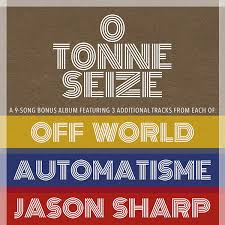
sardine6SOUNDTRACK0 Tonne Seize [CST bonus] (2016).

tonne0 Tonne Seize is a bonus compilation of three tracks each from Off World, Automatiste and Jason Sharp.  The collection is 41 minutes of music (not too shabby) and came with a pre-order of the three records (and is available on Soundcloud as well).

The first three songs are by Off World and the first two of those are remixes.  The original “Wonder Farm” is dominated by popping drum sounds.  There are some other sounds that go through the track but the base is mostly a kind of slow Asian melody.  The “Wonder Farm (Summer Crop)” mix removes those snaps and percussion entirely.  It focuses just on the music, which I have to say is far more enjoyable without the bangs.  “Primitive Streak” is a slow droning piece, while this compilation’s “Primitive Streak (Silver Mix)” doesn’t sound all that different.  It also removes the drums, and highlights the squeaky synth sounds and the overall drone tone.  It seems to emphasize and de-emphasize different instruments but otherwise sounds pretty similar. The final track  “Lost Meadow” is a pretty, delicate piano based piece with some twinkling of spacey synth notes.  It’s easily the prettiest piece.

The three Automatiste tracks do not quite follow the same naming convention as the actual disc, although the first track is called “Simultanéité 5.” It has slow beats and is basically two-note washes building on top of each other.  “Fragments continus” is a noisy piece with layered thudding drums (like heartbeats especially around the 1 minute mark) and drone noises that wash in and out.   About half way through what sounds like a melody appears amid the din, but it feels like it formed organically around the synths and drums which is pretty cool.   “Le Silence 3” opens with some jackhammer sounding drums and then almost easy listening synths.  The juxtaposition is interesting and by the end the song feels nicely dancey.

The final three songs are from Jason Sharp.  These three are quite different from his album because they really feature the saxophone to a larger degree.  “Plummeting Veins” opens with a heartbeat and some rumbling sax (that sounds like the opening of the Speed Racer TV show).   This track is under 2 minutes, the shortest he’s done by far, and the way the heartbeat speeds up as the sax plays some low rumbling notes is pretty cool. “Hear a Fading Cry” is a much longer number.  The heartbeat is quieter but the sax is much louder.  It sounds a lot like Colin Stetson in the low rumbling and noisy barking that the bass sax can produce.  It ends with some rather high-pitched squeaky sounds that I assume come from the sax, but which I can’t imagine coming from such a bass instrument.  It’s 7 minutes long although it takes almost 2 minutes to really get going.  And it swerves between loud and rumbling and then sort of menacing by the end,  “Ride On Into the Sweetening Dark” is perhaps the most conventional of Sharp’s songs.  It is a series of sax solo lines over a gentle tinkling backing drone.  Some of the solos lead to noisy wailing, but for the most part the line are pretty and jazzy.

It’s interesting how different these bonus tracks tend to be from the actual releases.  I enjoyed listening to these variants to see what else these artists are capable of.

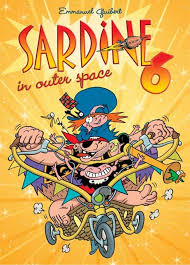
[READ: April 9, 2016] Sardine in Outer Space 6

Sardine is a children’s book published by First Second.  It was originally published in France (and in French) and was translated by Sasha Watson.  There are six Sardine books out.

The inner flap says “No Grownups Allowed (Unless they’re pirates or space adventurers).”  This is the final Sardine book.  And while I didn’t enjoy the first book much, by now I’m sorry to see the series end.

This book also has the fewest stories in it (only 9). (more…)

Read Full Post »

« Newer Posts - Older Posts »