Feeds:
Posts
Comments

Archive for the ‘Death’ Category

ornerSOUNDTRACK: PHISH-Hoist (1994).

hoistI always think of Hoist as a kind of goofy album because of the way they are dressed on it (and the crazy cover).  But it is absolutely not.  Indeed, opener “Julius” sounds like a ZZ Top song.  In fact, every time they’ve played it live I assumed it was a cover.  It is less restrained in the live setting, because this version has more acoustic guitar.  There’s even backing vocalists and horns.  “Down with Disease” has that great watery bass, but the song (which sounds good) here is a little stiffer than the live version.  It also has something of an R&B feel (with backing vocals) even if the guitar is certainly not R&B at all.  It bleeds right into “If I Could” a pretty harmony-voiced mellow song.  The big surprise comes from the Alison Krauss vocals–she gets a solitary line or two and then harmonies.  The song is very pretty but the strings are overkill.

“Riker’s Mailbox” is indeed a reference to the Star Trek character, although the 30 second burst of noise is pretty hard to explain. Nevertheless, the trombone is played Mr Riker himself, Jonathan Frakes.  It jumps into the rocking “Axilla, Pt. 2” which is usually a little faster live (I like the sloppier crazier live version better). There’s some vulgar dialogue in the middle of the song.

“Lifeboy” is a mellow acoustic song that builds from just guitar.  Lyrically it’s interesting: “God never listens to what I say…and you don’t get a refund if you overpray.”  It folds into “Sample in a Jar,” which is just as good here as any live set.  “Wolfman’s Brother” ahs horns thrown on top and some interesting sound effects.  Although overall l don’t like this version nearly as much—I don’t care for the horns or the backing vocals plus in the live version they emphasize the bruh of brother more which is cooler.  (Although I do enjoy the weird “Shirley Temple” line at the end).  “Scent of  Mule” opens so strangely with crazy guitars and a thundering drum.  The singing is very silly (with silly voices) and has a very twangy style (complete with banjo and yeehah).

“Dog Faced Boy” is a sweet (but weird) acoustic guitar number.  “Demand” is a ten minute song which I don’t really know at all.  It has a strange, staccato style riff.  At 2 minutes in, a car starts and after a commercial on the radio the driver pops in “Split Open and Melt” (a nod to “Detroit Rock City,” perhaps?).  This goes on until 9:30 at which time there’s a car crash and choir of angels (sick!).

I don’t car for the horns and R&B flavoring of this album, but the song selection is really quite good.

[READ: September 24, 2013] Last Car Over the Sagamore Bridge

I read about this book in Tom Bissell’s reviews recently.  He really made it sound like an interesting book.  So when I saw that we had just received a copy, I grabbed it and brought it home for the weekend.

There are 52 short stories in the short book (which is less than 200 pages).  Some of the stories are very short (1 page) with a few coming in at 5 or 6.  The 1 page stories are like flash fiction but they seem to be more of snapshots than actual full stories and they seem like they might be diary entries or something. The fact that a number of them are italicized with dates at the end make them seem like a selection from the same person rather than individual stories.

The stories are set all over the world, although they tend to focus on Chicago and Boston.  They are pretty universally dark with themes of death and loss permeating the collection.  And yet despite their overall negative feeling, the stories aren’t really depressing, exactly.  Bissell described the narrators as like someone telling a story about someone telling a story.  And that is true and that distance seems to take some of the edge off the stories.

But what’s impressive is the consistently strong and powerful writing.  The way that Orner is able to convey so much with such few words.  Some stories are just a scene, others are a whole lifetime.  But either way they are all really gripping.

I wasn’t going to write about each story, but it would have nagged at me if I didn’t, so here’s a few words about 52 stories. (more…)

Read Full Post »

underwSOUNDTRACK: OZOKIDZ-“Germs” (2013).

ozokidsThis song is also on the WXPN Kids Corner CD.  Ozokidz is related to the band Ozomatli, who I don’t know all that much about.

The music in this song is very upbeat reggae with the main melody done on kazoos (I suspect this is all one person, but i don’t know for sure).  There’s also some kids’ instruments playing along.  The beat is fast enough that I might consider this ska.

This song is a lesson about germs.  It begins by telling us how to prevent germs from causing us trouble (washing your hands, mostly).  The second half talks about how some germs—some bacteria—are good for us (bacteria is rhymed with healing ya).  But certainly the most memorable part of the song is when he rhymes food with poo (and the song stops so a tiny voice can say “ew, he said poo”).

The message is a good one, and the delivery method is more fun than anything else.  Although it seems a little half-baked of an idea to me.

[READ: August and September 2013] The Underworlds series

I was delighted when I saw that Tony Abbott had a new series and I couldn’t wait to start reading it to the kids.  T. has been asking me to read the Droon series to her like I did for C.  But it is such a long series that I was happy to find something shorter to start with.  It turns out that this Underworlds series is aimed a little older than Droon.  It gets pretty dark, and I was a little worried about some of the concepts in it (the Underworlds are the realm of death after all–and hmm, she has been talking a lot about death lately…).  But in pure Tony Abbott fashion, this was an exciting series where nothing less than the fate of the world is at stake.  And there’s humor as well (although somewhat less than in his other series).  But what really sold me on this series was the way he uses classical mythology (accurately) to generate the basis and conflict of this story.

And even better than using these mythologies, Abbot merges them so that the different cultural underworlds run into each other and even join forces.  It is a great way to learn some mythology if you don’t know it (there are handy maps of the Underworlds) or to gain a more in-depth understanding of the mythologies.  By the end of the series, the kids will have encountered the Greek, Norse, Egyptian and Babylonian gods of the Underworld as well as some of the major scary guys that come out of the Underworld. (more…)

Read Full Post »

dec2004SOUNDTRACK: AWAY-Cities (2013).

awayAway is Michel Langevin, the drummer for metal band Voivod.  But on his first solo album he eschews all conventional music.  Rather, he has created an exercise in found sound and released it on the small label Utech Records.

The album is described as

Strong field recordings capture more than just the sound of an area, they capture a mood and spirit of the place and people. On Cities, local color and nature recordings clash with riots and discord, capturing the full human experience across the world. Literal and metaphorical “found music” appears: the booming stereo of a passing car or distant church bells, as does the rhythmic engine hum of a bus or the chirping of birds. This tour is a fast paced one, rapidly weaving through the geographic locations building a diverse, yet consistently engaging experience. The audio journey captured here perfectly reinforces the fact that, regardless of one’s location, the presence of music is never far, nor should it be.

What we get is a collection that sounds like a tour through the streets of the respective cities (nothing more specific than Europe is given, sadly).  We hear street noise and buskers playing (interestingly just about every type of music I have heard in Boston subways as well).

I only wish more information was given about just what Away was up to.  Where he was and, more importantly, how he recorded these sounds. The recording quality is amazing—the panpipes and harmonicas sound crisp and clean with no other ambient noise.  Did he ask the performers if he could record?  How did he get them so pristine especially since I assume they are in the streets?  And for the Europe ones, was there any given order to the way they were edited?  Is it the progression of their Voivod tour, or is it just random?  The mixing and sequencing is quite good, especially in the shorter pieces which really take you on a journey.  Not knowing what’s happening is maddening and part of the fun as you try to picture (especially if you use headphones) exactly what you are hearing.

“Montreal 2010” opens with the sound of travel until we zoom in on panpipes (for a few seconds).  This switches to a lurching shanty (sung, I suspect in French—it’s a little hard to hear).  Then from the shadows comes the sound of someone playing Leonard Cohen’s “Hallelujah” on the harmonica.

“Europe 2012” opens with someone playing what I suspect is a hammered dulcimer (exactly the kind of thing that buskers play in subway stations), it shifts to a jazz trio (sax, bass, drums) wailing away with traffic noises in the background.  After some busses and an accordion solo, there are delicate chimes.  Finally a bagpipe melody leads us away from the delicate chimes until we hear announcements in what sound like Russian and then French.  The track ends with fans chanting “Voivod Voivod.”

Montreal 2012 returns Away to near his home city.  This time the scene is much nosier—it could be joyous, it could be angry—there are whistles and horns, and by the end it seems like a joyous parade.  The noise diminishes as an operatic voice pierces through briefly until the drums return.  More street noises, including police sirens, French chanting and a train passing by as we return to yet more street drumming.  If this track had more context for the title it would probably be more enjoyable. And yet as the parade (for surely that is what it is ) marches past you feel like you’re there.

“Mexico City 2012” opens with a truck honking and street noise until we hear what sounds like an indigenous band playing, then some more flute music and church bells pealing. Then there are announcements in Spanish (by both a man and woman presumably in the church) and church organ music.  Pan pipes and drums bring us back into the street and what sounds like a market scene which ends with some Mexican music playing.

“Europe 2011” opens with some beautiful guitar or perhaps an Indian stringed instrument playing and some traditional Indian singing.  There’s some more music playing and cheering and then some peace as birds take us out of this short track.

“Montreal 2011” opens with banjo music (!).  And then the more typically French sounding violin moves us along.  More pan pipes and traffic noise progress us through the city.  Then two very different examples of accordion music meld until the noise of the train wipes them out.   The track fades out with a band playing a  jaunty accordion inspired track.

“Chicago 2012” ends the disc with a symphony orchestra tuning up (I presume) for a few minutes.  It’s a shocking cacophony.  Until someone shushes the noises and the birds return, playing us out of this aural tour.

You can stream, download or buy the CD  here.  Buying the CD gets you some of Away’s cool art (although I wish there was more).

[READ: October 8, 2013] “War Wounds”

Since I’ve been enjoying Tom Bissell’s book reviews, I thought I’d see what else he had written in Harper’s.  He seems to have a storied career with the magazine as a traveling journalist.  And this article dates back to 2004.

It is a personal article about himself and his father.  What I found fascinating about this is that his father was a Vietnam veteran, and I don’t know too much in the way of writing that concerns being the child of a Vietnam veteran.  There are a lot of books and films about the Vietnam experience for the soldiers, but not so much about the families that they returned to (as far as I know).  So it was interesting to read Bissell’s account of growing up with his father–who was a hard man and who wasn’t afraid to fight with his children (especially when drunk).

The man that Tom grew up with had a temper and didn’t much approve of Tom’s chosen profession.  But unlike many people of his generation, Tom didn’t feel that he had a particularly estranged relationship with his father.  What on earth possessed him to invite his father on a trip to Vietnam–to visit the sites where he lost friends and was himself wounded, is the stuff of journalism. (more…)

Read Full Post »

corin SOUNDTRACK: THE DISMEMBERMENT PLAN-“No One’s Saying Nothing” (2013).

IDismembermentPlan_CVR-a71cdf7d3b8dde6270c3a01bb56278949eddb5fa-s1 thought I knew The Dismemberment Plan, but I must have them confused with someone else, because this song doesn’t sound anything like what a band called The Dismemberment Plan ought to sound like (which is noisy and chaotic and probably death metal).  This song has big vocals, organ and piano.  Nevertheless, it is rather raucous and is quite fun (and has what sounds like a drill sound effect in the beginning and middle).

Lyrically, the song is odd–“If you press the space bar enough, cocaine comes out.  I really like this computer.”

But it has a very fun devil-may-care, throw in everything attitude that I really like it.  The entire album was streaming on NPR, and I’m looking forward to hearing more from them–including their back catalog work, to see if they ever sounded like what I thought they sounded like.

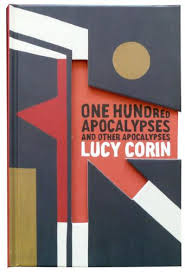
[READ: October 1, 2013] One Hundred Apocalypses and Other Apocalypses

I was excited to get this book because I thought the title was quite intriguing (and the crazy way the cover is cut out was also interesting).

There are four “stories” in the book.  The first three are about twenty pages each while the fourth is over 100 and is comprised of the titular 100 apocalypses (I didn’t count them).

“Eyes of Dogs”
This story contained marginalia (which is sort of like footnotes but not attached to anything specific). In this story a solider meets a witch and she tells him how to get money—climb down a hole and encounter three dogs.  He must wink at the first, blink at the second and hold his eyes closed for the third.  The story seems to be going along sensibly like a fairy tale but then it grows introspective and stops.  I was disappointed in this one.

“Madmen”
This story was utterly bizarre and yet by the middle of the story the bizarreness was explained and by the end I enjoyed it very much.  The premise of this story is that when children grow old they are given a madman to take care of (it is told matter of factly which makes you have to wonder if madman is code for something else.  When boys reach a certain age and when girl;s have their first period (which is an unfair division of genders) they get to go to the asylum and pick which madman (or woman) they want to bring home and care for.  The bulk of the story is at the asylum with the girl “interviewing” the candidates and her mother being mad at her choices.  Ultimately the story turns onto a nice moment between the girl and her dad, who may or may not have married his own madman.  As I said very weird, but satisfying.

“Godzilla versus the Smog Monster”
This was the most “real” of the four stories and it was my favorite.  A fourteen year old boy is watching “Godzilla vs the Smog Monster.”  He found the unlabelled video of it in his father’s sweatshirt drawer and assumed it was porn.  He’s bummed that it turns out to be this Godzilla movie.  In a parallel story, when the boy goes to school his class is watching live footage of California burning—and this burning is uncontainable.  The whole state is slowly engulfed in flames.  This fire, which seems to be some kind of attack obviously changes the minds of everyone in the story, including Sara, a girl who Peter thinks is pretty but who never talks to him.  But when she crashes her car in front of his house, he helps her and they go for a ride to a cave.  Images of the smog monster crop up in interesting ways.  Things get weird and less tangible, but because the beginning was so real it made the ending okay.

“A Hundred Apocalypses”
So this selection disappointed me because it proved to be 100 (I assume) flash fiction pieces.  And I have more or less come down against flash fiction these days.  Especially the kinds of stories that make an interesting “sketch” but aren’t really stories The other problem is that all 100 seemed to be about “apocalypses” which is a useless words when tossed around so much and which loses all meaning when there are 100 that seem to be about actual apocalypses.  Or something.  I also just learned that apocalypse means un-covering or revelation, not really the end of the world, but whatever.

There were probably 6 out of the hundred that I really enjoyed.  Sadly, I didn’t mark them and I don’t remember which ones they were.  The rest were okay or worse.

I am ready for flash fiction to go away.  And I fear that my beloved McSweeney’s is one of the prime generators of the genre, so perhaps they could knock it off for a bit.

Read Full Post »

harper juneSOUNDTRACK: JOHN ZORN-“The Dream Machine” (2013).

dreamThis is the title track to the third installment of instrumental albums by composer Zorn (as opposed to wild sax-player Zorn).  The new album is called Dreammachines.  Evidently this trilogy is somehow related to William S. Burroughs (sure, why not).  The first was called Interzone (and was three 15 minute-plus suites), the second was Nova Express (which was shorter pieces) and now Dreammachines (which is also shorter pieces).

It’s impossible to know what Zorn will throw at us next, but this song proves to be a beautiful jazz piece with the quartet of pianist John Medeski, bassist Trevor Dunn, vibraphonist Kenny Wollesen, and drummer Joey Baron.  It opens with a quick but pretty vibraphone melody.  The melody shifts keys but stays in the same pattern until the main melody kicks in.

Variations on the theme continue until about 2 minutes in when Medeski gets a big piano solo and this sounds more like traditional jazz than most Zorn pieces.  Then there’s a very cool vibes solo.  It’s pretty standard jazz and it’s really quite beautiful.

[READ: September 20, 2013] 2 book reviews

Bissell reviews two books this month.

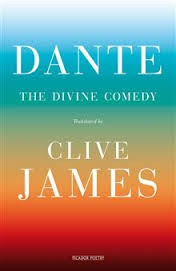
danteThe first is Dante’s Divine Comedy as translated by Clive James.  James has decided that since Italian is so easy to rhyme “For an Italian poet it’s not rhyming that’s hard,” rather than following Dante’s linked terza rima rhyme scheme, he chose the rhyming quatrain.  Bissell expects that academics and traditionalists will be very suspicious of the book because of that, but he says that for the average person (the average person who wants to read Dante, of course), it will be more fun and enjoyable.  Especially, James popularizes the book.  I have always resisted The Divine Comedy but this one sounds like it might be a bit more fun, and isn’t that what reading is all about?

magicalThe second book is The Magical Stranger by Stephen Rodrick.  When Rodrick was 13 his father died in a military plane crash.  His carrier was en route home when it was told to reroute to help with the hostage crisis in Tehran.  But his plane was destroyed.  The hardest part for Stephen was when he read that the accident was deemed “pilot error.”

This book is Stephen’s attempt to learn more about his father.  Through the course of the book, he discovers more and more unpleasant facts about his father—from the lies his father told his mother to a pilot who knew his father who calls his an asshole.  Bissell finds this part of the book very moving but not quite warranting a novel length treatment.

But there is a secondary story about the man who now commands his father’s squadron James Hunter “Tupper” Ware.  Bissell says that this part of the story is far more engaging (Stephen is a journalist and this section is more investigative).  Stephen more or less tries to live his father’s life through Ware, a man who finds the same level of difficulties in his job and his life as Rodrick’s father did.

This is definitely not the kind of book I would read, but for those with an interest in the military and pilots its sound like a good warts-and-all investigation.

Read Full Post »

ailisSOUNDTRACK: THE BLOW-“Parentheses” (2006).

blow1I learned about The Blow from NPR Music.  The lads played a new song by them, but this song, which is also available on NPR, is from 2006.  I don’t know anything else about The Blow.  But I do know that “Parentheses” is a delightful little pop confection (with enough elements of weirdness that explain why it was never a hit).

“Parentheses” immediately sounds like something I’ve heard before.  That chorus is just so perfect—“when you’re holding me, we make a pair of parentheses” that I can’t believe no one has thought of it before.  Of course, the bit in the verses about the deli aisle is certainly unexpected.

I normally don’t like the bap bap // bap drum beat, but it’s perfect here.  The stripped down nature of the music (simple chords on a few different keyboard sounds) accompanies this perfectly.  It’s sung with Khaela Maricich’s sweet and almost fragile (but not) voice.

It is so catchy I have now listened to it three times in a row.  And that little guitar tail at the end is very inviting as well.  I can’t believe this song wasn’t huge.

[READ: September 26, 2013] Desolate Heaven

I read this play because of my friend Ailish—I’ve never seen anyone with a name almost like hers—Ailís—before.  And, given the Irish name it is no surprise that the story is set in Ireland.  But rather than Dublin, it is set on a desolate beach.  We see two young girls: Orlaith (13) and Sive (12) messing about.  They are acting like adults—complaining about the beach and “the kids” and how everything is awful.  Despite some tensions, the girls bond over their difficult lives.  Each lives with a single parent and in each case, the parent is an invalid.  Each girl has to do everything for her parent in addition to going to school.  And in the next few scenes we see just how desperate their situations are: Sive’s mother has broken her pelvis (and has been unable to move for two years) and Orlaith’s father didn’t get up at all today because he didn’t feel he was able to.

In the next scene, we see the girls acting out a plan—to meet at the beach with as much money as they can grab.  And just like that, they are off on a road trip. (more…)

Read Full Post »

school spiritSOUNDTRACK: PINK FLOYD-Live BBC 1970-1971 (1970/1971).

pink-floyd-paris-theatre-london-bbc-archives-back-cover-17638Since I am delving deeply into early Pink Floyd, I came across this bootleg of Floyd on the John Peel show.

The first show is Live at Paris Cinema, London 07-16-1970, just before the release of the album Atom Heart Mother (which we know because Peel says the song will be on their forthcoming album).  The first set includes “Embryo” (which only ever appeared on their compilation Works, in a much shorter version), “Fat Old Sun” (from AHM), “Green is the Colour” (from the More soundtrack), “Careful with that Axe, Eugene” (available on Relics and in live formats), “If” (from AHM) and “Atom Heart Mother.”

The version of “AHM” here is interesting  because the cello solo is played by a horn instead.  The reason for this is because it allowed them to have fewer musicians on tour.  It’s the same theme but the horn brings a very different feel than the cello did.  It’s also interesting to hear that the horn players are nowhere near as polished as they might be.  (In Geesin’s book he does talk about the lack of rehearsal the orchestra had for their live shows).

The second show is Live at Paris Cinema 09-30-1971, just over a year later.  They once again do “Fat Old Sun” but in 1970 it was 6 minutes and in 1971 it is now 15 minutes long with a lot of jamming and keyboard stuff thrown on top.  Next up is “One of These Days” (from the forthcoming Meddle) a favorite of mine. From this set I learned that the distorted voice that says “one of these days I’m going to cut  you in to little pieces” is actually that of Nick Mason (and interestingly, in this version, the quote comes at the end of the song rather than the middle).  Then they play “Embryo” again (it was clearly a concert favorite even if it never got a proper release (same length for each show and not drastically different).  Then comes “Echoes,” the big side long epic from Meddle.  And the set ends with “Blues,” which is indeed a blues.  I don’t really expect to hear a blues from Pink Floyd, but here it is, and it’s a good one (Gilmour clearly can jam to anything).

The video below contains the two complete shows running at over 2 hours.

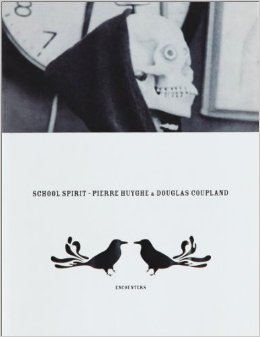
[READ: September 29, 2013] School Spirit

This is the final obscure Douglas Coupland book that I’m aware of and will be the final DC book that I need to hunt down for this blog (I have three other proper novels that I haven’t posted about, but those are proper books and will be dealt with in turn).

This book has about the least amount of information about it that I’ve seen in a book.

The (I assume) official description of the book (which I get from Amazon and Google Books) says

Dis Voir’s Encounters series invites a well-known contemporary artist to choose a subject for a book. The artist also selects a person with “elective affinities”–someone with whom he or she would like to share this exchange. The resulting collaborative volumes serve as an artistic and political laboratory of the present. For this first installment, French artist Pierre Huyghe choose Canadian writer Douglas Coupland, author of Generation X, for the influence that Coupland has had on his generation, and on Huyghe’s own work. Using a high school yearbook as scaffolding for their meditations, they discuss the construction of character, narrative techniques based on chance and the political dimensions of Coupland’s work–themes that are also fundamental questions for Huyghe’s projects.  Using a high school yearbook as the framework for a meditation on memory.

But my copy (which has a different cover and limited publication information so may possibly be a different version) does not have anything to say at all about “the construction of character, narrative techniques based on chance and the political dimensions of Coupland’s work.” (more…)

Read Full Post »

CV1_TNY_09_09_13McCall.inddSOUNDTRACK: KISS-Alive III (1993).

alive iiiI’m aware that there are questions about the real “live” nature of the first two Kiss Alive albums.  This naturally makes me suspect the nature of the live-ness of this one as well.  Not that I don’t think the songs are live, but I have to question the volume of the fans, who at times sound artificially enhanced.  I’ve also read that the “I Was Made for Lovin’ You” was taken from the soundboard during soundcheck with cheers added later.  If that’s true I have to give credit to Paul for being so “into it” during soundcheck.

back in the 70s, Kiss made a point for Alive II to not duplicate any songs from Alive!.  Obviously Kiss are much more mercenary now than they were back then–duplication is part of their thing now.  But since this is the first live album since the 70s, there’s a lot of new material to choose from.  Nevertheless, this probably shows a realistic set list for the time, so there are going to be some overlap from the 70s, and that’s okay.  And the band sounds quite good (this was 20 years ago it’s hard to believe).

“Creatures of the Night” is a rousing opener.  It’s hard to imagine they didn’t open with “Detroit Rock City” and end with “Rock n Roll Al Nite”.  “Deuce” is one of their best songs, so it’s a welcome old song.  Then there’s some questionable choices.  “I Just Wanna” is a bad song with a very obvious vocal line.  But it came from the then current album and it’s got the “naughty” singalong section (which was apparently dubbed out to avoid a Parental Warning sticker).  Despite all of the entendre in Kiss, they’ve never really been explicit, so the “I just wanna fuck” seems weird for them (especially when you know how many kids have been going to their tours recently).

“Unholy” fares much better.  It’s one of their cooler new songs.  Paul introduces “Heaven’s on Fire” in a fairly amusing way (and he can still ht those notes).  I don’t especially like that song or “Lick it Up,” but they will always be their bigger hits, so they get played.  Obviously I’m delighted to hear “Watching You” which they do very well.  I dislike “domino” lyrically quite a lot and I feel like Gene’s delivery here is disinterested at best (is it possible he is as disgusted by the lyrics as I am?).  But the song rocks musically.  “I Was Made for Loving You” is updated and sounds far less discoey.  “I Still Love You” is a great concert staple and it’s nice to have it on record.

Probably the biggest surprise on the disc is that “Rock n Roll All Nite” is not the encore (or maybe it was in concert, but it’s not last on the album.  I’d be delighted to see them and have this not be the encore.  I’d also be delighted if I never heard “Lick It Up” again.  I don’t know why this song irks me so much, but it does.  And in this live version, hearing Paul state “I wanna lick you” just creeps me out.  “Forever,” cheesy ballad and all, sounds pretty great live.   but “I Love It Loud” which is a great song sounds off here—too many backing vocals or something?  “Detroit Roock City”sounds great of course, although it’s funny to hear it have an introduction.

The disc is pretty much over for me here because I don’t like “God Gave Rock n Roll to You II” although this version is fine.  And the very end of the disc is, strangely, “The Star Spangled Banner.”  It’s a whole band version (without words) but  simple cannot imagine them doing it live for any reason.

So, this proves to be a pretty decent live album.  Not quite up to the stellar heights of Alive! and Alive II, but a worthy addition to the series.

[READ: September 15, 2013] “The Heron”

This story begins with the statement that the best place to feed herons is in Frederiksberg Gardens because they are tame.  The tone is very much like Julie Hecht–all matter of fact and somewhat indignant.

The story continues to talk about herons and the strange man who often stands on the paths that lead to the Chinese Pavilion. The narrator avoids this man by walking around to Damhus Pond (where the suitcase with the woman’s body chopped up inside of it was found).  He imagines the man who found it (well, technically the dog found it) was never the same again (nor, no doubt was the dog).  Despite the grisly scene (the narrator has never found anything there) he walks out of his way by the pond to avoid the herons.  And the strange man. (more…)

Read Full Post »

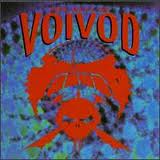
2013-10SOUNDTRACK: VOIVOD-The Best of Voivod (1992).

bestvoivodMost Best of records promise you a selection of popular songs from a band.  Voivod never really had any popular songs, so this is an interesting choice to start with.  This may also be the only Best of compilation of a band where people who like some of the songs almost assuredly will not like other songs.

As my posts about the band have indicated, Voivod changed drastically over their first six records (which is the  period this collection covers).  And so in twelve tracks and 50 some minutes you get the very diverse history of this very unusual band.  I’m not going to talk about each track (already done that), but I will list the songs

  • Voivod [War and Pain] classic screaming metal.

  • Ripping Headaches [Rrröööaaarrr] brutal, but I must say sounds a ton better than the original CD.  I wonder if this was remastered for the compilation).

  • Korgull the Exterminator [Rrröööaaarrr] hard to believe they used two songs from this album.

  • Tornado [Killing Technology] heavy but quite catchy.

  • Ravenous Medicine [Killing Technology] signs of complexity enter the heaviness.

  • Cockroaches [EP] a strange inclusion, almost a rarity.

  • Tribal Convictions [Dimension Hätross] very complex with some heaviness.

  • Psychic Vacuum  [Dimension Hätross] I’m surprised they didn’t pick other songs though from this album.

  • Astronomy Domine [Nothingface] their hit.

  • The Unknown Knows [Nothingface] very hard to choose just two songs from this masterpiece.

  • Panorama [Angel Rat] Their newest single and quite a departure from everything that has come before.

  • The Prow [Angel Rat] their prettiest number ever.  If you buy this CD for this song you’ll hate the early stuff.

Although Voivod fans (like Dave Grohl)

are diehard, anyone who would buy only a Best of record from the band is sure to be disappointed. There are so many phases of the band and they are so radically different from “Voivod” to “The Prow” that it’s almost not even the same band.  I’m very curious as to what sales for this album were like.  (Even the cover isn’t that inspired)

[READ: September 2013] The Walrus: Tenth Anniversary Issue

It’s hard for me to believe that The Walrus has been around for ten years (even they seem a bit surprised).  I still remember hearing about the magazine on Book TV from some Canadian channel that I just happened upon.

When I heard about it The Walrus seemed interesting–kind of like Harper’s and elements of the New Yorker but all about Canada.  I’ve been a Canuckophile for decades now, so it seemed like an interesting prospect.  And over the ten years of the magazine, while I haven’t written about every issue, I have read every article.  I have written about all of the short stories that they’ve published.

This issue eschews some of my favorite elements (the short articles in the front and the arts section in the back), but they make up for it with an oversized issue (twice as long as usual and the articles are all packed with content) and some fascinating articles.

And while there are none of the short articles from the front, there are “Time Capsules,” one page articles about things that have happened in the last ten years: The iPhone, Sports Concussions, Armed Drones, The Residential School Apology, Justin Bieber, Foodies, Hand Sanitizer and Cyberbullying.  It’s interesting to read about these phenomena from a slightly different perspective.  We know that Canada and the U.S. share many similarities but there are, at heart some core differences.  And it’s these differences that make you rethink a subject.  (more…)

Read Full Post »

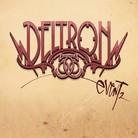
almostsilentSOUNDTRACK: DELTRON 3030-“The Return” (2013).

Deltron3030-EventII-caa19c164f9e01c2441aab420c0b54356b261e87-s1After thirteen years, alternative rap supergroup Deltron 3030 is back.  If you’ve forgotten, Deltron 3030 is comprised of Dan the Automator, Del the Funky Homosapien and DJ Kid Koala.  Evidently the album is chock full of guest stars (which I usually dislike, but the guest stars are a weirdly unexpected bunch–David Cross, Amber Tamblyn, chef David Chang?–so I’m curious to hear what they are going to add to the sound.

Okay even I admit I don’t really remember what the first Deltron album sounded like, but if memory serves this seems to be picking up in that same spacey vibe that made Deltron so weird and fun.

There’s a story going on here, told in Del’s awesome rapping style–mellow and trippy with big words and convoluted phrasings.  Of course, this is only track 2 on the record so I don’t know exactly what the story is about.  But I know that Deltron 0 is back and I’m pretty excited to hear the whole thing.

You can hear this track on NPR and you can watch the intro track (featuring Joseph Gordon-Levitt) here:

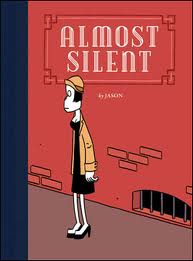
[READ: September 20, 2013] Almost Silent

This book collects four of Jason’s previous books “Meow, Baby,” “Tell Me Something,” “You Can’t Get There from Here” and “The Living and the Dead.”

“Meow, Baby” (2006) is a collection of  “short stories” from Jason.  They feature the same (looking) cast of characters as most of the other Jason books I’ve read (anthropomorphic animals), but there’s a few additions: a mummy, a zombie,a  skeleton and a vampire.  None of the pieces are titled and the only way to know when each is done is when you see his signature.  This is just to note that if there is a mummy in two stories, it’s good to know he’s not necessarily the same mummy.

The stories are quite funny with variations on mummy stories (wrapping your head in a bandage after you are hurt, getting an erection(!)), and vampire stories (the same looking guy is always following him with a stake) and some very amusing domestic scenes with skeletons.  I enjoyed the one where the mummy comes out of the sarcophagus, looks at a newspaper and then walks back into the sarcophagus with a look of despair on his face (his face is still covered in bandages—Jason has an amazing way of expression even with people who have no faces). There’s also a whole series of skeletons who climb out of their graves and go about mundane tasks .  There’s even a guy dressed like the Terminator who has some funny moments where he misses the opportunity to say his trademark lines.

The last few pages are three panel strips—like daily cartoons .  Were they ever shown in newspapers?  These show that Jason is also very funny at punchlines, not just dark stories and black humor.  True, all of these three panel comic are black humor (with the same cast of zombies, vampires, mummies and skeletons), but he really makes some funny and unexpected strips here. (more…)

Read Full Post »

« Newer Posts - Older Posts »