Feeds:
Posts
Comments

Archive for the ‘Consumerism’ Category

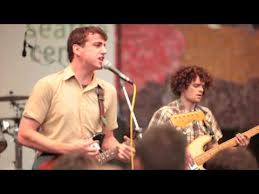
SOUNDTRACK: JAPANDROIDS-Live on KEXP, June 16, 2009 (2009).

Back in 2009,  one of the guys from Japandroids had surgery and they had to cancel some dates.  That’s only relevant to this because when this set is over, the guitarist is bleeding from his scar.

Japandroids are two guys and they make a lot of noise.  I can recall jamming on guitar with my friend on drums and even when we were totally in synch, we never sounded this good.  It really sounds like there are four or five people playing.  This set has three songs from their debut album and an amazing cover of Big Black’s “Racer X.”

The three  songs are very good and the guys pay hard and fast and, as I said, they sound amazing.  It’s a great set.  You can hear the whole thing here.  There’s also video of the performance.  It’s broken  into two parts.  This is part two, with the blistering cover of “Racer X.”

[READ: September 17, 2012] Bluebeard

I’ve mentioned this book a few times in the last couple of days as something that I’d been struggling with.  And, indeed, I found it to be a little slow going.  I was excited to start reading it because, as the subtitle says, this is an autobiography of Rabo Karabekian, an artist who appeared in Breakfast of Champions–I love that Vonnegut keeps working within his own universe.  But there was something about the early pages of the story that were just not that compelling.

Rabo is having a hard time getting his book going, and while that is a dramatic effect, I had a hard time getting into the book too.  It’s not that complicated of a story.  There are really only about a half dozen characters in the book:

Rabo–he is an American Abstract Expressionist painter (contemporary of Jackson Pollack, Jasper Johns, et al).
Circe Berman–she is an author who writes under the pseudonym Polly Madison (ha).  Madison’s books look at the real life of American young people and are staggeringly popular.
Paul Slazinger–Rabo’s next door neighbor who spends most of his time in Rabo’s house, although he and Rabo mostly ignore each other.  Slazinger is a writer with a decades long writer’s block.
Dan Gregory–a famous artist for whom Rabo apprenticed.  Gregory was such a good detailist that he once created a perfect forgery of a bill (on a dare).  Gregory was also a terrible racist and philanderer and treated Rabo with contempt at best.
Marilee Kemp–Gregory’s mistress and sometime muse.  She inadvertently sends Rabo an encouraging letter on behalf of Gregory and then she and Rabo begin a writing relationship which blossoms when they eventually meet. (more…)

Read Full Post »

SOUNDTRACK: CYMBALS EAT GUITARS-Live on KEXP June 18, 2009 (2009).

Cymbals Eat Guitars are from Staten Island (with members from New Jersey).  They have released two albums, although this recording is from after the release of their first album.    They play four songs:  “And the Hazy Sea,” “Cold Spring,” “Tunguska,” and “Wind Phoenix.”   They are noisy songs (mostly) with squalls of guitars (squalls is a good word since two of the guys are from Manahawkin, New Jersey.

The band has true progenitors in the indie rock scene–there’s sounds of Pavement, The Replacements,  even more melodic Sonic Youth .  They play noisy guitars and the vocals veer from softly sung to loudly screamed (often within the same line).    “Cold Spring” starts like a kind of shoegazery song and then after almost three minutes it turns into a  blast of pummeling rock with a noisy guitar section, before moving into a third more melodic section.

There’s   a lengthy interview with the band, where they give a shout out to New Jersey and seem genuinely surprised by the success they’ve had.  It’s a good show, and you can hear it here

[READ: September 25, 2012] God Bless You, Dr. Kevorkian

Again, against my better judgment I brought this Vonnegut book home too because it was on the shelf (and it was very short).  I still haven’t finished Bluebeard yet, but I have been curious about this book for some time.  It references Vonnegut’s early novel God Bless You, Mr Rosewater, but it also name checks Dr Jack Kevorkian.  So just what is it?

Well, it is collection of radio spots that Vonnegut did for WNYC radio in New York back in 1998.  Vonnegut claimed that he went to Kevorkian’s facility, was strapped in and almost killed multiple times, but Kevorkian brought him back each time creating a near-death experience. And each time Vonnegut travelled through that “blue tunnel,” he would interview a dead person.

The people he interviews vary quite a lot in fame and stature: (more…)

Read Full Post »

SOUNDTRACK: …AND YOU WILL KNOW US BY THE TRAIL OF DEAD-Live on KEXP, March 12, 2009 (2009).

Back in 2009, …And You Will Know Us by the Trail of Dead had been hit by a truck.  Really.  Evidently no one was hurt too bad, but they did have to cancel a show in Salt Lake City. 

Nevertheless, they managed to get to KEXP to play a four song set from their latest album The Century of Self.  The opener “The Giant’s Causeway” is full of bombast and noise  and has a surprisingly catchy melody in the middle.  It merges into “The Far Pavillion” (just like on the album) which sounds like pretty typical Trail of Dead–rocking and yet melodic, with some good screaming parts.

“Luna Park” is something of a surprise to me as it’s a piano-based ballad (which I suppose Trail of Dead plays, but which I don’t associate with them).   “Bells of Creation” also opens with a piano, but it quickly grows very loud.  It’s a cool song with lots of depth.

I had actually stopped listening to Trail of Dead after Worlds Apart (and album I liked, but I guess the band fell off my radar) so it’s nice to hear they’ve still got it.  At least as of three years ago.

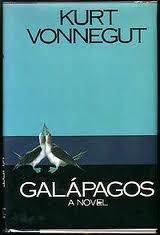
[READ: September 17, 2012] Galápagos

Each of these 1980’s era Vonnegut books gets darker than the last.  In this one the entire human race is wiped out (except for a few people who spawn what eventually becomes of the human race in a million years).  For indeed, this book is set one million years in the future and it is written by a person who was there, one million years in the past when the human race destroyed itself.  It’s not till very late in the book that we learn who the narrator is and, hilariously, what his relationship is to the Vonnegut canon.

In typically Vonnegut fashion, the story is told in that spiral style in which he tells you a bit of something and then circles back to it again later and comes back again later until finally 200 or so pages into the book you get all the details of what is happening.  Interspersed with the respawning f the human race (and flippers) is the story of the Adam and Eve and Eve and Eve and Eve and Eve who created the human race–how they got to be together, what their lives were like before and what contribution they made to humanity, such as it is now.

In another bizarre and fascinating twist, every character who is going to die in the near future gets a star next to his name so that the reader knows that that person is going to die.  We get a lot of things like ★Andrew MacIntosh for many pages until the character finally dies.  And pretty much everybody does die.  Well, obviously if it is set a million years in the future, but aside from that part, only a few of the characters survive.

So here’s how these few people managed to create a new human race in the Galápagos Islands.   (more…)

Read Full Post »

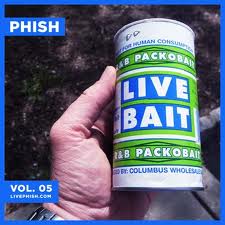
SOUNDTRACK: PHISH-Live Bait 5 (2011).

When this was released it was an astonishing free giveaway.  A mix of previously released and brand new recordings that spanned from 1987 to 2009!  Over 6 hours of music!  For free.

It’s fun to hear the really early stuff–like the songs that are from “Ian McLean’s Party at Connie Condon’s Farm” where the band is laughing with the audience (which seems like it’s about 100 people).  And when they invite everyone to another free part coming up.   This was back in 1987 before they had released their official debut Junta (who was taping all this stuff for them back then?  And with such good quality?).  But this one is especially fun because you can hear dogs barking during the quieter parts.

There’s also a big chunk of live Gamehendge material from Townshend Family Park in Vermont (circa 1989).  The middle block features the addition of The Giant Country Horns who play on “Flat Fee” and great versions of “David Bowie” and “Gumbo.”  I wouldn’t want the horns all the time, but they do add something to these shows.

Then there’s a jump to 1996 and a whole series of songs from shows at Loring Air Force base (through 1998).  There’s a 27 minute “Down with Disease” and a fun “Bathtub Gin.”  There’s then a bunch of songs from one show at the Big Cypress Seminole Reservation.

After a few year’s hiatus, they resume in 2003 back at Loring.  There’s a great version of “Waves,” although I found the “Mike’s Song” from this era kind of anemic.  And then, interestingly, there’s a “Split Open and Melt Jam” which is indeed, just the jam from the song and not the song itself.  “Suzy Greenberg” features Sharon Jones–it’s funny to me to hear r&b singers singing about a Jewish woman going to a neurologist. Fish, by the way has some of the funniest lines during the “forgotten my name bit.”  I’m also intrigued by the 2009 version of “McGrupp and the Watchful Hosemasters,” a pretty but kind of goofy song that dates back to 1985!

All in all, this was a very cool freebie to give to fans.

[READ: July 5, 2011] Five Dials 24

The newest Five Dials came as something of a surprise since Number 23 came out not too long ago and there was talk of the next issue being quite large.  But I like the small editions of Five Dials.  And this one is a cool, bite-sized nugget–a little fiction, an interview and an essay.  I have to assume this one was released when it was because it has a remembrance of David Rakoff, making this release rather timely.

…plus bear illustrations like you won’t believe by BECKY BARNICOAT (funny and dark drawings), LIZZY STEWART (beautiful pencil drawings) and NEAL JONES (blue bears). (more…)

Read Full Post »

SOUNDTRACK: THE FLAMING LIPS-“Smoke on the Water” (2012).

There’s a new Deep Purple tribute album coming out shortly (is this the year of tributes?  what’s going on?).  Anyway, the lineup isn’t all that inspired, but I was curious to see what the Flaming Lips would do with that song

As with their recent reinterpretation of Dark Side of the Moon, this cover is respectful and utterly disrespectful.  Musically the song is pretty accurate. Well, the notes are the same.  But the style is very different, kind of wahwahed delicate chords–no heavy bass or anything.  But it’s the vocals that are the contentious point–he recites the entire song (which kind of works because it is a story) in a stilted, faux British accent.

The second verse has a very computerized voice singing an autotuned melody along with the recitation–sort of a harmony but not.  This voice continues through to the chorus (which the main vocals also simply recite).

I appreciate the Flaming Lips’ approaches to popular songs, but this version renders a big loud song kind of anemic.  Which is so weird because the last few Lips albums were so loud and bass-heavy.  I listened twice, I probably don’t need to listen again.

So, this is yet another tribute I won’t be buying.

[READ: August 22, 2012] Don’t Get Too Comfortable

I’m already making good on my promise to read more David Rakoff.  Indeed, as soon as I heard that he died, I put this book on hold at the library.  The strange thing about this book is that I feel like I read parts of it already.  I don’t feel like I read the whole book because some things were unfamiliar to me, and yet there was a strange feeling of déjà vu throughout the book.  But I looked in the front of the book to see where these essays had appeared and I don’t read any of the magazines where they initially showed up.  And while I like This American Life, I don’t really listen to it very often.  So either I read this book seven years ago or these pieces are inspirations for other pieces I have read (which is possible–two or three articles in here reminded me of things that A.J .Jacobs has since done).

So this collection of essays takes place during the early 2000s, George W. Bush’s first term (not the happiest time to be a gay Canadian living in New York).  But in addition to the first essay which is all about his quest for citizenship, it seems that Rakoff was now gainfully employed as a freelance writer.  Most of these essays seem to have been requested for magazines–like they sought him out to write them.  So his fame was clearly growing.  And, again, like A.J. Jacobs, he seems to have been picked as a guinea pig for certain pieces.   I don’t really know if this is a “genre” per se, I mean lots of un-knowledgeable people have gone into new experiences to write about them (insert inevitable David Foster Wallace reference here–but of course he wasn’t the first either).  But Rakoff’s subjects in the last couple essays seem to be closer to what Wikipedia calls Jacob’s “stunt” journalism. (more…)

Read Full Post »

SOUNDTRACK: PINK FLOYD-Alan’s Psychedelic Christmas (1970).

I’ve always loved Pink Floyd’s Atom Heart Mother.  I have no recollection of how I stumbled upon this live bootleg, but when I saw that it contained one of the few live recordings of “Alan’s Psychedelic Breakfast” I had to give it a listen.

So this show is from 1970 and was recorded in Sheffield just before Christmas (Nick Mason evidently introduced the show while wearing a Santa Claus suit).  The sound quality is pretty good given that it is 40 some years old.  There’s a bunch of hiss, and the quieter talking bits are hard to understand, but the music sounds fine.

So the show opens with “Alan’s Psychedelic Breakfast” and what is so silly (and I assume funny to watch (a little less funny on bootleg) is that the band made and ate breakfast on stage.  As Collectors Music reviews writes: “This is the only known live recording of ‘Alan’s Psychedelic Breakfast’ but also hosts an amazing performance by the band which included them making morning tea on stage which is audible. Just like most of their earlier performances, the performance of “Alan’s Psychedelic Breakfast” slightly differs from the album version due to some nice jamming done by the band, especially Gilmour with his delay pedal.” As I said, some of the audio is static and hard to make out in this song–the band is conversing during their tea, but who knows what they are saying.  And who know what is o the radio.

Then the band gets down to business.  One of things I love about this period Floyd which is so different from their later work is that the played really long spacey jams often with very few lyrics.  So we get a 12-minute version of “The Embryo” (the only available studio version is a very short one on Works which is quite a shame as the song is really good).  A 14-minute workout of “Fat Old Sun” which is usually only about 5 minutes.

There’s a great version of “Careful with that Axe Eugene” and “Set the Controls for the Heart of the Sun” (15 and 12 minutes respectively).

Then in a killer version of “Saucerful of Secrets,” just as they get to the end, there’s a power failure (at least according to the song title).  The band is rocking out just hitting the climax when suddenly all you can hear are un-miked drums.  Ha. After a couple of minutes, power comes back and they pick up from just before where they left off.

Then the band launches into a full 31-minute version of “Atom Heart Mother” complete with horns and choir  of voices.  It sounds quite good (the horns seem a little sketchy but that might be expected with such staccato music).

The set ends and the band needs an encore.  Apparently they couldn’t remember anything else because they just re-do the last few minutes of “Atom Heart Mother” again.

One of the things that cracks me up about these shows in the 70s in England, is that the audience is so polite. Their applause sounds like a classical theater rather than a rock show.  And with a bootleg you know they didn’t try to make the audience sound bigger than they are.

The whole package is a fun trip.

[READ: August 17, 2012] Welcome to the Monkey House

So this book is Vonnegut’s second collection of short stories.  But there’s a twist.  This collection contains all of the short stories from Canary in a Cat House except one. It also contains many of the stories he had written since then as well as stories not collected in Canary.  So you get basically 18 years worth of stories here.  And it’s interesting to see how much he has changed over those years (during which he wrote 5 novels, but not yet Slaughterhouse Five).

Since I read Canary a little while ago (see comments about the stories here), I knew that his 50’s era stories were influenced by WWII.  So it’s interesting to see how his stories from the 690s are not.  They deal more with day to day things and, of course, abstract concepts about humanity, although politics do enter the picture again once Kennedy is elected .

  • Where I Live (1964)

This was a good story to open with because it shows the then-later-period Vonnegut’s mindset and location.  This story is about Barnstable Village on Cape Cod (where I assume Vonnegut lived since there are a number of stories set on the Cape).  This is a very casually written story about an encyclopedia salesman who goes to the local library and sees that their two encyclopedias are from 1910 and 1938.  I enjoyed this line: “He said that many important things had happened since 1938, naming among others, penicillin and Hitler’s invasion of Poland.”  He is told to talk to the library directors who are at the yacht club.  I love the attitude that Vonnegut creates around the village which “has a policy of never accepting anything.  As a happy consequence, it changes about as fast as the rules of chess.” For really, this story is about the Village more than the encyclopedia salesman, and it’s an interesting look at people who move into a new place and want it to never change. (more…)

Read Full Post »

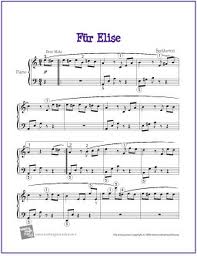
SOUNDTRACK: LUDWIG VAN BEETHOVEN-“Für Elise”

I didn’t know a lot of the music mentioned in this book, but like most people, I know and enjoy “Für Elise.”  It’s an interesting choice of music to end such a crazy chaotic story, although I suppose there are some less than peaceful moments ion the song too.  It’s a shame Bast never gets to play it.

I find the most engaging moments to be when the lone high note comes before the reintroduction of the initial melody.  The middle, minor key section that sounds kind of menacing is also neat–a big switch from the delicate opening.

Why not take 3 minutes and enjoy it now:

[READ: Week of August 20, 2012] JR Week 10

The end is here.  After endlessly interrupted conversations, the book has actually hit a period.

As the last week ended, Bast was being dropped off at the hospital by Coen.  And the bulk of the end of the book takes place in the hospital.  There are many similarities between this book and a big 60s/70s comedy romp, and here is another one–all the characters seems to pile into one location for a big finale.  (Technically the finale happens at Bast’s house, but you get the idea). (more…)

Read Full Post »

SOUNDTRACK: KISS-Smashes, Thrashes + Hits (1988).

This was Kiss’ second greatest hits collection (Double Platinum being the first).  This was before there were literally hundreds of Kiss Greatest Hits collections.  Seriously, look at the list on AllMusic.  This was also the era in which bands would release a greatest hits collection and include one song to sucker fans into buying it.  And we did.

Kiss also re-recorded a bunch of songs for this disc (something they would do many times in the future as well).  I’m not exactly sure what has been re-recorded, although the one obvious change is that Eric Carr sings on “Beth.”  But some of the other songs get tweaks as well.

As for the two new songs, it seems like maybe they were leftovers from the Crazy Nights sessions–they are poppy with keyboards.  “Let’s Put the X in Sex” sounds a lot like Robert Palmer, which is pretty embarrassing.  Although interestingly, the song itself seems to serve as a model for a couple of songs on Hot in the Shade (as if maybe they thought Kiss fans wouldn’t buy the greatest hits?).  “(You Make Me) Rock Hard” is another okay song (which sounds a lot like another song on Hot in the Shade).  Both of these songs are just filled with sex similes, I swear they have more than any other writers in the world.  Both songs would be better without those pesky keyboards.  I rather liked the songs at the time as they are both better than anything on Crazy Nights, although neither one has held up all that well.

And “Beth,”  Kiss’ biggest hit, which may be largely forgotten by the general public by now, has Eric Carr on vocals.  He sounds a bit like Peter Criss, but without Criss’ years of hard living in his voice.  It’s a weird choice, although I understand it from a business standpoint–which is clearly more important than the music, right?

[READ: August 10, 2012] “Paris in the Twenties”

This story starts out with a paragraph that I found very confusingly written.  There’s a very long sentence with several clauses that, after reading the story, make perfect sense, but which up front are more than a little confusing.  The upshot of that paragraph is that in 1972, when the narrator was a senior in high school, a whole bunch of bad things happened to her in a short period of time–just before they were to hear which of the Seven Sisters had accepted them.

The catalyst was that her father threw a tumbler of scotch at the giant window of their penthouse apartment.  The window shattered but did not fall and the glass came back into the room.  The irony of course is that he had chosen the apartment for the gorgeous panoramic views those windows afforded.  Her father had been riled up about the state of the world, and felt that the sexual revolution meant that monogamy was outdated.

Their father was also very conscious of wealth and was very conscious of appearing wealthy–even if “he usually had more credit than money and now had very little of either.”

The narrator escaped into fantasies of Paris in the twenties–she read A Moveable Feast and was determined to move to Paris even if the party was over decades ago. (more…)

Read Full Post »

SOUNDTRACK: MOGWAI-Burning DVD (2010).

What might one expect from a Mogwai DVD?  Well, what one gets is a high contrast black and white concert with excellent sound (I have since burned the audio on a CD).

The film zooms in on the players–the guitar necks, the cymbals–and occasional two or three person shots (but very rarely faces).

The faces come in the interstitials, where the filmmakers show the band walking around (getting on subways–walking in rain), and where they talk to fans.

The film is gorgeously shot, but I have to admit it’s not the kind of live show that I enjoy watching.  It’s a little dull–not in individual moments because just about every shot is gorgeous, but in five-minute blocks.  Don’t get me wrong, I love seeing how these guys make this wall of music.  I love watching Stuart’s hands on the neck of his guitar, but this is not a very mobile bunch.  Indeed, many of the people in the audience seem to just be closing their eyes and absorbing the music rather than watching them.  And I found myself doing the same thing (in which case, I would just get an audio concert, right?).  This is compounded by the fact that the camera is in so tight, any big movements are missed.

This is not to say that there aren’t moments of brilliance to see.  Watching the band wait and wait and wait as the chords from “Fear Satan” fade out before they blast into the finale is pretty darn awesome.  And there are moments like that–crisp clarity where everything comes together.

Some kind souls have put the entire show on YouTube.  Here’s part 3 (with “Fear Satan”)

And the fan who speaks over the closing credits is trippy but cool.

[READ: July 31, 2012] “The Places You Find Yourself”

I found this story because a reader left a comment that Junot Díaz’ story ”The Cheater’s Guide to Love” was just like this one.

I have to disagree almost entirely with that sentiment because Díaz’ story talks about what it is like after someone has broken up with you and this story is about being stuck in a relationship that you feel compelled to get out of.

Edwards’ story (which won the 2009 Open City Rrofihe Trophy) is about settling.  And it’s a very realistic portrayal of the frustrations of life: relationships, job, commute–it’s a rather cathartic story.  It is especially cathartic because there is no main character, only “you.”  And Edwards keeps this second person narrator throughout the story.

The story is set up as a series of monogamous relationships: “Then one morning you’ll wake up and there will be another one lying next to you, maybe this one a brunette…” (more…)

Read Full Post »

Gore Vidal [1925-2012]

Gore Vidal died last night at age 86 because of complications from pneumonia.

When I was younger, back in college, I loved Gore Vidal.  I read almost all of his essays and I tried to read most of his novels (I didn’t succeed–he has published some 50 books).  His book United States: Essays 1952–1992 is one of the best collection of political essays I have read.

People who know Vidal at all know him for different reasons.  Some know him as a writer of historical novels known as the Narratives of Empire: Burr (covering 1775-1805 and 1833-1836), Lincoln (1861-1865) 1876 (1875-1877), Empire (1898-1907), Hollywood (1917-1923), Washington D.C. (1937-1952) and The Golden Age (1939-1954).

Others know him for his outspoken pro-homosexuality stance.  His third novel 1948’s The City and the Pillar caused quite the controversy for presenting sympathetic gay characters.  He also wrote Myra Breckenridge about a transsexual character.  His published quote from about sexuality (from 1969) is:

We are all bisexual to begin with. That is a fact of our condition. And we are all responsive to sexual stimuli from our own as well as from the opposite sex. Certain societies at certain times, usually in the interest of maintaining the baby supply, have discouraged homosexuality. Other societies, particularly militaristic ones, have exalted it. But regardless of tribal taboos, homosexuality is a constant fact of the human condition and it is not a sickness, not a sin, not a crime … despite the best efforts of our puritan tribe to make it all three. Homosexuality is as natural as heterosexuality. Notice I use the word ‘natural,’ not normal.” (more…)

Read Full Post »

« Newer Posts - Older Posts »