Feeds:
Posts
Comments

Archive for the ‘Books about music’ Category

SOUNDTRACK: BUILT TO SPILL-“Carry the Zero” (1999).

For a time, before the bands each took off, I lumped Built to Spill, Death Cab for Cutie and Modest Mouse into a pile of bands I really liked but wasn’t always sure who was who.  They each have melodic sections, noisy sections and high pitched singers.  (It also turns out that both Modest Mouse and Death Cab for Cutie cite Built to Spill as a big influence).  The big difference between the three is that Built to Spill’s Doug Martsch is a guitar god—he does amazing solos which is why his songs are so long (their Live album features a 20 minute version of Neil Young’s “Cortez the Killer.”

I have no real idea what this song is about, but I love it.  It’s catchy and fun with a great melody.  And, in this case it kind of ties in to JR, because JR is all about making money but his basic math is shaky.  In the same way, carrying the zero won’t do anything in basic math.  Although “you have become a fraction of the sum” is a nice refrain.

This was the song and album that introduced me to Built to Spill and I love it.  Great 90s alt rock.

[READ: Week of June 25, 2012] JR Week 2

And since there are no paragraph breaks, week two picks up mid-flow.  However, this proved to be a good breaking point because almost the entire read for this week is about Mrs Joubert and her class on their field trip to the New York Stock Exchange.  And Edward Bast is steamrollered into doing (and paying for) everything.   Gaddis’ style completely allows for the miscommunication and ease with which Bast is overtaken by Joubert and Gibbs.  While it certainly calls into question Bast’s ability to stand up for himself, it also shows how easily one can be pushed into doing things (although in real life I suspect you’d just say “wait a minute, I can’t,” at some point).  It’s still very funny and the action moves along so quickly that it works perfectly with the flow.

The scene begins with Mrs Joubert herding the kids onto a car and then talking to Mr Bast.  He apologizes for what happened yesterday,  Of course, he is talking about his disastrous TV meltdown but she thinks he means the loss of the bag of money and its turning up 3 pennies short.  Through a series of unsubtle hints from Mrs Joubert, Mr Bast winds up joining their trip to the city.  He had business to conduct in Manhattan so he was going in anyway, but now he’s roped in with the kids.  There’s a lot of sexual tension on this trip–the boys are watching women bend over and Mr Bast keeps pressing his body again “her unyielding thigh.”

Then we get our first really big scene with JR.  In this scene he and a friend (unnamed as far as I can tell) are going through all of their free mail publications and doing trades.  Everything the boys try to trade is a load of crap (a word count on “crap” would be very high indeed). So the kids start looking through their brochures: K’ung-p’a, piano lessons, rare coins, scientific method builds powerful muscles,government surplus (a Tank that turns out to be an airplane gas tank (ha)), How to Make Big Profits Overseas, selling shoes, etc.  There’s some very funny back and forth as smart-assed kids will do (he really has young kids’ dialogue down very well), like :What are you gonna do where it says “married” or what are you gonna do when it says shoe size and you put yours? (more…)

Read Full Post »

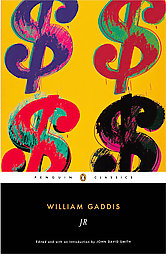
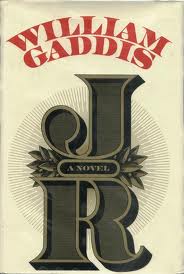
The edition I’m using.

SOUNDTRACK: RICHARD WAGNER-“Ride of the Valkyries” (1856).

Possibly the most famous piece of music from any opera (known for a billion reasons other than the opera itself).  This song was introduced to be by Bugs Bunny.  And then cemented in my consciousness in Apocalypse Now.

It’s really impossible for me to listen to it without seeing helicopters dropping napalm.

I’ve never seen it performed before.  Most of us think of it as an instrumental, but there are vocals, and they add a lot to the performance.  I also didn’t realize that the whole first minutes is a prelude to the third Act–with a darkened stage.  I just watched this version by the Danish Royal Opera in which the setting is updated.  The Stage is amazing and it’s a pretty powerful image, that won’t leave me head too soon.  And of course, the women sound phenomenal.

Smells like victory to me.

[READ: Week of June 19, 2012] JR Week 1

And so begins the saga of JR.  A little of my background:

I read JR about a decade ago.  I recall the structure and some of what happens, but not enough to actually remember anything ahead of time, plotwise.

Usually for these weekly group reads, I post fairly detailed recaps of the book.  And usually I do that because there’s so much going on in a large book, that it’s one way for me to keep track.  JR is going to be a little different.  If you’ve gotten this far in the book, you’ll notice that there’s not a lot of plot going on.  There’s a few scenes with lots of dialogue and maybe something comes of it, maybe not.  So, I’m certainly not going to try to recap everything that happens in the dialogue, nor am I even going to try to figure out who said what or even who is in every conversation–I’m not even sure that’s possible.  But I am going to talk about each scene a bit and see if I can pick out anything that seems important.

The book strikes me as being like an unedited film.  Or like a Picasso–Gaddis wants to show you everything, and let you pick out the important bits.  And so the book feels like a boom mike has been inserted into a room or scene.  We’re not really sure who everyone is, or even who is talking at a given moment.  But we hear everything that’s said. And then the boom mike pulls out and the camera pans somewhere else and the boom mike goes down and we hear some more.  It’s not always clear even that a scene has shifted–although usually a dense paragraph of prose indicates a shift in scene.

As far as characters, it’s not clear if anyone mentioned early on is going to stay with us through the book.  It’s clear that JR will be here (although his first real scene is right after my spoiler line for this week).  There’s also the Bast family who will no doubt play some ind of important role.  Then there’s a lot of teachers as well. (more…)

Read Full Post »

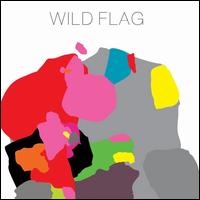
SOUNDTRACK: WILD FLAG-Wild Flag (2011).

For reasons unclear to me now, I wasn’t psyched when I heard about this band.  Despite the fact that it was 2/3 of Sleater-Kinney and the force behind Helium joining together, I didn’t jump for joy.  But now that I have listened to the album a million times, I can say that it is one of the best albums not only of that year, but of many years.  Man is it good.

Sleater-Kinney was a great band, they were melodic and tuneful but also abrasive and occasionally off-putting.  Who knew that the majority of the adhesiveness came from Corinne Tucker (well, she was the screamer, admittedly).  It’s pretty clear that Carrie Brownstein is bringing a ton of melody (and a wee bit of amativeness) to the mix.  Mary Timony always included trippy imagery and a weird kind of whispered/loud singing voice.  The tunes are so catchy so strong, so singalongable.

There’s little moments in each song that are amazing.  The backing vocals (and the pitch shift in the chorus) in “Romance”.  The way “Something Came Over Me” sounds so different from “Romance” (and is clearly a Timony-sung song).  I absolutely love the guitar “solo” that begins each verse and how it stands out but fits in so nicely as a baritone guitar sound (I assume from Carrie?)  “Boom” is just a full-on rocker with some great guitar pyrotechnics and Carrie’s more extreme vocals.  And man is it catchy.

“Glass Tambourine” is a cool trippy psychedelic workout  that’s still catchy and interesting.  “Endless Talk” has a strange British retro vibe.  (Carrie seems to be singing with a kind of punk British voice).  And there’s lot of keyboards.  It’s great that the album has so many different sounds, but still sounds cohesive.  “Short Version” has some great guitar soloing in the front and back.  “Electric Band” is like a perfect pop song–great backing vocals, great poppy solos and a cool video to boot.  “Future Crimes” is another amazing tune, with a keyboard solo!

“Racehorse” is probably my least favorite song on the disc.  It’s got some cool parts and some interesting swagger (and I like the live versions where they really jam) but the album version feels a little dragged out (although the chorus is really hot).  The disc ends with the wonderful “Black Tiles” which could easily be a Helium song, but which still sounds very Wild Flag.

And, I can’t say it enough, Janet Weiss is amazing on drums.  I feel badly because I tend to leave out the keyboardist–because I don’t know who she is or the band that she came from.  But her keyboards play an essential role in the music.  They fill out the spaces that the two guitars don;t always fill.  They even introduce the opening of the album.

If you go back through previous posts you’ll see I’ve mentioned them 3 times already because they have special bond with NPR and three of their concerts are available there.  I can’t wait for more from them.

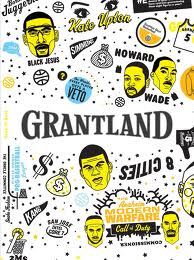
[READ: May 8, 2012] Grantland 2

I was surprised at how much I enjoyed Grantland #1.  So I was pretty excited to get Grantland #2.  #2 has all of the elements that I loved about #1–non-sports articles about entertainment (video games, music, TV), and sports articles that are short and digestible for a non-sports fan.  This issue also features a number of really long articles about basketball.  I like basketball fine, but I can’t say I paid any attention to the lockout.  Thus, much of this was lost on me. It probably doesn’t help that I don’t know any sports people either.

I may have said this last time, but I will reiterate for Issue #3–for those of us who don’t follow sports, or those of us who may not remember back to September when most of these articles were written, or heck, for people who are going to read this in ten years’ time:  For certain articles, can you give us an epilogue about what happened after the article was written.  If you speculate about  the lockout. Have an epilogue to say about how the lockout turned out.  If you talk about a game 5 of a series and the series didn’t end, have an epilogue that tells us how the series ended.  It doesn’t have to even fit the style of the article, just a few words: so and so ended like this. It can show how prescient the writers were.  And it can help us complete the stories.

So, despite a few articles that I thought were too long, (although probably aren’t if you love basketball) I really enjoyed this issue of Grantland, too. (more…)

Read Full Post »

SOUNDTRACK: THE VASELINES-The Way of the Vaselines (1992).

I had never heard of The Vaselines until Kurt Cobain praised them so much back in 1992.  SubPop quickly issued Way of the Vaselines, a fairly comprehensive collection of their recordings.

I bought it and thought it was okay.  Not revolutionary or anything, but decent indie pop.  And I think my lackluster response is in part because I often react the same way to what you’d call originators of a scene when I’ve already been in the scene for a while.  Once people have blown the fundamentals away, it’s hard to appreciate the fundamentals anymore.

And so I’ve given them a new listen with more appreciative ears.  I also enjoyed poppier music a lot more now than I did in 1992 (it’s funny how poppy The Vaselines are and yet how noisy Cobain was).

The songs really hold up quite well in a Velvet Underground way (“Rory Rides Me Raw”), or the left field dance anthem cover of Divine’s “You Think You’re a Man.”  They also have some fast punk songs (“Dying for It”).

Nirvana covered three of their songs, “Son of a Gun” and more famously “Molly’s Lips.”  (The Vaselines version of “Molly” is much cuter (with a bike horn in the chorus)).  And, perhaps most famously, “Jesus Wants Me for a Sunbeam” (which is pretty close to the original).

The Vaselines sang a lot about sex, (“Sex Sux,” “Monsterpussy”) that was disguised in a largely pop context.  But they also had inclinations towards fuzzy punk.

I think what’s so wonderful about this collection is that it’s four Scottish kids who had good pop sensibilities (and some talent) playing what they liked.  They’re an amateur love to the whole disc, and yet for all of their lo-fi ness, the songs sound good–even if you can’t always understand the lyrics. (Sub Pop remastered and re-released the package with bonus tracks as Enter the Vaselines, but I’ll not be getting that).

Were they, as Allmusic says, the best pop band from 1986 to 1989? I don’t know.  But they sure played some great songs.  I’m don’t think I need to hear their reunited selves, because there’s something about the charm of these Edinburgh kids playing these songs in something of a vacuum that I rather like.  It only took two listens to this record (probably the first time in ten years) for me to see how much was here.

[READ: April 16, 2011] “Underachievers Please Try Harder”

The subtitle of this article is “Indie Rock Reunites on the English Coast,” and I’m mentioning it because it got me to listen to the Vaselines record again.

It was an interesting article about the state of music and “festival” tours, specifically All Tomorrow’s Parties.  (This year’s ATP spinoff, I’ll Be Your Mirror will be in Asbury Park, New Jersey! and features Portishead, Mogwai and A Silver Mount Zion among others–were I 20 years younger, I’d be there). (more…)

Read Full Post »

SOUNDTRACK: RADIOHEAD-The King of Limbs (2011).

I finally had a chance to really listen to this CD and I have some mixed feeling about it.  It doesn’t excite me as much as previous Radiohead releases have and yet, at the same time I can’t stop listening to it.  But I find that I’m listening to it a lot as background music, so I haven’t been able to fully appreciate what’s happening on all the tracks.  Now that I’ve really listened, my appreciation for the disc is higher, although I don’t find it as overall exciting as In Rainbows.

The opener, “Bloom” is a really spare song.  And although I like it, there’s a part of me that wonders almost what’s the point of making an electronica song that is so spare when many others have done much the same.  (It’s interesting to me that iTunes declares that this album is in the genre Electronica).  Of course, with some closer listening, there are some interesting Radiohead things happening, but for me the album doesn’t really start until “Morning Mr. Magpie,” a wonderful weird little song with a great opening guitar riff and excellent use of noisy drumming.  The drumming is really amazing.  It seems to be off-beat and then it speeds up to get on the beat–in every line!  Disorienting and compelling.  But it’s the guitar, I think, that was really missing from the opener.  (Of course, having said that I did like Radiohead’s previous forays into electronica that was sans guitar).

“Little By Little” proves that you can make a weird electronica song that is full of crazy noises and still have a supremely catchy chorus too.  “Feral” is, as far as I can tell, an instrumental (there are lots of sounds that could be voices, but I’m not sure).  It also features one of the great spooky keyboard type sound in a Radiohead song.  Its pretty cool.

“Lotus Flower” is the “obvious” single from the disc (and the radio by me is actually playing it!).  Even though it’s not radically different from the rest of the album, it stands out as the most melodic, the most catchy, the most, well, “single.”  It’s really great.

“Codex” slows things down with, if not a traditional piano ballad, something of a traditional Radiohead piano ballad.  My 5-year-old son made his first venture into music criticism when this song came on.  He said: “Why are you listening to a sad song?”  And when I asked if he liked sad songs he said, “No, sad songs make me feel sad.”  This is a pretty sad song, but it has Thom Yorke’s vocals of redemption pulling through at the end, even while the song retains its sadness.

My son really liked “Give Up the Ghost” though.  He said it sounding like the music at the end of a film, in fact, he was certain it was the music from the end of The Land Before Time movies. (That song is actually a James Horner song, sung by Diana Ross called “If We Hold On Together”).

The final song is a more drum filled track.  Yet despite the manic percussion, the song itself is actually kind of mellow and slow.  It’s pretty much a quintessential late Radiohead song.  Clark’s final review came with this song: “I love this song!  It sounds like someone bonking bananas on your head.”  So there ya go.

So overall, I enjoy the album, but I don’t think it will have as much staying power for me as their other discs.  It’s also surprisingly short (about 35 minutes–although just the other day they released two more tracks).  However, having said that, I’ve since listened again, and I find that I notice something new with each listen, so maybe it will continue to grow and grow on me.

Two of the more interesting things on the album though are the liner notes.  I can’t imagine what inspired, “A big thank you very much indeed to Drew Barrymore”.  And I’m intrigued at “Fluegelhorn on “Bloom” and “Codex” performed by Noel Langley and Yazz Ahmed.”  I’m intrigued that a) there is a fluegelhorn and b) that they needed two people!

[READ: April 10, 2011] The Universal Sigh

This “newspaper” was distributed at some record stores around the world as a tie-in to the new Radiohead album’s release in hard format.  I found out about it from my friend Lar.  He comments that he is too old to be hanging around in the streets waiting for this kind of titbit, and I couldn’t agree more.  He is too old.  As am I.  So it’s nice that there’s a digital version of the paper available.  (Remember when Radiohead snuck little things like this into the backs of their CD cases?)

Now just what is this thing?  Well, it is a newspaper of sorts.  There is a tenuous connection to Radiohead (in other words if you didn’t know they made it, you wouldn’t find out from looking at it). But the main focus seems to be environmental causes.  (Which means that since I printed out the PDF, I have undermined the band’s intention of producing a low carbon footprint product–but hey at least I printed it double-sided). (more…)

Read Full Post »

SOUNDTRACK: SONIC YOUTH on World Cafe, August 21, 2006 (2006).

Travelling back even further on the NPR timeline, Sonic Youth appeared on World Cafe in 2006 to promote Rather Ripped.

This is a brief session (only three songs) but as with the interview with Thurston Moore, David Dye does another great interviewing the band here.  Although it must be said that saying the band is once again a four piece (when clearly there are five people in the picture and in the studio and when he later says two guitars, two basses and drums–which I also think is incorrect, as I’m pretty sure Kim switched to guitars at this point, although I don’t know if she did during this set) is not a great way to start the interview.

Facts aside, the interview is informative and interesting and provides a glimpse into the band’s psyche all these years into their career.

The set is also good (although Thurston’s voice sounds a little off on the opener “Incinerate”).  The surprising thing about the set is that even with the five of them, the feeling is one of restraint. True, the songs on Rather Ripped are not as noisy as previous records, but this feels like they are trying not to wake anybody up the NPR folks.  It’s a weird feeling for a Sonic Youth set, but the plus side to it is that you can really hear everything clearly.

The other two songs are sung by Kim: “Jams Run Free” and “What a Waste” (why do they never promote any of Lee’s songs??).  And there’s the very amusing comment that the first time they played “What a Waste” Thurston and Kim’s daughter said it sounded like the theme from Friends.  Ha!

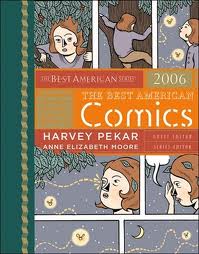
[READ: April 15, 2011] The Best American Comics 2006

I just recently learned about this series from The Best American line of books.  I had known about the Best American Short Stories and Essays and even Non-Required Reading (which I have not yet read).  But once I found out about the best comics, I knew I had to check it out.

The first issue came out in 2006.  The series editor is Anne Elizabeth Moore and the Guest Editor for this volume was Harvey Pekar.  Each of them has an introductory essay in the book.  To me the amazing thing about Pekar”s essay is how aggressively defensive he sounds (a sort of, “you may not like this one, but try this one” attitude) about these comics and comics in general.  I don’t know much about Pekar’s work.  I know he’s a kind of underground icon, but I seem to have missed him.  My impression of him is that this sort of antagonistic/defensive attitude seems to go along quite well with his comics, so I guess that makes sense, but I didn’t find it very welcoming.

But that’s okay, because I really enjoyed the comics.  And quite a few were by artists that I had never read before, which is even better! (more…)

Read Full Post »

SOUNDTRACK: DC3-“Theme from an Imaginary Western” (1985).

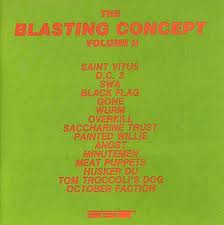
This song comes from the SST compilation The Blasting Concept Volume II, which came out in 1985.  I bought it on vinyl and was psyched when it came out on CD.   This version of an old Mountain song was one of my favorite songs on the disc (I don’t even know the Mountain version very well).

DC3 was the brainchild of Dez Cadena, former singer for Black Flag.  They put out a couple of albums and then disappeared.  And yet all these years later this song has stayed with me.  For a singer from Black Flag, this song is remarkably poppy (and features a lengthy keyboard solo!).  The real treasure of this song for me comes at the first chorus.  When the band sings “Oh the sun was in their eyes…” the vocals begin in a disparate, perhaps minor key harmony, and then merge into a perfect harmony.   It gets me every time.

DC3’s records have never been released on CD, and the vinyl is out of print. There’s a live CD out, but I’ve never heard it.   So, as far as I can tell, this is the only studio song available in the world.  Maybe the albums are terrible, but DC3 will always be great because of this one track.

Oh, and someone posted it on YouTube

Thanks!

[READ: March 22, 2011] Consider David Foster Wallace [essays 13-16]

This is the final batch of essays from this collection about David Foster Wallace.  The first is about Oblivion and the last three are about his non-fiction.  Perhaps it’s because I have been reading his non-fiction a lot lately (or maybe I enjoy reading essays about nonfiction more than fiction) but I found these to be the most enjoyable essays in the book.

As I’ve stated with each post, because I don’t have a lot to say about the pieces (I’m not an academic anymore), I’m only going to mention things that I found puzzling/confusing.  But be assured that if I don’t mention the vast majority of the article it’s because I found it interesting/compelling/believable.  I don’t feel comfortable paraphrasing the articles’ argument, so I won’t really summarize. (more…)

Read Full Post »

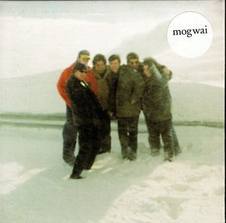
SOUNDTRACKMOGWAI-No Education = No Future (Fuck the Curfew) (1998).

This is a 3 song EP. The opener “Xmas Stripes” is one of my favorite early Mogwai songs.  The opening melody is really great, with a cool interesting bass and a nice guitar over the top.  At about 3:30 the song grows from a silent track to a menacing, growing beast until the drums start and the song and the main riff begins.  By 5 minutes it’s all out rock noise.  By 6 minutes the song is scaled back for the violin solo.  The remaining 7 (!) minutes are a denouement for the song.  Even though I love the track, I mostly love the first 8 or 9 minutes.  The ending tends to drag a bit.

But for all of their noise, Mogwai’s early releases were really quieter instrumentals, meditative songs that were really quite pretty.  “Rollerball” is a beautiful, sad three-minute track.

The last song “Small Children in the Background” continues in this quieter vein.  At nearly 7 minutes, it allows for a noisy middle section.  This noisy section is indeed mostly noise.  And yet the pretty melody of the rest of the track is just as loud throughout the mix, making for a very cool and very brief explosion mid-song.

Not all EPs are essential, but this one is pretty fantastic.  And I have Lar to thank for getting it for me.

[READ: March 10, 2011] Changing My Mind

It’s funny to me when that when I get into an author, I seem to wind up not reading the books that people most talk about until much later.  Take Zadie Smith.  Her debut, White Teeth, is something of a touchstone for many readers.  I missed it when it came out, but I loved On Beauty and figured I’d go back and read it.  That was almost a year ago.  And in that time I have read lots of little things by her and now this collection of essays.

Regardless, this collection of essays is a wonderful look in to the nonfiction world of a writer whom I admire.  And it was quite a treat.  Zadie is an intellectual, and that comes across in all of these paces.  Whether it’s the subjects she’s writing about, the footnotes she uses or just the acknowledgment that she likes art films and not blockbusters, we know where she’s speaking from.  And, of course, I’m right there with her.  The funny thing about this book then is how few of the subjects I know.

The book is broken down into five sections: Reading, Being, Seeing, Feeling and Remembering.  The Reading section is basically book reviews.  The Being section is about her experiences.  The Seeing section is about films.  The Feeling section is about her father and the Remembering section is about David Foster Wallace. (more…)

Read Full Post »

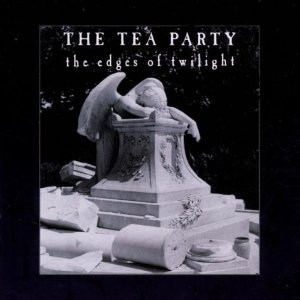
SOUNDTRACK: THE TEA PARTY-The Edge of Twilight (1995).

In the way that Ian Astbury of The Cult reminded everyone of Jim Morrison, so does Jeff Martin, singer of The Tea Party.  He looks a bit like him and he sings in a baritone voice that, while all his own, sounds like perhaps a 1990s Jim Morrison.

This, their third album, is full of what I think of as their trademark sound: all manner of exotic instrumentation laid over heavy Zeppelinesque riffs.  Opener “Fire in the Head’ is not unlike “Kashmir” in its riff, and what’s funny is that the exotic instrumentation makes it sound even more like “Kashmir” than “Kashmir” does.  Zep didn’t use instruments like the sitar and sarod to make their sound more authentic.  Indeed, authenticity seems to be what the band is going for, as later albums describe them spending time in the middle east where they learned to play these instruments more proficiently.

“The Grand Bazaar” takes that concept further with some really Eastern sounding music within a very heavy rocking track.  And “Ianna,” although not my favorite track, really showcases the Middle Eastern instrumentation in this cool, twisty track.  There’s also a more traditional rock number, “Drawing Down the Moon” which features lengthy blues-guitar solos over a fairly conventional track.

It’s not all heaviness though, as “Correspondences” is a seven minute piano based ballad in which Martin’s voice is right in your ears.  It’s on this track that you decide whether you love his voice or think he’s preposterous.  If the latter, well, then there’s the beautiful instrumental “The Badger.”  And “Shadows on the Mountainside” is a quieter acoustic number in which Martin sings in his much more delicate range.

But perhaps the most over-the-top, and consequently, best track on the disc is “Sister Awake” which features 12-string guitar, sitar, sarod, harmonium and goblet drums.  It starts slowly and quietly and builds into multiple climaxes (complete with loudly whispered “Sister!”).

Whether or not this confers any kind of approval on The Tea Party or not, Roy Harper (as in “Hats Off to Roy”) does a spoken word bonus track at the end of the disc.  I don’t know much about Roy Harper or what he was up to in 1995 (perhaps he’d do anything for a buck?) but it give an air of legitimacy, no?

The Tea Party is a band that splits people into love it or hate it groups.  They have sold millions of copies and yet there are those who despise them.  Their next album Transmission found some success in the U.S. because it was a bit more industrial sounding (with samples and loops), but they never really broke through down here.

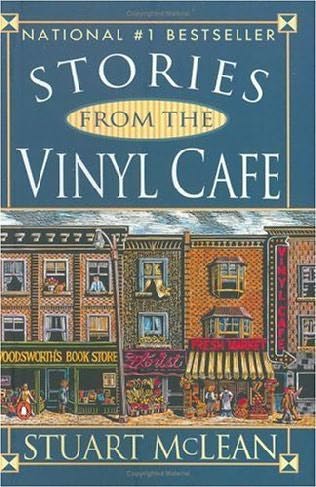
[READ: February 4, 2011] Stories from the Vinyl Cafe

I’m not sure how I found out about this book.  I know I bought it in a Chapters in Toronto.  I wonder if it was on a display and I was intrigued by the title.  Or, more likely, I had heard a bit about him in my preparations for my trip and decided to buy his book.   Whatever the case, I didn’t read it until now.

McLean is described in one of the (practically a dozen) pages of praise and advertisements for his other books as a Canadian Garrison Keillor.  And, as lazy as that seems, it’s fairly accurate.  Especially because although McLean is a humorist (he won the Stephen Leacock Memorial Medal for Humor), like Keillor, who is mostly funny, McLean also deals a lot with serious matters.  Indeed, some of the stories in this collection are utterly unfunny: ending with a dead dog or a dead grandmother.

And here’s the thing.  These stories are slices of people’s lives.  They are incidents that impact them and are worth recollecting, but that don’t cause anyone to change.  They’re like perfect little anecdotes, and I imagine they are excellent to hear aloud. (more…)

Read Full Post »

SOUNDTRACK: WEEPING TILE-eePee (1995).

Canadian singer Sarah Harmer was originally in the band Weeping Tile.  As far as I knew, they had only released this cleverly titled EP.  Further research at Sarah’s site proves this to be incorrect.  They released two albums and this EP, all of which are available at her site (and elsewhere).  There’s also mention of something called Secret Sessions although there is no evidence of its physical existence on the net.

So this EP is 7 tracks and features two songs that were recorded later on Sarah’s solo discs.

The opener, “Anyone” opens with a nice R.E.M. type guitar sound, but jumps into an uptempo alt rocker.  It’s a very satisfying opening and seems like it should have been a hit.  Interestingly, the next song, “Basement Apt” was a hit…six years later on Sarah’s solo disc.  This version is rawer and feels slower even though it is the same overall length.  The big difference is that Sarah’s solo version has a louder and faster drum track that really makes the song fly.  This version feels more aching though.

“Dogs and Thunder” introduces a more country sound (folk guitar and strings) that Harmer would experiment with off and on for years.    It’s followed by a great cover of Neil Young’s “Don’t Let It Bring You Down.”

Another highlight is “Westray” a very stark almost a capella track which highlights Sarah’s raw voice.  It’s very affecting.  And the disc concludes with “King Lion,” a great song that is back to guitar basics.  The chorus is wonderfully catchy.

This is a great EP from a short-lived Canadian band.  Sarah Harmer has always had great songwriting chops and it’s fun to hear her in her more youthful rock version here.

[READ: January 11, 2011] “Hard Currency”

This is one of the longest stories in The Walrus that I can remember.  It’s set in Russia and concerns Alexei, a Russian writer who now lives in America.  He has had great success internationally (and won a Pulitzer) for his novels, all of which were set in Russia.

And yet, for all of his connections to his motherland, he doesn’t really like Russia very much.  He has been back there several times but he is never treated with respect. In fact, he is never even treated as a Russian–despite his birth, people look at him and know that he’s not a Russian anymore.

The plot of the story is about prostitutes.  [I am pretty surprised at the proliferation of prostitutes in stories…do authors frequent prostitutes more than other people?].  When the story opens, we learn that Alexei’s very first sexual experience was with a prostitute.  And now, twenty-eight years later, after much success and a failed marriage, he has returned to Russia and has called upon another prostitute. (more…)

Read Full Post »

« Newer Posts - Older Posts »