Feeds:
Posts
Comments

Archive for the ‘Artists’ Category

SOUNDTRACK: hiatus

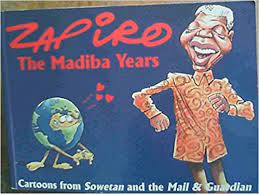
[READ: February 9, 2022] The Madiba Years

Having read some of the more recent Zapiro books, I was delighted to see that our library had most if not all of his previous books as well–one that cover pretty much from the start of the Mandela years.  Mandela even blurbed this book: “Very exciting ad quite accurate.”

So why is it called the Madiba years?  It doesn’t say in the book, so I had to look it up

The clan or family name represents a person’s ancestry. The meaning is deeper than a surname and is used as a sign of respect and affection. The origin of Madiba comes from a chief who ruled in the 18th century, according to the Nelson Mandela Foundation.  Madiba would be used in “an intimate context,” said Richard Pithouse, a politics professor at Rhodes University in South Africa. When Mandela entered school, a teacher gave him the name Nelson. It was customary for Africans to also give children English names back then.  But the wider public had also taken to referring to Mandela as Madiba.  “People would not tend to use that name if they didn’t have positive feelings for him,” Pithouse said.

So there you have it.

This collection opens in 1994 with leader Mangope of Bophuthatswana’s declaration that democracy would not be coming to his homeland (he was very wrong).  With the eyes of the world on South Africa, Election Day shows the shining face of Mandela, pictured as the rising sun over the garbage heap that was the un-democratic elections.

June sees the proposal of the Truth and Reconciliation Commission–to find out what really happened during Apartheid.  There’s also talk of Joe Tokyo, a figure who has been mentioned in other books.  I’m fascinated by his name. In this particular cartoons, his housing plan is described as a pie in the sky.

Things that could apply to any leader include a woman scrubbing the floor in the Prime Minister’s Office.  In 1956, the assistant says to the PM: “Delegation of women to see you.” Then in 1994, the same woman (now much older), the same comment.  This time the scrubber says, “And this time it better work.”

There’s a lot of pages about Winnie Mandela (full name: Winnie Madikizela-Mandela).  I’d heard of her but never really realized what all the fuss was about–she was Nelson’s wife, right?   Well, apparently after he was imprisoned (citing Wikipedia):

In the mid-1980s Madikizela-Mandela exerted a “reign of terror”, and was “at the centre of an orgy of violence” in Soweto, which led to condemnation by the anti-apartheid movement in South Africa, and a rebuke by the ANC in exile. The Truth and Reconciliation Commission (TRC) established by Nelson Mandela’s government to investigate human rights abuses found Madikizela-Mandela to have been “politically and morally accountable for the gross violations of human rights committed by the Mandela United Football Club”, her security detail.  Madikizela-Mandela endorsed the necklacing of alleged police informers and apartheid government collaborators, and her security detail carried out kidnapping, torture, and murder, most notoriously the killing of 14-year-old Stompie Sepei whose kidnapping she was convicted of.

Damn!  And apparently her totally horrific activities weighed on Mandela.

They divorced about two years after he was elected.  But even in 1996 there’s a cartoon of Mandela behind bars with 1962-1990 and then from 1990-1996, he is chained to Winnie.

The big question after the Apartheid government failed was what to do with the men leftover.  Could they just put them in a museum?  Boerassic park?  Apparently F.W. De Klerk had a lot of “amnesia”–couldn’t remember anything that happened before 1990.

And what about the 3,000 former government functionaries that acting president Pik Botha indemnified?  It sounds like the blanket indemnity was ripped off of them–hopefully that will happen to anyone in this country pardoned under our former leader.

I particularly like the one where all of the dominoes fall, knocking down all of the former bad leaders with de Klerk next–again, could be very relevant to our country if they can actually act on it. It’s depressing though that this de Klerk cartoon is in November 1995–so long after the election in April 1994.

But Mandela wasn’t perfect.  When it comes to South African arms sales, apparently he turned a blind eye to backdoor sales.  And his Assembly Chairperson Cyril Rhamaphosa was concerned that when he consulted the public, they seemed to be full of intolerance.  The leaders cut down a hangman’s noose, but there’s a large tree with “pro hanging public opinion.”

There’s also the great unsolved mysteries of the world like The Curse of Tutankhamen, Bigfoot, The Bermuda Triangle and South African foreign policy.

It’s not all politics–there’s some strips about rugby and Springbok, which I’m fascinated by.  And of course much celebration for South Africa in the football (soccer) world.

He also has a strip for National Crime Prevention week. It was suggested that prisons becomes places of education.  But Zapiro says they already are–the criminal leaves with his diploma in drugs, gangs, guns, and knives.  Maybe they just need to change the curriculum.

And the first of many anti pro-life cartoons.  This one has Dr. Claude Newbury saying there shall be no abortion under any circumstance.  Then there’s a lightning bolt with Newbury suddenly pregnant and unwanted babies all round him with god saying “Get real, Claude.”

Evidently the Boer separatists (Volkstaat) were trying to prevent a new South Africa from forming

The concept of a Volkstaat, also called a Boerestaat, is the set of proposals to establish self-determination for Afrikaners (Whites) in South Africa, either on federal principles or as a fully independent Boer/Afrikaner homeland.

Then he shows the trouble with the integration of primary schools as two black students.  The room full of students all look like H.F. Verwoerd (and old man with his nose in the air).  But the glimmer of hope comes when a little white girl takes off her Verwoerd mask and smiles the black students.

Bishop Desmond Tutu as part of the Truth and Reconciliation Committee is shown in a graveyard labelled Apartheid Crimes.  Tutu says, “God help is to remember that the people who did this are also your children.”  God says “lemme get back to you on that one.”

And then in May 1996 De Klerk says the new NP position is “We brought you democracy.”  This compares to the short attention span of the voter:  Western Cape voters oppressed by the Nats for 40 years and happily votes Nat today.

On to Olympics fever! We see that Cape Town is bidding for the Olympics in 2004.  There’s old man Uncle Sam with an Atlanta 1996 shirt tripping over hurdles of security and efficiency and asking Baby South Africa if he really wants to try this.

Then Mandela went to England and it was a big celebration with Nelson’s column having its own Nelson removed and the nearby lion statue saying “tough luck old chap there’s only one Nelson In London this week.

Speaking of London, there’s nothing like the Charles and Diana Royal Side Show to distract the world from real problems.

And remember mad cow disease?

Zapiro sets his sights on Mugabe.

Robert Gabriel Mugabe was a Zimbabwean revolutionary and politician who served as Prime Minister of Zimbabwe from 1980 to 1987 and then as President from 1987 to 2017.

Obviously Mugabe was a bad dude.  Zapiro shows Mugabe putting targets on the back of gays and lesbians in Zimbabwe, while wearing a button that says bigot and proud of it

There’s only one mention of Clinton in this book.  He looks like Tintin as he is in The Adventures of Clintin in Bosnia.  He waltzes in with a peace but there’s Snowy the dog “I’d feel a lot better if that piece of paper has a disarmament clause.”

Zapiro also introduces Netanyahu who will have Isareal aiming for peace (by firing missilesat the peace dove)–he sure nailed that one.

You can see more of his cartoons at https://www.dailymaverick.co.za/zapiro and at www.zapiro.com.

Read Full Post »

SOUNDTRACK: hiatus

[READ: January 2022] Rivers

I’m quite the fan of Top Shelf Comics.  Their stories are usually off the beaten path and have a satisfying indie feel.  I hadn’t heard of either of these two writers before though

This book is full of different stories that don’t seem connected. I really applaud the creators for making the story this way because there were times when I wondered if this was meant to be little short pieces instead of a full narrative.  It was a bold decision and it pays off handsomely.

The book opens on yellowish pages (each storyline has a color scheme).  Two boys are reading a comic book in 1992.  The next page shows the book they are reading–a sci-fi story about evil creatures named Ghoulors and the man and do who hunt them.

The boys are very funny and appear throughout the story with deep conversations like “I think if your life is not great you should just take drugs all the time.” “Me too.”  And “What do you think you’ll be doing when you’re 25?” “I’ll be in a band on guitar and occasional synths.  The lead singer will leave and I’ll make the band into an instrumental outfit and we’ll do soundtracks to foreign films with subtitles.” “Cool.”

Then we cut to a blueish story about a girl and her dad.  The girl’s parents have split up and she and her dad spend their weekends at the dump throwing rocks at TVs. She enjoys it (and becomes quite accurate), but enough is enough. (more…)

Read Full Post »

SOUNDTRACK: hiatus

[READ: January 2022] Nanny Ogg’s Cookbook

I bought this book when it came out because I was working in a book store that sold British imported books.  I knew I’d never find it at the mall, si grabbed it,  And now, twenty-some years later, I’ve finally read it.

I read it a little out of order, but I assumed it would come after Maskerade because in that novel, Nanny Ogg has a book published.  Although, it turns out this is her third book (the other two only came out in Discworld).  This book also references Jingo and Hogfather.

So this is in fact a viable cookbook.  You can cook everything that’s in here (provided you don’t include the arsenic).  But the recipes all have a narrative from Nanny Ogg, so there’s a degree of nudge nudge involved in the whole thing.

In addition to the recipes, there is a section on etiquette, which is more of the sort of naughty fun that Nanny Ogg sprinkles in the books she appears in.

The book opens with notes from the publisher (the one who published The Joy of Snacks), discussing whether or not they can actually publish this book and if any of it should be censored.  They just can’t understand how Nanny can use normal every day words and yet some how make them all sound dirty. (more…)

Read Full Post »

SOUNDTRACK: hiatus

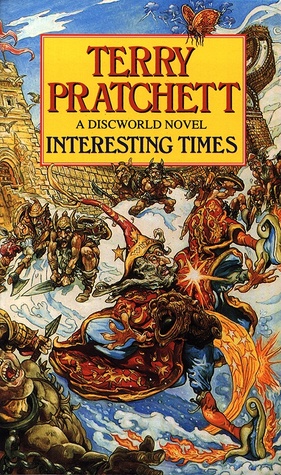
[READ: December 2021] Interesting Times

I tend to think that there aren’t that many Rincewind novels, but it’s clear that Terry liked to have him around as this is the fifth one!

I’ll also preface this by saying that some readers find this book to be problematic because it deals with people from the Aurient (Asia) and tends toward the stereotypical.  I will come right out and say that some of the things said in this book were cringeworthy, and one or two things made me uncomfortable.  However, keep in mind that Pratchett was clearly anti-racist in the Disc overall.  The Watch is one of the most un-racist institutions in fiction.

Remember also that Pratchett was a satirist and is writing for comedy.  Few people fare worse than white “European” men under Pratchett’s pen.  Finally, this book is mostly meant to be about ancient China and the draconian empires.  Yes, he throws in anachronisms (as he always does), and he blurs the boundaries into Japanese culture here and there–not cool.  But the real targets are bureaucracy and tyranny.

The book starts out with Rincewind finally happy.  That doesn’t bode well.

Then the Patrician of Ankh-Morpork receives a demand from the Agatean Empire that the “Great Wizzard” be sent to them immediately.  Vetinari doesn’t know what to make of this, but it obviously involves the WIzards.  All signs (well, the spelling of WIzzard) points to Rincewind.  Although the “great” part surely doesn’t.  But the wizards are suspicious of foreign parts and no one else wants to go, so why not send Rincewind?

In part because after Eric, Rincewind has been on a desert island.  The Wizards use their machine Hex (a proto-computer) to bring him back to Anhk-Morpork.  Rincewind is none too happy–he was really looking forward to the Amazon women that had just arrived on the island.  They might have potatoes after all.

But Hex worked and Rincewind is back.  Although soon enough they are about to send him to the Agatean Empire.  The Hex works by displacing something from where you land.  Which in this case was a lit cannon.  It arrives in the middle of the University (the Wizards wisely put out the fuse). (more…)

Read Full Post »

SOUNDTRACK: hiatus

[READ: January 15, 2021] The Prox Transmissions

I had recently seen Starset live and decided to check out lead singer Dustin Bates’ books (which I had gotten for my son for his birthday and I think he hasn’t read).

All of the CDs have a theme and the story of the Prox Transmissions is meant to tie into the album called Transmission.

My understanding was that the graphic novel was an adaptation of the novel.  I couldn’t find the novel in his room, but I did see the graphic novel, so I started with that (even though I’m sure it would have ben smarter to read the novel first).

The most impressive thing about this to me was that it was published by Marvel.  Not because I’m a Marvel fan boy but because I just assumed it was self published.  That being said, I think a thing or two was lost in the abridgement.

There are double crosses and possibly triple crosses and seemingly minor characters come to have major roles without a very satisfying explanation.  Basically it feels like a story that has has a lot removed (which it is).

The actual story line is pretty cool though. (more…)

Read Full Post »

SOUNDTRACK: hiatus

[READ: January 13, 2022] The Genius Under the Table

Why would anyone read an autobiography of someone they’d never heard of?

Well, in part because it’s a children’s biography, and therefore a fairly easy read.  But mostly because Eugene Yelchin grew up in the Soviet Union under the watchful eyes of Lenin and his KGB informants.  And it’s a fascinating look at a world that is as bizarre as it is unsettling.

And it’s a well-written and interesting story, too!

Yelchin was the youngest of two sons.  His older brother was on track to become a national figure skater.  His mother worked in the ballet, assisting the ballerinas and having a close up view of the amazing Mikhail Baryshnikov.  His father was a working man as well–they needed all the money they could get (which wasn’t much).  And what of Eugene (Yevgeny)?  He had no talent.

He couldn’t play sports (not even chess).  He couldn’t dance.  He wasn’t super smart.  He wasn’t exactly a disappointment to his parents (although he was, kind of), but they knew that the only way to get out of the squalor they lived in was to be great at something.

And he wasn’t great at anything. (more…)

Read Full Post »

SOUNDTRACK: hiatus

[READ: January 9, 2022] It Only Comes in Orange, Mr Zuma

This is the second collection of editorial cartoons from South Africa’s Daily Maverick newspaper.  Zapiro (Jonathan Shapiro) has been making editorial cartoons and caricatures since the early 1990s and has 25 books of cartoons published.  Turns out I have access to most of them so I may need to d a deep dive–maybe I’ll understand some of the politics more.

I really don’t know very much about the South Africa, and I feel like news about the country is not covered very much here.  I don’t understand all of the jokes in here, but I do feel like I have a vague grasp on the country now. However, it’s when Zapiro turns his pen abroad–especially against trump, that I can see how good of a satirist he is.  I posted this picture when talking about the previous book, but this cartoon appears in this one:

When he publishes the cartoons in the newspaper, they speak for themselves.  But in these collections, he adds a caption since most of the details are no longer fresh.  For the above he wrote:

Hell-bent on overturning the election result, trump supporters storm the Capitol building in Washington. The riot leaves five people dead.

How is it that there is any question about this still in our country.  Why is our justice system so slow?

Well, given the justice system in South Africa, our looks like a quick resolution. (more…)

Read Full Post »

SOUNDTRACK: hiatus

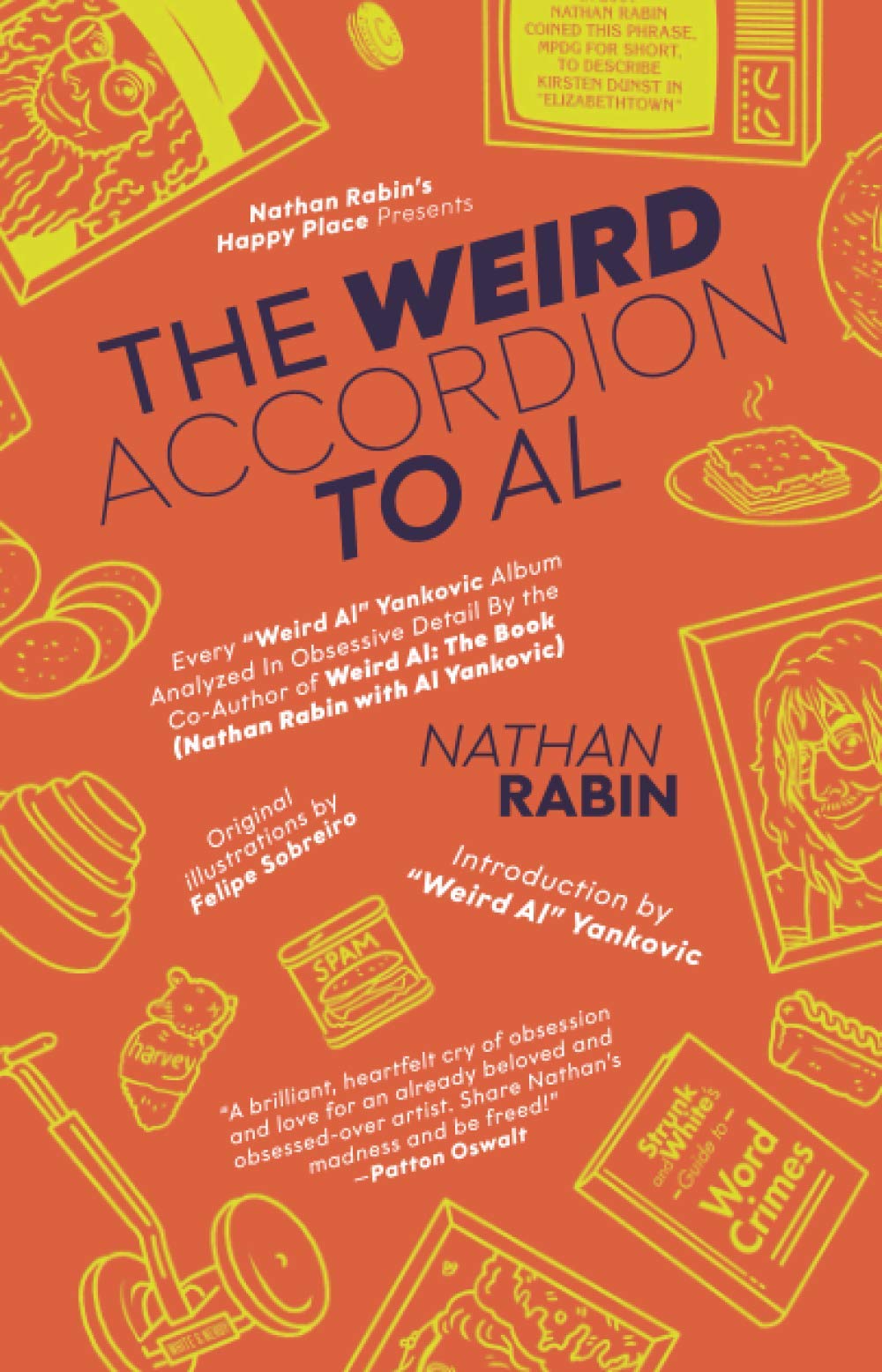
[READ: December 20, 2021] Weird Accordion to Al

After writing the “Weird Al” biography, with “Weird Al” himself, Nathan Rabin dug even deeper into his “Weird Al” fandom to write a detailed account of, as the subtitle says, “Every ‘Weird Al’ Yankovic Album Analyzed in Obsessive Detail.”

“Weird Al” wrote the (short) introduction and then Nathan drops the needle on “Weird Al” Yankovic, Al’s 1983 debut album.

Nathan goes into varying degrees of detail on each of the songs.  Nathan was a rabid “Weird Al” fan from when he was a little kid.  And when he talks about how much he loves Al, you can see his deep abiding appreciation for everything Al has done.

Some songs get a paragraph, nut most get a page or so.  He usually talks about how much he likes (or loves) the song (and occasionally dislikes).  There’s nostalgia in the older songs and jokes and observations about contemporary things as well (Rabin’s politics poke through once in a while.  Good thing he’s a smart guy.

Because he did the Al biography with Al, he presumably got a lot of insight into the man and his work.  So although sometimes his insights seem like maybe he’s reading too much into a goofy parody, perhaps he’s on to things.  Maybe Al’s depth is deeper than rhyming Sharona with Bologna.  Which is not in any way to diminish Al’s intelligence.  He’s obviously very smart, especially as his later songs indicate.

Rabin’s tone throughout the book is smart and snarky.  He talks about the songs and the video (if there is one).  He talks about the production quality (or lack thereof) on the first album.  He references Dr. Demento (because the Dr is essential to Al’s career).  He also references Don DeLillo’s White Noise and says things like “Al is in deconstructionist mode.” (more…)

Read Full Post »

[LISTENED TO: November 2021] Girl in a Band

I didn’t really have that much interest in this book when it came out.  I love Sonic Youth, but I didn’t really think I cared all that much about their origin stories.  Then I saw that there was an audio book read by Kim and that sounded pretty cool.

I realized that I had no idea anything about Kim Gordon’s life and it was fascinating to learn just how much of a bohemian artist she was before she joined the band.

The memoir starts with the final Sonic Youth show.  Kim and Thurston’s divorce was already going to happen.  They simply wanted to finish out their final shows.  So Kim played while watching her disappointment of a husband absorb all the adulation.

But Kim’s book isn’t a salacious tell-all. It’s the story of her life and how she wound up where she did.  In fact, there’s very little about Sonic Youth (a lot more about the earliest records and then bits and pieces about the later records).  And, while she’s obviously pissed at Thurston for what he did, she’s restrained in her need to thrash the guy.

Perhaps the biggest take away from the book is that after thirty years of being in a rock band, she doesn’t consider herself a musician or a Rock Star (maybe a small letter rock star).  That eye opening statement is a kind of lead in to the fact that she has been an artist for most of her life–just not necessarily in music.

She moved to New York from California in 1980.  It’s crazy thinking that Kim was a California girl.

It’s even crazier thinking about her older brother Keller who was manipulative and mean and ultimate institutionalized. Kim idolized him and he abused her terribly (more than an older brother might normally do).  All of this made Kim into the shy and sensitive woman who you would never think was responsible for some of the most iconoclastic and then iconic music of the 20th century. (more…)

Read Full Post »

SOUNDTRACK:  hiatus

[READ: December 25, 2021] “How Wang-Fo Was Saved”

This year, S. ordered me The Short Story Advent Calendar.  This is my seventh time reading the Calendar.  The 2021 Short Story Advent Calendar is a deluxe box set of individually bound short stories.

As always, each story is a surprise, so you won’t know what you’re getting until you crack the seal every morning starting December 1. Once you’ve read that day’s story, check this link where editor Alberto Manguel is providing daily commentary on each of the stories he selected for this year’s calendar.

So here’s yet another story translated by Manguel.

The last few stories in this collection just left me feeling unhappy.  I didn’t really enjoy them, and found them mostly tedious.  A lot of them felt like stories that took an idea and kept building on it with more an more examples. Rather than advancing the story, it just reiterated the story.

Yourcenar evidently wrote many

Oriental Tales, stories set in the Near and Far East, a few based on traditional legends and folktales. According to Yourcenar, the story of the painter Wang-Fo and his disciple is her own invention, though inspired by a Chinese Taoist classic. Scholars, however, have pointed out that Yourcenar seems to have taken her inspiration from a collection of Japanese tales collected and retold by the nineteenth-century Greek-Irish scholar Lafcadio Hearn.

So, yes, another old story, which is what this reads like.

First we meet Wang-Fo’s disciple, who gave up his life to follow the amazing painter Wang-Fo.  He was very wealthy and slowly gave up everything so that Wang-Fo could continue to do his work. Everything he painted felt better than life–more vivid, more real. (more…)

Read Full Post »

« Newer Posts - Older Posts »