Feeds:
Posts
Comments

Archive for the ‘Art’ Category

SOUNDTRACK: MOSES SUMNEY-Tiny Desk Concert #678 (November 29, 2017).
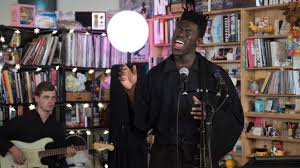
I had never heard of Moses Sumney before this show.  And the blurb seems to anticipate this:

If you don’t know this Los-Angeles-based force of nature, and haven’t heard him on tour with James Blake or Sufjan Stevens or perhaps on albums by Beck or Solange, then this is your chance to watch one of the most thoughtful talents of today as he makes music that is outside the box but easy to relate and connect to.

I’m very curious to know what he did with Beck.

I found Moses’ voice to be mesmerizing–a gorgeous soaring falsetto that he seemed to effortless get to rise higher and higher.  But beyond that, the blurb talks about his lyrics:

Moses Sumney puts a great deal of thought into the heartfelt music he creates. On his debut album, Aromanticism, he was inspired by everything from the works of Plato and Aristophanes’ account of the origin of humanity to the Bible, particularly Genesis and the story of creation. It’s all in an attempt to understand human relationships and the sorts of couplings we tend to be drawn to.

He plays 3 songs in the 20 minute time frame.  I wanted to describe the first song, but Bob’s description is too good:

The concert opens up with Moses not behind my desk, but at the piano we keep in our office. As his team of sax, harp and guitar players set up, Moses sat at the piano and began to play “Doomed.” He had instructed the band, which had already perched behind my desk 40 or so feet away, to create a transition for him to walk from piano to desk, continuing one of the most inspired 8-minute stretches I’ve witnessed here at the Tiny Desk.

So he plays the pretty piano melody and sings with those gorgeous falsetto vocals for about a minute and a half.  Then he strolls (in his cape) to the desk.  He activates some looping pedals.  He plays a beat on the microphone and then Sam Gendel plays a cool modified sax solo.  After 2 minutes of set up, he sings again.  The beats are in full and Brandee Younger is playing some simple gorgeous harp and Mike Haldeman has some echoed guitar on top.  Meanwhile, Sam has switched to a synth and Moses is also playing some kind of synth.  The song builds beautifully and he sings in a  higher and higher register.  It starts to sound otherworldly with the harp and his voice and the loops going faster and faster.  And then the wall of noise abruptly ends and the final minute is delicate and lovely.

He introduces the band and then says “we’re going to keep making noise.”  And then “hopefully no one’s printer goes off” (wonder if that happened).

“Quarrel” opens with him looping his own voice and then playing it faster and faster so it sound like a skipping CD.  Sam has picked up a guitar to pluck out notes (the head of his guitar is fascinating and I want to see it better).  Throughout the song Moses hits that looped vocal section for one or two seconds to add texture–it’s pretty cool.  The mix of that harsh(ish) electronic sound and the angelic harp is wonderful.

For the final song, “Plastic,” he removes his cape.  Everybody else leaves and he says “I want to make more room… for me!”  He picks up a guitar and says, “This is the end.  The bitter end.  Although for some of you, it will be sweet because it’s ending.”  It’s interesting how self-deprecating he is when his voice is so gorgeous.

This final song is much more jazzy with him playing interesting chords and singing to the guitar.  Overall it’s a bit less exciting than the other songs possibly because the last minute or so is just him repeating the line “my wings are made of plastic.”

But overall, Moses Sumney really impressed me with this set.  Right up to the end where he sinks slowly below the desk, to much laughter.

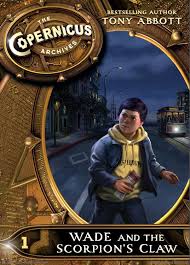
[READ: March 6, 2017] Wade and the Scorpion’s Claw

The Copernicus Legacy is a four book series.  But, in an interesting diversion, there are also two “extra” books inserted between the first two.  They are smaller and do not exactly affect the continuity of the main story, but they seem to delve into one character a little further (and there is some plot advancement).

Interestingly, Book One of the main series ends with Kaplans and their friends leaving Guam for New York.  The second book of the series opens with them in New York.  But this book, the first of the The Copernicus Archives, takes place between Guam and New York.  The big difference is that unlike the main books, this is told entirely from Wade’s Point of view.

En route to New York, the family has to stop in Hawaii.  They are in the airport for a while and they trust no one.  They are waiting for the flight to San Francisco when there are two notable people in the airport around them.  There’s a German man (you can tell by his shoes, Lily whispers) in a leather coat.  The kids don’t trust him and call him Leathercoat.  And then there’s a Chinese man doing acrobatics and other tricks to amuse some children while they wait. (more…)

Read Full Post »

SOUNDTRACKPHISH-Live Phish Downloads 12.7.97 Nutter Center, Dayton, OH (2007).

This concert included five covers out of a total of nineteen songs.

The show opens with a fairly slow “AC/DC Bag,” but there’s a seamless segue into an excellent cover of Talking Heads’ Psycho Killer” (only the second time they’d played it).  There’s some spacey sounds in the jam which then segues nicely into ZZ Top’s “Jesus Just Left Chicago,” a groovy blues.  The whole thing ends in a jaunty bluegrass “My Minds Got a Mind of Its Own.”

I have to admit at this point I’m pretty bummed by the setlist.  The songs are all good and the jams are fun, but if I were at this show I’d want to some actual Phish songs, you know?  I know a lot of people love the covers, but that’s not what I’m here for.

They rectify this with a fun “It’s Ice.”  There’s a lengthy piano solo and then the song segues into two deep cuts from Billy Breathes–a one minute “Swept Away” and then a one minute “Steep”–before closing “It’s Ice.”

Up next is a 10 minute “Theme from the Bottom” with a long solo and great harmonies at the end.  Then the band plays a great funky “Tube,” a non-album track with some great 70s sounding keyboards from Page.  After a pause (apparently the lights went out).  You can hear them chatting a bit and then they pick up a 6 minute instrumental called “Dayton Jam” that plays with the themes from “Tube.”

The set closes with a 12 minute “Slave to the Traffic Light.” There’s a great solo from Trey followed by a mellow section before coming to a good solid end.

Usually there’s a few really lengthy jams in the second set, but this upcoming set is full of mid-length songs.

It opens with a jam-filled 9 minute “Timber” and then a 7 minute “Wolfman’s Brother.”  This segues into yet another cover of Stevie Wonder’s “Boogie on Reggae Woman” before settling into a fast-paced 14 minute “Reba,” the longest song of the night.  The solos in the song remind me a bit of Frank Zappa.  It’s really amazing how tight they are during these jams.

Before they begin the next song, you can hear Trey ask, “Guyute?” and they play a 10 minute jam with a really fun middle section.  The show ends with a 12 minute “Possum.”  So while there are no really super long jams, there are a number of pretty long jams.

The Encore is a great loose version of The Beatles’ “A Day in the Life.”  I love how they handle the end.  The classic chord progression that ends the song is done sort of like that but more just fun noisy chaos.

[READ: March 6, 2017] The Forbidden Stone

I really like Tony Abbott books. He has tackled many different stories and I’ve found that I haven’t been disappointed by anything he’s written.  This series, The Copernicus Legacy is in the vein of The 39 Clues, although there are plenty of differences.  But as an outline, the premise is the same–some kids (and an adult) are trying to save the world from bad guys by collecting a bunch of things that cannot fall into the wrong hands.

Whereas The 39 Clues divides the family into 4 warring clans, this series seems to be basically good guys and bad guys.  The good guys are inspired by Copernicus.  This works out well because the main family loves astronomy.

So the main family is Wade Kaplan and his father Roald Kaplan.  Wade follows in his father’s footsteps and loves the stars and science. Roald is re-married to Sara (who is on a business trip as the book opens).  Sara has a son named Darrell.  Darrell is hip and cool and plays guitar.  He is also always hungry (a trait that Abbott loves to have in at least one character, although I haven’t seen it as being very important yet–and it seems to fade as the book goes on). I assume that Roald is not Darrell’s father as well, but I got a little lost in the family tree.  The crux is that Wade and Darrell are stepbrothers–and they get along really well.  The rest of the crew includes Wade’s cousin Lily and her friend Becca.  Lily is a techie girl who is able to wield a smart phone like a librarian.  And then there’s Becca  who is, interesting. Wade has had a crush on Becca (who is super smart and can speak several languages because her parents traveled so much) for a long time.

Okay, so there’s five people.  How does the excitement start? (more…)

Read Full Post »

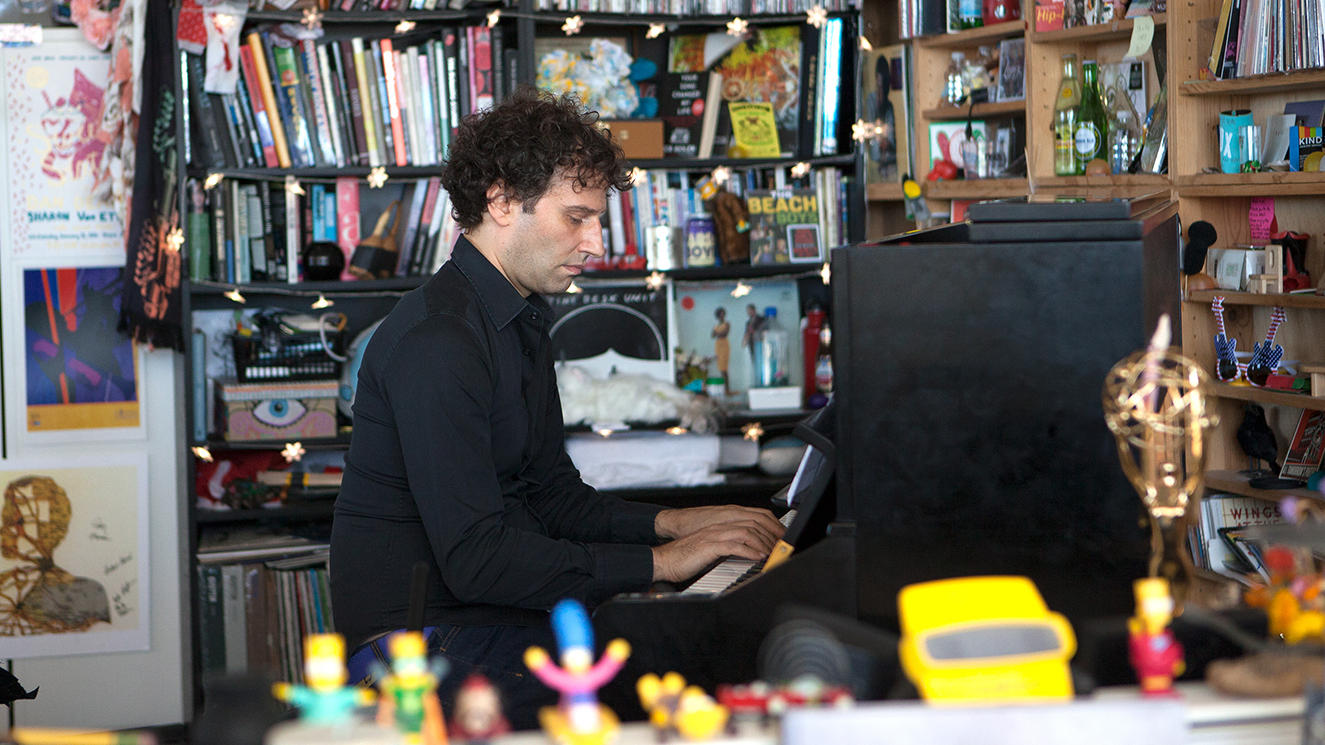
SOUNDTRACK: DAVID GREILSAMMER-Tiny Desk Concert #676 (November 24, 2017).

It has been quite a while since there has been a classical pianist on Tiny Desk.  I’m unfamiliar with the Israeli pianist David Greilsammer, but his playing is wonderful and his selections are quite fun and diverse.

For this Tiny Desk appearance, Greilsammer begins with his muse Domenico Scarlatti, the 18th-century Italian whose 500-some keyboard sonatas are compelling, colorful snapshots of his decades-long service to Spanish royalty. In the “Sonata in E, K. 380” you can hear a little street band processing along with trumpet fanfares.

Greilsammer describes the piece as sounding very contemporary.  Scarlatti lived 300 years ago and his music sounds ahead of its time.  He says it’s almost jazzy or pop-like harmonies.  He says it feels like he is playing a Beatles song.

Greilsammer follows by jumping ahead 175 years to the eccentric Frenchman Erik Satie, who not only owned seven identical gray velvet suits but, with a freewheeling spaciousness and humor in his music, is often thought of as the precursor to everything from minimalism to new age. His series of mysterious pieces called Gnossiennes strike a particularly sedate mood, capable of neutralizing any source of anxiety.

Greilsammer plays “Gnossienne No. 3” which he describes as full of pop and jazz and colors and harmonies.  He was writing these strange short pieces that at the time people in Paris didn’t understand.  Everybody loves Satie now but just over 100 years ago he was completely misunderstood.

I absolutely love the way the final notes ring out in this room–they are quite haunting

Lastly, Greilsammer takes a left turn to Leoš Janáček, the idiosyncratic Czech composer from the early 20th century, acclaimed for his operas. He set one of them on the moon; another, the dramatically taut and emotionally wrenching Jenůfa, is perhaps the most undervalued opera of a generation. But Janáček also wrote in smaller forms. His piano cycle On An Overgrown Path plays out like a diary of musings, nervous tics, simple pleasures and mysteries. Within the claustrophobic tension that pervades “The Barn Owl Has Not Flown Away,” you can hear the rustling of wings and the repeated four-note bird call.

Greilsammer says that Janáček lived in the Romantic period and all of his music is enigmatic, with many secretive things.  He wrote things related to dreams and wild scenes with things obsessively haunting him.  In “The Barn Owl Has Not Flown Away” (from On An Overgrown Path) the theme of the owl comes back many times.  Every time you try to get away from it, it comes back.

For Greilsammer, who recently performed in a working crypt in Harlem, threading these disparate musical fabrics together comes as naturally as, well, playing behind a desk in an office building.

These are some really beautiful and nicely unexpected pieces.

[READ: May 31, 2017] Audubon

I have really enjoyed most of the French graphic novels that come across my desk.  This book, translated by Etienne Gilfillan, is no exception.

It is a biographical sketch of John James Audubon (born Jean-Jacques Audubon in Haiti in 1785).  His story, aside from the whole birding aspect, is quite fascinating in itself. He was an illegitimate child (his father has seduced a servant) who was eventuality adopted by his father (!) and called Forgèére (which means fern).  His father wanted him to escape military conscription, so the boy was sent to Mill Grove in he United States in 1803.  He became a US citizen and there met his wife Lucy Bakewell.

The book actually begins in 1820 with Audubon and two other men sailing on the Mississippi river.  They hit bad weather but all he cares about are his drawings.

Then we jump back to 1812 in Kentucky.  Audubon climbs into a tree to study the swallows who are living in it–some 9,000. He took home more than 100 birds to study them.  And then he tagged some others to study their migratory patterns.

As the end of the book points out, Audubon was one of the world’s greatest naturalists who did a lot for birding. Except he was also responsible for the death of thousands of birds.  There’s a section where he kills two ivory billed woodpeckers.  He is so excited at his luck because they are becoming a rarity. (more…)

Read Full Post »

SOUNDTRACK: CHILLING THRILLING SOUNDS OF THE HAUNTED HOUSE (1964).

The cover during Phish’s 2014 concert was of this album.

Apparently many people grew up with this record.  I personally didn’t know it, but if you read the comments (don’t read the comments!) on any YouTube clip of the album you will see how popular it is.

Wikipedia describes it as  intended for “older children, teenagers, and adults” released by Disneyland Records (now known as Walt Disney Records). The album was mainly composed of sound effects that had been collected by the sound effects department of Walt Disney Studios. The album was released in several different forms. The album was first released in 1964 in a white sleeve, with a second release in 1973 with an orange sleeve. In both versions, the first side contained 10 stories narrated by Laura Olsher, complete with sound effects. The second side contained 10 sound effects meant for others to create their own stories.

Despite the title, most of the cuts had nothing to do with haunted houses or witches or ghostly spirits. Featured were such situations as an ocean liner hitting rocks, an idiotic lumberjack, a man crossing an unsafe bridge, someone lighting a stick of dynamite and a spaceship landing on Mars. Also, there are tracks with several examples of cats, dogs and birds (similar to “The Birds”) becoming enraged for some reason, as well as a skit about Chinese water torture. In addition, some of the screams were taken directly from the scene where Miss Havisham catches fire in the 1946 David Lean film Great Expectations.

The full track listing is

  • “The Haunted House” 3:00
  • “The Very Long Fuse” 1:28
  • “The Dogs” 1:13
  • “Timber” 1:45
  • “Your Pet Cat” 0:49
  • “Shipwreck” 1:39
  • “The Unsafe Bridge” 1:21
  • “Chinese Water Torture” 2:02
  • “The Birds” 0:46
  • “The Martian Monsters” 1:41
  • “Screams and Groans” 0:57
  • “Thunder, Lightning and Rain” 2:01
  • “Cat Fight” 0:37
  • “Dogs” 0:48
  • “A Collection Of Creaks” 1:54
  • “Fuses and Explosions” 1:11
  • “A Collection Of Crashes” 0:45
  • “Birds” 0:33
  • “Drips and Splashes” 1:18
  • “Things In Space” 0:53

Nothing is especially scary–although maybe for a kid, as many adults claim to have been really frightened by it.  Everything is quite over the top, especially the screams and cat howls and dog snarling.  Even the stories are a little silly, although having them in the second person is pretty genius.

But things like “one night as you lie in your lonely room in your stone hut on the moors…”  (What?).  And the Martian one.  Just keeping with continuity: if “you,” meaning me, went on the trip, then I couldn’t hear the crunching as it ate me.  Or the silly voice saying “I wonder what that was.”

And the less said about the horribly racist Chinese Water Torture the better.  I mean, the opening is bad enough: “The ancient Chinese were a very clever race” but the end of the song is really awful.  But if we can look past that, the rest of the record has fun with sound effects and is generally pretty enjoyable.

During the John Congleton interview, he also talks about this album and says (at 40:28) “the speakers are 180 degrees out of phase to make it sound extremely stereophonic.”  He says now as an engineer it is totally painful to listen to.  Bob says it sounds like it comes from the back of your head.

[READ: October 15, 2017] Half-Minute Horrors.

The premise of this book (edited by Susan Rich) is simple: how scared can you get in 30 seconds?  To me, the answer is actually not very.  I guess for me fear builds over time.  It’s hard to get genuinely frightened over something that just suddenly happens (unless it is just trying to frighten you quickly, of course).

Having said that, I enjoyed this book a lot (look at the list of authors!).  I liked the arbitrary goal of writing a scary story in a paragraph or two (or more).  And some of them were really quite creepy.

I was originally going to point out which ones I felt were the most creepy, but there are so many stories, I kind of lost track.  So instead, here’s a rundown and a brief summary. (more…)

Read Full Post »

SOUNDTRACK: SHABAZZ PALACES-Tiny Desk Concert #662 (October 23, 2017).

Shabazz Palaces is really nothing like anything else I’ve heard.

“On the ground we have leopard skin carpets Only the exalted come in and rock with us.”

With those words, spoken in the opening moments of Shabazz Palaces‘ Tiny Desk performance, Palaceer Lazaro (aka Ishmael Butler, also of Digable Planets fame) lays the ground rules for all present to enter the group’s metaphysical headspace.

And, man, talk about being transported to the other side. It’s impossible not to envision the Seattle studio, Black Space Labs, where Shabazz’s otherworldly soundscapes emerge to provide the ideal backdrop for shining a light on the fake.

 It’s the perfect proxy for the growing sense of alienation we’re all suffering, to some degree or another, in today’s space and time.

Shabazz Palaces is perhaps the most unusual rap band I’ve heard. There are hardly any beats. The songs are trippy with washes of synths and other sound effects.  There’s no heavy bass, it’s just up to Palaceer Lazaro to keep the flow.

There’s an 80 second intro in which Palaceer Lazaro introduces the band and talks about their sacred study, safe from the “Colluding Oligarchs.”

The first proper song “Colluding Oligarchs”says that “sacred spaces still exist / safe from colluding oligarchs.”  Theirs almost glitchy (but pretty) synth melodies (which I think Palaceer Lazaro triggered before he started rapping).  His partner Tendai Maraire plays a hand drum and congas (as well as some synth triggers).  And all the while he is singing echoed backing vocals.  Meanwhile, Otis Calvin plays an intertwining, slow, almost improved bass line.

For “They Come In Gold” there is no bass.  He says “this one we wrote to our phones.”  There’s a weird repeating melody that sounds like  snippet of vocals. Once again there’s lot of percussion–shakers, cymbals etc.  Half way through, he puts a filter on his voice to slow it down (a cool spacey effect) and then speeds it back up.

“Shine A Light” includes some squeaky synths and Palaceer Lazaro singing into a different mic.  When the music starts formally, the melody is a looped sample from Dee Dee Sharp’s 1965 song “I Really Love You.”  The bass is back playing some simple but groovy lines.  That second mic is connected to a higher-pitched echoed setting when he sings shine a light on the fake.

[READ: March 15, 2017] Punch

I don’t know much about Pablo Boffelli aside from that he is an Argentinian artist–he creates music as well as visual arts.

This book is a collection of line drawings (which remind me a lot of things that I draw when I am doodling).

Since the book is published in Spanish, with no English information anywhere (it’s not even on Goodreads), I couldn’t get a lot of information about it.  So from the publisher’s website I got (in translation):

In the PUNCH world, space is a character that unfolds and unfolds in millions of scenes. Cynicism and the absurd coexist with hints of synthetic humor.

Punch is the book drawn by Feli. His imprudent stroke runs through the pages building a city in which everything can happen. In the Punch world, space becomes a character that unfolds and unfolds in millions of possibilities. The urban landscape eats everything, the exteriors become interior and the fantasies materialize in the most unforeseen forms. The cynicism and the absurd coexist with hints of humor: the joke to discover for that spectator who contemplates in a disinterested way.

Punch is tender and corrosive, is infinite and minimal. It reverses the logic of physics and plays with the scale: stacked things, types or giant landscapes, a springboard that does not point to the pool, soccer balls in a refrigerator, humans without head, debauchery and micro-obsession. Put another way: this book is crazy. We recommend looking with a magnifying glass.

(more…)

Read Full Post »

SOUNDTRACK: RHEOSTATICS-Copps Coliseum, Hamilton, ON (December 11 1996).

This is the final show on Rheostatics Live in which the band is opening for The Tragically Hip.

For this show, the intro music is also from The Wizard of Oz, but this time it’s Judy singing “Somewhere Over the Rainbow.”  It’s just one verse before fading out and then guitars fading in for Martin to play “A Mid Winter Night’s Dream.”

Turns out that this setlist is similar to the one from Buffalo with a lot of new songs.  Although there are a few older/more popular songs in places.

The new songs include “Fat” which sounds great of course.  I gather they are maybe sharing a microphone because at the end Dave says “See you in the next song, Martin.”  “Okay, Dave.”  This leads into a perfect version of “All the Same Eyes.”

Martin says “We are the Rheostatics.”  Dave says “We are the Rheostatics, not to be confused with The Howell Brothers (?).  They couldn’t make it but we got their jackets.  It’s nice of you to come out early.  We’re playing selections from our new record. Get it before it’s reduced to clear.”  (You can hear someone laugh on tape).

This is a segue into the single “Bad Time to Be Poor.”  It’s followed by another Tim song, “Claire” with the acoustic guitar opening in place.  There’s another lengthy guitar solo, although it’s not quiet as exciting as some of the other ones.  But Martin was saving up for a spirited version of “California Dreamline.”

They end their set with a rough rocking “Feed Yourself.”  During the spoken part, they slow things down to just a bass and washes of guitar.  It’s a pretty intense ending and a good preparation for The Tragically Hip.

[READ: June 25, 2017] The Story of Canada in 150 Objects

In celebration of Canada’s 150th year, Canadian Geographic and The Walrus created this special issue–a fun way to describe many elements of Canadian culture through “objects.”

The objects are grouped in vague categories.  Some have just a few words written about them while others get a few pages.  Some are humorous, some are more serious.  Most are happy or amusing, some not so much.  And all of it together paints a diverse and complex portrait of the country–as well as teaching this person from South of the border a number of things I did not know.

It’s with comic pride and humility that the first object is politeness (which is not an object at all, of course).  The amusing thing about this article about “politeness” is that while the author of it is very pleased to be so polite, he also can’t wait for his fellow Canucks to forget to be polite so he can rub it in with a extra smarmy “You’re Welcome.” (more…)

Read Full Post »

SOUNDTRACK: RHEOSTATICS-Ontario Place Forum (May 30, 1992).

This is a short set with the band opening for Barenaked Ladies, just prior to the release of Whale Music.

It’s a pretty intense set what with Horses, Shaved Head, California and Queer–especially since they’re opening for BNL.

The beginning of “Aliens” is cut off, but it sounds great and the end of the song Clark throws in a really fast verse of “Tom Sawyer.”  Indeed, the whole show sounds great.

While introducing “Soul Glue,” Dave says “Ladies and gentlemen, Doctor Christopher Brown” he plays piano and keys and is the Canadian musician who has been around for years in various bands.  “Horses” sounds great with the whole band really into it.  “Shaved Head” is wonderfully intense until the very end when Clark starts singing “pray for me King George” for some reason.

Bidini says this is the first time they played Ontario Place and he thanks them for being very gentle.  Then Clark adds “Don’t forget to get up and wag your bums around folks or else you’re gonna get cold.”

Then there’s another great Martin song, “California Dreamline.”  Before the final song, they introduce each other (incorrectly) and also Brown and Lewis Melville on pedal steel.  And then they encourage everyone to make Ontario Place, “one big green sprouts music club.”  “Queer” sounds great and has a little slide guitar section (from Melville) and a piano section (from Brown) before seguing into the finale of the song.

I love this note added to the concert:

 This was the night that Rheos and BNL finished their show at Ontario Place and then all made their way to Clinton’s Tavern to join The Bourbon Tabernacle Choir onstage. That was the show where BTC started their final song People Get Ready with all members of the Bourbons on stage and then gradually they swapped out with other musicians until the song finally ended with none of the band onstage, only members of other bands.

[READ: August 28, 2016] “Creative Licentious”

I believe that this is an excerpt from a story called Instruction.  And while an excerpt is often unsatisfying in its incompleteness, I don’t think any more of this story would have made it any better.  In fact I found it too long as it was.

The basic premise is that artists are subject to all kinds of abuse.  George takes the abuses over the top and makes them repulsive–he fosters an “only the strong survive” type of attitude. In addition to producing a piece of art a week, students must also attend interviews, perform menial jobs, as well as carpentry and maintenance around the building.  They must also repair the stables and bury the dead horses at the rate of once per week.

If the story had ended there, I would have been amused by the excesses of the story but this was one of a dozen or so sections, each of which goes to the same extremism as the above (and more). (more…)

Read Full Post »

SOUNDTRACK: NONAME-Tiny Desk Concert #609 (April 3, 2017).

Noname (born Fatimah Warner) is a wrapper and crooner.  her voice is pretty and her demeanor is infectiously upbeat.  Although I don’t really love her songs, I find her attitude infectious.

The blurb says

It’s in the way she’s able to muster a smile while performing a heartbreaking tale of abortion. It’s those sometimes bleak, melancholy lyrics over brilliant, colorful production.

“Diddy Bop” is a strange mix of gentle music (delicate guitar lines from Brian Sanborn meld with synthesized flutes) and rather vulgar lines:  There’s a line “you about to get your ass beat” and lots of “my niggas” thrown around.  Phoelix (bass) sings a verse as well.  The song is only two minutes long.

After it she says she has watched many Tiny Desk Concerts and she “Just wants to be as good as T-Pain.”

The second song is actually a medley.  It begins with “Reality Check” and then segues into “Casket Pretty,” and “Bye Bye Baby.”

She says “Reality Check” is her most straightforward song, but “it would be shitty if you were like ‘damn that made no sense either.'”  I normally speak “in like, scramble-think, so hopefully you guys follow it.” “Scramble-think” refers to the clever metaphors she weaves in detailing the many ways she’s dodged destiny.

Akenya Seymour (keys, vox) takes a verse in this song and Phoelix gets some backing vocals.

“Casket Pretty” is quite an evocative expression but she repeats the lyric an awful lot during the song.  The drums by Connor Baker are interesting throughout the set, but especially in this song.

She says that “Yesterday” is her favorite song on the tape.  It’s the first song she made.  It’s vulnerable and honest and she was surprised how much people liked it so she decided she had more sadness and vulnerability for her album.

[READ: January 20, 2017] “Constructed Worlds”

I enjoyed this story very much.  It is the story of a girl who is off to Harvard.  The story is set in the early 1990s–in the time of Discman and the beginning of e-mail.  It even opens with the fascinating line:

I didn’t know what e-mail was until I got to college. I had heard of e-mail, and knew that in some sense I would “have” it. “You’ll be so fancy,” said my mother’s sister, who had married a computer scientist, “sending your e-mails.”

The girl, Selin, has been hearing all about the World Wide Web from her father. He described that he was in the Met and one second later he was in Anitkabir in Ankara. (more…)

Read Full Post »

SOUNDTRACK: AGNES OBEL-Tiny Desk Concert #599  (February 15, 2017).

Agnes Obel recently played a show near me, but it wasn’t until after I watched this show that I realized I should have gone to see her.

Agnes Obel, a Danish singer and writer of deeply alluring music, brought her work into what you could call its opposite — an office in the daylight. While the setting is a bit contrary to her carefully plotted, vocally dense songs, she mapped out a strategy which included her own reverb and monitor mix in the (successful, I think) hope of giving the Tiny Desk an aesthetic more suitable to these focused and powerful songs.

Obel plays three songs from Citizen of Glass alongside her band, keeping it sonically spare.  “It’s Happening Again” opens with fairly standard-sounding piano chords.  Then Obel’s voice kicks in and it’s unique–not weird, but with a cool almost detached delivery.  Accompanying her is a cellist and keyboardist.  They each sing backing vocals (along with a third backing vocalist).  When they all sing together, it is magical–sometimes creepy, sometimes beautiful.  The song builds to the end with all of the strings growing louder as the cello plays some wild, sliding sounds.  It is quite striking.

For “Golden Green,” the cellist switches to percussion (which is a kind of clacky ball that she throws in the air).  The main melody comes from the mellotron.  Once again when the backing vocalists kick, in everything is magical, especially the way the final note ends with a dramatic rise in pitch from all of the singers.

On “Stone,” the mellotron player switches to (electric) ukulele.  The melody comes from the uke and it is quite quiet until the chord when the cello and keyboard adds some deep bass notes that seem to overwhelm the room–quite dramatic and quite lovely.

[READ: December 1, 2016] Bandette Volume Three

Bandette Volume Three is just as much fun as books one and two.  It opens with Bandette getting shot at as she gives her little dog Pimento an important note for Daniel.  Daniel calls her and she proceeds to tell him about an upcoming heist (while she is still being shot at).  She says that there is a fabulous emerald on display.  An emerald that was once owned by Madame Presto: fabulist, mesmerist, woman of impudent morals.

And later that night (after she easily dispatches the bad guys) she goes to that special event and steals… a film about Madame Presto.

The next night several people (and a dog) are hit with sleeping darts from a new villain–Dart Petite. (more…)

Read Full Post »

  SOUNDTRACK: DANA FALCONBERRY-Tiny Desk Concert #292 (July 29, 2013).

This Tiny Desk Concert introduced me to Dana Falconberry:

Dana Falconberry’s songs are gentle, almost invariably delicate, sometimes mysterious and frequently feather-light. But her music’s sweet, intricate softness never stands in for strength: This is a confident songwriter, whether she’s ambling through six- and seven-minute epics (“Leelanau,” “Dolomite”) or chirping sweetly in the bouncy “Crooked River.”

The compositions on Falconberry’s most recent album, last year’s Leelanau, are sturdy enough to be stripped down for a space like Bob Boilen’s desk at the NPR Music offices. But each benefits immeasurably from the broad assortment of lovely flourishes she re-creates here with the help of five instrument-swapping backing players. What makes Falconberry stand out in a crowded field of singer-songwriters is her music’s unfailing impeccability, and this Tiny Desk Concert finds her and her crack band hitting every immaculately crafted mark.

I tend to agree with the blurbs, but this one really is spot on: delicate, impeccable, sturdy.  These are words I would absolutely use to describe these songs.  I would also use fantastical–not suggesting that there might be fairies floating around during these songs, but it wouldn’t surprise me if one made an appearance.

“Dolomite” is a beautiful 7 minute song with many different sections.  Falconberry’s delicate (but not wimpy, it must be said) voice works perfectly with the capoed guitar she’s playing.  After the first verse, she’s joined by a cello, banjo and backing vocals, and the song builds.  Then after almost 2 minutes the bass and drums jump in and the song, while staying basically the same, gets a whole new feel (the bassline is staccato and unexpected while everything else is so smooth).  At around 3 and a half minutes the keyboards start adding these pretty little runs that make the song seem even more magical.  The middle of the song has the three female singers rotating through a  series of oohs and ahs as they make a cool-sounding fugue.

For “Crooked River,” the bassist switches to melodica.  Once again there’s a great sequence where each of the female singers sings one note in a very complex melody–it’s quite enchanting.  The cello is plucked giving the whole song a very different feel from the first.

Before the final song Bob asks if she has had any desk jobs.  She says she has had her fair share.  “I currently have a desk job…I hope. We’ll see when I get home.”

For Leelanau, the keyboardist switches to accordion, and there is prominent banjo and delicate melodica.  The verse is really quite catchy, and after the verse there is a gently rocking section where everyone joins together–it bursts forth in contrast to the rest.  It is repeated a few times throughout the song, and each one is more fun than the previous.  The middle has a kind of slow break down with the cello scratching and the melodica and accordion sounding like they are running out of breath.  Dana even hit’s Bob’s gong.  The accordion is even “breathing” without making a musical note.  The song returns to that super catchy verse and jam section and just as you think its going to fade to an end, there’s very cool chime that echoes and then a huge buildup to the conclusion.

I was so entranced by Falconberry’s music that I need to hear more of it.

[READ: September 19, 2016] Bandette 2

Two years ago I wrote about Bandette Volume 1: “The book was very exciting and sweetly charming as well.  I’m looking forward to Volume 2.”  And I waited and waited for it to come out.  I even saw Vol 1 the other day and wondered when we’d get volume 2.  Well, apparently this has been out since 2015, but the library just acquired it.  So I’m happy to say it’s not my fault it took two years for me to get around to reading it.

Even though I didn’t exactly remember how book 1 had ended, Tobin & Coover added a helpful “Previously” section to get us caught up.

The wit and charm of the first book is back in spades. Bandette continues to be seemingly immune to the world around her–she says what she wants and does what she wants and no resistance will get in her way–whether it is verbal sparring or her uncanny gravity-defying stunts.  Her love of chocolate remains as well, of course.  And the tone retains that agelessness.  It feels like this book could have been written in the 1950s but for the cell phones and scooters.

Chapter One reminds us that Bandette is a civilizan as well  She has dark hair and a love of pastries–she even gives the bakery owner priceless urn (from where) as payment for the delicious sweets. (more…)

Read Full Post »

« Newer Posts - Older Posts »