Feeds:
Posts
Comments

Archive for the ‘Animals’ Category

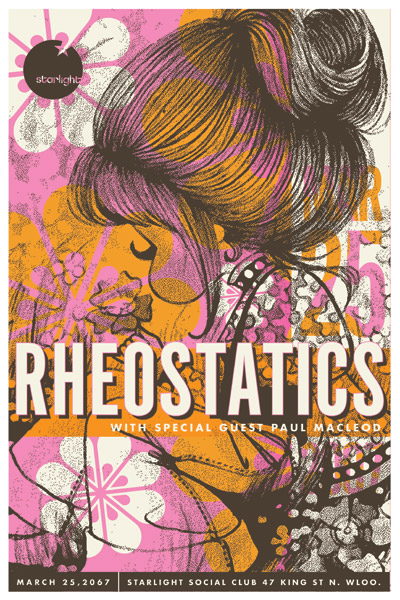
SOUNDTRACK: RHEOSTATICS-Starlight Club Waterloo, ON (March 25, 2007).

Rheostatics ended the first (or second, or third or whatever it was) phase of their career on March 30, 2007, presuming never to play again.  Before that final show at Massey Hall, the band played a few warm up gigs.

This first one was in Waterloo, perhaps a little over a year since their last live gig together.  It was hampered by the fact that Martin Tielli had laryngitis (just a few days before their final ever gig!).  Martin sounds like a caricature of a mobster whenever he talks–deep voiced and strangely Brooklyn-y.  And, obviously they don’t play many of the songs that he sings lead vocals on.  So, it’s a practice show of a sort.

Martin’s guitar is also too loud in the mix for some reason.  This means you can really hear the great sounds he’s making but it’s really distracting when it’s all you can hear.

“Fat” opens the show with all kinds of crazy sounds that Martin is making.  It sounds really cool and it goes on for quite a while, but it totally overwhelms Dave’s guitar and you can barely hear the bass.  The first time Martin sings backing vocals, he sounds completely sinister.

Next up is “Marginalized.”  There’s a long intro with some cool guitar sounds.  Tim’s voice is so quiet and Martin’s guitar so loud that the song sounds bizarre.  It also feels strangely subdued for such an angry song, but that may just be the mix.

“Me and Stupid” sounds good, although Dave forgets some words: “hang on, I got it, I got it.”

Dave tells a story of their first ever trip away from their home town.  Thanks to doc who brought us in to our first show in Waterloo in 1981.  We were ate the Kent hotel opening for L’Étranger, an old heroic Toronto punk/new wave band with Andy Cash, Chuck Angus and Bruce “Bruce P.M.” Meikle.  [Interestingly as of 2011, Angus and Cash were both in politics, sitting in the Canadian House of Commons as members of the New Democratic Party caucus].   We had on our dad’s blazers–our dads dressed cool at one time.  We did our set and were preparing to get high when L’Étranger showed up.  They had ripped jeans and leather jackets and they were shaking.  They had opened for the Dead Kennedys at the Concert Hall where they had been driven from the stage by spit and blood.  We thought they were a real band.

Tim picks up the story: they decided t o drive around and went to a park to get high.  Then the police came by.  Maybe they’d never smelled marijuana in Kitchener/Waterloo, but they let us go. Then we couldn’t find our way out of the twin cities.  We always got lost and ended up at the Alexanian Carpet Factory.

Paul Macleod fronts us for the next song, “Soul Glue,” another Northern Ontario tragedy.  Although it is sung by Tim.

“Four Little Songs” runs to 12 minutes long.  It has a fun cheesy keyboard sound and a silly long introduction.  Martin sings his and sounds insane.  Ford would you like to sing us a song?  Ford recites a quote from Valley of the Dolls, and the band poo poos that it was a song.  Martin sounding like a movie wise guy asks, “Ford was that really a song?”  So Ford sings a new song about Martin having laryngitis and he gets half of the room to sing “laryn” and the other have “gitis.”  Dave: “That bit’s gonna be great at Massey Hall.”

They do a really nice harmony at he end of the song “now they’re gone.”

Paul is back to the stage for “Little Bird, Little Bird,” although I’m not sure doing what.

Tim sings “Here comes the Image.”  I guess Martin is not on this song at all because everyone sounds the same level.  The keyboard solo is all back and forth in the headphones.

Guitar tech Tim Mech plays the terrific solo on “Legal Age Life.”  Then Martin says, “we’re gonna do ‘Take Me In Your Hand.'”  He gets cranky (or it’s just his voice–“oh Jesus, I’ll play it on electric.”  They either don;t play it or it didn’t get taped.  They move on to “Ozzy,” instead.  Martin, “we’re skipping tunes… things are changing…  We’re doing “Feed Yourself.”  This version is really intense with a lengthy guitar solo.   It runs about nine minutes.

Selina Martin comes out to sing “Dope Fiends and Booze Hounds.”  She says, “Poor Martin broke his voice.”  He makes up for it with a wild loud solo.  Then the go for a break.

Tim comes back out for the encore. He says some nice things, explains Martin’s voice and says somebody asked “Row” which he hasn’t done in a long time.  It sounds pretty good.

Andrew Roark the world’s tallest guitar tech and Paul will help us sing “Claire.”  Then they start “Horses” and Dave asks, “who has it in them to sing ‘Horses’ for us?”  The unnamed fan comes up and does a pretty decent job.  Martin’s solo is also really loud.

Finally Paul Macleod comes back to sing “Record Body Count.”  He says can you believe I get to to do this?  This is fucking crazy?  He sings an angry sounding version (not all that well).  Then he starts singing the praises of the band–really lays it on thick.  “This is the best band of all time.  Nobody is as good as this.  He gives a nod to Rush (Martin plays the Tom Sawyer riff).  He ends with I cannot believe that I have been alive during the time of this band (Dave: Holy shit!)

Martin recites (incorrectly) the end of the lyrics in that scary voice.

Someone (Paul, Michael?) starts the “whoo hoo hoo” intro to “Aliens.”  It’s pretty poor singing (he can’t get even close to the high notes), but it’s all in fun.

Michael: “give me more of Martin’s guitar in the monitor.”  Tim: “give me more of Martin’s voice, I can’t hear him.” (ha)

They play a really solid version of “When Winter Comes” (all 8 minutes of it), with Dave correcting one mistaken lyric “It’s ‘coal men’ not ‘snow men.'”

The show ends with a wild, scorching rendition of “R.D.A” with lots and lots of screaming from everyone except for Martin.  We hope that he will be ready in five days.

[READ: September 10, 2017] “Synchronicity”

I don’t know if it’s because I’m a city slicker or cosmopolitan or whatever stupid word people use for us East Coasters, but I don’t get stories like this.  And I don’t like them, either.

I can never tell if there’s supposed to be something beyond the obvious–some down home wisdom that I’m missing, maybe?

As far as I can tell, this story is about a guy visiting his friend Ward.  Ward likes to fix things, so when the narrator has a problem–like with his John Deere, he asks Ward for help. (more…)

Read Full Post »

CV1_TNY_06_08_15_09.inddSOUNDTRACKLUCY DACUS-“Historians” NPR’S SOUTH X LULLABY (March 21, 2018).

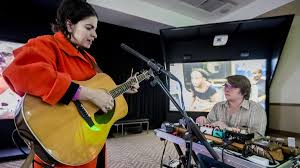
I’m looking forward to seeing Lucy Dacus live in a few weeks.  Her music is often spare but grows very intense.  For this particular song it is just her and her guitarist who is creating textures and sounds as Lucy sings clearly and starkly.  She plays the (almost) title track from her new album Historian.

The idea behind our South X Lullaby series was to offer intimate moments with musicians as an antidote to the commotion and deluge that is the SXSW music festival. When we met Lucy Dacus for her Lullaby and found out she’d perform “Historians,” a most somber song from her deeply personal and triumphant album Historian, it felt just right. It’s a song of reflection, the story of two intertwined partners and the way they document one another’s lives and preserve each other’s memories.

With simple but compelling swirls of sound, Dacus begins singing clearly with a bit of softness on the edges of her words.  It’s fascinating to watch her face illuminated by the video around her (the same video that Stella Donnelly performed in front of).

The song is warm despite the sadness inherent in it.

The setting for this performance, by Lucy Dacus and guitarist Jacob Blizard, is an interactive art installation by the multidisciplinary Israeli artist Ronen Sharabani that’s part of the SXSW Art Program. This work, titled “Conductors and Resistance,” explores human-machine interaction in our ever-evolving technological world. The images projected behind Lucy and Jacob are two coffee cups, one empty and one that’s been almost drained, both tangled in and tugged at by a complex series of wires, representing what I think is human communication and miscommunication.  This is just one of three walls onto which images are projected in this installation — you can see another wall behind Stella Donnelly in her South X Lullaby video.

[READ: April 13, 2016] “The Magic Mountain”

Back in June of 2009, The New Yorker had their annual summer fiction issue.  Included in that issue were three short essays under the heading of “Summer Reading.”  I knew all three authors, so I decided to include them here.

This essay was about Aleksander Hemon’s childhood in Sarajevo.

He says that (not unlike Angell) his family had a cabin on the mountain called Jahorina.  His family would spend winter breaks there skiing and partying.  His parents thought it was heaven up there.  But he and his sister hated to go there in the summer. (more…)

Read Full Post »

SOUNDTRACK: BECCA MANCARI-“Dirty Dishes” NPR’S SOUTH X LULLABY (March 15, 2018).

Becca Mancari plays a pretty acosutic guitar melody while Blake’s effects-laden pedal steel guitar soars and echoes around her.

I don’t know the original, but according to the blurb, “Mancari removes the clicking pulse of the studio version to underline the song’s lonely atmospherics.”

The song is simple–one that speaks to a relationship: “‘I can’t face myself,’ Mancari repeats the line like a broken admission spoken through a pinhole camera, a whispered truth so potent it can’t be looked right in the eye. “

At 2:41, the guitarist hits a great effect that turns the soaring pedal steel guitar into a buzzy rocking guitar solo while Becca strums on.  It’s a great interlude that really sells this song.

I also love that the final 30 seconds is just the sound of the guitar(s) fading out.

There are moments in this video where the Nashville-based singer-songwriter turns away from the many faces of the Life Underground installation by Hervé Cohen, which is part of the SXSW Art Program and supported by the Cultural Services of the French Embassy in the United States. What’s being projected onto the screens in the room are interviews with subway passengers from around the world who share their stories and dreams. The installation’s notion is that empathy often comes by just asking a few questions, which, maybe for “Dirty Dishes,” is just too damn hard right now.

[READ: April 12, 2016] “The Tiger’s Wife”

Téa Obreht took the literary world by storm with her debut novel The Tiger’s Wife.  I’ve had a copy of it on my bedside I guess now for 8 years.  I’ve been meaning to read it but other things always jump in first.

So finally I got around to reading this excerpt from the novel.

The excerpt is, I assume, the first few sections of the novel since they are numbered and begin with 1.

The first part is called The Tiger and it talks all about the titular tiger.  The tiger was in a zoo (or a circus) in 1941 when the Germans began bombing the city for three straight days.

The tiger should have died in the concussion and rubble, but he managed to escape and wandered to the village. (more…)

Read Full Post »

[ATTENDED: March 11, 2018] The Flaming Lips

After Sarah and I saw The Flaming Lips in Philly, I really didn’t think I ‘d see them again.  I never said never, but I said, unlikely.  Then they announced a short tour which included a spot at the newly opened Xcite Center at the Parx Casino.  This was a close show in a small, seated venue.  And when I heard that they had added a few new surprises, I decided it was worth going once more.

There was some confusion in the listing.  Originally, Chappo was supposed to open for them.  They had opened for them in Bethlehem and I really enjoyed their set.  I would have been happy to see them again. Then Chappo said they were not opening (they opened on the three earlier shows).  But there was no word on who would be opening.  To make things weirder, the Parx site said the show was at 7 and the Lips said the show was at 8.

Well, I arrived at like 5 to 7, fought my way through the smokers at the casino (really??) and made it to the Xcite Center at one minute to 7.  The lady at Will Call said they’d be going on in 15 minutes and there was no opener.

Holy cow. (more…)

Read Full Post »

 SOUNDTRACK: RED BARAAT-Chaal Baby (2010).

Red Baraat is one of the few bands to play two Tiny Desk Concerts. I’ve also had the fun experience of seeing them live.

The band was founded by dhol player Sunny Jain as a way to bring Bangrha music to Brooklyn.  The band speaks to many disciplines and plays a wonderful mash up of styles.  So while the foundation is bangrha music, there’s elements of funk, go-go, Afro-Cuban, Brazilian, and jazz–all designed as one big party.

This debut album features the dhol, soprano and tenor sax, trumpets, trombones, sousaphone and drums and percussion.

To my ear the sousaphone is the grounding instrument–often standing out as the bass while the rest of the brass is playing melody or soloing.  And yes, sometimes the sousaphone gets a solo or two as well.

I love the vocal interjections–whether nonsense or actual words I can’t tell, but they are often fast and fun–good punctuation to the melody.  And the band knows melody.  The main riff of “Tunak Tunak Tun” is a blast.  And the vocal phrases are there to humanize the party.  I didn’t realize that this was a cover of Bhangra pop singer Daler Mehndi’s song of the same name, but that explains the catchiness.

In fact there are several covers on the album.  “Hey Jamalo” (a reworking of Malkit Singh’s popular “Hey Jamalo Tootak Tootak Tootiyan”) opens with a rousing introduction with a solo from dhol.  I rather wish there was more obvious dhol playing (which is so much fun to watch live) but it blends in pretty perfectly with the rest of the music and fits perfectly with the percussion solo in the middle of this song.

They play three Bollywood soundtrack hits “Dum Maro Dum,” “Samaro Mantra,” and “Mehndi Laga Ke Rakhna.” “Dum Maro Dum” has some cool percussion sounds an a real jazz feel–I love the way they stretch out the notes in the middle.

The word Baraat (Hindi: बरात) (Urdu: برات‬‎) means a groom’s wedding procession in North India, West India and Pakistan.  Unsurprisingly, they play two covers of traditional Indian wedding songs “Punjabi Wedding Song (Balle Balle),” which has some fun stop and start melodies and a real marching band kind of vibe and “Aaj Mere Yaar Ki Shaadi Hai” which opens with some dramatic percussion before settling into some very pretty processional music.

But it’s not all raucous party music.  “Arcana” slows things down with a cool riff or two and nice accompaniment.

However, other songs like “Drum and Brass,” escape easy categorization with a clarinet reminiscent of Eastern Europe combined with percussion and melodies from Western Asia.

The title song “Chaal Baby” has some great chanting and dramatic horns moments which I saw described as “the Dirty Dozen Brass Band gone Bollywood” or belonging at a Punjabi football halftime show.

Speaking of marching band, there are a few moments on this album that felt kind of like a marching band to me.  “Mehndi Laga Ke Rakhna” was an example of a marching band vibe.  That kind of sound is hard to avoid (if indeed they are trying to) with that kind of instrumentation, although perhaps that is the inevitable comparison to processional music. My experience is that it works better live than on record.

But songs like the original “Baraat to Nowhere,” showcase a great original melody and some fun soloing.  Nearly every song features a solo by one or more members of the band allowing everyone to show his chops.  And back to that sousaphone–I’ve never heard anyone make sounds like that from an instrument before.  Great stuff.

“Samaro Mantra” the Bollywood song, ends the album on almost a down note.  The melody is somber, the drums are martial.  It’s kind of an odd choice for an otherwise upbeat and celebratory album.  But maybe it works as a calm down after an exiting wedding–time to go home everybody, party’s over.

Sunny Jain – dhol / drumset / percussion ; Rohin Khemani – tavil / doumbek ; Tomas Fujiwara – drumset ; Arun Luthra – soprano sax ; Mike Bomwell – tenor sax ; Sonny Singh – trumpet ; MiWi La Lupa – bass trumpet ; Smoota – trombone ; John Altieri – sousaphone

[READ: January 14, 2018] “Pieces”

I rather enjoyed Hye-Young Pyun’s previous story and was intrigued to read another one.  This one was translated by Sora Kim-Russell.

The previous one was thoughtful and disturbing and so is this one.

In this story, which is surprisingly unspecific about the characters, a man’s wife went missing a month earlier.  She slipped off off of a gorge and was presumed drowned.

He has just gotten a call from the police that a body part has been found and they would like him to identify it.  The part that was found was a right leg. (more…)

Read Full Post »

McSweeney’s 49: Cover Stories: Contemporary writers reimagining classic tales (2017)

SOUNDTRACKBIG K.R.I.T.-Tiny Desk Concert #714 (March 5, 2018).

A while back I downloaded one of Big K.R.I.T.’s mixtapes and rather liked it.  Since then he seems to have become pretty huge and I feel like he has really expanded on his style.

K.R.I.T. sings/raps three songs from his new album.

4eva Is a Mighty Long Time, a double album in which he covers everything from blessings to depression while plumbing the carnal and spiritual depths of his own duality. All three songs performed here come from side two, titled after his birth name Justin Scott.

The first song “Mixed Messages” is really thoughtful.  He sings and raps

I gotta whole lotta mixed messages / in my songs am I wrong / to feel this way
I got me a lover but I still wanna cheat / I wanna be saved but its fuck the police
i never really liked the fake shit / but I’m attracted to the fake ass and fake tits
i really wanna sing but id better rap

K.R.I.T.’s backing band, which includes Burniss Travis II on bass and Justin Tyson on drums, also features on keys Bryan Michael Cox — the hitmaking producer and songwriter behind a slew of Billboard chart-toppers. Together, the trio delivers stripped-down versions of the latest thought-provoking material in Big K.R.I.T.’s catalog.

Introducing the second song, “Keep The Devil Off” he says his grandmother introduced him to gospel.  She brought him to church and “she would wake me up when i fell asleep saying wake up you gotta hear this.”  He sings beautifully.  And then the rapped verses are really well structured.

And when he stops to pay homage to his church-going grandmother before performing “Keep The Devil Off,” it’s clear that everything she instilled in him is keeping him alive, too.

Definitely in these times we need to keep the negativity away–keep the devil off.

His grandmother was clearly very important to him.

Big K.R.I.T. has kept her spirit alive through his music since his breakout mixtape, K.R.I.T. Wuz Here, which he released in 2010, the same year she died.  So it only makes sense that he would bring her with him for his Tiny Desk concert.

Halfway through his three-song set at NPR Music headquarters, K.R.I.T. stops to pull out an old-school tape recorder — the same one his grandmother would use to record him singing and reciting poetry as a child. “I have to feel like my grandmother was my first mix engineer,” he says before pressing play to reveal him and his brother as kids singing a duet of R&B crooner Donell Jones’ 1999 slow burner, “Where I Wanna Be.”

He plays the tape and cracks up listening to it.  He gets the audience to sing the refrain with his younger sell.  And then his grandmother introduces he and his brother as an R&B singer, “but I’m sticking with the rap thing.”

It’s a sublime interlude — one that resonated so strongly with K.R.I.T. that he had to start his last song, “Bury Me In Gold,” over to catch the proper beat. “I’m super emotional from this, too,” he says, laughing in a moment so genuine it was only right to leave it unedited.

He says “Bury Me in Gold” is not about gold really, it’s about having something so that in the event he gets to heaven he’ll give everything away.

He tells us to remember that peace of mind and your soul are more important than gold.

I’ve always enjoyed thought provoking rap and K.R.I.T.’s lyrics combined with his voice really work wonders.

[READ: May 29, 2017] McSweeney’s 49

It has been a long time (three years or so) since the previous McSweeney’s volume.  During that silence, the publishing house went non-profit and that seems to have taken up a lot of their resources.  They even address this a bit in the interdiction to this book.

But regardless of the reasons why, it is great to have them back.

As the subtitle says, this is a book of “cover stories.” What that means is a little vague–the contemporary writers model their story after a classic story.  I try to compare it to music covers, although in music covers the music and words are typically the same with some kind of variations.  Typically, the words are the same but the music is different.  I liked to flip this idea on its head for describing these stories in that the words are different by the music is the same.

Since I don’t know most of the original stories here I don’t know how similar these are to the originals–same character names?  Same ideas?  Same plot?  I don’t know.  And perhaps it would affect the way I read these stories if I was familiar with theory original pieces.  But without knowing them, these just turned out to be good stories from good writers.

Interspersed between the stories were poems and, in a wonderful commentary on our current shitty president and the cowardly house of representatives who on the day I finished this voted to strip 24 million people of health care, are comparisons of classic historical figures’ speeches with the petty garbled tweets of out current crap in chief.  Can we impeach this motherfucker already?  And send the whole lot of them to jail, please.  #ITMFA

As many McSweeney’s do, this one opens with letters.  And of course they aren’t really letters at all, even if they are addressed to McSweeney’s.  Many deal with cover songs, but a few are much more serious, political and right on.

WAJAHAT ALI writes from Camp FDR in Washington DC where he and his fellow prisoners were finally able to cobble together WiFi.  Ali explains that the Executive Order was inevitable the ban, the vetting, the registry were all just prelude. The need to protect against terrorism outweighs the individual rights and the rights of American Muslims…read the Supreme Court decision.

NICK JAINA writes about the Sept 23, 1970 episode of The Johnny Cash Show in which Ray Charles appears and plays “Walk the Line” and then “Ring of Fire.”  The letter states that the creator of “Ring of Fire” is actually mis-attributed.  The story is that June Carter wrote it after seeing a page in her uncle’s book of Elizabethan poetry.  But Johnny first wife claims that Johnny wrote it while drunk about a certain female body part: “all those years of her claiming she wrote it and she probably never knew what the song was really about.”  Then it reverts back to Ray Charles’ performance with an unseen band playing behind him–especially a great baseline–and as the song ends he lets out one last shudder and cackle like he just invented the orgasm.  “Johnny returns to the stage looking like a man who just watched someone have sex with his wife but was so in awe of how good he was at it that he could only thank him.”

ROBIN TERRELL talks about trumpmania in the Czech Republic from the perspective of a black woman, lesbian, child of civil rights activists, mother of a black man living in Prague.  The look in the eyes of people after the election: The U.S. is going to fuck us over again.  It stunned Europeans that the U.S. could generate someone fouler than Europe’s own crop of white male extremists.  She is now a refugee from her own country.  #RESIST #ITMFA

KIMBERLY HARRINGTON says she always believed that even in the darkest times humor has its place.  But lately she’s been bursting into tears rather than cracking a smile.  She hopes she can find things to laugh at–even death in these horrible times.

MARY MILLER says that for the longest time she thought her uncles wrote “Stagger Lee.”  Her uncles were musicians who wrote songs but also threw some covers into their shows.  She believed that “Stagger Lee” was one of theirs. She realizes that they are not famous and that no one will remember them–but she promises them that she will remember them.

RICK MOODY writes at length about Elektra’s 1990 tribute album Rubaiyat: Elektra’s 40th Anniversary.  I remember it coming out and I remember not getting it because it was too expensive. But Moody talks about what a great conceit this collection was to have contemporary artists cover classic songs.  He also talks about how the tribute album was quite popular in the 1990s (was it ever).  Some thought: He loves Bjork, but he thinks of the Sugarcubes as a cheeseball imitation of the B-52s (and that their “Motorcycle Mama” is pretty bad.  He mentions a few great tracks, like Kronos Quartet covering “Marquee Moon,” Metallica doing “Stone Cold Crazy,” and even a Howard Jones cover of “Road to Cairo” by the cult hero David Ackles.   But he says fully half of the collection is bad, some of it even awful–not worth its list price at the time but it has a great number of masterpieces on it.

Will Buttler (from Arcade Fire) wishes to make some amusing corrections: some errors during concerts, and apologizing for singing “I’m So Bored” with the USA because he is not.

ARIEL S. WINTER-This is an interesting philosophical question wondering whether or not Marty McFly actually created “Johnny B. Goode.”  How could he cover it before Chuck Berry had released the original.  As a child this blew her mind.  This facile beginning then goes on to say that before recorded music the notion of a cover didn’t really exist.  And indeed in the 1950s people recorded songs without concern for copyright.  It’s also true that when Chuck Berry plays Johnny B. Goode live, it’s not considered a cover of his original.  She concludes by that the Back to the Future is probably the first time she ever heard Johnny B. Goode.  So Marty McFly’s is the original to her (as it is to all the kids at the dance).  So in addition to a song having an original for the performer there is also an original for the listener.  Anyone who has loved a song for years before finding out that it’s a cover has had that experience.

INTRODUCTION BY THE EDITORS

This introduction talks about how the first time they did a “cover story” was in 1999 in issue 4.  Rick Moody covered Sherwood Anderson’s “The Egg.”  They had been planning to do an entire issue of covers as far back as two years ago and then things happened in the McSweeney’s universe to delay it.  And now : this issue is being born in a moment of racial, social and economic reckoning and imminent fascism…into a country that looks much different from the one in which it began, fronted now by a mean and disingenuous imitation of a president.   As such: Tucked between these thirteen beautiful renditions of thirteen classic stories are instances when a cover is not an homage but rather a perversion of its predecessor”  And by that they offer examples of eloquent speeches by former leaders and then tweets from our pervert in chief.

GARY BURDEN-excerpt from Nobody Knows (an autobiography)

Gary Burden created the cover images for this issue.  I had no idea who he was, but this autobiography tells me just how interesting a fellow he was.  He has been responsible for some of the most iconic album covers of the last 60 years!

These excerpt shows his origin story–he was 8 on December 7, 1941 and he has had vivid memories of WWII.  When he was 16 he joined the Marines.  But he was restless, got involved in bad things, was dishonorably discharged and got mixed up with even worse people (he says he can’t believe the things he did back then).  In 1964 he met “Mama” Cass Elliot. They spent a lot of time together and this opened him up to meeting all kinds of people: David Crosby, Stephen Stills, Graham Nash.  Eventually he met and hung out with Jim Morrison and designed Morrison Hotel (a fascinating story that).  In one of the nicer things I’ve heard someone say he says that Jim was a real poet, someone who was unafraid of delving deeply into life irrespective of the personal cost.  Then he met Neil Young. He says that Buffalo Springfield has been his favorite band and then one day Neil came to Mama Cass’ house in his 1948 Buick Hearse.  He was also hanging around when CSN decided to become CSN&Y and then he and Neil became friends. and Neil sold him his house in Topanga.  Eventually he made the cover art for After the Gold Rush (and he gives a little story about the old lady there on the cover).  I’m kind of curious to read this whole book now, especially if it includes album covers.

EMILY RABOTEAU-“The Babysitter” after “Some Women” by Alice Munro
This is the story of a babysitter for Mrs Fagan.  She is a young girl and her employer is very rich and locally famous.  And quite eccentric (she went to East Africa and allegedly witness the Ark of the Covenant and then wrote a controversial book about it).  But in their town she was known as the white lady with black kids (Maya 3, Eddie 10 months old).  The story reflects back on the babysitter as child (she is now the same age as Mrs Fagan was when the babysitting began.  The babysitter’s mother is kind of jerk and is very sarcastic about this babysitting arrangement.  She is also a very strict Jehovah’s Witness, so when the narrator gets her first period rather than tell her mom, she just takes products from Mrs Fagan.  As the story opens Mrs Fagan’s son has just arrived and that changes the dynamic in the house.  How will Mrs Fagan take it when the narrator accidentally sets fire to the kitchen? I really enjoyed the way the end of the story plays on the notions of memories and the impact people have on others.

MEGAN MAYHEW BERGMAN-“The Lottery, Redux” after “The Lottery” by Shirley Jackson
“The Lottery” seems like a pretty easy story to cover–I think everyone knows everything about it and it has been covered in things like The Hunger Games in their own ways.  I don’t know if this story references the original (with the redux),  for this story the people of the island of Timothy were exiled from America fifty years earlier for crimes against the environment.  They were gathering on July 27th, the day of the lottery.  And indeed the lottery is a death sentence, although it’s not entirely clear why.  Interestingly, the story is more about the girl chosen and what her life up to that point has been like.

ANTHONY MARRA-“The Tell-Tale Heart” after “The Tell Tale Heart” by Edgar Allan Poe
This story doesn’t diverge all that much from the original except for the wonderful modern twist on the beating heart.  It’s hard to say more without giving things away but I loved the modernization.

JESS WALTER-“Falling Faintly” after “The Dead” by James Joyce
I didn’t know all that many stories before hand, but I knew this one very well and this is wonderful homage.  It is not in any way rewriting the story–it’s a very different story, but it alludes to the Joyce story and directly mentions it and it is quite clear where the connection between them is.
Michael is a writer.  He is married with kids but has moved temporarily out to New York to write for this new police procedural.  The show is doing well and the female star is quite beautiful.  They bond over cigarettes–she is foreign and smokes like a European, he recently started again.  As stories like this tend to go, Micheal gets the wrong idea about this young, hot actress.  And given that she is not American she misunderstands the subtleties of his behavior (which isn’t very subtle admittedly).  But he wants her to know that his story is a tribute to Joyce’s “The Dead.”  When he talks about the dead she thinks he means real dead people and is pretty freaked out.  This leads to a restraining order and a police intervention–not how he thought his life in New York would go.  What doe sit have to do with “The Dead”?  Well they are standing smoking in the snow as it gently floats to the ground falling through the universe, faintly falling.

LAUREN GROFF-“Once” after “Wants” by Grace Paley
I loved the way this story started.  I saw my enemy at the beach.  With that as a groundwork we slowly learn just how this woman has an enemy (it’s an old boyfriend’s mother) and how they have grudgingly begun to respect each other decades after the two broke up. I really enjoyed this short piece.

ROXANE GAY-“Men on Bikes” after “Rape Fantasies” by Margaret Atwood
I can’t imagine what the original of this story is.  The actual story of this is pretty peculiar itself.  Basically, the men in town have all started riding bicycles everywhere.  It started when one of them was arrested for drunk driving.  He didn’t lose his license but his wife took it away from him.  He dug out a bike and began riding it.  She thought he looked ridiculous, but when another man had his license taken away, they began riding together.  It was quite a sight, although I’m not sure what the point of it was.

NAMWALI SERPELL-“Company” after “Company” by Samuel Beckett
I like Beckett, and I know that he can be confusing.  I don’t know what “Company” is about so I have no idea how it relates to it, but man I did not get this at all.

It was confusing and really long.  It is broken into many small sections which might be connected.  The first is about the brightening which happened although many people missed it. Then we learn about the ship which is electro epidermal, which is cool but not really explained  and then the story turns into a quest for melanin and just when you think it’s a sci-fi story, it becomes a story about race.  There is a pale man tied to a tree hitting a sack (pound pound).  There’s a lot of vomit.  If the white man inseminates even one person, finding pure stem cells is impossible.  Dark skin marked you as  lucky when the darkening came.  But then she says the mission is over.  There’s more vomiting.  A fellow is supposed to be invisible in the village but Pound sees him.  There’s more vomit, a section titled rape, where Pound rapes Lila every once in a while and then who the hell knows what happens at he end.

KIESE LAYMON-“And So On” after “Hills Like White Elephants” by Ernest Hemingway
Weeks ago 64 black folks changed the world.  You are the 11th.  Aside from the direct address to the reader the story is pretty straightforward and interesting.  Chanda Stewart was 8th, the narrators research assistant was 9th and Doug E., Chandra’s boyfriend was 1st.  They are at a fancy restaurant, Chandra, the narrator and you.  She swears that Doug is a porn star, but the narrator argues that having 1089 twitter followers and awkward consensual sex with a few white women filmed on an iPhone 2 in his fake Timberlands, blue knee brace and yellow wrist bands makes you a porn participant, not a star.  The story comes down to which side the narrator is going to choose.   sides or run for our lives.  Because while they were talking, Doug E. and about sixty young black kids were marching down the street.  To the school.  They each had an ax and a shovel.

MEG WOLITZER-“If You’re Happy and You Know It” after “A Perfect Day for Bananafish” By J.D. Salinger
I haven’t read this Salinger story in a long time, so I don’t really know how it connects to this, but I really enjoyed it.  I enjoyed the way that it was written which was a little confusing but in an intriguing way.  Set in a hotel on Miami there is the young woman in 609 who arrived with her new husband.  She’d sent him off to the beach.  We see her telling her parents that he is taking it easy, but they want to know if he is taking the Klonopin.  Later that night in the lobby, a four year old girl, Chloe, is in the lobby of that hotel watching a man play piano.  The man is a guest also and he is playing and really getting into it.  Another boy asks if he can play This Old Man and the player jokes about the boy calling him old.  But Chloe asks if he can play “If You’re Happy and You Know It.”  He says he might be happy but he may not know it. She is puzzled by that.  He says she is breaking his heart.  We soon realize that the pianist is the Klonopin man, and while things don’t get dark exactly, they certainly get strange.  And Chole’s parents have foisted her off on a poor babysitter the whole time.  This was one of my favorites in the book.

T.C. BOYLE-“The Argentine Ant” after “The Argentine Ant” by Italo Calvino
I can’t imagine what the original story is like, but this one from Boyle was really icky and really fantastic.  Its’ a fairly simple premise–a family moves to a rental property in Argentina, only to find that it is swarming with ants.  The ants are everywhere–even crawling all over their baby.  They run to the next door neighbor’s house only to see that they know about the ants and might have a secret weapon.  But mostly they just seem to be putting their furniture in jugs of water–presumably as a deterrent.  There is also an Ant Man who might be fighting the ants or who might actually be bringing more.  What is great about the way Boyle writes this is that the guy renting the house is working on an academic theorem that his wife thinks is rather frivolous.  And that tension underpins everything.

ALICE SOLA KIM-“One Hour, Every Seven Years” after “All Summer in a Day” by Ray Bradbury
Again I don’t know the original, but this story was great, and also weird. The weird part is that the story seems to start over multiple times. And that’s because there is a kind of time travel component to it.  The title refers to how often the sun comes out on Venus.  There is a girl, the main character, named Nargit. She was born on Earth and so she saw the sun.  The other kids are pretty angry at her for it (as if it’s her fault).  They are abusive to her, and the time travelling is the girl’s attempt to protect her younger self.  Many things go wrong but they bring about different results.

CHRIS ABANI-“Sleepy” after “Sleepy” by Anton Chekhov
This story was pretty horrific.  Kemi, a sixteen year old black girl who is now an orphan is working for a white family.  The family has two little children, one of whom is a baby.   The family is horrible to Kemi.  Pretty unrelentingly horrible.  Kemi is tired and never gets a break and the baby cries all the time.  She can’t soothe the baby and the family blames her for her failures.  Her exhaustion builds and builds until you pretty much know the ending several pages before it happens.

TOM DRURY-“The Yellow Wallpaper” after “The Yellow Wallpaper” by Charlotte Perkins Gilman
I know the original story although not super well.  But this version feels almost exactly the same. I honestly can’t tell what the difference is (without having re-read the original again to compare).   Jane and John are renting a place on an island for the summer.  John thinks Jane is not strong and keeps her hidden away in a room with yellow wallpaper.  He more or less runs everything in her life until she starts seeing people through the wallpaper.  You know things can’t go well from there.

POETRY:

REBECCA LINDENBERG-“Having a Coke with You” after “Having a Coke with You” by Frank O’Hara

MATTHEW ZAPRUDER-“Poem for Keats” after “Ode to a Nightingale” by John Keats

STEPHEN BURT-“A Nickel on Top of a Penny” after “Piedra Negra Sobre Una Piedra Blanca” by César Vallejo

BRIAN TURNER-“The Metaphor Program” after “The Red Wheelbarrow” by William Carlos Williams

STEPHEN BURT-“Roofers” after “The Armadillo” by Elizabeth Bishop

MATTHEW ZAPRUDER-“Poem on the Occasion of a Weekly Staff Meeting” [the first two lines are taken from “A Poem on the Occasion of the Consecration of Sandford and Shippon Churches” by Rev. F. Wilson Kittermaster, 1855]

STEPHEN BURT-“Suspense” after “To Brooklyn Bridge” by Hart Crane

KEVIN MOFFETT-“Second Wonder”-a monologue that will air on The Organist.
I found this puzzling at best.

PATTY YUMI COTTRELL-excerpt from Sorry to Disrupt the Peace
I read this book not too long ago.
This except was about two young children who invented a game called “Confession” in which the boy confesses his real or imagined sins to his sister.

~~~~~

The comparison quotes are called Great Speeches from History vs. the Tweets of Donald J. Trump:  I can’t bring myself to write any of the jerks tweets.

Mahatma Gandhi from the “Quit India” speech, 1942 vs. a Feb 4 2017 tweet

Abraham Lincoln’s “The Gettysburg Address” 1863 vs. a Feb 18 217 tweet (about fake news)

Martin Luther King Jr from “Letter from Birmingham Jail” vs. Feb 21 2017 (crowds planted by liberal activists)

Frederick Douglass from “The Hypocrisy of American Slavery” 1852 vs. Feb 6 2017 (negative polls are fake news).

Franklin D. Roosevelt, inauguration speech 1933 vs. Jan 22, 2017 (including all my enemies)


The bad thing about this issue is that the last four or five stories were all real downers, making it a pretty tough slog.  But I loved the idea, and I liked that they found the time and space to point out how stupid trump sounds and looks and is.

For ease of searching, I include: Cesar Vallejo

Read Full Post »
SOUNDTRACK: ANNA MEREDITH-Tiny Desk Concert #713 (March 2, 2018).

I have never heard anything like this.  From sound to melody, to intensity, to instrumentation, this whole thing just rocked my world.

The melody for “Nautilus” is just so unexpected.  It opens with an echoed horn sound repeating.  And then the melody progresses up a scale, but not a scale, a kind of modified scale that seems off kilter just as it seems familiar.  The cello plays it, the guitar plays it, the sousaphone (!) plays it.  And it continues on in like fashion until only the high notes remain and then a menacing low riff on sousaphone cello and guitar breaks through–a great villain soundtrack if ever there was.  While everyone plays this riff, Anna returns to the keys to play the modified scale.

Meanwhile, the drummer has looked like he’s asleep behind his small kit.  And then 3 anda half minutes in he wakes up and starts playing a loud but slow rhythm.  The guitar begins soloing and as it fades out that main riff begins, now with a simple drum beat–not matching what anyone else is playing, mind you.  The sousaphone (which must have an echo on it or something and the cello pick up the low menace and it seems like everybody is doing his and her own thing.  But it all works amazingly.

So just who is Anna Meredith?

Anna Meredith was a former BBC Scottish Symphony Orchestra Composer in Residence. Two of the three songs performed here come from her 2016 release called Varmints.

Bob Boilen was also impressed when he first saw Anna Meredith live:

I first saw this British composer a year ago, in a stunning performance at the SXSW musical festival. It was one of the best concerts of my life. The music I heard sent me into a state of reverie. If music could levitate my body, this is how it would sound. It carried me away and thrilled my soul. I was giddy for days.

Now, I know this isn’t music for everyone. … But if you know and love the music of Philip Glass, King Crimson or Steve Reich — music that’s electrifying, challenging and sonically soars and ripples through your body — then crank this up.

Lest you worry that she couldn’t translate it to the Tiny Desk (she says they normally have 23 suitcases full of crap so this has been an exciting challenge to squeeze in here)

Out of nearly 700 performances at the Tiny Desk, this is simply the most exhilarating one I’ve experienced. The instrumentation is unusual, with pulsing bass sounds produced by a wonderful combination of cello, tuba and electronics. It’s all rhythmically propelled by an astonishing drummer and Meredith pounding a pair of floor toms. And much of the repetitive melody is keyboard-and-guitar-driven that morphs and erupt with earth-shaking fervor.

The second song, “Ribbons” is quieter.  It’s and new song and it has vocals.  Her vocals aren’t great (“hard when you’ve got the voice of a five-year old boy”) but the melody she builds around it shows that her  voice is just one more instrument (albeit saying interesting words).  Actually, that’s not fair, they are just so different from the noise of the other two songs that it feels very faint in comparison.

It opens with a quiet guitar and electronic drum.  And slowly everyone else joins in.  A nice string accompaniment from the cello (Maddie Cutter), bass notes on the sousaphone (Tom Kelly) and even backing vocals from everyone.  By the third go around the drummer (Sam Wilson) is playing the glockenspiel.  By that time the song has built into a beautiful round and the quietness of her voice makes complete sense.  As the song nears its end, Sam has switches to a very fast but quiet rhythm on the floor tom.

She introduces the band and wishes a happy birthday to guitarist Jack Ross.  She says this is a great present as “so far all we’ve gotten him is an apple corer, the gifts have been a bit low grade.”

They make some gear switches, “we have a bit of a logistics problem with all our gear we can’t quite afford to bring enough glockenspiels, we pass the pure crap glockenspiel  around ans everyone gets to go ‘my turn!'”

“The Vapours” opens with a wonderfully wild guitar riff–fast and high-pitched and repeated over and over.  Anna Meredith adds waves of synths and then in comes the sousaphone and plucked cello.  Then fast thumping on the floor tom propels the song along.  The song slows a bit a Anna plays the clarinet (!).  The song dramatically shifts to some complicated time signature while Anna plays glockenspiel.  After a few rounds, while this complex guitar riff continues the drum and sousaphone start playing a pretty standard beat the contradicts everything else that’s going on and then Anna just starts pounding the crap out of some more toms.

All through this there are electronic sounds adding to the chaos and I have no idea who is triggering them, but it’s really cool.

The end is almost circusy with the big sousaphone notes and yet it’s like no circus anyone has every heard.  When the camera pulls back and you can see everyone working so hard and yet smiling ear to ear (especially Maddie), you know this is some great stuff.

The end of the song winds up with a hugely complicated tapping melody on the guitar and everyone else working up a huge sweat.

I couldn’t get over how much I loved this.  I immediately ordered Varmints and checked her touring schedule.

How disappointed was I to see that Anna Meredith had played Philly just last month and has now gone back to Europe!  I do hope she comes back soon.

[READ: August 30, 2017] McSweeney’s 48

For some reason, I find the prospect of reading McSweeney’s daunting.  I think it’s because I like to post about every story in them, so I know I’m in for a lot of work when I undertake it.

And yet I pretty much always enjoy every piece in each issue.  Well, that explains why it took me some three years to read this issue (although I did read Boots Riley’s screenplay in under a year).

This issue promised: “dazzling new work; a screenplay from Boots Riley with a septet of stories from Croatia.”

LETTERS

GARY RUDOREN writes about using the Giellete Fusion Platinum Razor every day for 18 days and how things were good but have gotten a little ugly.  On day 24 he had a four-inch gash under his nose.  Later on Day 38 it was even worse–a face full of bloody tissue squares.  By day 67 he is writing to thank McSweeney’s for whatever they did perhaps it was the medical marijuana but now his face is baby butt smooth even without shaving.  He wants to change the slogan to Gilette Fusion the shave that lasts forever. (more…)

Read Full Post »

SOUNDTRACK: SHAKEY GRAVES-Tiny Desk Concert #495 (December 14, 2015).

I thought I had posted about every Tiny Desk Concert, but on double checking I found that I had missed this one.  I had heard of Shakey Graves and I assumed he was a country/folkie singer.  Which he is, although really his style is to mix country, blues and rock ‘n’ roll.  I also had no idea his real name is Alejandro Rose-Garcia.

This set sees Graves on acoustic guitar (with a strap with his name on it) accompanied by another acoustic guitar (which seems rather small) and a mandolin.

“To Cure What Ails” is a pretty, slow folk song. It’s simple enough with nice high mandolin notes and a good guitar line between verses.  Shakey has a nice voice and the song feels compelling like a story, although I don’t think it is.  He’s also charming and funny in little ways–he makes a lot of funny faces and chuckles.  But his music is really solid and the harmony at he end of the song is really great.

For “The Perfect Parts” the mandolin switches to bass and they have a little discussion n how to play it.  Shakey tells the drummer how to play the beat and then says they’re going to make it us as they go along.  This song is darker and has a cool sinister vibe.  He sings in kind of deep mumble for this song which works well for this song.  The song gets a little intense for a few lines.  And by the end it builds pretty loud with some good whoa ho ho backing vocals.  So much so that for the last chord, “he attempted a stage dive at the Tiny Desk.”

For the last song, “Only Son,” he:

breaks out his guitar and suitcase kick drum/hi-hat, [and] a palpable rush of swooning adrenaline hits the room. I felt that at the Americana Festival in Nashville, at the Newport Folk Festival and here at the Tiny Desk.

He says it is soon to be the last of the suitcase kick drums (this is his third).  He dreamed about having an object that he could cart around with him and still make a lot of noise.  The drum is actually behind him and he stomps the pedals with his heels (I can;t believe the camera never zoomed in on it).

He says the song is about “the moment in your life when you realize you’re not alone… there’s an aha! moment where you’re like ‘not just me?’  The drummer plays bass, the mandolin player has the mandolin back and Shakey has the kick drum suitcase.  There’s some terrific harmonies (and chuckling ) throughout the song, and I love the way it stops and starts.

[READ: Late 2016 and early 2017] McSweeney’s #45

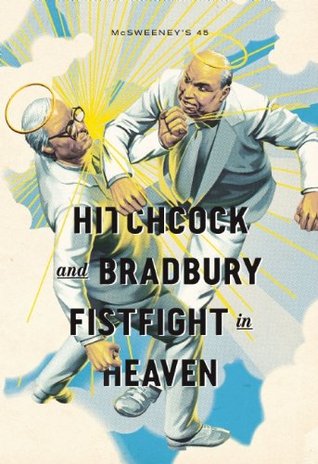
The premise of this collection was just too juicy to pass up.  Although it did take me a while to read it.  Eggers’ introduction talks about the contents of this issue.

DAVE EGGERS-Introduction
Eggers says he came across a collection of stories edited by Hitchcock. He really liked it and then learned that Hitchcock had edited 60 volumes over the course of 35 years.  He was excited to read literary genre fiction.  But he was more impressed that theses stories did what literary fiction often forgets: having something happen.  He then bought a cheap book edited by Bradbury (Timeless Stories for Today and Tomorrow) and he liked it too.  He was surprised that there were so many canonical writers (Steinbeck, Kafka, Cheever) in a Bradbury collection.

So, why not make a new collection in which we can compare the two genres.

Despite this looking like a pulpy paperback, there were still Letters.

LETTERS

CORY DOCTOROW
Doctorow says that Science fiction is not, indeed, predictive.  That any genre which deals with so many potential future events is bound to get some things right.

JAMIE QUATRO
Quatro says she was asked to write a letter for this genre issue, but Quatro doesn’t do genre, so she was about to pass.  Then her son, from the backseat, asks what bulwark means.  Then inimical.  Then miasma.  He is reading a book called Deathwatch about soldiers whose brains are removed so they no longer fear. Suddenly, when she compares this idea to her essay on Barthelme, she sees that maybe McSweeney’s was on to something after all.

BENAJMIN PERCY
In fifth grade Percy (who has a story below) gave his teacher a jar full of ectoplasm.  He has always been different.  He proposes the Exploding Helicopter clause: if a story does not contain an exploding helicopter (or giant sharks, or robots with lasers for eyes or demons, sexy vampires. et al), they won’t publish it.

ANTHONY MARRA
Marra discusses Michael Crichton and how something doesn’t have to be Good to be good.  He says Crichton was a starting point for him as an adult reader.  And what can be wrong with that? (more…)

Read Full Post »

SOUNDTRACK: VAGABON-Tiny Desk Concert #710 (February 23, 2018).

It’s always my favorite artists who play the shortest Tiny Desk Concerts.  August Greene was okay and it went 36 minutes but Vagabon didn’t even manage ten.  Neverthless, there’s something magical about Vagabon.  Her voice is unique, she brings a new perspective to indie rock and she seems pretty nice too.

Laetitia Tamko, the artist known as Vagabon, is a 25-year-old, Cameroon-born musician with a big, tenor voice just bursting with new musical ideas. Though all the songs here are about love, Vagabon also speaks proudly to black women on her 2017 album, Infinite Worlds. There aren’t a lot of black women in this bedroom studio community of independents, a community that, especially in New York, has welcomed her and where she mostly found stimulus and guidance.

Her pride shines bright in her smile and as well it should. For someone self-taught and who’s been playing for only the past four years, her arrangements are adept and thoughtful in an independent rock music scene that can often be lyrically lazy and texturally tepid.

Her album is quite big with loud guitars and crashing drums.  But in this Tiny Desk, it’s just her and her equipment (and a stellar bassist on the second and third songs).

For the first song “Fear & Force,” she plays electric guitar.  There’s some lovely picking and great chords before she sings in her unique voice–whispered and deep (so much deeper than her speaking voice).  I love that she is still picking as she uses her left hand to start the electronic drum machine that makes the song sound so big.  The album version gets really big in the middle but she keeps things quiet here.  The chorus is wonderfully powerful and elliptical.

“Freddy come back, I know you love where you are, but I think I changed my mind.”

I love the abrupt ending too.

We were also treated to a new song during this Tiny Desk performance called “Full Moon In Gemini,” which, coincidentally, was performed on the day of a total lunar eclipse in Leo – she warned us all to “watch yourselves.

It’s amazing to hear her sing so powerfully after her delicate speaking voice.  She introduces Evan Lawrence on bass and his live bass is a tremendous addition.  He plays great lines that really flesh out her playing.  I love the way the song ends.  She sings “I lay in my bed with you it fees so …  so … good,” and the drums and bass continue for ten seconds before she shuts it all down (having already grabbed her mug and taken a sip).

Before the final song she explains that she taught herself how to play these instruments about four years ago.  Since then she’s been “hauling ass.”

Vagabon’s poetry speaks to love. You can hear it in “Cold Apartment.” While she closes the Tiny Desk set with it, it was the first song she ever wrote and one that came to her during a difficult time in her life.

“And we sat on my cold apartment floor
Where we thought we would stay in love
Stay in love”

She says she finds it very gratifying to share it in this powerful way.  The song has a terrific guitar melody with an outstanding accompany bass.  This is all especially true during the bridge/chorus when the bass gets really low and works perfectly with what she’s playing.  I find it actually works even better than on record where the drums are terrific but kind of drown out the bass.

I really hope she comes back around for a tour soon.

[READ: December 30, 2017] Beyond the Western Deep 

Tabby brought this book home and thought I’d enjoy it.  Which I did.

It’s a story of war with rather cute animals drawn by Bennett

It opens with some story telling about the history of this land.  It looks almost like cave drawings chaos and endless nights of war.  Eventually a treaty was signed and the land was divided into four places.

The Ermehn were driven from ancestral lands and made to live in the Northern Wastes (they’re not happy about it).
The Canid established the Kingdom of Aisling and has the strongest army in the land.  They are ruthless and humorless.
The Felis built the crowing achievement city of Gair.
The Vulpin live in the desert kingdon of Navran.
Sungrove is ruled jointly by the Lutren and Tamian races

The seafaring Polcan are poised to invade Sunsgrove.

Confused? Me too. It’s a heck of a lot of backstory for what is a fairly short and simple first part. (more…)

Read Full Post »

SOUNDTRACK: BETSAYDA MACHADO Y PARRANDA EL CLAVO-Tiny Desk Concert #707 (February 16, 2018).

How can you not love a band that is decked out in wonderful colors and whose only instruments are percussion?

I love the first song, “Santa Rosa.”  The chorus is super catchy and when they raise the note in the chorus on the “Oh! Santa Rosa” the song just soars.  Although Betsayda Machado sings most of the songs, this one opens with one of the men (in yellow) singing and I really like his voice, too.  I could even figure out the gist of the words.

And the percussion?  Two floor drums, 2 hands drums, shakers and that friction drum.  So cool.

So who are these folks?

The roots of the music of Betsayda Machado y Parranda El Clavo extend to the Venezuelan slave trade, and while the vocals are in Spanish and not an African dialect, the instruments the group plays date back more than 500 years.

The large bamboo cylinders, the djembe-like drums and the large friction drum together create a symphony of interlocking polyrhythms that was unlike anything I’d heard. Machado’s vocals soar over the unrelenting rhythms, and when she harmonizes with the other singers, it creates a choir-like display of African call-and-response vocals.

When discussing African-influenced music from the southern hemisphere, we often focus on countries like Brazil and Cuba, places where the folk music eventually made its way into popular music. Afro-Venezuelan culture and music is rarely featured or even acknowledged outside of the country. As you’ll see in this video, that should change once music fans take in the beauty of Machado’s voice and the power of her historical message.

“Alaé Alaó” is much more somber, but the percussion is incredible–three men playing bamboo sticks against bricks–the details of what they do are fascinating.  The song starts to pick up with bongos and other hand drums as the guy starts singing again.  During the middle of the song one of the women goes out dancing on the main floor with some of the crew.  This can only lead to more dancing.

“Sentimiento”  The guy in yellow sings the beginning of the song and then Betsayda comes in.  The friction drum is back along with all the shakers and percussion.  I love the way they all stop perfectly at the end.

The band includes: Betsayda Machado, Nereida Machado, Youse Cardozo, Blanca Castilo, Adrian “Ote” Gomez, Jose Gomez, Oscar Ruiz.

[READ: November 20, 2017] Science Comics: Dogs

I have enjoyed every Science Comic that has come out, but this might have been my favorite.

In addition to being about a great topic: dogs, it was also updated with a ton of new information that I had no awareness of.  On top of that there’s a ton of scientific information about genetics, evolution and natural selection.  To top it off, it’s narrated by an adorable pup named Rudy who loves a tennis ball.

Once Rudy drags his owner to the dog park, Rudy can tell us all about dogs.

He explains that all dogs are from the species lupus, and yet look at how different all of the breeds are.  So Rudy rushed back to 25000 BP (before present). (more…)

Read Full Post »

« Newer Posts - Older Posts »