Feeds:
Posts
Comments

Archive for the ‘18th Century’ Category

SOUNDTRACKLOS CAMPESINOS!-“By Your Hand” (2011).

I’ve enjoyed Los Campesinos!’s records in the past and I’m pretty excited about the prospect of a new release.  This song doesn’t deviate too far from their previous releases although to my ear it sounds a bit more musical (more instruments, more vocals) and less abrasive.  The basic elements are still there:great lyrics delivered in a more or less spoken way, followed on its heels by big shouty sections (and the whole band seems to be shouting along on this one).

This song also feels a little warmer, although the lyrics “by your hand is the only end I’ve foreseen” is either really dark or really naughty depending on how well it correlates to the verses.  Regardless, the chorus is catchy and fun to sing and the lyrics are wonderfully twisted.  Los Campesinos! have done it again.

And here’s the video.

[READ: September 16, 2011] “Jean-Baptiste Labat and the Buccaneer Barbecue in Seventeenth-Century Martinique”

I was interested in this article because it talked about the boucan and the buccaneer, and both of these things were mentioned in Book 9 of The 39 Clues.  It was a weird sort of coincidence that the boucan which I had never heard of before should appear in two things that I read about week apart (and then this weekend the Pa Renaissance Faire was pyrate themed!).   I was also interested because of the way this article was presented in the email to us: “if you have ever wondered on what foods a seventeenth-century missionary from the island of Martinique dined, check out this article from Gastronomica. (Hint: They include manatee, lizard, and parakeet)” made it a must-read.

While the article does, indeed make mention of these foodstuffs, it is by no means the extent of the article.  Rather, Toczyski looks at what Labat, a French priest and a missionary, wrote in his extensive chronicle about his stay in the Caribbean.  In particular, she focuses on the amazing breadth and depth of his gastronomical accounts (which includes details about all the meals they ate en route (the ship was amazingly well stocked–they even had a garden on board, which was under guard day and night (!); and then on the island he also talks in loving detail (with recipes) of all of the native dishes that he would eventually consume (including turtles, frogs and the palm worm (see picture at right (the picture and an awesome description of eating the palm worm is here at Boots in the Oven, at the bottom of the page).

(more…)

Read Full Post »

SOUNDTRACK: METRIC-Live at the 9:30 Club, June 18, 2009 (2009).

I love the new Metric album and this tour supported that disc, so, it’s a win-win for me!  Metric sound great live, and the notes on the NPR page where I downloaded this give a fascinating history of the band.  Evidently they burnt out in 2005 while touring for Live It Out.  So they made solo records and kind of went their separate ways.  Then:

in March 2008, Haines was on stage, in the middle of a live solo performance, when she had an epiphany: She was tired of being sad. While playing one of the standout cuts from her gloomy but beautiful album Knives Don’t Have Your Back, Haines stopped, turned to the audience and said, “I don’t want to play these songs anymore.” Instead, she spent the rest of the show performing her favorite Metric tunes.

The band reunited and made Fantasies, the poptastic album that I love so much.

This show plays pretty much all of the album (except “Collect Call” and “Blindness”) and they rock the house!  The only odd part for me is the opening track, “Satellite Mind.”  The band chose to have the first half of the song performed with just the keyboards, so it has no bottom end at all.  It sounds kind of tinny and weird.  Then when the guitars and bass kick in (for the rest of the show, thankfully), the band sounds whole again.

The other weird thing is Emily Haines’ banter.  I like chatty lead singers (–The Swell Season’s banter is great, Wayne Coyne’s banter is emotional but enjoyable), but there’s something about Haines’ musing that are just kind of…lame.  She’s very earnest, but her thoughts are kind of, well, vapid.  So, I just skip past all the chatter and enjoy the music.

It’s a really great, rocking set and the crowd is very into it.

[READ: August 25, 2011] Atlas of Remote Islands

If you need an unusual but doubtlessly cool book, my brother-in-law Ben is your man.  For my birthday and Christmases he often gets me books that I have never heard of but that are weird and interesting.

This book is no exception.  As the subtitle states, this is a book about fifty remote islands that virtually no one lives on.  True, some are inhabited, but many are not.  And a goodly amount of them are little more than icebergs (I wonder how they will survive global warming).  There’s even one that the accompanying story implies was created from bird droppings. (more…)

Read Full Post »

SOUNDTRACK: THE KOPECKY FAMILY BAND-Tiny Desk Concert #131 (June 6, 2011).

I’d never heard of The Kopecky Family Band, but the write-up about them was pretty interesting, so I decided to give the Tiny Desk concert a listen.  The band (all 7 of them) play a great collective of music: two guitars (acoustic & electic) bass, cello, violin, drums and keyboard.  They play a sort of traditional folk with a very full sound.

Indeed, they remind me an awful lot of The Head and the Heart (the singer’s voice in particular), although they are from different edges of the continent and have been playing music about as long as each other (indeed, The Kopecky Family Band released an EP in 2008 whereas Head and the Heart formed in 2009).

And the Kopecky website offers lots of free music (which is very cool).

“Howlin’ at the Moon” is a full acoustic sounding track.  “Birds” has a simply gorgeous whistle/xylophone melody that is as beautiful as it is catchy.  “Disaster” is a tender ballad with wonderful harmonies.  And “Red Devil” is a somewhat more rocking song, which really helps to demonstrate the bands’ diversity.

And the band is charming.  Keyboardist/singer Kelsey admits to having left a trinket of some kind of the office bookshelves (which are littered with things).  It’s a wonderful set, and because of it, I downloaded the band’s first EP from their site.

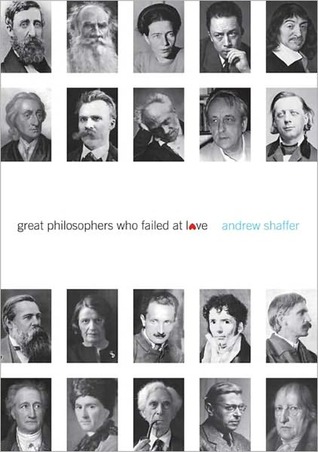
[READ: June 5, 2011] Great Philosophers Who Failed at Love

Shaffer was signing books at BEA this year.  My coworker told me that he was very funny and that he signed her book in an amusing way.  He happened to be signing at the table next to the line I was on. Sadly, he finished before I was able to get to him.  But I was pretty close to the beginning of the line, so I asked if I could grab a copy of his book, which I did (although no autograph for me).

This is a silly book of nonfiction.  It looks at thirty-seven philosopher or thinkers and their utter failure at love.  Each man (and occasional woman) has had some distinguishing characteristic that made them pretty lousy in the emotional range.

The title of the book is funny and is meant to be kind of surprising: these smart folks were terrible at love.  Of course, spending a minute or two thinking about who these people were and what they did, it’s not surprising that they were lousy at love.  These were intellectuals, people who spend most of their time in their own mind.  Of course they couldn’t have a serious relationship.

Nevertheless, these stories are all more or less amusing (Louis Althusser accidentally strangled his wife to death(!) which isn’t amusing per se, but the story of it is, kind of).  Shaffer does a great job at keeping each entry brief but really retaining the salient points of the thinker’s philosophy and a cogent example of his or her lousiness at love.  He also throws in some amusingly snarky comments of his own as he goes along.

I was delighted that the book order was done alphabetically rather than chronologically.  A chronological list would have been a little too samey in terms of each person’s context.  The alphabetical list allows for jumping around from say Plato to Ayn Rand which keeps the stories interesting and fresh.

At the end of each person’s piece, there’s an “In His Own Words” which offers a quote that details his or her written philosophy regarding love.

Dare I say that this is an ideal bathroom book?   It certainly is. And it makes you feel a little better about yourself (if you haven’t for instance, adopted your mistress as your daughter (Sartre)).

Read Full Post »

SOUNDTRACK: THE TRAGICALLY HIP-Live from the Vault-Volume 4 (2009).

Faithful reader will recall that this disc got trapped in my car’s CD changer.  When I had it the player replaced, they sent the old one back to mysterious Toyota offices far away.  And, about a month or so after sending it out, I received a package from Toyota with my three lost discs (this one, a Black Sabbath disc and, a promo disc I took from the library to try and wedge into the player to get it to eject the other discs (that doesn’t work, by the way) which was, embarrassingly, Ozzy & Kelly Osbourne doing a duet of something or other).

Thank you random Toyota person for keeping this disc, which is not easily replaced, in good condition.

So this concert is from 1994 and was recorded in Brussels on the Day for Night Tour.  I think many fans feel that this is a high point in The Hip’s recording career, and this concert attests to it.  The band sounds fantastic, energetic and really tight.  And the music from this era is just great: dynamic and dramatic.

This disc also adds to speculation that lead singer Gord Downie is a weird guy.  His between song banter is quite peculiar, to say the least (apropos of nothing: “Do you think of your pet as a pet or a member of the family?”).  Which also leads me to wonder if fans in non-English speaking countries (and yes, I know that many people in Brussels do speak English) think or care or even mind when lead singers babble in English to them.  Just curious.

I don’t have any other Vault discs from The Hip, but this one is certainly great.

[READ: During an ∞ of minutes during December 2009 & January 2010] Everything and More

As part of my pledge to read all of DFW’s works, I skipped the fiction and moved straight to this.  I hadn’t heard all that much about this book, except that it was pretty dense.  And, yup it is.

I’m going to give a comparison for any other DFW fans who are thinking about reading this.  If you have read Infinite Jest (and if you’re interested in DFW you should certainly read that before this book), and if you recall Endnote 123: Pemulis’ high tech math formula for calculating Mean Value w/r/t Eschaton, then you will have a fair idea of what you’re in for with Everything and More.  So, if your eyes glazed when you started to read that endnote, you’ll likely want to skip this book altogether.  However, if you plugged through with that endnote and you didn’t care that you didn’t get it, but you kind of enjoyed it because despite the math, it is very funny, well, then you might enjoy this book too.

If you’re a hard core math dude and you understand what things like: ∃ and ∈ and ∉ and ∏ and ℜ and even ∀ then you’ll have no problem with this book.

But math aside, there’s a lot of funny things in this book.  And DFW is in full conversational tone, with several places where he says things like “not sure if this has been mentioned in the book yet” implying that he never proofread the thing, which we know he did.  There’s even a funny observation as to the placement of a picture (“it’s not entirely clear to me why they put [this pencil sketch] here”).  There’s also tons of footnotes.  And most of them are labeled IYI (meaning If You’re Interested), and he totally lets you off the hook if you don’t feel compelled to read these.  Although as with most things DFW does, the footnotes are always tons of fun.

He also shows his great undying affection for his math professor, Dr. Goris (Dr. G).  He quotes liberally from Dr G’s classes, citing examples, funny quotes and the amusing joke that Irrational Numbers are called ‘surds.  There’s also great joke about schnitt (which I’ll explain later).  It even opens with a hilarious (or maybe not) section about the inability to get out of bed in the morning when you think about infinity.

As in for example in the early morning, especially if you wake up slightly before your alarm goes off, when it can suddenly and for no reason occur to you that you’ve been getting out of bed every morning without the slightest doubt that the floor would support you. Lying there now considering the matter, it appears at least theoretically possible that some flaw in the floor’s construction or its molecular integrity could make it buckle, or that even some aberrant bit of quantum flux or something could cause you to melt right through. Meaning it doesn’t seem logically impossible or anything. It’s not like you’re actually scared that the floor might give way in a moment when you really do get out of bed. It’s just that certain moods and lines of thinking are more abstract, not just focused on whatever needs or obligations you’re going to get out of bed to attend to.

And but so, what is this thing about?

Okay, so it’s about ∞ and the history of ∞.  It begins with a great section about the ancient Greeks (Zeno’s Paradox and all that) and slowly moves up through to Aristotle.  I myself have always been a Platonist (yes, in fact, I have made that distinction in my life, which may say more about me than many people know), and have always been kind of anti-Aristotle.  And, for the purposes of this book, that’s a great position to take.  Aristotle turns out to be like the arch-nemesis of ∞. (more…)

Read Full Post »

walrus 99 SOUNDTRACK: DEATH CAB FOR CUTE: Narrow Stairs EP (2009).

This EP follows the release of Narrow Stairs and is sort of a collection of outtakes from that session.  And the impressive thing is that these are the outtakes. There are four original songs and one demo version of a track from Narrow Stairs.

All of the originals are what you’ve come to expect from recent Death Cab: catchy, somewhat somber and yet strangely uplifting tunes. The demo track is “Talking Bird” with just Ben Gibbard and a ukulele, although frankly it is the most well produced, “biggest” sounding ukulele I have ever heard.  If you’re a fan of DCFC, you won’t be disappointed by this disc.  If you’re not too familiar, this is a pretty good place to start as it is a cheaper EP (although really, the full-lengths are the place to go).  

Basically, you can’t go wrong with this disc.

[READ: August 21, 2009] “On the Plains of Abraham”

If I had a bit more Canadian history knowledge, I would know this battle (one of Canada’s Greatest), well, at all.

This piece is a historical recreation of The Battle of the Plains of Abraham (or the Battle of Québec) from one soldier’s point of view.  The Canadian Encyclopedia states:

A powerful British force under Major-General James WOLFE and Vice-Admiral Charles Saunders was sent up the St Lawrence to capture Québec. The French, commanded by Lieutenant-General the Marquis de MONTCALM, at first held the British at bay….  Québec surrendered on September 18. A French attack early in 1760 failed to recover the city, and later in the year the British captured Montréal and NEW FRANCE fell.

The fascinating thing about this “story” is that Humphries chooses a soldier from the losing side.  (more…)

Read Full Post »

ny1It took me going to Seattle to learn about The New Yorker magazine.  I was visiting my friend Rob and he was really surprised that I didn’t read the magazine all the time (my reading always seems to surprise people, see The Believer.)

Upon my first read of the magazine, I was surprised to see that the first twenty pages or so are taken up with upcoming shows: films, concerts, sports, everything.  I actually wondered how much content would be left after all that small print.

Since then I have learned that Sasha Frere-Jones writes columns in here quite ofuiten.  For reasons known only to my head, I was convinced that Sasha was a black woman.  Little did I realize that he is not.  And that he was in a band that I have a CD of called Ui.  He is an excellent resource for all things music, whether I like the artist he’s talking about or not.  Some entries are here.  This audio entry about Auto-Tune is simply fantastic.

But of course, there’s a lot of content.  And the first thing you get are letters.  I don’t think I have EVER looked at the letters section. (more…)

Read Full Post »

believerA few years ago I was visiting my friend Roman.  He asked me if I read The Believer.  I told him I hadn’t heard of it.  He silently reproved me, knowing that it would be right up my alley and being quite displeased that I wasn’t keeping up with the hip.  I was very impressed with what I saw.

The Believer is put out through McSweeney’s.  It seems to have filled in for the non-fiction niche that McSweeney’s slowly removed from its pages.

And since then, I have become a devoted follower.  At some point (probably around issue ten or eleven) I decided that I was going to read every word in every issue.  And so, (this was pre-kids) when I went to an ALA conference with Sarah, I spent a lot of the down time reading all of the back issues’ articles that I hadn’t read.

Since then, I have read every issue cover to cover.  The thing that I love about the magazine (in addition to all of the stuff that I would normally like about it) is that every article is so well written that even if I don’t care about the subject, I know I’ll be interested for the duration of the piece.  Whether or not I will go on to read anything else about the person or topic is neither here nor there, but when I’m in the moment I’m really hooked. (more…)

Read Full Post »

tristramshandy2SOUNDTRACK: PEARL JAM-Binaural (2000).

binauraBinaural bursts forth with the rampaging “Breakerfall” and “God’s Dice.”  The latter pauses only briefly for a chorus break.  They are followed by “Evacuation,” a song that sounds a bit off kilter in this studio version but which blasts off on the live version. It’s got a great shouty chorus too.

“Light Years” is another wonderfully singalongable PJ track. The verses are delicate and, while the choruses don’t build, they are still very catchy.  “Nothing as It Seems” is a haunting track that is dark and fantastic.  The opening guitar riff sounds like it’s coming from the middle of a desert, and the rest of the song is great and great sounding too.  “Thin Air” is another mid- tempo song that doesn’t wear out its welcome, and is fun to sing along to as well.

“Insignificance” is one of the great stop/start songs in PJ’s history. The staggered guitar work builds and stops, builds and stops and just gets better as it goes along.  “Of the Girl” is one of those moody pieces that on previous discs sounded kind of throwaway, and yet this song has enough interesting nooks in it that it never gets dull.  It doesn’t really ever bust out into big chorus, but the subtle changes are just as powerful.  “Grievance” is also fantastic. Another staggered type of song with powerful lyrics and rocking verses and choruses. And when played live, this song is a behemoth.

“Rival” is one of those weird little songs that PJ throws in.  An experiment that works more than some of t heir others.  Followed by “Sleight of Hand” one of their more impressive ballads.  Even though the chorus isn’t dramatically different, it’s still very powerful. “Parting Ways” is one of their best album enders in a long time. It’s another slow one, yet it doesn’t meander. There’s some nice guitar interplay that keeps the song interesting.

And then there’s “Soon Forget” a little number played on a ukulele.  For another band this would be a gimmick yet Eddie’s sincerity pulls it off quite nicely. There’s also a hidden track at the end (evidently called “Writer’s Block”) which is the sound of a typewriter typing.

This was the disc that got me back into Pearl Jam, and it really is a great album. Most of their first barrage of live discs came from this tour, which may explain why I like these songs so much (I heard them all about 70 times, right?), but it’s a great place to start for latter-day Pearl Jam.

[READ: April 2007] The Life and Opinions of Tristram Shandy, Gentleman

I read this book a long time ago, in college, based on the recommendation of my friend Gene.  I really enjoyed it and found it quite funny.  Then, last year, I watched Tristram Shandy: A Cock and Bull Story, which is sort of a film adaptation of Tristram Shandy.  A post about this movie could be just as long as the movie itself, but the short version is that the hilarious Steve Coogan is an actor in a production of the film of Tristram Shandy.  As they are filming Tristram Shandy, the camera follows Coogan, the actor, as his neuroses get the better of him in both his professional and personal life.  This Coogan stuff has absolutely nothing to do with the book, making the whole proceeding weird and wonderful. (more…)

Read Full Post »

« Newer Posts