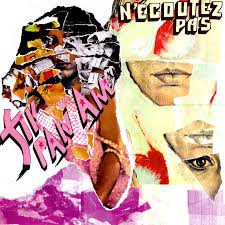
 SOUNDTRACK: LE FLY PAN AM: N’écoutez pas [CST031] (2004).
 N’écoutez pas (Do Not Listen) was the third and final full length album from Constellation’s Fly Pan Am (or in this case Le Fly Pan Am). There are several short tracks on the disc as well as two 11 minutes songs
“Brûlez suivant, suivante!” (Burn Next, Next!) Opens the disc and hints that it’s going to be a standard rock album—4×4 drums and a dense buzzy electric guitar. And even when the song proper starts, there’s chanted worded in French and some noisy guitar—its very far from the bass and funky glitchy stuff of previous albums. The song has very conventional element—a drum break where one might clap along and what sounds like people singing lalalalalala, but all under a veneer of noise and decay that makes it anything but poppy. There’s a deep voice speaking insistently in French and way in the background a person screaming. So, really it’s rather unconventional, but within a relatively “normal” framework. “Ex éleveurs de renards argentés” (Ex breeders silver foxes) is the noise of completely detuned guitars getting plucked and strummed for 30 seconds until a piano plays a chord and all else stops. It seems like a song will begin but, no, more noises—industrial waves and cars honking takes over. And then a cacophony of voices begins talking all over each other (including a couple in English). It’s all over after about 2 minutes.
“Autant zig-zag” (As much zig-zag) is a totally apt name for this song. This is the first 11 minute track. After a minute or so introduction, the song comes in with a propulsive bass (not funky at all like the last album) and the song feels like it’s ready to rock. And it does. It keeps up this rhythm for a bit and then shifts to a new part with wordless vocals. There’s even a call and response section with sung words and ooh ooohs as response. The song shifts to a kind of pummeling section that continues for several minutes until the end. It contains pretty much everything the band does. “Buvez nos larmes de métal” (Drink our metal tears) is a noise collage with dramatic movie soundtrack type music played behind the static and distant voices and noises.
“Pas à pas step until” (Step by Step until) has a commanding one, two, three, pause, four, riff going on that is at once catchy and noisy. The song proper comes in with whispered singing and a wild bass line. Alexandre St-Onge contributes his wonderful chaos to this song which has some really catchy backing vocals in it
“…” opens side two with what sounds like a voice repeating Fly Pan Am over an over amidst the sound of someone else chewing. It segues into “Très très ‘retro'” “Very Very ‘Retro’” is the other 11 minute song. It has two guests, Dominique Petrin on vocals and Tim Heck on electronics. The song opens with a high-pitched bass and some great counterpoint rhythms. There’s more hidden vocals throughout the song Around three minutes in, the bass gets funky. This runs on for several minutes with some interesting sound effects thrown in until there’s a loud pop and silence. And then another pop and organ music takes over. At about 9 minute the song resumes the funky bass line. Again, the band has crammed a lot of stuff into this song.
“Vos rêves revers” (Your dreams setback) has a nice bass sound with some ringing guitar notes. There’s whispered vocals that sing a melody of sorts. It’s a fairly conventional song—catchy and bouncy with vocals and everything (true they are whispered and hushed vocals but they do follow a melody line). At about 4 minutes (of 6), the songs crashes unto itself with the drums and the guitars seeming to fall apart
“Ce sale désir éfilé qui sortant de ma bouche” (This dirty tapered desire coming out of my mouth) has a deep echoing drum kick which keeps a beat. In the distant background a keening voice kind of follows the melody. The disc ends with “Le faux pas aimer vous souhaite d’être follement ami” (The false not love you madly want to be friend). It’s a one minute song with sliding guitars and rock drums which propel this to as close to punk as the band has gotten. There’s chanting and excitement and fun and then the whole song unravels after about 40 seconds at the end with a sloppy piano denouement.
And that was it from this avant-garde band. The members went on to make lots of other music, Jonathan Parant went on to form Feu Thérèse. Felix Morel has played drums with all kind of interesting bands including Et Sans. Roger Tellier-Craig has been in Et Sans and Set Fire to Flames among others. And Jean-Sebastian Truchy has played in several bands including Avec le soleil sortant de sa bouche.
[READ: February 6, 2016] City of Clowns
In the afterword to this book, Alarcón explains how it as written. He lived in Lima, Peru for a year, teaching. But while he was there, he had writer’s block. So he moved to a farmhouse in the middle of America–pure solitude. And there he wrote the story “City of Clowns” (which I read back in 2013 in the New Yorker) in English. Sheila Alvarado talked to him about turning the book into a graphic novel. And so it was completed (after much labor, he says) in a slightly condensed Spanish edition to be released in Spain. And then, eventually, it was translated into English again, from the Spanish graphic novel.
Since the story really doesn’t change from the short story version, I’m going to put my original comments here:
It opens with Oscarcito going to the hospital because his father died the night before. He finds his mother mopping floors because his father’s bill was unpaid. And in that very first paragraph, she introduces her son to Carmela—the woman whom his father left them for. She was mopping the floor with Oscarcito’s mother. He is confused and enraged by this.
His half brothers are also there. He had never met them before, preferring to stay away from his father’s other life. But he saw them in front of him and clearly saw that they were related to him. But the most galling thing was that although he was the oldest of all the children, they were clearly the chosen children—after all, his father stayed with them.
Then we learn about his father’s life. He was born in Cerro de Pasco and moved to Lima when his young family was still young. He worked hard in semi-legitimate businesses and then brought his family to the city. Young Oscarcito, age 8, loved it. But his mother hated missing her family in Cerro de Pasco. And now they were living with his father who was practically a stranger. His father worked hard and succeeded, but he was rarely home.
Between flashbacks to his father’s story we see that Oscarcito is now a reporter for the local newspaper and he has been asked to write about the clowns that are prevalent around the city. Oscarcito is on a bus when a clown approaches. The clown is pelted by water balloons but still manages to climb aboard the bus and peddle his wares—gaining a few coins for his “act.” Oscarcito is not interested in the subject and puts it off.
So he travels to his mother’s house to see how she is doing, but a neighbor there tells him she has been living with Carmela since his father got sick. His mother was embarrassed by this and asked the neighbor not to say anything to him.
His mother had been a cleaning lady since they moved to Lima. She worked for the Azcártes, a wealthy local family who treated her very well and treated Oscarcito practically like their own son. Oscar was even sent to a nice school where he was welcomed until they realized where he was from. Gangs would steal anything from anyone, and were called Piranhas. And that became Oscar’s nickname at school. And soon he was made fun of by just about everyone, but especially by one boy.
A flashback then shows that Oscarcito went to work with his father doing construction on a few occasions—they worked very hard on expansions of people’s houses—working hard and working well and making good improvements. But all the while, they were waiting patiently until they could rob them of all of their fine things.
So when he found his father was working for the father of the boy who made fun of him, he wanted in, and he stole the boy’s suit.
Finally, after putting off his article for ages, Oscarcito meets and interviews a clown. And that clown tells him how he started and invites him along. And Oscarcito does. He finds that he likes the anonymity of the job.
All of the threads come to a head as the story reaches its close—where Oscar will confront his mother and deal with his newfound joy at being a clown.
The ending was very powerful and I enjoyed this story immensely.
There are few details from the original story that have been changed (and I amended my comments accordingly).
There is also an extra scene added of him dating a girl named Carla who walked on stilts. There’s an erotic moment which is really interesting and which brings a whole new level of fascination to Oscar’s clown life.
Obviously the biggest change is Alvarado’s illustrations. She does an excellent job recreating these scenes much as I imagined them. I really enjoyed the way she worked within the mens’ professions–putting words on bricks as his father was laying them, hanging papers up to dry with text on them, and using excellent distinctions of black and white to show the different settings in Oscar’s life.
The biggest change I think is the depiction of Oscar in his clown suit. It’s nothing like I imagined and is all the better for it. Alarcón says that now this is “its true and definitive form” of the book, and I imagine that this is what I will think of when I think of the story.
For ease of searching, I include: Daniel Alarcon.
Read Full Post »
 As of this summer I didn’t know who Umphrey’s McGee were. I assumed they were a country band or something. Then I found out a friend of mine who was at the Phish show that I went to was a huge fan of Umphrey’s McGee too. She said that they were amazing live. I listened to some of their stuff (and learned that their debut was called Greatest Hits Volume III, which I love), and then saw that they were playing three nights at The Fillmore in Philadelphia. So I got a ticket for the middle night to see what the story was.

















 I Just Read About That...