Feeds:
Posts
Comments

wild thingsSOUNDTRACK: FANTÔMAS-Suspended Animation (2005).

fantomasIf you know Fantômas, then you know what you’re in for.  If you don’t, well, it’s a surprise!

Fantômas are the brain child of Mike Patton (Mr Bungle-era more than Faith No More with help from Buzz Osborne from The Melvins and Dave Lombardo from Slayer).  Suspended Animation is designed as a soundtrack to April, 2005.  There are thirty tracks, and each one corresponds to a calendar page.  The limited edition (which is apparently still in print as I got one last month) is a calendar with art by Yoshitomo Nara.  Nara’s work combines cuteness and menace, just like the CD.

A piece by Nara

A piece by Nara

Although, really the CD is more menace than cute.

This disc seems to combine Patton’s favorite things: cartoon music (many ‘toons are sampled here), death metal, short sharp blasts of noise and his fascinating vocal deliveries.

This write-up makes the disc sound very intriguing, but before you rush out to check it out, do know what you’re in for: short, noisy blasts of utter chaos.  It is not for the weak of heart or the queasy of stomach (or for the lover of melody).  It’s not even a case of , oh the songs are short, the next one will come along soon.  While there is diversity, it’s diverse within it’s own little world.  Of noise!

Be afraid.  But if you’re still interested after that caveat, then by all means check it out, if only for the calendar!

[READ: August 23, 2009] Where the Wild Things Are/”Max at Sea”

Because of Dave Egger’s story “Max at Sea” (which is basically a retelling of Where the Wild Things Are I felt I needed to re-read the original.  So thank you Dave Eggers for that.

The original is a fun story which seems to be more visually based than word based.  The drawings are sublime and indeed there are several pgaes with no words at all.  And, so, the filmmakers’ question remains: how to you make a film out of a 48-page book, many of which don’t even have words?  Stills from the movie do look pretty awesome.

And thus, Dave Eggers’ story was born.

I’m not actually going to reveiw Where the Wild Things Are, because, well, it’s a classic, and it’s  awesome.  What more can I say about it?  But I did want to reevaluate Egger’s piece having re-read Sendak’s.

It is quite clear that Eggers is in no way trying to re-write the story.  He has fleshed out a lot of details that are absent from the original (which the original in now way needs, but again, if you’re going to make a film, you need some kind of backstory). Continue Reading »

ij9SOUNDTRACK: SONIC YOUTH: A Thousand Leaves (1998).

1000This CD actually ties to the book because the crossed out title on the CD is “mille feuille” and the first song is called “Contre le Sexism.”

This opening song is weird and lets you know that this disc is not going to be a friendly listen.  Over some feedback and scratchy noise, Kim whispers and hollers, most notably that “it’s just a kitten.”  But just when you think that the disc is going to be a crazy noise experiment, the next track “Sunday” proves to be another one of Thurston’s supremely catchy singles.

The back and forth continues with Kim’s abrasive “Female Mechanic Now on Duty” and Thurston’s delicate “Wildflower Soul.”  But the pattern is broken with Lee’s spoken-word over simple guitar lines piece, “Hoarfrost.”  It lacks Lee’s usual catchiness, although his later song “Karen Koltrane” more than makes up for it.  Then Kim surprises us by giving us the catchy “French Tickler.”

To me, “Hits of Sunshine” is the centerpiece (literally and metaphorically) of the disc.  It’s 11 minutes long and ranges through the main stylistic feelings of the disc.

The whole disc is over 70 minutes long and it feels meandering.  This is not to say that it has no focus, it’s just not full of pop gems.  And yet for all of its wandering, it hasn’t lost the tunes.  Mixed reviews abound for this disc with everything from 1 to 4 stars coming from the pros.  And, I think depending on my mood, my overall rating could be just as diverse.

I admit that at the time I was starting to lose my adoration for the band.  These longer, more abstract pieces were less enticing than the noise of yore.  But now that I’m a bit older, I can appreciate what they were doing.

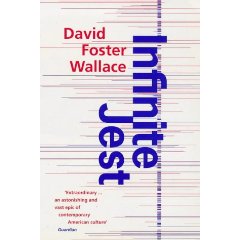
[READ: Week of August 17] Infinite Jest (to page 651)

I was planning on starting this week’s write up with a bit about J.O.I’s filmography, which I delved back into and found some fascinating information.  But this week’s write up is pretty long already, so I’m going to do a mid-week (but still spoiler line approved) retrurn to the filmography shortly.

So until then, let’s get back to the book:

This week’s reading gets off to some detailed viewing of the Incandenza men’s psyches before launching into an adrenaline fueled rush.

Mario is still freaked out about Madame Psychosis not being on the air.  He’s not sleeping well at all, and when the insomnia hits him, he goes for walks (even though he knows, and is worried about, how much it freaks out the Moms).

Mario is slowly turning into the absolute heart of the book.  He absolutely and without question loves Hal, and he is concerned for him because he’s been acting differently lately (Mario himself never changes).  He also prays nightly, and in a serious way, talks to God (although he doesn’t expect any one to answer…he’s not crazy).  And, in a very touching scene, which seems to resonate so well with late 1990s America, he is troubled that no one can talk about things sincerely without it being ironic.  (Pemulis wants to set up a prayer hotline for atheists that would just ring and ring). Continue Reading »

scott2SOUNDTRACK: SONIC YOUTH-SYR 2: Slaapkamers Met Slagroom (1997).

syr2The second SYR release is like the other side of the coin from SYR1.  The premise is the same, the players are the same, but the result is rather different.

The first track is nearly as long as the previous disc (17 + minutes) and it seems to run through a variety of song styles (including noise experiments) before settling down into a noisy improv.  The third track features the first “vocals” on these discs–rather unsettling sounds that Kim spits out.  (Online lyrics pages say that there are actual words here so I’ll take their word for it; I just like to think of them as vocal stylings).

While SYR1 was a smoother listen, this one is more jagged.  Not quite the noisefest they are capable of but not exactly easy listening either.

For this disc all of the titles, liner notes etc. are in Dutch.  (SYR1 was in French).  Each volume in the series is in a different language.

[READ: August 9, 2009] Scott Pilgrim Vs The World

The second volume of the series, (and the one the film is named after) continues the exciting saga of Scott Pilgrim and his band Sex Bob-omb.

This second volume introduces us to The Clash at Demonhead, the band that Scott’s ex-girlfriend took to stardom, after they kicked Scott out of the band, of course.

But before we get to the Knives Chu’s new favorite band,we learn about the origins of her former favorite band: Sex Bob-omb.  We see how Scott and Kim first met and why she acts so strangely around him.

But more importantly, plotwise, we get to meet Ramona’s second evil ex-boyfriend, Lucas Lee.  He is a broody actor who also just happens to be in Toronto filming a new picture.  And fight they do.

But they’re not the only ones who do battle in this volume.  There’s a rip-roaring battle scene between Knives and Ramona that takes place in the beautiful Toronto Reference Library.

But the book is more than fighting and music: there’s a cooking lesson for making vegan shepherd’s pie.  Veganism will loom large in Vol 3!   And there’s even more fun asides (with captions and comments about various characters) in this volume.  I especially enjoyed the ones that give the characters’ states of mind.

While the first volume was certainly fun, it feels like he is having even more fun with volume two.  It’s a very fun series, and the books are very fast reads (for better or worse…often worse.)

pilgrimSOUNDTRACK: SONIC YOUTH -SYR 1 Anagrama (1997).

syr1

After Washing Machine, Sonic Youth began recording a series of EPs (that gradually grew into longer discs) in which they explored their improvisation/longer piece needs.

And so SYR1 was released.

It contains for tracks and runs about 25 minute.  It’s not simply guitar feedback or waves of distortion.  Rather it is songs built around themes which are followed to their logical ends.

Thee EPs aren’t for everyone. There’s no lyrics, there’s no choruses.  It’s sort of like how the end of “The Diamond Sea” was a chance for SY to let loose and see what happened. I can’t even say that the songs and motifs are necessarily memorable (although I’m led to believe that some have cropped up on the proper albums).  I don’t listen to these a lot, but they are fun to put on from time to time, if you’re in an avant garde mood.

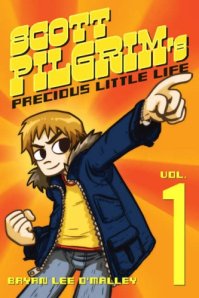
[READ August 9, 2009] Scott Pilgrim’s Precious Little Life

I had read this book a few years ago.  But I had read it in bits and pieces over several weeks, and so I didn’t feel like I had a real grasp of the story.  This is especially true because the story begins simply enough and then turns into a wild hallucinogenic story that is very funny, very very funny, in fact, but also incredibly surreal.

When I was at BEA in New York this year I ran into the guy from Oni Press who told me that they are making a film of Scott Pilgrim, which is pretty fantastic.  I’m rather looking forward to seeing it.  But because there are so many interesting visual things going on in th graphic novel, I can’t help but wonder how they will transform them.  And also, Book 6 of this series may be written with a different ending from the film, so that should be fun, too.

But speaking of the visuals….

O’Malley’s style is utterly fascinating.  When I first started reading, I felt like the artwork was “sloppy” in that sort of stylized sloppiness that people take some time to achieve.  (I think mostly this is because of the character’s eyes.  They are a refined sort of manga but the pupils are so large that i found it disconcerting.)  But when reading it through this time, I realized not only is it not sloppy, it is meticulously designed in a very cool way.  Take Scott’s hair, which is commented about through the series.  I’m not going to go and spout on about how long he must have spent getting his hair just right, but clearly there was effort and planning in the length and style, even if it is primarily drawn with a  few broad triangles. Continue Reading »

nyorkerSOUNDTRACK: SONIC YOUTH-TV Shit (1993).

tvshitThis is a funny little addition to the SY catalog. It is essentially four covers of a song by Youth Brigade called “No Song II” (which is from Dischord records, Possible EP here).

The original song is one second long, with the band shouting “No”

So, covers of it are obviously absurd.  There are 4 tracks in total on the disc, the last two are each over three minutes long (!)

The band is in full noise/freak out ensemble, complete with maniacal screamer/lunatic  Yamatsuka Eye from the Boredoms (and elsewhere).

Obviously it’s a bit of fun, and little more. It’s only for super-die-hard fans or anyone who might like the Boredoms-style of noise rock.

[READ, August 18, 2009] “Max at Sea”

Since I just finished Eggers’ How We Are Hungry, I was delighted to find a new story by him in the New Yorker. The picture next to it looks like a still from the upcoming film of Where the Wild Things Are (Eggers cowrote the screenplay). So, when the story started and Max put on a bear costume, I thought, huh, that seems very familiar.

As the story progressed, well, it seemed really really familiar. Now, I admit I don’t know Where the Wild Things Are by heart, but I sure recognized a lot of it. And then I confirmed with Sarah that indeed, this short story IS the story of Where the Wild Things Are. Eggers has fleshed it out (presumably for the screenplay) and added some details and things, but the whole plot of the story is Maurice Sendak’s.

And I’m not sure how I feel about releasing it as a short story. It is acknowledged in the Eggers bio in the front of the magazine that it does come from Sendak’s work, but somehow it seems wrong to take up a fiction spot in the New Yorker (that most venerable of fiction locations) with a story that is a retelling of someone else’s story. Continue Reading »

eggersSOUNDTRACK: SONIC YOUTH-Washing Machine (1995).

washingAfter the short blasts and diverse collection fo songs on Experimental Jet Set Trash and No Star, Washing Machine sounds like almost a different band. For although there are a few shorter pieces here, they also give us the 9 minute title track and the, brace yourself, almost 20 minute “The Diamond Sea.”

Perhaps the most amazing thing about “The Diamond Sea” is that the first 5 or so minutes are probably the catchiest song they’ve ever recorded.  It’s a gentle, meandering piece with great chord changes and some of Thurston’s most delicate singing to date.   There’s an edited version available which basically just lops off the last 12 or 13 minutes, but keeps the first chunk (including the controlled chaos of the feedback solo) intact.  Those last 13 minutes are where SY gets to open up and experiment.  It’s all sounds and washes and textures.  There very little in the way of feedback squalls, and yet it’s not  conventional song structure either.  It’s very cool.

The other lengthy song is “Washing Machine” one of their weirdest songs in recent memory with Kim going downtown to buy her”baby a soda-pop.”  She talks in a sort of New Yawk accent, exaggerated and almost silly as they discuss washing machines.  Actually, I take that back, their weirdest song (for Sonic Youth) is clearly “Little Trouble Girl” as it is a straight up tribute to/mockery of doo-wop songs (with main vocals done by the Pixies’ own Kim Deal).

Two Thurston songs, “Junkie’s Promise” and “No Queen Blues” give him some great lyrics done in a catchy fashion (even is “No Queen” revels in its own dissonance).

But none of the songs are “singles” per se.  Even the catchiest among them have portions that are designed to keep casual listeners at bay.  Although “Unwind,” another delicate song could easily meet the most sensitive listener’s needs.

But it’s “The Diamond Sea” that points the direction SY would be heading for in the next few years: longer, more abstract pieces.

[READ: August 8, 2009] How We Are Hungry

I really enjoyed Dave Eggers’ first book A Heartbreaking Work of Staggering Genius.  And, obviously, I’ve been a fan of McSweeney’s for years. So, why did it take me this long to read his collection of short stories?  I have no idea.

They were really fantastic.

But before getting to them, I want to address the look of this book.  I have often commented on the quality of the books that McSweeney’s publishes.  But it seems like especially for Egger’s books, they pull out all he stops (and, sure, he’s allowed, it is his company).  This book is beautiful.  It has an embossed leather (faux?) cover of a gryphon on it.  It also comes with a page ribbon and an elastic to keep it closed.  It truly is a beautiful book. Continue Reading »

ew2I’ve been reading Entertainment Weekly for years and years.  I think I subscribed back in like 1993 or so.  And I’ve always had a love/hate relationship with it.  I’ve canceled my subscription on a number of occasions, mostly because I believed that it didn’t cover enough of the indie stuff I enjoyed (which is still largely true).  But then I’d see an issue and realize that it is a fun magazine to flip through, so I’d re-subscribe.

Over the years, EW has morphed more and more.  And each change to the magazine makes me like it less.  And now in its current iteration, which happened about a year ago, I feel that they have removed all pretense to being a “smart” publication.  Although, at least they stopped including the bold line of text which presumably highlighted the best line of a review.  Evidently they thought we couldn’t ewread the entire half-a-column-length of an article.  But they removed that, and it’s back to simple reviews.

I’ve always been sort of iffy about their rating system (A through F).  It’s a simple guide, so it’s easy to see quickly whether they liked it or not, but as in school, it seems hard to pinpoint exactly what the difference is between say an A- and a B+.  But hey, that’s their thing, so it’s okay.

And as a sort of all-purpose guide to entertainment, it’s pretty useful.

The new design has largely changed the order of things in the magazine.  And so The Must List which used to be a small thing in the middle now opens the magazine as a full page extravaganza (highlighting in a nutshell what is wrong with this latest incarnation of the magazine–something that used to fill up a page at most is now a two page spread with bigger pictures!) Continue Reading »

ij8SOUNDTRACK: SONIC YOUTH-Experimental Jet Set, Trash & No Star (1994).

ejstns“Bull in the Heather” is one of my favorite Sonic Youth songs.  I love everything about it (even if I haven’t got a clue what it’s about): the simple opening, the switch to harmonics, and, my favorite part, the drum break that leads to the chorus (who ever heard of getting a drum break stuck in your head?).

There’s a lot to speak for this disc even though it seems to be overlooked (as the empty spot between Dirty and Washing Machine).  Take the absolute variety of textures, and the almost surreal mixtures of styles within (short) songs (like “Bone” which opens with super fast paced drumming and howls from Kim and then breaks into a very mellow (and catchy) chorus).

For sheer variety: the disc opens with an acoustic guitar strummer by Thurston (“Winner’s Blues”), and then, after the single “Bull in the Heather,” there’s the 2 minute noise-fest “Starfield Road.”  This is followed by the cool and catchy “Skink,” which is like Kim’s version of the slinky and cool “Self-Obsessed and Sexxee.”  This is definitely Kim’s disc, she sings about half of the songs, and shows a great variety of styles here.

“Androgynous Mind” is one of those weird songs that has a wonderfully catchy vocal line but where the music is pretty much abstract nonsense.  And speaking of catchy, this disc continues with SY’s notion of sing along choruses (even if what you’re singing doesn’t make a lot of sense (“Screaming Skull” fits that bill perfectly)).  And then “Quest for the Cup” does a 90 degree turn after the intro.  All of these shifts and changes occur in less than half an hour.

The last 20 minutes or so settle the disc down somewhat (except for the brief “In the Mind of the Bourgeois Reader,” but the 7 minute closer “Sweet Shine” ends the disc on a mellow note.

This is also the last SY disc produced by Butch Vig.  Vig’s production is often described as clean. But Vig doesn’t clean up the noise that SY makes, he just makes it, I guess, crisper would be a better word.  Compare the way that Garbage’s “Vow” opens with a big grand noise and then stops dead after a few seconds.  Vig seems to be a master of controlling noise to make it stand out more.  And in that respect, his technique really shines through on this disc…it feels almost mechanical in its precision.

From this point forward, Sonic Youth would break away from this style of music into a freer and looser almost jazz feel, so even if the album title doesn’t make literal sense, it describes the disc quite well.

[READ: Week of August 10] Infinite Jest (to page 589)

Last week, showed Gately’s car speeding through Cambridge.  He runs over a discarded cup which we follow as it sails down the street and hits the Antitoi’s door.  It was very cinematic.  Discussions abound about whether IJ could (or should) be filmed.  I’m not going to add to that discussion but I did want to mention what I see as the filmic way the book written.

In many movies you are introduced almost casually to many of the protagonists, seeing them in their most typical place of employment or hang-out spot or some such thing.  And in films, it doesn’t seem that weird to get a two minute or even 30 second establishing shot of character A before jump cutting to character B.

And that’s how IJ starts, with all of these jump cuts, establishing shots, of characters.  Clenette’s scene is hard to read, but if you saw it in a movie, you’d say, okay that’s her character.  And, for the most part you would expect her to reappear later in the movie. I’m not sure what anyone expects to happen in IJ, so who knows what we think the Clenette scene is about, but realistically, the character has to come back, even if what she said didn’t make any sense at the time.

And as movies go, so does the book, cutting back and forth between scenes building the stories along as they inevitably intertwine.

It’s also not unheard of to have what seems like it may be the end of the chronological story appear first (we haven’t seen any return to the Year of Glad yet).

And so, yes I will say a thing about the filmic possibilities of  this book.  Sure the book is long, and yet so much of the book is description, stuff that in a movie can be done with an establishing shot, even a slow one.  The whole Joelle/overdose scene which covers so many pages could be filmed rather quickly.  So could Eschaton. The question of course is how much would be lost in translation.  And that I can’t answer (although I expect quite a lot).

Be a hell of a film, though.

ijdot

So, in a few places, especially on Infinite Tasks, people have been mentioning some crucial information that happens on Page 17.   I felt bad that I didn’t recall anything that happened on page 17, so I went back and re-read this section (and how weird is it to re-read parts of a book that you haven’t even finished yet?)

And so Page 17 feels like a major spoiler!  It feels like so much is given away!  It feels like such an essential part of the story that it’s amazing how it’s sort of tossed off in a hallucinatory sequence.

I think of John N.R. Wayne who would have won this year’s WhataBurger, standing watch in a mask as Donald Gately and I dig up my father’s head.  There’s very little doubt that Wayne would have won.

Wow.  So much packed into those two sentences!  Holy cow.

And, the end of that sequence has an orderly ask Hal, “so, yo, then man what’s your story?”

Is that the device that sets up that Hal is telling this whole book?  I just blew my mind.

ijdot

This week’s reading begins with the aftermath of The Escahton debacle.  Or the precursor to the aftermath, anyway.  And it features the color blue. A lot.

It also gets to a question I’ve been puzzling about for sometime: why isclouds every IJ book jacket/promotional material designed in a sort of cloud motif. Well, in the section we lean that Uncle Charles’ office is decked out in an unsettling cloud wallpaper (which is coincidentally the same wallpaper as Hal’s dentist).  It has only appeared briefly so far, so it seems odd that it would take on such an iconic feel.  But we’ll see if it comes back.

Continue Reading »

nySOUNDTRACK: SONIC YOUTH-Dirty (1991).

dirtyI think of Dirty as a pretty commercial album.  I mean, it’s got Butch Vig as a producer for crying out loud.  And, it has three singles released from it.

The lead off track “100%,” and track three “Theresa’s Sound World” are as catchy as anything.

And of course, Lee’s “Wish Fulfillment” is just an amazing track, and is certainly a nod to a more poppy sound.  But it is “Sugar Kane” that strikes me as their most commercial attempt yet. Of course, saying all this, one must remember that Daydream Nation & even Sister had tracks that were short and catchy.  Dirty almost feels like a condensation of that sound.

“Orange Rolls, Angel’s Spit” is one of those songs that mixes catchy sections and utter noise so successfully.  And “Youth Aginst Fascism” has a wonderfully catchy vocal line but it is backed by the squeakiest most unmusical guitars on the record (and has the memorable “I Believe Anita Hill” line).

But despite all that, there’s also two completely un-Sonic Youth songs on the disc: “Nic Fit” is a one minute hardcore punk blast while “Creme Brulee” is a solo guitar (a sort of out-of-tune, cheapo amp effect) strumalong sung by Kim.  Kim also gets “Drunken Butterfly” which is certainly not easy listening, (although the mocking of The Door’s lyrics is pretty funny).  And “Shoot,” which is one of Kim’s menacing spoken-wordish pieces that changes the overall temperament of the disc.

But, yea, there’s no denying that this is a commercial album. It features some of their catchiest and easiest-listening tracks.  And yet, the disc is certainly done on SY’s terms.  For even if they did make it onto the Billboard charts (#83), they certainly never got played on Top 40 radio.

[READ: August 6, 2009] “War Dances”

I wasn’t sure if I was going to read this short story or not.  But then this story is broken down into multiple small sections and the heading on the first was My Kafka Baggage. Now, I like Kafka, but Kafka can also be an “lazy” indicator for “weird stuff ahead”.   Nevertheless, I read the opening and I was intrigued. By the end of that section I was hooked.

And even though I felt the second section wrapped up things really nicely (it wraps up a story about the narrator’s father, but not the whole story itself), I pressed on.

All of this sounds like it’s not a strong vote of confidence for this story, but that’s far from the truth. The story was fantastic. I couldn’t get enough right up until the end, which was very satisfying.

The story concerns a forty year old Native American Indian guy. He has two kids and his wife is away in Rome on vacation. When his kids start clamoring for food, he realizes that he can’t hear them very well.  And sure enough, when he goes to the doctor, his hearing has suddenly dropped to about 30% of his normal ability. Continue Reading »

[WATCHED: August-October 2009] Clash of the Gods

clash

[UPDATE: October 26, 2009]

I have now finished the entire series.  I was pleasantly surprised by how much I learned from it.  (Not that I considered myself an expert, but you never know what you’ll get from TV series). The biggest surprise was how much this series filled in the gaps of things I half knew, or things that I didn’t know were missing from my knowledge.  Can’t ask for more than that!

I’m still a little confused by the inclusion of Tolkien, but that’s okay, it was a good episode nonetheless.

General negatives: I never did get used to the egregiously repetitive imagery (if I never see Zeus pulling off his hood again, I’ll be thrilled).  I also got rather tired of that crazy howling wind/scream noise that they used as some kind of dramatic effect.  But hey, that’s okay.

The actors and the CGI and all that was fine.  They had to include some kind of footage or else it would just be people talking to us, right?  I wonder where they got the actors?  The women were all quite beautiful. The men were less handsome than I would have expected (but then the male gods were all old, right?).  How did they cast these episodes, I wonder?  Okay Zeus: can you sit in that throne?  Good.  Can you remove your hood? Good. Athena: Can you stare smoldering at the camera?  Good.  I wonder how people tried out for the part of “soul writhing in hell” or whatever it was.

I’m not sure if the “that was the myth, but how does it relate to reality” part was supposed to be the real draw of the show.  Some of it was interesting, some of it was weird, and some of it was just stretching plausibility.  There’s been a lot if discussions below in the comments about the emphasis on Christianity throughout the series.  From a historical point of view I thought it was interesting.  Although there were time when I wasn’t entirely convinced.

It was the professors who really impressed me.  They were consistently informative, and clearly enjoyed what they were talking about.  There were one or two who I would NEVER have wanted in class (their voices were rather sharp) but there were also a few that I would have signed up for multiple times, no question. So thanks to them for doing the show (I know, it was a real drag for them to get out of the classroom and do TV, right).

I’m still trying to find more information about the people involved, but it is cleverly hidden (as is everything else about the show).  What is it with The History Channel’s website?  This is the only professor who I’ve found with a blog: Wormtalk and Slugspeak.  And he tells some interesting details about doing the show.  As for the rest, well, you’ll have to watch the episode and write down their names, apparently.

I’ll give a special shout out to the professor at Rutgers, since she’s just down the street, but i don’t remember her name.

[UPDATE: October 26, 2009]

See bottom for comments on final two episodes that i watched: Thor and Medusa (which I missed the first time around).

[UPDATE: October 15, 2009]

See bottom for comments about Beowulf and Tolkien.  (I haven’t watched Thor yet).

[UPDATE: September 28, 2009]

See bottom for comments about the Odyssey episodes.

[UPDATE: September 21, 2009]

I’ve been getting a number of hits here with people looking for the Clash of the Gods narrator.  So, his name is Stan Bernard.  He was also the narrator for Zero Hour and MonsterQuest as well as a few other things.  I’ve not seen anything else he’s done.

[UPDATE: September 2, 2009]

See bottom for reviews of 2 more episodes]

[WATCHED: August-October 2009]

I don’t normally review TV shows.  There’s just too much to keep up with.  But I’m making an exception in this case.

I had heard about this show on a public radio program.  The host was talking to some of the guys who were involved in making it, and it sounded fantastic. (I regret that I don’t know which host or even which radio station, I was driving a rental car and just happened upon the program, I think his name was John, which, frankly doesn’t help at all).

I love Greek mythology, and so did the host of the radio show.  When he said that the series was designed not only for people who are new to the mythology but that it would also give deeper information for those who were familiar with the stories, I has to check it out.

Two episodes have aired so far, Zeus and Hercules.  And the radio announcer was right.  The episodes are good.  They give the general story of the myth and then throw in some uncommon details.  But, perhaps most interestingly, they also include ways in which recent archaeological digs have uncovered information that shows the reality behind the stories.  And, even more interestingly, they discuss how some of the myths not only correspond very well to actual historical events, but also correspond to events from the Bible and other cultures’ mythologies.  So, Noah’s flood, is recounted in Greek mythology as a Zeus destroying the world.  And both are based on what is believed to be a real event in which a volcano erupted and flooded most of the Middle East.  The parallels are uncanny.

The stories (narrated by a frankly uninspired narrator) are interspersed with my favorite part: faculty from various universities (and Scientific American magazine) give their historical insight into the myths.  And they’re all pretty excited about what they’re talking about (and each has his or her own quirky mannerism which is fun to look for–and they were all apparently told to wear black, otherwise it is an amazing sartorial coincidence).

The absolute worst part of the series (and I fear it will continue through all  of the shows since it was in Zeus and Hercules) is the absolutely horrid “reenactment” footage.  It’s bad enough that the footage is kind of lame (even if the blue contacts do “pop” on screen as they said they would in the radio interview).  But they reuse the same footage over and over again in the same episode–heck in the same segments of the same episode.  It is maddening.  Are they really telling us that they couldn’t have had Zeus do something other than sit down heavily on his rocky throne?  (I think they showed that particular scene 6, maybe 7 times).  I realize that if the actor isn’t actually going to speak, there’s not a lot he can do, but come on, show us something else! Continue Reading »